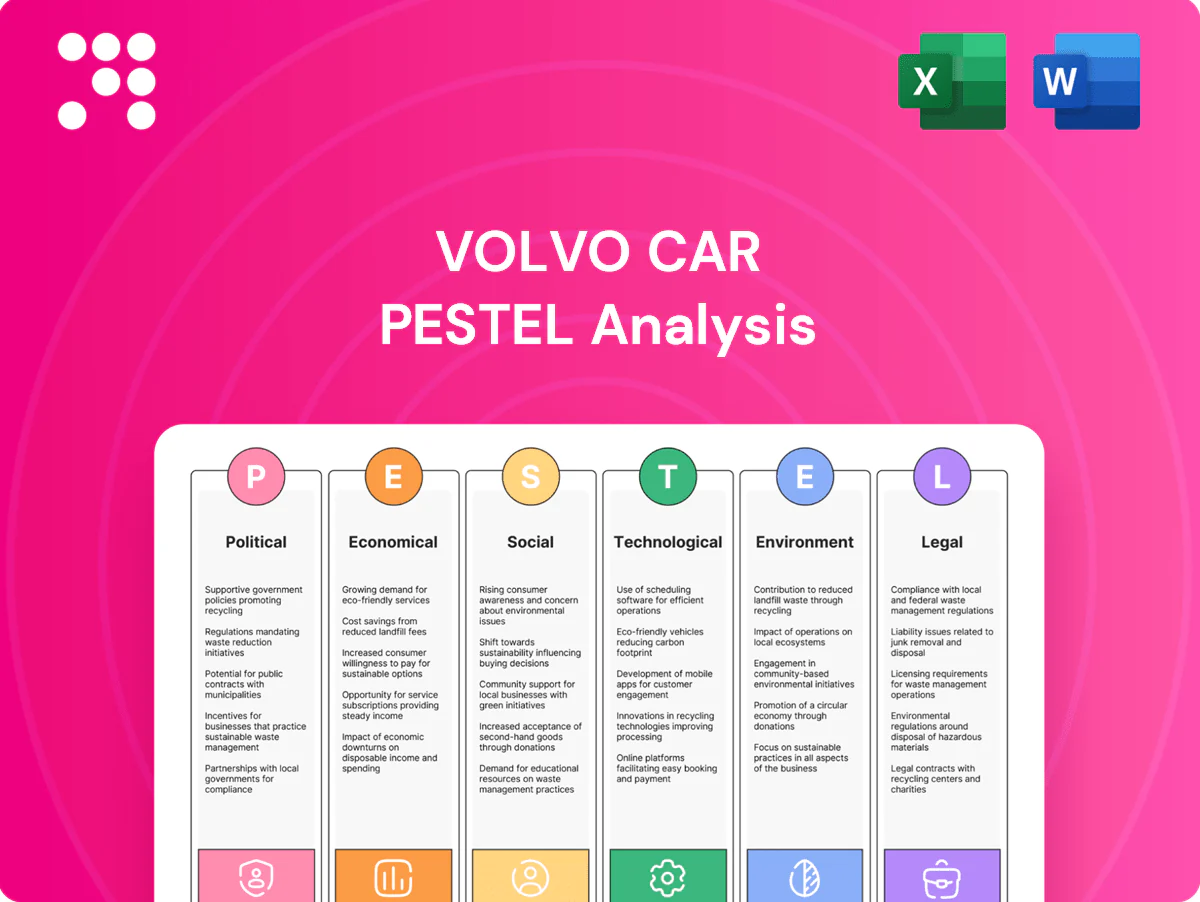
Volvo Car PESTLE Analysis

Plan Smarter. Present Sharper. Compete Stronger.
Understand how political shifts, economic volatility, and evolving social trends are shaping Volvo Car's strategic landscape. Our comprehensive PESTLE analysis dives deep into these critical external factors, offering actionable intelligence for your business. Download the full version now to gain a competitive edge and make informed decisions.
Political factors

Government policies on vehicle emissions
Governments globally are tightening vehicle emission regulations, pushing for a significant shift towards electric vehicles. For instance, the European Union's Fit for 55 package aims to cut CO2 emissions by 55% by 2030 and achieve carbon neutrality by 2050, directly impacting automakers like Volvo.
These stringent policies necessitate substantial investments from Volvo in electric vehicle technology and manufacturing. Failure to comply with regional mandates, such as the United States' Corporate Average Fuel Economy (CAFE) standards or China's New Energy Vehicle (NEV) credit system, could result in substantial financial penalties, influencing Volvo's strategic planning and R&D allocation.
International trade relations and tariffs
Global trade policies, including tariffs and non-tariff barriers, directly influence Volvo's operational costs and market access. For instance, the ongoing trade discussions between major economic blocs in 2024 and 2025 create uncertainty around import duties on automotive components and finished vehicles, potentially affecting Volvo's pricing strategies and profitability in key regions like the EU and North America.
Geopolitical tensions and evolving trade agreements demand strategic agility from Volvo. The company must remain adaptable in its production and sales strategies to navigate risks such as sudden tariff hikes or the imposition of new trade restrictions, ensuring it can still effectively serve its global customer base and capitalize on emerging market opportunities.

Geopolitical stability and supply chain resilience
Geopolitical shifts significantly impact Volvo's operations. For instance, the ongoing tensions in Eastern Europe, a key region for certain automotive components, have highlighted the fragility of extended supply chains. Volvo's proactive strategy to diversify suppliers, particularly for critical battery materials like lithium and cobalt, is essential. By reducing reliance on single-source regions, Volvo aims to mitigate risks associated with political instability and ensure consistent production flow for its expanding electric vehicle lineup, which is a core focus for 2024 and beyond.

Government incentives for EV adoption
Governments worldwide are actively promoting electric vehicle (EV) adoption through various financial incentives. These can include direct purchase subsidies, tax credits, and even exemptions from certain road taxes or tolls, making EVs a more appealing proposition for consumers. For instance, the United States' Inflation Reduction Act offers up to $7,500 in tax credits for qualifying new EVs, while many European nations provide similar, often more substantial, grants and tax benefits. These policies directly impact demand for manufacturers like Volvo, whose future hinges on the successful transition to electric mobility. By lowering the upfront cost, these incentives can significantly accelerate market penetration, particularly for price-sensitive buyers, and help Volvo achieve its ambitious electrification targets.
These government initiatives play a crucial role in leveling the playing field between EVs and traditional internal combustion engine vehicles. As of early 2024, countries like Norway continue to lead with extensive EV incentives, resulting in a market share exceeding 80% for electric cars. Similarly, China, the world's largest automotive market, offers substantial national and local subsidies and preferential policies for EVs. These measures are designed to reduce carbon emissions and foster domestic EV industries. Volvo, with its commitment to becoming a fully electric brand by 2030, benefits directly from this supportive policy environment, which helps to de-risk its significant investments in EV technology and production.
- Government subsidies and tax credits: Reduce the upfront cost of EVs for consumers.
- Accelerated market penetration: Make EVs more competitive against traditional vehicles.
- Support for electrification targets: Align with manufacturer goals, like Volvo's 2030 all-electric vision.
Political stability in key markets
Political stability in key markets significantly impacts Volvo's performance. For instance, in 2024, ongoing geopolitical tensions in Eastern Europe and the Middle East continue to create economic uncertainty, potentially affecting consumer spending on luxury goods like vehicles. Changes in trade policies or tariffs in major markets such as China and the United States can also directly influence Volvo's manufacturing costs and pricing strategies.
Volvo's strategic planning must account for the varying political landscapes across its core regions. In Europe, for example, upcoming elections in several member states throughout 2024 and 2025 could lead to shifts in environmental regulations and automotive industry support, requiring Volvo to adapt its product development and market approach. Similarly, the political climate in China, a crucial market for Volvo, directly affects its sales volume and investment decisions.
- China's economic policies: Government initiatives aimed at stimulating domestic consumption or regulating the automotive sector can significantly alter sales forecasts for Volvo.
- US trade relations: Fluctuations in trade agreements and tariffs between the US and other major economies can impact the cost of imported vehicles and components.
- European Union regulations: Evolving emissions standards and incentives for electric vehicles within the EU directly shape Volvo's product portfolio and R&D investments.
- Geopolitical stability: Regional conflicts or political instability can disrupt supply chains and dampen consumer demand in affected areas.
Political Forces Drive Automotive EV Strategy and Market Dynamics
Governments worldwide are increasingly implementing policies that favor electric vehicles (EVs), directly impacting Volvo's strategic direction. For instance, the European Union's Fit for 55 package aims for a 55% CO2 reduction by 2030, compelling automakers like Volvo to accelerate their EV transition. These regulations necessitate substantial investments in EV technology and manufacturing, with non-compliance risking significant financial penalties.
In 2024, government incentives such as purchase subsidies and tax credits, like the up to $7,500 US EV tax credit, are crucial for boosting EV adoption and making them more competitive. Norway, for example, saw over 80% EV market share in early 2024 due to such policies. These measures directly support Volvo's 2030 all-electric vision by reducing upfront costs for consumers and de-risking the company's substantial EV investments.
Political stability and evolving trade policies significantly influence Volvo's operational costs and market access. Geopolitical tensions in 2024, particularly concerning supply chains for critical battery materials, emphasize the need for diversification. Changes in trade agreements and tariffs in key markets like China and the US can impact manufacturing costs and pricing strategies, demanding agility from Volvo.
| Political Factor | Impact on Volvo | Example/Data (2024-2025) |
| Emissions Regulations | Drives EV investment & compliance costs | EU Fit for 55: 55% CO2 reduction target by 2030 |
| EV Incentives | Boosts EV demand & market penetration | US EV Tax Credit: Up to $7,500; Norway EV Market Share: >80% (early 2024) |
| Trade Policies & Tariffs | Affects operational costs & market access | Ongoing trade discussions impacting import duties on components and vehicles |
| Geopolitical Stability | Disrupts supply chains & consumer demand | Tensions in Eastern Europe affecting component sourcing; uncertainty in key markets like China |
What is included in the product
 Detailed Word Document
This PESTLE analysis delves into the Political, Economic, Social, Technological, Environmental, and Legal factors influencing Volvo Cars, providing a comprehensive overview of the external forces shaping its strategic landscape.
It offers actionable insights for stakeholders, highlighting potential threats and opportunities to inform strategic decision-making and ensure Volvo's continued success.

 Customizable Excel Spreadsheet
This PESTLE analysis offers a clear, summarized view of external factors impacting Volvo, acting as a pain point reliever by highlighting potential challenges and opportunities for strategic navigation.
Economic factors

Global economic growth and consumer spending
Global economic growth is a significant driver for luxury car sales. When economies are expanding, consumers, especially those with higher disposable incomes, tend to spend more on discretionary items like premium vehicles. For instance, in 2024, global GDP growth is projected to reach 2.7%, a slight slowdown from 2023 but still indicating expansion, which supports demand for brands like Volvo.
Consumer spending patterns are directly tied to economic health. A robust economy typically means higher employment rates and increased purchasing power, allowing affluent consumers to invest in higher-priced goods. Volvo's sales, particularly in its key markets, are sensitive to these trends; a strong consumer spending environment in 2025 would likely translate to better sales volumes for its electric and hybrid models.
Inflation and interest rate fluctuations
Rising inflation in 2024 and 2025 directly impacts Volvo's bottom line by increasing the cost of essential components like steel, aluminum, and semiconductors, as well as energy for manufacturing. For instance, global commodity prices saw significant volatility in early 2024, with some key materials for car production experiencing double-digit percentage increases year-over-year.
Furthermore, fluctuating interest rates present a dual challenge. For consumers, higher rates in major markets like the US and Europe throughout 2024 make car loans more expensive, potentially reducing demand for new Volvo vehicles. For Volvo itself, increased borrowing costs for capital expenditures, such as expanding EV production facilities, can strain investment plans.

Currency exchange rate volatility
Currency exchange rate volatility significantly impacts Volvo Cars as a global automotive manufacturer. Fluctuations in exchange rates directly affect the cost of imported components and the final price of vehicles in different markets, influencing sales volumes and profitability.
For instance, a stronger US dollar against the Swedish Krona in 2024 could make Volvo vehicles more expensive for American consumers, potentially dampening demand. Conversely, a weaker Euro could reduce the value of Volvo's earnings generated in the Eurozone when converted back to its reporting currency.
In 2023, the Euro averaged around 1.08 US dollars, a slight weakening from previous years. This kind of movement necessitates robust hedging strategies to mitigate potential losses and ensure stable financial performance across Volvo's diverse international operations.

Raw material costs
Raw material costs are a significant factor for Volvo. Prices for essential components like lithium, cobalt, and nickel, crucial for electric vehicle batteries, are heavily influenced by global supply and demand dynamics. For instance, the price of lithium carbonate averaged around $25,000 per metric ton in early 2024, a notable increase from previous years, impacting battery production costs.
Similarly, the cost of steel and aluminum, fundamental to vehicle body construction, fluctuates based on energy prices and geopolitical events. This volatility directly affects Volvo's manufacturing expenses, necessitating agile sourcing strategies and potential price adjustments for their vehicles to maintain profitability.
- Lithium carbonate prices saw an average of approximately $25,000/metric ton in early 2024.
- Nickel prices experienced significant volatility, with LME Nickel Cash prices trading between $16,000 and $19,000 per ton in the first half of 2024.
- Steel prices, particularly for automotive-grade steel, have been influenced by energy costs and global trade policies.
- Aluminum prices on the London Metal Exchange (LME) averaged around $2,300 per ton in early 2024, subject to supply chain disruptions.
Availability of consumer credit
The availability of consumer credit significantly impacts Volvo's sales, especially for its premium vehicles. When credit is readily accessible and affordable, consumers are more likely to finance larger purchases like cars. For instance, in early 2024, interest rates on auto loans, while still elevated compared to previous years, showed some signs of stabilization, which can encourage borrowing.
Changes in lending standards and interest rates directly affect consumer purchasing power and demand for new vehicles. Volvo's own financial arm, Volvo Car Financial Services, plays a crucial role here, offering financing options that can either stimulate or dampen sales depending on their terms. As of late 2023 and projected into 2024, the Federal Reserve's monetary policy has kept interest rates higher, making car loans more expensive, which could temper demand.
- Auto Loan Interest Rates: Rates for new car loans in the US averaged around 7.0% for good credit borrowers in Q4 2023, a slight decrease from earlier in the year but still a significant increase from 2021 lows.
- Credit Availability: Lenders may tighten credit standards in uncertain economic periods, making it harder for some consumers to qualify for loans, potentially impacting Volvo's market share.
- Financing Penetration: The percentage of new vehicles financed remains high, underscoring the critical importance of consumer credit availability for the automotive industry. In 2023, approximately 85% of new vehicles were financed or leased.
- Impact on Luxury Segment: Buyers of luxury vehicles like Volvos are often more sensitive to financing costs, as the overall price point is higher, making the cost of borrowing a more substantial factor in their decision-making.
Global Economy's Grip on Auto Sales and Costs
Global economic conditions directly influence Volvo's sales performance. A stable global GDP growth, projected at 2.7% for 2024, generally supports demand for premium vehicles by boosting consumer confidence and disposable income.
Inflationary pressures in 2024 and 2025 are increasing the cost of raw materials like lithium and nickel, essential for EV batteries, and impacting manufacturing expenses. For instance, lithium carbonate averaged around $25,000 per metric ton in early 2024.
Interest rates remain a critical factor, with auto loan rates around 7.0% for good credit in Q4 2023, making financing more expensive for consumers and potentially dampening demand for new Volvos.
Currency fluctuations, such as the Euro's value against the US dollar, affect Volvo's international pricing and profitability, necessitating careful financial management. The Euro averaged approximately 1.08 US dollars in 2023.
Same Document Delivered
Volvo Car PESTLE Analysis
The preview shown here is the exact document you’ll receive after purchase—fully formatted and ready to use. This comprehensive PESTLE analysis of Volvo Car delves into Political, Economic, Social, Technological, Legal, and Environmental factors impacting the automotive industry. Understand the strategic landscape and make informed decisions with this detailed report.

Plan Smarter. Present Sharper. Compete Stronger.
Understand how political shifts, economic volatility, and evolving social trends are shaping Volvo Car's strategic landscape. Our comprehensive PESTLE analysis dives deep into these critical external factors, offering actionable intelligence for your business. Download the full version now to gain a competitive edge and make informed decisions.
Political factors
Government policies on vehicle emissions
Governments globally are tightening vehicle emission regulations, pushing for a significant shift towards electric vehicles. For instance, the European Union's Fit for 55 package aims to cut CO2 emissions by 55% by 2030 and achieve carbon neutrality by 2050, directly impacting automakers like Volvo.
These stringent policies necessitate substantial investments from Volvo in electric vehicle technology and manufacturing. Failure to comply with regional mandates, such as the United States' Corporate Average Fuel Economy (CAFE) standards or China's New Energy Vehicle (NEV) credit system, could result in substantial financial penalties, influencing Volvo's strategic planning and R&D allocation.
International trade relations and tariffs
Global trade policies, including tariffs and non-tariff barriers, directly influence Volvo's operational costs and market access. For instance, the ongoing trade discussions between major economic blocs in 2024 and 2025 create uncertainty around import duties on automotive components and finished vehicles, potentially affecting Volvo's pricing strategies and profitability in key regions like the EU and North America.
Geopolitical tensions and evolving trade agreements demand strategic agility from Volvo. The company must remain adaptable in its production and sales strategies to navigate risks such as sudden tariff hikes or the imposition of new trade restrictions, ensuring it can still effectively serve its global customer base and capitalize on emerging market opportunities.
Geopolitical stability and supply chain resilience
Geopolitical shifts significantly impact Volvo's operations. For instance, the ongoing tensions in Eastern Europe, a key region for certain automotive components, have highlighted the fragility of extended supply chains. Volvo's proactive strategy to diversify suppliers, particularly for critical battery materials like lithium and cobalt, is essential. By reducing reliance on single-source regions, Volvo aims to mitigate risks associated with political instability and ensure consistent production flow for its expanding electric vehicle lineup, which is a core focus for 2024 and beyond.
Government incentives for EV adoption
Governments worldwide are actively promoting electric vehicle (EV) adoption through various financial incentives. These can include direct purchase subsidies, tax credits, and even exemptions from certain road taxes or tolls, making EVs a more appealing proposition for consumers. For instance, the United States' Inflation Reduction Act offers up to $7,500 in tax credits for qualifying new EVs, while many European nations provide similar, often more substantial, grants and tax benefits. These policies directly impact demand for manufacturers like Volvo, whose future hinges on the successful transition to electric mobility. By lowering the upfront cost, these incentives can significantly accelerate market penetration, particularly for price-sensitive buyers, and help Volvo achieve its ambitious electrification targets.
These government initiatives play a crucial role in leveling the playing field between EVs and traditional internal combustion engine vehicles. As of early 2024, countries like Norway continue to lead with extensive EV incentives, resulting in a market share exceeding 80% for electric cars. Similarly, China, the world's largest automotive market, offers substantial national and local subsidies and preferential policies for EVs. These measures are designed to reduce carbon emissions and foster domestic EV industries. Volvo, with its commitment to becoming a fully electric brand by 2030, benefits directly from this supportive policy environment, which helps to de-risk its significant investments in EV technology and production.
- Government subsidies and tax credits: Reduce the upfront cost of EVs for consumers.
- Accelerated market penetration: Make EVs more competitive against traditional vehicles.
- Support for electrification targets: Align with manufacturer goals, like Volvo's 2030 all-electric vision.
Political stability in key markets
Political stability in key markets significantly impacts Volvo's performance. For instance, in 2024, ongoing geopolitical tensions in Eastern Europe and the Middle East continue to create economic uncertainty, potentially affecting consumer spending on luxury goods like vehicles. Changes in trade policies or tariffs in major markets such as China and the United States can also directly influence Volvo's manufacturing costs and pricing strategies.
Volvo's strategic planning must account for the varying political landscapes across its core regions. In Europe, for example, upcoming elections in several member states throughout 2024 and 2025 could lead to shifts in environmental regulations and automotive industry support, requiring Volvo to adapt its product development and market approach. Similarly, the political climate in China, a crucial market for Volvo, directly affects its sales volume and investment decisions.
- China's economic policies: Government initiatives aimed at stimulating domestic consumption or regulating the automotive sector can significantly alter sales forecasts for Volvo.
- US trade relations: Fluctuations in trade agreements and tariffs between the US and other major economies can impact the cost of imported vehicles and components.
- European Union regulations: Evolving emissions standards and incentives for electric vehicles within the EU directly shape Volvo's product portfolio and R&D investments.
- Geopolitical stability: Regional conflicts or political instability can disrupt supply chains and dampen consumer demand in affected areas.
Political Forces Drive Automotive EV Strategy and Market Dynamics
Governments worldwide are increasingly implementing policies that favor electric vehicles (EVs), directly impacting Volvo's strategic direction. For instance, the European Union's Fit for 55 package aims for a 55% CO2 reduction by 2030, compelling automakers like Volvo to accelerate their EV transition. These regulations necessitate substantial investments in EV technology and manufacturing, with non-compliance risking significant financial penalties.
In 2024, government incentives such as purchase subsidies and tax credits, like the up to $7,500 US EV tax credit, are crucial for boosting EV adoption and making them more competitive. Norway, for example, saw over 80% EV market share in early 2024 due to such policies. These measures directly support Volvo's 2030 all-electric vision by reducing upfront costs for consumers and de-risking the company's substantial EV investments.
Political stability and evolving trade policies significantly influence Volvo's operational costs and market access. Geopolitical tensions in 2024, particularly concerning supply chains for critical battery materials, emphasize the need for diversification. Changes in trade agreements and tariffs in key markets like China and the US can impact manufacturing costs and pricing strategies, demanding agility from Volvo.
| Political Factor | Impact on Volvo | Example/Data (2024-2025) |
| Emissions Regulations | Drives EV investment & compliance costs | EU Fit for 55: 55% CO2 reduction target by 2030 |
| EV Incentives | Boosts EV demand & market penetration | US EV Tax Credit: Up to $7,500; Norway EV Market Share: >80% (early 2024) |
| Trade Policies & Tariffs | Affects operational costs & market access | Ongoing trade discussions impacting import duties on components and vehicles |
| Geopolitical Stability | Disrupts supply chains & consumer demand | Tensions in Eastern Europe affecting component sourcing; uncertainty in key markets like China |
What is included in the product
Detailed Word Document
This PESTLE analysis delves into the Political, Economic, Social, Technological, Environmental, and Legal factors influencing Volvo Cars, providing a comprehensive overview of the external forces shaping its strategic landscape.
It offers actionable insights for stakeholders, highlighting potential threats and opportunities to inform strategic decision-making and ensure Volvo's continued success.
Customizable Excel Spreadsheet
This PESTLE analysis offers a clear, summarized view of external factors impacting Volvo, acting as a pain point reliever by highlighting potential challenges and opportunities for strategic navigation.
Economic factors
Global economic growth and consumer spending
Global economic growth is a significant driver for luxury car sales. When economies are expanding, consumers, especially those with higher disposable incomes, tend to spend more on discretionary items like premium vehicles. For instance, in 2024, global GDP growth is projected to reach 2.7%, a slight slowdown from 2023 but still indicating expansion, which supports demand for brands like Volvo.
Consumer spending patterns are directly tied to economic health. A robust economy typically means higher employment rates and increased purchasing power, allowing affluent consumers to invest in higher-priced goods. Volvo's sales, particularly in its key markets, are sensitive to these trends; a strong consumer spending environment in 2025 would likely translate to better sales volumes for its electric and hybrid models.
Inflation and interest rate fluctuations
Rising inflation in 2024 and 2025 directly impacts Volvo's bottom line by increasing the cost of essential components like steel, aluminum, and semiconductors, as well as energy for manufacturing. For instance, global commodity prices saw significant volatility in early 2024, with some key materials for car production experiencing double-digit percentage increases year-over-year.
Furthermore, fluctuating interest rates present a dual challenge. For consumers, higher rates in major markets like the US and Europe throughout 2024 make car loans more expensive, potentially reducing demand for new Volvo vehicles. For Volvo itself, increased borrowing costs for capital expenditures, such as expanding EV production facilities, can strain investment plans.
Currency exchange rate volatility
Currency exchange rate volatility significantly impacts Volvo Cars as a global automotive manufacturer. Fluctuations in exchange rates directly affect the cost of imported components and the final price of vehicles in different markets, influencing sales volumes and profitability.
For instance, a stronger US dollar against the Swedish Krona in 2024 could make Volvo vehicles more expensive for American consumers, potentially dampening demand. Conversely, a weaker Euro could reduce the value of Volvo's earnings generated in the Eurozone when converted back to its reporting currency.
In 2023, the Euro averaged around 1.08 US dollars, a slight weakening from previous years. This kind of movement necessitates robust hedging strategies to mitigate potential losses and ensure stable financial performance across Volvo's diverse international operations.
Raw material costs
Raw material costs are a significant factor for Volvo. Prices for essential components like lithium, cobalt, and nickel, crucial for electric vehicle batteries, are heavily influenced by global supply and demand dynamics. For instance, the price of lithium carbonate averaged around $25,000 per metric ton in early 2024, a notable increase from previous years, impacting battery production costs.
Similarly, the cost of steel and aluminum, fundamental to vehicle body construction, fluctuates based on energy prices and geopolitical events. This volatility directly affects Volvo's manufacturing expenses, necessitating agile sourcing strategies and potential price adjustments for their vehicles to maintain profitability.
- Lithium carbonate prices saw an average of approximately $25,000/metric ton in early 2024.
- Nickel prices experienced significant volatility, with LME Nickel Cash prices trading between $16,000 and $19,000 per ton in the first half of 2024.
- Steel prices, particularly for automotive-grade steel, have been influenced by energy costs and global trade policies.
- Aluminum prices on the London Metal Exchange (LME) averaged around $2,300 per ton in early 2024, subject to supply chain disruptions.
Availability of consumer credit
The availability of consumer credit significantly impacts Volvo's sales, especially for its premium vehicles. When credit is readily accessible and affordable, consumers are more likely to finance larger purchases like cars. For instance, in early 2024, interest rates on auto loans, while still elevated compared to previous years, showed some signs of stabilization, which can encourage borrowing.
Changes in lending standards and interest rates directly affect consumer purchasing power and demand for new vehicles. Volvo's own financial arm, Volvo Car Financial Services, plays a crucial role here, offering financing options that can either stimulate or dampen sales depending on their terms. As of late 2023 and projected into 2024, the Federal Reserve's monetary policy has kept interest rates higher, making car loans more expensive, which could temper demand.
- Auto Loan Interest Rates: Rates for new car loans in the US averaged around 7.0% for good credit borrowers in Q4 2023, a slight decrease from earlier in the year but still a significant increase from 2021 lows.
- Credit Availability: Lenders may tighten credit standards in uncertain economic periods, making it harder for some consumers to qualify for loans, potentially impacting Volvo's market share.
- Financing Penetration: The percentage of new vehicles financed remains high, underscoring the critical importance of consumer credit availability for the automotive industry. In 2023, approximately 85% of new vehicles were financed or leased.
- Impact on Luxury Segment: Buyers of luxury vehicles like Volvos are often more sensitive to financing costs, as the overall price point is higher, making the cost of borrowing a more substantial factor in their decision-making.
Global Economy's Grip on Auto Sales and Costs
Global economic conditions directly influence Volvo's sales performance. A stable global GDP growth, projected at 2.7% for 2024, generally supports demand for premium vehicles by boosting consumer confidence and disposable income.
Inflationary pressures in 2024 and 2025 are increasing the cost of raw materials like lithium and nickel, essential for EV batteries, and impacting manufacturing expenses. For instance, lithium carbonate averaged around $25,000 per metric ton in early 2024.
Interest rates remain a critical factor, with auto loan rates around 7.0% for good credit in Q4 2023, making financing more expensive for consumers and potentially dampening demand for new Volvos.
Currency fluctuations, such as the Euro's value against the US dollar, affect Volvo's international pricing and profitability, necessitating careful financial management. The Euro averaged approximately 1.08 US dollars in 2023.
Same Document Delivered
Volvo Car PESTLE Analysis
The preview shown here is the exact document you’ll receive after purchase—fully formatted and ready to use. This comprehensive PESTLE analysis of Volvo Car delves into Political, Economic, Social, Technological, Legal, and Environmental factors impacting the automotive industry. Understand the strategic landscape and make informed decisions with this detailed report.
Description
Plan Smarter. Present Sharper. Compete Stronger.
Understand how political shifts, economic volatility, and evolving social trends are shaping Volvo Car's strategic landscape. Our comprehensive PESTLE analysis dives deep into these critical external factors, offering actionable intelligence for your business. Download the full version now to gain a competitive edge and make informed decisions.
Political factors
Government policies on vehicle emissions
Governments globally are tightening vehicle emission regulations, pushing for a significant shift towards electric vehicles. For instance, the European Union's Fit for 55 package aims to cut CO2 emissions by 55% by 2030 and achieve carbon neutrality by 2050, directly impacting automakers like Volvo.
These stringent policies necessitate substantial investments from Volvo in electric vehicle technology and manufacturing. Failure to comply with regional mandates, such as the United States' Corporate Average Fuel Economy (CAFE) standards or China's New Energy Vehicle (NEV) credit system, could result in substantial financial penalties, influencing Volvo's strategic planning and R&D allocation.
International trade relations and tariffs
Global trade policies, including tariffs and non-tariff barriers, directly influence Volvo's operational costs and market access. For instance, the ongoing trade discussions between major economic blocs in 2024 and 2025 create uncertainty around import duties on automotive components and finished vehicles, potentially affecting Volvo's pricing strategies and profitability in key regions like the EU and North America.
Geopolitical tensions and evolving trade agreements demand strategic agility from Volvo. The company must remain adaptable in its production and sales strategies to navigate risks such as sudden tariff hikes or the imposition of new trade restrictions, ensuring it can still effectively serve its global customer base and capitalize on emerging market opportunities.
Geopolitical stability and supply chain resilience
Geopolitical shifts significantly impact Volvo's operations. For instance, the ongoing tensions in Eastern Europe, a key region for certain automotive components, have highlighted the fragility of extended supply chains. Volvo's proactive strategy to diversify suppliers, particularly for critical battery materials like lithium and cobalt, is essential. By reducing reliance on single-source regions, Volvo aims to mitigate risks associated with political instability and ensure consistent production flow for its expanding electric vehicle lineup, which is a core focus for 2024 and beyond.
Government incentives for EV adoption
Governments worldwide are actively promoting electric vehicle (EV) adoption through various financial incentives. These can include direct purchase subsidies, tax credits, and even exemptions from certain road taxes or tolls, making EVs a more appealing proposition for consumers. For instance, the United States' Inflation Reduction Act offers up to $7,500 in tax credits for qualifying new EVs, while many European nations provide similar, often more substantial, grants and tax benefits. These policies directly impact demand for manufacturers like Volvo, whose future hinges on the successful transition to electric mobility. By lowering the upfront cost, these incentives can significantly accelerate market penetration, particularly for price-sensitive buyers, and help Volvo achieve its ambitious electrification targets.
These government initiatives play a crucial role in leveling the playing field between EVs and traditional internal combustion engine vehicles. As of early 2024, countries like Norway continue to lead with extensive EV incentives, resulting in a market share exceeding 80% for electric cars. Similarly, China, the world's largest automotive market, offers substantial national and local subsidies and preferential policies for EVs. These measures are designed to reduce carbon emissions and foster domestic EV industries. Volvo, with its commitment to becoming a fully electric brand by 2030, benefits directly from this supportive policy environment, which helps to de-risk its significant investments in EV technology and production.
- Government subsidies and tax credits: Reduce the upfront cost of EVs for consumers.
- Accelerated market penetration: Make EVs more competitive against traditional vehicles.
- Support for electrification targets: Align with manufacturer goals, like Volvo's 2030 all-electric vision.
Political stability in key markets
Political stability in key markets significantly impacts Volvo's performance. For instance, in 2024, ongoing geopolitical tensions in Eastern Europe and the Middle East continue to create economic uncertainty, potentially affecting consumer spending on luxury goods like vehicles. Changes in trade policies or tariffs in major markets such as China and the United States can also directly influence Volvo's manufacturing costs and pricing strategies.
Volvo's strategic planning must account for the varying political landscapes across its core regions. In Europe, for example, upcoming elections in several member states throughout 2024 and 2025 could lead to shifts in environmental regulations and automotive industry support, requiring Volvo to adapt its product development and market approach. Similarly, the political climate in China, a crucial market for Volvo, directly affects its sales volume and investment decisions.
- China's economic policies: Government initiatives aimed at stimulating domestic consumption or regulating the automotive sector can significantly alter sales forecasts for Volvo.
- US trade relations: Fluctuations in trade agreements and tariffs between the US and other major economies can impact the cost of imported vehicles and components.
- European Union regulations: Evolving emissions standards and incentives for electric vehicles within the EU directly shape Volvo's product portfolio and R&D investments.
- Geopolitical stability: Regional conflicts or political instability can disrupt supply chains and dampen consumer demand in affected areas.
Political Forces Drive Automotive EV Strategy and Market Dynamics
Governments worldwide are increasingly implementing policies that favor electric vehicles (EVs), directly impacting Volvo's strategic direction. For instance, the European Union's Fit for 55 package aims for a 55% CO2 reduction by 2030, compelling automakers like Volvo to accelerate their EV transition. These regulations necessitate substantial investments in EV technology and manufacturing, with non-compliance risking significant financial penalties.
In 2024, government incentives such as purchase subsidies and tax credits, like the up to $7,500 US EV tax credit, are crucial for boosting EV adoption and making them more competitive. Norway, for example, saw over 80% EV market share in early 2024 due to such policies. These measures directly support Volvo's 2030 all-electric vision by reducing upfront costs for consumers and de-risking the company's substantial EV investments.
Political stability and evolving trade policies significantly influence Volvo's operational costs and market access. Geopolitical tensions in 2024, particularly concerning supply chains for critical battery materials, emphasize the need for diversification. Changes in trade agreements and tariffs in key markets like China and the US can impact manufacturing costs and pricing strategies, demanding agility from Volvo.
| Political Factor | Impact on Volvo | Example/Data (2024-2025) |
| Emissions Regulations | Drives EV investment & compliance costs | EU Fit for 55: 55% CO2 reduction target by 2030 |
| EV Incentives | Boosts EV demand & market penetration | US EV Tax Credit: Up to $7,500; Norway EV Market Share: >80% (early 2024) |
| Trade Policies & Tariffs | Affects operational costs & market access | Ongoing trade discussions impacting import duties on components and vehicles |
| Geopolitical Stability | Disrupts supply chains & consumer demand | Tensions in Eastern Europe affecting component sourcing; uncertainty in key markets like China |
What is included in the product
Detailed Word Document
This PESTLE analysis delves into the Political, Economic, Social, Technological, Environmental, and Legal factors influencing Volvo Cars, providing a comprehensive overview of the external forces shaping its strategic landscape.
It offers actionable insights for stakeholders, highlighting potential threats and opportunities to inform strategic decision-making and ensure Volvo's continued success.
Customizable Excel Spreadsheet
This PESTLE analysis offers a clear, summarized view of external factors impacting Volvo, acting as a pain point reliever by highlighting potential challenges and opportunities for strategic navigation.
Economic factors
Global economic growth and consumer spending
Global economic growth is a significant driver for luxury car sales. When economies are expanding, consumers, especially those with higher disposable incomes, tend to spend more on discretionary items like premium vehicles. For instance, in 2024, global GDP growth is projected to reach 2.7%, a slight slowdown from 2023 but still indicating expansion, which supports demand for brands like Volvo.
Consumer spending patterns are directly tied to economic health. A robust economy typically means higher employment rates and increased purchasing power, allowing affluent consumers to invest in higher-priced goods. Volvo's sales, particularly in its key markets, are sensitive to these trends; a strong consumer spending environment in 2025 would likely translate to better sales volumes for its electric and hybrid models.
Inflation and interest rate fluctuations
Rising inflation in 2024 and 2025 directly impacts Volvo's bottom line by increasing the cost of essential components like steel, aluminum, and semiconductors, as well as energy for manufacturing. For instance, global commodity prices saw significant volatility in early 2024, with some key materials for car production experiencing double-digit percentage increases year-over-year.
Furthermore, fluctuating interest rates present a dual challenge. For consumers, higher rates in major markets like the US and Europe throughout 2024 make car loans more expensive, potentially reducing demand for new Volvo vehicles. For Volvo itself, increased borrowing costs for capital expenditures, such as expanding EV production facilities, can strain investment plans.
Currency exchange rate volatility
Currency exchange rate volatility significantly impacts Volvo Cars as a global automotive manufacturer. Fluctuations in exchange rates directly affect the cost of imported components and the final price of vehicles in different markets, influencing sales volumes and profitability.
For instance, a stronger US dollar against the Swedish Krona in 2024 could make Volvo vehicles more expensive for American consumers, potentially dampening demand. Conversely, a weaker Euro could reduce the value of Volvo's earnings generated in the Eurozone when converted back to its reporting currency.
In 2023, the Euro averaged around 1.08 US dollars, a slight weakening from previous years. This kind of movement necessitates robust hedging strategies to mitigate potential losses and ensure stable financial performance across Volvo's diverse international operations.
Raw material costs
Raw material costs are a significant factor for Volvo. Prices for essential components like lithium, cobalt, and nickel, crucial for electric vehicle batteries, are heavily influenced by global supply and demand dynamics. For instance, the price of lithium carbonate averaged around $25,000 per metric ton in early 2024, a notable increase from previous years, impacting battery production costs.
Similarly, the cost of steel and aluminum, fundamental to vehicle body construction, fluctuates based on energy prices and geopolitical events. This volatility directly affects Volvo's manufacturing expenses, necessitating agile sourcing strategies and potential price adjustments for their vehicles to maintain profitability.
- Lithium carbonate prices saw an average of approximately $25,000/metric ton in early 2024.
- Nickel prices experienced significant volatility, with LME Nickel Cash prices trading between $16,000 and $19,000 per ton in the first half of 2024.
- Steel prices, particularly for automotive-grade steel, have been influenced by energy costs and global trade policies.
- Aluminum prices on the London Metal Exchange (LME) averaged around $2,300 per ton in early 2024, subject to supply chain disruptions.
Availability of consumer credit
The availability of consumer credit significantly impacts Volvo's sales, especially for its premium vehicles. When credit is readily accessible and affordable, consumers are more likely to finance larger purchases like cars. For instance, in early 2024, interest rates on auto loans, while still elevated compared to previous years, showed some signs of stabilization, which can encourage borrowing.
Changes in lending standards and interest rates directly affect consumer purchasing power and demand for new vehicles. Volvo's own financial arm, Volvo Car Financial Services, plays a crucial role here, offering financing options that can either stimulate or dampen sales depending on their terms. As of late 2023 and projected into 2024, the Federal Reserve's monetary policy has kept interest rates higher, making car loans more expensive, which could temper demand.
- Auto Loan Interest Rates: Rates for new car loans in the US averaged around 7.0% for good credit borrowers in Q4 2023, a slight decrease from earlier in the year but still a significant increase from 2021 lows.
- Credit Availability: Lenders may tighten credit standards in uncertain economic periods, making it harder for some consumers to qualify for loans, potentially impacting Volvo's market share.
- Financing Penetration: The percentage of new vehicles financed remains high, underscoring the critical importance of consumer credit availability for the automotive industry. In 2023, approximately 85% of new vehicles were financed or leased.
- Impact on Luxury Segment: Buyers of luxury vehicles like Volvos are often more sensitive to financing costs, as the overall price point is higher, making the cost of borrowing a more substantial factor in their decision-making.
Global Economy's Grip on Auto Sales and Costs
Global economic conditions directly influence Volvo's sales performance. A stable global GDP growth, projected at 2.7% for 2024, generally supports demand for premium vehicles by boosting consumer confidence and disposable income.
Inflationary pressures in 2024 and 2025 are increasing the cost of raw materials like lithium and nickel, essential for EV batteries, and impacting manufacturing expenses. For instance, lithium carbonate averaged around $25,000 per metric ton in early 2024.
Interest rates remain a critical factor, with auto loan rates around 7.0% for good credit in Q4 2023, making financing more expensive for consumers and potentially dampening demand for new Volvos.
Currency fluctuations, such as the Euro's value against the US dollar, affect Volvo's international pricing and profitability, necessitating careful financial management. The Euro averaged approximately 1.08 US dollars in 2023.
Same Document Delivered
Volvo Car PESTLE Analysis
The preview shown here is the exact document you’ll receive after purchase—fully formatted and ready to use. This comprehensive PESTLE analysis of Volvo Car delves into Political, Economic, Social, Technological, Legal, and Environmental factors impacting the automotive industry. Understand the strategic landscape and make informed decisions with this detailed report.











