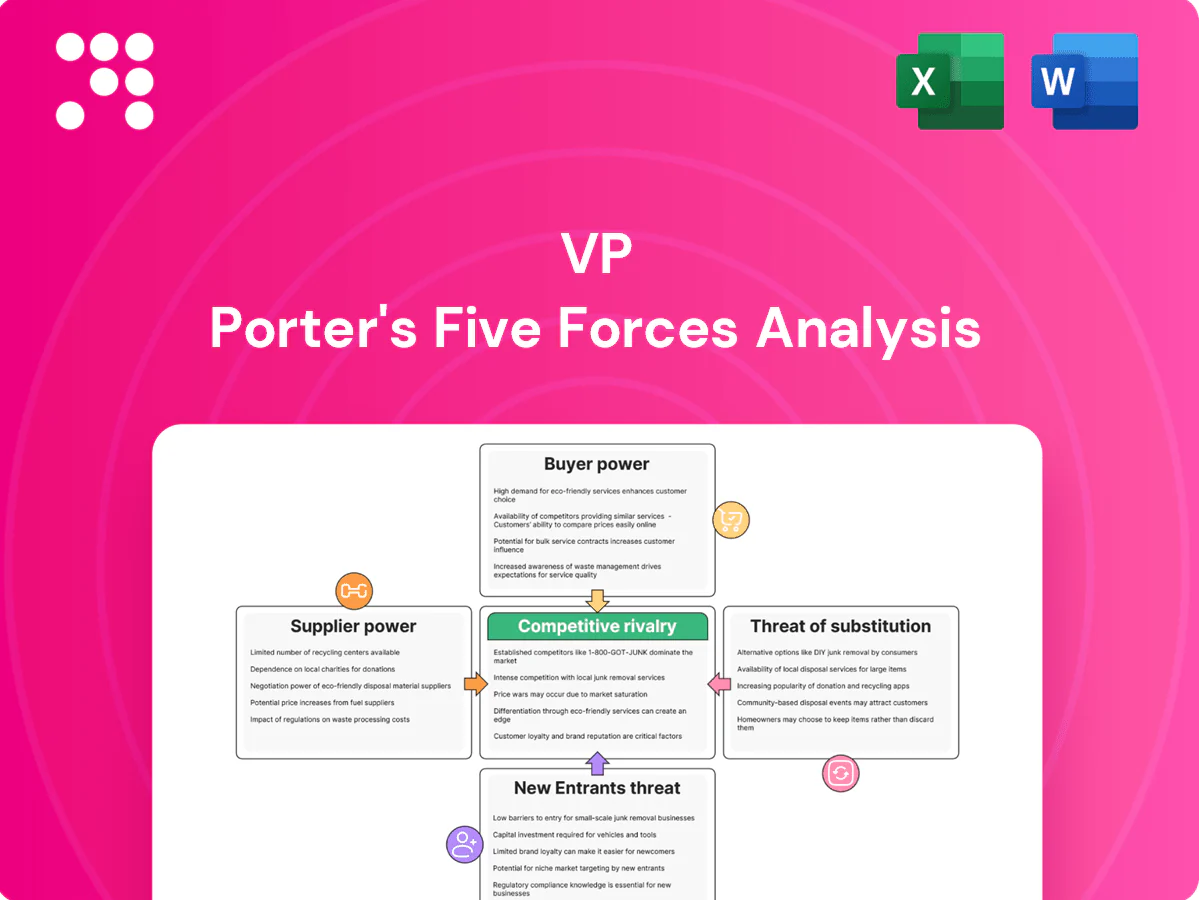
Vp Porter's Five Forces Analysis

Don't Miss the Bigger Picture
Vp's Porter’s Five Forces snapshot highlights supplier leverage, buyer pressure, rivalry intensity, and threats from substitutes and new entrants, revealing core strategic levers. This brief teases the competitive dynamics investors and managers must know. Unlock the full Porter’s Five Forces Analysis for force-by-force ratings, visuals, and actionable strategy tailored to Vp.
Suppliers Bargaining Power

Diverse OEM base moderates power
Bathroom fixtures can be sourced from numerous OEMs across the UK, EU and Asia, creating a fragmented supplier landscape that limits any single supplier’s leverage. VictoriaPlum routinely dual-sources components and complete suites to preserve negotiating power and competitive terms. However, strict quality assurance and certification requirements (WRAS, CE/UKCA) can narrow the effective supplier pool and increase switching costs.
Private-label reduces dependency
Emphasis on own-brand shifts value capture from branded suppliers: private-label reached about 18% of US grocery sales in 2024, reducing reliance on national brands. It weakens supplier pricing power and can improve retailer gross margins by roughly 150–300 basis points. Design ownership and tooling increase switching flexibility, though upfront tooling and MOQ commitments ($50k–$250k) can create short-term lock-in.

Logistics and freight volatility
Bulky SKUs rely on stable sea and road lanes, so tight markets give freight partners leverage—episodic 2024 port congestion kept schedule reliability below pre-2019 levels and amplified supplier power. Rate spikes and port disruptions during 2024 handed temporary pricing control to logistics providers, passing through costs to shippers. Long lead times of 30–90 days increase exposure to these swings; forward contracts and nearshoring reduce but do not eliminate the risk.

Compliance and certification constraints
WRAS approval and UKCA marking (implemented for Great Britain from Jan 1, 2021) restrict viable suppliers for potable fittings; certified vendors face lower compliance risk and often secure stronger commercial terms. Multi-week testing cycles and warranty expectations slow switching and raise onboarding costs, embedding moderate supplier power in regulated categories like taps and valves.
- Regulation: WRAS, UKCA
- Effect: lower supplier pool, higher premiums
- Impact: slower switching, raised onboarding costs
Currency and input cost pass-through
FX volatility and commodity input moves for brass, glass and ceramics drive supplier quotes and push-throughs; during inflationary episodes suppliers typically pass increases to buyers, and Victoria Plum’s purchasing scale determines how much it can resist or stagger hikes.
Hedging and long-dated contracts partially rebalance supplier bargaining by locking costs and smoothing timing of increases.
Fragmented OEMs, WRAS/UKCA limits and 30–90 days lead times cut leverage
Fragmented OEM base across UK, EU and Asia limits single-supplier leverage, and VictoriaPlum’s routine dual-sourcing preserves negotiation power. Regulatory certs (WRAS, UKCA) and multi-week testing narrow suppliers for potable fittings, raising onboarding costs and switching time. Logistics volatility (2024 port congestion) and 30–90 day lead times increase supplier and freight bargaining; private-label penetration (~18% in US groceries, 2024) shifts value capture to retailers.
| Factor | 2024 metric | Impact |
|---|---|---|
| Private-label | ~18% (US grocery) | Reduces brand supplier power |
| Tooling/MOQ | $50k–$250k | Short-term lock-in |
| Lead times | 30–90 days | Exposes to freight swings |
| Regulation | WRAS/UKCA | Narrows supplier pool |
What is included in the product
 Detailed Word Document
Uncovers competitive drivers, buyer/supplier power, threat of substitutes and new entrants for Vp, assessing pricing pressure and profitability while highlighting disruptive trends and strategic levers to strengthen Vp’s market position; delivered in an editable format for integration into reports, investor materials, and strategy decks.

 Customizable Excel Spreadsheet
Vp Porter's Five Forces turns complex competitive analysis into a one-sheet, actionable roadmap—instantly highlighting pressure points and strategic levers to relieve market uncertainty and speed decision-making.
Customers Bargaining Power

High price transparency online
High online price transparency lets customers compare prices instantly across rivals and marketplaces; by 2024 roughly 70% of shoppers reported price-checking online, compressing industry margins and boosting promotion intensity. Firms increasingly deploy dynamic pricing and bundled offers to stay competitive, while loyalty perks and point-of-sale financing reduce pure price-driven churn.
Low switching costs
Low switching costs mean shoppers can abandon carts—global cart abandonment averaged about 69.8% (Baymard 2023)—and buy similar SKUs elsewhere with minimal friction. With 92% of consumers reading reviews (BrightLocal 2024) and 61% prioritizing fast delivery (Deloitte 2024), reviews and delivery promises drive quick switches. Exclusive designs, clearer warranty terms and installation guidance raise differentiation and can materially reduce churn. Strong post‑sale service adds stickiness.

Lumpy, high-ticket purchases
Bathroom projects are episodic and high-ticket, with typical remodels ranging from $10,000 to $25,000 and homeowners renovating roughly every 15–20 years, prompting negotiation-like buyer behavior. Customers commonly expect discounts, free delivery or extras, increasing deal sensitivity. Robust project-planning tools and warranties can justify premium pricing and lower churn.

Service and delivery expectations
On-time, damage-free delivery of bulky items is mission-critical: 2024 online return rate averages ~16%, with bulky/damaged shipments driving disproportionate return costs and negative reviews that cut repeat purchase rates. Customers cite service ratings to demand price concessions; proactive communications and flexible slotting measurably lower perceived risk and complaints.
- On-time, damage-free delivery reduces costly returns
- Negative reviews lower repeat purchases
- Service ratings increase customer leverage on price/compensation
- Proactive comms + flexible slotting cut perceived delivery risk
Abundant information and reviews
User-generated reviews give buyers leverage to demand better terms; 93% of consumers consult reviews before purchase (2024), and poor ratings can drive immediate churn to competitors. Rich content, AR visualizers (lifting conversion up to 40% in 2024) and DIY installation guides cut perceived risk, restoring some bargaining power to sellers by boosting buyer confidence.
- 93% consult reviews (2024)
- Poor ratings = faster churn
- AR visualizers ↑ conversions up to 40% (2024)
Buyers wield leverage: 70% price-check, 92% read reviews; AR +40%
High price transparency (70% price-check online, 2024) and low switching costs (cart abandonment ~69.8%) give buyers strong leverage, amplified by review reliance (92%, BrightLocal 2024) and delivery expectations (61% prioritize speed). Sellers combat with AR (↑ conversions up to 40%, 2024), bundles, warranties and superior logistics to restore pricing power.
| Metric | 2024 Value |
|---|---|
| Price-checking | 70% |
| Cart abandonment | 69.8% |
| Read reviews | 92% |
| Fast delivery priority | 61% |
| AR boost | ↑40% |
Preview the Actual Deliverable
Vp Porter's Five Forces Analysis
This preview shows the exact Vp Porter's Five Forces analysis you'll receive after purchase—fully formatted, complete, and ready for use. It contains the same in‑depth force assessments, data points, and actionable implications included in the delivered file. After payment you'll get instant access to this identical document—no placeholders, no edits required.

Don't Miss the Bigger Picture
Vp's Porter’s Five Forces snapshot highlights supplier leverage, buyer pressure, rivalry intensity, and threats from substitutes and new entrants, revealing core strategic levers. This brief teases the competitive dynamics investors and managers must know. Unlock the full Porter’s Five Forces Analysis for force-by-force ratings, visuals, and actionable strategy tailored to Vp.
Suppliers Bargaining Power
Diverse OEM base moderates power
Bathroom fixtures can be sourced from numerous OEMs across the UK, EU and Asia, creating a fragmented supplier landscape that limits any single supplier’s leverage. VictoriaPlum routinely dual-sources components and complete suites to preserve negotiating power and competitive terms. However, strict quality assurance and certification requirements (WRAS, CE/UKCA) can narrow the effective supplier pool and increase switching costs.
Private-label reduces dependency
Emphasis on own-brand shifts value capture from branded suppliers: private-label reached about 18% of US grocery sales in 2024, reducing reliance on national brands. It weakens supplier pricing power and can improve retailer gross margins by roughly 150–300 basis points. Design ownership and tooling increase switching flexibility, though upfront tooling and MOQ commitments ($50k–$250k) can create short-term lock-in.
Logistics and freight volatility
Bulky SKUs rely on stable sea and road lanes, so tight markets give freight partners leverage—episodic 2024 port congestion kept schedule reliability below pre-2019 levels and amplified supplier power. Rate spikes and port disruptions during 2024 handed temporary pricing control to logistics providers, passing through costs to shippers. Long lead times of 30–90 days increase exposure to these swings; forward contracts and nearshoring reduce but do not eliminate the risk.
Compliance and certification constraints
WRAS approval and UKCA marking (implemented for Great Britain from Jan 1, 2021) restrict viable suppliers for potable fittings; certified vendors face lower compliance risk and often secure stronger commercial terms. Multi-week testing cycles and warranty expectations slow switching and raise onboarding costs, embedding moderate supplier power in regulated categories like taps and valves.
- Regulation: WRAS, UKCA
- Effect: lower supplier pool, higher premiums
- Impact: slower switching, raised onboarding costs
Currency and input cost pass-through
FX volatility and commodity input moves for brass, glass and ceramics drive supplier quotes and push-throughs; during inflationary episodes suppliers typically pass increases to buyers, and Victoria Plum’s purchasing scale determines how much it can resist or stagger hikes.
Hedging and long-dated contracts partially rebalance supplier bargaining by locking costs and smoothing timing of increases.
Fragmented OEMs, WRAS/UKCA limits and 30–90 days lead times cut leverage
Fragmented OEM base across UK, EU and Asia limits single-supplier leverage, and VictoriaPlum’s routine dual-sourcing preserves negotiation power. Regulatory certs (WRAS, UKCA) and multi-week testing narrow suppliers for potable fittings, raising onboarding costs and switching time. Logistics volatility (2024 port congestion) and 30–90 day lead times increase supplier and freight bargaining; private-label penetration (~18% in US groceries, 2024) shifts value capture to retailers.
| Factor | 2024 metric | Impact |
|---|---|---|
| Private-label | ~18% (US grocery) | Reduces brand supplier power |
| Tooling/MOQ | $50k–$250k | Short-term lock-in |
| Lead times | 30–90 days | Exposes to freight swings |
| Regulation | WRAS/UKCA | Narrows supplier pool |
What is included in the product
Detailed Word Document
Uncovers competitive drivers, buyer/supplier power, threat of substitutes and new entrants for Vp, assessing pricing pressure and profitability while highlighting disruptive trends and strategic levers to strengthen Vp’s market position; delivered in an editable format for integration into reports, investor materials, and strategy decks.
Customizable Excel Spreadsheet
Vp Porter's Five Forces turns complex competitive analysis into a one-sheet, actionable roadmap—instantly highlighting pressure points and strategic levers to relieve market uncertainty and speed decision-making.
Customers Bargaining Power
High price transparency online
High online price transparency lets customers compare prices instantly across rivals and marketplaces; by 2024 roughly 70% of shoppers reported price-checking online, compressing industry margins and boosting promotion intensity. Firms increasingly deploy dynamic pricing and bundled offers to stay competitive, while loyalty perks and point-of-sale financing reduce pure price-driven churn.
Low switching costs
Low switching costs mean shoppers can abandon carts—global cart abandonment averaged about 69.8% (Baymard 2023)—and buy similar SKUs elsewhere with minimal friction. With 92% of consumers reading reviews (BrightLocal 2024) and 61% prioritizing fast delivery (Deloitte 2024), reviews and delivery promises drive quick switches. Exclusive designs, clearer warranty terms and installation guidance raise differentiation and can materially reduce churn. Strong post‑sale service adds stickiness.
Lumpy, high-ticket purchases
Bathroom projects are episodic and high-ticket, with typical remodels ranging from $10,000 to $25,000 and homeowners renovating roughly every 15–20 years, prompting negotiation-like buyer behavior. Customers commonly expect discounts, free delivery or extras, increasing deal sensitivity. Robust project-planning tools and warranties can justify premium pricing and lower churn.
Service and delivery expectations
On-time, damage-free delivery of bulky items is mission-critical: 2024 online return rate averages ~16%, with bulky/damaged shipments driving disproportionate return costs and negative reviews that cut repeat purchase rates. Customers cite service ratings to demand price concessions; proactive communications and flexible slotting measurably lower perceived risk and complaints.
- On-time, damage-free delivery reduces costly returns
- Negative reviews lower repeat purchases
- Service ratings increase customer leverage on price/compensation
- Proactive comms + flexible slotting cut perceived delivery risk
Abundant information and reviews
User-generated reviews give buyers leverage to demand better terms; 93% of consumers consult reviews before purchase (2024), and poor ratings can drive immediate churn to competitors. Rich content, AR visualizers (lifting conversion up to 40% in 2024) and DIY installation guides cut perceived risk, restoring some bargaining power to sellers by boosting buyer confidence.
- 93% consult reviews (2024)
- Poor ratings = faster churn
- AR visualizers ↑ conversions up to 40% (2024)
Buyers wield leverage: 70% price-check, 92% read reviews; AR +40%
High price transparency (70% price-check online, 2024) and low switching costs (cart abandonment ~69.8%) give buyers strong leverage, amplified by review reliance (92%, BrightLocal 2024) and delivery expectations (61% prioritize speed). Sellers combat with AR (↑ conversions up to 40%, 2024), bundles, warranties and superior logistics to restore pricing power.
| Metric | 2024 Value |
|---|---|
| Price-checking | 70% |
| Cart abandonment | 69.8% |
| Read reviews | 92% |
| Fast delivery priority | 61% |
| AR boost | ↑40% |
Preview the Actual Deliverable
Vp Porter's Five Forces Analysis
This preview shows the exact Vp Porter's Five Forces analysis you'll receive after purchase—fully formatted, complete, and ready for use. It contains the same in‑depth force assessments, data points, and actionable implications included in the delivered file. After payment you'll get instant access to this identical document—no placeholders, no edits required.
Description
Don't Miss the Bigger Picture
Vp's Porter’s Five Forces snapshot highlights supplier leverage, buyer pressure, rivalry intensity, and threats from substitutes and new entrants, revealing core strategic levers. This brief teases the competitive dynamics investors and managers must know. Unlock the full Porter’s Five Forces Analysis for force-by-force ratings, visuals, and actionable strategy tailored to Vp.
Suppliers Bargaining Power
Diverse OEM base moderates power
Bathroom fixtures can be sourced from numerous OEMs across the UK, EU and Asia, creating a fragmented supplier landscape that limits any single supplier’s leverage. VictoriaPlum routinely dual-sources components and complete suites to preserve negotiating power and competitive terms. However, strict quality assurance and certification requirements (WRAS, CE/UKCA) can narrow the effective supplier pool and increase switching costs.
Private-label reduces dependency
Emphasis on own-brand shifts value capture from branded suppliers: private-label reached about 18% of US grocery sales in 2024, reducing reliance on national brands. It weakens supplier pricing power and can improve retailer gross margins by roughly 150–300 basis points. Design ownership and tooling increase switching flexibility, though upfront tooling and MOQ commitments ($50k–$250k) can create short-term lock-in.
Logistics and freight volatility
Bulky SKUs rely on stable sea and road lanes, so tight markets give freight partners leverage—episodic 2024 port congestion kept schedule reliability below pre-2019 levels and amplified supplier power. Rate spikes and port disruptions during 2024 handed temporary pricing control to logistics providers, passing through costs to shippers. Long lead times of 30–90 days increase exposure to these swings; forward contracts and nearshoring reduce but do not eliminate the risk.
Compliance and certification constraints
WRAS approval and UKCA marking (implemented for Great Britain from Jan 1, 2021) restrict viable suppliers for potable fittings; certified vendors face lower compliance risk and often secure stronger commercial terms. Multi-week testing cycles and warranty expectations slow switching and raise onboarding costs, embedding moderate supplier power in regulated categories like taps and valves.
- Regulation: WRAS, UKCA
- Effect: lower supplier pool, higher premiums
- Impact: slower switching, raised onboarding costs
Currency and input cost pass-through
FX volatility and commodity input moves for brass, glass and ceramics drive supplier quotes and push-throughs; during inflationary episodes suppliers typically pass increases to buyers, and Victoria Plum’s purchasing scale determines how much it can resist or stagger hikes.
Hedging and long-dated contracts partially rebalance supplier bargaining by locking costs and smoothing timing of increases.
Fragmented OEMs, WRAS/UKCA limits and 30–90 days lead times cut leverage
Fragmented OEM base across UK, EU and Asia limits single-supplier leverage, and VictoriaPlum’s routine dual-sourcing preserves negotiation power. Regulatory certs (WRAS, UKCA) and multi-week testing narrow suppliers for potable fittings, raising onboarding costs and switching time. Logistics volatility (2024 port congestion) and 30–90 day lead times increase supplier and freight bargaining; private-label penetration (~18% in US groceries, 2024) shifts value capture to retailers.
| Factor | 2024 metric | Impact |
|---|---|---|
| Private-label | ~18% (US grocery) | Reduces brand supplier power |
| Tooling/MOQ | $50k–$250k | Short-term lock-in |
| Lead times | 30–90 days | Exposes to freight swings |
| Regulation | WRAS/UKCA | Narrows supplier pool |
What is included in the product
Detailed Word Document
Uncovers competitive drivers, buyer/supplier power, threat of substitutes and new entrants for Vp, assessing pricing pressure and profitability while highlighting disruptive trends and strategic levers to strengthen Vp’s market position; delivered in an editable format for integration into reports, investor materials, and strategy decks.
Customizable Excel Spreadsheet
Vp Porter's Five Forces turns complex competitive analysis into a one-sheet, actionable roadmap—instantly highlighting pressure points and strategic levers to relieve market uncertainty and speed decision-making.
Customers Bargaining Power
High price transparency online
High online price transparency lets customers compare prices instantly across rivals and marketplaces; by 2024 roughly 70% of shoppers reported price-checking online, compressing industry margins and boosting promotion intensity. Firms increasingly deploy dynamic pricing and bundled offers to stay competitive, while loyalty perks and point-of-sale financing reduce pure price-driven churn.
Low switching costs
Low switching costs mean shoppers can abandon carts—global cart abandonment averaged about 69.8% (Baymard 2023)—and buy similar SKUs elsewhere with minimal friction. With 92% of consumers reading reviews (BrightLocal 2024) and 61% prioritizing fast delivery (Deloitte 2024), reviews and delivery promises drive quick switches. Exclusive designs, clearer warranty terms and installation guidance raise differentiation and can materially reduce churn. Strong post‑sale service adds stickiness.
Lumpy, high-ticket purchases
Bathroom projects are episodic and high-ticket, with typical remodels ranging from $10,000 to $25,000 and homeowners renovating roughly every 15–20 years, prompting negotiation-like buyer behavior. Customers commonly expect discounts, free delivery or extras, increasing deal sensitivity. Robust project-planning tools and warranties can justify premium pricing and lower churn.
Service and delivery expectations
On-time, damage-free delivery of bulky items is mission-critical: 2024 online return rate averages ~16%, with bulky/damaged shipments driving disproportionate return costs and negative reviews that cut repeat purchase rates. Customers cite service ratings to demand price concessions; proactive communications and flexible slotting measurably lower perceived risk and complaints.
- On-time, damage-free delivery reduces costly returns
- Negative reviews lower repeat purchases
- Service ratings increase customer leverage on price/compensation
- Proactive comms + flexible slotting cut perceived delivery risk
Abundant information and reviews
User-generated reviews give buyers leverage to demand better terms; 93% of consumers consult reviews before purchase (2024), and poor ratings can drive immediate churn to competitors. Rich content, AR visualizers (lifting conversion up to 40% in 2024) and DIY installation guides cut perceived risk, restoring some bargaining power to sellers by boosting buyer confidence.
- 93% consult reviews (2024)
- Poor ratings = faster churn
- AR visualizers ↑ conversions up to 40% (2024)
Buyers wield leverage: 70% price-check, 92% read reviews; AR +40%
High price transparency (70% price-check online, 2024) and low switching costs (cart abandonment ~69.8%) give buyers strong leverage, amplified by review reliance (92%, BrightLocal 2024) and delivery expectations (61% prioritize speed). Sellers combat with AR (↑ conversions up to 40%, 2024), bundles, warranties and superior logistics to restore pricing power.
| Metric | 2024 Value |
|---|---|
| Price-checking | 70% |
| Cart abandonment | 69.8% |
| Read reviews | 92% |
| Fast delivery priority | 61% |
| AR boost | ↑40% |
Preview the Actual Deliverable
Vp Porter's Five Forces Analysis
This preview shows the exact Vp Porter's Five Forces analysis you'll receive after purchase—fully formatted, complete, and ready for use. It contains the same in‑depth force assessments, data points, and actionable implications included in the delivered file. After payment you'll get instant access to this identical document—no placeholders, no edits required.











