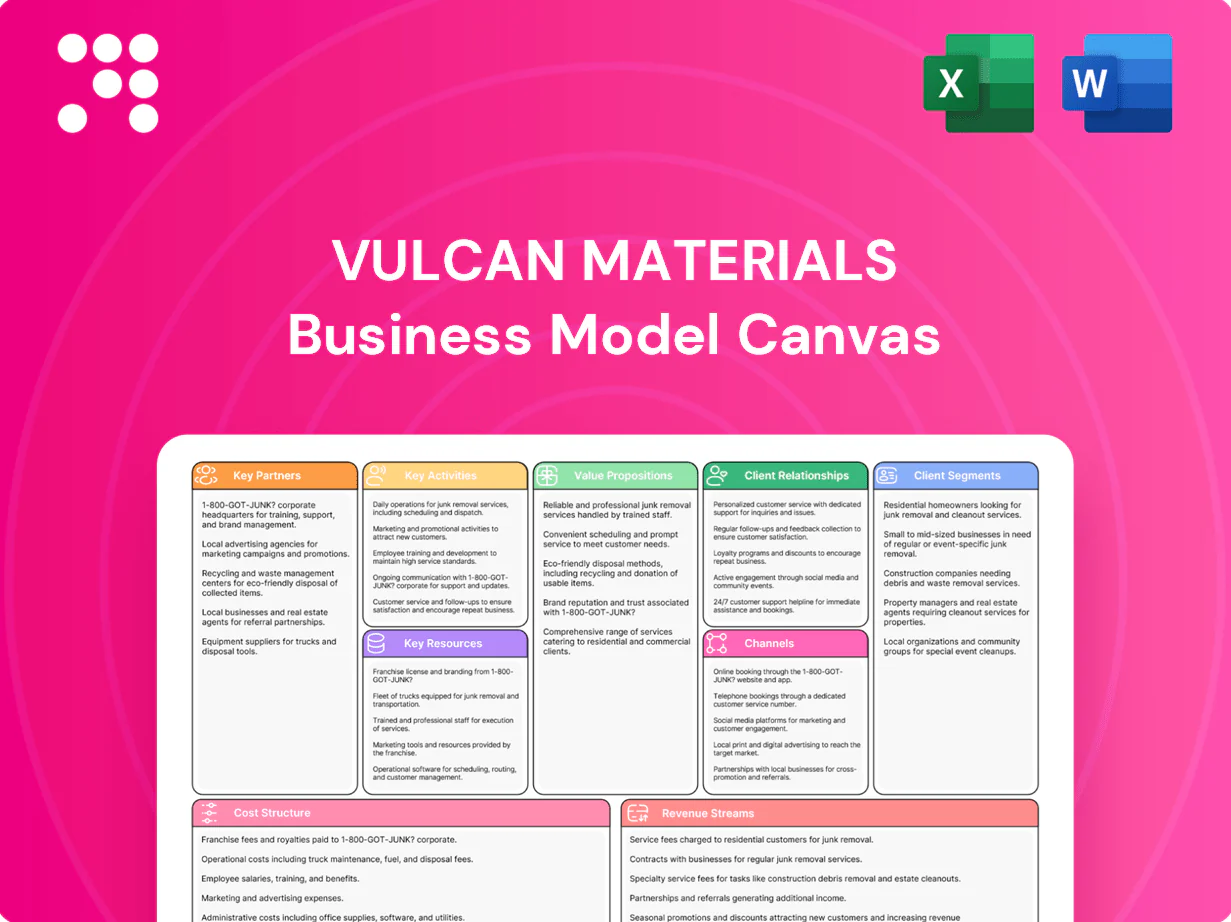
Vulcan Materials Business Model Canvas

Business Model Canvas Blueprint for a Leading Construction Materials Firm
Unlock the full strategic blueprint behind Vulcan Materials’s Business Model Canvas and discover how the company creates value, sustains margins, and wins market share in construction materials. This concise preview highlights key drivers—download the full, editable canvas for a section-by-section breakdown, financial implications, and actionable insights ideal for investors, consultants, and executives. Purchase now to accelerate strategic decisions.
Partnerships

State DOTs and Municipal Agencies
State DOTs and municipal agencies provide predictable, multi-year demand—backed by the Bipartisan Infrastructure Law’s roughly 110 billion allocated to roads and bridges—stabilizing Vulcan Materials’ aggregate sales. Collaboration aligns supply to project schedules and specs, while long-term approvals and prequalification streamline bidding and compliance. Data sharing with public partners improves forecasting and logistics efficiency, reducing delivery variability.
Construction and Engineering Firms
EPCs, general contractors, and paving firms coordinate on mix designs and delivery windows to align with project timelines, cutting downtime and waste through joint planning that can improve productivity by double-digit percentages; the US construction sector represented about 4.1% of GDP in 2024. Preferred supplier agreements lock in volume, pricing tiers, and service levels while structured feedback loops drive iterative product improvements and better jobsite outcomes.

Quarry Equipment and Technology Vendors
OEMs and tech providers boost uptime and automation, with predictive maintenance cutting maintenance costs 10–40% and unplanned downtime 30–50% (industry studies). Telemetry and process controls can improve throughput 5–15% and reduce unit costs per ton. Equipment upgrades enhance safety and environmental compliance, lowering reportable incidents ~20%. Co-development with vendors can accelerate throughput and quality control by 10–25%.

Railroads, Trucking, and Barge Carriers
Multimodal logistics partners enable regional reach and cost-effective haul distances, leveraging truck freight (about 70% of US tonnage in 2023–24) and rail (≈13%), while barge links reduce long-haul unit costs. Dedicated capacity and routing cut lead times for quarry-to-jobsite cycles. Backhaul and transload agreements boost utilization and lower empty miles; joint contingency plans reduce weather and peak-season disruption risk.
- Regional reach via truck/rail/barge
- Dedicated capacity reduces lead times
- Backhaul/transload optimize utilization
- Contingency planning mitigates seasonal/weather risks
Landowners and Permitting Authorities
Landowners and permitting authorities secure mineral rights and regulatory access essential to Vulcan Materials operations; long-dated leases and permits (commonly 20–99 years as of 2024) underpin asset life and valuation models. Proactive community engagement reduces approval risk and supports expansions, while environmental partners shape reclamation plans and long-term stewardship commitments.
- Leases: 20–99 years
- Permitting: underpins NPV of quarries
- Community: lowers approval risk
- Environmental: ensures reclamation compliance
DOT demand 110B; OEMs cut downtime 30–50%.
State DOTs/municipal agencies anchor multi‑year demand (BIL ≈110B for roads/bridges), EPCs/paving firms lock volume via preferred agreements improving productivity (~double‑digit gains), OEMs/tech cut maintenance 10–40% and downtime 30–50%, logistics (truck ≈70% tonnage, rail ≈13% 2023–24) lower haul costs; leases commonly 20–99 years.
| Partner | Value | 2024 metric |
|---|---|---|
| DOTs/Contractors/OEMs/Logistics | Demand, efficiency, uptime | BIL110B; construction 4.1% GDP; truck70% |
What is included in the product
 Detailed Word Document
A comprehensive Business Model Canvas for Vulcan Materials detailing nine BMC blocks—customer segments, value propositions, channels, customer relationships, revenue streams, key resources, key activities, key partners, and cost structure—reflecting real-world aggregates/aggregate materials operations, competitive advantages, and linked SWOT insights to support investor presentations, strategic planning, and validation of growth initiatives.

 Customizable Excel Spreadsheet
High-level snapshot of Vulcan Materials’ business model with editable cells to quickly identify core components and condense strategy into a digestible one-page format, saving hours of formatting for fast deliverables and team collaboration.
Activities

Aggregate Extraction and Processing
Drilling, blasting, crushing and screening convert rock into graded stone, sand and gravel for construction, supporting Vulcan Materials, the largest US producer of construction aggregates; Vulcan reported roughly $6.8 billion in net sales in 2023. Continuous plant and lab quality testing ensures specification compliance for asphalt, concrete and road projects. Process optimization and equipment upgrades drive down energy per ton and operating cost. Rigorous safety programs protect the workforce and operating permits.
Asphalt and Ready-Mix Production
Batching and blending at Vulcan convert aggregates and binders across 400+ facilities into asphalt and ready-mix, producing climate- and spec-tailored mixes through mix design customization for highways, municipal and commercial projects. Plant scheduling is tightly aligned with paving and pour windows to minimize downtime and meet seasonal demand peaks, supporting sustained throughput. Rigorous quality control programs—part of operations that contributed to Vulcan’s roughly $6.5 billion annual revenue range in 2024—reduce rework and claims, lowering warranty costs and improving margins.

Logistics and Distribution Management
Routing, load planning, and dispatch reduce delivered cost by optimizing miles and payloads while balancing empty miles and fuel usage. Coordination of rail, truck, and barge extends market reach and enables larger, lower-cost movements to distant projects. Reliable on-time delivery preserves construction critical paths and avoids project delay penalties. Telematics give live visibility to customers and operations for proactive adjustments.

Sales, Bidding, and Contract Management
Sales, bidding and contract management secure volume with margin discipline through targeted pricing, competitive quotations and disciplined RFP responses; Vulcan Materials (VMC) supported FY2024 revenue of about $6.8B while protecting margins. Indexing and fuel surcharges pass volatility to customers; framework agreements streamline repeat business; strict credit and risk controls protect cash flow.
- Pricing discipline
- Indexing & fuel surcharges
- Framework agreements
- Credit & risk controls
Permitting, ESG, and Community Relations
Permitting, ESG, and community relations ensure compliance that maintains operating licenses and social acceptance across Vulcan Materials' ~350 aggregates sites and S&P 500 standing; reclamation and water stewardship programs reduce environmental impact, while safety and community initiatives build trust; transparent reporting (2024 Sustainability Report) supports investors and partners.
- Compliance: licenses, social acceptance
- Reclamation & water stewardship: impact reduction
- Safety & community initiatives: trust
- Transparent reporting: investor/partner confidence
~400-site network converts rock to aggregates; $6.8B
Drilling, crushing, blending and logistics convert rock into spec aggregates, asphalt and ready-mix across ~400 facilities and ~350 sites, supporting Vulcan Materials’ ~ $6.8B revenue in 2024. Continuous QA, plant upgrades and telematics lower cost/ton and ensure on-time delivery. Sales, contracting and surcharges protect margins while permitting, reclamation and ESG sustain licenses and investor confidence.
| Metric | Value (2024) |
|---|---|
| Revenue | $6.8B |
| Facilities/sites | ~400 / ~350 |
| Operations focus | QA, upgrades, telematics, ESG |
Delivered as Displayed
Business Model Canvas
The Vulcan Materials Business Model Canvas you see here is the actual deliverable, not a mockup. When you purchase, you’ll receive this identical file—fully formatted and complete—in editable Word and Excel formats. No surprises: what you preview is what you’ll download and use immediately.

Business Model Canvas Blueprint for a Leading Construction Materials Firm
Unlock the full strategic blueprint behind Vulcan Materials’s Business Model Canvas and discover how the company creates value, sustains margins, and wins market share in construction materials. This concise preview highlights key drivers—download the full, editable canvas for a section-by-section breakdown, financial implications, and actionable insights ideal for investors, consultants, and executives. Purchase now to accelerate strategic decisions.
Partnerships
State DOTs and Municipal Agencies
State DOTs and municipal agencies provide predictable, multi-year demand—backed by the Bipartisan Infrastructure Law’s roughly 110 billion allocated to roads and bridges—stabilizing Vulcan Materials’ aggregate sales. Collaboration aligns supply to project schedules and specs, while long-term approvals and prequalification streamline bidding and compliance. Data sharing with public partners improves forecasting and logistics efficiency, reducing delivery variability.
Construction and Engineering Firms
EPCs, general contractors, and paving firms coordinate on mix designs and delivery windows to align with project timelines, cutting downtime and waste through joint planning that can improve productivity by double-digit percentages; the US construction sector represented about 4.1% of GDP in 2024. Preferred supplier agreements lock in volume, pricing tiers, and service levels while structured feedback loops drive iterative product improvements and better jobsite outcomes.
Quarry Equipment and Technology Vendors
OEMs and tech providers boost uptime and automation, with predictive maintenance cutting maintenance costs 10–40% and unplanned downtime 30–50% (industry studies). Telemetry and process controls can improve throughput 5–15% and reduce unit costs per ton. Equipment upgrades enhance safety and environmental compliance, lowering reportable incidents ~20%. Co-development with vendors can accelerate throughput and quality control by 10–25%.
Railroads, Trucking, and Barge Carriers
Multimodal logistics partners enable regional reach and cost-effective haul distances, leveraging truck freight (about 70% of US tonnage in 2023–24) and rail (≈13%), while barge links reduce long-haul unit costs. Dedicated capacity and routing cut lead times for quarry-to-jobsite cycles. Backhaul and transload agreements boost utilization and lower empty miles; joint contingency plans reduce weather and peak-season disruption risk.
- Regional reach via truck/rail/barge
- Dedicated capacity reduces lead times
- Backhaul/transload optimize utilization
- Contingency planning mitigates seasonal/weather risks
Landowners and Permitting Authorities
Landowners and permitting authorities secure mineral rights and regulatory access essential to Vulcan Materials operations; long-dated leases and permits (commonly 20–99 years as of 2024) underpin asset life and valuation models. Proactive community engagement reduces approval risk and supports expansions, while environmental partners shape reclamation plans and long-term stewardship commitments.
- Leases: 20–99 years
- Permitting: underpins NPV of quarries
- Community: lowers approval risk
- Environmental: ensures reclamation compliance
DOT demand 110B; OEMs cut downtime 30–50%.
State DOTs/municipal agencies anchor multi‑year demand (BIL ≈110B for roads/bridges), EPCs/paving firms lock volume via preferred agreements improving productivity (~double‑digit gains), OEMs/tech cut maintenance 10–40% and downtime 30–50%, logistics (truck ≈70% tonnage, rail ≈13% 2023–24) lower haul costs; leases commonly 20–99 years.
| Partner | Value | 2024 metric |
|---|---|---|
| DOTs/Contractors/OEMs/Logistics | Demand, efficiency, uptime | BIL110B; construction 4.1% GDP; truck70% |
What is included in the product
Detailed Word Document
A comprehensive Business Model Canvas for Vulcan Materials detailing nine BMC blocks—customer segments, value propositions, channels, customer relationships, revenue streams, key resources, key activities, key partners, and cost structure—reflecting real-world aggregates/aggregate materials operations, competitive advantages, and linked SWOT insights to support investor presentations, strategic planning, and validation of growth initiatives.
Customizable Excel Spreadsheet
High-level snapshot of Vulcan Materials’ business model with editable cells to quickly identify core components and condense strategy into a digestible one-page format, saving hours of formatting for fast deliverables and team collaboration.
Activities
Aggregate Extraction and Processing
Drilling, blasting, crushing and screening convert rock into graded stone, sand and gravel for construction, supporting Vulcan Materials, the largest US producer of construction aggregates; Vulcan reported roughly $6.8 billion in net sales in 2023. Continuous plant and lab quality testing ensures specification compliance for asphalt, concrete and road projects. Process optimization and equipment upgrades drive down energy per ton and operating cost. Rigorous safety programs protect the workforce and operating permits.
Asphalt and Ready-Mix Production
Batching and blending at Vulcan convert aggregates and binders across 400+ facilities into asphalt and ready-mix, producing climate- and spec-tailored mixes through mix design customization for highways, municipal and commercial projects. Plant scheduling is tightly aligned with paving and pour windows to minimize downtime and meet seasonal demand peaks, supporting sustained throughput. Rigorous quality control programs—part of operations that contributed to Vulcan’s roughly $6.5 billion annual revenue range in 2024—reduce rework and claims, lowering warranty costs and improving margins.
Logistics and Distribution Management
Routing, load planning, and dispatch reduce delivered cost by optimizing miles and payloads while balancing empty miles and fuel usage. Coordination of rail, truck, and barge extends market reach and enables larger, lower-cost movements to distant projects. Reliable on-time delivery preserves construction critical paths and avoids project delay penalties. Telematics give live visibility to customers and operations for proactive adjustments.
Sales, Bidding, and Contract Management
Sales, bidding and contract management secure volume with margin discipline through targeted pricing, competitive quotations and disciplined RFP responses; Vulcan Materials (VMC) supported FY2024 revenue of about $6.8B while protecting margins. Indexing and fuel surcharges pass volatility to customers; framework agreements streamline repeat business; strict credit and risk controls protect cash flow.
- Pricing discipline
- Indexing & fuel surcharges
- Framework agreements
- Credit & risk controls
Permitting, ESG, and Community Relations
Permitting, ESG, and community relations ensure compliance that maintains operating licenses and social acceptance across Vulcan Materials' ~350 aggregates sites and S&P 500 standing; reclamation and water stewardship programs reduce environmental impact, while safety and community initiatives build trust; transparent reporting (2024 Sustainability Report) supports investors and partners.
- Compliance: licenses, social acceptance
- Reclamation & water stewardship: impact reduction
- Safety & community initiatives: trust
- Transparent reporting: investor/partner confidence
~400-site network converts rock to aggregates; $6.8B
Drilling, crushing, blending and logistics convert rock into spec aggregates, asphalt and ready-mix across ~400 facilities and ~350 sites, supporting Vulcan Materials’ ~ $6.8B revenue in 2024. Continuous QA, plant upgrades and telematics lower cost/ton and ensure on-time delivery. Sales, contracting and surcharges protect margins while permitting, reclamation and ESG sustain licenses and investor confidence.
| Metric | Value (2024) |
|---|---|
| Revenue | $6.8B |
| Facilities/sites | ~400 / ~350 |
| Operations focus | QA, upgrades, telematics, ESG |
Delivered as Displayed
Business Model Canvas
The Vulcan Materials Business Model Canvas you see here is the actual deliverable, not a mockup. When you purchase, you’ll receive this identical file—fully formatted and complete—in editable Word and Excel formats. No surprises: what you preview is what you’ll download and use immediately.
Original: $10.00
-65%$10.00
$3.50Description
Business Model Canvas Blueprint for a Leading Construction Materials Firm
Unlock the full strategic blueprint behind Vulcan Materials’s Business Model Canvas and discover how the company creates value, sustains margins, and wins market share in construction materials. This concise preview highlights key drivers—download the full, editable canvas for a section-by-section breakdown, financial implications, and actionable insights ideal for investors, consultants, and executives. Purchase now to accelerate strategic decisions.
Partnerships
State DOTs and Municipal Agencies
State DOTs and municipal agencies provide predictable, multi-year demand—backed by the Bipartisan Infrastructure Law’s roughly 110 billion allocated to roads and bridges—stabilizing Vulcan Materials’ aggregate sales. Collaboration aligns supply to project schedules and specs, while long-term approvals and prequalification streamline bidding and compliance. Data sharing with public partners improves forecasting and logistics efficiency, reducing delivery variability.
Construction and Engineering Firms
EPCs, general contractors, and paving firms coordinate on mix designs and delivery windows to align with project timelines, cutting downtime and waste through joint planning that can improve productivity by double-digit percentages; the US construction sector represented about 4.1% of GDP in 2024. Preferred supplier agreements lock in volume, pricing tiers, and service levels while structured feedback loops drive iterative product improvements and better jobsite outcomes.
Quarry Equipment and Technology Vendors
OEMs and tech providers boost uptime and automation, with predictive maintenance cutting maintenance costs 10–40% and unplanned downtime 30–50% (industry studies). Telemetry and process controls can improve throughput 5–15% and reduce unit costs per ton. Equipment upgrades enhance safety and environmental compliance, lowering reportable incidents ~20%. Co-development with vendors can accelerate throughput and quality control by 10–25%.
Railroads, Trucking, and Barge Carriers
Multimodal logistics partners enable regional reach and cost-effective haul distances, leveraging truck freight (about 70% of US tonnage in 2023–24) and rail (≈13%), while barge links reduce long-haul unit costs. Dedicated capacity and routing cut lead times for quarry-to-jobsite cycles. Backhaul and transload agreements boost utilization and lower empty miles; joint contingency plans reduce weather and peak-season disruption risk.
- Regional reach via truck/rail/barge
- Dedicated capacity reduces lead times
- Backhaul/transload optimize utilization
- Contingency planning mitigates seasonal/weather risks
Landowners and Permitting Authorities
Landowners and permitting authorities secure mineral rights and regulatory access essential to Vulcan Materials operations; long-dated leases and permits (commonly 20–99 years as of 2024) underpin asset life and valuation models. Proactive community engagement reduces approval risk and supports expansions, while environmental partners shape reclamation plans and long-term stewardship commitments.
- Leases: 20–99 years
- Permitting: underpins NPV of quarries
- Community: lowers approval risk
- Environmental: ensures reclamation compliance
DOT demand 110B; OEMs cut downtime 30–50%.
State DOTs/municipal agencies anchor multi‑year demand (BIL ≈110B for roads/bridges), EPCs/paving firms lock volume via preferred agreements improving productivity (~double‑digit gains), OEMs/tech cut maintenance 10–40% and downtime 30–50%, logistics (truck ≈70% tonnage, rail ≈13% 2023–24) lower haul costs; leases commonly 20–99 years.
| Partner | Value | 2024 metric |
|---|---|---|
| DOTs/Contractors/OEMs/Logistics | Demand, efficiency, uptime | BIL110B; construction 4.1% GDP; truck70% |
What is included in the product
Detailed Word Document
A comprehensive Business Model Canvas for Vulcan Materials detailing nine BMC blocks—customer segments, value propositions, channels, customer relationships, revenue streams, key resources, key activities, key partners, and cost structure—reflecting real-world aggregates/aggregate materials operations, competitive advantages, and linked SWOT insights to support investor presentations, strategic planning, and validation of growth initiatives.
Customizable Excel Spreadsheet
High-level snapshot of Vulcan Materials’ business model with editable cells to quickly identify core components and condense strategy into a digestible one-page format, saving hours of formatting for fast deliverables and team collaboration.
Activities
Aggregate Extraction and Processing
Drilling, blasting, crushing and screening convert rock into graded stone, sand and gravel for construction, supporting Vulcan Materials, the largest US producer of construction aggregates; Vulcan reported roughly $6.8 billion in net sales in 2023. Continuous plant and lab quality testing ensures specification compliance for asphalt, concrete and road projects. Process optimization and equipment upgrades drive down energy per ton and operating cost. Rigorous safety programs protect the workforce and operating permits.
Asphalt and Ready-Mix Production
Batching and blending at Vulcan convert aggregates and binders across 400+ facilities into asphalt and ready-mix, producing climate- and spec-tailored mixes through mix design customization for highways, municipal and commercial projects. Plant scheduling is tightly aligned with paving and pour windows to minimize downtime and meet seasonal demand peaks, supporting sustained throughput. Rigorous quality control programs—part of operations that contributed to Vulcan’s roughly $6.5 billion annual revenue range in 2024—reduce rework and claims, lowering warranty costs and improving margins.
Logistics and Distribution Management
Routing, load planning, and dispatch reduce delivered cost by optimizing miles and payloads while balancing empty miles and fuel usage. Coordination of rail, truck, and barge extends market reach and enables larger, lower-cost movements to distant projects. Reliable on-time delivery preserves construction critical paths and avoids project delay penalties. Telematics give live visibility to customers and operations for proactive adjustments.
Sales, Bidding, and Contract Management
Sales, bidding and contract management secure volume with margin discipline through targeted pricing, competitive quotations and disciplined RFP responses; Vulcan Materials (VMC) supported FY2024 revenue of about $6.8B while protecting margins. Indexing and fuel surcharges pass volatility to customers; framework agreements streamline repeat business; strict credit and risk controls protect cash flow.
- Pricing discipline
- Indexing & fuel surcharges
- Framework agreements
- Credit & risk controls
Permitting, ESG, and Community Relations
Permitting, ESG, and community relations ensure compliance that maintains operating licenses and social acceptance across Vulcan Materials' ~350 aggregates sites and S&P 500 standing; reclamation and water stewardship programs reduce environmental impact, while safety and community initiatives build trust; transparent reporting (2024 Sustainability Report) supports investors and partners.
- Compliance: licenses, social acceptance
- Reclamation & water stewardship: impact reduction
- Safety & community initiatives: trust
- Transparent reporting: investor/partner confidence
~400-site network converts rock to aggregates; $6.8B
Drilling, crushing, blending and logistics convert rock into spec aggregates, asphalt and ready-mix across ~400 facilities and ~350 sites, supporting Vulcan Materials’ ~ $6.8B revenue in 2024. Continuous QA, plant upgrades and telematics lower cost/ton and ensure on-time delivery. Sales, contracting and surcharges protect margins while permitting, reclamation and ESG sustain licenses and investor confidence.
| Metric | Value (2024) |
|---|---|
| Revenue | $6.8B |
| Facilities/sites | ~400 / ~350 |
| Operations focus | QA, upgrades, telematics, ESG |
Delivered as Displayed
Business Model Canvas
The Vulcan Materials Business Model Canvas you see here is the actual deliverable, not a mockup. When you purchase, you’ll receive this identical file—fully formatted and complete—in editable Word and Excel formats. No surprises: what you preview is what you’ll download and use immediately.











