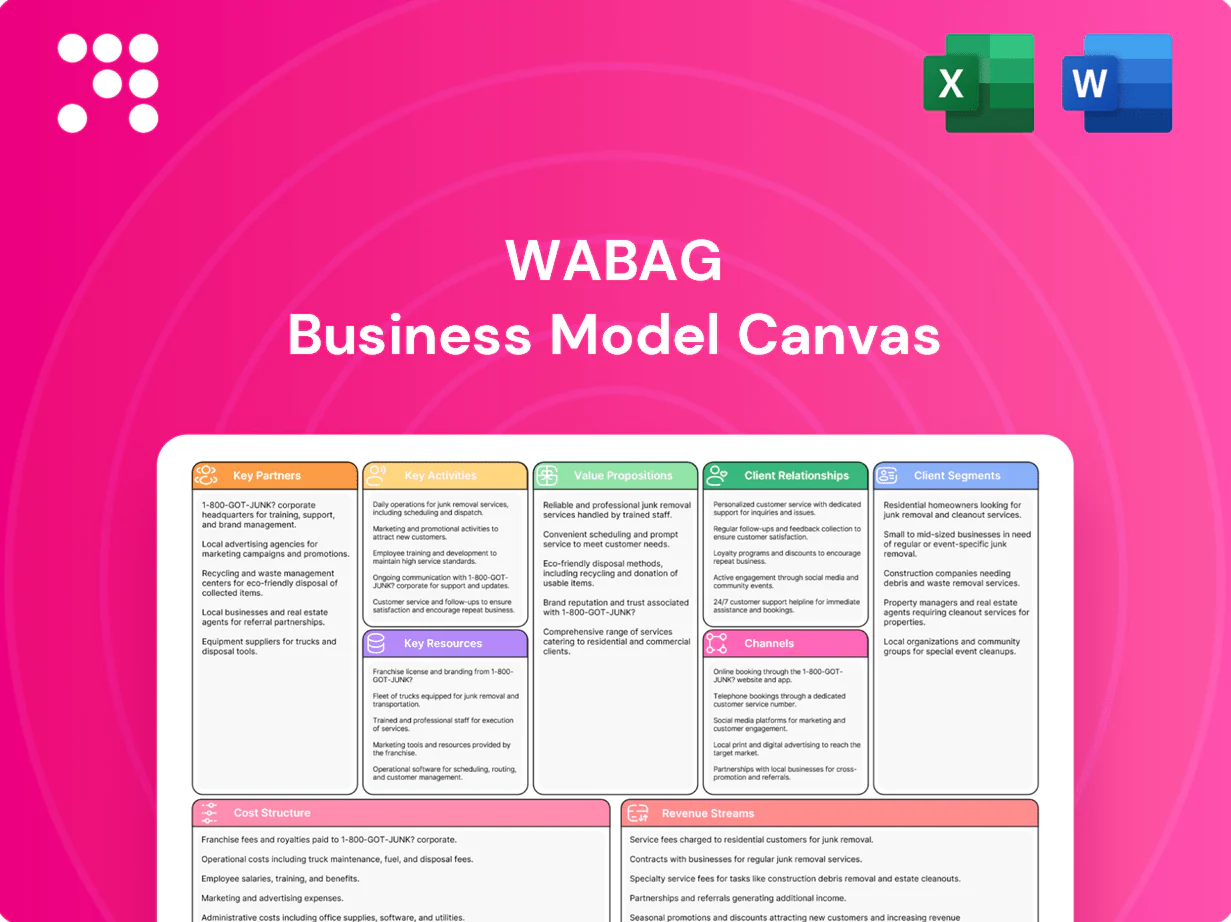
Wabag Business Model Canvas

Unlock Wabag’s strategic blueprint with our concise Business Model Canvas—see how it creates value, secures contracts, and scales in water-treatment markets. This snapshot highlights customer segments, revenue streams, key partners, and cost drivers. Ideal for investors, consultants, and founders seeking actionable insights. Buy the full, editable Canvas (Word & Excel) to benchmark, plan, and execute with confidence.
Partnerships

Municipal and utility alliances
Partnering with city water boards and public utilities secures access to large EPC and O&M programs, land and permits and typically yields long-term contracts of 10–25 years; in 2024 these alliances remain crucial for pipeline visibility. Such partnerships provide steady volumes that justify capital investment in advanced treatment tech and improve alignment with regulatory and service-level targets.
Technology and equipment OEMs
Wabag partners with membrane, pump, blower and instrumentation OEMs to secure best-in-class components and co-develop turnkey RO, MBR, MBBR and sludge digestion process packages. Preferential supply terms lower procurement cost and compress lead times while joint factory and site testing underpins contractual performance guarantees. These OEM alliances enable standardized modular skids and faster project commissioning.

EPC, civil, and construction partners
Forming consortia with civil contractors and specialist EPCs reduces execution risk and logistics complexity, cutting site mobilization and commissioning timelines by up to 30% and improving bid competitiveness with reported win-rate uplifts of 15–20% in large water projects; shared equipment and manpower lower capital outlays and can shave project costs by ~10% on turnkey contracts.

Financiers, DFIs, and PPP SPVs
- DFI-backed long tenors: reduced WACC, extended payback
- Risk-sharing: enables modular desalination and reuse at scale
- Credit enhancement: mobilizes private capital for municipal projects
Academic and R&D institutions
Collaborations with academic and R&D institutions enable joint pilot plants, novel materials and process optimization, with 2024 pilot projects reporting prototype RO energy reductions of about 25% and 40% faster scale-up timelines. Joint IP frameworks accelerate innovation in energy-efficient desalination and water reuse while access to university labs and talent speeds validation. Peer-reviewed publications and joint grants in 2024 raised bid win rates and credibility with clients.
- Pilot plants: 25% lower specific energy (2024)
- Validation speed: 40% faster (2024)
- Joint IP: faster tech transfer
- Publications/grants: higher bid win rates
Partnerships secure DFI blended finance, 10–25yr O&M/EPC deals and 30% faster mobilization
Key partnerships with city utilities, OEMs, EPC consortia, DFIs and R&D labs secure 10–25yr O&M/EPC contracts, lower procurement/capital costs, de‑risk execution (30% faster mobilization) and unlock DFI‑backed blended finance in 2024; pilots report ~25% lower RO energy and 40% faster scale‑up, improving bid win rates by ~15–20%.
| Partner | 2024 impact |
|---|---|
| City utilities | 10–25yr contracts |
| OEMs | lower cost, faster commissioning |
| EPC consortia | -30% mobilization |
| DFIs | blended finance, lower WACC |
| R&D | -25% RO energy, +40% scale-up |
What is included in the product
 Detailed Word Document
A comprehensive, pre-written Business Model Canvas tailored to VA Tech Wabag’s strategy, covering customer segments, channels, value propositions and the 9 classic BMC blocks with real-world operational detail; ideal for presentations, investor or bank discussions, it includes competitive-advantage analysis, linked SWOT insights and a clean, polished design to support decision-making and validation using company data.

 Customizable Excel Spreadsheet
Condenses Wabag’s complex, project-driven business model into an editable one-page snapshot that quickly highlights revenue streams, cost drivers, and partner ecosystems; ideal for fast decision-making and cross-team alignment.
Activities

Design and engineering
Process design, hydraulics and detailed engineering for water and wastewater plants focus on optimal train sizing and layout to meet capacity and effluent specs while targeting energy intensities typically in the 0.3–0.6 kWh/m3 range for municipal wastewater and minimizing chemical use. EPC-ready drawings and documentation are produced per ISO 9001/ISO 14001 quality and environmental frameworks to streamline procurement and handover. Digital control systems and cybersecurity are integrated from inception following IEC 62443 to protect OT/IT convergence.
EPC project execution
Procure, construct and integrate process equipment and civil works with strict vendor QA, targeting schedule adherence ≥95% and cost control within budget margins; manage site safety aiming for zero LTI and ISO-compliant quality systems. Coordinate multi-vendor interfaces to meet guaranteed outputs (≥99% effluent spec compliance) and deliver snag-free commissioning and handover within 30–90 days.

Operations and maintenance
Operate plants under SLAs targeting 99.5% uptime with defined water quality and cost KPIs; predictive maintenance via SCADA/IoT reduces unplanned downtime 30–50% and extends asset life; data analytics drive 10–20% energy savings and 8–15% lower consumable (chemicals) use; client staff training cuts O&M dependency and can reduce recurring O&M costs by ~10% while ensuring sustainable operations.

R&D and technology development
R&D develops advanced desalination, water reuse and sludge-to-energy processes targeting SWRO energy intensity of ~3–3.5 kWh/m3 and leveraging 2024 desalination market scale (~USD 17.5bn) to pilot innovations that cut lifecycle costs 15–25% via efficiency and modularity; file patents and standardize modular designs while continuously updating design libraries and control algorithms for faster deployment and lower OPEX.
- Develop: advanced RO, reuse, sludge-to-energy
- Pilot: lifecycle cost cuts 15–25%
- Patents: protect modular designs
- Standards: modular CAPEX ↓ up to 20%
- Ops: update libraries & control algorithms
Bid management and PPP structuring
Bid management and PPP structuring for WABAG focuses on identifying tenders across 30+ countries in 2024, performing techno-commercial estimations, and managing competitive proposals; BOOT/BOT contracts are structured with clear risk allocation, arranging financing and guarantees to secure projects. Negotiations set performance obligations and tariffs tied to O&M metrics and lifecycle costs.
- tenders identified: global shortlist 2024
- techno-commercial estimation and proposals
- BOOT/BOT structuring with risk allocation
- arrange financing and guarantees
- negotiate performance obligations and tariffs
Process engineering: 0.3–0.6 kWh/m3 municipal; 3–3.5 kWh/m3 SWRO; 99.5% uptime
Process engineering and EPC (ISO 9001/14001) target 0.3–0.6 kWh/m3 for municipal wastewater and SWRO ~3–3.5 kWh/m3. EPC/site works aim ≥95% schedule adherence, zero LTI and ≤30–90 day handover. O&M SLAs target 99.5% uptime, 10–20% energy and 8–15% chemical savings via SCADA/IoT. Bid teams active in 30+ countries (2024), desal market ~USD 17.5bn.
| Metric | Target/2024 |
|---|---|
| Municipal energy | 0.3–0.6 kWh/m3 |
| SWRO energy | 3–3.5 kWh/m3 |
| Uptime SLA | 99.5% |
| Desal market | USD 17.5bn (2024) |
Full Document Unlocks After Purchase
Business Model Canvas
The Wabag Business Model Canvas shown here is the actual deliverable, not a mockup, and reflects the full content you will receive after purchase. When you complete your order, you’ll get this same document—fully formatted and ready to edit, present, or share. No fillers or surprises: what you see in this preview is the exact file you’ll download.

Unlock Wabag’s strategic blueprint with our concise Business Model Canvas—see how it creates value, secures contracts, and scales in water-treatment markets. This snapshot highlights customer segments, revenue streams, key partners, and cost drivers. Ideal for investors, consultants, and founders seeking actionable insights. Buy the full, editable Canvas (Word & Excel) to benchmark, plan, and execute with confidence.
Partnerships
Municipal and utility alliances
Partnering with city water boards and public utilities secures access to large EPC and O&M programs, land and permits and typically yields long-term contracts of 10–25 years; in 2024 these alliances remain crucial for pipeline visibility. Such partnerships provide steady volumes that justify capital investment in advanced treatment tech and improve alignment with regulatory and service-level targets.
Technology and equipment OEMs
Wabag partners with membrane, pump, blower and instrumentation OEMs to secure best-in-class components and co-develop turnkey RO, MBR, MBBR and sludge digestion process packages. Preferential supply terms lower procurement cost and compress lead times while joint factory and site testing underpins contractual performance guarantees. These OEM alliances enable standardized modular skids and faster project commissioning.
EPC, civil, and construction partners
Forming consortia with civil contractors and specialist EPCs reduces execution risk and logistics complexity, cutting site mobilization and commissioning timelines by up to 30% and improving bid competitiveness with reported win-rate uplifts of 15–20% in large water projects; shared equipment and manpower lower capital outlays and can shave project costs by ~10% on turnkey contracts.
Financiers, DFIs, and PPP SPVs
- DFI-backed long tenors: reduced WACC, extended payback
- Risk-sharing: enables modular desalination and reuse at scale
- Credit enhancement: mobilizes private capital for municipal projects
Academic and R&D institutions
Collaborations with academic and R&D institutions enable joint pilot plants, novel materials and process optimization, with 2024 pilot projects reporting prototype RO energy reductions of about 25% and 40% faster scale-up timelines. Joint IP frameworks accelerate innovation in energy-efficient desalination and water reuse while access to university labs and talent speeds validation. Peer-reviewed publications and joint grants in 2024 raised bid win rates and credibility with clients.
- Pilot plants: 25% lower specific energy (2024)
- Validation speed: 40% faster (2024)
- Joint IP: faster tech transfer
- Publications/grants: higher bid win rates
Partnerships secure DFI blended finance, 10–25yr O&M/EPC deals and 30% faster mobilization
Key partnerships with city utilities, OEMs, EPC consortia, DFIs and R&D labs secure 10–25yr O&M/EPC contracts, lower procurement/capital costs, de‑risk execution (30% faster mobilization) and unlock DFI‑backed blended finance in 2024; pilots report ~25% lower RO energy and 40% faster scale‑up, improving bid win rates by ~15–20%.
| Partner | 2024 impact |
|---|---|
| City utilities | 10–25yr contracts |
| OEMs | lower cost, faster commissioning |
| EPC consortia | -30% mobilization |
| DFIs | blended finance, lower WACC |
| R&D | -25% RO energy, +40% scale-up |
What is included in the product
Detailed Word Document
A comprehensive, pre-written Business Model Canvas tailored to VA Tech Wabag’s strategy, covering customer segments, channels, value propositions and the 9 classic BMC blocks with real-world operational detail; ideal for presentations, investor or bank discussions, it includes competitive-advantage analysis, linked SWOT insights and a clean, polished design to support decision-making and validation using company data.
Customizable Excel Spreadsheet
Condenses Wabag’s complex, project-driven business model into an editable one-page snapshot that quickly highlights revenue streams, cost drivers, and partner ecosystems; ideal for fast decision-making and cross-team alignment.
Activities
Design and engineering
Process design, hydraulics and detailed engineering for water and wastewater plants focus on optimal train sizing and layout to meet capacity and effluent specs while targeting energy intensities typically in the 0.3–0.6 kWh/m3 range for municipal wastewater and minimizing chemical use. EPC-ready drawings and documentation are produced per ISO 9001/ISO 14001 quality and environmental frameworks to streamline procurement and handover. Digital control systems and cybersecurity are integrated from inception following IEC 62443 to protect OT/IT convergence.
EPC project execution
Procure, construct and integrate process equipment and civil works with strict vendor QA, targeting schedule adherence ≥95% and cost control within budget margins; manage site safety aiming for zero LTI and ISO-compliant quality systems. Coordinate multi-vendor interfaces to meet guaranteed outputs (≥99% effluent spec compliance) and deliver snag-free commissioning and handover within 30–90 days.
Operations and maintenance
Operate plants under SLAs targeting 99.5% uptime with defined water quality and cost KPIs; predictive maintenance via SCADA/IoT reduces unplanned downtime 30–50% and extends asset life; data analytics drive 10–20% energy savings and 8–15% lower consumable (chemicals) use; client staff training cuts O&M dependency and can reduce recurring O&M costs by ~10% while ensuring sustainable operations.
R&D and technology development
R&D develops advanced desalination, water reuse and sludge-to-energy processes targeting SWRO energy intensity of ~3–3.5 kWh/m3 and leveraging 2024 desalination market scale (~USD 17.5bn) to pilot innovations that cut lifecycle costs 15–25% via efficiency and modularity; file patents and standardize modular designs while continuously updating design libraries and control algorithms for faster deployment and lower OPEX.
- Develop: advanced RO, reuse, sludge-to-energy
- Pilot: lifecycle cost cuts 15–25%
- Patents: protect modular designs
- Standards: modular CAPEX ↓ up to 20%
- Ops: update libraries & control algorithms
Bid management and PPP structuring
Bid management and PPP structuring for WABAG focuses on identifying tenders across 30+ countries in 2024, performing techno-commercial estimations, and managing competitive proposals; BOOT/BOT contracts are structured with clear risk allocation, arranging financing and guarantees to secure projects. Negotiations set performance obligations and tariffs tied to O&M metrics and lifecycle costs.
- tenders identified: global shortlist 2024
- techno-commercial estimation and proposals
- BOOT/BOT structuring with risk allocation
- arrange financing and guarantees
- negotiate performance obligations and tariffs
Process engineering: 0.3–0.6 kWh/m3 municipal; 3–3.5 kWh/m3 SWRO; 99.5% uptime
Process engineering and EPC (ISO 9001/14001) target 0.3–0.6 kWh/m3 for municipal wastewater and SWRO ~3–3.5 kWh/m3. EPC/site works aim ≥95% schedule adherence, zero LTI and ≤30–90 day handover. O&M SLAs target 99.5% uptime, 10–20% energy and 8–15% chemical savings via SCADA/IoT. Bid teams active in 30+ countries (2024), desal market ~USD 17.5bn.
| Metric | Target/2024 |
|---|---|
| Municipal energy | 0.3–0.6 kWh/m3 |
| SWRO energy | 3–3.5 kWh/m3 |
| Uptime SLA | 99.5% |
| Desal market | USD 17.5bn (2024) |
Full Document Unlocks After Purchase
Business Model Canvas
The Wabag Business Model Canvas shown here is the actual deliverable, not a mockup, and reflects the full content you will receive after purchase. When you complete your order, you’ll get this same document—fully formatted and ready to edit, present, or share. No fillers or surprises: what you see in this preview is the exact file you’ll download.
Original: $10.00
-65%$10.00
$3.50Description
Unlock Wabag’s strategic blueprint with our concise Business Model Canvas—see how it creates value, secures contracts, and scales in water-treatment markets. This snapshot highlights customer segments, revenue streams, key partners, and cost drivers. Ideal for investors, consultants, and founders seeking actionable insights. Buy the full, editable Canvas (Word & Excel) to benchmark, plan, and execute with confidence.
Partnerships
Municipal and utility alliances
Partnering with city water boards and public utilities secures access to large EPC and O&M programs, land and permits and typically yields long-term contracts of 10–25 years; in 2024 these alliances remain crucial for pipeline visibility. Such partnerships provide steady volumes that justify capital investment in advanced treatment tech and improve alignment with regulatory and service-level targets.
Technology and equipment OEMs
Wabag partners with membrane, pump, blower and instrumentation OEMs to secure best-in-class components and co-develop turnkey RO, MBR, MBBR and sludge digestion process packages. Preferential supply terms lower procurement cost and compress lead times while joint factory and site testing underpins contractual performance guarantees. These OEM alliances enable standardized modular skids and faster project commissioning.
EPC, civil, and construction partners
Forming consortia with civil contractors and specialist EPCs reduces execution risk and logistics complexity, cutting site mobilization and commissioning timelines by up to 30% and improving bid competitiveness with reported win-rate uplifts of 15–20% in large water projects; shared equipment and manpower lower capital outlays and can shave project costs by ~10% on turnkey contracts.
Financiers, DFIs, and PPP SPVs
- DFI-backed long tenors: reduced WACC, extended payback
- Risk-sharing: enables modular desalination and reuse at scale
- Credit enhancement: mobilizes private capital for municipal projects
Academic and R&D institutions
Collaborations with academic and R&D institutions enable joint pilot plants, novel materials and process optimization, with 2024 pilot projects reporting prototype RO energy reductions of about 25% and 40% faster scale-up timelines. Joint IP frameworks accelerate innovation in energy-efficient desalination and water reuse while access to university labs and talent speeds validation. Peer-reviewed publications and joint grants in 2024 raised bid win rates and credibility with clients.
- Pilot plants: 25% lower specific energy (2024)
- Validation speed: 40% faster (2024)
- Joint IP: faster tech transfer
- Publications/grants: higher bid win rates
Partnerships secure DFI blended finance, 10–25yr O&M/EPC deals and 30% faster mobilization
Key partnerships with city utilities, OEMs, EPC consortia, DFIs and R&D labs secure 10–25yr O&M/EPC contracts, lower procurement/capital costs, de‑risk execution (30% faster mobilization) and unlock DFI‑backed blended finance in 2024; pilots report ~25% lower RO energy and 40% faster scale‑up, improving bid win rates by ~15–20%.
| Partner | 2024 impact |
|---|---|
| City utilities | 10–25yr contracts |
| OEMs | lower cost, faster commissioning |
| EPC consortia | -30% mobilization |
| DFIs | blended finance, lower WACC |
| R&D | -25% RO energy, +40% scale-up |
What is included in the product
Detailed Word Document
A comprehensive, pre-written Business Model Canvas tailored to VA Tech Wabag’s strategy, covering customer segments, channels, value propositions and the 9 classic BMC blocks with real-world operational detail; ideal for presentations, investor or bank discussions, it includes competitive-advantage analysis, linked SWOT insights and a clean, polished design to support decision-making and validation using company data.
Customizable Excel Spreadsheet
Condenses Wabag’s complex, project-driven business model into an editable one-page snapshot that quickly highlights revenue streams, cost drivers, and partner ecosystems; ideal for fast decision-making and cross-team alignment.
Activities
Design and engineering
Process design, hydraulics and detailed engineering for water and wastewater plants focus on optimal train sizing and layout to meet capacity and effluent specs while targeting energy intensities typically in the 0.3–0.6 kWh/m3 range for municipal wastewater and minimizing chemical use. EPC-ready drawings and documentation are produced per ISO 9001/ISO 14001 quality and environmental frameworks to streamline procurement and handover. Digital control systems and cybersecurity are integrated from inception following IEC 62443 to protect OT/IT convergence.
EPC project execution
Procure, construct and integrate process equipment and civil works with strict vendor QA, targeting schedule adherence ≥95% and cost control within budget margins; manage site safety aiming for zero LTI and ISO-compliant quality systems. Coordinate multi-vendor interfaces to meet guaranteed outputs (≥99% effluent spec compliance) and deliver snag-free commissioning and handover within 30–90 days.
Operations and maintenance
Operate plants under SLAs targeting 99.5% uptime with defined water quality and cost KPIs; predictive maintenance via SCADA/IoT reduces unplanned downtime 30–50% and extends asset life; data analytics drive 10–20% energy savings and 8–15% lower consumable (chemicals) use; client staff training cuts O&M dependency and can reduce recurring O&M costs by ~10% while ensuring sustainable operations.
R&D and technology development
R&D develops advanced desalination, water reuse and sludge-to-energy processes targeting SWRO energy intensity of ~3–3.5 kWh/m3 and leveraging 2024 desalination market scale (~USD 17.5bn) to pilot innovations that cut lifecycle costs 15–25% via efficiency and modularity; file patents and standardize modular designs while continuously updating design libraries and control algorithms for faster deployment and lower OPEX.
- Develop: advanced RO, reuse, sludge-to-energy
- Pilot: lifecycle cost cuts 15–25%
- Patents: protect modular designs
- Standards: modular CAPEX ↓ up to 20%
- Ops: update libraries & control algorithms
Bid management and PPP structuring
Bid management and PPP structuring for WABAG focuses on identifying tenders across 30+ countries in 2024, performing techno-commercial estimations, and managing competitive proposals; BOOT/BOT contracts are structured with clear risk allocation, arranging financing and guarantees to secure projects. Negotiations set performance obligations and tariffs tied to O&M metrics and lifecycle costs.
- tenders identified: global shortlist 2024
- techno-commercial estimation and proposals
- BOOT/BOT structuring with risk allocation
- arrange financing and guarantees
- negotiate performance obligations and tariffs
Process engineering: 0.3–0.6 kWh/m3 municipal; 3–3.5 kWh/m3 SWRO; 99.5% uptime
Process engineering and EPC (ISO 9001/14001) target 0.3–0.6 kWh/m3 for municipal wastewater and SWRO ~3–3.5 kWh/m3. EPC/site works aim ≥95% schedule adherence, zero LTI and ≤30–90 day handover. O&M SLAs target 99.5% uptime, 10–20% energy and 8–15% chemical savings via SCADA/IoT. Bid teams active in 30+ countries (2024), desal market ~USD 17.5bn.
| Metric | Target/2024 |
|---|---|
| Municipal energy | 0.3–0.6 kWh/m3 |
| SWRO energy | 3–3.5 kWh/m3 |
| Uptime SLA | 99.5% |
| Desal market | USD 17.5bn (2024) |
Full Document Unlocks After Purchase
Business Model Canvas
The Wabag Business Model Canvas shown here is the actual deliverable, not a mockup, and reflects the full content you will receive after purchase. When you complete your order, you’ll get this same document—fully formatted and ready to edit, present, or share. No fillers or surprises: what you see in this preview is the exact file you’ll download.











