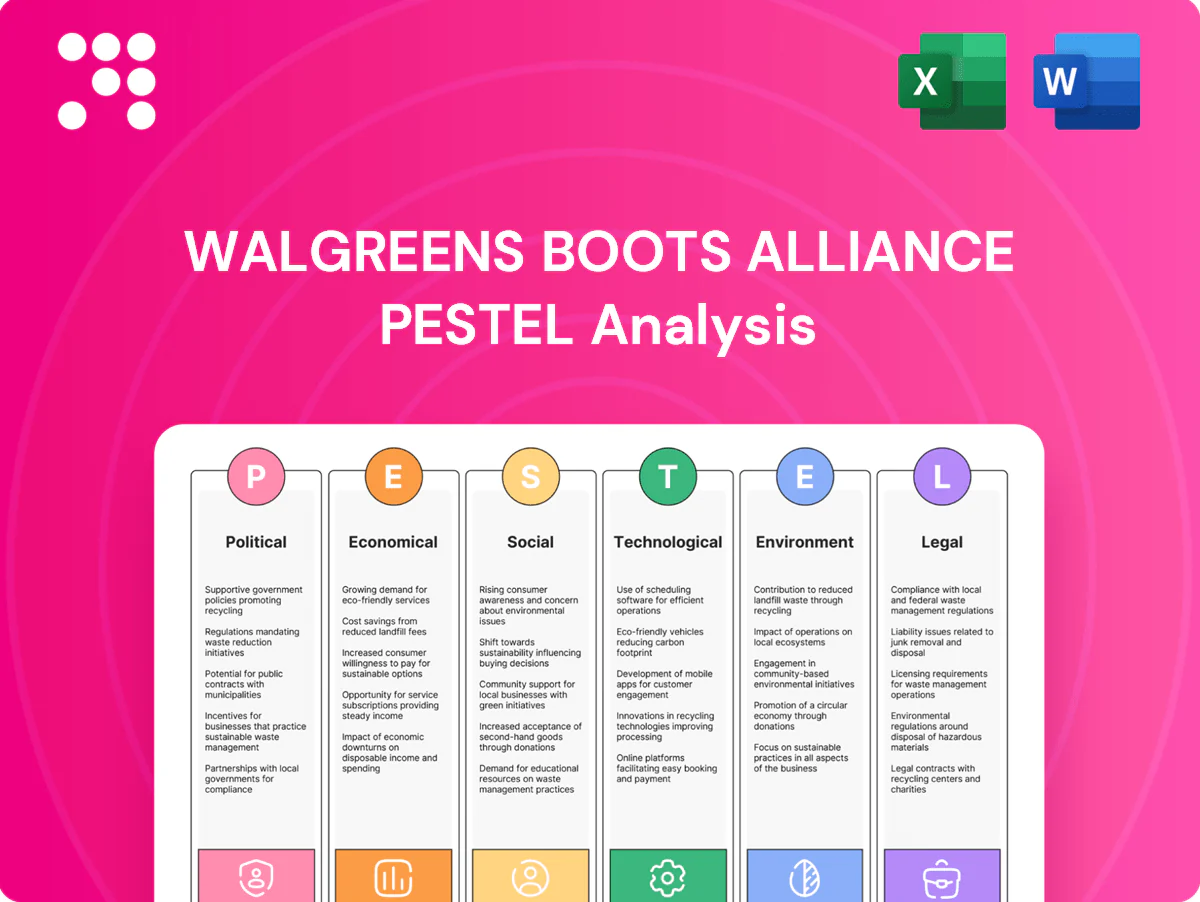
Walgreens Boots Alliance PESTLE Analysis

Your Competitive Advantage Starts with This Report
Our PESTLE snapshot reveals how regulatory shifts, consumer spending trends, digital health technologies and environmental pressures are reshaping Walgreens Boots Alliance’s strategy and risk profile. Tailored for investors and strategists, it highlights actionable implications and key risk hotspots. Purchase the full PESTLE to access the complete, downloadable analysis and prepare smarter decisions.
Political factors

Drug pricing and reimbursement policies
Government moves to curb drug costs, notably the Inflation Reduction Act enabling Medicare price negotiations beginning in 2026, directly compress pharmacy margins and restrict formulary access for Walgreens Boots Alliance. Medicare had about 66 million enrollees in 2024 and Medicaid/CHIP cover roughly 90 million, so reimbursement shifts materially change script profitability and patient copays. WBA must negotiate with PBMs—three dominant players manage roughly 80% of claims—and public payers while shifting mix toward higher-margin services. Policy volatility increases forecasting complexity and network strategy risk.
Healthcare reform and public funding
National reforms in the US, UK and EU shift coverage, preventive care and pharmacy scope of practice, and expanded public funding for vaccinations and primary care (notably boosted in several 2024 programs) can raise reimbursed clinical revenue; Walgreens Boots Alliance, which reported fiscal 2024 sales of about $132.6 billion and operates roughly 9,000 US pharmacies, aligns offerings to capture these services. Conversely, austerity or budget constraints can compress dispensing fees and margin on medicines, pressuring pharmacy income and prompting WBA to pivot toward reimbursed clinical services and vaccination delivery to sustain revenue.

Geopolitical supply-chain risks
Trade tensions and sanctions threaten pharmaceutical sourcing as China and India supply over 60% of global active pharmaceutical ingredients, increasing disruption risk to APIs. Tariffs and export controls raise costs and extend lead times for generics and medical devices, pressuring margins. WBA’s wholesale networks need diversified suppliers and contingency logistics. Political instability forces higher inventory buffers and dynamic pricing adjustments.

Local licensing and zoning
Municipal licensing and zoning shape Walgreens Boots Alliance store openings, hours, and clinic permits; with roughly 19,500 incorporated U.S. municipalities and about 3,000 local health departments, regulatory heterogeneity alters rollout speed and site economics.
- Local rules dictate permits and hours
- Clinic/vaccine licensing varies by jurisdiction
- Community-health priorities enable co-location
- Compliance slows expansion, raises capex
Public health priorities and partnerships
Government campaigns on immunization, opioid mitigation and chronic disease create partnership opportunities for Walgreens Boots Alliance, which operates over 8,000 US pharmacies and serves roughly 6 million customers daily; these programs position WBA as a frontline access point for public-health delivery.
- Partnerships: federal/state immunization and opioid grants
- Access: 8,000+ stores, ~6M customers/day
- Funding: contingent on political will and outcomes evidence
- Benefit: stronger public-health alignment boosts brand trust and footfall
Medicare pricing and prevention funding squeeze pharmacy margins, boost reimbursed clinical services
Policy shifts like the Inflation Reduction Act (Medicare negotiations from 2026) and expanded 2024 prevention funding compress drug margins while creating reimbursed clinical revenue opportunities for Walgreens Boots Alliance (fiscal 2024 sales $132.6B; ~9,000 US pharmacies; 8,000+ stores; ~6M customers/day). Medicare ~66M enrollees (2024), Medicaid/CHIP ~90M; APIs from China/India >60% raise supply risk; PBMs control ~80% of claims.
| Metric | 2024/2025 Data |
|---|---|
| Sales (FY2024) | $132.6B |
| US pharmacies | ~9,000 |
| Daily customers (US) | ~6M |
| Medicare enrollees | ~66M (2024) |
| Medicaid/CHIP | ~90M |
| PBM market share | ~80% |
| API sourcing risk | >60% from China/India |
What is included in the product
 Detailed Word Document
Explores how Political, Economic, Social, Technological, Environmental and Legal forces uniquely affect Walgreens Boots Alliance, linking industry trends, regulatory shifts, consumer behavior, digital health adoption, sustainability pressures and compliance risks to strategic implications. Every section is data-backed and forward-looking, crafted for executives, consultants and investors to identify threats, opportunities and scenario-driven actions.

 Customizable Excel Spreadsheet
Visually segmented Walgreens Boots Alliance PESTLE summary that relieves planning pain points by distilling regulatory, economic and technological risks into a concise, shareable slide-ready format for quick team alignment.
Economic factors

Consumer spending and inflation
Macro inflation (U.S. CPI 3.4% in 2024) pressures discretionary baskets while pharmacy scripts remain relatively resilient, underpinning WBA’s revenue mix. Wage and rent inflation raise operating costs and squeeze retail margins. Price-sensitive shoppers trade down to private label and promotions; WBA leverages value tiers and tighter cost control to defend profitability.
Prescription volume and mix
Demographics and rising chronic disease drive script growth within the US retail market, which totaled roughly 4.2 billion dispensed prescriptions in 2024 (IQVIA), but margins depend heavily on branded versus generic mix. Broad generic deflation pressures gross profit even as volume climbs, while specialty medications now represent about half of US drug spend (IQVIA 2024), shifting value to limited networks and clinical services. Investing in adherence and clinical programs raises patient lifetime value and offsets margin erosion by improving retention and capturing service fees.

Labor market dynamics
Pharmacist and technician shortages raise labor costs for Walgreens Boots Alliance, with BLS median wages at $128,570 for pharmacists and $37,390 for pharmacy technicians (May 2023), pressuring margins. Staffing constraints reduce service throughput and force shortened store hours in high-demand markets. Targeted investment in automation and workflow redesign, plus competitive benefits and training programs, improve retention and service quality.

Currency fluctuations
Walgreens Boots Alliance’s multinational operations create material FX translation and transaction risk, concentrated in USD/GBP/EUR corridors; management has flagged foreign-currency headwinds in recent earnings. Currency swings can compress reported revenue, margins and raise procurement costs in non‑USD markets. WBA uses hedging programs to smooth short‑term volatility but cannot hedge long‑term structural shifts, so pricing and local sourcing are adjusted by market.
- Exposure: USD/GBP/EUR
- Impact: revenues, margins, procurement
- Mitigation: hedging + market-specific pricing/sourcing
Interest rates and capital access
Higher policy rates (federal funds 5.25–5.50% mid‑2024/25) raise Walgreens Boots Alliance debt servicing and raise hurdle rates for store remodels and tech, while ~21% average credit card APR in 2024 tightens consumer discretionary spend; efficient working capital and faster inventory turns preserve cash and support service‑led investments.
- Debt service pressure: higher policy rates
- Consumer credit: high APRs constrain baskets
- Cash preservation: working capital & inventory turns
- Capital focus: portfolio optimization to service growth
Medicare pricing and prevention funding squeeze pharmacy margins, boost reimbursed clinical services
Inflation (US CPI 3.4% in 2024) and high rates (fed funds 5.25–5.50% mid‑2024/25) raise costs and debt service while pharmacy scripts (≈4.2bn dispensed, IQVIA 2024) and specialty (~50% of US drug spend) sustain revenues; wage shortages (pharmacist median $128,570, May 2023) push labor costs. FX (USD/GBP/EUR) and generic deflation compress margins; hedging and cost control mitigate.
| Metric | Value |
|---|---|
| US CPI 2024 | 3.4% |
| Scripts (US) 2024 | ≈4.2bn |
| Specialty share | ≈50% spend |
| Fed funds | 5.25–5.50% |
| Pharmacist wage | $128,570 (May 2023) |
Preview the Actual Deliverable
Walgreens Boots Alliance PESTLE Analysis
This Walgreens Boots Alliance PESTLE Analysis preview shows the complete assessment of political, economic, social, technological, legal and environmental factors affecting the company. The preview shown here is the exact document you’ll receive after purchase—fully formatted and ready to use. No placeholders or teasers; the file is the final, downloadable version you’ll get upon checkout.

Your Competitive Advantage Starts with This Report
Our PESTLE snapshot reveals how regulatory shifts, consumer spending trends, digital health technologies and environmental pressures are reshaping Walgreens Boots Alliance’s strategy and risk profile. Tailored for investors and strategists, it highlights actionable implications and key risk hotspots. Purchase the full PESTLE to access the complete, downloadable analysis and prepare smarter decisions.
Political factors
Drug pricing and reimbursement policies
Government moves to curb drug costs, notably the Inflation Reduction Act enabling Medicare price negotiations beginning in 2026, directly compress pharmacy margins and restrict formulary access for Walgreens Boots Alliance. Medicare had about 66 million enrollees in 2024 and Medicaid/CHIP cover roughly 90 million, so reimbursement shifts materially change script profitability and patient copays. WBA must negotiate with PBMs—three dominant players manage roughly 80% of claims—and public payers while shifting mix toward higher-margin services. Policy volatility increases forecasting complexity and network strategy risk.
Healthcare reform and public funding
National reforms in the US, UK and EU shift coverage, preventive care and pharmacy scope of practice, and expanded public funding for vaccinations and primary care (notably boosted in several 2024 programs) can raise reimbursed clinical revenue; Walgreens Boots Alliance, which reported fiscal 2024 sales of about $132.6 billion and operates roughly 9,000 US pharmacies, aligns offerings to capture these services. Conversely, austerity or budget constraints can compress dispensing fees and margin on medicines, pressuring pharmacy income and prompting WBA to pivot toward reimbursed clinical services and vaccination delivery to sustain revenue.
Geopolitical supply-chain risks
Trade tensions and sanctions threaten pharmaceutical sourcing as China and India supply over 60% of global active pharmaceutical ingredients, increasing disruption risk to APIs. Tariffs and export controls raise costs and extend lead times for generics and medical devices, pressuring margins. WBA’s wholesale networks need diversified suppliers and contingency logistics. Political instability forces higher inventory buffers and dynamic pricing adjustments.
Local licensing and zoning
Municipal licensing and zoning shape Walgreens Boots Alliance store openings, hours, and clinic permits; with roughly 19,500 incorporated U.S. municipalities and about 3,000 local health departments, regulatory heterogeneity alters rollout speed and site economics.
- Local rules dictate permits and hours
- Clinic/vaccine licensing varies by jurisdiction
- Community-health priorities enable co-location
- Compliance slows expansion, raises capex
Public health priorities and partnerships
Government campaigns on immunization, opioid mitigation and chronic disease create partnership opportunities for Walgreens Boots Alliance, which operates over 8,000 US pharmacies and serves roughly 6 million customers daily; these programs position WBA as a frontline access point for public-health delivery.
- Partnerships: federal/state immunization and opioid grants
- Access: 8,000+ stores, ~6M customers/day
- Funding: contingent on political will and outcomes evidence
- Benefit: stronger public-health alignment boosts brand trust and footfall
Medicare pricing and prevention funding squeeze pharmacy margins, boost reimbursed clinical services
Policy shifts like the Inflation Reduction Act (Medicare negotiations from 2026) and expanded 2024 prevention funding compress drug margins while creating reimbursed clinical revenue opportunities for Walgreens Boots Alliance (fiscal 2024 sales $132.6B; ~9,000 US pharmacies; 8,000+ stores; ~6M customers/day). Medicare ~66M enrollees (2024), Medicaid/CHIP ~90M; APIs from China/India >60% raise supply risk; PBMs control ~80% of claims.
| Metric | 2024/2025 Data |
|---|---|
| Sales (FY2024) | $132.6B |
| US pharmacies | ~9,000 |
| Daily customers (US) | ~6M |
| Medicare enrollees | ~66M (2024) |
| Medicaid/CHIP | ~90M |
| PBM market share | ~80% |
| API sourcing risk | >60% from China/India |
What is included in the product
Detailed Word Document
Explores how Political, Economic, Social, Technological, Environmental and Legal forces uniquely affect Walgreens Boots Alliance, linking industry trends, regulatory shifts, consumer behavior, digital health adoption, sustainability pressures and compliance risks to strategic implications. Every section is data-backed and forward-looking, crafted for executives, consultants and investors to identify threats, opportunities and scenario-driven actions.
Customizable Excel Spreadsheet
Visually segmented Walgreens Boots Alliance PESTLE summary that relieves planning pain points by distilling regulatory, economic and technological risks into a concise, shareable slide-ready format for quick team alignment.
Economic factors
Consumer spending and inflation
Macro inflation (U.S. CPI 3.4% in 2024) pressures discretionary baskets while pharmacy scripts remain relatively resilient, underpinning WBA’s revenue mix. Wage and rent inflation raise operating costs and squeeze retail margins. Price-sensitive shoppers trade down to private label and promotions; WBA leverages value tiers and tighter cost control to defend profitability.
Prescription volume and mix
Demographics and rising chronic disease drive script growth within the US retail market, which totaled roughly 4.2 billion dispensed prescriptions in 2024 (IQVIA), but margins depend heavily on branded versus generic mix. Broad generic deflation pressures gross profit even as volume climbs, while specialty medications now represent about half of US drug spend (IQVIA 2024), shifting value to limited networks and clinical services. Investing in adherence and clinical programs raises patient lifetime value and offsets margin erosion by improving retention and capturing service fees.
Labor market dynamics
Pharmacist and technician shortages raise labor costs for Walgreens Boots Alliance, with BLS median wages at $128,570 for pharmacists and $37,390 for pharmacy technicians (May 2023), pressuring margins. Staffing constraints reduce service throughput and force shortened store hours in high-demand markets. Targeted investment in automation and workflow redesign, plus competitive benefits and training programs, improve retention and service quality.
Currency fluctuations
Walgreens Boots Alliance’s multinational operations create material FX translation and transaction risk, concentrated in USD/GBP/EUR corridors; management has flagged foreign-currency headwinds in recent earnings. Currency swings can compress reported revenue, margins and raise procurement costs in non‑USD markets. WBA uses hedging programs to smooth short‑term volatility but cannot hedge long‑term structural shifts, so pricing and local sourcing are adjusted by market.
- Exposure: USD/GBP/EUR
- Impact: revenues, margins, procurement
- Mitigation: hedging + market-specific pricing/sourcing
Interest rates and capital access
Higher policy rates (federal funds 5.25–5.50% mid‑2024/25) raise Walgreens Boots Alliance debt servicing and raise hurdle rates for store remodels and tech, while ~21% average credit card APR in 2024 tightens consumer discretionary spend; efficient working capital and faster inventory turns preserve cash and support service‑led investments.
- Debt service pressure: higher policy rates
- Consumer credit: high APRs constrain baskets
- Cash preservation: working capital & inventory turns
- Capital focus: portfolio optimization to service growth
Medicare pricing and prevention funding squeeze pharmacy margins, boost reimbursed clinical services
Inflation (US CPI 3.4% in 2024) and high rates (fed funds 5.25–5.50% mid‑2024/25) raise costs and debt service while pharmacy scripts (≈4.2bn dispensed, IQVIA 2024) and specialty (~50% of US drug spend) sustain revenues; wage shortages (pharmacist median $128,570, May 2023) push labor costs. FX (USD/GBP/EUR) and generic deflation compress margins; hedging and cost control mitigate.
| Metric | Value |
|---|---|
| US CPI 2024 | 3.4% |
| Scripts (US) 2024 | ≈4.2bn |
| Specialty share | ≈50% spend |
| Fed funds | 5.25–5.50% |
| Pharmacist wage | $128,570 (May 2023) |
Preview the Actual Deliverable
Walgreens Boots Alliance PESTLE Analysis
This Walgreens Boots Alliance PESTLE Analysis preview shows the complete assessment of political, economic, social, technological, legal and environmental factors affecting the company. The preview shown here is the exact document you’ll receive after purchase—fully formatted and ready to use. No placeholders or teasers; the file is the final, downloadable version you’ll get upon checkout.
Original: $10.00
-65%$10.00
$3.50Description
Your Competitive Advantage Starts with This Report
Our PESTLE snapshot reveals how regulatory shifts, consumer spending trends, digital health technologies and environmental pressures are reshaping Walgreens Boots Alliance’s strategy and risk profile. Tailored for investors and strategists, it highlights actionable implications and key risk hotspots. Purchase the full PESTLE to access the complete, downloadable analysis and prepare smarter decisions.
Political factors
Drug pricing and reimbursement policies
Government moves to curb drug costs, notably the Inflation Reduction Act enabling Medicare price negotiations beginning in 2026, directly compress pharmacy margins and restrict formulary access for Walgreens Boots Alliance. Medicare had about 66 million enrollees in 2024 and Medicaid/CHIP cover roughly 90 million, so reimbursement shifts materially change script profitability and patient copays. WBA must negotiate with PBMs—three dominant players manage roughly 80% of claims—and public payers while shifting mix toward higher-margin services. Policy volatility increases forecasting complexity and network strategy risk.
Healthcare reform and public funding
National reforms in the US, UK and EU shift coverage, preventive care and pharmacy scope of practice, and expanded public funding for vaccinations and primary care (notably boosted in several 2024 programs) can raise reimbursed clinical revenue; Walgreens Boots Alliance, which reported fiscal 2024 sales of about $132.6 billion and operates roughly 9,000 US pharmacies, aligns offerings to capture these services. Conversely, austerity or budget constraints can compress dispensing fees and margin on medicines, pressuring pharmacy income and prompting WBA to pivot toward reimbursed clinical services and vaccination delivery to sustain revenue.
Geopolitical supply-chain risks
Trade tensions and sanctions threaten pharmaceutical sourcing as China and India supply over 60% of global active pharmaceutical ingredients, increasing disruption risk to APIs. Tariffs and export controls raise costs and extend lead times for generics and medical devices, pressuring margins. WBA’s wholesale networks need diversified suppliers and contingency logistics. Political instability forces higher inventory buffers and dynamic pricing adjustments.
Local licensing and zoning
Municipal licensing and zoning shape Walgreens Boots Alliance store openings, hours, and clinic permits; with roughly 19,500 incorporated U.S. municipalities and about 3,000 local health departments, regulatory heterogeneity alters rollout speed and site economics.
- Local rules dictate permits and hours
- Clinic/vaccine licensing varies by jurisdiction
- Community-health priorities enable co-location
- Compliance slows expansion, raises capex
Public health priorities and partnerships
Government campaigns on immunization, opioid mitigation and chronic disease create partnership opportunities for Walgreens Boots Alliance, which operates over 8,000 US pharmacies and serves roughly 6 million customers daily; these programs position WBA as a frontline access point for public-health delivery.
- Partnerships: federal/state immunization and opioid grants
- Access: 8,000+ stores, ~6M customers/day
- Funding: contingent on political will and outcomes evidence
- Benefit: stronger public-health alignment boosts brand trust and footfall
Medicare pricing and prevention funding squeeze pharmacy margins, boost reimbursed clinical services
Policy shifts like the Inflation Reduction Act (Medicare negotiations from 2026) and expanded 2024 prevention funding compress drug margins while creating reimbursed clinical revenue opportunities for Walgreens Boots Alliance (fiscal 2024 sales $132.6B; ~9,000 US pharmacies; 8,000+ stores; ~6M customers/day). Medicare ~66M enrollees (2024), Medicaid/CHIP ~90M; APIs from China/India >60% raise supply risk; PBMs control ~80% of claims.
| Metric | 2024/2025 Data |
|---|---|
| Sales (FY2024) | $132.6B |
| US pharmacies | ~9,000 |
| Daily customers (US) | ~6M |
| Medicare enrollees | ~66M (2024) |
| Medicaid/CHIP | ~90M |
| PBM market share | ~80% |
| API sourcing risk | >60% from China/India |
What is included in the product
Detailed Word Document
Explores how Political, Economic, Social, Technological, Environmental and Legal forces uniquely affect Walgreens Boots Alliance, linking industry trends, regulatory shifts, consumer behavior, digital health adoption, sustainability pressures and compliance risks to strategic implications. Every section is data-backed and forward-looking, crafted for executives, consultants and investors to identify threats, opportunities and scenario-driven actions.
Customizable Excel Spreadsheet
Visually segmented Walgreens Boots Alliance PESTLE summary that relieves planning pain points by distilling regulatory, economic and technological risks into a concise, shareable slide-ready format for quick team alignment.
Economic factors
Consumer spending and inflation
Macro inflation (U.S. CPI 3.4% in 2024) pressures discretionary baskets while pharmacy scripts remain relatively resilient, underpinning WBA’s revenue mix. Wage and rent inflation raise operating costs and squeeze retail margins. Price-sensitive shoppers trade down to private label and promotions; WBA leverages value tiers and tighter cost control to defend profitability.
Prescription volume and mix
Demographics and rising chronic disease drive script growth within the US retail market, which totaled roughly 4.2 billion dispensed prescriptions in 2024 (IQVIA), but margins depend heavily on branded versus generic mix. Broad generic deflation pressures gross profit even as volume climbs, while specialty medications now represent about half of US drug spend (IQVIA 2024), shifting value to limited networks and clinical services. Investing in adherence and clinical programs raises patient lifetime value and offsets margin erosion by improving retention and capturing service fees.
Labor market dynamics
Pharmacist and technician shortages raise labor costs for Walgreens Boots Alliance, with BLS median wages at $128,570 for pharmacists and $37,390 for pharmacy technicians (May 2023), pressuring margins. Staffing constraints reduce service throughput and force shortened store hours in high-demand markets. Targeted investment in automation and workflow redesign, plus competitive benefits and training programs, improve retention and service quality.
Currency fluctuations
Walgreens Boots Alliance’s multinational operations create material FX translation and transaction risk, concentrated in USD/GBP/EUR corridors; management has flagged foreign-currency headwinds in recent earnings. Currency swings can compress reported revenue, margins and raise procurement costs in non‑USD markets. WBA uses hedging programs to smooth short‑term volatility but cannot hedge long‑term structural shifts, so pricing and local sourcing are adjusted by market.
- Exposure: USD/GBP/EUR
- Impact: revenues, margins, procurement
- Mitigation: hedging + market-specific pricing/sourcing
Interest rates and capital access
Higher policy rates (federal funds 5.25–5.50% mid‑2024/25) raise Walgreens Boots Alliance debt servicing and raise hurdle rates for store remodels and tech, while ~21% average credit card APR in 2024 tightens consumer discretionary spend; efficient working capital and faster inventory turns preserve cash and support service‑led investments.
- Debt service pressure: higher policy rates
- Consumer credit: high APRs constrain baskets
- Cash preservation: working capital & inventory turns
- Capital focus: portfolio optimization to service growth
Medicare pricing and prevention funding squeeze pharmacy margins, boost reimbursed clinical services
Inflation (US CPI 3.4% in 2024) and high rates (fed funds 5.25–5.50% mid‑2024/25) raise costs and debt service while pharmacy scripts (≈4.2bn dispensed, IQVIA 2024) and specialty (~50% of US drug spend) sustain revenues; wage shortages (pharmacist median $128,570, May 2023) push labor costs. FX (USD/GBP/EUR) and generic deflation compress margins; hedging and cost control mitigate.
| Metric | Value |
|---|---|
| US CPI 2024 | 3.4% |
| Scripts (US) 2024 | ≈4.2bn |
| Specialty share | ≈50% spend |
| Fed funds | 5.25–5.50% |
| Pharmacist wage | $128,570 (May 2023) |
Preview the Actual Deliverable
Walgreens Boots Alliance PESTLE Analysis
This Walgreens Boots Alliance PESTLE Analysis preview shows the complete assessment of political, economic, social, technological, legal and environmental factors affecting the company. The preview shown here is the exact document you’ll receive after purchase—fully formatted and ready to use. No placeholders or teasers; the file is the final, downloadable version you’ll get upon checkout.











