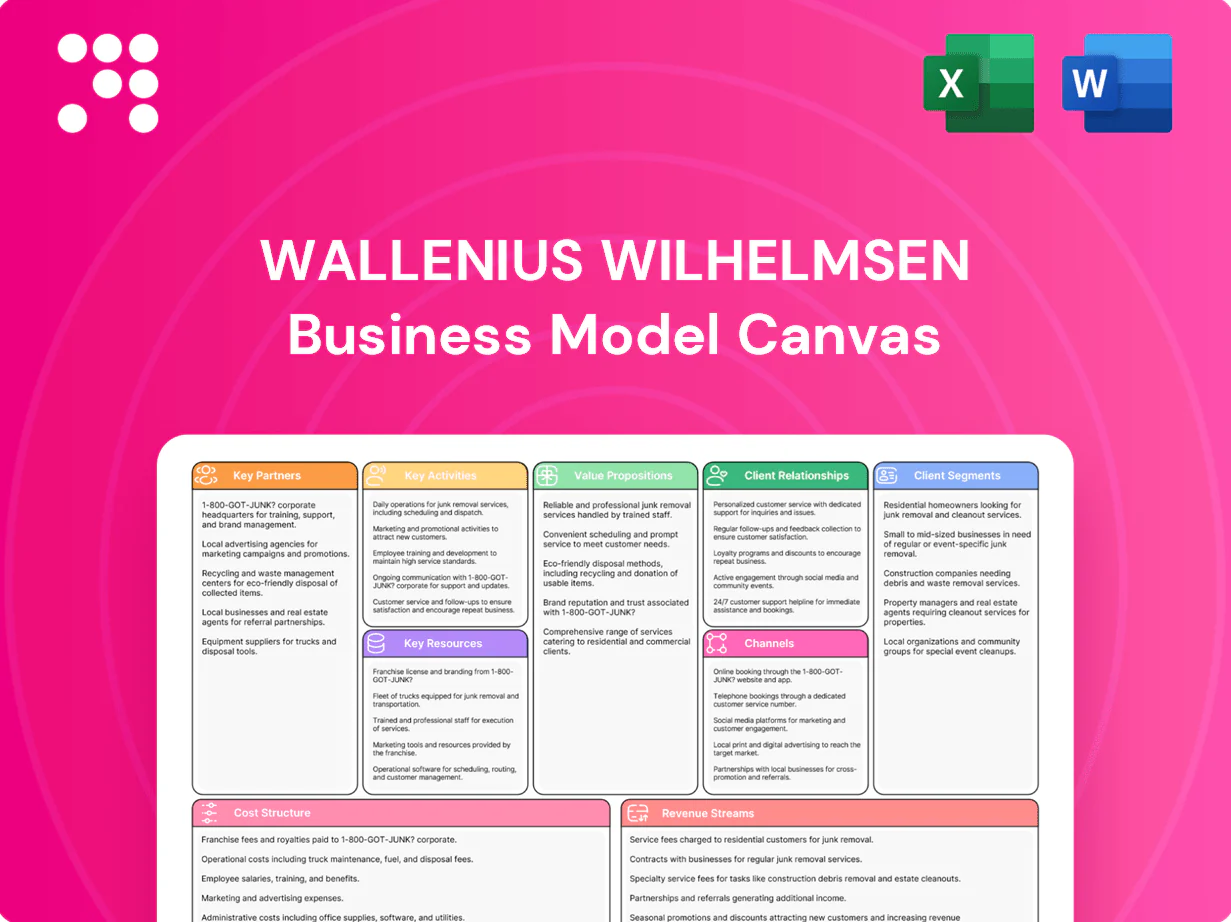
Wallenius Wilhelmsen Business Model Canvas

Strategic Business Model Canvas preview for global RoRo and auto logistics investors
Unlock the strategic blueprint behind Wallenius Wilhelmsen with our concise Business Model Canvas preview. See how value propositions, key partners and revenue streams interlock to drive scale and margin. Purchase the full canvas for a complete nine-block breakdown, editable Word/Excel files, and actionable insights for investors and strategists.
Partnerships

Automotive and equipment OEM alliances
Strategic partnerships with global automakers and heavy-equipment manufacturers secure stable, long-term cargo volumes through multi-year contracts and collaborative forecasting. Joint planning aligns production schedules with vessel rotations and processing slots, reducing dwell time and improving on-time delivery. Co-created standards ensure vehicle quality, safety and regulatory compliance across the journey. These alliances underpin network design and capacity commitments across Wallenius Wilhelmsen's fleet of about 120 vessels and over 100 OEM customers.
Port authorities and terminal operators
Collaborations with port authorities and terminal operators at key RoRo hubs enable priority berthing, smoother yard flows and direct customs interfaces, supporting Wallenius Wilhelmsen's schedule reliability targets (2024 on-time aims >85%). Shared investments in ramps, storage and EV charging/handling infrastructure—often co-funded—lower unit handling costs and improve capacity utilization. Joint safety and productivity programs have cut typical turnaround times by double digits, aiding cost control.

Inland logistics and last-mile providers
Trucking, rail and barge partners extend port reach to plants, dealers and job sites across Wallenius Wilhelmsen’s 70+ country network, enabling seamless door-to-door flows. Integrated planning and multimodal coordination cut dwell and improve handoffs, aligning with industry data showing last-mile can represent up to 53% of delivery costs. Capacity frameworks and performance SLAs lock throughput during seasonal peaks and nodal congestion.

Shipyards, bunker suppliers, and technical vendors
Shipbuilders, dry-dock yards and OEMs enable Wallenius Wilhelmsen fleet expansion and lifecycle work, supporting its ~120 RoRo and PCTC vessels with scheduled overhauls and retrofits to sustain uptime.
Fuel suppliers and alternative-energy partners (LNG, biofuels, methanol pilots in 2024) underpin decarbonization pathways while technical vendors deliver navigation, safety and cargo‑handling systems that reduce emissions and operating costs.
- Fleet support: shipyards + OEMs — lifecycle & uptime
- Fuel partners — decarbonization fuels/solutions (2024 pilots)
- Technical vendors — navigation, safety, cargo systems; cost & emissions control
Digital, data, and insurance partners
Digital partners deliver IoT tracking, EDI/API integration and visibility platforms that enable end-to-end cargo monitoring. Data partners improve forecasting, emissions reporting and route optimization, enhancing operational efficiency. Insurers and P&I clubs manage cargo and vessel risk and streamline claims, together strengthening service quality and customer trust.
- IoT and visibility platforms
- EDI/API integration
- Forecasting & emissions reporting
- P&I and insurance claims efficiency
100+ OEMs, 120-vessel fleet target >85% on-time delivery and decarbonization pilots
Partnerships with 100+ OEMs and multi-year contracts secure steady volumes for Wallenius Wilhelmsen’s ~120-vessel fleet and 70+ country network, targeting >85% on-time delivery in 2024. Port, terminal and multimodal partners reduce turnaround and last-mile costs (last-mile ≈53% of delivery cost). Fuel, shipyards and tech partners drive decarbonization pilots (LNG/bio/methanol) and real-time visibility.
| Metric | Value |
|---|---|
| Fleet | ~120 vessels |
| OEM partners | 100+ |
| Network | 70+ countries |
| 2024 on-time target | >85% |
What is included in the product
 Detailed Word Document
A concise, pre-written Business Model Canvas for Wallenius Wilhelmsen mapping customer segments, channels, value propositions and revenue streams across the 9 BMC blocks with real-world operational detail, competitive-advantage analysis and linked SWOT insights—designed for presentations, investor/funder discussions and strategic decision-making by entrepreneurs and analysts.

 Customizable Excel Spreadsheet
High-level view of Wallenius Wilhelmsen’s business model with editable cells that condense shipping, terminal, and logistics strategy into a one-page snapshot for quick review. Shareable and editable for team collaboration, it saves hours of formatting while making it easy to compare models and adapt to new operational insights.
Activities

Ocean RoRo and breakbulk shipping
Operate a global RoRo and breakbulk fleet moving cars, trucks, heavy machinery and project cargo, leveraging over 100 vessels in 2024 to serve major OEM and project customers. Optimize stowage and lashing for cargo care and vessel stability with standardized procedures and cargo-securing audits. Manage schedules across 70+ trade lanes to balance utilization and reliability. Continuously monitor weather and port conditions to mitigate disruptions and reroute as needed.
Port terminal and yard operations
Port terminal and yard operations ensure safe discharge/load using shore ramps and specialized ro-ro gear, handling approximately 3 million units annually (2024). Yard flows, storage optimization and customs documentation are orchestrated to minimize dwell and paperwork. Coordination with pilots, stevedores and authorities targets turnarounds under 48 hours. HSE protocols and quality controls are enforced at every touchpoint.

Inland transport and distribution
Arrange trucking, rail and barge from ports to plants and dealers, using coordinated bookings and multimodal transfers to shorten lead times. Plan milk-runs and hub-and-spoke networks to cut empty miles and improve load factors. Track shipments and manage exceptions in real time with TMS and telematics. Align capacity planning with OEM production cycles and seasonal ramps in 2024 to avoid bottlenecks.

Processing and value-added services
Processing and value-added services include PDI, accessorization, washing and minor repairs to ready vehicles and equipment, with 2024 operations focused on compliance-driven configuration to market specs.
Storage, inventory and sequencing are managed to align with dealer networks and seasonal demand, while bundled services compress lead times and improve turn rates.
- PDI and minor repairs
- Market-specific configuration
- Storage, inventory & sequencing
- Bundled services to reduce lead times
Network planning and digital enablement
Network planning and digital enablement run forecasting, yield management and capacity allocation across ~120 vessels, maintaining EDI/API integrations and customer portals for real-time visibility and >95% schedule reliability. Carbon accounting and route optimization drive CO2 intensity reductions while continuous improvement and safety programs cut incident rates and boost operational efficiency.
- Forecasting: capacity allocation and yield mgmt
- Digital: EDI/API + customer portals
- Sustainability: carbon accounting & route opt
- Ops: continuous improvement & safety
Operate ~120 RoRo vessels, moving 3.0M units with >95% reliability and <48h turns
Operate a global RoRo fleet of ~120 vessels in 2024 across 70+ trade lanes, moving ~3.0M units/year for OEMs with >95% schedule reliability. Terminal, yard and multimodal logistics ensure <48h turnarounds, PDI/accessorization, sequencing and customs to minimize dwell. Digital EDI/API, TMS and carbon accounting optimize capacity, cut empty miles and lower CO2 intensity.
| Metric | 2024 |
|---|---|
| Vessels | ~120 |
| Units handled | 3,000,000 |
| Trade lanes | 70+ |
| Schedule reliability | >95% |
| Avg turnaround | <48 hours |
Full Document Unlocks After Purchase
Business Model Canvas
The Business Model Canvas for Wallenius Wilhelmsen shown here is the actual deliverable, not a mockup. When you purchase, you’ll receive this exact file—complete and ready to use—in editable Word and Excel formats. No hidden pages or placeholders; what you see is what you’ll download and edit.

Strategic Business Model Canvas preview for global RoRo and auto logistics investors
Unlock the strategic blueprint behind Wallenius Wilhelmsen with our concise Business Model Canvas preview. See how value propositions, key partners and revenue streams interlock to drive scale and margin. Purchase the full canvas for a complete nine-block breakdown, editable Word/Excel files, and actionable insights for investors and strategists.
Partnerships
Automotive and equipment OEM alliances
Strategic partnerships with global automakers and heavy-equipment manufacturers secure stable, long-term cargo volumes through multi-year contracts and collaborative forecasting. Joint planning aligns production schedules with vessel rotations and processing slots, reducing dwell time and improving on-time delivery. Co-created standards ensure vehicle quality, safety and regulatory compliance across the journey. These alliances underpin network design and capacity commitments across Wallenius Wilhelmsen's fleet of about 120 vessels and over 100 OEM customers.
Port authorities and terminal operators
Collaborations with port authorities and terminal operators at key RoRo hubs enable priority berthing, smoother yard flows and direct customs interfaces, supporting Wallenius Wilhelmsen's schedule reliability targets (2024 on-time aims >85%). Shared investments in ramps, storage and EV charging/handling infrastructure—often co-funded—lower unit handling costs and improve capacity utilization. Joint safety and productivity programs have cut typical turnaround times by double digits, aiding cost control.
Inland logistics and last-mile providers
Trucking, rail and barge partners extend port reach to plants, dealers and job sites across Wallenius Wilhelmsen’s 70+ country network, enabling seamless door-to-door flows. Integrated planning and multimodal coordination cut dwell and improve handoffs, aligning with industry data showing last-mile can represent up to 53% of delivery costs. Capacity frameworks and performance SLAs lock throughput during seasonal peaks and nodal congestion.
Shipyards, bunker suppliers, and technical vendors
Shipbuilders, dry-dock yards and OEMs enable Wallenius Wilhelmsen fleet expansion and lifecycle work, supporting its ~120 RoRo and PCTC vessels with scheduled overhauls and retrofits to sustain uptime.
Fuel suppliers and alternative-energy partners (LNG, biofuels, methanol pilots in 2024) underpin decarbonization pathways while technical vendors deliver navigation, safety and cargo‑handling systems that reduce emissions and operating costs.
- Fleet support: shipyards + OEMs — lifecycle & uptime
- Fuel partners — decarbonization fuels/solutions (2024 pilots)
- Technical vendors — navigation, safety, cargo systems; cost & emissions control
Digital, data, and insurance partners
Digital partners deliver IoT tracking, EDI/API integration and visibility platforms that enable end-to-end cargo monitoring. Data partners improve forecasting, emissions reporting and route optimization, enhancing operational efficiency. Insurers and P&I clubs manage cargo and vessel risk and streamline claims, together strengthening service quality and customer trust.
- IoT and visibility platforms
- EDI/API integration
- Forecasting & emissions reporting
- P&I and insurance claims efficiency
100+ OEMs, 120-vessel fleet target >85% on-time delivery and decarbonization pilots
Partnerships with 100+ OEMs and multi-year contracts secure steady volumes for Wallenius Wilhelmsen’s ~120-vessel fleet and 70+ country network, targeting >85% on-time delivery in 2024. Port, terminal and multimodal partners reduce turnaround and last-mile costs (last-mile ≈53% of delivery cost). Fuel, shipyards and tech partners drive decarbonization pilots (LNG/bio/methanol) and real-time visibility.
| Metric | Value |
|---|---|
| Fleet | ~120 vessels |
| OEM partners | 100+ |
| Network | 70+ countries |
| 2024 on-time target | >85% |
What is included in the product
Detailed Word Document
A concise, pre-written Business Model Canvas for Wallenius Wilhelmsen mapping customer segments, channels, value propositions and revenue streams across the 9 BMC blocks with real-world operational detail, competitive-advantage analysis and linked SWOT insights—designed for presentations, investor/funder discussions and strategic decision-making by entrepreneurs and analysts.
Customizable Excel Spreadsheet
High-level view of Wallenius Wilhelmsen’s business model with editable cells that condense shipping, terminal, and logistics strategy into a one-page snapshot for quick review. Shareable and editable for team collaboration, it saves hours of formatting while making it easy to compare models and adapt to new operational insights.
Activities
Ocean RoRo and breakbulk shipping
Operate a global RoRo and breakbulk fleet moving cars, trucks, heavy machinery and project cargo, leveraging over 100 vessels in 2024 to serve major OEM and project customers. Optimize stowage and lashing for cargo care and vessel stability with standardized procedures and cargo-securing audits. Manage schedules across 70+ trade lanes to balance utilization and reliability. Continuously monitor weather and port conditions to mitigate disruptions and reroute as needed.
Port terminal and yard operations
Port terminal and yard operations ensure safe discharge/load using shore ramps and specialized ro-ro gear, handling approximately 3 million units annually (2024). Yard flows, storage optimization and customs documentation are orchestrated to minimize dwell and paperwork. Coordination with pilots, stevedores and authorities targets turnarounds under 48 hours. HSE protocols and quality controls are enforced at every touchpoint.
Inland transport and distribution
Arrange trucking, rail and barge from ports to plants and dealers, using coordinated bookings and multimodal transfers to shorten lead times. Plan milk-runs and hub-and-spoke networks to cut empty miles and improve load factors. Track shipments and manage exceptions in real time with TMS and telematics. Align capacity planning with OEM production cycles and seasonal ramps in 2024 to avoid bottlenecks.
Processing and value-added services
Processing and value-added services include PDI, accessorization, washing and minor repairs to ready vehicles and equipment, with 2024 operations focused on compliance-driven configuration to market specs.
Storage, inventory and sequencing are managed to align with dealer networks and seasonal demand, while bundled services compress lead times and improve turn rates.
- PDI and minor repairs
- Market-specific configuration
- Storage, inventory & sequencing
- Bundled services to reduce lead times
Network planning and digital enablement
Network planning and digital enablement run forecasting, yield management and capacity allocation across ~120 vessels, maintaining EDI/API integrations and customer portals for real-time visibility and >95% schedule reliability. Carbon accounting and route optimization drive CO2 intensity reductions while continuous improvement and safety programs cut incident rates and boost operational efficiency.
- Forecasting: capacity allocation and yield mgmt
- Digital: EDI/API + customer portals
- Sustainability: carbon accounting & route opt
- Ops: continuous improvement & safety
Operate ~120 RoRo vessels, moving 3.0M units with >95% reliability and <48h turns
Operate a global RoRo fleet of ~120 vessels in 2024 across 70+ trade lanes, moving ~3.0M units/year for OEMs with >95% schedule reliability. Terminal, yard and multimodal logistics ensure <48h turnarounds, PDI/accessorization, sequencing and customs to minimize dwell. Digital EDI/API, TMS and carbon accounting optimize capacity, cut empty miles and lower CO2 intensity.
| Metric | 2024 |
|---|---|
| Vessels | ~120 |
| Units handled | 3,000,000 |
| Trade lanes | 70+ |
| Schedule reliability | >95% |
| Avg turnaround | <48 hours |
Full Document Unlocks After Purchase
Business Model Canvas
The Business Model Canvas for Wallenius Wilhelmsen shown here is the actual deliverable, not a mockup. When you purchase, you’ll receive this exact file—complete and ready to use—in editable Word and Excel formats. No hidden pages or placeholders; what you see is what you’ll download and edit.
Original: $10.00
-65%$10.00
$3.50Description
Strategic Business Model Canvas preview for global RoRo and auto logistics investors
Unlock the strategic blueprint behind Wallenius Wilhelmsen with our concise Business Model Canvas preview. See how value propositions, key partners and revenue streams interlock to drive scale and margin. Purchase the full canvas for a complete nine-block breakdown, editable Word/Excel files, and actionable insights for investors and strategists.
Partnerships
Automotive and equipment OEM alliances
Strategic partnerships with global automakers and heavy-equipment manufacturers secure stable, long-term cargo volumes through multi-year contracts and collaborative forecasting. Joint planning aligns production schedules with vessel rotations and processing slots, reducing dwell time and improving on-time delivery. Co-created standards ensure vehicle quality, safety and regulatory compliance across the journey. These alliances underpin network design and capacity commitments across Wallenius Wilhelmsen's fleet of about 120 vessels and over 100 OEM customers.
Port authorities and terminal operators
Collaborations with port authorities and terminal operators at key RoRo hubs enable priority berthing, smoother yard flows and direct customs interfaces, supporting Wallenius Wilhelmsen's schedule reliability targets (2024 on-time aims >85%). Shared investments in ramps, storage and EV charging/handling infrastructure—often co-funded—lower unit handling costs and improve capacity utilization. Joint safety and productivity programs have cut typical turnaround times by double digits, aiding cost control.
Inland logistics and last-mile providers
Trucking, rail and barge partners extend port reach to plants, dealers and job sites across Wallenius Wilhelmsen’s 70+ country network, enabling seamless door-to-door flows. Integrated planning and multimodal coordination cut dwell and improve handoffs, aligning with industry data showing last-mile can represent up to 53% of delivery costs. Capacity frameworks and performance SLAs lock throughput during seasonal peaks and nodal congestion.
Shipyards, bunker suppliers, and technical vendors
Shipbuilders, dry-dock yards and OEMs enable Wallenius Wilhelmsen fleet expansion and lifecycle work, supporting its ~120 RoRo and PCTC vessels with scheduled overhauls and retrofits to sustain uptime.
Fuel suppliers and alternative-energy partners (LNG, biofuels, methanol pilots in 2024) underpin decarbonization pathways while technical vendors deliver navigation, safety and cargo‑handling systems that reduce emissions and operating costs.
- Fleet support: shipyards + OEMs — lifecycle & uptime
- Fuel partners — decarbonization fuels/solutions (2024 pilots)
- Technical vendors — navigation, safety, cargo systems; cost & emissions control
Digital, data, and insurance partners
Digital partners deliver IoT tracking, EDI/API integration and visibility platforms that enable end-to-end cargo monitoring. Data partners improve forecasting, emissions reporting and route optimization, enhancing operational efficiency. Insurers and P&I clubs manage cargo and vessel risk and streamline claims, together strengthening service quality and customer trust.
- IoT and visibility platforms
- EDI/API integration
- Forecasting & emissions reporting
- P&I and insurance claims efficiency
100+ OEMs, 120-vessel fleet target >85% on-time delivery and decarbonization pilots
Partnerships with 100+ OEMs and multi-year contracts secure steady volumes for Wallenius Wilhelmsen’s ~120-vessel fleet and 70+ country network, targeting >85% on-time delivery in 2024. Port, terminal and multimodal partners reduce turnaround and last-mile costs (last-mile ≈53% of delivery cost). Fuel, shipyards and tech partners drive decarbonization pilots (LNG/bio/methanol) and real-time visibility.
| Metric | Value |
|---|---|
| Fleet | ~120 vessels |
| OEM partners | 100+ |
| Network | 70+ countries |
| 2024 on-time target | >85% |
What is included in the product
Detailed Word Document
A concise, pre-written Business Model Canvas for Wallenius Wilhelmsen mapping customer segments, channels, value propositions and revenue streams across the 9 BMC blocks with real-world operational detail, competitive-advantage analysis and linked SWOT insights—designed for presentations, investor/funder discussions and strategic decision-making by entrepreneurs and analysts.
Customizable Excel Spreadsheet
High-level view of Wallenius Wilhelmsen’s business model with editable cells that condense shipping, terminal, and logistics strategy into a one-page snapshot for quick review. Shareable and editable for team collaboration, it saves hours of formatting while making it easy to compare models and adapt to new operational insights.
Activities
Ocean RoRo and breakbulk shipping
Operate a global RoRo and breakbulk fleet moving cars, trucks, heavy machinery and project cargo, leveraging over 100 vessels in 2024 to serve major OEM and project customers. Optimize stowage and lashing for cargo care and vessel stability with standardized procedures and cargo-securing audits. Manage schedules across 70+ trade lanes to balance utilization and reliability. Continuously monitor weather and port conditions to mitigate disruptions and reroute as needed.
Port terminal and yard operations
Port terminal and yard operations ensure safe discharge/load using shore ramps and specialized ro-ro gear, handling approximately 3 million units annually (2024). Yard flows, storage optimization and customs documentation are orchestrated to minimize dwell and paperwork. Coordination with pilots, stevedores and authorities targets turnarounds under 48 hours. HSE protocols and quality controls are enforced at every touchpoint.
Inland transport and distribution
Arrange trucking, rail and barge from ports to plants and dealers, using coordinated bookings and multimodal transfers to shorten lead times. Plan milk-runs and hub-and-spoke networks to cut empty miles and improve load factors. Track shipments and manage exceptions in real time with TMS and telematics. Align capacity planning with OEM production cycles and seasonal ramps in 2024 to avoid bottlenecks.
Processing and value-added services
Processing and value-added services include PDI, accessorization, washing and minor repairs to ready vehicles and equipment, with 2024 operations focused on compliance-driven configuration to market specs.
Storage, inventory and sequencing are managed to align with dealer networks and seasonal demand, while bundled services compress lead times and improve turn rates.
- PDI and minor repairs
- Market-specific configuration
- Storage, inventory & sequencing
- Bundled services to reduce lead times
Network planning and digital enablement
Network planning and digital enablement run forecasting, yield management and capacity allocation across ~120 vessels, maintaining EDI/API integrations and customer portals for real-time visibility and >95% schedule reliability. Carbon accounting and route optimization drive CO2 intensity reductions while continuous improvement and safety programs cut incident rates and boost operational efficiency.
- Forecasting: capacity allocation and yield mgmt
- Digital: EDI/API + customer portals
- Sustainability: carbon accounting & route opt
- Ops: continuous improvement & safety
Operate ~120 RoRo vessels, moving 3.0M units with >95% reliability and <48h turns
Operate a global RoRo fleet of ~120 vessels in 2024 across 70+ trade lanes, moving ~3.0M units/year for OEMs with >95% schedule reliability. Terminal, yard and multimodal logistics ensure <48h turnarounds, PDI/accessorization, sequencing and customs to minimize dwell. Digital EDI/API, TMS and carbon accounting optimize capacity, cut empty miles and lower CO2 intensity.
| Metric | 2024 |
|---|---|
| Vessels | ~120 |
| Units handled | 3,000,000 |
| Trade lanes | 70+ |
| Schedule reliability | >95% |
| Avg turnaround | <48 hours |
Full Document Unlocks After Purchase
Business Model Canvas
The Business Model Canvas for Wallenius Wilhelmsen shown here is the actual deliverable, not a mockup. When you purchase, you’ll receive this exact file—complete and ready to use—in editable Word and Excel formats. No hidden pages or placeholders; what you see is what you’ll download and edit.











