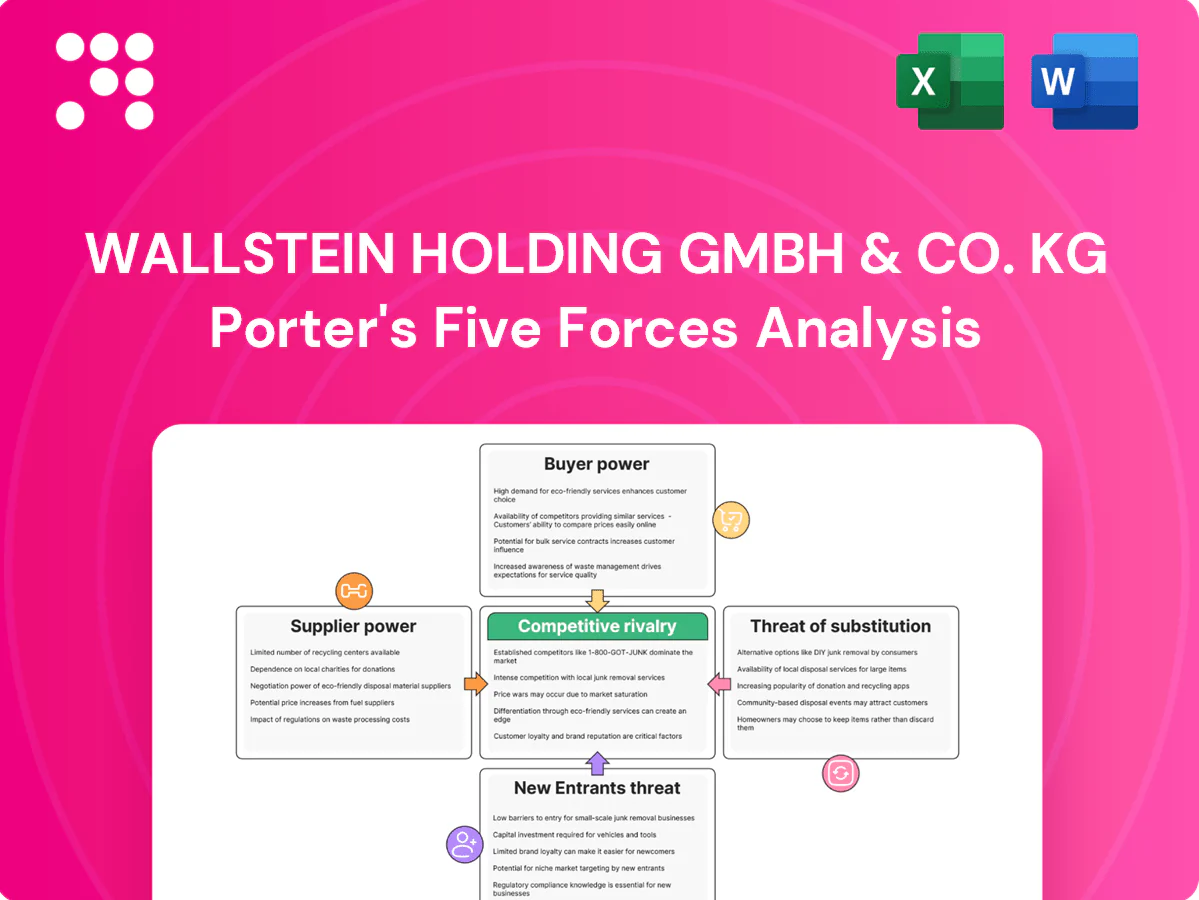
Wallstein Holding GmbH & Co. KG Porter's Five Forces Analysis

Don't Miss the Bigger Picture
This snapshot outlines key competitive pressures facing Wallstein Holding GmbH & Co. KG—supplier leverage, buyer power, rivalry, substitutes, and entry threats. Unlock the full Porter's Five Forces Analysis to see force-by-force ratings, visualizations, and strategic implications tailored to Wallstein. Purchase the comprehensive report to inform investment and strategy decisions with consultant-grade insights.
Suppliers Bargaining Power

Specialized alloys and coatings
Wallstein depends on a limited set of qualified mills for nickel alloys, duplex steels and corrosion-resistant coatings, and in 2024 supplier concentration and certification requirements continued to give vendors measurable leverage. Price volatility in metals remained elevated in 2024, which can compress margins on fixed-price contracts. Dual-sourcing reduces risk but cannot fully eliminate dependency due to certification and lead-time constraints.
Advanced fabrication and skilled welding
Pressure parts and flue gas components require certified welders and specialized fabrication equipment, and 2024 industry reports indicate ISO/ASME-qualified shops remain limited, boosting supplier leverage. Capacity constraints during demand peaks commonly push lead times beyond 20–26 weeks. Long qualification cycles, often 9–18 months, make switching suppliers costly and lock in terms and pricing.

Lead times and logistics for large modules
Custom heat exchangers and gas-treatment modules commonly have manufacturing and transport lead times of 6–12 months, with oversized components requiring special road, rail or barge logistics that limit alternative suppliers within feasible distance. Such long lead times mean delays can cascade into project penalties, increasing supplier leverage and potential cost exposure. Early locking of production slots, used by 70% of EPCs in 2024, partially offsets this risk.

Compliance-critical inputs and testing
Compliance-critical inputs—NDT services, pressure testing and certification bodies—are indispensable for Wallstein to meet EN and ASME codes, narrowing acceptable providers and giving approved suppliers leverage due to high cost of compliance failures.
- Approved suppliers command negotiating power
- EN/ASME compliance reduces supplier pool
- Framework agreements stabilize pricing but need volume commitments
Digital sensors and control components
IoT sensors, instrumentation and controls for Wallstein are sourced from global OEMs, keeping supplier power moderate as many components are standardized, though 2020s supply chain shocks caused sporadic constraints and longer lead times. Interoperability and cybersecurity certifications limit viable substitutes and raise switching costs, while approved vendor lists constrain emergency flexibility.
- Global OEM sourcing
- Standardized components but sporadic constraints
- Interoperability/cybersecurity limits substitution
- Approved vendor lists reduce agility
Concentrated suppliers, 20–26 weeks lead times and 70% EPC slot locking amplify supplier leverage
Wallstein faces high supplier leverage due to concentrated qualified mills and certified fabricators, long qualification cycles (9–18 months) and peak lead times (20–26 weeks) that raise switching costs. Custom modules have 6–12 month manufacture/transport lead times; 70% of EPCs lock slots early. IoT components present moderate power but cybersecurity/interoperability limit substitutes.
| Metric | 2024 Value | Impact |
|---|---|---|
| Qualification cycle | 9–18 months | High switching cost |
| Lead times (peak) | 20–26 weeks | Project delay risk |
| Custom module lead time | 6–12 months | Logistics constraint |
| EPCs locking slots | 70% | Supplier leverage |
What is included in the product
 Detailed Word Document
Uncovers key drivers of competition, customer influence, supplier power, entry barriers and substitutes tailored to Wallstein Holding GmbH & Co. KG, identifying disruptive forces, pricing pressures and strategic levers to protect market share and inform investor or management decisions.

 Customizable Excel Spreadsheet
A one-sheet Porter's Five Forces for Wallstein Holding—quickly spot strategic pressures with a radar chart, adjust force levels to reflect market shifts, swap in your data and drop straight into pitch decks or board reports.
Customers Bargaining Power

Concentrated utility and waste operators
Customers are concentrated among large power plants, waste-to-energy operators and industrial majors—notably RWE, E.ON, EnBW and Uniper—each with robust procurement teams. Tender-driven purchasing remains the norm in 2024, increasing price pressure and enabling buyers to extract concessions via multi-year framework agreements. Project criticality and uptime requirements, however, limit extreme cost-cutting for Wallstein’s engineered solutions.
High technical specs and guarantees
Performance guarantees on efficiency, emissions and corrosion are standard, with warranty terms often spanning 2–10 years and liquidated damages clauses commonly set at 1–3% of contract value, shifting risk to suppliers; long qualification processes (6–12 months) raise switching costs and entrench incumbents, while data-driven acceptance tests give buyers decisive leverage at handover.

Aftermarket service and parts lock-in
Once installed, Wallstein's bespoke designs and documentation favor the original supplier for spares and upgrades, materially reducing buyer power in the service phase. Predictive maintenance and long-term service agreements deepen customer stickiness; industry studies in 2024 show predictive maintenance can cut unplanned downtime by up to 30%. Buyers continue to benchmark pricing but face clear compatibility and integration risks when switching suppliers.

Capex cycles and budget sensitivity
Capex cycles in utilities and industry are tightly linked to regulatory timelines, leading buyers to defer or phase projects to extract better pricing and contract terms; inflation-adjusted budgets push procurement to emphasize total cost of ownership and lifecycle savings, while ESG-linked funding can unlock projects but imposes additional compliance and reporting burdens.
- Budget sensitivity: deferment/phasing common
- TCO focus: inflation erodes nominal budgets
- ESG funding: enables projects, raises compliance
Alternative sourcing via EPCs
Buyers commonly route procurement through EPC contractors who bundle equipment, which in 2024 continued to compress OEM pricing in competitive EPC packages; direct OEM relationships and strong project references can bypass EPC margin stacking, while co-bidding with EPCs preserves access and balances influence.
- Buyer routing via EPCs dilutes OEM pricing
- Direct OEM refs bypass EPC margins
- Co-bidding with EPCs balances leverage
Tender-driven 2024 market compresses OEM margins; long qualification and warranties shift risk
Customers (RWE, E.ON, EnBW, Uniper) drive tendering in 2024, compressing OEM margins; long qualification (6–12 months) and warranties (2–10 yrs) shift risk to suppliers but bespoke designs and service contracts reduce switching; predictive maintenance cuts downtime ~30%, raising lifecycle value over initial price.
| Metric | 2024 Value |
|---|---|
| Qualification time | 6–12 months |
| Warranty length | 2–10 yrs |
| Downtime reduction | ~30% |
Preview the Actual Deliverable
Wallstein Holding GmbH & Co. KG Porter's Five Forces Analysis
This preview shows the exact Porter’s Five Forces analysis for Wallstein Holding GmbH & Co. KG you’ll receive upon purchase—no samples, no placeholders. The document is fully formatted, professionally written and ready for immediate download and use. Purchase grants instant access to this identical file.

Don't Miss the Bigger Picture
This snapshot outlines key competitive pressures facing Wallstein Holding GmbH & Co. KG—supplier leverage, buyer power, rivalry, substitutes, and entry threats. Unlock the full Porter's Five Forces Analysis to see force-by-force ratings, visualizations, and strategic implications tailored to Wallstein. Purchase the comprehensive report to inform investment and strategy decisions with consultant-grade insights.
Suppliers Bargaining Power
Specialized alloys and coatings
Wallstein depends on a limited set of qualified mills for nickel alloys, duplex steels and corrosion-resistant coatings, and in 2024 supplier concentration and certification requirements continued to give vendors measurable leverage. Price volatility in metals remained elevated in 2024, which can compress margins on fixed-price contracts. Dual-sourcing reduces risk but cannot fully eliminate dependency due to certification and lead-time constraints.
Advanced fabrication and skilled welding
Pressure parts and flue gas components require certified welders and specialized fabrication equipment, and 2024 industry reports indicate ISO/ASME-qualified shops remain limited, boosting supplier leverage. Capacity constraints during demand peaks commonly push lead times beyond 20–26 weeks. Long qualification cycles, often 9–18 months, make switching suppliers costly and lock in terms and pricing.
Lead times and logistics for large modules
Custom heat exchangers and gas-treatment modules commonly have manufacturing and transport lead times of 6–12 months, with oversized components requiring special road, rail or barge logistics that limit alternative suppliers within feasible distance. Such long lead times mean delays can cascade into project penalties, increasing supplier leverage and potential cost exposure. Early locking of production slots, used by 70% of EPCs in 2024, partially offsets this risk.
Compliance-critical inputs and testing
Compliance-critical inputs—NDT services, pressure testing and certification bodies—are indispensable for Wallstein to meet EN and ASME codes, narrowing acceptable providers and giving approved suppliers leverage due to high cost of compliance failures.
- Approved suppliers command negotiating power
- EN/ASME compliance reduces supplier pool
- Framework agreements stabilize pricing but need volume commitments
Digital sensors and control components
IoT sensors, instrumentation and controls for Wallstein are sourced from global OEMs, keeping supplier power moderate as many components are standardized, though 2020s supply chain shocks caused sporadic constraints and longer lead times. Interoperability and cybersecurity certifications limit viable substitutes and raise switching costs, while approved vendor lists constrain emergency flexibility.
- Global OEM sourcing
- Standardized components but sporadic constraints
- Interoperability/cybersecurity limits substitution
- Approved vendor lists reduce agility
Concentrated suppliers, 20–26 weeks lead times and 70% EPC slot locking amplify supplier leverage
Wallstein faces high supplier leverage due to concentrated qualified mills and certified fabricators, long qualification cycles (9–18 months) and peak lead times (20–26 weeks) that raise switching costs. Custom modules have 6–12 month manufacture/transport lead times; 70% of EPCs lock slots early. IoT components present moderate power but cybersecurity/interoperability limit substitutes.
| Metric | 2024 Value | Impact |
|---|---|---|
| Qualification cycle | 9–18 months | High switching cost |
| Lead times (peak) | 20–26 weeks | Project delay risk |
| Custom module lead time | 6–12 months | Logistics constraint |
| EPCs locking slots | 70% | Supplier leverage |
What is included in the product
Detailed Word Document
Uncovers key drivers of competition, customer influence, supplier power, entry barriers and substitutes tailored to Wallstein Holding GmbH & Co. KG, identifying disruptive forces, pricing pressures and strategic levers to protect market share and inform investor or management decisions.
Customizable Excel Spreadsheet
A one-sheet Porter's Five Forces for Wallstein Holding—quickly spot strategic pressures with a radar chart, adjust force levels to reflect market shifts, swap in your data and drop straight into pitch decks or board reports.
Customers Bargaining Power
Concentrated utility and waste operators
Customers are concentrated among large power plants, waste-to-energy operators and industrial majors—notably RWE, E.ON, EnBW and Uniper—each with robust procurement teams. Tender-driven purchasing remains the norm in 2024, increasing price pressure and enabling buyers to extract concessions via multi-year framework agreements. Project criticality and uptime requirements, however, limit extreme cost-cutting for Wallstein’s engineered solutions.
High technical specs and guarantees
Performance guarantees on efficiency, emissions and corrosion are standard, with warranty terms often spanning 2–10 years and liquidated damages clauses commonly set at 1–3% of contract value, shifting risk to suppliers; long qualification processes (6–12 months) raise switching costs and entrench incumbents, while data-driven acceptance tests give buyers decisive leverage at handover.
Aftermarket service and parts lock-in
Once installed, Wallstein's bespoke designs and documentation favor the original supplier for spares and upgrades, materially reducing buyer power in the service phase. Predictive maintenance and long-term service agreements deepen customer stickiness; industry studies in 2024 show predictive maintenance can cut unplanned downtime by up to 30%. Buyers continue to benchmark pricing but face clear compatibility and integration risks when switching suppliers.
Capex cycles and budget sensitivity
Capex cycles in utilities and industry are tightly linked to regulatory timelines, leading buyers to defer or phase projects to extract better pricing and contract terms; inflation-adjusted budgets push procurement to emphasize total cost of ownership and lifecycle savings, while ESG-linked funding can unlock projects but imposes additional compliance and reporting burdens.
- Budget sensitivity: deferment/phasing common
- TCO focus: inflation erodes nominal budgets
- ESG funding: enables projects, raises compliance
Alternative sourcing via EPCs
Buyers commonly route procurement through EPC contractors who bundle equipment, which in 2024 continued to compress OEM pricing in competitive EPC packages; direct OEM relationships and strong project references can bypass EPC margin stacking, while co-bidding with EPCs preserves access and balances influence.
- Buyer routing via EPCs dilutes OEM pricing
- Direct OEM refs bypass EPC margins
- Co-bidding with EPCs balances leverage
Tender-driven 2024 market compresses OEM margins; long qualification and warranties shift risk
Customers (RWE, E.ON, EnBW, Uniper) drive tendering in 2024, compressing OEM margins; long qualification (6–12 months) and warranties (2–10 yrs) shift risk to suppliers but bespoke designs and service contracts reduce switching; predictive maintenance cuts downtime ~30%, raising lifecycle value over initial price.
| Metric | 2024 Value |
|---|---|
| Qualification time | 6–12 months |
| Warranty length | 2–10 yrs |
| Downtime reduction | ~30% |
Preview the Actual Deliverable
Wallstein Holding GmbH & Co. KG Porter's Five Forces Analysis
This preview shows the exact Porter’s Five Forces analysis for Wallstein Holding GmbH & Co. KG you’ll receive upon purchase—no samples, no placeholders. The document is fully formatted, professionally written and ready for immediate download and use. Purchase grants instant access to this identical file.
Description
Don't Miss the Bigger Picture
This snapshot outlines key competitive pressures facing Wallstein Holding GmbH & Co. KG—supplier leverage, buyer power, rivalry, substitutes, and entry threats. Unlock the full Porter's Five Forces Analysis to see force-by-force ratings, visualizations, and strategic implications tailored to Wallstein. Purchase the comprehensive report to inform investment and strategy decisions with consultant-grade insights.
Suppliers Bargaining Power
Specialized alloys and coatings
Wallstein depends on a limited set of qualified mills for nickel alloys, duplex steels and corrosion-resistant coatings, and in 2024 supplier concentration and certification requirements continued to give vendors measurable leverage. Price volatility in metals remained elevated in 2024, which can compress margins on fixed-price contracts. Dual-sourcing reduces risk but cannot fully eliminate dependency due to certification and lead-time constraints.
Advanced fabrication and skilled welding
Pressure parts and flue gas components require certified welders and specialized fabrication equipment, and 2024 industry reports indicate ISO/ASME-qualified shops remain limited, boosting supplier leverage. Capacity constraints during demand peaks commonly push lead times beyond 20–26 weeks. Long qualification cycles, often 9–18 months, make switching suppliers costly and lock in terms and pricing.
Lead times and logistics for large modules
Custom heat exchangers and gas-treatment modules commonly have manufacturing and transport lead times of 6–12 months, with oversized components requiring special road, rail or barge logistics that limit alternative suppliers within feasible distance. Such long lead times mean delays can cascade into project penalties, increasing supplier leverage and potential cost exposure. Early locking of production slots, used by 70% of EPCs in 2024, partially offsets this risk.
Compliance-critical inputs and testing
Compliance-critical inputs—NDT services, pressure testing and certification bodies—are indispensable for Wallstein to meet EN and ASME codes, narrowing acceptable providers and giving approved suppliers leverage due to high cost of compliance failures.
- Approved suppliers command negotiating power
- EN/ASME compliance reduces supplier pool
- Framework agreements stabilize pricing but need volume commitments
Digital sensors and control components
IoT sensors, instrumentation and controls for Wallstein are sourced from global OEMs, keeping supplier power moderate as many components are standardized, though 2020s supply chain shocks caused sporadic constraints and longer lead times. Interoperability and cybersecurity certifications limit viable substitutes and raise switching costs, while approved vendor lists constrain emergency flexibility.
- Global OEM sourcing
- Standardized components but sporadic constraints
- Interoperability/cybersecurity limits substitution
- Approved vendor lists reduce agility
Concentrated suppliers, 20–26 weeks lead times and 70% EPC slot locking amplify supplier leverage
Wallstein faces high supplier leverage due to concentrated qualified mills and certified fabricators, long qualification cycles (9–18 months) and peak lead times (20–26 weeks) that raise switching costs. Custom modules have 6–12 month manufacture/transport lead times; 70% of EPCs lock slots early. IoT components present moderate power but cybersecurity/interoperability limit substitutes.
| Metric | 2024 Value | Impact |
|---|---|---|
| Qualification cycle | 9–18 months | High switching cost |
| Lead times (peak) | 20–26 weeks | Project delay risk |
| Custom module lead time | 6–12 months | Logistics constraint |
| EPCs locking slots | 70% | Supplier leverage |
What is included in the product
Detailed Word Document
Uncovers key drivers of competition, customer influence, supplier power, entry barriers and substitutes tailored to Wallstein Holding GmbH & Co. KG, identifying disruptive forces, pricing pressures and strategic levers to protect market share and inform investor or management decisions.
Customizable Excel Spreadsheet
A one-sheet Porter's Five Forces for Wallstein Holding—quickly spot strategic pressures with a radar chart, adjust force levels to reflect market shifts, swap in your data and drop straight into pitch decks or board reports.
Customers Bargaining Power
Concentrated utility and waste operators
Customers are concentrated among large power plants, waste-to-energy operators and industrial majors—notably RWE, E.ON, EnBW and Uniper—each with robust procurement teams. Tender-driven purchasing remains the norm in 2024, increasing price pressure and enabling buyers to extract concessions via multi-year framework agreements. Project criticality and uptime requirements, however, limit extreme cost-cutting for Wallstein’s engineered solutions.
High technical specs and guarantees
Performance guarantees on efficiency, emissions and corrosion are standard, with warranty terms often spanning 2–10 years and liquidated damages clauses commonly set at 1–3% of contract value, shifting risk to suppliers; long qualification processes (6–12 months) raise switching costs and entrench incumbents, while data-driven acceptance tests give buyers decisive leverage at handover.
Aftermarket service and parts lock-in
Once installed, Wallstein's bespoke designs and documentation favor the original supplier for spares and upgrades, materially reducing buyer power in the service phase. Predictive maintenance and long-term service agreements deepen customer stickiness; industry studies in 2024 show predictive maintenance can cut unplanned downtime by up to 30%. Buyers continue to benchmark pricing but face clear compatibility and integration risks when switching suppliers.
Capex cycles and budget sensitivity
Capex cycles in utilities and industry are tightly linked to regulatory timelines, leading buyers to defer or phase projects to extract better pricing and contract terms; inflation-adjusted budgets push procurement to emphasize total cost of ownership and lifecycle savings, while ESG-linked funding can unlock projects but imposes additional compliance and reporting burdens.
- Budget sensitivity: deferment/phasing common
- TCO focus: inflation erodes nominal budgets
- ESG funding: enables projects, raises compliance
Alternative sourcing via EPCs
Buyers commonly route procurement through EPC contractors who bundle equipment, which in 2024 continued to compress OEM pricing in competitive EPC packages; direct OEM relationships and strong project references can bypass EPC margin stacking, while co-bidding with EPCs preserves access and balances influence.
- Buyer routing via EPCs dilutes OEM pricing
- Direct OEM refs bypass EPC margins
- Co-bidding with EPCs balances leverage
Tender-driven 2024 market compresses OEM margins; long qualification and warranties shift risk
Customers (RWE, E.ON, EnBW, Uniper) drive tendering in 2024, compressing OEM margins; long qualification (6–12 months) and warranties (2–10 yrs) shift risk to suppliers but bespoke designs and service contracts reduce switching; predictive maintenance cuts downtime ~30%, raising lifecycle value over initial price.
| Metric | 2024 Value |
|---|---|
| Qualification time | 6–12 months |
| Warranty length | 2–10 yrs |
| Downtime reduction | ~30% |
Preview the Actual Deliverable
Wallstein Holding GmbH & Co. KG Porter's Five Forces Analysis
This preview shows the exact Porter’s Five Forces analysis for Wallstein Holding GmbH & Co. KG you’ll receive upon purchase—no samples, no placeholders. The document is fully formatted, professionally written and ready for immediate download and use. Purchase grants instant access to this identical file.











