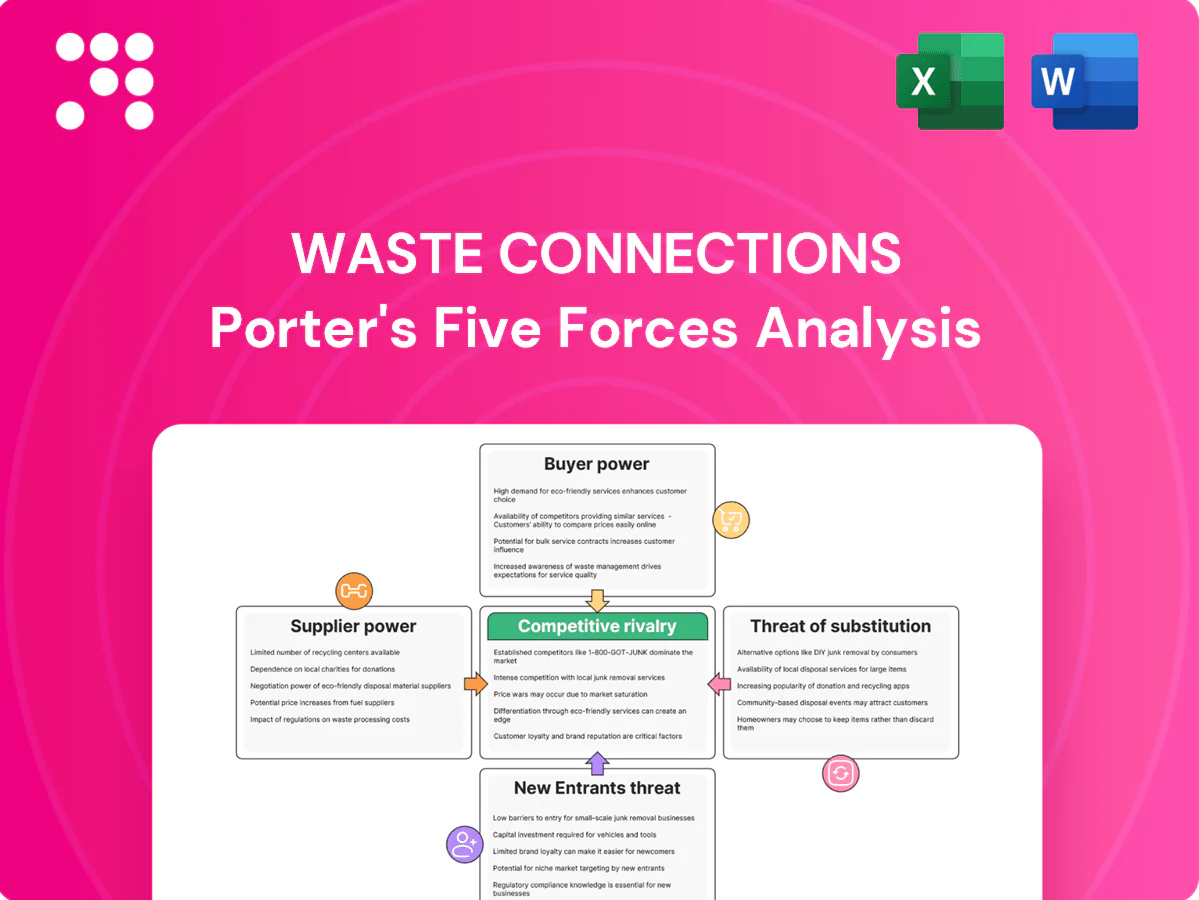
Waste Connections Porter's Five Forces Analysis

Elevate Your Analysis with the Complete Porter's Five Forces Analysis
Waste Connections operates in a sector where supplier power is moderate, as specialized equipment and fuel costs can impact profitability. The threat of new entrants is somewhat limited by high capital requirements and regulatory hurdles, but the industry's stability attracts attention. Understanding these dynamics is crucial for anyone looking to invest or strategize within the waste management space.
This brief snapshot only scratches the surface. Unlock the full Porter's Five Forces Analysis to explore Waste Connections’s competitive dynamics, market pressures, and strategic advantages in detail.
Suppliers Bargaining Power

Specialized Equipment and Vehicle Manufacturers
Waste Connections depends on a select group of manufacturers for its specialized fleet, including collection trucks, transfer trailers, and landfill machinery. This reliance on a few specialized suppliers grants them a degree of bargaining power.
The high cost and technical expertise required to produce this heavy equipment mean few companies can compete, giving these suppliers leverage. For instance, a significant portion of the refuse collection vehicle market is dominated by a handful of global players.
As Waste Connections explores electric vehicle options, the supplier landscape for these specialized electric refuse trucks is still evolving. This nascent market could see new entrants or existing players gaining significant influence, potentially altering existing supplier power dynamics.
Fuel and Energy Providers
Fuel is a major expense for Waste Connections, powering its vast fleet of trucks. In 2023, Waste Connections reported that fuel and lubricants represented a significant portion of its operating costs, though specific percentages vary by quarter. The company's profitability can be directly affected by the volatile nature of oil and gas prices.
While fuel is generally a commodity, suppliers can wield some bargaining power, especially in regions with limited distribution networks or during periods of high demand. Waste Connections is actively working to reduce its reliance on external fuel sources through strategic investments in renewable natural gas (RNG) production. By generating RNG from its own landfill operations, the company aims to gain more control over its energy costs and mitigate the impact of fluctuating fossil fuel prices.

Land and Permitting for Disposal Sites
The availability of suitable land for new landfills and the intricate, time-consuming, and costly permitting procedures create a significant barrier to entry for new competitors. This scarcity and complexity grant considerable bargaining power to landowners and regulatory authorities, influencing Waste Connections' operational expansion.
Waste Connections' proactive approach of owning and operating its own disposal sites mitigates reliance on external providers. However, securing new locations or expanding existing ones remains a crucial element, directly impacted by the influence of these suppliers.

Technology and Software Providers
Technology and software providers hold increasing sway in the waste management sector as companies like Waste Connections lean into digital solutions. The drive for operational efficiency through route optimization, fleet management, and advanced recycling means a growing dependence on specialized tech suppliers. This reliance can amplify their bargaining power, especially for providers offering proprietary or highly integrated systems crucial for Waste Connections' digital transformation initiatives.
- Increased Demand for Smart Solutions: The waste management industry saw significant investment in technology in 2023, with companies allocating more resources to digital transformation projects aimed at improving efficiency and sustainability.
- Supplier Specialization: Niche software developers focusing on AI-driven route planning or advanced sorting technologies can command higher prices due to their unique expertise.
- Integration Costs: Switching between technology providers can be costly and disruptive, giving established suppliers leverage.
Skilled Labor and Specialized Expertise
The demand for skilled labor, such as truck drivers, equipment operators, and maintenance technicians, is fundamental to Waste Connections' ability to provide its services. A scarcity of these qualified individuals can directly lead to higher labor expenses and hinder operational effectiveness.
This situation can empower employees, either through collective bargaining or by intensifying the competition for talent among companies. For instance, in 2023, the U.S. Bureau of Labor Statistics reported a median annual wage for heavy and tractor-trailer truck drivers of $53,000, indicating a baseline cost for essential personnel.
- Demand for skilled roles: Truck drivers, equipment operators, and maintenance technicians are critical for Waste Connections' daily operations.
- Impact of shortages: Lack of qualified personnel can drive up labor costs and affect service delivery efficiency.
- Employee bargaining power: Shortages can increase the collective bargaining power of employees or intensify competition for talent.
- Retention efforts: Waste Connections has demonstrated progress in improving employee retention, which can mitigate some of this pressure.
Supplier Power Dynamics in Waste Management
Waste Connections faces moderate bargaining power from its equipment suppliers due to the specialized nature of refuse trucks and landfill machinery. While a few dominant manufacturers exist, Waste Connections' scale and long-term contracts can temper supplier leverage.
Fuel suppliers, particularly for diesel, exert some influence given the vast fleet's consumption, though Waste Connections' investment in RNG production aims to reduce this dependency. The evolving market for electric refuse trucks presents a dynamic supplier landscape where power could shift.
Landowners and regulatory bodies hold significant power regarding landfill sites due to scarcity and complex permitting, impacting expansion opportunities. Technology and software providers are gaining influence as Waste Connections adopts more digital solutions for efficiency.
Labor availability, especially for skilled drivers and operators, can increase costs and affect operations, though Waste Connections' retention efforts help manage this. The U.S. Bureau of Labor Statistics reported a median annual wage of $53,000 for heavy and tractor-trailer truck drivers in 2023.
| Supplier Category | Bargaining Power Level | Key Factors | Impact on Waste Connections |
|---|---|---|---|
| Specialized Fleet Manufacturers | Moderate | Few dominant players, high switching costs, Waste Connections' scale | Potential for price increases, need for strategic partnerships |
| Fuel Suppliers | Moderate | Commodity nature, regional distribution, Waste Connections' RNG investments | Vulnerability to price volatility, opportunity for cost control through RNG |
| Landowners & Regulators | High | Scarcity of suitable land, complex permitting processes | Barriers to entry for new landfills, increased costs for site acquisition/expansion |
| Technology & Software Providers | Growing | Increasing reliance on digital solutions, proprietary systems, integration costs | Potential for higher software costs, dependence on specialized expertise |
| Skilled Labor | Moderate to High | Shortages of drivers/operators, competition for talent, unionization potential | Increased labor costs, operational efficiency challenges, need for retention strategies |
What is included in the product
 Detailed Word Document
This analysis specifically examines Waste Connections' competitive environment, detailing the intensity of rivalry, the bargaining power of customers and suppliers, the threat of new entrants, and the impact of substitute services.

 Customizable Excel Spreadsheet
Instantly assess competitive pressures with a dynamic, interactive model that highlights Waste Connections' strategic positioning.
Customers Bargaining Power

Fragmented Residential and Commercial Customers
Waste Connections serves a vast customer base, numbering in the millions across both residential and commercial sectors throughout North America. This sheer volume means that, individually, each customer holds minimal leverage.
The essential nature of waste management services, coupled with significant switching costs for customers, further diminishes their individual bargaining power. In many areas where Waste Connections operates with exclusive contracts or a dominant market share, this power is even more constrained.
This fragmented customer base, each with low individual bargaining power, contributes to a stable and recurring revenue stream for Waste Connections, a key strength in their business model.
Large Municipal and Industrial Clients
Large municipal and industrial clients wield considerable bargaining power, primarily due to the sheer volume of waste they produce. This volume makes them attractive targets for competitors, and they often leverage this by engaging in competitive bidding processes. For instance, securing a major city contract or a large industrial account can represent a significant portion of a waste management company's revenue, giving these clients leverage in negotiations.
These contracts are frequently long-term commitments, and clients are highly attuned to pricing. Waste Connections must therefore present compellingly competitive rates and robust service offerings to win and keep these valuable relationships. The ability of these clients to switch providers, if not satisfied with pricing or service, underscores their significant influence over Waste Connections.

Customer Price Sensitivity
While waste collection is a fundamental service, customers, especially residential and smaller commercial clients, can exhibit price sensitivity. However, Waste Connections has demonstrated a strong ability to implement price adjustments. For instance, the company reported robust core pricing gains in both 2024 and early 2025, suggesting that price sensitivity in its primary solid waste operations is relatively contained.

Service Switching Costs and Contractual Agreements
Switching waste service providers can involve administrative hassle, new bin deliveries, and adjusting to different collection schedules, creating moderate switching costs for customers. For instance, a small business might face a few days of disruption and the effort of updating billing information when changing providers, which can be a deterrent.
Waste Connections often secures long-term contracts, particularly with municipalities and larger commercial accounts, which further locks in customers and reduces their immediate bargaining power. In 2023, Waste Connections reported that a significant portion of its revenue was derived from these long-term agreements, highlighting the stability these contracts provide and the reduced ability for customers to easily switch.
- Moderate Switching Costs: Customers face administrative burdens and logistical changes when switching waste haulers.
- Long-Term Contracts: Waste Connections utilizes extended contracts, especially with municipal and large commercial clients, to secure customer loyalty.
- Reduced Customer Power: These contractual agreements and switching costs limit the immediate bargaining leverage of customers.
- Revenue Stability: Long-term contracts contribute to predictable revenue streams for Waste Connections.
Customer Demand for Sustainability and Transparency
Customers, particularly large municipalities and corporate clients, are increasingly prioritizing sustainability and transparency in waste management. This translates into a demand for services that go beyond basic disposal, focusing on enhanced recycling programs, waste reduction strategies, and the generation of renewable energy from waste. For instance, in 2023, Waste Connections reported that a significant portion of their revenue was derived from commercial and industrial customers who often have specific environmental, social, and governance (ESG) mandates.
This rising customer expectation grants them considerable bargaining power. They can leverage their demand for greener practices to influence Waste Connections' service development and capital allocation towards more environmentally friendly technologies and operational improvements. This push for sustainability can lead to customers negotiating for better terms or seeking providers who demonstrably lead in environmental performance.
- Growing Demand: Customers actively seek sustainable waste solutions like advanced recycling and waste-to-energy.
- Customer Leverage: This demand empowers customers to negotiate for higher environmental standards and transparency.
- Influence on Investment: Customer preferences drive Waste Connections' investments in sustainable technologies and practices.
- Market Shift: The trend necessitates a focus on ESG compliance, impacting service offerings and pricing structures.
Client Clout: Shaping Waste Management Deals
While individual residential and small commercial customers have minimal bargaining power due to the essential nature of the service and moderate switching costs, larger clients like municipalities and industrial businesses hold significant sway. These major clients often negotiate based on the sheer volume of waste they generate, leveraging competitive bidding processes and long-term contracts. For example, in 2023, Waste Connections noted that a substantial portion of its revenue stemmed from these larger, contract-based relationships, underscoring the influence these customers possess.
| Customer Segment | Individual Bargaining Power | Key Factors Influencing Power | Impact on Waste Connections |
| Residential/Small Commercial | Low | Low volume, moderate switching costs | Stable, recurring revenue base |
| Municipalities/Large Industrial | High | High volume, long-term contracts, competitive bidding, ESG demands | Negotiation leverage on pricing and service, drives investment in sustainability |
What You See Is What You Get
Waste Connections Porter's Five Forces Analysis
This preview showcases the complete Waste Connections Porter's Five Forces Analysis, offering a thorough examination of competitive forces within the waste management industry. The document you see here is the exact, professionally formatted report you will receive immediately after purchase, providing actionable insights for strategic decision-making.

Elevate Your Analysis with the Complete Porter's Five Forces Analysis
Waste Connections operates in a sector where supplier power is moderate, as specialized equipment and fuel costs can impact profitability. The threat of new entrants is somewhat limited by high capital requirements and regulatory hurdles, but the industry's stability attracts attention. Understanding these dynamics is crucial for anyone looking to invest or strategize within the waste management space.
This brief snapshot only scratches the surface. Unlock the full Porter's Five Forces Analysis to explore Waste Connections’s competitive dynamics, market pressures, and strategic advantages in detail.
Suppliers Bargaining Power
Specialized Equipment and Vehicle Manufacturers
Waste Connections depends on a select group of manufacturers for its specialized fleet, including collection trucks, transfer trailers, and landfill machinery. This reliance on a few specialized suppliers grants them a degree of bargaining power.
The high cost and technical expertise required to produce this heavy equipment mean few companies can compete, giving these suppliers leverage. For instance, a significant portion of the refuse collection vehicle market is dominated by a handful of global players.
As Waste Connections explores electric vehicle options, the supplier landscape for these specialized electric refuse trucks is still evolving. This nascent market could see new entrants or existing players gaining significant influence, potentially altering existing supplier power dynamics.
Fuel and Energy Providers
Fuel is a major expense for Waste Connections, powering its vast fleet of trucks. In 2023, Waste Connections reported that fuel and lubricants represented a significant portion of its operating costs, though specific percentages vary by quarter. The company's profitability can be directly affected by the volatile nature of oil and gas prices.
While fuel is generally a commodity, suppliers can wield some bargaining power, especially in regions with limited distribution networks or during periods of high demand. Waste Connections is actively working to reduce its reliance on external fuel sources through strategic investments in renewable natural gas (RNG) production. By generating RNG from its own landfill operations, the company aims to gain more control over its energy costs and mitigate the impact of fluctuating fossil fuel prices.
Land and Permitting for Disposal Sites
The availability of suitable land for new landfills and the intricate, time-consuming, and costly permitting procedures create a significant barrier to entry for new competitors. This scarcity and complexity grant considerable bargaining power to landowners and regulatory authorities, influencing Waste Connections' operational expansion.
Waste Connections' proactive approach of owning and operating its own disposal sites mitigates reliance on external providers. However, securing new locations or expanding existing ones remains a crucial element, directly impacted by the influence of these suppliers.
Technology and Software Providers
Technology and software providers hold increasing sway in the waste management sector as companies like Waste Connections lean into digital solutions. The drive for operational efficiency through route optimization, fleet management, and advanced recycling means a growing dependence on specialized tech suppliers. This reliance can amplify their bargaining power, especially for providers offering proprietary or highly integrated systems crucial for Waste Connections' digital transformation initiatives.
- Increased Demand for Smart Solutions: The waste management industry saw significant investment in technology in 2023, with companies allocating more resources to digital transformation projects aimed at improving efficiency and sustainability.
- Supplier Specialization: Niche software developers focusing on AI-driven route planning or advanced sorting technologies can command higher prices due to their unique expertise.
- Integration Costs: Switching between technology providers can be costly and disruptive, giving established suppliers leverage.
Skilled Labor and Specialized Expertise
The demand for skilled labor, such as truck drivers, equipment operators, and maintenance technicians, is fundamental to Waste Connections' ability to provide its services. A scarcity of these qualified individuals can directly lead to higher labor expenses and hinder operational effectiveness.
This situation can empower employees, either through collective bargaining or by intensifying the competition for talent among companies. For instance, in 2023, the U.S. Bureau of Labor Statistics reported a median annual wage for heavy and tractor-trailer truck drivers of $53,000, indicating a baseline cost for essential personnel.
- Demand for skilled roles: Truck drivers, equipment operators, and maintenance technicians are critical for Waste Connections' daily operations.
- Impact of shortages: Lack of qualified personnel can drive up labor costs and affect service delivery efficiency.
- Employee bargaining power: Shortages can increase the collective bargaining power of employees or intensify competition for talent.
- Retention efforts: Waste Connections has demonstrated progress in improving employee retention, which can mitigate some of this pressure.
Supplier Power Dynamics in Waste Management
Waste Connections faces moderate bargaining power from its equipment suppliers due to the specialized nature of refuse trucks and landfill machinery. While a few dominant manufacturers exist, Waste Connections' scale and long-term contracts can temper supplier leverage.
Fuel suppliers, particularly for diesel, exert some influence given the vast fleet's consumption, though Waste Connections' investment in RNG production aims to reduce this dependency. The evolving market for electric refuse trucks presents a dynamic supplier landscape where power could shift.
Landowners and regulatory bodies hold significant power regarding landfill sites due to scarcity and complex permitting, impacting expansion opportunities. Technology and software providers are gaining influence as Waste Connections adopts more digital solutions for efficiency.
Labor availability, especially for skilled drivers and operators, can increase costs and affect operations, though Waste Connections' retention efforts help manage this. The U.S. Bureau of Labor Statistics reported a median annual wage of $53,000 for heavy and tractor-trailer truck drivers in 2023.
| Supplier Category | Bargaining Power Level | Key Factors | Impact on Waste Connections |
|---|---|---|---|
| Specialized Fleet Manufacturers | Moderate | Few dominant players, high switching costs, Waste Connections' scale | Potential for price increases, need for strategic partnerships |
| Fuel Suppliers | Moderate | Commodity nature, regional distribution, Waste Connections' RNG investments | Vulnerability to price volatility, opportunity for cost control through RNG |
| Landowners & Regulators | High | Scarcity of suitable land, complex permitting processes | Barriers to entry for new landfills, increased costs for site acquisition/expansion |
| Technology & Software Providers | Growing | Increasing reliance on digital solutions, proprietary systems, integration costs | Potential for higher software costs, dependence on specialized expertise |
| Skilled Labor | Moderate to High | Shortages of drivers/operators, competition for talent, unionization potential | Increased labor costs, operational efficiency challenges, need for retention strategies |
What is included in the product
Detailed Word Document
This analysis specifically examines Waste Connections' competitive environment, detailing the intensity of rivalry, the bargaining power of customers and suppliers, the threat of new entrants, and the impact of substitute services.
Customizable Excel Spreadsheet
Instantly assess competitive pressures with a dynamic, interactive model that highlights Waste Connections' strategic positioning.
Customers Bargaining Power
Fragmented Residential and Commercial Customers
Waste Connections serves a vast customer base, numbering in the millions across both residential and commercial sectors throughout North America. This sheer volume means that, individually, each customer holds minimal leverage.
The essential nature of waste management services, coupled with significant switching costs for customers, further diminishes their individual bargaining power. In many areas where Waste Connections operates with exclusive contracts or a dominant market share, this power is even more constrained.
This fragmented customer base, each with low individual bargaining power, contributes to a stable and recurring revenue stream for Waste Connections, a key strength in their business model.
Large Municipal and Industrial Clients
Large municipal and industrial clients wield considerable bargaining power, primarily due to the sheer volume of waste they produce. This volume makes them attractive targets for competitors, and they often leverage this by engaging in competitive bidding processes. For instance, securing a major city contract or a large industrial account can represent a significant portion of a waste management company's revenue, giving these clients leverage in negotiations.
These contracts are frequently long-term commitments, and clients are highly attuned to pricing. Waste Connections must therefore present compellingly competitive rates and robust service offerings to win and keep these valuable relationships. The ability of these clients to switch providers, if not satisfied with pricing or service, underscores their significant influence over Waste Connections.
Customer Price Sensitivity
While waste collection is a fundamental service, customers, especially residential and smaller commercial clients, can exhibit price sensitivity. However, Waste Connections has demonstrated a strong ability to implement price adjustments. For instance, the company reported robust core pricing gains in both 2024 and early 2025, suggesting that price sensitivity in its primary solid waste operations is relatively contained.
Service Switching Costs and Contractual Agreements
Switching waste service providers can involve administrative hassle, new bin deliveries, and adjusting to different collection schedules, creating moderate switching costs for customers. For instance, a small business might face a few days of disruption and the effort of updating billing information when changing providers, which can be a deterrent.
Waste Connections often secures long-term contracts, particularly with municipalities and larger commercial accounts, which further locks in customers and reduces their immediate bargaining power. In 2023, Waste Connections reported that a significant portion of its revenue was derived from these long-term agreements, highlighting the stability these contracts provide and the reduced ability for customers to easily switch.
- Moderate Switching Costs: Customers face administrative burdens and logistical changes when switching waste haulers.
- Long-Term Contracts: Waste Connections utilizes extended contracts, especially with municipal and large commercial clients, to secure customer loyalty.
- Reduced Customer Power: These contractual agreements and switching costs limit the immediate bargaining leverage of customers.
- Revenue Stability: Long-term contracts contribute to predictable revenue streams for Waste Connections.
Customer Demand for Sustainability and Transparency
Customers, particularly large municipalities and corporate clients, are increasingly prioritizing sustainability and transparency in waste management. This translates into a demand for services that go beyond basic disposal, focusing on enhanced recycling programs, waste reduction strategies, and the generation of renewable energy from waste. For instance, in 2023, Waste Connections reported that a significant portion of their revenue was derived from commercial and industrial customers who often have specific environmental, social, and governance (ESG) mandates.
This rising customer expectation grants them considerable bargaining power. They can leverage their demand for greener practices to influence Waste Connections' service development and capital allocation towards more environmentally friendly technologies and operational improvements. This push for sustainability can lead to customers negotiating for better terms or seeking providers who demonstrably lead in environmental performance.
- Growing Demand: Customers actively seek sustainable waste solutions like advanced recycling and waste-to-energy.
- Customer Leverage: This demand empowers customers to negotiate for higher environmental standards and transparency.
- Influence on Investment: Customer preferences drive Waste Connections' investments in sustainable technologies and practices.
- Market Shift: The trend necessitates a focus on ESG compliance, impacting service offerings and pricing structures.
Client Clout: Shaping Waste Management Deals
While individual residential and small commercial customers have minimal bargaining power due to the essential nature of the service and moderate switching costs, larger clients like municipalities and industrial businesses hold significant sway. These major clients often negotiate based on the sheer volume of waste they generate, leveraging competitive bidding processes and long-term contracts. For example, in 2023, Waste Connections noted that a substantial portion of its revenue stemmed from these larger, contract-based relationships, underscoring the influence these customers possess.
| Customer Segment | Individual Bargaining Power | Key Factors Influencing Power | Impact on Waste Connections |
| Residential/Small Commercial | Low | Low volume, moderate switching costs | Stable, recurring revenue base |
| Municipalities/Large Industrial | High | High volume, long-term contracts, competitive bidding, ESG demands | Negotiation leverage on pricing and service, drives investment in sustainability |
What You See Is What You Get
Waste Connections Porter's Five Forces Analysis
This preview showcases the complete Waste Connections Porter's Five Forces Analysis, offering a thorough examination of competitive forces within the waste management industry. The document you see here is the exact, professionally formatted report you will receive immediately after purchase, providing actionable insights for strategic decision-making.
Original: $10.00
-65%$10.00
$3.50Description
Elevate Your Analysis with the Complete Porter's Five Forces Analysis
Waste Connections operates in a sector where supplier power is moderate, as specialized equipment and fuel costs can impact profitability. The threat of new entrants is somewhat limited by high capital requirements and regulatory hurdles, but the industry's stability attracts attention. Understanding these dynamics is crucial for anyone looking to invest or strategize within the waste management space.
This brief snapshot only scratches the surface. Unlock the full Porter's Five Forces Analysis to explore Waste Connections’s competitive dynamics, market pressures, and strategic advantages in detail.
Suppliers Bargaining Power
Specialized Equipment and Vehicle Manufacturers
Waste Connections depends on a select group of manufacturers for its specialized fleet, including collection trucks, transfer trailers, and landfill machinery. This reliance on a few specialized suppliers grants them a degree of bargaining power.
The high cost and technical expertise required to produce this heavy equipment mean few companies can compete, giving these suppliers leverage. For instance, a significant portion of the refuse collection vehicle market is dominated by a handful of global players.
As Waste Connections explores electric vehicle options, the supplier landscape for these specialized electric refuse trucks is still evolving. This nascent market could see new entrants or existing players gaining significant influence, potentially altering existing supplier power dynamics.
Fuel and Energy Providers
Fuel is a major expense for Waste Connections, powering its vast fleet of trucks. In 2023, Waste Connections reported that fuel and lubricants represented a significant portion of its operating costs, though specific percentages vary by quarter. The company's profitability can be directly affected by the volatile nature of oil and gas prices.
While fuel is generally a commodity, suppliers can wield some bargaining power, especially in regions with limited distribution networks or during periods of high demand. Waste Connections is actively working to reduce its reliance on external fuel sources through strategic investments in renewable natural gas (RNG) production. By generating RNG from its own landfill operations, the company aims to gain more control over its energy costs and mitigate the impact of fluctuating fossil fuel prices.
Land and Permitting for Disposal Sites
The availability of suitable land for new landfills and the intricate, time-consuming, and costly permitting procedures create a significant barrier to entry for new competitors. This scarcity and complexity grant considerable bargaining power to landowners and regulatory authorities, influencing Waste Connections' operational expansion.
Waste Connections' proactive approach of owning and operating its own disposal sites mitigates reliance on external providers. However, securing new locations or expanding existing ones remains a crucial element, directly impacted by the influence of these suppliers.
Technology and Software Providers
Technology and software providers hold increasing sway in the waste management sector as companies like Waste Connections lean into digital solutions. The drive for operational efficiency through route optimization, fleet management, and advanced recycling means a growing dependence on specialized tech suppliers. This reliance can amplify their bargaining power, especially for providers offering proprietary or highly integrated systems crucial for Waste Connections' digital transformation initiatives.
- Increased Demand for Smart Solutions: The waste management industry saw significant investment in technology in 2023, with companies allocating more resources to digital transformation projects aimed at improving efficiency and sustainability.
- Supplier Specialization: Niche software developers focusing on AI-driven route planning or advanced sorting technologies can command higher prices due to their unique expertise.
- Integration Costs: Switching between technology providers can be costly and disruptive, giving established suppliers leverage.
Skilled Labor and Specialized Expertise
The demand for skilled labor, such as truck drivers, equipment operators, and maintenance technicians, is fundamental to Waste Connections' ability to provide its services. A scarcity of these qualified individuals can directly lead to higher labor expenses and hinder operational effectiveness.
This situation can empower employees, either through collective bargaining or by intensifying the competition for talent among companies. For instance, in 2023, the U.S. Bureau of Labor Statistics reported a median annual wage for heavy and tractor-trailer truck drivers of $53,000, indicating a baseline cost for essential personnel.
- Demand for skilled roles: Truck drivers, equipment operators, and maintenance technicians are critical for Waste Connections' daily operations.
- Impact of shortages: Lack of qualified personnel can drive up labor costs and affect service delivery efficiency.
- Employee bargaining power: Shortages can increase the collective bargaining power of employees or intensify competition for talent.
- Retention efforts: Waste Connections has demonstrated progress in improving employee retention, which can mitigate some of this pressure.
Supplier Power Dynamics in Waste Management
Waste Connections faces moderate bargaining power from its equipment suppliers due to the specialized nature of refuse trucks and landfill machinery. While a few dominant manufacturers exist, Waste Connections' scale and long-term contracts can temper supplier leverage.
Fuel suppliers, particularly for diesel, exert some influence given the vast fleet's consumption, though Waste Connections' investment in RNG production aims to reduce this dependency. The evolving market for electric refuse trucks presents a dynamic supplier landscape where power could shift.
Landowners and regulatory bodies hold significant power regarding landfill sites due to scarcity and complex permitting, impacting expansion opportunities. Technology and software providers are gaining influence as Waste Connections adopts more digital solutions for efficiency.
Labor availability, especially for skilled drivers and operators, can increase costs and affect operations, though Waste Connections' retention efforts help manage this. The U.S. Bureau of Labor Statistics reported a median annual wage of $53,000 for heavy and tractor-trailer truck drivers in 2023.
| Supplier Category | Bargaining Power Level | Key Factors | Impact on Waste Connections |
|---|---|---|---|
| Specialized Fleet Manufacturers | Moderate | Few dominant players, high switching costs, Waste Connections' scale | Potential for price increases, need for strategic partnerships |
| Fuel Suppliers | Moderate | Commodity nature, regional distribution, Waste Connections' RNG investments | Vulnerability to price volatility, opportunity for cost control through RNG |
| Landowners & Regulators | High | Scarcity of suitable land, complex permitting processes | Barriers to entry for new landfills, increased costs for site acquisition/expansion |
| Technology & Software Providers | Growing | Increasing reliance on digital solutions, proprietary systems, integration costs | Potential for higher software costs, dependence on specialized expertise |
| Skilled Labor | Moderate to High | Shortages of drivers/operators, competition for talent, unionization potential | Increased labor costs, operational efficiency challenges, need for retention strategies |
What is included in the product
Detailed Word Document
This analysis specifically examines Waste Connections' competitive environment, detailing the intensity of rivalry, the bargaining power of customers and suppliers, the threat of new entrants, and the impact of substitute services.
Customizable Excel Spreadsheet
Instantly assess competitive pressures with a dynamic, interactive model that highlights Waste Connections' strategic positioning.
Customers Bargaining Power
Fragmented Residential and Commercial Customers
Waste Connections serves a vast customer base, numbering in the millions across both residential and commercial sectors throughout North America. This sheer volume means that, individually, each customer holds minimal leverage.
The essential nature of waste management services, coupled with significant switching costs for customers, further diminishes their individual bargaining power. In many areas where Waste Connections operates with exclusive contracts or a dominant market share, this power is even more constrained.
This fragmented customer base, each with low individual bargaining power, contributes to a stable and recurring revenue stream for Waste Connections, a key strength in their business model.
Large Municipal and Industrial Clients
Large municipal and industrial clients wield considerable bargaining power, primarily due to the sheer volume of waste they produce. This volume makes them attractive targets for competitors, and they often leverage this by engaging in competitive bidding processes. For instance, securing a major city contract or a large industrial account can represent a significant portion of a waste management company's revenue, giving these clients leverage in negotiations.
These contracts are frequently long-term commitments, and clients are highly attuned to pricing. Waste Connections must therefore present compellingly competitive rates and robust service offerings to win and keep these valuable relationships. The ability of these clients to switch providers, if not satisfied with pricing or service, underscores their significant influence over Waste Connections.
Customer Price Sensitivity
While waste collection is a fundamental service, customers, especially residential and smaller commercial clients, can exhibit price sensitivity. However, Waste Connections has demonstrated a strong ability to implement price adjustments. For instance, the company reported robust core pricing gains in both 2024 and early 2025, suggesting that price sensitivity in its primary solid waste operations is relatively contained.
Service Switching Costs and Contractual Agreements
Switching waste service providers can involve administrative hassle, new bin deliveries, and adjusting to different collection schedules, creating moderate switching costs for customers. For instance, a small business might face a few days of disruption and the effort of updating billing information when changing providers, which can be a deterrent.
Waste Connections often secures long-term contracts, particularly with municipalities and larger commercial accounts, which further locks in customers and reduces their immediate bargaining power. In 2023, Waste Connections reported that a significant portion of its revenue was derived from these long-term agreements, highlighting the stability these contracts provide and the reduced ability for customers to easily switch.
- Moderate Switching Costs: Customers face administrative burdens and logistical changes when switching waste haulers.
- Long-Term Contracts: Waste Connections utilizes extended contracts, especially with municipal and large commercial clients, to secure customer loyalty.
- Reduced Customer Power: These contractual agreements and switching costs limit the immediate bargaining leverage of customers.
- Revenue Stability: Long-term contracts contribute to predictable revenue streams for Waste Connections.
Customer Demand for Sustainability and Transparency
Customers, particularly large municipalities and corporate clients, are increasingly prioritizing sustainability and transparency in waste management. This translates into a demand for services that go beyond basic disposal, focusing on enhanced recycling programs, waste reduction strategies, and the generation of renewable energy from waste. For instance, in 2023, Waste Connections reported that a significant portion of their revenue was derived from commercial and industrial customers who often have specific environmental, social, and governance (ESG) mandates.
This rising customer expectation grants them considerable bargaining power. They can leverage their demand for greener practices to influence Waste Connections' service development and capital allocation towards more environmentally friendly technologies and operational improvements. This push for sustainability can lead to customers negotiating for better terms or seeking providers who demonstrably lead in environmental performance.
- Growing Demand: Customers actively seek sustainable waste solutions like advanced recycling and waste-to-energy.
- Customer Leverage: This demand empowers customers to negotiate for higher environmental standards and transparency.
- Influence on Investment: Customer preferences drive Waste Connections' investments in sustainable technologies and practices.
- Market Shift: The trend necessitates a focus on ESG compliance, impacting service offerings and pricing structures.
Client Clout: Shaping Waste Management Deals
While individual residential and small commercial customers have minimal bargaining power due to the essential nature of the service and moderate switching costs, larger clients like municipalities and industrial businesses hold significant sway. These major clients often negotiate based on the sheer volume of waste they generate, leveraging competitive bidding processes and long-term contracts. For example, in 2023, Waste Connections noted that a substantial portion of its revenue stemmed from these larger, contract-based relationships, underscoring the influence these customers possess.
| Customer Segment | Individual Bargaining Power | Key Factors Influencing Power | Impact on Waste Connections |
| Residential/Small Commercial | Low | Low volume, moderate switching costs | Stable, recurring revenue base |
| Municipalities/Large Industrial | High | High volume, long-term contracts, competitive bidding, ESG demands | Negotiation leverage on pricing and service, drives investment in sustainability |
What You See Is What You Get
Waste Connections Porter's Five Forces Analysis
This preview showcases the complete Waste Connections Porter's Five Forces Analysis, offering a thorough examination of competitive forces within the waste management industry. The document you see here is the exact, professionally formatted report you will receive immediately after purchase, providing actionable insights for strategic decision-making.











