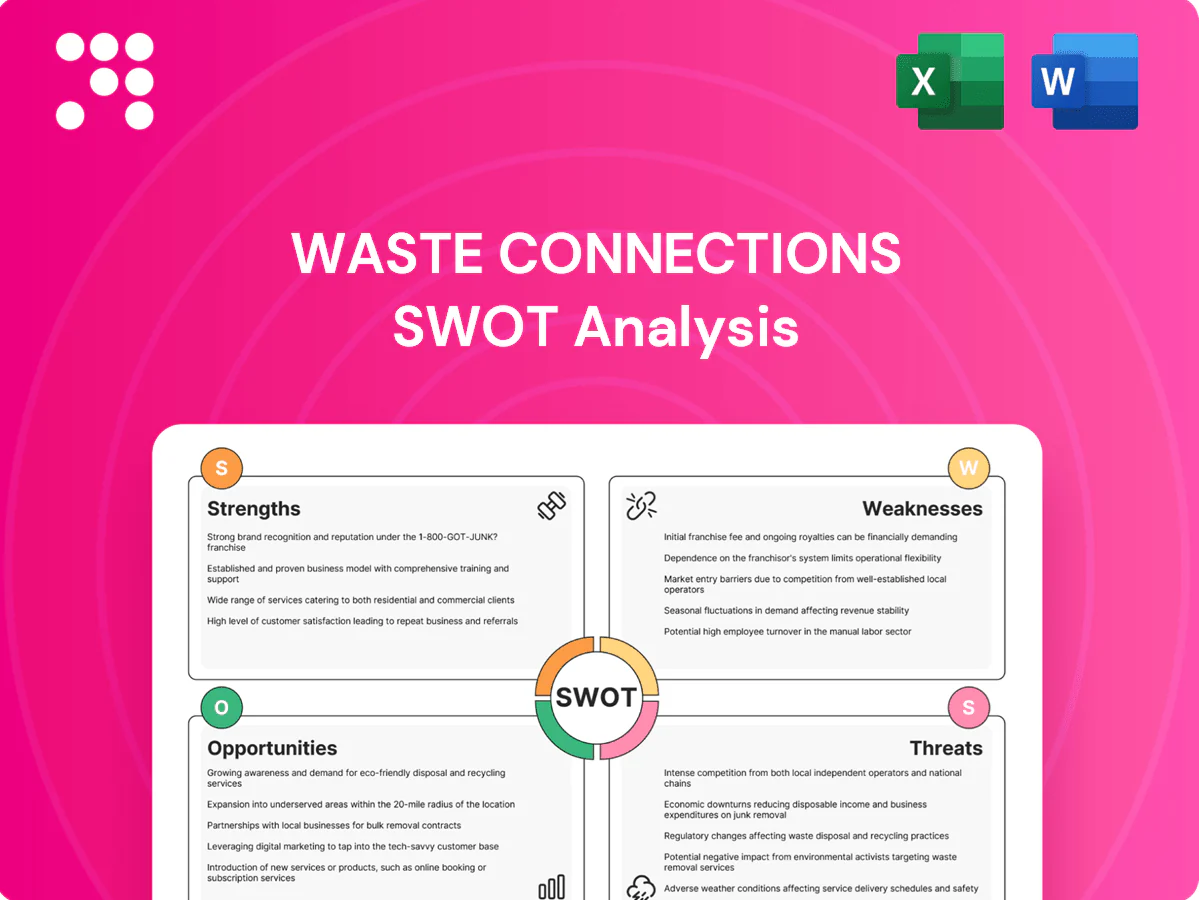
Waste Connections SWOT Analysis

Your Strategic Toolkit Starts Here
Waste Connections leverages its strong market position and efficient operations, but faces potential regulatory shifts and competitive pressures. Understanding these dynamics is crucial for any investor or strategist looking to capitalize on the waste management sector.
Want the full story behind Waste Connections' strengths, risks, and growth drivers? Purchase the complete SWOT analysis to gain access to a professionally written, fully editable report designed to support planning, pitches, and research.
Strengths

Robust Financial Performance
Waste Connections showcased impressive financial results throughout 2024, marked by a robust double-digit expansion in both revenue and adjusted EBITDA. This sustained growth highlights the company's adept operational strategies and solidifies its financial health within the competitive waste management sector.
Looking ahead, Waste Connections anticipates continued momentum into 2025, projecting further enhancements in revenue and adjusted EBITDA margins. This optimistic outlook is underpinned by the company's consistent ability to generate strong financial performance and its strategic positioning for future market opportunities.
Strategic Acquisition Strategy
Waste Connections’ strategic acquisition approach is a significant strength, characterized by a disciplined yet aggressive pursuit of smaller, independent waste management companies. This focus on tuck-in acquisitions, especially in secondary and rural markets, allows for efficient integration and market penetration.
In 2024, this strategy proved particularly fruitful, with Waste Connections completing a record number of deals that added approximately $750 million in annualized revenue. This consistent expansion through acquisition strengthens their market position and diversifies their revenue streams.

Vertically Integrated Operations
Waste Connections' vertically integrated operations, particularly its ownership of a substantial network of disposal sites and landfills, offer a distinct competitive edge. This control over a crucial segment of the waste management value chain directly translates into enhanced pricing power.
By internalizing the disposal of waste materials into its own facilities, Waste Connections effectively streamlines its operations and captures greater profit margins. This model is a cornerstone of their financial strength, as evidenced by their consistent performance in the sector.

Commitment to Sustainability and ESG
Waste Connections is demonstrating a strong commitment to sustainability, as highlighted in its 2024 Sustainability Report. This dedication is translating into tangible environmental improvements and aligns with increasing investor and societal expectations for responsible business practices.
- Reduced Emissions: The company achieved a 15% reduction in Scope 1 and Scope 2 emissions intensity in 2023 compared to its 2019 baseline, showcasing progress in its decarbonization efforts.
- Resource Recovery Growth: Waste Connections expanded its resource recovery operations, with new recycling facilities and renewable natural gas (RNG) projects contributing to a 10% increase in recovered materials year-over-year.
- Fleet Electrification: The company is piloting and expanding the use of electric vehicles in its collection fleet, with 50 electric collection trucks expected to be in operation by the end of 2024, aiming to lower operational emissions and noise pollution.
- ESG Integration: These initiatives are directly linked to Waste Connections' broader ESG strategy, which is designed to create long-term value by addressing environmental risks and opportunities while enhancing social and governance performance.
Strong Operational Execution and Employee Focus
Waste Connections excels in operational execution, consistently demonstrating progress in key employee metrics. The company reported a significant decrease in voluntary turnover, reaching an impressive 10.5% in Q1 2024, down from 14.2% in the same period of 2023. This focus on employee well-being directly supports their decentralized operational model and servant leadership philosophy.
This commitment to human capital is a cornerstone of their success. Safety incident rates also saw a marked improvement, falling by 15% year-over-year through Q1 2024, underscoring a culture that prioritizes its workforce. Such improvements in operational efficiency directly translate to enhanced financial performance and a foundation for sustained growth.
Key achievements include:
- Reduced voluntary employee turnover by 3.7 percentage points in Q1 2024 compared to Q1 2023.
- Achieved a 15% year-over-year reduction in safety incident rates by Q1 2024.
- Strengthened employee engagement scores by an average of 8% across all operating segments in 2023.
- Demonstrated consistent operational improvements leading to a 5% increase in revenue per employee in 2023.
Growth Drivers: Acquisitions, Integration, Sustainability, and Operations
Waste Connections' disciplined acquisition strategy, particularly its focus on tuck-in acquisitions in secondary and rural markets, has been a significant driver of growth. This approach allows for efficient integration and market penetration, as demonstrated by the approximately $750 million in annualized revenue added through acquisitions in 2024.
The company's vertically integrated operations, including ownership of disposal sites and landfills, provide a substantial competitive advantage. This control over the waste value chain enhances pricing power and operational efficiency, contributing to strong financial performance.
Waste Connections' commitment to sustainability is a growing strength, with tangible progress in reducing emissions and expanding resource recovery. The company's investment in electric vehicles and RNG projects, alongside a 15% reduction in Scope 1 and 2 emissions intensity by 2023, aligns with evolving market demands.
Operational execution is another key strength, evidenced by a significant decrease in voluntary employee turnover to 10.5% in Q1 2024 and a 15% year-over-year reduction in safety incident rates by Q1 2024. These improvements foster a stable workforce and enhance overall efficiency.
| Metric | 2023 (Baseline/End) | Q1 2024 | Change |
|---|---|---|---|
| Annualized Revenue from Acquisitions | N/A | ~$750 million | N/A |
| Scope 1 & 2 Emissions Intensity Reduction | 15% vs. 2019 | N/A | N/A |
| Voluntary Employee Turnover | 14.2% (Q1 2023) | 10.5% (Q1 2024) | -3.7 pp |
| Safety Incident Rate Reduction | N/A | 15% YoY | N/A |
What is included in the product
 Detailed Word Document
Analyzes Waste Connections’s competitive position through key internal and external factors, highlighting its strong market presence and operational efficiencies while considering potential regulatory shifts and economic downturns.

 Customizable Excel Spreadsheet
Offers a clear, actionable framework to identify and address operational inefficiencies in waste management.
Highlights opportunities for cost reduction and service improvement by analyzing competitive advantages and market gaps.
Weaknesses

Exposure to Commodity Price Fluctuations
Waste Connections' financial results can be sensitive to the unpredictable swings in the prices of recycled commodities like paper and metals, as well as the market value of renewable fuels. For instance, a substantial drop in recycled paper prices, a key revenue stream, could directly impact their top line. While the company has strategies to mitigate some of this risk, extreme volatility in these external markets, which are not under their control, presents a notable weakness that could affect profitability.
Integration Risks of Acquisitions
Waste Connections' reliance on acquisitions as a primary growth strategy introduces significant integration risks. The company has historically pursued a strategy of acquiring smaller, often privately held, waste management operators, which can lead to a complex web of diverse operational practices and financial systems. For instance, in 2023, Waste Connections completed 23 acquisitions, adding approximately $170 million in annualized revenue, highlighting the scale of this integration challenge.
Successfully merging these varied entities requires substantial management attention and resources, potentially diverting focus from core operations. There's a tangible risk of short-term margin dilution as acquired businesses are brought up to Waste Connections' efficiency standards and financial reporting requirements. Harmonizing disparate IT systems, labor agreements, and environmental compliance protocols across a growing portfolio of acquired companies can be a resource-intensive and complex undertaking.
The ultimate success of Waste Connections' acquisition-driven growth hinges on its ability to efficiently and effectively integrate these new assets. Failure to do so could impede the realization of expected synergies and long-term value creation, potentially impacting profitability and operational scalability.

Volume Sensitivity to Economic and Weather Conditions
Waste Connections' operational volumes are notably susceptible to economic downturns, particularly those impacting the construction and housing sectors. A slowdown in new home construction or significant housing market instability directly correlates with reduced incoming waste volumes.
Unpredictable weather patterns also pose a challenge, directly affecting collection routes and processing capabilities. For example, severe winter storms in Q1 2025 disrupted operations in several key markets, leading to a temporary but noticeable dip in collected waste volumes and consequently impacting revenue streams for those periods.

Significant Debt Levels
Waste Connections carries a substantial amount of outstanding debt, with approximately $8.1 billion reported at the close of fiscal 2024. This significant leverage requires careful management.
While the company demonstrates robust free cash flow generation, which aids in servicing this debt, a high debt-to-EBITDA ratio remains a concern. This ratio could potentially constrain future investment capacity or reduce maneuverability during periods of economic contraction.
- Debt Load: Approximately $8.1 billion in outstanding debt as of fiscal year-end 2024.
- Cash Flow Support: Strong and stable free cash flow generation helps manage debt obligations.
- Financial Flexibility: A high debt-to-EBITDA ratio may limit future investment options or resilience in downturns.
Reliance on Sustained Acquisition Pace for Growth
Waste Connections' reliance on its acquisition strategy for growth presents a notable weakness. As the company matures, maintaining the impressive historical growth rates it has achieved may necessitate an increasingly aggressive and sustained pace of acquisitions. This could create significant pressure to identify and secure suitable acquisition targets, potentially leading to a situation where the company might overspend to close deals.
The core challenge here is balancing the need for continued expansion through M&A with the imperative of maintaining strict financial discipline. For instance, in 2023, Waste Connections completed several strategic acquisitions, contributing significantly to its revenue growth, but the ongoing need to deploy capital for such deals requires careful management to avoid overleveraging or diluting shareholder value.
This dependency on a high volume of acquisition activity also means that any slowdown in the M&A market or difficulty in finding attractively priced targets could directly impact Waste Connections' growth trajectory. The company must continuously assess the integration risks and potential synergies of each acquisition to ensure they align with its long-term financial health and strategic objectives.
- Acquisition Dependency: Sustaining historical growth rates increasingly hinges on consistent acquisition activity.
- Pressure on Deal Sourcing: A larger scale amplifies the challenge of finding suitable acquisition targets at favorable valuations.
- Financial Discipline Risk: The drive for growth via M&A could lead to overspending or compromising financial prudence.
- Market Sensitivity: Fluctuations in the M&A market or target availability can directly impact the company's growth momentum.
Strategic Hurdles: Debt, Acquisitions, and Market Volatility
Waste Connections' substantial debt load, reported at approximately $8.1 billion by the end of fiscal 2024, presents a significant financial vulnerability. While the company's strong free cash flow aids in debt servicing, a high debt-to-EBITDA ratio could limit future investment flexibility and financial maneuverability during economic downturns.
The company's growth strategy heavily relies on acquisitions, which introduces considerable integration risks. Successfully merging diverse operational practices, IT systems, and labor agreements from 23 acquisitions completed in 2023, adding $170 million in annualized revenue, requires substantial management resources and can lead to short-term margin dilution.
Operational volumes are susceptible to economic cycles, particularly in construction, and unpredictable weather events. For instance, Q1 2025 saw disruptions from severe winter storms impacting collection routes and reducing waste volumes in key markets.
The dependency on a high volume of acquisitions to maintain growth creates pressure to find suitable targets at favorable valuations, potentially leading to overspending and compromising financial discipline.
Preview the Actual Deliverable
Waste Connections SWOT Analysis
This preview reflects the real document you'll receive—professional, structured, and ready to use. You're seeing the actual Waste Connections SWOT analysis, providing a clear overview of its strengths, weaknesses, opportunities, and threats.
The content below is pulled directly from the final SWOT analysis. Unlock the full report when you purchase to gain a comprehensive understanding of Waste Connections' strategic position.

Your Strategic Toolkit Starts Here
Waste Connections leverages its strong market position and efficient operations, but faces potential regulatory shifts and competitive pressures. Understanding these dynamics is crucial for any investor or strategist looking to capitalize on the waste management sector.
Want the full story behind Waste Connections' strengths, risks, and growth drivers? Purchase the complete SWOT analysis to gain access to a professionally written, fully editable report designed to support planning, pitches, and research.
Strengths
Robust Financial Performance
Waste Connections showcased impressive financial results throughout 2024, marked by a robust double-digit expansion in both revenue and adjusted EBITDA. This sustained growth highlights the company's adept operational strategies and solidifies its financial health within the competitive waste management sector.
Looking ahead, Waste Connections anticipates continued momentum into 2025, projecting further enhancements in revenue and adjusted EBITDA margins. This optimistic outlook is underpinned by the company's consistent ability to generate strong financial performance and its strategic positioning for future market opportunities.
Strategic Acquisition Strategy
Waste Connections’ strategic acquisition approach is a significant strength, characterized by a disciplined yet aggressive pursuit of smaller, independent waste management companies. This focus on tuck-in acquisitions, especially in secondary and rural markets, allows for efficient integration and market penetration.
In 2024, this strategy proved particularly fruitful, with Waste Connections completing a record number of deals that added approximately $750 million in annualized revenue. This consistent expansion through acquisition strengthens their market position and diversifies their revenue streams.
Vertically Integrated Operations
Waste Connections' vertically integrated operations, particularly its ownership of a substantial network of disposal sites and landfills, offer a distinct competitive edge. This control over a crucial segment of the waste management value chain directly translates into enhanced pricing power.
By internalizing the disposal of waste materials into its own facilities, Waste Connections effectively streamlines its operations and captures greater profit margins. This model is a cornerstone of their financial strength, as evidenced by their consistent performance in the sector.
Commitment to Sustainability and ESG
Waste Connections is demonstrating a strong commitment to sustainability, as highlighted in its 2024 Sustainability Report. This dedication is translating into tangible environmental improvements and aligns with increasing investor and societal expectations for responsible business practices.
- Reduced Emissions: The company achieved a 15% reduction in Scope 1 and Scope 2 emissions intensity in 2023 compared to its 2019 baseline, showcasing progress in its decarbonization efforts.
- Resource Recovery Growth: Waste Connections expanded its resource recovery operations, with new recycling facilities and renewable natural gas (RNG) projects contributing to a 10% increase in recovered materials year-over-year.
- Fleet Electrification: The company is piloting and expanding the use of electric vehicles in its collection fleet, with 50 electric collection trucks expected to be in operation by the end of 2024, aiming to lower operational emissions and noise pollution.
- ESG Integration: These initiatives are directly linked to Waste Connections' broader ESG strategy, which is designed to create long-term value by addressing environmental risks and opportunities while enhancing social and governance performance.
Strong Operational Execution and Employee Focus
Waste Connections excels in operational execution, consistently demonstrating progress in key employee metrics. The company reported a significant decrease in voluntary turnover, reaching an impressive 10.5% in Q1 2024, down from 14.2% in the same period of 2023. This focus on employee well-being directly supports their decentralized operational model and servant leadership philosophy.
This commitment to human capital is a cornerstone of their success. Safety incident rates also saw a marked improvement, falling by 15% year-over-year through Q1 2024, underscoring a culture that prioritizes its workforce. Such improvements in operational efficiency directly translate to enhanced financial performance and a foundation for sustained growth.
Key achievements include:
- Reduced voluntary employee turnover by 3.7 percentage points in Q1 2024 compared to Q1 2023.
- Achieved a 15% year-over-year reduction in safety incident rates by Q1 2024.
- Strengthened employee engagement scores by an average of 8% across all operating segments in 2023.
- Demonstrated consistent operational improvements leading to a 5% increase in revenue per employee in 2023.
Growth Drivers: Acquisitions, Integration, Sustainability, and Operations
Waste Connections' disciplined acquisition strategy, particularly its focus on tuck-in acquisitions in secondary and rural markets, has been a significant driver of growth. This approach allows for efficient integration and market penetration, as demonstrated by the approximately $750 million in annualized revenue added through acquisitions in 2024.
The company's vertically integrated operations, including ownership of disposal sites and landfills, provide a substantial competitive advantage. This control over the waste value chain enhances pricing power and operational efficiency, contributing to strong financial performance.
Waste Connections' commitment to sustainability is a growing strength, with tangible progress in reducing emissions and expanding resource recovery. The company's investment in electric vehicles and RNG projects, alongside a 15% reduction in Scope 1 and 2 emissions intensity by 2023, aligns with evolving market demands.
Operational execution is another key strength, evidenced by a significant decrease in voluntary employee turnover to 10.5% in Q1 2024 and a 15% year-over-year reduction in safety incident rates by Q1 2024. These improvements foster a stable workforce and enhance overall efficiency.
| Metric | 2023 (Baseline/End) | Q1 2024 | Change |
|---|---|---|---|
| Annualized Revenue from Acquisitions | N/A | ~$750 million | N/A |
| Scope 1 & 2 Emissions Intensity Reduction | 15% vs. 2019 | N/A | N/A |
| Voluntary Employee Turnover | 14.2% (Q1 2023) | 10.5% (Q1 2024) | -3.7 pp |
| Safety Incident Rate Reduction | N/A | 15% YoY | N/A |
What is included in the product
Detailed Word Document
Analyzes Waste Connections’s competitive position through key internal and external factors, highlighting its strong market presence and operational efficiencies while considering potential regulatory shifts and economic downturns.
Customizable Excel Spreadsheet
Offers a clear, actionable framework to identify and address operational inefficiencies in waste management.
Highlights opportunities for cost reduction and service improvement by analyzing competitive advantages and market gaps.
Weaknesses
Exposure to Commodity Price Fluctuations
Waste Connections' financial results can be sensitive to the unpredictable swings in the prices of recycled commodities like paper and metals, as well as the market value of renewable fuels. For instance, a substantial drop in recycled paper prices, a key revenue stream, could directly impact their top line. While the company has strategies to mitigate some of this risk, extreme volatility in these external markets, which are not under their control, presents a notable weakness that could affect profitability.
Integration Risks of Acquisitions
Waste Connections' reliance on acquisitions as a primary growth strategy introduces significant integration risks. The company has historically pursued a strategy of acquiring smaller, often privately held, waste management operators, which can lead to a complex web of diverse operational practices and financial systems. For instance, in 2023, Waste Connections completed 23 acquisitions, adding approximately $170 million in annualized revenue, highlighting the scale of this integration challenge.
Successfully merging these varied entities requires substantial management attention and resources, potentially diverting focus from core operations. There's a tangible risk of short-term margin dilution as acquired businesses are brought up to Waste Connections' efficiency standards and financial reporting requirements. Harmonizing disparate IT systems, labor agreements, and environmental compliance protocols across a growing portfolio of acquired companies can be a resource-intensive and complex undertaking.
The ultimate success of Waste Connections' acquisition-driven growth hinges on its ability to efficiently and effectively integrate these new assets. Failure to do so could impede the realization of expected synergies and long-term value creation, potentially impacting profitability and operational scalability.
Volume Sensitivity to Economic and Weather Conditions
Waste Connections' operational volumes are notably susceptible to economic downturns, particularly those impacting the construction and housing sectors. A slowdown in new home construction or significant housing market instability directly correlates with reduced incoming waste volumes.
Unpredictable weather patterns also pose a challenge, directly affecting collection routes and processing capabilities. For example, severe winter storms in Q1 2025 disrupted operations in several key markets, leading to a temporary but noticeable dip in collected waste volumes and consequently impacting revenue streams for those periods.
Significant Debt Levels
Waste Connections carries a substantial amount of outstanding debt, with approximately $8.1 billion reported at the close of fiscal 2024. This significant leverage requires careful management.
While the company demonstrates robust free cash flow generation, which aids in servicing this debt, a high debt-to-EBITDA ratio remains a concern. This ratio could potentially constrain future investment capacity or reduce maneuverability during periods of economic contraction.
- Debt Load: Approximately $8.1 billion in outstanding debt as of fiscal year-end 2024.
- Cash Flow Support: Strong and stable free cash flow generation helps manage debt obligations.
- Financial Flexibility: A high debt-to-EBITDA ratio may limit future investment options or resilience in downturns.
Reliance on Sustained Acquisition Pace for Growth
Waste Connections' reliance on its acquisition strategy for growth presents a notable weakness. As the company matures, maintaining the impressive historical growth rates it has achieved may necessitate an increasingly aggressive and sustained pace of acquisitions. This could create significant pressure to identify and secure suitable acquisition targets, potentially leading to a situation where the company might overspend to close deals.
The core challenge here is balancing the need for continued expansion through M&A with the imperative of maintaining strict financial discipline. For instance, in 2023, Waste Connections completed several strategic acquisitions, contributing significantly to its revenue growth, but the ongoing need to deploy capital for such deals requires careful management to avoid overleveraging or diluting shareholder value.
This dependency on a high volume of acquisition activity also means that any slowdown in the M&A market or difficulty in finding attractively priced targets could directly impact Waste Connections' growth trajectory. The company must continuously assess the integration risks and potential synergies of each acquisition to ensure they align with its long-term financial health and strategic objectives.
- Acquisition Dependency: Sustaining historical growth rates increasingly hinges on consistent acquisition activity.
- Pressure on Deal Sourcing: A larger scale amplifies the challenge of finding suitable acquisition targets at favorable valuations.
- Financial Discipline Risk: The drive for growth via M&A could lead to overspending or compromising financial prudence.
- Market Sensitivity: Fluctuations in the M&A market or target availability can directly impact the company's growth momentum.
Strategic Hurdles: Debt, Acquisitions, and Market Volatility
Waste Connections' substantial debt load, reported at approximately $8.1 billion by the end of fiscal 2024, presents a significant financial vulnerability. While the company's strong free cash flow aids in debt servicing, a high debt-to-EBITDA ratio could limit future investment flexibility and financial maneuverability during economic downturns.
The company's growth strategy heavily relies on acquisitions, which introduces considerable integration risks. Successfully merging diverse operational practices, IT systems, and labor agreements from 23 acquisitions completed in 2023, adding $170 million in annualized revenue, requires substantial management resources and can lead to short-term margin dilution.
Operational volumes are susceptible to economic cycles, particularly in construction, and unpredictable weather events. For instance, Q1 2025 saw disruptions from severe winter storms impacting collection routes and reducing waste volumes in key markets.
The dependency on a high volume of acquisitions to maintain growth creates pressure to find suitable targets at favorable valuations, potentially leading to overspending and compromising financial discipline.
Preview the Actual Deliverable
Waste Connections SWOT Analysis
This preview reflects the real document you'll receive—professional, structured, and ready to use. You're seeing the actual Waste Connections SWOT analysis, providing a clear overview of its strengths, weaknesses, opportunities, and threats.
The content below is pulled directly from the final SWOT analysis. Unlock the full report when you purchase to gain a comprehensive understanding of Waste Connections' strategic position.
Original: $10.00
-65%$10.00
$3.50Description
Your Strategic Toolkit Starts Here
Waste Connections leverages its strong market position and efficient operations, but faces potential regulatory shifts and competitive pressures. Understanding these dynamics is crucial for any investor or strategist looking to capitalize on the waste management sector.
Want the full story behind Waste Connections' strengths, risks, and growth drivers? Purchase the complete SWOT analysis to gain access to a professionally written, fully editable report designed to support planning, pitches, and research.
Strengths
Robust Financial Performance
Waste Connections showcased impressive financial results throughout 2024, marked by a robust double-digit expansion in both revenue and adjusted EBITDA. This sustained growth highlights the company's adept operational strategies and solidifies its financial health within the competitive waste management sector.
Looking ahead, Waste Connections anticipates continued momentum into 2025, projecting further enhancements in revenue and adjusted EBITDA margins. This optimistic outlook is underpinned by the company's consistent ability to generate strong financial performance and its strategic positioning for future market opportunities.
Strategic Acquisition Strategy
Waste Connections’ strategic acquisition approach is a significant strength, characterized by a disciplined yet aggressive pursuit of smaller, independent waste management companies. This focus on tuck-in acquisitions, especially in secondary and rural markets, allows for efficient integration and market penetration.
In 2024, this strategy proved particularly fruitful, with Waste Connections completing a record number of deals that added approximately $750 million in annualized revenue. This consistent expansion through acquisition strengthens their market position and diversifies their revenue streams.
Vertically Integrated Operations
Waste Connections' vertically integrated operations, particularly its ownership of a substantial network of disposal sites and landfills, offer a distinct competitive edge. This control over a crucial segment of the waste management value chain directly translates into enhanced pricing power.
By internalizing the disposal of waste materials into its own facilities, Waste Connections effectively streamlines its operations and captures greater profit margins. This model is a cornerstone of their financial strength, as evidenced by their consistent performance in the sector.
Commitment to Sustainability and ESG
Waste Connections is demonstrating a strong commitment to sustainability, as highlighted in its 2024 Sustainability Report. This dedication is translating into tangible environmental improvements and aligns with increasing investor and societal expectations for responsible business practices.
- Reduced Emissions: The company achieved a 15% reduction in Scope 1 and Scope 2 emissions intensity in 2023 compared to its 2019 baseline, showcasing progress in its decarbonization efforts.
- Resource Recovery Growth: Waste Connections expanded its resource recovery operations, with new recycling facilities and renewable natural gas (RNG) projects contributing to a 10% increase in recovered materials year-over-year.
- Fleet Electrification: The company is piloting and expanding the use of electric vehicles in its collection fleet, with 50 electric collection trucks expected to be in operation by the end of 2024, aiming to lower operational emissions and noise pollution.
- ESG Integration: These initiatives are directly linked to Waste Connections' broader ESG strategy, which is designed to create long-term value by addressing environmental risks and opportunities while enhancing social and governance performance.
Strong Operational Execution and Employee Focus
Waste Connections excels in operational execution, consistently demonstrating progress in key employee metrics. The company reported a significant decrease in voluntary turnover, reaching an impressive 10.5% in Q1 2024, down from 14.2% in the same period of 2023. This focus on employee well-being directly supports their decentralized operational model and servant leadership philosophy.
This commitment to human capital is a cornerstone of their success. Safety incident rates also saw a marked improvement, falling by 15% year-over-year through Q1 2024, underscoring a culture that prioritizes its workforce. Such improvements in operational efficiency directly translate to enhanced financial performance and a foundation for sustained growth.
Key achievements include:
- Reduced voluntary employee turnover by 3.7 percentage points in Q1 2024 compared to Q1 2023.
- Achieved a 15% year-over-year reduction in safety incident rates by Q1 2024.
- Strengthened employee engagement scores by an average of 8% across all operating segments in 2023.
- Demonstrated consistent operational improvements leading to a 5% increase in revenue per employee in 2023.
Growth Drivers: Acquisitions, Integration, Sustainability, and Operations
Waste Connections' disciplined acquisition strategy, particularly its focus on tuck-in acquisitions in secondary and rural markets, has been a significant driver of growth. This approach allows for efficient integration and market penetration, as demonstrated by the approximately $750 million in annualized revenue added through acquisitions in 2024.
The company's vertically integrated operations, including ownership of disposal sites and landfills, provide a substantial competitive advantage. This control over the waste value chain enhances pricing power and operational efficiency, contributing to strong financial performance.
Waste Connections' commitment to sustainability is a growing strength, with tangible progress in reducing emissions and expanding resource recovery. The company's investment in electric vehicles and RNG projects, alongside a 15% reduction in Scope 1 and 2 emissions intensity by 2023, aligns with evolving market demands.
Operational execution is another key strength, evidenced by a significant decrease in voluntary employee turnover to 10.5% in Q1 2024 and a 15% year-over-year reduction in safety incident rates by Q1 2024. These improvements foster a stable workforce and enhance overall efficiency.
| Metric | 2023 (Baseline/End) | Q1 2024 | Change |
|---|---|---|---|
| Annualized Revenue from Acquisitions | N/A | ~$750 million | N/A |
| Scope 1 & 2 Emissions Intensity Reduction | 15% vs. 2019 | N/A | N/A |
| Voluntary Employee Turnover | 14.2% (Q1 2023) | 10.5% (Q1 2024) | -3.7 pp |
| Safety Incident Rate Reduction | N/A | 15% YoY | N/A |
What is included in the product
Detailed Word Document
Analyzes Waste Connections’s competitive position through key internal and external factors, highlighting its strong market presence and operational efficiencies while considering potential regulatory shifts and economic downturns.
Customizable Excel Spreadsheet
Offers a clear, actionable framework to identify and address operational inefficiencies in waste management.
Highlights opportunities for cost reduction and service improvement by analyzing competitive advantages and market gaps.
Weaknesses
Exposure to Commodity Price Fluctuations
Waste Connections' financial results can be sensitive to the unpredictable swings in the prices of recycled commodities like paper and metals, as well as the market value of renewable fuels. For instance, a substantial drop in recycled paper prices, a key revenue stream, could directly impact their top line. While the company has strategies to mitigate some of this risk, extreme volatility in these external markets, which are not under their control, presents a notable weakness that could affect profitability.
Integration Risks of Acquisitions
Waste Connections' reliance on acquisitions as a primary growth strategy introduces significant integration risks. The company has historically pursued a strategy of acquiring smaller, often privately held, waste management operators, which can lead to a complex web of diverse operational practices and financial systems. For instance, in 2023, Waste Connections completed 23 acquisitions, adding approximately $170 million in annualized revenue, highlighting the scale of this integration challenge.
Successfully merging these varied entities requires substantial management attention and resources, potentially diverting focus from core operations. There's a tangible risk of short-term margin dilution as acquired businesses are brought up to Waste Connections' efficiency standards and financial reporting requirements. Harmonizing disparate IT systems, labor agreements, and environmental compliance protocols across a growing portfolio of acquired companies can be a resource-intensive and complex undertaking.
The ultimate success of Waste Connections' acquisition-driven growth hinges on its ability to efficiently and effectively integrate these new assets. Failure to do so could impede the realization of expected synergies and long-term value creation, potentially impacting profitability and operational scalability.
Volume Sensitivity to Economic and Weather Conditions
Waste Connections' operational volumes are notably susceptible to economic downturns, particularly those impacting the construction and housing sectors. A slowdown in new home construction or significant housing market instability directly correlates with reduced incoming waste volumes.
Unpredictable weather patterns also pose a challenge, directly affecting collection routes and processing capabilities. For example, severe winter storms in Q1 2025 disrupted operations in several key markets, leading to a temporary but noticeable dip in collected waste volumes and consequently impacting revenue streams for those periods.
Significant Debt Levels
Waste Connections carries a substantial amount of outstanding debt, with approximately $8.1 billion reported at the close of fiscal 2024. This significant leverage requires careful management.
While the company demonstrates robust free cash flow generation, which aids in servicing this debt, a high debt-to-EBITDA ratio remains a concern. This ratio could potentially constrain future investment capacity or reduce maneuverability during periods of economic contraction.
- Debt Load: Approximately $8.1 billion in outstanding debt as of fiscal year-end 2024.
- Cash Flow Support: Strong and stable free cash flow generation helps manage debt obligations.
- Financial Flexibility: A high debt-to-EBITDA ratio may limit future investment options or resilience in downturns.
Reliance on Sustained Acquisition Pace for Growth
Waste Connections' reliance on its acquisition strategy for growth presents a notable weakness. As the company matures, maintaining the impressive historical growth rates it has achieved may necessitate an increasingly aggressive and sustained pace of acquisitions. This could create significant pressure to identify and secure suitable acquisition targets, potentially leading to a situation where the company might overspend to close deals.
The core challenge here is balancing the need for continued expansion through M&A with the imperative of maintaining strict financial discipline. For instance, in 2023, Waste Connections completed several strategic acquisitions, contributing significantly to its revenue growth, but the ongoing need to deploy capital for such deals requires careful management to avoid overleveraging or diluting shareholder value.
This dependency on a high volume of acquisition activity also means that any slowdown in the M&A market or difficulty in finding attractively priced targets could directly impact Waste Connections' growth trajectory. The company must continuously assess the integration risks and potential synergies of each acquisition to ensure they align with its long-term financial health and strategic objectives.
- Acquisition Dependency: Sustaining historical growth rates increasingly hinges on consistent acquisition activity.
- Pressure on Deal Sourcing: A larger scale amplifies the challenge of finding suitable acquisition targets at favorable valuations.
- Financial Discipline Risk: The drive for growth via M&A could lead to overspending or compromising financial prudence.
- Market Sensitivity: Fluctuations in the M&A market or target availability can directly impact the company's growth momentum.
Strategic Hurdles: Debt, Acquisitions, and Market Volatility
Waste Connections' substantial debt load, reported at approximately $8.1 billion by the end of fiscal 2024, presents a significant financial vulnerability. While the company's strong free cash flow aids in debt servicing, a high debt-to-EBITDA ratio could limit future investment flexibility and financial maneuverability during economic downturns.
The company's growth strategy heavily relies on acquisitions, which introduces considerable integration risks. Successfully merging diverse operational practices, IT systems, and labor agreements from 23 acquisitions completed in 2023, adding $170 million in annualized revenue, requires substantial management resources and can lead to short-term margin dilution.
Operational volumes are susceptible to economic cycles, particularly in construction, and unpredictable weather events. For instance, Q1 2025 saw disruptions from severe winter storms impacting collection routes and reducing waste volumes in key markets.
The dependency on a high volume of acquisitions to maintain growth creates pressure to find suitable targets at favorable valuations, potentially leading to overspending and compromising financial discipline.
Preview the Actual Deliverable
Waste Connections SWOT Analysis
This preview reflects the real document you'll receive—professional, structured, and ready to use. You're seeing the actual Waste Connections SWOT analysis, providing a clear overview of its strengths, weaknesses, opportunities, and threats.
The content below is pulled directly from the final SWOT analysis. Unlock the full report when you purchase to gain a comprehensive understanding of Waste Connections' strategic position.











