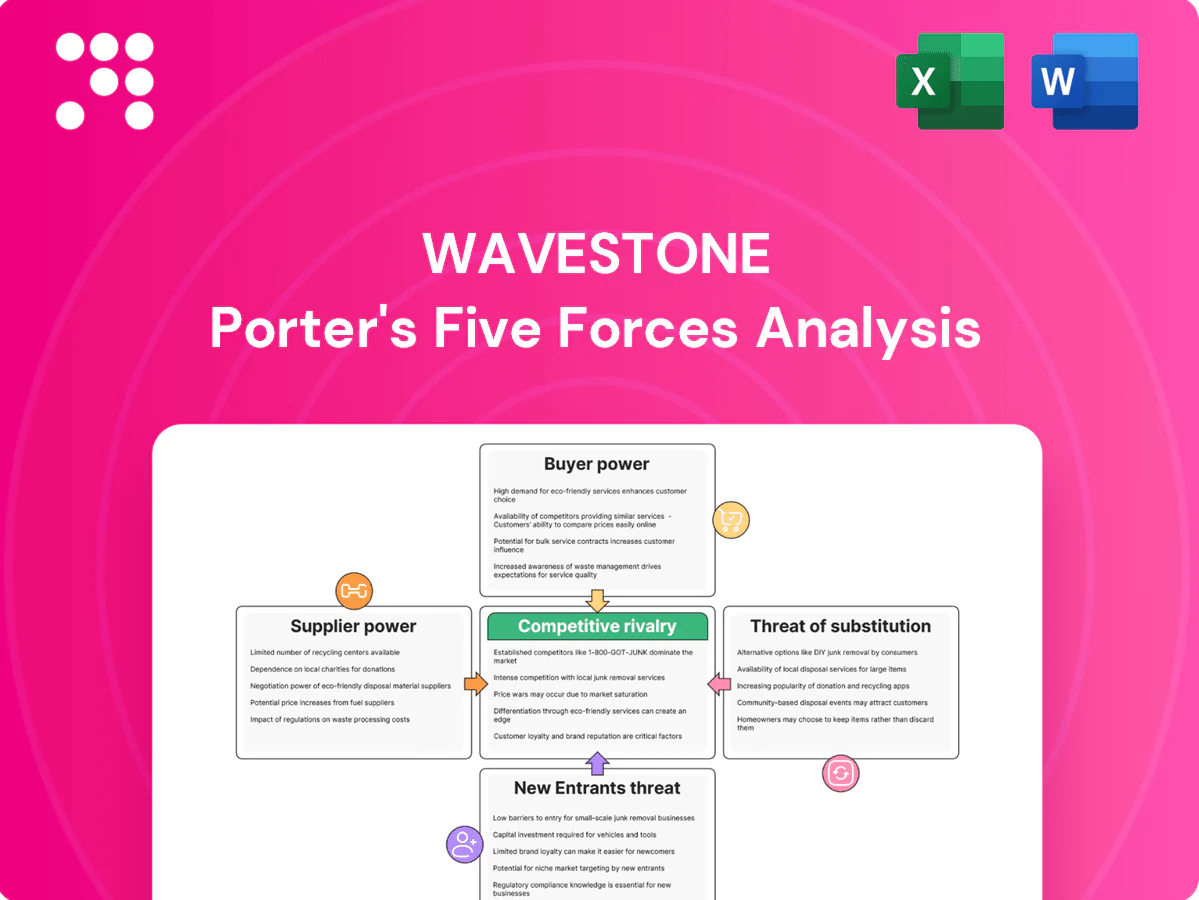
Wavestone Porter's Five Forces Analysis

From Overview to Strategy Blueprint
Wavestone operates in a competitive digital and management consulting market where client bargaining power and substitute digital platforms shape pricing and margins. Barriers to entry are moderate—brand and specialized expertise protect incumbents while agile boutiques and tech vendors raise rivalry. This brief snapshot only scratches the surface. Unlock the full Porter's Five Forces Analysis to explore Wavestone’s competitive dynamics, market pressures, and strategic advantages in detail.
Suppliers Bargaining Power

Scarce senior talent and niche skills
Experienced consultants in cybersecurity, data & AI and cloud hold strong leverage amid a global shortage: ISC2 estimated a 3.4 million cybersecurity workforce gap in 2024. Premium salaries and retention packages push up input costs and wage volatility for firms like Wavestone. Graduate pipelines and career-development programs mitigate long-term supply strain, but immediate access to scarce niche skills remains supplier-favorable. Employer brand and mission lower, not remove, supplier power.
Dependence on hyperscalers and major software
Certifications and partner status with AWS, Azure and Google Cloud remain critical as AWS (≈32%), Azure (≈24%) and GCP (≈11%) dominate cloud spend in 2024. Vendors can steer delivery choices, inflate training and certification costs (cert fees commonly range from $100 to $3,000) and prescribe preferred methodologies. Wavestone’s multi-cloud and vendor-agnostic positioning, aligned with 92% of enterprises adopting multi-cloud, limits supplier lock-in. Co-selling programs with hyperscalers provide tangible business development offsets to vendor bargaining power.

Specialist subcontractors and independent experts
On peak loads and niche engagements Wavestone relies on specialist subcontractors who in 2024 commanded premium day rates often 20–40% above in‑house billing; this elevates supplier bargaining power. Quality assurance and confidentiality needs limit easy switching, while preferred supplier networks and framework rates keep extreme price spikes in check. Ongoing hiring and a 2024 headcount expansion to ~3,850 staff aim to reduce long‑term reliance.

Data providers and research tools
Access to threat intel, data feeds, and analytics platforms directly affects Wavestone project quality by shaping detection accuracy, response speed, and advisory depth; a concentrated supplier base gives a few vendors pricing power for differentiated datasets, while enterprise licenses and volume deals typically reduce per-seat costs and lock clients into ecosystems. In-house IP and accelerators reduce dependency and improve margin predictability.
- Concentration: few dominant providers
- Pricing: premium for unique datasets
- Licensing: enterprise discounts lower unit cost
- Mitigation: in-house IP reduces vendor risk
Training, certification, and accreditation bodies
- Mandatory certs affect bid eligibility
- Diversification across certs reduces vendor lock-in
- Internal academies lower external fee exposure
Cyber talent gap 3.4M fuels 20–40% subcontractor premium
Supplier power is elevated: ISC2 estimates a 3.4M cybersecurity workforce gap in 2024, pushing premium salaries and subcontractor day rates 20–40% above in‑house billing. Hyperscalers (AWS ≈32%, Azure ≈24%, GCP ≈11% in 2024) influence tooling and cert costs ($100–$3,000), but multi‑cloud stance and co‑selling reduce lock‑in. In‑house IP, internal academies and ~3,850 staff (2024) lower long‑term dependency.
| Metric | 2024 Value |
|---|---|
| Cyber workforce gap | 3.4M (ISC2) |
| Hyperscaler share | AWS 32% / Azure 24% / GCP 11% |
| Headcount | ~3,850 |
What is included in the product
 Detailed Word Document
Uncovers key drivers of competition, customer influence, and market entry risks tailored to Wavestone; evaluates supplier and buyer power, substitutes, and rivalry to highlight disruptive threats, strategic opportunities, and actionable levers to protect and grow market share.

 Customizable Excel Spreadsheet
Wavestone's Porter's Five Forces template delivers a clear, one-sheet diagnosis of competitive pressures with customizable sliders and spider charts for instant strategic clarity, no macros required—perfect for fast decision-making and seamless integration into decks or dashboards.
Customers Bargaining Power

Large enterprises run competitive RFPs
Procurement-led tenders standardize scope and price, tightening margins as comparable proposals increase price transparency and fee pressure. In 2024 enterprises increasingly benchmark bids, forcing consultancies to defend value beyond fees. Wavestone offsets by proving outcomes and deploying IP-based accelerators. Strong references and case studies improve win rates without excessive discounting.
Framework agreements and rate cards
Framework agreements and Master Service Agreements cap rates and set service levels, anchoring commercial terms and limiting ad hoc price increases. Volume commitments let buyers trade guaranteed spend for lower prices, strengthening buyer leverage in negotiations. Differentiated roles and outcome-based pricing shift focus from pure rate comparison to value delivery, while multi-year renewals soften the impact of annual pricing resets.

Switching costs from embedded knowledge
Deep process knowledge and stakeholder trust create high switching costs, making replacement costly and risky and helping moderate buyer power during ongoing transformations; McKinsey estimates about 70% of large transformations fail when continuity is disrupted. Clear documentation and transition clauses can sustain pressure on incumbents, while Wavestone increases stickiness through proprietary methodologies and dedicated tools.

Outcome and risk-sharing demands
Clients increasingly demand value-based fees and strict SLAs, shifting outcome risk to suppliers and compressing margins when benefits realization is delayed. Robust baselining, measurable KPIs and governance are essential to protect economics and avoid retrospective disputes. Structuring contracts with phased milestones and holdbacks aligns incentives without overexposing the supplier.
- Outcome-based fees: increased client demand
- Delay risk: margin compression
- Governance: baselining and KPIs
- Phased milestones: incentive alignment
Public sector transparency and budgets
Public sector procurement, estimated at about 12% of GDP (OECD) and roughly €2 trillion annually in the EU (European Commission 2024), enforces open competition and tight budgets, which increases buyer leverage via price-weighted scoring. Mandatory frameworks and inclusion criteria are often prerequisites to access demand, while required security clearances and specialized domain expertise narrow the bidder pool, partly easing pricing pressure on qualified firms.
- Buyer leverage: price-weighted scoring
- Market size: ~12% of GDP; EU ≈ €2T (2024)
- Access: framework inclusion critical
- Supply constraint: clearances & specialist expertise
Procurement transparency cuts prices and caps rates, EU public spend ≈ €2T
Procurement-led tenders and frameworks raise price transparency and cap rates, boosting buyer leverage; EU public procurement ≈ €2T (2024), public procurement ~12% of GDP (OECD). Clients push outcome-based fees and SLAs, compressing margins; baselining, phased milestones and IP accelerators protect economics. High switching costs and strong references lower churn; large transformations fail ~70% when continuity is disrupted (McKinsey).
| Metric | Value |
|---|---|
| Public procurement share | ~12% GDP (OECD) |
| EU public spend | ≈ €2T (2024) |
| Transformation failure | ~70% (McKinsey) |
Preview Before You Purchase
Wavestone Porter's Five Forces Analysis
This preview shows the Wavestone Porter's Five Forces analysis exactly as delivered upon purchase—no placeholders or mockups. The complete, professionally formatted document you see here is ready for immediate download and use the moment you buy. What’s displayed is precisely what you’ll receive.

From Overview to Strategy Blueprint
Wavestone operates in a competitive digital and management consulting market where client bargaining power and substitute digital platforms shape pricing and margins. Barriers to entry are moderate—brand and specialized expertise protect incumbents while agile boutiques and tech vendors raise rivalry. This brief snapshot only scratches the surface. Unlock the full Porter's Five Forces Analysis to explore Wavestone’s competitive dynamics, market pressures, and strategic advantages in detail.
Suppliers Bargaining Power
Scarce senior talent and niche skills
Experienced consultants in cybersecurity, data & AI and cloud hold strong leverage amid a global shortage: ISC2 estimated a 3.4 million cybersecurity workforce gap in 2024. Premium salaries and retention packages push up input costs and wage volatility for firms like Wavestone. Graduate pipelines and career-development programs mitigate long-term supply strain, but immediate access to scarce niche skills remains supplier-favorable. Employer brand and mission lower, not remove, supplier power.
Dependence on hyperscalers and major software
Certifications and partner status with AWS, Azure and Google Cloud remain critical as AWS (≈32%), Azure (≈24%) and GCP (≈11%) dominate cloud spend in 2024. Vendors can steer delivery choices, inflate training and certification costs (cert fees commonly range from $100 to $3,000) and prescribe preferred methodologies. Wavestone’s multi-cloud and vendor-agnostic positioning, aligned with 92% of enterprises adopting multi-cloud, limits supplier lock-in. Co-selling programs with hyperscalers provide tangible business development offsets to vendor bargaining power.
Specialist subcontractors and independent experts
On peak loads and niche engagements Wavestone relies on specialist subcontractors who in 2024 commanded premium day rates often 20–40% above in‑house billing; this elevates supplier bargaining power. Quality assurance and confidentiality needs limit easy switching, while preferred supplier networks and framework rates keep extreme price spikes in check. Ongoing hiring and a 2024 headcount expansion to ~3,850 staff aim to reduce long‑term reliance.
Data providers and research tools
Access to threat intel, data feeds, and analytics platforms directly affects Wavestone project quality by shaping detection accuracy, response speed, and advisory depth; a concentrated supplier base gives a few vendors pricing power for differentiated datasets, while enterprise licenses and volume deals typically reduce per-seat costs and lock clients into ecosystems. In-house IP and accelerators reduce dependency and improve margin predictability.
- Concentration: few dominant providers
- Pricing: premium for unique datasets
- Licensing: enterprise discounts lower unit cost
- Mitigation: in-house IP reduces vendor risk
Training, certification, and accreditation bodies
- Mandatory certs affect bid eligibility
- Diversification across certs reduces vendor lock-in
- Internal academies lower external fee exposure
Cyber talent gap 3.4M fuels 20–40% subcontractor premium
Supplier power is elevated: ISC2 estimates a 3.4M cybersecurity workforce gap in 2024, pushing premium salaries and subcontractor day rates 20–40% above in‑house billing. Hyperscalers (AWS ≈32%, Azure ≈24%, GCP ≈11% in 2024) influence tooling and cert costs ($100–$3,000), but multi‑cloud stance and co‑selling reduce lock‑in. In‑house IP, internal academies and ~3,850 staff (2024) lower long‑term dependency.
| Metric | 2024 Value |
|---|---|
| Cyber workforce gap | 3.4M (ISC2) |
| Hyperscaler share | AWS 32% / Azure 24% / GCP 11% |
| Headcount | ~3,850 |
What is included in the product
Detailed Word Document
Uncovers key drivers of competition, customer influence, and market entry risks tailored to Wavestone; evaluates supplier and buyer power, substitutes, and rivalry to highlight disruptive threats, strategic opportunities, and actionable levers to protect and grow market share.
Customizable Excel Spreadsheet
Wavestone's Porter's Five Forces template delivers a clear, one-sheet diagnosis of competitive pressures with customizable sliders and spider charts for instant strategic clarity, no macros required—perfect for fast decision-making and seamless integration into decks or dashboards.
Customers Bargaining Power
Large enterprises run competitive RFPs
Procurement-led tenders standardize scope and price, tightening margins as comparable proposals increase price transparency and fee pressure. In 2024 enterprises increasingly benchmark bids, forcing consultancies to defend value beyond fees. Wavestone offsets by proving outcomes and deploying IP-based accelerators. Strong references and case studies improve win rates without excessive discounting.
Framework agreements and rate cards
Framework agreements and Master Service Agreements cap rates and set service levels, anchoring commercial terms and limiting ad hoc price increases. Volume commitments let buyers trade guaranteed spend for lower prices, strengthening buyer leverage in negotiations. Differentiated roles and outcome-based pricing shift focus from pure rate comparison to value delivery, while multi-year renewals soften the impact of annual pricing resets.
Switching costs from embedded knowledge
Deep process knowledge and stakeholder trust create high switching costs, making replacement costly and risky and helping moderate buyer power during ongoing transformations; McKinsey estimates about 70% of large transformations fail when continuity is disrupted. Clear documentation and transition clauses can sustain pressure on incumbents, while Wavestone increases stickiness through proprietary methodologies and dedicated tools.
Outcome and risk-sharing demands
Clients increasingly demand value-based fees and strict SLAs, shifting outcome risk to suppliers and compressing margins when benefits realization is delayed. Robust baselining, measurable KPIs and governance are essential to protect economics and avoid retrospective disputes. Structuring contracts with phased milestones and holdbacks aligns incentives without overexposing the supplier.
- Outcome-based fees: increased client demand
- Delay risk: margin compression
- Governance: baselining and KPIs
- Phased milestones: incentive alignment
Public sector transparency and budgets
Public sector procurement, estimated at about 12% of GDP (OECD) and roughly €2 trillion annually in the EU (European Commission 2024), enforces open competition and tight budgets, which increases buyer leverage via price-weighted scoring. Mandatory frameworks and inclusion criteria are often prerequisites to access demand, while required security clearances and specialized domain expertise narrow the bidder pool, partly easing pricing pressure on qualified firms.
- Buyer leverage: price-weighted scoring
- Market size: ~12% of GDP; EU ≈ €2T (2024)
- Access: framework inclusion critical
- Supply constraint: clearances & specialist expertise
Procurement transparency cuts prices and caps rates, EU public spend ≈ €2T
Procurement-led tenders and frameworks raise price transparency and cap rates, boosting buyer leverage; EU public procurement ≈ €2T (2024), public procurement ~12% of GDP (OECD). Clients push outcome-based fees and SLAs, compressing margins; baselining, phased milestones and IP accelerators protect economics. High switching costs and strong references lower churn; large transformations fail ~70% when continuity is disrupted (McKinsey).
| Metric | Value |
|---|---|
| Public procurement share | ~12% GDP (OECD) |
| EU public spend | ≈ €2T (2024) |
| Transformation failure | ~70% (McKinsey) |
Preview Before You Purchase
Wavestone Porter's Five Forces Analysis
This preview shows the Wavestone Porter's Five Forces analysis exactly as delivered upon purchase—no placeholders or mockups. The complete, professionally formatted document you see here is ready for immediate download and use the moment you buy. What’s displayed is precisely what you’ll receive.
Description
From Overview to Strategy Blueprint
Wavestone operates in a competitive digital and management consulting market where client bargaining power and substitute digital platforms shape pricing and margins. Barriers to entry are moderate—brand and specialized expertise protect incumbents while agile boutiques and tech vendors raise rivalry. This brief snapshot only scratches the surface. Unlock the full Porter's Five Forces Analysis to explore Wavestone’s competitive dynamics, market pressures, and strategic advantages in detail.
Suppliers Bargaining Power
Scarce senior talent and niche skills
Experienced consultants in cybersecurity, data & AI and cloud hold strong leverage amid a global shortage: ISC2 estimated a 3.4 million cybersecurity workforce gap in 2024. Premium salaries and retention packages push up input costs and wage volatility for firms like Wavestone. Graduate pipelines and career-development programs mitigate long-term supply strain, but immediate access to scarce niche skills remains supplier-favorable. Employer brand and mission lower, not remove, supplier power.
Dependence on hyperscalers and major software
Certifications and partner status with AWS, Azure and Google Cloud remain critical as AWS (≈32%), Azure (≈24%) and GCP (≈11%) dominate cloud spend in 2024. Vendors can steer delivery choices, inflate training and certification costs (cert fees commonly range from $100 to $3,000) and prescribe preferred methodologies. Wavestone’s multi-cloud and vendor-agnostic positioning, aligned with 92% of enterprises adopting multi-cloud, limits supplier lock-in. Co-selling programs with hyperscalers provide tangible business development offsets to vendor bargaining power.
Specialist subcontractors and independent experts
On peak loads and niche engagements Wavestone relies on specialist subcontractors who in 2024 commanded premium day rates often 20–40% above in‑house billing; this elevates supplier bargaining power. Quality assurance and confidentiality needs limit easy switching, while preferred supplier networks and framework rates keep extreme price spikes in check. Ongoing hiring and a 2024 headcount expansion to ~3,850 staff aim to reduce long‑term reliance.
Data providers and research tools
Access to threat intel, data feeds, and analytics platforms directly affects Wavestone project quality by shaping detection accuracy, response speed, and advisory depth; a concentrated supplier base gives a few vendors pricing power for differentiated datasets, while enterprise licenses and volume deals typically reduce per-seat costs and lock clients into ecosystems. In-house IP and accelerators reduce dependency and improve margin predictability.
- Concentration: few dominant providers
- Pricing: premium for unique datasets
- Licensing: enterprise discounts lower unit cost
- Mitigation: in-house IP reduces vendor risk
Training, certification, and accreditation bodies
- Mandatory certs affect bid eligibility
- Diversification across certs reduces vendor lock-in
- Internal academies lower external fee exposure
Cyber talent gap 3.4M fuels 20–40% subcontractor premium
Supplier power is elevated: ISC2 estimates a 3.4M cybersecurity workforce gap in 2024, pushing premium salaries and subcontractor day rates 20–40% above in‑house billing. Hyperscalers (AWS ≈32%, Azure ≈24%, GCP ≈11% in 2024) influence tooling and cert costs ($100–$3,000), but multi‑cloud stance and co‑selling reduce lock‑in. In‑house IP, internal academies and ~3,850 staff (2024) lower long‑term dependency.
| Metric | 2024 Value |
|---|---|
| Cyber workforce gap | 3.4M (ISC2) |
| Hyperscaler share | AWS 32% / Azure 24% / GCP 11% |
| Headcount | ~3,850 |
What is included in the product
Detailed Word Document
Uncovers key drivers of competition, customer influence, and market entry risks tailored to Wavestone; evaluates supplier and buyer power, substitutes, and rivalry to highlight disruptive threats, strategic opportunities, and actionable levers to protect and grow market share.
Customizable Excel Spreadsheet
Wavestone's Porter's Five Forces template delivers a clear, one-sheet diagnosis of competitive pressures with customizable sliders and spider charts for instant strategic clarity, no macros required—perfect for fast decision-making and seamless integration into decks or dashboards.
Customers Bargaining Power
Large enterprises run competitive RFPs
Procurement-led tenders standardize scope and price, tightening margins as comparable proposals increase price transparency and fee pressure. In 2024 enterprises increasingly benchmark bids, forcing consultancies to defend value beyond fees. Wavestone offsets by proving outcomes and deploying IP-based accelerators. Strong references and case studies improve win rates without excessive discounting.
Framework agreements and rate cards
Framework agreements and Master Service Agreements cap rates and set service levels, anchoring commercial terms and limiting ad hoc price increases. Volume commitments let buyers trade guaranteed spend for lower prices, strengthening buyer leverage in negotiations. Differentiated roles and outcome-based pricing shift focus from pure rate comparison to value delivery, while multi-year renewals soften the impact of annual pricing resets.
Switching costs from embedded knowledge
Deep process knowledge and stakeholder trust create high switching costs, making replacement costly and risky and helping moderate buyer power during ongoing transformations; McKinsey estimates about 70% of large transformations fail when continuity is disrupted. Clear documentation and transition clauses can sustain pressure on incumbents, while Wavestone increases stickiness through proprietary methodologies and dedicated tools.
Outcome and risk-sharing demands
Clients increasingly demand value-based fees and strict SLAs, shifting outcome risk to suppliers and compressing margins when benefits realization is delayed. Robust baselining, measurable KPIs and governance are essential to protect economics and avoid retrospective disputes. Structuring contracts with phased milestones and holdbacks aligns incentives without overexposing the supplier.
- Outcome-based fees: increased client demand
- Delay risk: margin compression
- Governance: baselining and KPIs
- Phased milestones: incentive alignment
Public sector transparency and budgets
Public sector procurement, estimated at about 12% of GDP (OECD) and roughly €2 trillion annually in the EU (European Commission 2024), enforces open competition and tight budgets, which increases buyer leverage via price-weighted scoring. Mandatory frameworks and inclusion criteria are often prerequisites to access demand, while required security clearances and specialized domain expertise narrow the bidder pool, partly easing pricing pressure on qualified firms.
- Buyer leverage: price-weighted scoring
- Market size: ~12% of GDP; EU ≈ €2T (2024)
- Access: framework inclusion critical
- Supply constraint: clearances & specialist expertise
Procurement transparency cuts prices and caps rates, EU public spend ≈ €2T
Procurement-led tenders and frameworks raise price transparency and cap rates, boosting buyer leverage; EU public procurement ≈ €2T (2024), public procurement ~12% of GDP (OECD). Clients push outcome-based fees and SLAs, compressing margins; baselining, phased milestones and IP accelerators protect economics. High switching costs and strong references lower churn; large transformations fail ~70% when continuity is disrupted (McKinsey).
| Metric | Value |
|---|---|
| Public procurement share | ~12% GDP (OECD) |
| EU public spend | ≈ €2T (2024) |
| Transformation failure | ~70% (McKinsey) |
Preview Before You Purchase
Wavestone Porter's Five Forces Analysis
This preview shows the Wavestone Porter's Five Forces analysis exactly as delivered upon purchase—no placeholders or mockups. The complete, professionally formatted document you see here is ready for immediate download and use the moment you buy. What’s displayed is precisely what you’ll receive.











