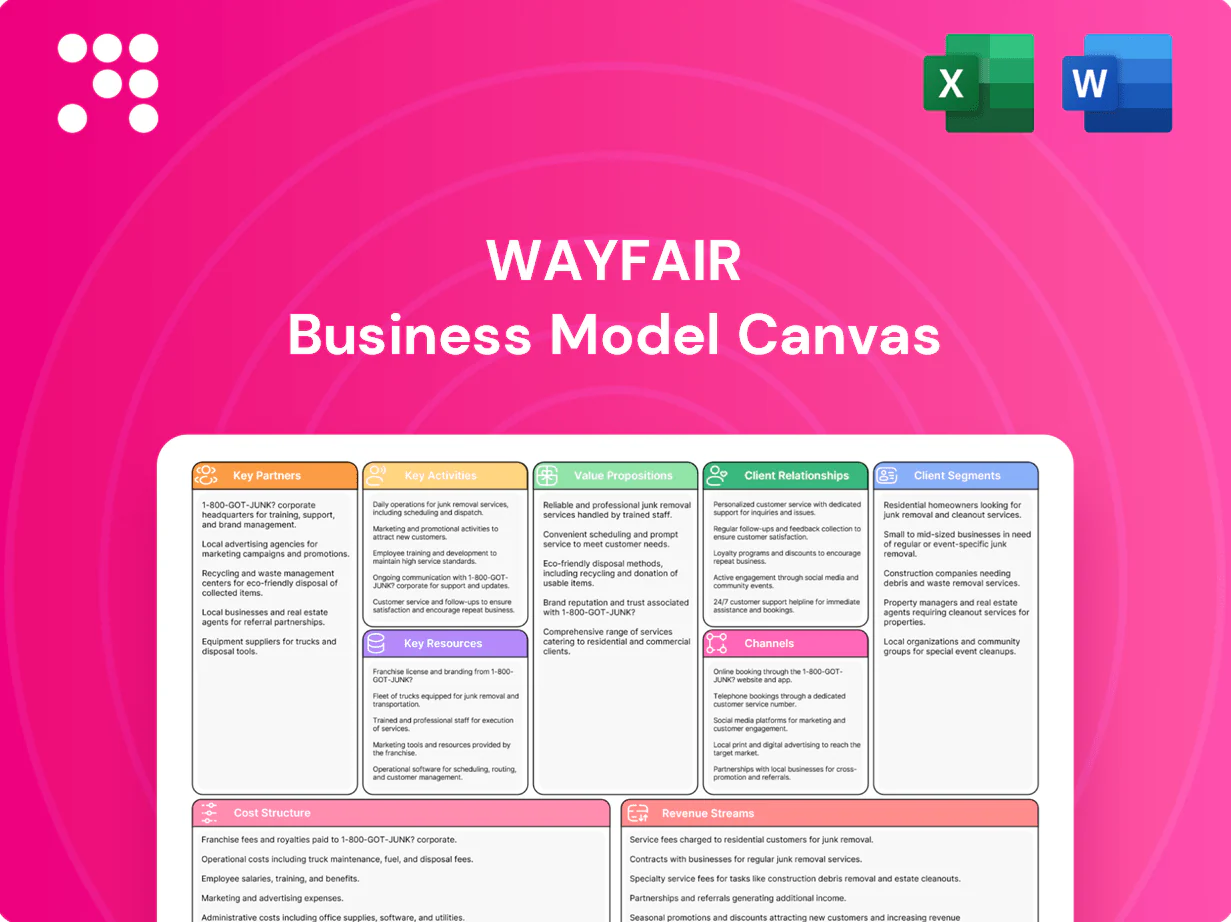
Wayfair Business Model Canvas

Tech-first home goods marketplace: business model canvas snapshot for investors
Explore Wayfair’s Business Model Canvas to see how its tech-driven marketplace, customer segmentation, logistics partnerships, and diversified revenue streams create scale and margin. This concise snapshot explains core activities, key partners, and cost structure in practical terms. Ideal for investors, strategists, and founders. Download the full Word/Excel canvas for a section-by-section playbook you can use today.
Partnerships

Supplier and manufacturer network
Wayfair relies on thousands of furniture and home‑goods suppliers to offer a broad assortment without owning most inventory; many partners drop‑ship directly to customers, supporting a multi‑billion dollar platform (platform GMV in the low tens of billions annually). Strong vendor relationships secure competitive pricing, exclusive SKUs and inventory availability, while supplier performance programs target on‑time ship rates above 95%, quality thresholds and compliance metrics.
Logistics, carriers, and last‑mile delivery
Parcel carriers and freight partners move bulky goods across regions, supporting Wayfair’s scale—Wayfair reported $11.36 billion revenue in 2023. White-glove and room-of-choice providers handle heavy-item delivery, assembly and returns, reducing damage and lift costs. Wayfair’s network integrates partner routing and time-window optimization to cut last-mile spend, where last-mile can represent up to 53% of total delivery cost. Service-level agreements target high on-time and damage-free rates to preserve satisfaction.

Technology and cloud infrastructure providers
Cloud, analytics, and CDN partners (AWS ~33% market share in 2023) power Wayfair’s reliability, personalization, and scalability, supporting multi‑region delivery and near‑real‑time data processing. Third‑party tools for fraud detection, search, and recommendations accelerate feature launches and cut time‑to‑market. These integrations help maintain high uptime targets (99.9%+ SLA) and reduce operational risk, while security and compliance vendors protect transactions and customer data.

Payments, financing, and BNPL partners
Payment processors, card networks, and BNPL providers streamline Wayfair checkout, raising conversion and average order value by offering instant authorization and split‑pay options.
Financing partners supply installment plans and private‑label credit that increase loyalty and repeat purchases while revenue sharing and lower chargeback rates protect margins.
Support for global payment methods broadens reach to diverse customer preferences and cross‑border sales.
- Seamless checkout
- Installments & private credit
- Revenue sharing & lower chargebacks
- Global payment coverage
Advertising, installation, and service partners
Ad networks and Wayfair's retail media monetize on‑site traffic and brand demand, contributing to ancillary revenue alongside core sales; Wayfair reported approximately $11.4 billion in net revenue for 2023, highlighting scale for ad monetization. Installation and assembly partners deliver post‑purchase services that raise NPS and repeat purchase rates. Protection plan providers add extended warranties and coverage, deepening loyalty and margin.
- Ad networks/retail media: monetize traffic
- Installation/assembly: improved post‑purchase experience
- Protection plans: extended warranties, higher margin
- Result: ancillary revenue and stronger customer retention
Platform scales assortment, delivery & checkout with $11.36B revenue
Wayfair partners thousands of suppliers (drop‑ship model), carriers, white‑glove services, cloud and payments to scale assortment, delivery and checkout; 2023 revenue $11.36B, platform GMV in low tens of billions, supplier on‑time targets >95% and last‑mile can be ~53% of delivery cost.
| Metric | Value |
|---|---|
| Net revenue (2023) | $11.36B |
| Platform GMV | Low tens of billions |
| Supplier on‑time target | >95% |
| Last‑mile share | ~53% |
| AWS market share (2023) | ~33% |
What is included in the product
 Detailed Word Document
A concise, pre-written Business Model Canvas for Wayfair detailing its marketplace and direct retail model, customer segments (consumers, designers, B2B), omni-channel fulfillment and logistics, supplier partnerships, and data-driven personalization. Ideal for presentations and investor discussions, it maps nine BMC blocks with competitive advantages, SWOT-linked insights, and actionable strategic recommendations.

 Customizable Excel Spreadsheet
Condenses Wayfair’s complex e-commerce model into a one-page snapshot to quickly identify customer pain points, fulfillment and supplier bottlenecks, and UX opportunities—ideal for teams solving supply chain and conversion challenges.
Activities

Marketplace curation and vendor management
Onboarding, rating and active vendor management keep quality and assortment broad—Wayfair worked with over 10,000 suppliers in 2024, driving selection across home categories. Catalog standardization and content governance ensure comparability and reduce returns, supporting platform listings that follow strict attribute templates. Performance metrics (shipping speed, defect rates, CSAT) tie to vendor scorecards and influence merchandising; aggressive negotiations secure pricing, occasional exclusives and service-level commitments.
Merchandising, pricing, and promotions
Data-driven pricing aligns with demand, seasonality and competition, using real-time elasticity models that Wayfair applied across ~16 million SKUs in 2024 to improve price responsiveness. Visual merchandising and curated collections simplify discovery across styles and budgets, increasing average session depth. Promotions and events drive traffic and inventory turns, while systematic A/B testing optimizes conversion, margin and attachment rates.

Customer experience and support operations
Proactive order updates, swift issue resolution, and streamlined returns management build trust and reduce churn for Wayfair customers. Self-service tools like order tracking and returns portals lower friction and cut cost to serve. Contact centers handle complex cases such as damages and freight rescheduling. Post-purchase surveys feed continuous improvement and product/fulfillment refinements.

Logistics orchestration and delivery planning
Routing bulky items requires coordinating carriers, line‑haul and last‑mile while integrating tracking, appointment scheduling and white‑glove options; last‑mile can represent up to 53% of total delivery cost. Exceptions such as missed deliveries and damages are triaged rapidly through centralized dispatch and claims workflows. Cost optimization balances speed, reliability and margin via carrier mix and dynamic routing.
- Carriers
- Tracking & appointments
- White‑glove
- Exception triage
Technology development and data analytics
- Platform engineering: search, recommendations, personalization
- Analytics: forecasting, assortment, supplier selection
- Ad tech: retail media targeting & measurement
- Security: fraud prevention & performance monitoring
Marketplace scale: >10,000 suppliers, ~16M SKUs, last-mile ~53%
Vendor onboarding and governance scale assortment—Wayfair worked with over 10,000 suppliers in 2024 and standardized catalog attributes to cut returns. Real‑time pricing and merchandising across ~16 million SKUs in 2024 optimize conversion and margin. Fulfillment focuses on bulky logistics, white‑glove and exception triage (last‑mile can be ~53% of delivery cost). Platform engineering, analytics and ad tech enable personalization and retail media.
| Metric | Value |
|---|---|
| Suppliers (2024) | >10,000 |
| SKUs (2024) | ~16M |
| Last‑mile cost | ~53% |
Preview Before You Purchase
Business Model Canvas
The document you're previewing is the actual Wayfair Business Model Canvas you will receive after purchase, not a mockup or sample. It captures the same channels, value propositions, customer segments, revenue streams, and key activities as the final file. After buying, you'll download this exact, fully editable canvas in its complete format. No placeholders—what you see is what you'll get.

Tech-first home goods marketplace: business model canvas snapshot for investors
Explore Wayfair’s Business Model Canvas to see how its tech-driven marketplace, customer segmentation, logistics partnerships, and diversified revenue streams create scale and margin. This concise snapshot explains core activities, key partners, and cost structure in practical terms. Ideal for investors, strategists, and founders. Download the full Word/Excel canvas for a section-by-section playbook you can use today.
Partnerships
Supplier and manufacturer network
Wayfair relies on thousands of furniture and home‑goods suppliers to offer a broad assortment without owning most inventory; many partners drop‑ship directly to customers, supporting a multi‑billion dollar platform (platform GMV in the low tens of billions annually). Strong vendor relationships secure competitive pricing, exclusive SKUs and inventory availability, while supplier performance programs target on‑time ship rates above 95%, quality thresholds and compliance metrics.
Logistics, carriers, and last‑mile delivery
Parcel carriers and freight partners move bulky goods across regions, supporting Wayfair’s scale—Wayfair reported $11.36 billion revenue in 2023. White-glove and room-of-choice providers handle heavy-item delivery, assembly and returns, reducing damage and lift costs. Wayfair’s network integrates partner routing and time-window optimization to cut last-mile spend, where last-mile can represent up to 53% of total delivery cost. Service-level agreements target high on-time and damage-free rates to preserve satisfaction.
Technology and cloud infrastructure providers
Cloud, analytics, and CDN partners (AWS ~33% market share in 2023) power Wayfair’s reliability, personalization, and scalability, supporting multi‑region delivery and near‑real‑time data processing. Third‑party tools for fraud detection, search, and recommendations accelerate feature launches and cut time‑to‑market. These integrations help maintain high uptime targets (99.9%+ SLA) and reduce operational risk, while security and compliance vendors protect transactions and customer data.
Payments, financing, and BNPL partners
Payment processors, card networks, and BNPL providers streamline Wayfair checkout, raising conversion and average order value by offering instant authorization and split‑pay options.
Financing partners supply installment plans and private‑label credit that increase loyalty and repeat purchases while revenue sharing and lower chargeback rates protect margins.
Support for global payment methods broadens reach to diverse customer preferences and cross‑border sales.
- Seamless checkout
- Installments & private credit
- Revenue sharing & lower chargebacks
- Global payment coverage
Advertising, installation, and service partners
Ad networks and Wayfair's retail media monetize on‑site traffic and brand demand, contributing to ancillary revenue alongside core sales; Wayfair reported approximately $11.4 billion in net revenue for 2023, highlighting scale for ad monetization. Installation and assembly partners deliver post‑purchase services that raise NPS and repeat purchase rates. Protection plan providers add extended warranties and coverage, deepening loyalty and margin.
- Ad networks/retail media: monetize traffic
- Installation/assembly: improved post‑purchase experience
- Protection plans: extended warranties, higher margin
- Result: ancillary revenue and stronger customer retention
Platform scales assortment, delivery & checkout with $11.36B revenue
Wayfair partners thousands of suppliers (drop‑ship model), carriers, white‑glove services, cloud and payments to scale assortment, delivery and checkout; 2023 revenue $11.36B, platform GMV in low tens of billions, supplier on‑time targets >95% and last‑mile can be ~53% of delivery cost.
| Metric | Value |
|---|---|
| Net revenue (2023) | $11.36B |
| Platform GMV | Low tens of billions |
| Supplier on‑time target | >95% |
| Last‑mile share | ~53% |
| AWS market share (2023) | ~33% |
What is included in the product
Detailed Word Document
A concise, pre-written Business Model Canvas for Wayfair detailing its marketplace and direct retail model, customer segments (consumers, designers, B2B), omni-channel fulfillment and logistics, supplier partnerships, and data-driven personalization. Ideal for presentations and investor discussions, it maps nine BMC blocks with competitive advantages, SWOT-linked insights, and actionable strategic recommendations.
Customizable Excel Spreadsheet
Condenses Wayfair’s complex e-commerce model into a one-page snapshot to quickly identify customer pain points, fulfillment and supplier bottlenecks, and UX opportunities—ideal for teams solving supply chain and conversion challenges.
Activities
Marketplace curation and vendor management
Onboarding, rating and active vendor management keep quality and assortment broad—Wayfair worked with over 10,000 suppliers in 2024, driving selection across home categories. Catalog standardization and content governance ensure comparability and reduce returns, supporting platform listings that follow strict attribute templates. Performance metrics (shipping speed, defect rates, CSAT) tie to vendor scorecards and influence merchandising; aggressive negotiations secure pricing, occasional exclusives and service-level commitments.
Merchandising, pricing, and promotions
Data-driven pricing aligns with demand, seasonality and competition, using real-time elasticity models that Wayfair applied across ~16 million SKUs in 2024 to improve price responsiveness. Visual merchandising and curated collections simplify discovery across styles and budgets, increasing average session depth. Promotions and events drive traffic and inventory turns, while systematic A/B testing optimizes conversion, margin and attachment rates.
Customer experience and support operations
Proactive order updates, swift issue resolution, and streamlined returns management build trust and reduce churn for Wayfair customers. Self-service tools like order tracking and returns portals lower friction and cut cost to serve. Contact centers handle complex cases such as damages and freight rescheduling. Post-purchase surveys feed continuous improvement and product/fulfillment refinements.
Logistics orchestration and delivery planning
Routing bulky items requires coordinating carriers, line‑haul and last‑mile while integrating tracking, appointment scheduling and white‑glove options; last‑mile can represent up to 53% of total delivery cost. Exceptions such as missed deliveries and damages are triaged rapidly through centralized dispatch and claims workflows. Cost optimization balances speed, reliability and margin via carrier mix and dynamic routing.
- Carriers
- Tracking & appointments
- White‑glove
- Exception triage
Technology development and data analytics
- Platform engineering: search, recommendations, personalization
- Analytics: forecasting, assortment, supplier selection
- Ad tech: retail media targeting & measurement
- Security: fraud prevention & performance monitoring
Marketplace scale: >10,000 suppliers, ~16M SKUs, last-mile ~53%
Vendor onboarding and governance scale assortment—Wayfair worked with over 10,000 suppliers in 2024 and standardized catalog attributes to cut returns. Real‑time pricing and merchandising across ~16 million SKUs in 2024 optimize conversion and margin. Fulfillment focuses on bulky logistics, white‑glove and exception triage (last‑mile can be ~53% of delivery cost). Platform engineering, analytics and ad tech enable personalization and retail media.
| Metric | Value |
|---|---|
| Suppliers (2024) | >10,000 |
| SKUs (2024) | ~16M |
| Last‑mile cost | ~53% |
Preview Before You Purchase
Business Model Canvas
The document you're previewing is the actual Wayfair Business Model Canvas you will receive after purchase, not a mockup or sample. It captures the same channels, value propositions, customer segments, revenue streams, and key activities as the final file. After buying, you'll download this exact, fully editable canvas in its complete format. No placeholders—what you see is what you'll get.
Original: $10.00
-65%$10.00
$3.50Description
Tech-first home goods marketplace: business model canvas snapshot for investors
Explore Wayfair’s Business Model Canvas to see how its tech-driven marketplace, customer segmentation, logistics partnerships, and diversified revenue streams create scale and margin. This concise snapshot explains core activities, key partners, and cost structure in practical terms. Ideal for investors, strategists, and founders. Download the full Word/Excel canvas for a section-by-section playbook you can use today.
Partnerships
Supplier and manufacturer network
Wayfair relies on thousands of furniture and home‑goods suppliers to offer a broad assortment without owning most inventory; many partners drop‑ship directly to customers, supporting a multi‑billion dollar platform (platform GMV in the low tens of billions annually). Strong vendor relationships secure competitive pricing, exclusive SKUs and inventory availability, while supplier performance programs target on‑time ship rates above 95%, quality thresholds and compliance metrics.
Logistics, carriers, and last‑mile delivery
Parcel carriers and freight partners move bulky goods across regions, supporting Wayfair’s scale—Wayfair reported $11.36 billion revenue in 2023. White-glove and room-of-choice providers handle heavy-item delivery, assembly and returns, reducing damage and lift costs. Wayfair’s network integrates partner routing and time-window optimization to cut last-mile spend, where last-mile can represent up to 53% of total delivery cost. Service-level agreements target high on-time and damage-free rates to preserve satisfaction.
Technology and cloud infrastructure providers
Cloud, analytics, and CDN partners (AWS ~33% market share in 2023) power Wayfair’s reliability, personalization, and scalability, supporting multi‑region delivery and near‑real‑time data processing. Third‑party tools for fraud detection, search, and recommendations accelerate feature launches and cut time‑to‑market. These integrations help maintain high uptime targets (99.9%+ SLA) and reduce operational risk, while security and compliance vendors protect transactions and customer data.
Payments, financing, and BNPL partners
Payment processors, card networks, and BNPL providers streamline Wayfair checkout, raising conversion and average order value by offering instant authorization and split‑pay options.
Financing partners supply installment plans and private‑label credit that increase loyalty and repeat purchases while revenue sharing and lower chargeback rates protect margins.
Support for global payment methods broadens reach to diverse customer preferences and cross‑border sales.
- Seamless checkout
- Installments & private credit
- Revenue sharing & lower chargebacks
- Global payment coverage
Advertising, installation, and service partners
Ad networks and Wayfair's retail media monetize on‑site traffic and brand demand, contributing to ancillary revenue alongside core sales; Wayfair reported approximately $11.4 billion in net revenue for 2023, highlighting scale for ad monetization. Installation and assembly partners deliver post‑purchase services that raise NPS and repeat purchase rates. Protection plan providers add extended warranties and coverage, deepening loyalty and margin.
- Ad networks/retail media: monetize traffic
- Installation/assembly: improved post‑purchase experience
- Protection plans: extended warranties, higher margin
- Result: ancillary revenue and stronger customer retention
Platform scales assortment, delivery & checkout with $11.36B revenue
Wayfair partners thousands of suppliers (drop‑ship model), carriers, white‑glove services, cloud and payments to scale assortment, delivery and checkout; 2023 revenue $11.36B, platform GMV in low tens of billions, supplier on‑time targets >95% and last‑mile can be ~53% of delivery cost.
| Metric | Value |
|---|---|
| Net revenue (2023) | $11.36B |
| Platform GMV | Low tens of billions |
| Supplier on‑time target | >95% |
| Last‑mile share | ~53% |
| AWS market share (2023) | ~33% |
What is included in the product
Detailed Word Document
A concise, pre-written Business Model Canvas for Wayfair detailing its marketplace and direct retail model, customer segments (consumers, designers, B2B), omni-channel fulfillment and logistics, supplier partnerships, and data-driven personalization. Ideal for presentations and investor discussions, it maps nine BMC blocks with competitive advantages, SWOT-linked insights, and actionable strategic recommendations.
Customizable Excel Spreadsheet
Condenses Wayfair’s complex e-commerce model into a one-page snapshot to quickly identify customer pain points, fulfillment and supplier bottlenecks, and UX opportunities—ideal for teams solving supply chain and conversion challenges.
Activities
Marketplace curation and vendor management
Onboarding, rating and active vendor management keep quality and assortment broad—Wayfair worked with over 10,000 suppliers in 2024, driving selection across home categories. Catalog standardization and content governance ensure comparability and reduce returns, supporting platform listings that follow strict attribute templates. Performance metrics (shipping speed, defect rates, CSAT) tie to vendor scorecards and influence merchandising; aggressive negotiations secure pricing, occasional exclusives and service-level commitments.
Merchandising, pricing, and promotions
Data-driven pricing aligns with demand, seasonality and competition, using real-time elasticity models that Wayfair applied across ~16 million SKUs in 2024 to improve price responsiveness. Visual merchandising and curated collections simplify discovery across styles and budgets, increasing average session depth. Promotions and events drive traffic and inventory turns, while systematic A/B testing optimizes conversion, margin and attachment rates.
Customer experience and support operations
Proactive order updates, swift issue resolution, and streamlined returns management build trust and reduce churn for Wayfair customers. Self-service tools like order tracking and returns portals lower friction and cut cost to serve. Contact centers handle complex cases such as damages and freight rescheduling. Post-purchase surveys feed continuous improvement and product/fulfillment refinements.
Logistics orchestration and delivery planning
Routing bulky items requires coordinating carriers, line‑haul and last‑mile while integrating tracking, appointment scheduling and white‑glove options; last‑mile can represent up to 53% of total delivery cost. Exceptions such as missed deliveries and damages are triaged rapidly through centralized dispatch and claims workflows. Cost optimization balances speed, reliability and margin via carrier mix and dynamic routing.
- Carriers
- Tracking & appointments
- White‑glove
- Exception triage
Technology development and data analytics
- Platform engineering: search, recommendations, personalization
- Analytics: forecasting, assortment, supplier selection
- Ad tech: retail media targeting & measurement
- Security: fraud prevention & performance monitoring
Marketplace scale: >10,000 suppliers, ~16M SKUs, last-mile ~53%
Vendor onboarding and governance scale assortment—Wayfair worked with over 10,000 suppliers in 2024 and standardized catalog attributes to cut returns. Real‑time pricing and merchandising across ~16 million SKUs in 2024 optimize conversion and margin. Fulfillment focuses on bulky logistics, white‑glove and exception triage (last‑mile can be ~53% of delivery cost). Platform engineering, analytics and ad tech enable personalization and retail media.
| Metric | Value |
|---|---|
| Suppliers (2024) | >10,000 |
| SKUs (2024) | ~16M |
| Last‑mile cost | ~53% |
Preview Before You Purchase
Business Model Canvas
The document you're previewing is the actual Wayfair Business Model Canvas you will receive after purchase, not a mockup or sample. It captures the same channels, value propositions, customer segments, revenue streams, and key activities as the final file. After buying, you'll download this exact, fully editable canvas in its complete format. No placeholders—what you see is what you'll get.











