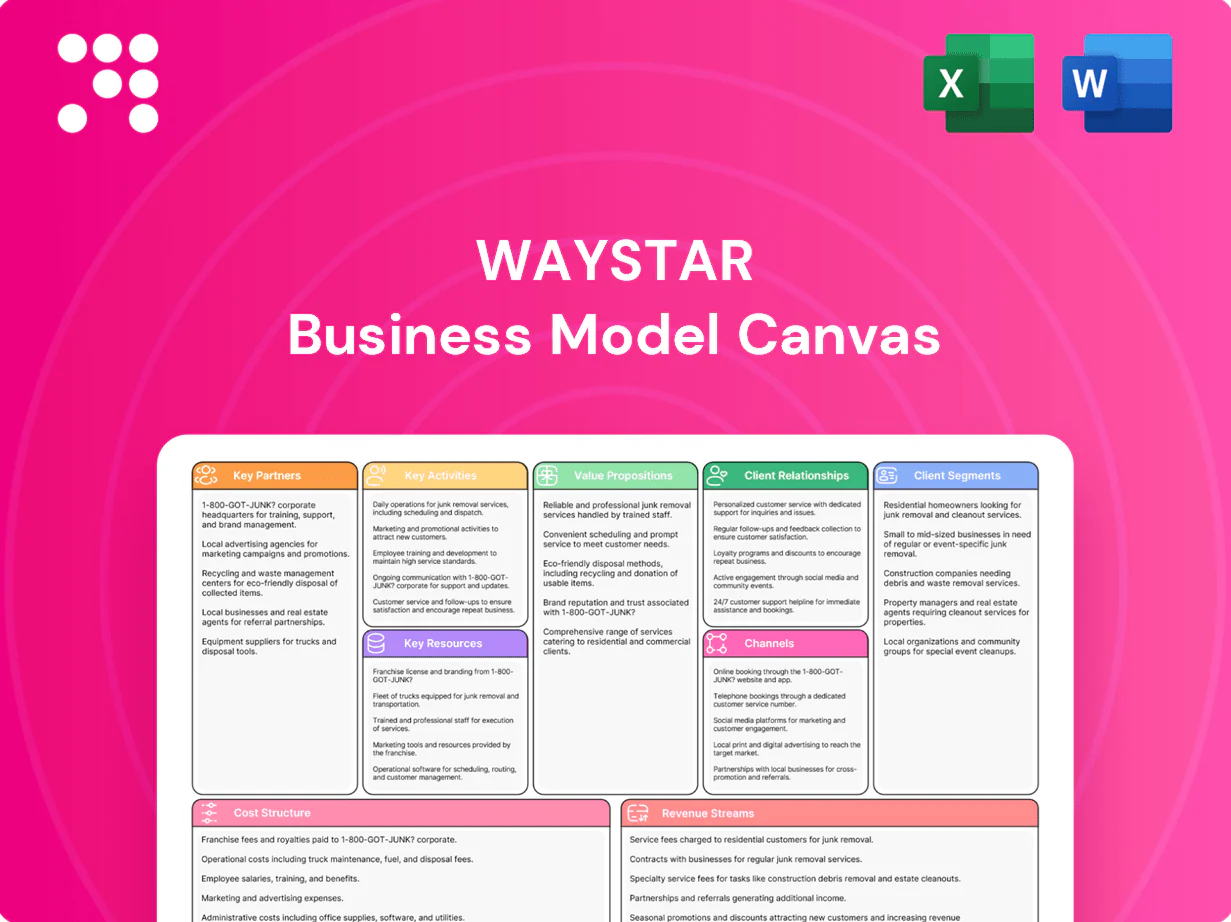
Waystar Business Model Canvas

Business Model Canvas: Map value, customers, and revenue levers for scalable growth
Explore Waystar’s strategic engine with our concise Business Model Canvas—three-plus sentences that unpack value propositions, customer segments, and revenue levers to reveal how Waystar scales and sustains competitive advantage. Download the full Word/Excel canvas for a sector-ready, actionable playbook to benchmark and execute.
Partnerships

EHR and Practice Management Vendors
Integrations with leading EHR/PM systems like Epic and Oracle Cerner, which together cover about 60% of US acute-care beds (KLAS 2023), ensure seamless data flow across the revenue cycle. Certified interfaces cut implementation friction and lower data-error rates by improving structured data exchange. Joint go-to-market motions accelerate adoption through co-selling and referral channels. Co-innovation roadmaps keep compatibility current as interoperability standards evolve.
Payers and Clearinghouses
Direct connections to commercial and government payers speed eligibility checks, claims submission, and remits, supporting Waystar’s platform that processed about $1.2 trillion in healthcare payments in 2024. Clearinghouse partners extend network reach and transaction reliability across major payers. Contracted rules and edits improve first-pass acceptance rates, while shared payer-provider data reduces denials and speeds reconciliation.

Payment Processors and Merchant Services
Partners enable compliant card, ACH, and digital wallet acceptance across providers, with U.S. card interchange averaging about 1.8% in 2024 and ACH costs typically under $1 per transaction, lowering payment friction for healthcare clients.
Competitive interchange and gateway fees improve client economics by reducing per-transaction expense and shrink net collections; optimized routing can boost margin several basis points per payment.
Tokenization and PCI-compliant vaulting remove card data from provider systems, narrowing PCI scope and reducing breach risk and compliance overhead.
Co-branded patient payment experiences increase conversion and patient satisfaction, with industry implementations commonly reporting double-digit uplifts in online payment completion.

External datasets from payers and claims vendors enrich Waystar's propensity-to-pay and risk models, improving coverage of edge-case patient segments; AI infrastructure partners accelerate model training and inference for near-real-time scoring, while benchmarking sources like CMS and Fair Health enable comparative performance insights; collaborative R&D with academic and industry partners boosts prediction accuracy and explainability.
- Data providers: broader claims and socioeconomic datasets
- AI infra: GPU/accelerator partners for faster training
- Benchmarking: CMS, Fair Health for comparisons
- R&D: joint projects to improve accuracy and explainability
Consulting, Channel, and Implementation Firms
Certified SI and RCM consulting partners scale deployment capacity and embed revenue integrity experts who drive configuration best practices, opening enterprise health systems and midsize provider access via referral channels; ongoing optimization services capture continuous ROI in a U.S. health system spending roughly 4.6 trillion in 2024 (CMS projection).
- Certified SI scale
- Revenue integrity experts
- Referral access to systems & midsize providers
- Ongoing optimization = continuous ROI
Integrated EHR, payer and payments + AI fuel faster claims and higher first-pass acceptance
Strategic EHR, payer, payments, data, AI infra and SI partners enable seamless revenue-cycle integration, faster claims/eligibility and higher first-pass acceptance. Waystar’s network processed about $1.2T in healthcare payments in 2024 and integrates with EHRs covering ~60% of US acute-care beds (KLAS 2023). Card interchange averaged ~1.8% in 2024 while ACH costs remained under $1, improving client economics.
| Partnership | Role | 2024 metric |
|---|---|---|
| EHRs | Data flow | ~60% acute-care beds |
| Payments | Processing | $1.2T processed |
| Payments rails | Costs | Card 1.8% / ACH < $1 |
What is included in the product
 Detailed Word Document
A comprehensive Business Model Canvas tailored to Waystar’s strategy, covering nine BMC blocks with detailed customer segments, channels, value propositions, revenue streams, and key resources/partners. Ideal for presentations and funding discussions, it includes SWOT-linked insights and competitive advantages to guide analysts and entrepreneurs.

 Customizable Excel Spreadsheet
High-level, editable Business Model Canvas that condenses Waystar’s strategy into a one-page snapshot to quickly identify core components and pain points. Shareable format saves hours formatting, supports collaboration and side-by-side comparisons for fast deliverables and strategy alignment.
Activities

Revenue Cycle Platform Development
Build and enhance modules for eligibility, claims, denials, payments, and analytics to cut denial rates (industry average 6–12%) and recover an estimated 5–10% of net patient revenue; maintain robust APIs and connectors for EHRs and payer networks to support integrations at scale. Ensure high availability, scalability, and SOC 2/PHI-grade security to meet healthcare compliance. Continuously improve UX to reduce staff workload and speed cash cycle times.
Data Integration and Interoperability
Ingest, normalize, and map clinical, financial, and payer data to create unified patient and claim records, supporting 21st Century Cures Act FHIR API requirements enforced in 2024. Maintain standards compliance for X12, HL7/FHIR, and NCPDP to ensure claims, eligibility, and pharmacy messaging interoperate across systems. Continuously monitor interface health and data quality with automated alerts and SLA tracking, and expand connectivity to new payers and partners to broaden network reach.

AI/Rules Engine Optimization
Build ML models for denial prediction, coding edits, and payment likelihood to reduce the industry initial claim denial rate near 10% and lift first-pass acceptance toward the 85% benchmark (2024 billing benchmarks). Continuously update rules to reflect new payer policies and run A/B workflow tests to accelerate cash and improve first-pass rates. Include model explainability for compliance, auditability, and clinician/user trust.

Client Implementation and Support
Project-manage discovery, configuration, testing, and training to ensure go-live readiness; migrate and reconcile historical data and validate end-to-end transactions; provide 24/7 support with defined SLAs and dedicated success managers; drive continuous improvement through health checks and quarterly business reviews (QBRs).
- Discovery to go-live project management
- Historical data migration and reconciliation
- 24/7 support, SLAs, success management
- Health checks and quarterly QBRs
Compliance, Security, and Risk Management
Maintain HIPAA, SOC 2, HITRUST, and PCI compliance through continuous audits, quarterly penetration tests, and annual incident response drills; manage BAAs and payer agreements to ensure contractual security obligations and claims integrity; continuously monitor regulatory changes and update controls and product features to preserve revenue cycle continuity and trust.
- Quarterly pen tests and annual drills
- BAA + payer agreement lifecycle mgmt
- Real-time regulatory monitoring & controls updates
RCM: cut denials under 12%, recover 5–10% revenue, secure SOC2/HIPAA, lift first-pass to 85%
Build and operate RCM modules (eligibility, claims, denials, payments, analytics) to cut denial rates vs industry 6–12% and recover 5–10% of net patient revenue; maintain SOC2/HIPAA/HITRUST security and 99.9% uptime. Support FHIR/X12/NCPDP with 2024 FHIR API enforcement, expand payer connectivity, and run ML for denial prediction to lift first-pass acceptance toward 85%.
| Metric | Target | 2024 Benchmark |
|---|---|---|
| Denial rate | <12% | 6–12% |
| Revenue recovery | 5–10% | — |
| First-pass | ≈85% | 85% |
| Uptime | 99.9% | — |
Full Version Awaits
Business Model Canvas
This document preview is the exact Waystar Business Model Canvas you'll receive after purchase. It's not a mockup—it's the live, editable deliverable, formatted and complete. After you buy, you'll instantly download the same file ready for editing, presenting, and sharing.

Business Model Canvas: Map value, customers, and revenue levers for scalable growth
Explore Waystar’s strategic engine with our concise Business Model Canvas—three-plus sentences that unpack value propositions, customer segments, and revenue levers to reveal how Waystar scales and sustains competitive advantage. Download the full Word/Excel canvas for a sector-ready, actionable playbook to benchmark and execute.
Partnerships
EHR and Practice Management Vendors
Integrations with leading EHR/PM systems like Epic and Oracle Cerner, which together cover about 60% of US acute-care beds (KLAS 2023), ensure seamless data flow across the revenue cycle. Certified interfaces cut implementation friction and lower data-error rates by improving structured data exchange. Joint go-to-market motions accelerate adoption through co-selling and referral channels. Co-innovation roadmaps keep compatibility current as interoperability standards evolve.
Payers and Clearinghouses
Direct connections to commercial and government payers speed eligibility checks, claims submission, and remits, supporting Waystar’s platform that processed about $1.2 trillion in healthcare payments in 2024. Clearinghouse partners extend network reach and transaction reliability across major payers. Contracted rules and edits improve first-pass acceptance rates, while shared payer-provider data reduces denials and speeds reconciliation.
Payment Processors and Merchant Services
Partners enable compliant card, ACH, and digital wallet acceptance across providers, with U.S. card interchange averaging about 1.8% in 2024 and ACH costs typically under $1 per transaction, lowering payment friction for healthcare clients.
Competitive interchange and gateway fees improve client economics by reducing per-transaction expense and shrink net collections; optimized routing can boost margin several basis points per payment.
Tokenization and PCI-compliant vaulting remove card data from provider systems, narrowing PCI scope and reducing breach risk and compliance overhead.
Co-branded patient payment experiences increase conversion and patient satisfaction, with industry implementations commonly reporting double-digit uplifts in online payment completion.
External datasets from payers and claims vendors enrich Waystar's propensity-to-pay and risk models, improving coverage of edge-case patient segments; AI infrastructure partners accelerate model training and inference for near-real-time scoring, while benchmarking sources like CMS and Fair Health enable comparative performance insights; collaborative R&D with academic and industry partners boosts prediction accuracy and explainability.
- Data providers: broader claims and socioeconomic datasets
- AI infra: GPU/accelerator partners for faster training
- Benchmarking: CMS, Fair Health for comparisons
- R&D: joint projects to improve accuracy and explainability
Consulting, Channel, and Implementation Firms
Certified SI and RCM consulting partners scale deployment capacity and embed revenue integrity experts who drive configuration best practices, opening enterprise health systems and midsize provider access via referral channels; ongoing optimization services capture continuous ROI in a U.S. health system spending roughly 4.6 trillion in 2024 (CMS projection).
- Certified SI scale
- Revenue integrity experts
- Referral access to systems & midsize providers
- Ongoing optimization = continuous ROI
Integrated EHR, payer and payments + AI fuel faster claims and higher first-pass acceptance
Strategic EHR, payer, payments, data, AI infra and SI partners enable seamless revenue-cycle integration, faster claims/eligibility and higher first-pass acceptance. Waystar’s network processed about $1.2T in healthcare payments in 2024 and integrates with EHRs covering ~60% of US acute-care beds (KLAS 2023). Card interchange averaged ~1.8% in 2024 while ACH costs remained under $1, improving client economics.
| Partnership | Role | 2024 metric |
|---|---|---|
| EHRs | Data flow | ~60% acute-care beds |
| Payments | Processing | $1.2T processed |
| Payments rails | Costs | Card 1.8% / ACH < $1 |
What is included in the product
Detailed Word Document
A comprehensive Business Model Canvas tailored to Waystar’s strategy, covering nine BMC blocks with detailed customer segments, channels, value propositions, revenue streams, and key resources/partners. Ideal for presentations and funding discussions, it includes SWOT-linked insights and competitive advantages to guide analysts and entrepreneurs.
Customizable Excel Spreadsheet
High-level, editable Business Model Canvas that condenses Waystar’s strategy into a one-page snapshot to quickly identify core components and pain points. Shareable format saves hours formatting, supports collaboration and side-by-side comparisons for fast deliverables and strategy alignment.
Activities
Revenue Cycle Platform Development
Build and enhance modules for eligibility, claims, denials, payments, and analytics to cut denial rates (industry average 6–12%) and recover an estimated 5–10% of net patient revenue; maintain robust APIs and connectors for EHRs and payer networks to support integrations at scale. Ensure high availability, scalability, and SOC 2/PHI-grade security to meet healthcare compliance. Continuously improve UX to reduce staff workload and speed cash cycle times.
Data Integration and Interoperability
Ingest, normalize, and map clinical, financial, and payer data to create unified patient and claim records, supporting 21st Century Cures Act FHIR API requirements enforced in 2024. Maintain standards compliance for X12, HL7/FHIR, and NCPDP to ensure claims, eligibility, and pharmacy messaging interoperate across systems. Continuously monitor interface health and data quality with automated alerts and SLA tracking, and expand connectivity to new payers and partners to broaden network reach.
AI/Rules Engine Optimization
Build ML models for denial prediction, coding edits, and payment likelihood to reduce the industry initial claim denial rate near 10% and lift first-pass acceptance toward the 85% benchmark (2024 billing benchmarks). Continuously update rules to reflect new payer policies and run A/B workflow tests to accelerate cash and improve first-pass rates. Include model explainability for compliance, auditability, and clinician/user trust.
Client Implementation and Support
Project-manage discovery, configuration, testing, and training to ensure go-live readiness; migrate and reconcile historical data and validate end-to-end transactions; provide 24/7 support with defined SLAs and dedicated success managers; drive continuous improvement through health checks and quarterly business reviews (QBRs).
- Discovery to go-live project management
- Historical data migration and reconciliation
- 24/7 support, SLAs, success management
- Health checks and quarterly QBRs
Compliance, Security, and Risk Management
Maintain HIPAA, SOC 2, HITRUST, and PCI compliance through continuous audits, quarterly penetration tests, and annual incident response drills; manage BAAs and payer agreements to ensure contractual security obligations and claims integrity; continuously monitor regulatory changes and update controls and product features to preserve revenue cycle continuity and trust.
- Quarterly pen tests and annual drills
- BAA + payer agreement lifecycle mgmt
- Real-time regulatory monitoring & controls updates
RCM: cut denials under 12%, recover 5–10% revenue, secure SOC2/HIPAA, lift first-pass to 85%
Build and operate RCM modules (eligibility, claims, denials, payments, analytics) to cut denial rates vs industry 6–12% and recover 5–10% of net patient revenue; maintain SOC2/HIPAA/HITRUST security and 99.9% uptime. Support FHIR/X12/NCPDP with 2024 FHIR API enforcement, expand payer connectivity, and run ML for denial prediction to lift first-pass acceptance toward 85%.
| Metric | Target | 2024 Benchmark |
|---|---|---|
| Denial rate | <12% | 6–12% |
| Revenue recovery | 5–10% | — |
| First-pass | ≈85% | 85% |
| Uptime | 99.9% | — |
Full Version Awaits
Business Model Canvas
This document preview is the exact Waystar Business Model Canvas you'll receive after purchase. It's not a mockup—it's the live, editable deliverable, formatted and complete. After you buy, you'll instantly download the same file ready for editing, presenting, and sharing.
Description
Business Model Canvas: Map value, customers, and revenue levers for scalable growth
Explore Waystar’s strategic engine with our concise Business Model Canvas—three-plus sentences that unpack value propositions, customer segments, and revenue levers to reveal how Waystar scales and sustains competitive advantage. Download the full Word/Excel canvas for a sector-ready, actionable playbook to benchmark and execute.
Partnerships
EHR and Practice Management Vendors
Integrations with leading EHR/PM systems like Epic and Oracle Cerner, which together cover about 60% of US acute-care beds (KLAS 2023), ensure seamless data flow across the revenue cycle. Certified interfaces cut implementation friction and lower data-error rates by improving structured data exchange. Joint go-to-market motions accelerate adoption through co-selling and referral channels. Co-innovation roadmaps keep compatibility current as interoperability standards evolve.
Payers and Clearinghouses
Direct connections to commercial and government payers speed eligibility checks, claims submission, and remits, supporting Waystar’s platform that processed about $1.2 trillion in healthcare payments in 2024. Clearinghouse partners extend network reach and transaction reliability across major payers. Contracted rules and edits improve first-pass acceptance rates, while shared payer-provider data reduces denials and speeds reconciliation.
Payment Processors and Merchant Services
Partners enable compliant card, ACH, and digital wallet acceptance across providers, with U.S. card interchange averaging about 1.8% in 2024 and ACH costs typically under $1 per transaction, lowering payment friction for healthcare clients.
Competitive interchange and gateway fees improve client economics by reducing per-transaction expense and shrink net collections; optimized routing can boost margin several basis points per payment.
Tokenization and PCI-compliant vaulting remove card data from provider systems, narrowing PCI scope and reducing breach risk and compliance overhead.
Co-branded patient payment experiences increase conversion and patient satisfaction, with industry implementations commonly reporting double-digit uplifts in online payment completion.
External datasets from payers and claims vendors enrich Waystar's propensity-to-pay and risk models, improving coverage of edge-case patient segments; AI infrastructure partners accelerate model training and inference for near-real-time scoring, while benchmarking sources like CMS and Fair Health enable comparative performance insights; collaborative R&D with academic and industry partners boosts prediction accuracy and explainability.
- Data providers: broader claims and socioeconomic datasets
- AI infra: GPU/accelerator partners for faster training
- Benchmarking: CMS, Fair Health for comparisons
- R&D: joint projects to improve accuracy and explainability
Consulting, Channel, and Implementation Firms
Certified SI and RCM consulting partners scale deployment capacity and embed revenue integrity experts who drive configuration best practices, opening enterprise health systems and midsize provider access via referral channels; ongoing optimization services capture continuous ROI in a U.S. health system spending roughly 4.6 trillion in 2024 (CMS projection).
- Certified SI scale
- Revenue integrity experts
- Referral access to systems & midsize providers
- Ongoing optimization = continuous ROI
Integrated EHR, payer and payments + AI fuel faster claims and higher first-pass acceptance
Strategic EHR, payer, payments, data, AI infra and SI partners enable seamless revenue-cycle integration, faster claims/eligibility and higher first-pass acceptance. Waystar’s network processed about $1.2T in healthcare payments in 2024 and integrates with EHRs covering ~60% of US acute-care beds (KLAS 2023). Card interchange averaged ~1.8% in 2024 while ACH costs remained under $1, improving client economics.
| Partnership | Role | 2024 metric |
|---|---|---|
| EHRs | Data flow | ~60% acute-care beds |
| Payments | Processing | $1.2T processed |
| Payments rails | Costs | Card 1.8% / ACH < $1 |
What is included in the product
Detailed Word Document
A comprehensive Business Model Canvas tailored to Waystar’s strategy, covering nine BMC blocks with detailed customer segments, channels, value propositions, revenue streams, and key resources/partners. Ideal for presentations and funding discussions, it includes SWOT-linked insights and competitive advantages to guide analysts and entrepreneurs.
Customizable Excel Spreadsheet
High-level, editable Business Model Canvas that condenses Waystar’s strategy into a one-page snapshot to quickly identify core components and pain points. Shareable format saves hours formatting, supports collaboration and side-by-side comparisons for fast deliverables and strategy alignment.
Activities
Revenue Cycle Platform Development
Build and enhance modules for eligibility, claims, denials, payments, and analytics to cut denial rates (industry average 6–12%) and recover an estimated 5–10% of net patient revenue; maintain robust APIs and connectors for EHRs and payer networks to support integrations at scale. Ensure high availability, scalability, and SOC 2/PHI-grade security to meet healthcare compliance. Continuously improve UX to reduce staff workload and speed cash cycle times.
Data Integration and Interoperability
Ingest, normalize, and map clinical, financial, and payer data to create unified patient and claim records, supporting 21st Century Cures Act FHIR API requirements enforced in 2024. Maintain standards compliance for X12, HL7/FHIR, and NCPDP to ensure claims, eligibility, and pharmacy messaging interoperate across systems. Continuously monitor interface health and data quality with automated alerts and SLA tracking, and expand connectivity to new payers and partners to broaden network reach.
AI/Rules Engine Optimization
Build ML models for denial prediction, coding edits, and payment likelihood to reduce the industry initial claim denial rate near 10% and lift first-pass acceptance toward the 85% benchmark (2024 billing benchmarks). Continuously update rules to reflect new payer policies and run A/B workflow tests to accelerate cash and improve first-pass rates. Include model explainability for compliance, auditability, and clinician/user trust.
Client Implementation and Support
Project-manage discovery, configuration, testing, and training to ensure go-live readiness; migrate and reconcile historical data and validate end-to-end transactions; provide 24/7 support with defined SLAs and dedicated success managers; drive continuous improvement through health checks and quarterly business reviews (QBRs).
- Discovery to go-live project management
- Historical data migration and reconciliation
- 24/7 support, SLAs, success management
- Health checks and quarterly QBRs
Compliance, Security, and Risk Management
Maintain HIPAA, SOC 2, HITRUST, and PCI compliance through continuous audits, quarterly penetration tests, and annual incident response drills; manage BAAs and payer agreements to ensure contractual security obligations and claims integrity; continuously monitor regulatory changes and update controls and product features to preserve revenue cycle continuity and trust.
- Quarterly pen tests and annual drills
- BAA + payer agreement lifecycle mgmt
- Real-time regulatory monitoring & controls updates
RCM: cut denials under 12%, recover 5–10% revenue, secure SOC2/HIPAA, lift first-pass to 85%
Build and operate RCM modules (eligibility, claims, denials, payments, analytics) to cut denial rates vs industry 6–12% and recover 5–10% of net patient revenue; maintain SOC2/HIPAA/HITRUST security and 99.9% uptime. Support FHIR/X12/NCPDP with 2024 FHIR API enforcement, expand payer connectivity, and run ML for denial prediction to lift first-pass acceptance toward 85%.
| Metric | Target | 2024 Benchmark |
|---|---|---|
| Denial rate | <12% | 6–12% |
| Revenue recovery | 5–10% | — |
| First-pass | ≈85% | 85% |
| Uptime | 99.9% | — |
Full Version Awaits
Business Model Canvas
This document preview is the exact Waystar Business Model Canvas you'll receive after purchase. It's not a mockup—it's the live, editable deliverable, formatted and complete. After you buy, you'll instantly download the same file ready for editing, presenting, and sharing.











