Wendy's Porter's Five Forces Analysis

Go Beyond the Preview—Access the Full Strategic Report
Wendy's faces moderate supplier power, intense rivalry from major chains, and rising substitute threats from fast-casual and delivery platforms. This snapshot highlights the forces shaping margins and growth. This preview only scratches the surface. Unlock the full Porter's Five Forces Analysis to explore Wendy's competitive dynamics in detail.
Suppliers Bargaining Power

Concentrated protein suppliers
Beef and chicken for Wendy's are drawn from a concentrated supplier base—roughly four beef packers control about 80% of U.S. fed-cattle processing and the top four chicken processors handle ~55%–60% of capacity—giving suppliers strong pricing leverage. Wendy's fresh, never-frozen beef requirement further narrows qualified suppliers, raising dependence and sourcing costs. Industry consolidation and periodic plant capacity constraints in 2023–24 tightened availability, increasing exposure to supply shocks and bargaining pressure.
Commodity price volatility
Input costs for beef, poultry, dairy and potatoes are cyclical and driven by feed, weather and disease; USDA data showed 2024 monthly beef cutout swings remained elevated, reflecting continued volatility.
Spikes can compress margins if menu prices cannot adjust quickly, and hedging programs reduce but do not eliminate exposure.
In tight supplier markets, producers can pass through costs, increasing supplier bargaining power and pressuring gross margins.

Scale and long-term contracts
Wendy's scale—about 7,000 global restaurants in 2024—lets it aggregate purchasing and commit volume to processors, providing counter-leverage vs suppliers. Multi-year contracts and approved-vendor programs standardize quality and pricing, stabilizing supply and reducing opportunistic renegotiations. This moderates supplier power despite commodity cycles, lowering input-cost volatility for franchisees.

Switching costs tied to quality and safety
Wendy's strict product specs, food-safety protocols and brand claims—supporting roughly 7,000 global restaurants (2024)—create high qualification hurdles for replacement vendors; onboarding new suppliers requires audits, lab tests and logistics integration, typically taking months and generating implicit switching costs that preserve supplier leverage.
Logistics and distribution intermediaries
Logistics and third-party distribution are critical to Wendy's freshness and store uptime; as of 2024 Wendy's network serves roughly 7,000 restaurants, making distribution-center reliability vital. Regional bottlenecks or carrier shortages—the US 3PL market was about $300 billion in 2023—can quickly empower intermediaries and cause lost sales. Network optimization and multi-sourcing reduce exposure, but significant disruptions still translate into supplier-side leverage and margin pressure.
- ~7,000 restaurants served (2024)
- US 3PL market ≈ $300B (2023)
- Multi-sourcing lowers single-point risk
- Regional carrier shortages increase intermediary power
Meat supplier concentration raises leverage despite restaurant scale and contracts
Supplier power is elevated: four beef packers control ~80% of U.S. fed-cattle processing and top four chicken processors cover ~55–60%, with 2024 beef cutout volatility remaining high. Wendy's fresh, never-frozen spec narrows qualified vendors and raises switching costs. Scale (~7,000 restaurants in 2024) and contracts moderate but do not eliminate supplier leverage.
| Metric | 2023–24 |
|---|---|
| Beef packer share | ~80% |
| Chicken top-4 | 55–60% |
| Restaurants | ~7,000 (2024) |
What is included in the product
 Detailed Word Document
Concise Porter’s Five Forces assessment of Wendy’s, highlighting competitive rivalry with QSR peers, buyer price sensitivity, supplier influence, threat of new entrants and substitutes, and strategic levers to protect margins.

 Customizable Excel Spreadsheet
Instant one-sheet Porter's Five Forces for Wendy's—quickly spot competitive pressures, supplier power, and substitute threats to inform menu, pricing, and expansion strategies.
Customers Bargaining Power

Low switching costs for diners
Customers can switch among QSRs with minimal effort and small price gaps; in the ~300 billion USD US QSR market in 2024, in-the-moment proximity and speed often trump brand loyalty. This high-torque buying behavior keeps price elasticity elevated and constrains Wendy's pricing power. Wendy's must lean on value bundles, limited-time offers and menu differentiation to sustain traffic and frequency.
Price sensitivity and deal-seeking
Value menus and competitive discounting at Wendy's steer price-sensitive demand, with promotions, combo pricing and coupons heavily shaping purchases. US inflation eased to about 3.4% in 2024, which amplified deal-seeking and coupon use. Increased promotion intensity strengthens buyer power and can compress margins when traffic falters.

Digital visibility and reviews
Mobile apps, delivery platforms and social media increase transparency on price, wait times and quality, with DoorDash holding roughly 60% of the U.S. delivery market in 2023 and third-party channels crucial for quick-service traffic.
Negative reviews on platforms and social feeds can rapidly divert customers to rivals; Wendy's reported digital sales were about one-third of systemwide sales in 2023, amplifying the impact.
Digital price and quality comparisons intensify buyer bargaining clout, so Wendy's must sustain consistency and rapid responsiveness to protect share and margins.

Loyalty programs as counterweight
Wendy's app-based Rewards—with over 30 million active members as of 2024—reduces churn and raises switching costs by delivering personalized offers; data-driven targeting has lifted visit frequency and average ticket size, supporting digital sales that approach ~25% of systemwide sales. This creates perceived value that partially offsets buyer power, though execution quality and coupon economics determine net margin impact.
Customization expectations
Wendy's positioning on made-to-order, fresh never frozen beef elevates customer customization expectations, increasing satisfaction but adding labor and order-accuracy complexity for its restaurant base. Operational lapses prompt immediate switching in a crowded burger market where Wendy's is the third-largest chain by locations in 2024. Consistently meeting customization tempers buyer power by raising perceived differentiation and loyalty.
- Customization raises satisfaction yet increases labor/accuracy risk
- Failure to meet expectations leads to rapid switching
- Meeting expectations reduces buyer power via differentiation
QSR churn compresses margins in $300B US market; promos, delivery, coupons
Customers switch QSRs easily in the ~$300B US market (2024), keeping price elasticity high and pressuring Wendy's pricing. Promotions, value menus and delivery transparency (DoorDash ~60% share, 2023) amplify buyer power. Wendy's 30M+ Rewards and ~25% digital sales raise stickiness but coupon economics constrain margins.
| Metric | Value |
|---|---|
| US QSR market | $300B (2024) |
| Rewards | 30M+ (2024) |
| Digital sales | ~25% |
| DoorDash share | ~60% (2023) |
Preview Before You Purchase
Wendy's Porter's Five Forces Analysis
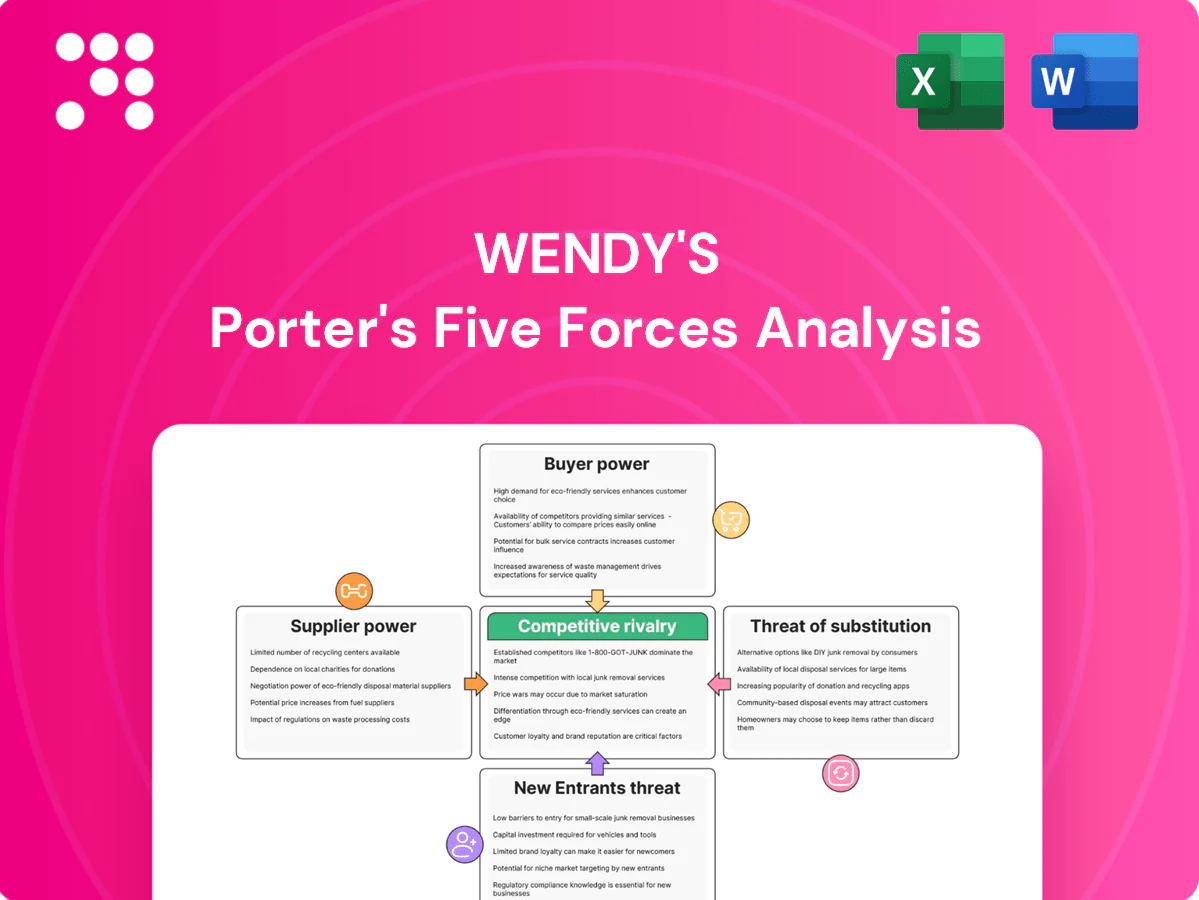
This preview shows the exact Wendy's Porter's Five Forces analysis you'll receive immediately after purchase—no placeholders or changes. It covers competitive rivalry, supplier and buyer power, and threats from new entrants and substitutes with concise, data-driven insights. The document is fully formatted and ready to download the moment you buy.

Go Beyond the Preview—Access the Full Strategic Report
Wendy's faces moderate supplier power, intense rivalry from major chains, and rising substitute threats from fast-casual and delivery platforms. This snapshot highlights the forces shaping margins and growth. This preview only scratches the surface. Unlock the full Porter's Five Forces Analysis to explore Wendy's competitive dynamics in detail.
Suppliers Bargaining Power
Concentrated protein suppliers
Beef and chicken for Wendy's are drawn from a concentrated supplier base—roughly four beef packers control about 80% of U.S. fed-cattle processing and the top four chicken processors handle ~55%–60% of capacity—giving suppliers strong pricing leverage. Wendy's fresh, never-frozen beef requirement further narrows qualified suppliers, raising dependence and sourcing costs. Industry consolidation and periodic plant capacity constraints in 2023–24 tightened availability, increasing exposure to supply shocks and bargaining pressure.
Commodity price volatility
Input costs for beef, poultry, dairy and potatoes are cyclical and driven by feed, weather and disease; USDA data showed 2024 monthly beef cutout swings remained elevated, reflecting continued volatility.
Spikes can compress margins if menu prices cannot adjust quickly, and hedging programs reduce but do not eliminate exposure.
In tight supplier markets, producers can pass through costs, increasing supplier bargaining power and pressuring gross margins.
Scale and long-term contracts
Wendy's scale—about 7,000 global restaurants in 2024—lets it aggregate purchasing and commit volume to processors, providing counter-leverage vs suppliers. Multi-year contracts and approved-vendor programs standardize quality and pricing, stabilizing supply and reducing opportunistic renegotiations. This moderates supplier power despite commodity cycles, lowering input-cost volatility for franchisees.
Switching costs tied to quality and safety
Wendy's strict product specs, food-safety protocols and brand claims—supporting roughly 7,000 global restaurants (2024)—create high qualification hurdles for replacement vendors; onboarding new suppliers requires audits, lab tests and logistics integration, typically taking months and generating implicit switching costs that preserve supplier leverage.
Logistics and distribution intermediaries
Logistics and third-party distribution are critical to Wendy's freshness and store uptime; as of 2024 Wendy's network serves roughly 7,000 restaurants, making distribution-center reliability vital. Regional bottlenecks or carrier shortages—the US 3PL market was about $300 billion in 2023—can quickly empower intermediaries and cause lost sales. Network optimization and multi-sourcing reduce exposure, but significant disruptions still translate into supplier-side leverage and margin pressure.
- ~7,000 restaurants served (2024)
- US 3PL market ≈ $300B (2023)
- Multi-sourcing lowers single-point risk
- Regional carrier shortages increase intermediary power
Meat supplier concentration raises leverage despite restaurant scale and contracts
Supplier power is elevated: four beef packers control ~80% of U.S. fed-cattle processing and top four chicken processors cover ~55–60%, with 2024 beef cutout volatility remaining high. Wendy's fresh, never-frozen spec narrows qualified vendors and raises switching costs. Scale (~7,000 restaurants in 2024) and contracts moderate but do not eliminate supplier leverage.
| Metric | 2023–24 |
|---|---|
| Beef packer share | ~80% |
| Chicken top-4 | 55–60% |
| Restaurants | ~7,000 (2024) |
What is included in the product
Detailed Word Document
Concise Porter’s Five Forces assessment of Wendy’s, highlighting competitive rivalry with QSR peers, buyer price sensitivity, supplier influence, threat of new entrants and substitutes, and strategic levers to protect margins.
Customizable Excel Spreadsheet
Instant one-sheet Porter's Five Forces for Wendy's—quickly spot competitive pressures, supplier power, and substitute threats to inform menu, pricing, and expansion strategies.
Customers Bargaining Power
Low switching costs for diners
Customers can switch among QSRs with minimal effort and small price gaps; in the ~300 billion USD US QSR market in 2024, in-the-moment proximity and speed often trump brand loyalty. This high-torque buying behavior keeps price elasticity elevated and constrains Wendy's pricing power. Wendy's must lean on value bundles, limited-time offers and menu differentiation to sustain traffic and frequency.
Price sensitivity and deal-seeking
Value menus and competitive discounting at Wendy's steer price-sensitive demand, with promotions, combo pricing and coupons heavily shaping purchases. US inflation eased to about 3.4% in 2024, which amplified deal-seeking and coupon use. Increased promotion intensity strengthens buyer power and can compress margins when traffic falters.
Digital visibility and reviews
Mobile apps, delivery platforms and social media increase transparency on price, wait times and quality, with DoorDash holding roughly 60% of the U.S. delivery market in 2023 and third-party channels crucial for quick-service traffic.
Negative reviews on platforms and social feeds can rapidly divert customers to rivals; Wendy's reported digital sales were about one-third of systemwide sales in 2023, amplifying the impact.
Digital price and quality comparisons intensify buyer bargaining clout, so Wendy's must sustain consistency and rapid responsiveness to protect share and margins.
Loyalty programs as counterweight
Wendy's app-based Rewards—with over 30 million active members as of 2024—reduces churn and raises switching costs by delivering personalized offers; data-driven targeting has lifted visit frequency and average ticket size, supporting digital sales that approach ~25% of systemwide sales. This creates perceived value that partially offsets buyer power, though execution quality and coupon economics determine net margin impact.
Customization expectations
Wendy's positioning on made-to-order, fresh never frozen beef elevates customer customization expectations, increasing satisfaction but adding labor and order-accuracy complexity for its restaurant base. Operational lapses prompt immediate switching in a crowded burger market where Wendy's is the third-largest chain by locations in 2024. Consistently meeting customization tempers buyer power by raising perceived differentiation and loyalty.
- Customization raises satisfaction yet increases labor/accuracy risk
- Failure to meet expectations leads to rapid switching
- Meeting expectations reduces buyer power via differentiation
QSR churn compresses margins in $300B US market; promos, delivery, coupons
Customers switch QSRs easily in the ~$300B US market (2024), keeping price elasticity high and pressuring Wendy's pricing. Promotions, value menus and delivery transparency (DoorDash ~60% share, 2023) amplify buyer power. Wendy's 30M+ Rewards and ~25% digital sales raise stickiness but coupon economics constrain margins.
| Metric | Value |
|---|---|
| US QSR market | $300B (2024) |
| Rewards | 30M+ (2024) |
| Digital sales | ~25% |
| DoorDash share | ~60% (2023) |
Preview Before You Purchase
Wendy's Porter's Five Forces Analysis
This preview shows the exact Wendy's Porter's Five Forces analysis you'll receive immediately after purchase—no placeholders or changes. It covers competitive rivalry, supplier and buyer power, and threats from new entrants and substitutes with concise, data-driven insights. The document is fully formatted and ready to download the moment you buy.
Original: $10.00
-65%$10.00
$3.50Description
Go Beyond the Preview—Access the Full Strategic Report
Wendy's faces moderate supplier power, intense rivalry from major chains, and rising substitute threats from fast-casual and delivery platforms. This snapshot highlights the forces shaping margins and growth. This preview only scratches the surface. Unlock the full Porter's Five Forces Analysis to explore Wendy's competitive dynamics in detail.
Suppliers Bargaining Power
Concentrated protein suppliers
Beef and chicken for Wendy's are drawn from a concentrated supplier base—roughly four beef packers control about 80% of U.S. fed-cattle processing and the top four chicken processors handle ~55%–60% of capacity—giving suppliers strong pricing leverage. Wendy's fresh, never-frozen beef requirement further narrows qualified suppliers, raising dependence and sourcing costs. Industry consolidation and periodic plant capacity constraints in 2023–24 tightened availability, increasing exposure to supply shocks and bargaining pressure.
Commodity price volatility
Input costs for beef, poultry, dairy and potatoes are cyclical and driven by feed, weather and disease; USDA data showed 2024 monthly beef cutout swings remained elevated, reflecting continued volatility.
Spikes can compress margins if menu prices cannot adjust quickly, and hedging programs reduce but do not eliminate exposure.
In tight supplier markets, producers can pass through costs, increasing supplier bargaining power and pressuring gross margins.
Scale and long-term contracts
Wendy's scale—about 7,000 global restaurants in 2024—lets it aggregate purchasing and commit volume to processors, providing counter-leverage vs suppliers. Multi-year contracts and approved-vendor programs standardize quality and pricing, stabilizing supply and reducing opportunistic renegotiations. This moderates supplier power despite commodity cycles, lowering input-cost volatility for franchisees.
Switching costs tied to quality and safety
Wendy's strict product specs, food-safety protocols and brand claims—supporting roughly 7,000 global restaurants (2024)—create high qualification hurdles for replacement vendors; onboarding new suppliers requires audits, lab tests and logistics integration, typically taking months and generating implicit switching costs that preserve supplier leverage.
Logistics and distribution intermediaries
Logistics and third-party distribution are critical to Wendy's freshness and store uptime; as of 2024 Wendy's network serves roughly 7,000 restaurants, making distribution-center reliability vital. Regional bottlenecks or carrier shortages—the US 3PL market was about $300 billion in 2023—can quickly empower intermediaries and cause lost sales. Network optimization and multi-sourcing reduce exposure, but significant disruptions still translate into supplier-side leverage and margin pressure.
- ~7,000 restaurants served (2024)
- US 3PL market ≈ $300B (2023)
- Multi-sourcing lowers single-point risk
- Regional carrier shortages increase intermediary power
Meat supplier concentration raises leverage despite restaurant scale and contracts
Supplier power is elevated: four beef packers control ~80% of U.S. fed-cattle processing and top four chicken processors cover ~55–60%, with 2024 beef cutout volatility remaining high. Wendy's fresh, never-frozen spec narrows qualified vendors and raises switching costs. Scale (~7,000 restaurants in 2024) and contracts moderate but do not eliminate supplier leverage.
| Metric | 2023–24 |
|---|---|
| Beef packer share | ~80% |
| Chicken top-4 | 55–60% |
| Restaurants | ~7,000 (2024) |
What is included in the product
Detailed Word Document
Concise Porter’s Five Forces assessment of Wendy’s, highlighting competitive rivalry with QSR peers, buyer price sensitivity, supplier influence, threat of new entrants and substitutes, and strategic levers to protect margins.
Customizable Excel Spreadsheet
Instant one-sheet Porter's Five Forces for Wendy's—quickly spot competitive pressures, supplier power, and substitute threats to inform menu, pricing, and expansion strategies.
Customers Bargaining Power
Low switching costs for diners
Customers can switch among QSRs with minimal effort and small price gaps; in the ~300 billion USD US QSR market in 2024, in-the-moment proximity and speed often trump brand loyalty. This high-torque buying behavior keeps price elasticity elevated and constrains Wendy's pricing power. Wendy's must lean on value bundles, limited-time offers and menu differentiation to sustain traffic and frequency.
Price sensitivity and deal-seeking
Value menus and competitive discounting at Wendy's steer price-sensitive demand, with promotions, combo pricing and coupons heavily shaping purchases. US inflation eased to about 3.4% in 2024, which amplified deal-seeking and coupon use. Increased promotion intensity strengthens buyer power and can compress margins when traffic falters.
Digital visibility and reviews
Mobile apps, delivery platforms and social media increase transparency on price, wait times and quality, with DoorDash holding roughly 60% of the U.S. delivery market in 2023 and third-party channels crucial for quick-service traffic.
Negative reviews on platforms and social feeds can rapidly divert customers to rivals; Wendy's reported digital sales were about one-third of systemwide sales in 2023, amplifying the impact.
Digital price and quality comparisons intensify buyer bargaining clout, so Wendy's must sustain consistency and rapid responsiveness to protect share and margins.
Loyalty programs as counterweight
Wendy's app-based Rewards—with over 30 million active members as of 2024—reduces churn and raises switching costs by delivering personalized offers; data-driven targeting has lifted visit frequency and average ticket size, supporting digital sales that approach ~25% of systemwide sales. This creates perceived value that partially offsets buyer power, though execution quality and coupon economics determine net margin impact.
Customization expectations
Wendy's positioning on made-to-order, fresh never frozen beef elevates customer customization expectations, increasing satisfaction but adding labor and order-accuracy complexity for its restaurant base. Operational lapses prompt immediate switching in a crowded burger market where Wendy's is the third-largest chain by locations in 2024. Consistently meeting customization tempers buyer power by raising perceived differentiation and loyalty.
- Customization raises satisfaction yet increases labor/accuracy risk
- Failure to meet expectations leads to rapid switching
- Meeting expectations reduces buyer power via differentiation
QSR churn compresses margins in $300B US market; promos, delivery, coupons
Customers switch QSRs easily in the ~$300B US market (2024), keeping price elasticity high and pressuring Wendy's pricing. Promotions, value menus and delivery transparency (DoorDash ~60% share, 2023) amplify buyer power. Wendy's 30M+ Rewards and ~25% digital sales raise stickiness but coupon economics constrain margins.
| Metric | Value |
|---|---|
| US QSR market | $300B (2024) |
| Rewards | 30M+ (2024) |
| Digital sales | ~25% |
| DoorDash share | ~60% (2023) |
Preview Before You Purchase
Wendy's Porter's Five Forces Analysis
This preview shows the exact Wendy's Porter's Five Forces analysis you'll receive immediately after purchase—no placeholders or changes. It covers competitive rivalry, supplier and buyer power, and threats from new entrants and substitutes with concise, data-driven insights. The document is fully formatted and ready to download the moment you buy.











