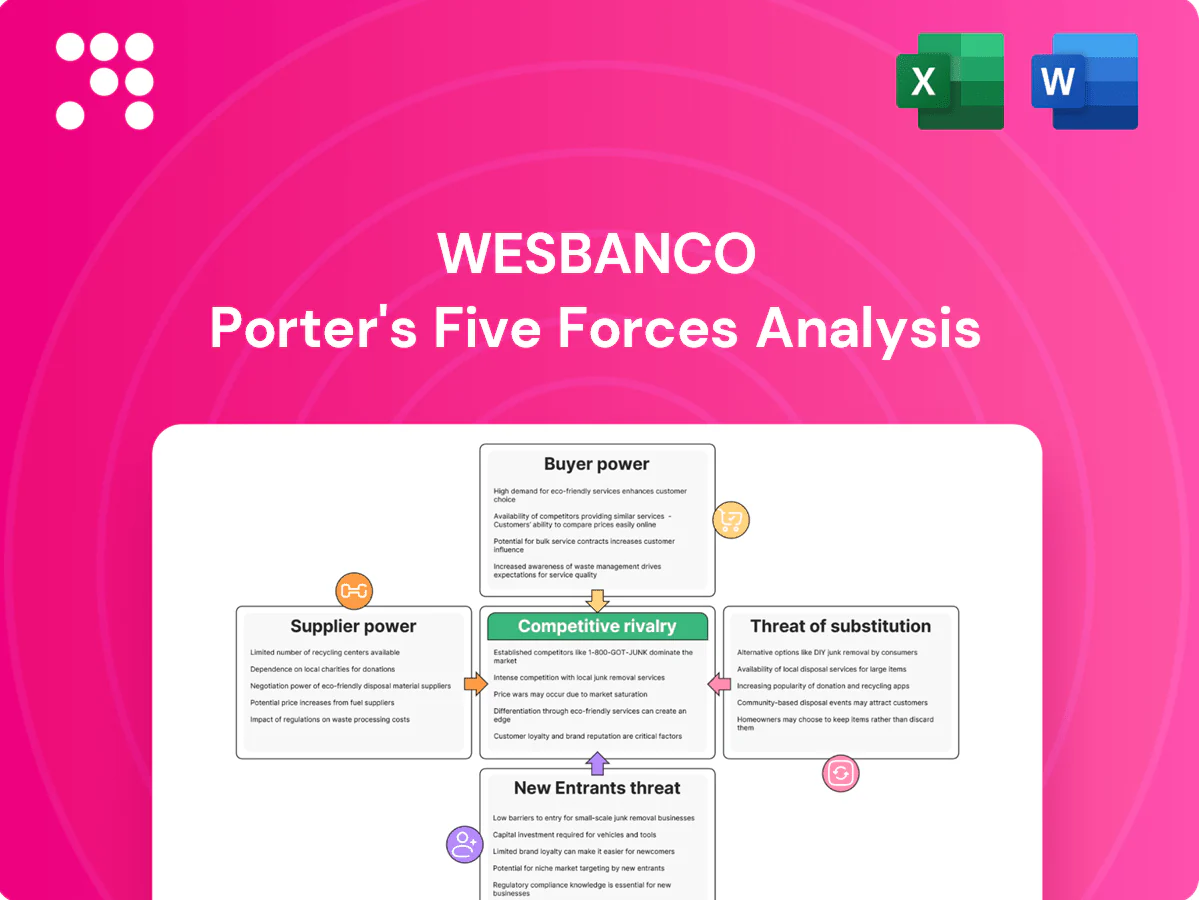
WesBanco Porter's Five Forces Analysis

A Must-Have Tool for Decision-Makers
WesBanco's Porter’s Five Forces reveals moderate competitive rivalry, limited supplier power, strong buyer expectations, manageable threat of substitutes, and entry barriers shaped by regulation and scale. This snapshot highlights key pressures on margins and growth. Unlock the full Porter's Five Forces Analysis to explore WesBanco’s competitive dynamics, market pressures, and strategic advantages in detail.
Suppliers Bargaining Power

Core tech and payments vendors concentrated
Core banking platforms, card networks and payments processors are concentrated and sticky: Visa and Mastercard handled roughly 83% of global card transactions in 2023, while core migrations typically take 12–36 months and often cost $10M–$100M, creating high switching risk and dependence. Vendor roadmaps therefore shape WesBanco’s product cadence; negotiation leverage improves with scale bundling and multi‑vendor strategies.
Depositors as funding suppliers
Households and businesses provide WesBanco with low-cost core deposits—WesBanco reported approximately $20.8 billion in total deposits at YE 2024—yet rate sensitivity rose in 2024 as market yields climbed, forcing higher retail rates and weighing on NIM. Large-account concentrations increase repricing risk, while deeper relationships and tailored deposit products have helped moderate churn.

Wholesale funding and capital markets
FHLB advances, brokered CDs and debt issuance give WesBanco funding flexibility but are priced to market; the Fed funds peak at 5.25–5.50% in 2023–24 pushed wholesale funding costs higher. Spreads widened in volatile 2022–24 periods, lifting dependence and expense. Covenants and availability can tighten under stress. A diversified liquidity mix reduces reliance on any single supplier.

Specialist talent and compliance services
Risk, credit, cybersecurity, and compliance specialists are scarce, with ISC2 estimating a global cybersecurity workforce gap of about 3.4 million in 2024, driving upward wage pressure for banks including WesBanco. External legal, audit, and consulting firms retain knowledge advantages and command premium rates, while accelerating regulatory change in 2023–24 amplified demand for outsourced services. Building selective in-house capability can rebalance supplier bargaining power and reduce outsourced spend over time.
- 3.4M: 2024 global cyber workforce gap (ISC2)
- Higher wages: specialist roles drive cost inflation
- Consulting firms hold expertise and pricing leverage
- In-house build lowers long-term supplier dependence
Data, cloud, and analytics platforms
Cloud and analytics vendors are oligopolistic—AWS 32%, Microsoft Azure 23%, Google Cloud 11% (2024)—so egress and integration costs create meaningful lock-in for WesBanco. Consumption-based pricing can escalate as data and analytics workloads grow, while banking security and resiliency requirements restrict switching. Contract clauses for portability and open standards materially reduce supplier leverage.
- Market share: AWS 32%, Azure 23%, GCP 11% (2024)
- Key risks: egress fees, integration lock-in, regulatory security constraints
- Mitigants: portability clauses, open standards, multi-cloud strategies
Payment networks, cloud dominance and cyber talent gap squeeze bank margins despite solid deposits
Suppliers exert moderate-to-high power: concentrated card networks (Visa+Mastercard ~83% of card volume in 2023) and sticky core/cloud vendors (AWS 32%, Azure 23%, GCP 11% in 2024) create switching costs and pricing leverage. WesBanco’s $20.8B deposits (YE 2024) and diversified funding mix reduce dependence, but higher market yields and a 3.4M global cyber workforce gap (2024) raise cost pressure and outsourcing premiums.
| Metric | Value |
|---|---|
| Total deposits (WesBanco) | $20.8B (YE 2024) |
| Card network share | Visa+MC ~83% (2023) |
| Cloud market share | AWS 32% / Azure 23% / GCP 11% (2024) |
| Cyber workforce gap | 3.4M (ISC2, 2024) |
| Fed funds peak | 5.25–5.50% (2023–24) |
What is included in the product
 Detailed Word Document
Concise Porter's Five Forces review tailored to WesBanco, assessing competitive rivalry, customer and supplier power, entry barriers, substitutes, and emerging threats to its regional banking franchise.

 Customizable Excel Spreadsheet
A concise, one-sheet WesBanco Porter's Five Forces summary that visualizes competitive pressure with an editable spider chart—perfect for board decks or quick risk decisions. It eliminates analysis bottlenecks with no-code customization, copy-ready slides, and easy integration into reports.
Customers Bargaining Power

Rate-sensitive retail depositors
Rate-sensitive retail depositors can compare rates instantly and move funds digitally, raising price pressure; in 2024 top high-yield online savings approached 5% while US money market fund assets exceeded $5 trillion, elevating alternatives. Loyalty based on convenience and trust persists but erodes as yield gaps widen; personalization and bundled services can blunt switching.
Commercial clients with multi-banking
Commercial clients commonly multi-bank, giving them leverage to negotiate fees and rates; WesBanco, with roughly $18.5 billion in assets in 2024, faces this pricing pressure. Treasury services such as payments and cash management are sticky but clients still re-bid relationships periodically. Credit appetite remains linked to relationship depth and cross-sell penetration. Tailored lending and treasury bundles can materially reduce switching and customer bargaining power.

Transparent fees and switching ease
Digital account opening and automated transfers cut switching friction, with 65% of U.S. consumers using digital channels to open accounts in 2024, accelerating churn risk for WesBanco. Comparison sites and aggregator tools make fees and features immediately visible, amplifying price sensitivity. Negative experiences prompt rapid attrition, so proactive retention and clear value propositions materially reduce customer bargaining power.

Wealth and trust clients expect integration
Affluent WesBanco clients increasingly demand integrated banking, wealth, and trust solutions and can reallocate assets to national platforms if service lags; WesBanco reported about $11.9 billion in total assets (2024) which limits scale versus national rivals.
Strong advisor-client relationships can anchor funds and fee income, while robust performance reporting and digital tools materially reduce client churn risk.
- Affluent demand: holistic wealth + trust
- Switch risk: national platforms lure assets
- Advisor stickiness: anchors AUM and fees
- Digital/reporting: key bargaining lever
Community expectations and service quality
In regional markets, WesBanco’s local reputation and responsiveness—supported by a roughly 125-branch footprint across its five-state footprint in 2024—makes community ties a buffer against pure price competition.
Service lapses quickly translate into customer leverage in close-knit markets, while consistent CX across branches and digital channels reduces switching incentives and weakens buyer power.
- 125 branches (2024); five-state presence
- Strong local service = lower price sensitivity
- CX consistency reduces customer leverage
Regional bank $18.5B faces churn as online yields near 5%
Price-sensitive retail depositors and commercial clients exert rising pressure as 2024 high‑yield online savings neared 5% and US money market assets topped $5T; digital switching (65% open accounts digitally in 2024) amplifies churn risk for WesBanco (≈$18.5B assets, 125 branches across five states). Strong advisor relationships, tailored lending and bundled treasury services reduce customer bargaining power.
| Metric | 2024 |
|---|---|
| WesBanco assets | $18.5B |
| Wealth/related assets | $11.9B |
| Branches | 125 |
| Digital account openings | 65% |
| US money market assets | >$5T |
| Top online yields | ~5% |
What You See Is What You Get
WesBanco Porter's Five Forces Analysis
This preview shows the exact WesBanco Porter’s Five Forces analysis you’ll receive upon purchase—no placeholders or samples. The document is fully formatted, professional, and ready for immediate download and use. What you see here is precisely the file you’ll get after payment.

A Must-Have Tool for Decision-Makers
WesBanco's Porter’s Five Forces reveals moderate competitive rivalry, limited supplier power, strong buyer expectations, manageable threat of substitutes, and entry barriers shaped by regulation and scale. This snapshot highlights key pressures on margins and growth. Unlock the full Porter's Five Forces Analysis to explore WesBanco’s competitive dynamics, market pressures, and strategic advantages in detail.
Suppliers Bargaining Power
Core tech and payments vendors concentrated
Core banking platforms, card networks and payments processors are concentrated and sticky: Visa and Mastercard handled roughly 83% of global card transactions in 2023, while core migrations typically take 12–36 months and often cost $10M–$100M, creating high switching risk and dependence. Vendor roadmaps therefore shape WesBanco’s product cadence; negotiation leverage improves with scale bundling and multi‑vendor strategies.
Depositors as funding suppliers
Households and businesses provide WesBanco with low-cost core deposits—WesBanco reported approximately $20.8 billion in total deposits at YE 2024—yet rate sensitivity rose in 2024 as market yields climbed, forcing higher retail rates and weighing on NIM. Large-account concentrations increase repricing risk, while deeper relationships and tailored deposit products have helped moderate churn.
Wholesale funding and capital markets
FHLB advances, brokered CDs and debt issuance give WesBanco funding flexibility but are priced to market; the Fed funds peak at 5.25–5.50% in 2023–24 pushed wholesale funding costs higher. Spreads widened in volatile 2022–24 periods, lifting dependence and expense. Covenants and availability can tighten under stress. A diversified liquidity mix reduces reliance on any single supplier.
Specialist talent and compliance services
Risk, credit, cybersecurity, and compliance specialists are scarce, with ISC2 estimating a global cybersecurity workforce gap of about 3.4 million in 2024, driving upward wage pressure for banks including WesBanco. External legal, audit, and consulting firms retain knowledge advantages and command premium rates, while accelerating regulatory change in 2023–24 amplified demand for outsourced services. Building selective in-house capability can rebalance supplier bargaining power and reduce outsourced spend over time.
- 3.4M: 2024 global cyber workforce gap (ISC2)
- Higher wages: specialist roles drive cost inflation
- Consulting firms hold expertise and pricing leverage
- In-house build lowers long-term supplier dependence
Data, cloud, and analytics platforms
Cloud and analytics vendors are oligopolistic—AWS 32%, Microsoft Azure 23%, Google Cloud 11% (2024)—so egress and integration costs create meaningful lock-in for WesBanco. Consumption-based pricing can escalate as data and analytics workloads grow, while banking security and resiliency requirements restrict switching. Contract clauses for portability and open standards materially reduce supplier leverage.
- Market share: AWS 32%, Azure 23%, GCP 11% (2024)
- Key risks: egress fees, integration lock-in, regulatory security constraints
- Mitigants: portability clauses, open standards, multi-cloud strategies
Payment networks, cloud dominance and cyber talent gap squeeze bank margins despite solid deposits
Suppliers exert moderate-to-high power: concentrated card networks (Visa+Mastercard ~83% of card volume in 2023) and sticky core/cloud vendors (AWS 32%, Azure 23%, GCP 11% in 2024) create switching costs and pricing leverage. WesBanco’s $20.8B deposits (YE 2024) and diversified funding mix reduce dependence, but higher market yields and a 3.4M global cyber workforce gap (2024) raise cost pressure and outsourcing premiums.
| Metric | Value |
|---|---|
| Total deposits (WesBanco) | $20.8B (YE 2024) |
| Card network share | Visa+MC ~83% (2023) |
| Cloud market share | AWS 32% / Azure 23% / GCP 11% (2024) |
| Cyber workforce gap | 3.4M (ISC2, 2024) |
| Fed funds peak | 5.25–5.50% (2023–24) |
What is included in the product
Detailed Word Document
Concise Porter's Five Forces review tailored to WesBanco, assessing competitive rivalry, customer and supplier power, entry barriers, substitutes, and emerging threats to its regional banking franchise.
Customizable Excel Spreadsheet
A concise, one-sheet WesBanco Porter's Five Forces summary that visualizes competitive pressure with an editable spider chart—perfect for board decks or quick risk decisions. It eliminates analysis bottlenecks with no-code customization, copy-ready slides, and easy integration into reports.
Customers Bargaining Power
Rate-sensitive retail depositors
Rate-sensitive retail depositors can compare rates instantly and move funds digitally, raising price pressure; in 2024 top high-yield online savings approached 5% while US money market fund assets exceeded $5 trillion, elevating alternatives. Loyalty based on convenience and trust persists but erodes as yield gaps widen; personalization and bundled services can blunt switching.
Commercial clients with multi-banking
Commercial clients commonly multi-bank, giving them leverage to negotiate fees and rates; WesBanco, with roughly $18.5 billion in assets in 2024, faces this pricing pressure. Treasury services such as payments and cash management are sticky but clients still re-bid relationships periodically. Credit appetite remains linked to relationship depth and cross-sell penetration. Tailored lending and treasury bundles can materially reduce switching and customer bargaining power.
Transparent fees and switching ease
Digital account opening and automated transfers cut switching friction, with 65% of U.S. consumers using digital channels to open accounts in 2024, accelerating churn risk for WesBanco. Comparison sites and aggregator tools make fees and features immediately visible, amplifying price sensitivity. Negative experiences prompt rapid attrition, so proactive retention and clear value propositions materially reduce customer bargaining power.
Wealth and trust clients expect integration
Affluent WesBanco clients increasingly demand integrated banking, wealth, and trust solutions and can reallocate assets to national platforms if service lags; WesBanco reported about $11.9 billion in total assets (2024) which limits scale versus national rivals.
Strong advisor-client relationships can anchor funds and fee income, while robust performance reporting and digital tools materially reduce client churn risk.
- Affluent demand: holistic wealth + trust
- Switch risk: national platforms lure assets
- Advisor stickiness: anchors AUM and fees
- Digital/reporting: key bargaining lever
Community expectations and service quality
In regional markets, WesBanco’s local reputation and responsiveness—supported by a roughly 125-branch footprint across its five-state footprint in 2024—makes community ties a buffer against pure price competition.
Service lapses quickly translate into customer leverage in close-knit markets, while consistent CX across branches and digital channels reduces switching incentives and weakens buyer power.
- 125 branches (2024); five-state presence
- Strong local service = lower price sensitivity
- CX consistency reduces customer leverage
Regional bank $18.5B faces churn as online yields near 5%
Price-sensitive retail depositors and commercial clients exert rising pressure as 2024 high‑yield online savings neared 5% and US money market assets topped $5T; digital switching (65% open accounts digitally in 2024) amplifies churn risk for WesBanco (≈$18.5B assets, 125 branches across five states). Strong advisor relationships, tailored lending and bundled treasury services reduce customer bargaining power.
| Metric | 2024 |
|---|---|
| WesBanco assets | $18.5B |
| Wealth/related assets | $11.9B |
| Branches | 125 |
| Digital account openings | 65% |
| US money market assets | >$5T |
| Top online yields | ~5% |
What You See Is What You Get
WesBanco Porter's Five Forces Analysis
This preview shows the exact WesBanco Porter’s Five Forces analysis you’ll receive upon purchase—no placeholders or samples. The document is fully formatted, professional, and ready for immediate download and use. What you see here is precisely the file you’ll get after payment.
Original: $10.00
-65%$10.00
$3.50Description
A Must-Have Tool for Decision-Makers
WesBanco's Porter’s Five Forces reveals moderate competitive rivalry, limited supplier power, strong buyer expectations, manageable threat of substitutes, and entry barriers shaped by regulation and scale. This snapshot highlights key pressures on margins and growth. Unlock the full Porter's Five Forces Analysis to explore WesBanco’s competitive dynamics, market pressures, and strategic advantages in detail.
Suppliers Bargaining Power
Core tech and payments vendors concentrated
Core banking platforms, card networks and payments processors are concentrated and sticky: Visa and Mastercard handled roughly 83% of global card transactions in 2023, while core migrations typically take 12–36 months and often cost $10M–$100M, creating high switching risk and dependence. Vendor roadmaps therefore shape WesBanco’s product cadence; negotiation leverage improves with scale bundling and multi‑vendor strategies.
Depositors as funding suppliers
Households and businesses provide WesBanco with low-cost core deposits—WesBanco reported approximately $20.8 billion in total deposits at YE 2024—yet rate sensitivity rose in 2024 as market yields climbed, forcing higher retail rates and weighing on NIM. Large-account concentrations increase repricing risk, while deeper relationships and tailored deposit products have helped moderate churn.
Wholesale funding and capital markets
FHLB advances, brokered CDs and debt issuance give WesBanco funding flexibility but are priced to market; the Fed funds peak at 5.25–5.50% in 2023–24 pushed wholesale funding costs higher. Spreads widened in volatile 2022–24 periods, lifting dependence and expense. Covenants and availability can tighten under stress. A diversified liquidity mix reduces reliance on any single supplier.
Specialist talent and compliance services
Risk, credit, cybersecurity, and compliance specialists are scarce, with ISC2 estimating a global cybersecurity workforce gap of about 3.4 million in 2024, driving upward wage pressure for banks including WesBanco. External legal, audit, and consulting firms retain knowledge advantages and command premium rates, while accelerating regulatory change in 2023–24 amplified demand for outsourced services. Building selective in-house capability can rebalance supplier bargaining power and reduce outsourced spend over time.
- 3.4M: 2024 global cyber workforce gap (ISC2)
- Higher wages: specialist roles drive cost inflation
- Consulting firms hold expertise and pricing leverage
- In-house build lowers long-term supplier dependence
Data, cloud, and analytics platforms
Cloud and analytics vendors are oligopolistic—AWS 32%, Microsoft Azure 23%, Google Cloud 11% (2024)—so egress and integration costs create meaningful lock-in for WesBanco. Consumption-based pricing can escalate as data and analytics workloads grow, while banking security and resiliency requirements restrict switching. Contract clauses for portability and open standards materially reduce supplier leverage.
- Market share: AWS 32%, Azure 23%, GCP 11% (2024)
- Key risks: egress fees, integration lock-in, regulatory security constraints
- Mitigants: portability clauses, open standards, multi-cloud strategies
Payment networks, cloud dominance and cyber talent gap squeeze bank margins despite solid deposits
Suppliers exert moderate-to-high power: concentrated card networks (Visa+Mastercard ~83% of card volume in 2023) and sticky core/cloud vendors (AWS 32%, Azure 23%, GCP 11% in 2024) create switching costs and pricing leverage. WesBanco’s $20.8B deposits (YE 2024) and diversified funding mix reduce dependence, but higher market yields and a 3.4M global cyber workforce gap (2024) raise cost pressure and outsourcing premiums.
| Metric | Value |
|---|---|
| Total deposits (WesBanco) | $20.8B (YE 2024) |
| Card network share | Visa+MC ~83% (2023) |
| Cloud market share | AWS 32% / Azure 23% / GCP 11% (2024) |
| Cyber workforce gap | 3.4M (ISC2, 2024) |
| Fed funds peak | 5.25–5.50% (2023–24) |
What is included in the product
Detailed Word Document
Concise Porter's Five Forces review tailored to WesBanco, assessing competitive rivalry, customer and supplier power, entry barriers, substitutes, and emerging threats to its regional banking franchise.
Customizable Excel Spreadsheet
A concise, one-sheet WesBanco Porter's Five Forces summary that visualizes competitive pressure with an editable spider chart—perfect for board decks or quick risk decisions. It eliminates analysis bottlenecks with no-code customization, copy-ready slides, and easy integration into reports.
Customers Bargaining Power
Rate-sensitive retail depositors
Rate-sensitive retail depositors can compare rates instantly and move funds digitally, raising price pressure; in 2024 top high-yield online savings approached 5% while US money market fund assets exceeded $5 trillion, elevating alternatives. Loyalty based on convenience and trust persists but erodes as yield gaps widen; personalization and bundled services can blunt switching.
Commercial clients with multi-banking
Commercial clients commonly multi-bank, giving them leverage to negotiate fees and rates; WesBanco, with roughly $18.5 billion in assets in 2024, faces this pricing pressure. Treasury services such as payments and cash management are sticky but clients still re-bid relationships periodically. Credit appetite remains linked to relationship depth and cross-sell penetration. Tailored lending and treasury bundles can materially reduce switching and customer bargaining power.
Transparent fees and switching ease
Digital account opening and automated transfers cut switching friction, with 65% of U.S. consumers using digital channels to open accounts in 2024, accelerating churn risk for WesBanco. Comparison sites and aggregator tools make fees and features immediately visible, amplifying price sensitivity. Negative experiences prompt rapid attrition, so proactive retention and clear value propositions materially reduce customer bargaining power.
Wealth and trust clients expect integration
Affluent WesBanco clients increasingly demand integrated banking, wealth, and trust solutions and can reallocate assets to national platforms if service lags; WesBanco reported about $11.9 billion in total assets (2024) which limits scale versus national rivals.
Strong advisor-client relationships can anchor funds and fee income, while robust performance reporting and digital tools materially reduce client churn risk.
- Affluent demand: holistic wealth + trust
- Switch risk: national platforms lure assets
- Advisor stickiness: anchors AUM and fees
- Digital/reporting: key bargaining lever
Community expectations and service quality
In regional markets, WesBanco’s local reputation and responsiveness—supported by a roughly 125-branch footprint across its five-state footprint in 2024—makes community ties a buffer against pure price competition.
Service lapses quickly translate into customer leverage in close-knit markets, while consistent CX across branches and digital channels reduces switching incentives and weakens buyer power.
- 125 branches (2024); five-state presence
- Strong local service = lower price sensitivity
- CX consistency reduces customer leverage
Regional bank $18.5B faces churn as online yields near 5%
Price-sensitive retail depositors and commercial clients exert rising pressure as 2024 high‑yield online savings neared 5% and US money market assets topped $5T; digital switching (65% open accounts digitally in 2024) amplifies churn risk for WesBanco (≈$18.5B assets, 125 branches across five states). Strong advisor relationships, tailored lending and bundled treasury services reduce customer bargaining power.
| Metric | 2024 |
|---|---|
| WesBanco assets | $18.5B |
| Wealth/related assets | $11.9B |
| Branches | 125 |
| Digital account openings | 65% |
| US money market assets | >$5T |
| Top online yields | ~5% |
What You See Is What You Get
WesBanco Porter's Five Forces Analysis
This preview shows the exact WesBanco Porter’s Five Forces analysis you’ll receive upon purchase—no placeholders or samples. The document is fully formatted, professional, and ready for immediate download and use. What you see here is precisely the file you’ll get after payment.











