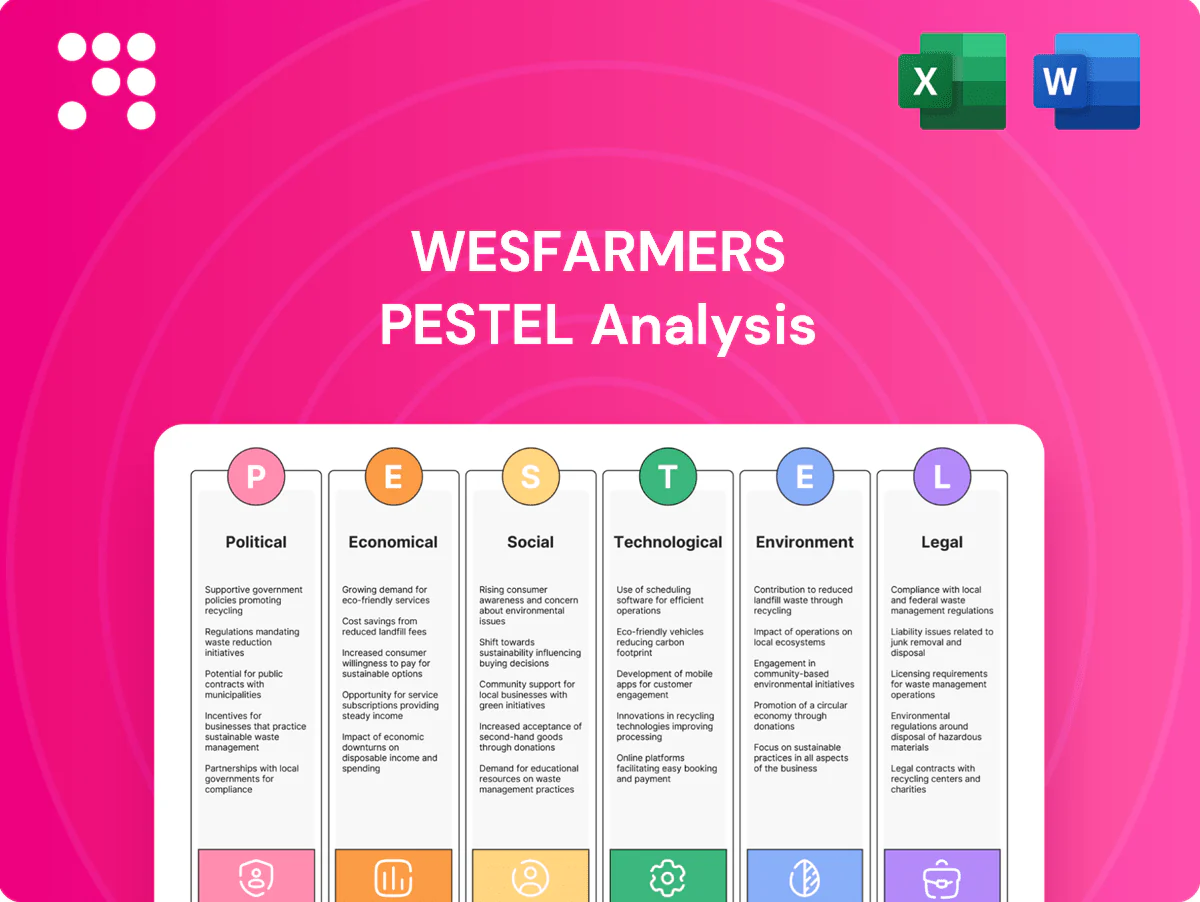
Wesfarmers PESTLE Analysis

Your Shortcut to Market Insight Starts Here
Our PESTLE analysis reveals how political shifts, economic cycles, social trends, technological change, legal frameworks and environmental pressures shape Wesfarmers' strategy and risks. Ideal for investors and strategists, it highlights opportunities and threats across divisions. Ready-to-use and fully sourced—buy the full report to access the complete deep-dive instantly.
Political factors

Federal and state policy stability
Stable federal and New Zealand policy settings—serving populations of about 26.1 million Australians and 5.1 million New Zealanders—enable Wesfarmers to plan long-term retail and industrial investment. Changes in budgets and procurement can quickly shift demand for safety and industrial supplies. State-level differences (NSW, VIC, QLD) affect store approvals, logistics and operating hours. Consistent engagement with regulators helps anticipate shifts.
Trade and tariffs on imports
Wesfarmers sources a large share of merchandise and inputs from Asia, so altered tariffs, anti-dumping measures or China-Australia geopolitical frictions can materially raise landed costs and margins. Customs modernisation, including Australia’s Single Trade Window rollout to 2025, can speed clearance and cut inventory buffers. Active supplier diversification across SE Asia and India mitigates trade concentration and political risk.

Infrastructure and regional development
Government investment in roads, rail and ports directly shapes Wesfarmers distribution efficiency and unit costs, influencing margins across Bunnings, Kmart and Coles; regional grants alter the economics of opening new stores and DCs. Infrastructure bottlenecks increase freight lead times and working capital tied up in inventory. Active collaboration with federal and state authorities can unlock last-mile improvements and reduce delivery costs.

Energy and resource policy
Policies on gas, electricity and fertiliser feedstocks directly affect industrial margins for Wesfarmers; Australia’s 43% emissions reduction pledge for 2030 fuels incentives for low-emissions manufacturing that can support chemicals and energy transitions. Price caps or market interventions increase planning uncertainty, so long-term supply contracts and hedges are used to manage policy-driven volatility.
- Gas and power policy: margin pressure
- 2030 target: 43% emissions reduction
- Intervention risk: planning uncertainty
- Mitigation: long-term contracts/hedging
Workforce and immigration settings
Visa rules and skilled migration (Australia permanent migration ceiling ~195,000 in 2023–24) shape availability of retail staff and specialist tech roles, forcing Wesfarmers to source more trainees and contractors; wage policies and public sector agreements set local pay benchmarks that compress margins. Political pressure on cost-of-living can prompt pricing inquiries and require adaptive workforce planning across policy cycles.
- visa: permanent ceiling 195,000
- staffing: >100,000 employees (Wesfarmers group scale)
- wages: public agreements set market benchmarks
- policy cycles: require flexible workforce plans
Policy stability in Australia and NZ shapes retail, trade costs, energy and labour outlook
Stable Australia (26.1M) and NZ (5.1M) policy settings support Wesfarmers’ long-term retail and industrial planning, while state-level rules affect store approvals and logistics. Trade frictions, tariffs and Single Trade Window (rollout to 2025) affect import costs; supplier diversification limits China concentration. Energy, gas policy and the 43% 2030 emissions target drive industrial cost and capex decisions; migration cap ~195,000 shapes labour supply.
| Metric | Value |
|---|---|
| Australia pop | 26.1M |
| NZ pop | 5.1M |
| 2030 target | 43% emissions ↓ |
| Migration cap 23–24 | 195,000 |
| Wesfarmers employees | >100,000 |
What is included in the product
 Detailed Word Document
Explores how Political, Economic, Social, Technological, Environmental and Legal forces uniquely affect Wesfarmers, with data-driven trends and region-specific examples; designed to support executives and investors by highlighting risks, opportunities and forward-looking scenarios for strategic planning.

 Customizable Excel Spreadsheet
A concise, visually segmented PESTLE summary of Wesfarmers for quick reference in meetings and presentations, editable for local context or business lines to align teams on external risks, market positioning and strategic priorities.
Economic factors

Consumer spending and cost-of-living
Household budgets directly drive demand at Bunnings, Kmart, Target and Officeworks as consumers prioritise essentials and home projects; Australia’s CPI eased to about 3.4% y/y in Dec 2024, but cost-of-living pressure persists. Inflation and rising utilities shift baskets toward value formats and private label ranges, boosting everyday-low-price performance. Promotional intensity increases during weak spending periods to protect volumes. Active category and mix management help sustain margins despite lower ASPs.
Interest rates and housing cycle
RBA cash rate peaked at 4.35% in November 2023, and subsequent rate moves directly influence mortgage stress and DIY renovation spend as households reprice budgets for repayments. Housing starts and approvals historically track Bunnings trade and retail sales, so a rebound in approvals would lift volumes. Rate cuts can release pent-up demand for home improvement; inventory positioning should therefore monitor housing approvals and lending growth closely.

Currency and import exposure
AUD/NZD volatility (AUD ranged roughly 0.62–0.74 USD in 2024–mid‑2025) raises import costs for Wesfarmers’ general merchandise and technology lines, with short‑term hedging smoothing COGS but not preventing long‑term price resets. A stronger USD/NZD/foreign basket squeezes gross margins unless offset by price increases or product mix shifts. Active supplier negotiations and multi‑currency sourcing provide operational flexibility and margin protection.

Commodity and input prices
Gas, ammonia and chemical inputs remain central to fertiliser economics; global ammonia prices dropped about 45% from 2022 peaks into 2024, easing input costs for Wesfarmers' CSBP operations. Freight, resin, cotton and metals swings directly affect merchandising margins; container rates fell sharply from 2022 highs, improving gross margin while any commodity spike compresses it. Active dynamic pricing and supplier risk management (SRM) are used to hedge these swings.
- Gas/ammonia: major input cost driver; ammonia ~45% below 2022 peak (2024)
- Freight/resin/metals: lower freight in 2024 supported margins
- Mitigation: dynamic pricing + SRM to hedge volatility
Labour market and productivity
Wage pressure from a tight Australian labour market (unemployment ~3.7% in 2024; Wage Price Index ~4.1% y/y June 2024) raises wage and training costs for Wesfarmers, while productivity programs across stores, DCs and manufacturing partially offset margin squeeze. Automation and rostering optimisation have lifted service levels, and higher retention is cutting recruitment spend.
- Labour tightness: unemployment ~3.7% (2024)
- Wage growth: WPI ~4.1% y/y (Jun 2024)
- Offset: store/DC/manufacturing productivity
- Efficiency: automation + rostering
- Retention lowers hiring cost
Policy stability in Australia and NZ shapes retail, trade costs, energy and labour outlook
Consumer spending remains constrained as Australia CPI ~3.4% y/y (Dec 2024) and cost‑of‑living pressures shift demand to value formats; RBA rates (cash peak 4.35% Nov 2023) affect mortgage/DIY spend. Labour tightness (unemployment ~3.7% 2024; WPI ~4.1% Jun 2024) lifts wages; AUD ranged ~0.62–0.74 USD (2024–mid‑2025) raising import costs. Ammonia ~45% below 2022 peaks easing fertiliser inputs; lower freight in 2024 supported margins.
| Metric | Value |
|---|---|
| CPI (Dec 2024) | ~3.4% y/y |
| Unemployment (2024) | ~3.7% |
| WPI (Jun 2024) | ~4.1% y/y |
| AUD USD range | 0.62–0.74 (2024–mid‑2025) |
| Ammonia vs 2022 | ~-45% |
Full Version Awaits
Wesfarmers PESTLE Analysis
The preview of the Wesfarmers PESTLE Analysis shown here is the exact document you’ll receive after purchase—fully formatted and ready to use. The layout, content, and structure visible are identical to the downloadable file you’ll get immediately after payment. No placeholders or teasers—this is the real, finished analysis ready for application.

Your Shortcut to Market Insight Starts Here
Our PESTLE analysis reveals how political shifts, economic cycles, social trends, technological change, legal frameworks and environmental pressures shape Wesfarmers' strategy and risks. Ideal for investors and strategists, it highlights opportunities and threats across divisions. Ready-to-use and fully sourced—buy the full report to access the complete deep-dive instantly.
Political factors
Federal and state policy stability
Stable federal and New Zealand policy settings—serving populations of about 26.1 million Australians and 5.1 million New Zealanders—enable Wesfarmers to plan long-term retail and industrial investment. Changes in budgets and procurement can quickly shift demand for safety and industrial supplies. State-level differences (NSW, VIC, QLD) affect store approvals, logistics and operating hours. Consistent engagement with regulators helps anticipate shifts.
Trade and tariffs on imports
Wesfarmers sources a large share of merchandise and inputs from Asia, so altered tariffs, anti-dumping measures or China-Australia geopolitical frictions can materially raise landed costs and margins. Customs modernisation, including Australia’s Single Trade Window rollout to 2025, can speed clearance and cut inventory buffers. Active supplier diversification across SE Asia and India mitigates trade concentration and political risk.
Infrastructure and regional development
Government investment in roads, rail and ports directly shapes Wesfarmers distribution efficiency and unit costs, influencing margins across Bunnings, Kmart and Coles; regional grants alter the economics of opening new stores and DCs. Infrastructure bottlenecks increase freight lead times and working capital tied up in inventory. Active collaboration with federal and state authorities can unlock last-mile improvements and reduce delivery costs.
Energy and resource policy
Policies on gas, electricity and fertiliser feedstocks directly affect industrial margins for Wesfarmers; Australia’s 43% emissions reduction pledge for 2030 fuels incentives for low-emissions manufacturing that can support chemicals and energy transitions. Price caps or market interventions increase planning uncertainty, so long-term supply contracts and hedges are used to manage policy-driven volatility.
- Gas and power policy: margin pressure
- 2030 target: 43% emissions reduction
- Intervention risk: planning uncertainty
- Mitigation: long-term contracts/hedging
Workforce and immigration settings
Visa rules and skilled migration (Australia permanent migration ceiling ~195,000 in 2023–24) shape availability of retail staff and specialist tech roles, forcing Wesfarmers to source more trainees and contractors; wage policies and public sector agreements set local pay benchmarks that compress margins. Political pressure on cost-of-living can prompt pricing inquiries and require adaptive workforce planning across policy cycles.
- visa: permanent ceiling 195,000
- staffing: >100,000 employees (Wesfarmers group scale)
- wages: public agreements set market benchmarks
- policy cycles: require flexible workforce plans
Policy stability in Australia and NZ shapes retail, trade costs, energy and labour outlook
Stable Australia (26.1M) and NZ (5.1M) policy settings support Wesfarmers’ long-term retail and industrial planning, while state-level rules affect store approvals and logistics. Trade frictions, tariffs and Single Trade Window (rollout to 2025) affect import costs; supplier diversification limits China concentration. Energy, gas policy and the 43% 2030 emissions target drive industrial cost and capex decisions; migration cap ~195,000 shapes labour supply.
| Metric | Value |
|---|---|
| Australia pop | 26.1M |
| NZ pop | 5.1M |
| 2030 target | 43% emissions ↓ |
| Migration cap 23–24 | 195,000 |
| Wesfarmers employees | >100,000 |
What is included in the product
Detailed Word Document
Explores how Political, Economic, Social, Technological, Environmental and Legal forces uniquely affect Wesfarmers, with data-driven trends and region-specific examples; designed to support executives and investors by highlighting risks, opportunities and forward-looking scenarios for strategic planning.
Customizable Excel Spreadsheet
A concise, visually segmented PESTLE summary of Wesfarmers for quick reference in meetings and presentations, editable for local context or business lines to align teams on external risks, market positioning and strategic priorities.
Economic factors
Consumer spending and cost-of-living
Household budgets directly drive demand at Bunnings, Kmart, Target and Officeworks as consumers prioritise essentials and home projects; Australia’s CPI eased to about 3.4% y/y in Dec 2024, but cost-of-living pressure persists. Inflation and rising utilities shift baskets toward value formats and private label ranges, boosting everyday-low-price performance. Promotional intensity increases during weak spending periods to protect volumes. Active category and mix management help sustain margins despite lower ASPs.
Interest rates and housing cycle
RBA cash rate peaked at 4.35% in November 2023, and subsequent rate moves directly influence mortgage stress and DIY renovation spend as households reprice budgets for repayments. Housing starts and approvals historically track Bunnings trade and retail sales, so a rebound in approvals would lift volumes. Rate cuts can release pent-up demand for home improvement; inventory positioning should therefore monitor housing approvals and lending growth closely.
Currency and import exposure
AUD/NZD volatility (AUD ranged roughly 0.62–0.74 USD in 2024–mid‑2025) raises import costs for Wesfarmers’ general merchandise and technology lines, with short‑term hedging smoothing COGS but not preventing long‑term price resets. A stronger USD/NZD/foreign basket squeezes gross margins unless offset by price increases or product mix shifts. Active supplier negotiations and multi‑currency sourcing provide operational flexibility and margin protection.
Commodity and input prices
Gas, ammonia and chemical inputs remain central to fertiliser economics; global ammonia prices dropped about 45% from 2022 peaks into 2024, easing input costs for Wesfarmers' CSBP operations. Freight, resin, cotton and metals swings directly affect merchandising margins; container rates fell sharply from 2022 highs, improving gross margin while any commodity spike compresses it. Active dynamic pricing and supplier risk management (SRM) are used to hedge these swings.
- Gas/ammonia: major input cost driver; ammonia ~45% below 2022 peak (2024)
- Freight/resin/metals: lower freight in 2024 supported margins
- Mitigation: dynamic pricing + SRM to hedge volatility
Labour market and productivity
Wage pressure from a tight Australian labour market (unemployment ~3.7% in 2024; Wage Price Index ~4.1% y/y June 2024) raises wage and training costs for Wesfarmers, while productivity programs across stores, DCs and manufacturing partially offset margin squeeze. Automation and rostering optimisation have lifted service levels, and higher retention is cutting recruitment spend.
- Labour tightness: unemployment ~3.7% (2024)
- Wage growth: WPI ~4.1% y/y (Jun 2024)
- Offset: store/DC/manufacturing productivity
- Efficiency: automation + rostering
- Retention lowers hiring cost
Policy stability in Australia and NZ shapes retail, trade costs, energy and labour outlook
Consumer spending remains constrained as Australia CPI ~3.4% y/y (Dec 2024) and cost‑of‑living pressures shift demand to value formats; RBA rates (cash peak 4.35% Nov 2023) affect mortgage/DIY spend. Labour tightness (unemployment ~3.7% 2024; WPI ~4.1% Jun 2024) lifts wages; AUD ranged ~0.62–0.74 USD (2024–mid‑2025) raising import costs. Ammonia ~45% below 2022 peaks easing fertiliser inputs; lower freight in 2024 supported margins.
| Metric | Value |
|---|---|
| CPI (Dec 2024) | ~3.4% y/y |
| Unemployment (2024) | ~3.7% |
| WPI (Jun 2024) | ~4.1% y/y |
| AUD USD range | 0.62–0.74 (2024–mid‑2025) |
| Ammonia vs 2022 | ~-45% |
Full Version Awaits
Wesfarmers PESTLE Analysis
The preview of the Wesfarmers PESTLE Analysis shown here is the exact document you’ll receive after purchase—fully formatted and ready to use. The layout, content, and structure visible are identical to the downloadable file you’ll get immediately after payment. No placeholders or teasers—this is the real, finished analysis ready for application.
Original: $10.00
-65%$10.00
$3.50Description
Your Shortcut to Market Insight Starts Here
Our PESTLE analysis reveals how political shifts, economic cycles, social trends, technological change, legal frameworks and environmental pressures shape Wesfarmers' strategy and risks. Ideal for investors and strategists, it highlights opportunities and threats across divisions. Ready-to-use and fully sourced—buy the full report to access the complete deep-dive instantly.
Political factors
Federal and state policy stability
Stable federal and New Zealand policy settings—serving populations of about 26.1 million Australians and 5.1 million New Zealanders—enable Wesfarmers to plan long-term retail and industrial investment. Changes in budgets and procurement can quickly shift demand for safety and industrial supplies. State-level differences (NSW, VIC, QLD) affect store approvals, logistics and operating hours. Consistent engagement with regulators helps anticipate shifts.
Trade and tariffs on imports
Wesfarmers sources a large share of merchandise and inputs from Asia, so altered tariffs, anti-dumping measures or China-Australia geopolitical frictions can materially raise landed costs and margins. Customs modernisation, including Australia’s Single Trade Window rollout to 2025, can speed clearance and cut inventory buffers. Active supplier diversification across SE Asia and India mitigates trade concentration and political risk.
Infrastructure and regional development
Government investment in roads, rail and ports directly shapes Wesfarmers distribution efficiency and unit costs, influencing margins across Bunnings, Kmart and Coles; regional grants alter the economics of opening new stores and DCs. Infrastructure bottlenecks increase freight lead times and working capital tied up in inventory. Active collaboration with federal and state authorities can unlock last-mile improvements and reduce delivery costs.
Energy and resource policy
Policies on gas, electricity and fertiliser feedstocks directly affect industrial margins for Wesfarmers; Australia’s 43% emissions reduction pledge for 2030 fuels incentives for low-emissions manufacturing that can support chemicals and energy transitions. Price caps or market interventions increase planning uncertainty, so long-term supply contracts and hedges are used to manage policy-driven volatility.
- Gas and power policy: margin pressure
- 2030 target: 43% emissions reduction
- Intervention risk: planning uncertainty
- Mitigation: long-term contracts/hedging
Workforce and immigration settings
Visa rules and skilled migration (Australia permanent migration ceiling ~195,000 in 2023–24) shape availability of retail staff and specialist tech roles, forcing Wesfarmers to source more trainees and contractors; wage policies and public sector agreements set local pay benchmarks that compress margins. Political pressure on cost-of-living can prompt pricing inquiries and require adaptive workforce planning across policy cycles.
- visa: permanent ceiling 195,000
- staffing: >100,000 employees (Wesfarmers group scale)
- wages: public agreements set market benchmarks
- policy cycles: require flexible workforce plans
Policy stability in Australia and NZ shapes retail, trade costs, energy and labour outlook
Stable Australia (26.1M) and NZ (5.1M) policy settings support Wesfarmers’ long-term retail and industrial planning, while state-level rules affect store approvals and logistics. Trade frictions, tariffs and Single Trade Window (rollout to 2025) affect import costs; supplier diversification limits China concentration. Energy, gas policy and the 43% 2030 emissions target drive industrial cost and capex decisions; migration cap ~195,000 shapes labour supply.
| Metric | Value |
|---|---|
| Australia pop | 26.1M |
| NZ pop | 5.1M |
| 2030 target | 43% emissions ↓ |
| Migration cap 23–24 | 195,000 |
| Wesfarmers employees | >100,000 |
What is included in the product
Detailed Word Document
Explores how Political, Economic, Social, Technological, Environmental and Legal forces uniquely affect Wesfarmers, with data-driven trends and region-specific examples; designed to support executives and investors by highlighting risks, opportunities and forward-looking scenarios for strategic planning.
Customizable Excel Spreadsheet
A concise, visually segmented PESTLE summary of Wesfarmers for quick reference in meetings and presentations, editable for local context or business lines to align teams on external risks, market positioning and strategic priorities.
Economic factors
Consumer spending and cost-of-living
Household budgets directly drive demand at Bunnings, Kmart, Target and Officeworks as consumers prioritise essentials and home projects; Australia’s CPI eased to about 3.4% y/y in Dec 2024, but cost-of-living pressure persists. Inflation and rising utilities shift baskets toward value formats and private label ranges, boosting everyday-low-price performance. Promotional intensity increases during weak spending periods to protect volumes. Active category and mix management help sustain margins despite lower ASPs.
Interest rates and housing cycle
RBA cash rate peaked at 4.35% in November 2023, and subsequent rate moves directly influence mortgage stress and DIY renovation spend as households reprice budgets for repayments. Housing starts and approvals historically track Bunnings trade and retail sales, so a rebound in approvals would lift volumes. Rate cuts can release pent-up demand for home improvement; inventory positioning should therefore monitor housing approvals and lending growth closely.
Currency and import exposure
AUD/NZD volatility (AUD ranged roughly 0.62–0.74 USD in 2024–mid‑2025) raises import costs for Wesfarmers’ general merchandise and technology lines, with short‑term hedging smoothing COGS but not preventing long‑term price resets. A stronger USD/NZD/foreign basket squeezes gross margins unless offset by price increases or product mix shifts. Active supplier negotiations and multi‑currency sourcing provide operational flexibility and margin protection.
Commodity and input prices
Gas, ammonia and chemical inputs remain central to fertiliser economics; global ammonia prices dropped about 45% from 2022 peaks into 2024, easing input costs for Wesfarmers' CSBP operations. Freight, resin, cotton and metals swings directly affect merchandising margins; container rates fell sharply from 2022 highs, improving gross margin while any commodity spike compresses it. Active dynamic pricing and supplier risk management (SRM) are used to hedge these swings.
- Gas/ammonia: major input cost driver; ammonia ~45% below 2022 peak (2024)
- Freight/resin/metals: lower freight in 2024 supported margins
- Mitigation: dynamic pricing + SRM to hedge volatility
Labour market and productivity
Wage pressure from a tight Australian labour market (unemployment ~3.7% in 2024; Wage Price Index ~4.1% y/y June 2024) raises wage and training costs for Wesfarmers, while productivity programs across stores, DCs and manufacturing partially offset margin squeeze. Automation and rostering optimisation have lifted service levels, and higher retention is cutting recruitment spend.
- Labour tightness: unemployment ~3.7% (2024)
- Wage growth: WPI ~4.1% y/y (Jun 2024)
- Offset: store/DC/manufacturing productivity
- Efficiency: automation + rostering
- Retention lowers hiring cost
Policy stability in Australia and NZ shapes retail, trade costs, energy and labour outlook
Consumer spending remains constrained as Australia CPI ~3.4% y/y (Dec 2024) and cost‑of‑living pressures shift demand to value formats; RBA rates (cash peak 4.35% Nov 2023) affect mortgage/DIY spend. Labour tightness (unemployment ~3.7% 2024; WPI ~4.1% Jun 2024) lifts wages; AUD ranged ~0.62–0.74 USD (2024–mid‑2025) raising import costs. Ammonia ~45% below 2022 peaks easing fertiliser inputs; lower freight in 2024 supported margins.
| Metric | Value |
|---|---|
| CPI (Dec 2024) | ~3.4% y/y |
| Unemployment (2024) | ~3.7% |
| WPI (Jun 2024) | ~4.1% y/y |
| AUD USD range | 0.62–0.74 (2024–mid‑2025) |
| Ammonia vs 2022 | ~-45% |
Full Version Awaits
Wesfarmers PESTLE Analysis
The preview of the Wesfarmers PESTLE Analysis shown here is the exact document you’ll receive after purchase—fully formatted and ready to use. The layout, content, and structure visible are identical to the downloadable file you’ll get immediately after payment. No placeholders or teasers—this is the real, finished analysis ready for application.











