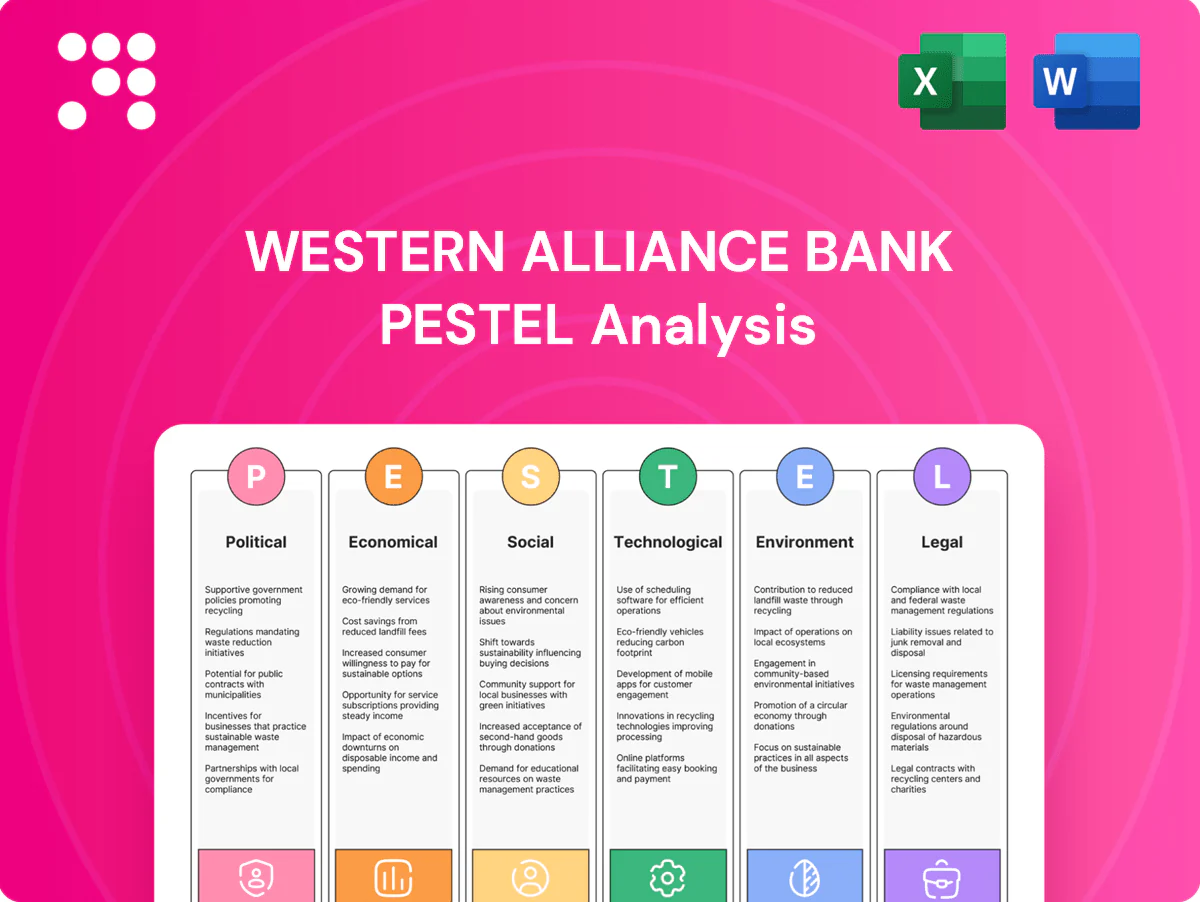
Western Alliance Bank PESTLE Analysis

Skip the Research. Get the Strategy.
Unlock strategic clarity with our targeted PESTLE Analysis of Western Alliance Bank—three concise sections revealing how political shifts, economic cycles, and regulatory trends shape its outlook. Actionable insights on technology, social change, and environmental risk help investors and strategists spot opportunities. Purchase the full report to access the complete, ready-to-use analysis and recommendations.
Political factors

US banking policy direction and oversight
Post-2023 bank failures (SVB, Signature, First Republic) and the $250,000 FDIC insurance cap prompted tighter supervisory focus on interest-rate risk and liquidity buffers for regionals. Regulators signaled higher capital and contingency-liquidity expectations and updated interagency guidance in 2023–24, which Western Alliance must embed into balance-sheet strategy. Political turnover can shift enforcement tone and accelerate FDIC reform proposals affecting examination rigor.
Basel III Endgame and capital calibration
Proposed Basel III Endgame capital rules issued by US regulators in 2023–2025 may raise risk-weighted assets and capital needs for specific portfolios, with higher market and operational risk add-ons squeezing returns and lending appetite. Western Alliance’s concentrated CRE and specialty lending could face differentiated, higher risk weights. Advocacy and the timing of final rules through mid-2025 will determine implementation costs and capital planning.

Deposit insurance reform and systemic risk debates
Policy discussions on targeted deposit insurance for business payments, against the backdrop of the $250,000 statutory limit and the 89% uninsured deposit share at Silicon Valley Bank’s failure, could materially alter WAL’s treasury-client economics. Changes to FDIC assessment rates or coverage design would force repricing of cash-management products. Clarity on treatment of large noninsured deposits is critical for liquidity planning and stress tests. Political consensus will dictate scope and speed.

State-level policy in core markets
- Housing shortfall CA ~1.5M
- CA median price ~$830k (2024)
- AZ pop growth ~1.8% (2023)
- NV median price ~$460k
- Water/climate rules reshape development
- Procurement influences muni banking
- Local stability affects permitting timelines
US–technology sector industrial policy
- CHIPS $52.7B → fab financing demand
- IRA ~$369B → clean-tech capex & lending
- Announced private chip investment >$200B → deposit & cash-management needs
- Policy risk → contingent financing structures
Post-2023 oversight and Basel III Endgame pressure capital, deposits and corporate cash pricing
Post-2023 failures tightened supervision on interest-rate risk, liquidity and contingency funding; Western Alliance must raise buffers and adjust ALM. Proposed Basel III Endgame (2023–25) could lift RWAs, pressuring capital for CRE and specialty lending. Deposit-insurance reform and targeted coverage debates directly affect treasury economics and pricing for large corporate cash.
| Item | Metric |
|---|---|
| FDIC cap | $250,000 |
| SVB uninsured | 89% |
| CA median price (2024) | $830,000 |
| CHIPS | $52.7B |
What is included in the product
 Detailed Word Document
Explores how Political, Economic, Social, Technological, Environmental and Legal forces uniquely affect Western Alliance Bank, with data-backed trends and forward-looking insights to identify risks and opportunities for executives, investors and strategists, formatted for easy insertion into plans, pitch decks, or reports.

 Customizable Excel Spreadsheet
A concise, visually segmented PESTLE summary of Western Alliance Bank that can be dropped into presentations, shared across teams, and annotated for regional or business-line risks to streamline planning, align stakeholders, and support external-risk discussions.
Economic factors

Interest-rate cycle and NIM sensitivity
Rate paths—with the fed funds target near 5.25–5.50% in mid‑2025—drive asset yields, deposit betas and NIM; in volatile or high‑rate regimes funding costs can rise faster than loan repricing, compressing margins. Western Alliance’s commercial‑heavy, treasury‑client mix increases sensitivity to these swings. Active hedging and dynamic product pricing are essential to protect NIM and control deposit beta exposure.
Commercial real estate cycle exposure
Western US CRE, notably office and multifamily, faces valuation, refinancing and occupancy pressures with metro office vacancy near 20% and multifamily rent growth slowing to low single digits in 2024; cap rates have repriced up roughly 150–250 bps since 2021, tightening underwriting and depressing new originations. Rising credit costs and higher special mention/criticized loan trends (mid-single-digit share in many regional portfolios) can pressure earnings, making portfolio granularity and collateral monitoring critical.

Sector concentration in tech and healthcare
Sector concentration in tech and healthcare means VC and life‑sciences funding cycles (swings of roughly 40% since the 2021 peak) materially drive deposit flows and loan demand; IPO/M&A windows can shift treasury balances by $10M–$500M per client. Downcycles can raise credit stress—cash‑burn clients see default risk rise about 3x—while diversification across industries and strict covenant discipline have reduced loss volatility by ~30%.

Labor market and wage dynamics
Tight labor markets—U.S. unemployment about 3.7% in mid‑2025 and average hourly earnings up ~4% YoY—push WAL’s operating costs higher, alter consumer credit card and business credit utilization, and squeeze small business clients facing wage and hiring pressures that reduce cash‑flow coverage; staffing for risk and compliance also becomes costlier while productivity investments (automation, digital onboarding) help offset margin pressure.
- Wage growth: ~4% YoY (mid‑2025)
- Unemployment: ~3.7% (mid‑2025)
- Impact: higher OPEX, tighter small business cash flow
- Mitigant: productivity/automation investments
Regional growth and migration trends
Regional migration reshapes Western Alliance Bank opportunities: Census estimates through 2023 show high-cost coastal states experiencing net domestic outflows while Sun Belt metros (Texas, Arizona, Florida) captured significant inflows, shifting mortgage and small-business loan demand toward growing metros. Major infrastructure and industrial buildouts in the West (ports, logistics, semiconductor sites) are supporting C&I loan growth, while local economic resilience drives deposit stability.
- Net migration: coastal outflows to Sun Belt per Census/IRS
- Loan shift: increased mortgage/SMB demand in Phoenix/Austin/Dallas
- C&I tailwinds: infrastructure/industrial projects boost lending
- Deposits: local employment strength underpins stability
Post-2023 oversight and Basel III Endgame pressure capital, deposits and corporate cash pricing
Rate path (fed funds 5.25–5.50% mid‑2025) raises funding costs and compresses NIM; Western Alliance’s commercial/treasury mix heightens sensitivity. Western US CRE shows ~20% metro office vacancy and cap rates +150–250bps since 2021, slowing originations. Tech/health exposure drives deposit/loan volatility; unemployment ~3.7% and wage growth ~4% lift OPEX.
| Metric | Value |
|---|---|
| Fed funds | 5.25–5.50% |
| Unemployment | 3.7% |
| Wage growth | ~4% YoY |
| Office vacancy | ~20% |
| CRE cap rate move | +150–250bps |
Preview the Actual Deliverable
Western Alliance Bank PESTLE Analysis
The Western Alliance Bank PESTLE Analysis preview shown here is the exact document you’ll receive after purchase—fully formatted and ready to use. This is a real screenshot of the product you’re buying and contains no placeholders or teasers. The layout, content, and structure visible here are exactly what you’ll download immediately after payment. What you see is the final, professionally structured file.

Skip the Research. Get the Strategy.
Unlock strategic clarity with our targeted PESTLE Analysis of Western Alliance Bank—three concise sections revealing how political shifts, economic cycles, and regulatory trends shape its outlook. Actionable insights on technology, social change, and environmental risk help investors and strategists spot opportunities. Purchase the full report to access the complete, ready-to-use analysis and recommendations.
Political factors
US banking policy direction and oversight
Post-2023 bank failures (SVB, Signature, First Republic) and the $250,000 FDIC insurance cap prompted tighter supervisory focus on interest-rate risk and liquidity buffers for regionals. Regulators signaled higher capital and contingency-liquidity expectations and updated interagency guidance in 2023–24, which Western Alliance must embed into balance-sheet strategy. Political turnover can shift enforcement tone and accelerate FDIC reform proposals affecting examination rigor.
Basel III Endgame and capital calibration
Proposed Basel III Endgame capital rules issued by US regulators in 2023–2025 may raise risk-weighted assets and capital needs for specific portfolios, with higher market and operational risk add-ons squeezing returns and lending appetite. Western Alliance’s concentrated CRE and specialty lending could face differentiated, higher risk weights. Advocacy and the timing of final rules through mid-2025 will determine implementation costs and capital planning.
Deposit insurance reform and systemic risk debates
Policy discussions on targeted deposit insurance for business payments, against the backdrop of the $250,000 statutory limit and the 89% uninsured deposit share at Silicon Valley Bank’s failure, could materially alter WAL’s treasury-client economics. Changes to FDIC assessment rates or coverage design would force repricing of cash-management products. Clarity on treatment of large noninsured deposits is critical for liquidity planning and stress tests. Political consensus will dictate scope and speed.
State-level policy in core markets
- Housing shortfall CA ~1.5M
- CA median price ~$830k (2024)
- AZ pop growth ~1.8% (2023)
- NV median price ~$460k
- Water/climate rules reshape development
- Procurement influences muni banking
- Local stability affects permitting timelines
US–technology sector industrial policy
- CHIPS $52.7B → fab financing demand
- IRA ~$369B → clean-tech capex & lending
- Announced private chip investment >$200B → deposit & cash-management needs
- Policy risk → contingent financing structures
Post-2023 oversight and Basel III Endgame pressure capital, deposits and corporate cash pricing
Post-2023 failures tightened supervision on interest-rate risk, liquidity and contingency funding; Western Alliance must raise buffers and adjust ALM. Proposed Basel III Endgame (2023–25) could lift RWAs, pressuring capital for CRE and specialty lending. Deposit-insurance reform and targeted coverage debates directly affect treasury economics and pricing for large corporate cash.
| Item | Metric |
|---|---|
| FDIC cap | $250,000 |
| SVB uninsured | 89% |
| CA median price (2024) | $830,000 |
| CHIPS | $52.7B |
What is included in the product
Detailed Word Document
Explores how Political, Economic, Social, Technological, Environmental and Legal forces uniquely affect Western Alliance Bank, with data-backed trends and forward-looking insights to identify risks and opportunities for executives, investors and strategists, formatted for easy insertion into plans, pitch decks, or reports.
Customizable Excel Spreadsheet
A concise, visually segmented PESTLE summary of Western Alliance Bank that can be dropped into presentations, shared across teams, and annotated for regional or business-line risks to streamline planning, align stakeholders, and support external-risk discussions.
Economic factors
Interest-rate cycle and NIM sensitivity
Rate paths—with the fed funds target near 5.25–5.50% in mid‑2025—drive asset yields, deposit betas and NIM; in volatile or high‑rate regimes funding costs can rise faster than loan repricing, compressing margins. Western Alliance’s commercial‑heavy, treasury‑client mix increases sensitivity to these swings. Active hedging and dynamic product pricing are essential to protect NIM and control deposit beta exposure.
Commercial real estate cycle exposure
Western US CRE, notably office and multifamily, faces valuation, refinancing and occupancy pressures with metro office vacancy near 20% and multifamily rent growth slowing to low single digits in 2024; cap rates have repriced up roughly 150–250 bps since 2021, tightening underwriting and depressing new originations. Rising credit costs and higher special mention/criticized loan trends (mid-single-digit share in many regional portfolios) can pressure earnings, making portfolio granularity and collateral monitoring critical.
Sector concentration in tech and healthcare
Sector concentration in tech and healthcare means VC and life‑sciences funding cycles (swings of roughly 40% since the 2021 peak) materially drive deposit flows and loan demand; IPO/M&A windows can shift treasury balances by $10M–$500M per client. Downcycles can raise credit stress—cash‑burn clients see default risk rise about 3x—while diversification across industries and strict covenant discipline have reduced loss volatility by ~30%.
Labor market and wage dynamics
Tight labor markets—U.S. unemployment about 3.7% in mid‑2025 and average hourly earnings up ~4% YoY—push WAL’s operating costs higher, alter consumer credit card and business credit utilization, and squeeze small business clients facing wage and hiring pressures that reduce cash‑flow coverage; staffing for risk and compliance also becomes costlier while productivity investments (automation, digital onboarding) help offset margin pressure.
- Wage growth: ~4% YoY (mid‑2025)
- Unemployment: ~3.7% (mid‑2025)
- Impact: higher OPEX, tighter small business cash flow
- Mitigant: productivity/automation investments
Regional growth and migration trends
Regional migration reshapes Western Alliance Bank opportunities: Census estimates through 2023 show high-cost coastal states experiencing net domestic outflows while Sun Belt metros (Texas, Arizona, Florida) captured significant inflows, shifting mortgage and small-business loan demand toward growing metros. Major infrastructure and industrial buildouts in the West (ports, logistics, semiconductor sites) are supporting C&I loan growth, while local economic resilience drives deposit stability.
- Net migration: coastal outflows to Sun Belt per Census/IRS
- Loan shift: increased mortgage/SMB demand in Phoenix/Austin/Dallas
- C&I tailwinds: infrastructure/industrial projects boost lending
- Deposits: local employment strength underpins stability
Post-2023 oversight and Basel III Endgame pressure capital, deposits and corporate cash pricing
Rate path (fed funds 5.25–5.50% mid‑2025) raises funding costs and compresses NIM; Western Alliance’s commercial/treasury mix heightens sensitivity. Western US CRE shows ~20% metro office vacancy and cap rates +150–250bps since 2021, slowing originations. Tech/health exposure drives deposit/loan volatility; unemployment ~3.7% and wage growth ~4% lift OPEX.
| Metric | Value |
|---|---|
| Fed funds | 5.25–5.50% |
| Unemployment | 3.7% |
| Wage growth | ~4% YoY |
| Office vacancy | ~20% |
| CRE cap rate move | +150–250bps |
Preview the Actual Deliverable
Western Alliance Bank PESTLE Analysis
The Western Alliance Bank PESTLE Analysis preview shown here is the exact document you’ll receive after purchase—fully formatted and ready to use. This is a real screenshot of the product you’re buying and contains no placeholders or teasers. The layout, content, and structure visible here are exactly what you’ll download immediately after payment. What you see is the final, professionally structured file.
Original: $10.00
-65%$10.00
$3.50Description
Skip the Research. Get the Strategy.
Unlock strategic clarity with our targeted PESTLE Analysis of Western Alliance Bank—three concise sections revealing how political shifts, economic cycles, and regulatory trends shape its outlook. Actionable insights on technology, social change, and environmental risk help investors and strategists spot opportunities. Purchase the full report to access the complete, ready-to-use analysis and recommendations.
Political factors
US banking policy direction and oversight
Post-2023 bank failures (SVB, Signature, First Republic) and the $250,000 FDIC insurance cap prompted tighter supervisory focus on interest-rate risk and liquidity buffers for regionals. Regulators signaled higher capital and contingency-liquidity expectations and updated interagency guidance in 2023–24, which Western Alliance must embed into balance-sheet strategy. Political turnover can shift enforcement tone and accelerate FDIC reform proposals affecting examination rigor.
Basel III Endgame and capital calibration
Proposed Basel III Endgame capital rules issued by US regulators in 2023–2025 may raise risk-weighted assets and capital needs for specific portfolios, with higher market and operational risk add-ons squeezing returns and lending appetite. Western Alliance’s concentrated CRE and specialty lending could face differentiated, higher risk weights. Advocacy and the timing of final rules through mid-2025 will determine implementation costs and capital planning.
Deposit insurance reform and systemic risk debates
Policy discussions on targeted deposit insurance for business payments, against the backdrop of the $250,000 statutory limit and the 89% uninsured deposit share at Silicon Valley Bank’s failure, could materially alter WAL’s treasury-client economics. Changes to FDIC assessment rates or coverage design would force repricing of cash-management products. Clarity on treatment of large noninsured deposits is critical for liquidity planning and stress tests. Political consensus will dictate scope and speed.
State-level policy in core markets
- Housing shortfall CA ~1.5M
- CA median price ~$830k (2024)
- AZ pop growth ~1.8% (2023)
- NV median price ~$460k
- Water/climate rules reshape development
- Procurement influences muni banking
- Local stability affects permitting timelines
US–technology sector industrial policy
- CHIPS $52.7B → fab financing demand
- IRA ~$369B → clean-tech capex & lending
- Announced private chip investment >$200B → deposit & cash-management needs
- Policy risk → contingent financing structures
Post-2023 oversight and Basel III Endgame pressure capital, deposits and corporate cash pricing
Post-2023 failures tightened supervision on interest-rate risk, liquidity and contingency funding; Western Alliance must raise buffers and adjust ALM. Proposed Basel III Endgame (2023–25) could lift RWAs, pressuring capital for CRE and specialty lending. Deposit-insurance reform and targeted coverage debates directly affect treasury economics and pricing for large corporate cash.
| Item | Metric |
|---|---|
| FDIC cap | $250,000 |
| SVB uninsured | 89% |
| CA median price (2024) | $830,000 |
| CHIPS | $52.7B |
What is included in the product
Detailed Word Document
Explores how Political, Economic, Social, Technological, Environmental and Legal forces uniquely affect Western Alliance Bank, with data-backed trends and forward-looking insights to identify risks and opportunities for executives, investors and strategists, formatted for easy insertion into plans, pitch decks, or reports.
Customizable Excel Spreadsheet
A concise, visually segmented PESTLE summary of Western Alliance Bank that can be dropped into presentations, shared across teams, and annotated for regional or business-line risks to streamline planning, align stakeholders, and support external-risk discussions.
Economic factors
Interest-rate cycle and NIM sensitivity
Rate paths—with the fed funds target near 5.25–5.50% in mid‑2025—drive asset yields, deposit betas and NIM; in volatile or high‑rate regimes funding costs can rise faster than loan repricing, compressing margins. Western Alliance’s commercial‑heavy, treasury‑client mix increases sensitivity to these swings. Active hedging and dynamic product pricing are essential to protect NIM and control deposit beta exposure.
Commercial real estate cycle exposure
Western US CRE, notably office and multifamily, faces valuation, refinancing and occupancy pressures with metro office vacancy near 20% and multifamily rent growth slowing to low single digits in 2024; cap rates have repriced up roughly 150–250 bps since 2021, tightening underwriting and depressing new originations. Rising credit costs and higher special mention/criticized loan trends (mid-single-digit share in many regional portfolios) can pressure earnings, making portfolio granularity and collateral monitoring critical.
Sector concentration in tech and healthcare
Sector concentration in tech and healthcare means VC and life‑sciences funding cycles (swings of roughly 40% since the 2021 peak) materially drive deposit flows and loan demand; IPO/M&A windows can shift treasury balances by $10M–$500M per client. Downcycles can raise credit stress—cash‑burn clients see default risk rise about 3x—while diversification across industries and strict covenant discipline have reduced loss volatility by ~30%.
Labor market and wage dynamics
Tight labor markets—U.S. unemployment about 3.7% in mid‑2025 and average hourly earnings up ~4% YoY—push WAL’s operating costs higher, alter consumer credit card and business credit utilization, and squeeze small business clients facing wage and hiring pressures that reduce cash‑flow coverage; staffing for risk and compliance also becomes costlier while productivity investments (automation, digital onboarding) help offset margin pressure.
- Wage growth: ~4% YoY (mid‑2025)
- Unemployment: ~3.7% (mid‑2025)
- Impact: higher OPEX, tighter small business cash flow
- Mitigant: productivity/automation investments
Regional growth and migration trends
Regional migration reshapes Western Alliance Bank opportunities: Census estimates through 2023 show high-cost coastal states experiencing net domestic outflows while Sun Belt metros (Texas, Arizona, Florida) captured significant inflows, shifting mortgage and small-business loan demand toward growing metros. Major infrastructure and industrial buildouts in the West (ports, logistics, semiconductor sites) are supporting C&I loan growth, while local economic resilience drives deposit stability.
- Net migration: coastal outflows to Sun Belt per Census/IRS
- Loan shift: increased mortgage/SMB demand in Phoenix/Austin/Dallas
- C&I tailwinds: infrastructure/industrial projects boost lending
- Deposits: local employment strength underpins stability
Post-2023 oversight and Basel III Endgame pressure capital, deposits and corporate cash pricing
Rate path (fed funds 5.25–5.50% mid‑2025) raises funding costs and compresses NIM; Western Alliance’s commercial/treasury mix heightens sensitivity. Western US CRE shows ~20% metro office vacancy and cap rates +150–250bps since 2021, slowing originations. Tech/health exposure drives deposit/loan volatility; unemployment ~3.7% and wage growth ~4% lift OPEX.
| Metric | Value |
|---|---|
| Fed funds | 5.25–5.50% |
| Unemployment | 3.7% |
| Wage growth | ~4% YoY |
| Office vacancy | ~20% |
| CRE cap rate move | +150–250bps |
Preview the Actual Deliverable
Western Alliance Bank PESTLE Analysis
The Western Alliance Bank PESTLE Analysis preview shown here is the exact document you’ll receive after purchase—fully formatted and ready to use. This is a real screenshot of the product you’re buying and contains no placeholders or teasers. The layout, content, and structure visible here are exactly what you’ll download immediately after payment. What you see is the final, professionally structured file.











