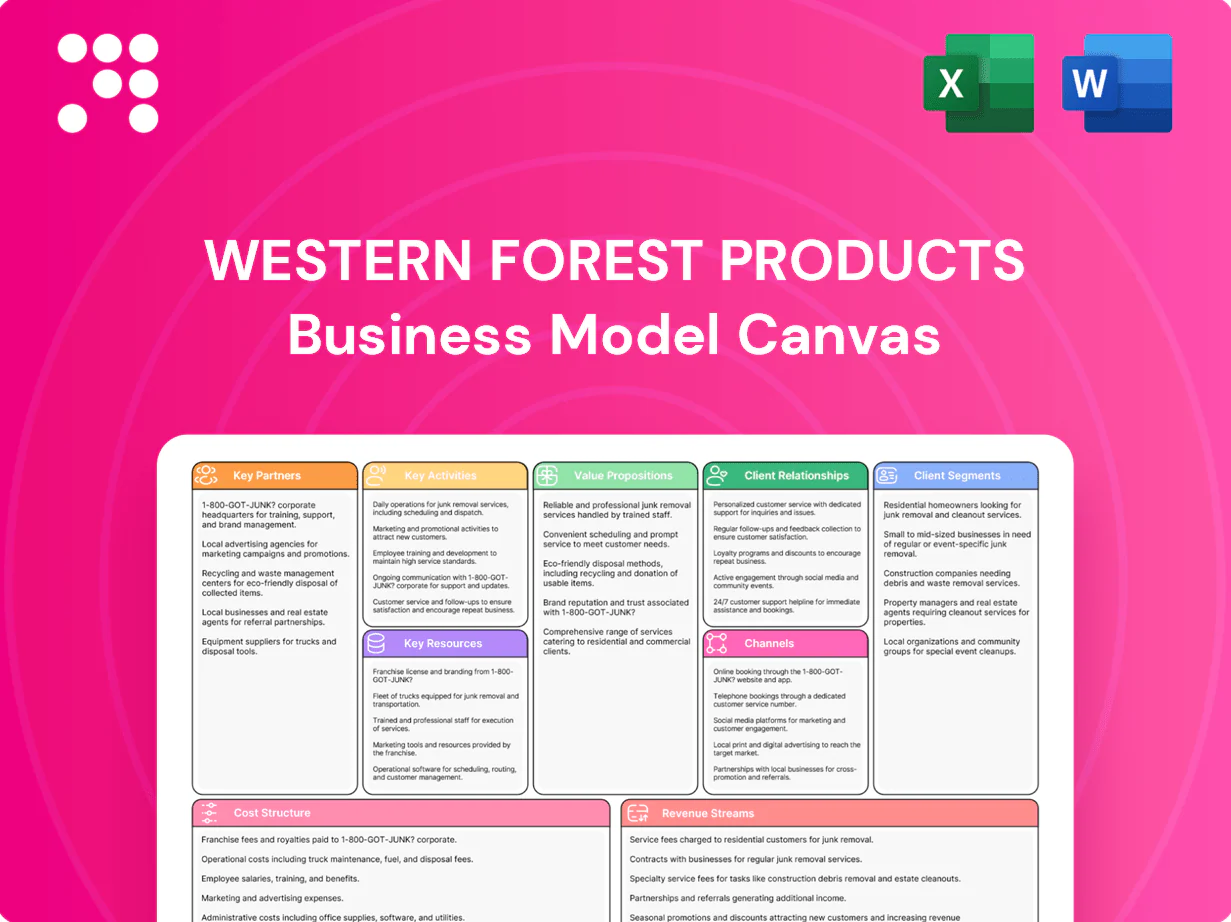
Western Forest Products Business Model Canvas

Unlock the strategic Business Model Canvas for forestry operations
Unlock the full strategic blueprint behind Western Forest Products with our Business Model Canvas. This in-depth, editable document maps value propositions, key partners, revenue streams and cost structure to reveal growth levers and risks. Purchase the full Canvas in Word/Excel to benchmark, plan, and present with confidence.
Partnerships

First Nations and Provincial Forestry Agreements
Collaborative agreements with First Nations and the Province of British Columbia secure timber access and align harvesting with local socio-economic priorities, enabling shared stewardship and respect for cultural values. These partnerships support community employment and reduce permitting risk, improving certainty in operating plans. Co-management fosters social license and long-term tenure stability.
Timberland Owners, Licensees, and Tree Farm Licence Holders
Relationships with public and private tenure holders secure steady log supply across species and grades, enabling predictable mill throughput. Coordinated planning optimizes cut blocks, haul schedules, and fiber mix to raise recovery and lower transport costs. Multi-year supply contracts (commonly 3–10 years) reduce price volatility and downtime. Joint silviculture and reforestation programs increase long-term yield and sustainability.

Certification Bodies and Environmental NGOs
Partnerships with FSC, SFI and PEFC auditors provide third-party certification of sustainable management, supporting Western Forest Products’ market access and compliance. Engagements with environmental NGOs advance habitat protection and biodiversity outcomes across coastal BC operations. Certification unlocks premium Europe and North American markets and can command price premiums of up to 10%, strengthening ESG credentials with institutional buyers.

Logistics, Ports, and Ocean Carriers
Alliances with coastal ports, stevedores, rail, and ocean carriers secure steady export flows to Asia, Europe, and the U.S. west coast, reducing transshipment risk and improving reliability. Priority berthing and bundled freight contracts lower cost-to-serve and shorten dwell times. Coordinated container and breakbulk capacity mitigates peak-season congestion and preserves margins. End-to-end visibility enhances on-time delivery and customer satisfaction.
- Priority berthing: lower berth wait and handling costs
- Bundled freight: stable rates, reduced variability
- Coordinated capacity: less peak congestion
- Visibility: improved ETA accuracy and OTIF
Equipment, Optimization Tech, and Maintenance Vendors
OEMs and tech partners supply sawmill machinery, scanning/optimization software, and predictive maintenance platforms that raise yield and asset uptime for Western Forest Products.
Service-level agreements with vendors cut unplanned downtime and enhance lumber recovery while energy and biomass system partners convert residues into heat and power, improving mill efficiency.
Ongoing equipment and software upgrades sustain cost competitiveness and support regulatory compliance.
- Equipment and tech supply
- Service-level agreements
- Energy and biomass partners
- Continuous upgrades
Secured timber tenure and multi-year contracts stabilize BC mill supply
Partnerships with First Nations and BC government secure timber tenure and local employment, reducing permitting risk and supporting long-term access. Multi-year supply contracts and public/private tenure agreements stabilize log supply and mill throughput. Certification bodies and ports/transport alliances preserve market access and lower logistics costs, while OEMs and service vendors raise yield and uptime.
| Metric (2024) | Value |
|---|---|
| Revenue (CAD) | 1.14B |
| Operating mills | 10 |
| Export share to Asia | ≈40% |
What is included in the product
 Detailed Word Document
A comprehensive Business Model Canvas for Western Forest Products outlining customer segments, channels, value propositions and operations across the 9 BMC blocks, with competitive advantages, linked SWOT and investor-ready insights.

 Customizable Excel Spreadsheet
High-level view of Western Forest Products’ business model with editable cells—quickly identify core components, align timber supply, manufacturing and sustainability strategies, and save hours of formatting for boardroom-ready collaboration.
Activities

Sustainable Forest Planning and Harvesting
Undertaking mosaic harvests, wildlife buffers and reforestation across Western Forest Products coastal tenure (approximately 600,000 ha) ensures compliance with CSA, FSC and SFI standards while targeting ~1.8 million m3 of annual harvested fiber. GIS-based planning balances yield, critical habitat and watershed health through spatial optimization and risk mapping. Rigorous contractor management in steep coastal terrain and post-harvest audits with regeneration tracking secure long-term fiber supply.
Sawmilling and Specialty Lumber Manufacturing
Sawmilling converts coastal hemlock, western red cedar and Douglas-fir into specialty grades using optimized sawing patterns to maximize recovery by dimension, appearance and structural properties. Mill processes include kiln drying to target 12% moisture content and precision planing to finish specs. Remanufacturing lines produce niche profiles and custom orders to capture higher-margin markets.

Quality Control, Grading, and Certification Compliance
Western Forest Products applies NLGA grading across its BC operations to ensure dimensional and visual consistency across domestic and export markets; the company reported roughly CAD 1.1 billion revenue in 2023, underpinning scale of graded shipments.
In-line scanning combined with manual checks targets defect reduction and claim mitigation, while chain-of-custody and legality documents accompany every shipment to meet buyer and regulatory requirements.
Continuous improvement programs focus on process control and waste reduction to lower variability and improve yield across sawmills.

Sales, Demand Planning, and Order Fulfillment
Sales, demand planning and order fulfillment align mill schedules with sales forecasts to balance species mix and inventory, while negotiating contracts with distributors and industrial users across North America, Asia and Europe to secure margins and market access. During tight fiber cycles allocations prioritize key accounts to preserve long-term relationships and revenue stability. Documentation, customs and export compliance complete each order cycle, ensuring timely cross-border delivery.
- Coordinated mill scheduling
- Global contract negotiation
- Allocation during tight fiber cycles
- Export documentation & compliance
Export Logistics and Port Operations
Export logistics consolidate loads, book breakbulk and container space and manage inland drayage to optimize port throughput and vessel utilization, while moisture protection, dunnage and securement preserve product integrity in transit. Real-time tracking and ETA updates increase customer visibility and expedite exception management; claims handling with root-cause analysis closes the loop and informs carrier and packaging improvements.
- Consolidation
- Moisture control
- Real-time ETA
- Claims root-cause
Mosaic harvests, GIS planning & kiln-dried specialty lumber target 1.8M m3
Undertaking mosaic harvests, wildlife buffers and reforestation across Western Forest Products coastal tenure (≈600,000 ha) ensures CSA/FSC/SFI compliance and targeted 2024 harvest of ~1.8 million m3. GIS-based planning balances yield, habitat and watershed health via spatial optimization and risk mapping. Sawmilling converts hemlock, cedar and Douglas‑fir into specialty grades with kiln drying to 12% moisture and remanufacturing for higher margins. Export logistics, chain-of-custody and real-time ETA systems secure deliveries and claims resolution.
| Metric | 2024 |
|---|---|
| Coastal tenure | 600,000 ha |
| Harvest (target) | ~1.8M m3 |
| Kiln target moisture | 12% |
Delivered as Displayed
Business Model Canvas
The Business Model Canvas for Western Forest Products shown here is the exact document you will receive—no mockup or sample. Upon purchase you’ll download this same fully formatted, editable file ready for presentation, analysis, and customization. No hidden sections, no surprises.

Unlock the strategic Business Model Canvas for forestry operations
Unlock the full strategic blueprint behind Western Forest Products with our Business Model Canvas. This in-depth, editable document maps value propositions, key partners, revenue streams and cost structure to reveal growth levers and risks. Purchase the full Canvas in Word/Excel to benchmark, plan, and present with confidence.
Partnerships
First Nations and Provincial Forestry Agreements
Collaborative agreements with First Nations and the Province of British Columbia secure timber access and align harvesting with local socio-economic priorities, enabling shared stewardship and respect for cultural values. These partnerships support community employment and reduce permitting risk, improving certainty in operating plans. Co-management fosters social license and long-term tenure stability.
Timberland Owners, Licensees, and Tree Farm Licence Holders
Relationships with public and private tenure holders secure steady log supply across species and grades, enabling predictable mill throughput. Coordinated planning optimizes cut blocks, haul schedules, and fiber mix to raise recovery and lower transport costs. Multi-year supply contracts (commonly 3–10 years) reduce price volatility and downtime. Joint silviculture and reforestation programs increase long-term yield and sustainability.
Certification Bodies and Environmental NGOs
Partnerships with FSC, SFI and PEFC auditors provide third-party certification of sustainable management, supporting Western Forest Products’ market access and compliance. Engagements with environmental NGOs advance habitat protection and biodiversity outcomes across coastal BC operations. Certification unlocks premium Europe and North American markets and can command price premiums of up to 10%, strengthening ESG credentials with institutional buyers.
Logistics, Ports, and Ocean Carriers
Alliances with coastal ports, stevedores, rail, and ocean carriers secure steady export flows to Asia, Europe, and the U.S. west coast, reducing transshipment risk and improving reliability. Priority berthing and bundled freight contracts lower cost-to-serve and shorten dwell times. Coordinated container and breakbulk capacity mitigates peak-season congestion and preserves margins. End-to-end visibility enhances on-time delivery and customer satisfaction.
- Priority berthing: lower berth wait and handling costs
- Bundled freight: stable rates, reduced variability
- Coordinated capacity: less peak congestion
- Visibility: improved ETA accuracy and OTIF
Equipment, Optimization Tech, and Maintenance Vendors
OEMs and tech partners supply sawmill machinery, scanning/optimization software, and predictive maintenance platforms that raise yield and asset uptime for Western Forest Products.
Service-level agreements with vendors cut unplanned downtime and enhance lumber recovery while energy and biomass system partners convert residues into heat and power, improving mill efficiency.
Ongoing equipment and software upgrades sustain cost competitiveness and support regulatory compliance.
- Equipment and tech supply
- Service-level agreements
- Energy and biomass partners
- Continuous upgrades
Secured timber tenure and multi-year contracts stabilize BC mill supply
Partnerships with First Nations and BC government secure timber tenure and local employment, reducing permitting risk and supporting long-term access. Multi-year supply contracts and public/private tenure agreements stabilize log supply and mill throughput. Certification bodies and ports/transport alliances preserve market access and lower logistics costs, while OEMs and service vendors raise yield and uptime.
| Metric (2024) | Value |
|---|---|
| Revenue (CAD) | 1.14B |
| Operating mills | 10 |
| Export share to Asia | ≈40% |
What is included in the product
Detailed Word Document
A comprehensive Business Model Canvas for Western Forest Products outlining customer segments, channels, value propositions and operations across the 9 BMC blocks, with competitive advantages, linked SWOT and investor-ready insights.
Customizable Excel Spreadsheet
High-level view of Western Forest Products’ business model with editable cells—quickly identify core components, align timber supply, manufacturing and sustainability strategies, and save hours of formatting for boardroom-ready collaboration.
Activities
Sustainable Forest Planning and Harvesting
Undertaking mosaic harvests, wildlife buffers and reforestation across Western Forest Products coastal tenure (approximately 600,000 ha) ensures compliance with CSA, FSC and SFI standards while targeting ~1.8 million m3 of annual harvested fiber. GIS-based planning balances yield, critical habitat and watershed health through spatial optimization and risk mapping. Rigorous contractor management in steep coastal terrain and post-harvest audits with regeneration tracking secure long-term fiber supply.
Sawmilling and Specialty Lumber Manufacturing
Sawmilling converts coastal hemlock, western red cedar and Douglas-fir into specialty grades using optimized sawing patterns to maximize recovery by dimension, appearance and structural properties. Mill processes include kiln drying to target 12% moisture content and precision planing to finish specs. Remanufacturing lines produce niche profiles and custom orders to capture higher-margin markets.
Quality Control, Grading, and Certification Compliance
Western Forest Products applies NLGA grading across its BC operations to ensure dimensional and visual consistency across domestic and export markets; the company reported roughly CAD 1.1 billion revenue in 2023, underpinning scale of graded shipments.
In-line scanning combined with manual checks targets defect reduction and claim mitigation, while chain-of-custody and legality documents accompany every shipment to meet buyer and regulatory requirements.
Continuous improvement programs focus on process control and waste reduction to lower variability and improve yield across sawmills.
Sales, Demand Planning, and Order Fulfillment
Sales, demand planning and order fulfillment align mill schedules with sales forecasts to balance species mix and inventory, while negotiating contracts with distributors and industrial users across North America, Asia and Europe to secure margins and market access. During tight fiber cycles allocations prioritize key accounts to preserve long-term relationships and revenue stability. Documentation, customs and export compliance complete each order cycle, ensuring timely cross-border delivery.
- Coordinated mill scheduling
- Global contract negotiation
- Allocation during tight fiber cycles
- Export documentation & compliance
Export Logistics and Port Operations
Export logistics consolidate loads, book breakbulk and container space and manage inland drayage to optimize port throughput and vessel utilization, while moisture protection, dunnage and securement preserve product integrity in transit. Real-time tracking and ETA updates increase customer visibility and expedite exception management; claims handling with root-cause analysis closes the loop and informs carrier and packaging improvements.
- Consolidation
- Moisture control
- Real-time ETA
- Claims root-cause
Mosaic harvests, GIS planning & kiln-dried specialty lumber target 1.8M m3
Undertaking mosaic harvests, wildlife buffers and reforestation across Western Forest Products coastal tenure (≈600,000 ha) ensures CSA/FSC/SFI compliance and targeted 2024 harvest of ~1.8 million m3. GIS-based planning balances yield, habitat and watershed health via spatial optimization and risk mapping. Sawmilling converts hemlock, cedar and Douglas‑fir into specialty grades with kiln drying to 12% moisture and remanufacturing for higher margins. Export logistics, chain-of-custody and real-time ETA systems secure deliveries and claims resolution.
| Metric | 2024 |
|---|---|
| Coastal tenure | 600,000 ha |
| Harvest (target) | ~1.8M m3 |
| Kiln target moisture | 12% |
Delivered as Displayed
Business Model Canvas
The Business Model Canvas for Western Forest Products shown here is the exact document you will receive—no mockup or sample. Upon purchase you’ll download this same fully formatted, editable file ready for presentation, analysis, and customization. No hidden sections, no surprises.
Original: $10.00
-65%$10.00
$3.50Description
Unlock the strategic Business Model Canvas for forestry operations
Unlock the full strategic blueprint behind Western Forest Products with our Business Model Canvas. This in-depth, editable document maps value propositions, key partners, revenue streams and cost structure to reveal growth levers and risks. Purchase the full Canvas in Word/Excel to benchmark, plan, and present with confidence.
Partnerships
First Nations and Provincial Forestry Agreements
Collaborative agreements with First Nations and the Province of British Columbia secure timber access and align harvesting with local socio-economic priorities, enabling shared stewardship and respect for cultural values. These partnerships support community employment and reduce permitting risk, improving certainty in operating plans. Co-management fosters social license and long-term tenure stability.
Timberland Owners, Licensees, and Tree Farm Licence Holders
Relationships with public and private tenure holders secure steady log supply across species and grades, enabling predictable mill throughput. Coordinated planning optimizes cut blocks, haul schedules, and fiber mix to raise recovery and lower transport costs. Multi-year supply contracts (commonly 3–10 years) reduce price volatility and downtime. Joint silviculture and reforestation programs increase long-term yield and sustainability.
Certification Bodies and Environmental NGOs
Partnerships with FSC, SFI and PEFC auditors provide third-party certification of sustainable management, supporting Western Forest Products’ market access and compliance. Engagements with environmental NGOs advance habitat protection and biodiversity outcomes across coastal BC operations. Certification unlocks premium Europe and North American markets and can command price premiums of up to 10%, strengthening ESG credentials with institutional buyers.
Logistics, Ports, and Ocean Carriers
Alliances with coastal ports, stevedores, rail, and ocean carriers secure steady export flows to Asia, Europe, and the U.S. west coast, reducing transshipment risk and improving reliability. Priority berthing and bundled freight contracts lower cost-to-serve and shorten dwell times. Coordinated container and breakbulk capacity mitigates peak-season congestion and preserves margins. End-to-end visibility enhances on-time delivery and customer satisfaction.
- Priority berthing: lower berth wait and handling costs
- Bundled freight: stable rates, reduced variability
- Coordinated capacity: less peak congestion
- Visibility: improved ETA accuracy and OTIF
Equipment, Optimization Tech, and Maintenance Vendors
OEMs and tech partners supply sawmill machinery, scanning/optimization software, and predictive maintenance platforms that raise yield and asset uptime for Western Forest Products.
Service-level agreements with vendors cut unplanned downtime and enhance lumber recovery while energy and biomass system partners convert residues into heat and power, improving mill efficiency.
Ongoing equipment and software upgrades sustain cost competitiveness and support regulatory compliance.
- Equipment and tech supply
- Service-level agreements
- Energy and biomass partners
- Continuous upgrades
Secured timber tenure and multi-year contracts stabilize BC mill supply
Partnerships with First Nations and BC government secure timber tenure and local employment, reducing permitting risk and supporting long-term access. Multi-year supply contracts and public/private tenure agreements stabilize log supply and mill throughput. Certification bodies and ports/transport alliances preserve market access and lower logistics costs, while OEMs and service vendors raise yield and uptime.
| Metric (2024) | Value |
|---|---|
| Revenue (CAD) | 1.14B |
| Operating mills | 10 |
| Export share to Asia | ≈40% |
What is included in the product
Detailed Word Document
A comprehensive Business Model Canvas for Western Forest Products outlining customer segments, channels, value propositions and operations across the 9 BMC blocks, with competitive advantages, linked SWOT and investor-ready insights.
Customizable Excel Spreadsheet
High-level view of Western Forest Products’ business model with editable cells—quickly identify core components, align timber supply, manufacturing and sustainability strategies, and save hours of formatting for boardroom-ready collaboration.
Activities
Sustainable Forest Planning and Harvesting
Undertaking mosaic harvests, wildlife buffers and reforestation across Western Forest Products coastal tenure (approximately 600,000 ha) ensures compliance with CSA, FSC and SFI standards while targeting ~1.8 million m3 of annual harvested fiber. GIS-based planning balances yield, critical habitat and watershed health through spatial optimization and risk mapping. Rigorous contractor management in steep coastal terrain and post-harvest audits with regeneration tracking secure long-term fiber supply.
Sawmilling and Specialty Lumber Manufacturing
Sawmilling converts coastal hemlock, western red cedar and Douglas-fir into specialty grades using optimized sawing patterns to maximize recovery by dimension, appearance and structural properties. Mill processes include kiln drying to target 12% moisture content and precision planing to finish specs. Remanufacturing lines produce niche profiles and custom orders to capture higher-margin markets.
Quality Control, Grading, and Certification Compliance
Western Forest Products applies NLGA grading across its BC operations to ensure dimensional and visual consistency across domestic and export markets; the company reported roughly CAD 1.1 billion revenue in 2023, underpinning scale of graded shipments.
In-line scanning combined with manual checks targets defect reduction and claim mitigation, while chain-of-custody and legality documents accompany every shipment to meet buyer and regulatory requirements.
Continuous improvement programs focus on process control and waste reduction to lower variability and improve yield across sawmills.
Sales, Demand Planning, and Order Fulfillment
Sales, demand planning and order fulfillment align mill schedules with sales forecasts to balance species mix and inventory, while negotiating contracts with distributors and industrial users across North America, Asia and Europe to secure margins and market access. During tight fiber cycles allocations prioritize key accounts to preserve long-term relationships and revenue stability. Documentation, customs and export compliance complete each order cycle, ensuring timely cross-border delivery.
- Coordinated mill scheduling
- Global contract negotiation
- Allocation during tight fiber cycles
- Export documentation & compliance
Export Logistics and Port Operations
Export logistics consolidate loads, book breakbulk and container space and manage inland drayage to optimize port throughput and vessel utilization, while moisture protection, dunnage and securement preserve product integrity in transit. Real-time tracking and ETA updates increase customer visibility and expedite exception management; claims handling with root-cause analysis closes the loop and informs carrier and packaging improvements.
- Consolidation
- Moisture control
- Real-time ETA
- Claims root-cause
Mosaic harvests, GIS planning & kiln-dried specialty lumber target 1.8M m3
Undertaking mosaic harvests, wildlife buffers and reforestation across Western Forest Products coastal tenure (≈600,000 ha) ensures CSA/FSC/SFI compliance and targeted 2024 harvest of ~1.8 million m3. GIS-based planning balances yield, habitat and watershed health via spatial optimization and risk mapping. Sawmilling converts hemlock, cedar and Douglas‑fir into specialty grades with kiln drying to 12% moisture and remanufacturing for higher margins. Export logistics, chain-of-custody and real-time ETA systems secure deliveries and claims resolution.
| Metric | 2024 |
|---|---|
| Coastal tenure | 600,000 ha |
| Harvest (target) | ~1.8M m3 |
| Kiln target moisture | 12% |
Delivered as Displayed
Business Model Canvas
The Business Model Canvas for Western Forest Products shown here is the exact document you will receive—no mockup or sample. Upon purchase you’ll download this same fully formatted, editable file ready for presentation, analysis, and customization. No hidden sections, no surprises.











