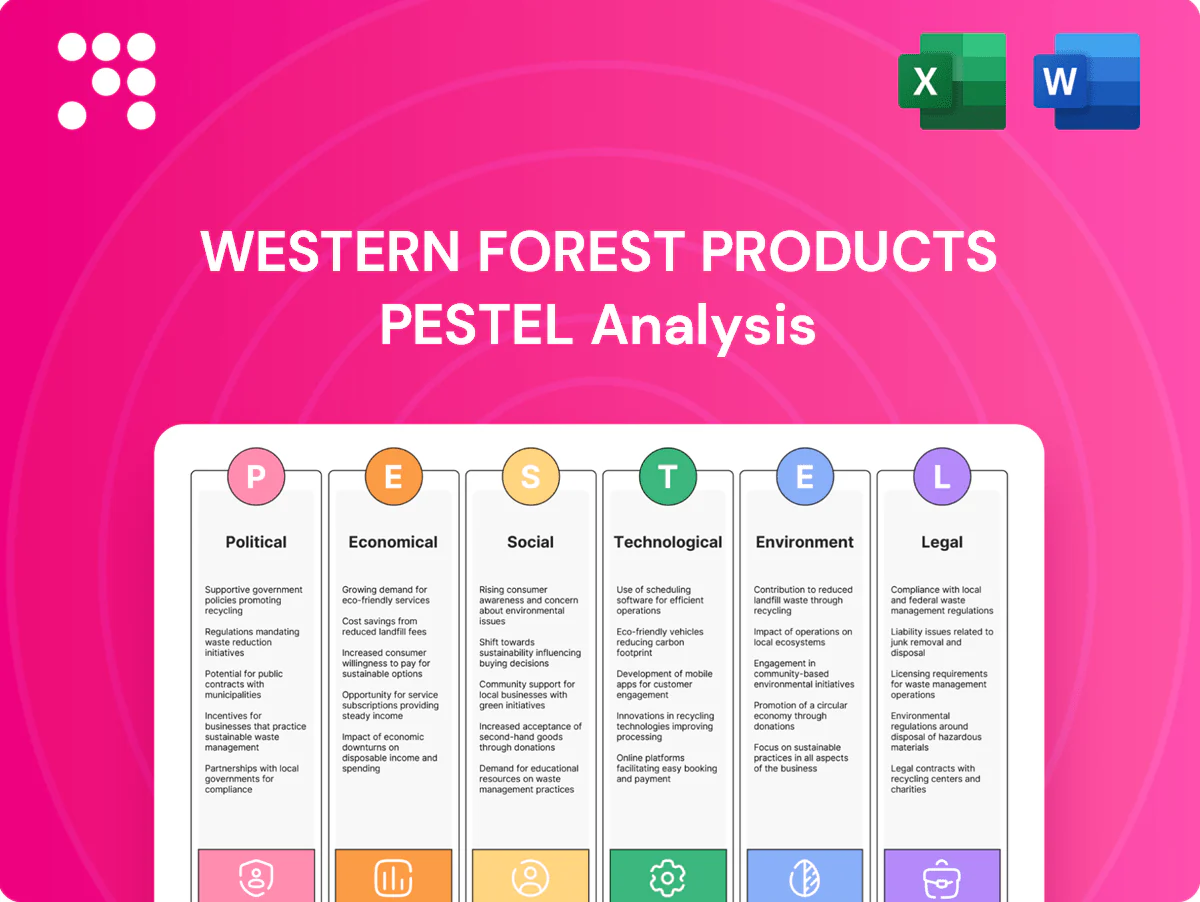
Western Forest Products PESTLE Analysis

Make Smarter Strategic Decisions with a Complete PESTEL View
Unlock how political shifts, environmental regulation, and market cycles are reshaping Western Forest Products’ strategic outlook. This concise PESTLE snapshot highlights key risks and opportunities for investors and managers. Buy the full analysis to access detailed, actionable insights and ready-to-use charts. Download now to inform smarter decisions fast.
Political factors

BC forestry policy stability
Provincial rules on allowable annual cut, tenure and land use directly determine fiber access and costs for Western Forest Products, with old-growth deferrals of roughly 2.6 million hectares and a provincial 30% conservation-by-2030 target materially constraining supply. Policy continuity lowers planning risk for mills and contractors and supports multi-year contracts and log-cost forecasting. Political turnover raises uncertainty for long-term capital deployment (10–20 year horizons).
Indigenous rights and co governance
Duty to consult, grounded in Supreme Court rulings (Haida 2004) and BC's 2019 Declaration on the Rights of Indigenous Peoples Act, reshapes permits and timelines for Western Forest Products; evolving shared decision frameworks often extend approval windows. Partnerships and revenue-sharing agreements increase social licence and can secure timber access and Indigenous labour from a 2021 Indigenous population of 1.8M (5% of Canada). Misalignment risks delays, litigation, or cancellations.

Trade relations and tariffs
Softwood lumber disputes with the US have produced duties historically reaching around 20%, compressing Western Forest Products’ margins and shifting sales toward domestic and Asian markets; Western reported just over CAD 1.0B revenue in 2023, so duty impacts materially affect earnings. Trade policy with Asia and Europe steers log and lumber flows, while currency and tariff dynamics determine competitiveness versus US southern pine and Scandinavian suppliers. Diplomatic shifts can open or close market access rapidly, creating short-term price and volume volatility.

Infrastructure and port governance
Government investment in BC coastal ports, rail and roads—backed by the National Trade Corridors Fund (over $3 billion nationally)—directly affects Western Forest Products export reliability; Port of Vancouver handled about 141 million tonnes in 2023, so corridor capacity shapes shipped volumes. Port labour stability and resiliency policies drive shipping costs and lead times; bottlenecks erode customer service and price realization, while efficient corridors strengthen the company’s Asia‑facing strategy.
- investment: NTCF > $3B
- throughput: Port of Vancouver ~141M tonnes (2023)
- risk: labour/policy → costs & lead times
- benefit: efficient corridors → Asia market access
Public sentiment and resource politics
Public sentiment—shaped by urban voters, NGOs and local Indigenous and rural communities—now drives forest policy and can rapidly alter operating conditions for Western Forest Products, with heightened attention in 2024 on old-growth and biodiversity risks. High-visibility sites and media scrutiny elevate political risk and can prompt swift regulatory responses or harvest deferrals. Transparent sustainability reporting and independent certification reduce pressure and help preserve market access. Protests and social media campaigns in 2024 accelerated policy reviews in BC and pressured buyers.
- Political drivers: urban voters, NGOs, local communities
- Risk factors: old-growth visibility, biodiversity scrutiny
- Mitigation: transparent sustainability and certification
- Trigger events: protests, media scrutiny prompting rapid regulation
2.6M ha deferrals and 30% conservation target tighten BC fibre access; duties ~20%.
Provincial allowable annual cut, tenure and old‑growth deferrals (~2.6M ha) plus BC's 30% conservation-by-2030 target materially constrain fibre access and costs for Western Forest Products; policy continuity aids multi-year planning but political turnover raises long-term capital risk. Duty to consult (Haida 2004; DRIPA 2019) and Indigenous partnerships reshape timelines and can secure access; misalignment risks delays or litigation. Trade disputes (softwood duties ~20% historically) and infrastructure (Port of Vancouver ~141M t, 2023) drive margins and market access.
| Factor | Metric / 2023–24 |
|---|---|
| Revenue (WFP) | ~CAD 1.0B (2023) |
| Old‑growth deferrals | ~2.6M ha |
| Port throughput | Port of Vancouver ~141M t (2023) |
| NTCF | >CAD 3B |
| Historical duties | ~20% |
What is included in the product
 Detailed Word Document
Provides a targeted PESTLE analysis of Western Forest Products, examining Political, Economic, Social, Technological, Environmental, and Legal forces with region- and industry-specific data and trends to identify risks and growth opportunities. Designed for executives and investors, it includes actionable, forward-looking insights and detailed sub-points ready for reports, plans, or investor materials.

 Customizable Excel Spreadsheet
A concise, visually segmented PESTLE summary for Western Forest Products that highlights regulatory, environmental and market risks for quick team alignment and slide‑ready inclusion; editable for regional context and easily shareable for planning sessions.
Economic factors

Housing cycle sensitivity
US housing starts averaged about 1.45M annualized in 2024 and Canadian starts near 250k, which directly steer demand for Western Forest specialty lumber; renovation and repair spending—roughly US$470B in 2024—stabilizes volumes when new builds fall. Interest-rate swings (30-year mortgage ~6.8% in 2024) can reprice order books rapidly. Diversification into Japan and Europe, representing about 20% of shipments, cushions North American cyclicality.
CAD USD exchange rate
Western Forest Products earns majority of revenue in USD while many costs remain CAD-based; as of July 2025 1 CAD ≈ 0.74 USD (USD/CAD ≈ 1.35), so a weaker CAD directly expands export margins. Currency swings force more active pricing and hedging—the company discloses periodic FX risk management—to protect realized margins. Volatility complicates capital planning and inventory valuation, increasing forecast risk for working capital and capex decisions.

Log and fiber cost inflation
Coastal harvesting and hauling costs remain structurally high for Western Forest Products, with diesel averaging about CAD 1.60/L in 2024 and contract hauling premiums reflecting regional access challenges; fuel, labour (wage growth ~6% in 2023–24) and higher contractor rates continue to pressure unit costs. Supply constraints from weather events and policy-driven curtailments drove stumpage and log price spikes of roughly 10–15% in coastal districts in 2024. Mill optimization and improved product mix (shift to higher-grade lumber and specialty panels) helped defend margins, recovering an estimated 50–150 basis points in operating margin versus a year earlier.

Global shipping and freight
Container availability and ocean rates (Drewry WCI ~1,500 USD in 2024) materially affect Asian/European sales viability; port congestion and surcharges (commonly 100–300 USD/TEU) erode delivered pricing. Long lead times of 30–60 days raise working capital and inventory exposure; reliable logistics sustain premium customer relationships and order retention.
- WCI ~1,500 USD (2024)
- Surcharges 100–300 USD/TEU
- Lead times 30–60 days
Customer mix and price premiums
Specialty cedar, hemlock and appearance grades command meaningful premiums over commodity SPF, supporting higher margins for Western Forest Products; downturns, however, shift buyer demand toward lower‑cost substitutes and compress pricing. Value‑added products raise average selling prices and customer stickiness through customization and finishing. Channel strategy balances wholesalers, distributors and direct OEM relationships to optimize reach and margin.
- Premiums: specialty grades vs SPF
- Downturn risk: substitution pressure
- Value‑added: higher ASP and retention
- Channels: wholesalers, distributors, direct OEMs
2.6M ha deferrals and 30% conservation target tighten BC fibre access; duties ~20%.
US housing starts ~1.45M (2024) and Canada ~250k; renovation spending ~US$470B (2024) stabilizes demand. USD/CAD ~1.35 (1 CAD≈0.74 USD, Jul 2025) boosts export margins; FX and rates (30y ~6.8% 2024) raise pricing/hedging needs. Coastal costs (diesel ~CAD1.60/L, stumpage +10–15% 2024) and WCI ~US$1,500/TEU constrain margins; specialty grades preserve premium pricing.
| Metric | Value |
|---|---|
| US starts | 1.45M (2024) |
| Canada starts | 250k (2024) |
| USD/CAD | 1.35 (Jul 2025) |
| Drewry WCI | US$1,500 (2024) |
Full Version Awaits
Western Forest Products PESTLE Analysis
The preview shown here is the exact Western Forest Products PESTLE Analysis you’ll receive after purchase—fully formatted, professionally structured, and ready to use. This is the real file with no placeholders or teasers, delivered exactly as displayed. After payment you’ll be able to download the same complete document immediately, with the same layout, content, and structure.

Make Smarter Strategic Decisions with a Complete PESTEL View
Unlock how political shifts, environmental regulation, and market cycles are reshaping Western Forest Products’ strategic outlook. This concise PESTLE snapshot highlights key risks and opportunities for investors and managers. Buy the full analysis to access detailed, actionable insights and ready-to-use charts. Download now to inform smarter decisions fast.
Political factors
BC forestry policy stability
Provincial rules on allowable annual cut, tenure and land use directly determine fiber access and costs for Western Forest Products, with old-growth deferrals of roughly 2.6 million hectares and a provincial 30% conservation-by-2030 target materially constraining supply. Policy continuity lowers planning risk for mills and contractors and supports multi-year contracts and log-cost forecasting. Political turnover raises uncertainty for long-term capital deployment (10–20 year horizons).
Indigenous rights and co governance
Duty to consult, grounded in Supreme Court rulings (Haida 2004) and BC's 2019 Declaration on the Rights of Indigenous Peoples Act, reshapes permits and timelines for Western Forest Products; evolving shared decision frameworks often extend approval windows. Partnerships and revenue-sharing agreements increase social licence and can secure timber access and Indigenous labour from a 2021 Indigenous population of 1.8M (5% of Canada). Misalignment risks delays, litigation, or cancellations.
Trade relations and tariffs
Softwood lumber disputes with the US have produced duties historically reaching around 20%, compressing Western Forest Products’ margins and shifting sales toward domestic and Asian markets; Western reported just over CAD 1.0B revenue in 2023, so duty impacts materially affect earnings. Trade policy with Asia and Europe steers log and lumber flows, while currency and tariff dynamics determine competitiveness versus US southern pine and Scandinavian suppliers. Diplomatic shifts can open or close market access rapidly, creating short-term price and volume volatility.
Infrastructure and port governance
Government investment in BC coastal ports, rail and roads—backed by the National Trade Corridors Fund (over $3 billion nationally)—directly affects Western Forest Products export reliability; Port of Vancouver handled about 141 million tonnes in 2023, so corridor capacity shapes shipped volumes. Port labour stability and resiliency policies drive shipping costs and lead times; bottlenecks erode customer service and price realization, while efficient corridors strengthen the company’s Asia‑facing strategy.
- investment: NTCF > $3B
- throughput: Port of Vancouver ~141M tonnes (2023)
- risk: labour/policy → costs & lead times
- benefit: efficient corridors → Asia market access
Public sentiment and resource politics
Public sentiment—shaped by urban voters, NGOs and local Indigenous and rural communities—now drives forest policy and can rapidly alter operating conditions for Western Forest Products, with heightened attention in 2024 on old-growth and biodiversity risks. High-visibility sites and media scrutiny elevate political risk and can prompt swift regulatory responses or harvest deferrals. Transparent sustainability reporting and independent certification reduce pressure and help preserve market access. Protests and social media campaigns in 2024 accelerated policy reviews in BC and pressured buyers.
- Political drivers: urban voters, NGOs, local communities
- Risk factors: old-growth visibility, biodiversity scrutiny
- Mitigation: transparent sustainability and certification
- Trigger events: protests, media scrutiny prompting rapid regulation
2.6M ha deferrals and 30% conservation target tighten BC fibre access; duties ~20%.
Provincial allowable annual cut, tenure and old‑growth deferrals (~2.6M ha) plus BC's 30% conservation-by-2030 target materially constrain fibre access and costs for Western Forest Products; policy continuity aids multi-year planning but political turnover raises long-term capital risk. Duty to consult (Haida 2004; DRIPA 2019) and Indigenous partnerships reshape timelines and can secure access; misalignment risks delays or litigation. Trade disputes (softwood duties ~20% historically) and infrastructure (Port of Vancouver ~141M t, 2023) drive margins and market access.
| Factor | Metric / 2023–24 |
|---|---|
| Revenue (WFP) | ~CAD 1.0B (2023) |
| Old‑growth deferrals | ~2.6M ha |
| Port throughput | Port of Vancouver ~141M t (2023) |
| NTCF | >CAD 3B |
| Historical duties | ~20% |
What is included in the product
Detailed Word Document
Provides a targeted PESTLE analysis of Western Forest Products, examining Political, Economic, Social, Technological, Environmental, and Legal forces with region- and industry-specific data and trends to identify risks and growth opportunities. Designed for executives and investors, it includes actionable, forward-looking insights and detailed sub-points ready for reports, plans, or investor materials.
Customizable Excel Spreadsheet
A concise, visually segmented PESTLE summary for Western Forest Products that highlights regulatory, environmental and market risks for quick team alignment and slide‑ready inclusion; editable for regional context and easily shareable for planning sessions.
Economic factors
Housing cycle sensitivity
US housing starts averaged about 1.45M annualized in 2024 and Canadian starts near 250k, which directly steer demand for Western Forest specialty lumber; renovation and repair spending—roughly US$470B in 2024—stabilizes volumes when new builds fall. Interest-rate swings (30-year mortgage ~6.8% in 2024) can reprice order books rapidly. Diversification into Japan and Europe, representing about 20% of shipments, cushions North American cyclicality.
CAD USD exchange rate
Western Forest Products earns majority of revenue in USD while many costs remain CAD-based; as of July 2025 1 CAD ≈ 0.74 USD (USD/CAD ≈ 1.35), so a weaker CAD directly expands export margins. Currency swings force more active pricing and hedging—the company discloses periodic FX risk management—to protect realized margins. Volatility complicates capital planning and inventory valuation, increasing forecast risk for working capital and capex decisions.
Log and fiber cost inflation
Coastal harvesting and hauling costs remain structurally high for Western Forest Products, with diesel averaging about CAD 1.60/L in 2024 and contract hauling premiums reflecting regional access challenges; fuel, labour (wage growth ~6% in 2023–24) and higher contractor rates continue to pressure unit costs. Supply constraints from weather events and policy-driven curtailments drove stumpage and log price spikes of roughly 10–15% in coastal districts in 2024. Mill optimization and improved product mix (shift to higher-grade lumber and specialty panels) helped defend margins, recovering an estimated 50–150 basis points in operating margin versus a year earlier.
Global shipping and freight
Container availability and ocean rates (Drewry WCI ~1,500 USD in 2024) materially affect Asian/European sales viability; port congestion and surcharges (commonly 100–300 USD/TEU) erode delivered pricing. Long lead times of 30–60 days raise working capital and inventory exposure; reliable logistics sustain premium customer relationships and order retention.
- WCI ~1,500 USD (2024)
- Surcharges 100–300 USD/TEU
- Lead times 30–60 days
Customer mix and price premiums
Specialty cedar, hemlock and appearance grades command meaningful premiums over commodity SPF, supporting higher margins for Western Forest Products; downturns, however, shift buyer demand toward lower‑cost substitutes and compress pricing. Value‑added products raise average selling prices and customer stickiness through customization and finishing. Channel strategy balances wholesalers, distributors and direct OEM relationships to optimize reach and margin.
- Premiums: specialty grades vs SPF
- Downturn risk: substitution pressure
- Value‑added: higher ASP and retention
- Channels: wholesalers, distributors, direct OEMs
2.6M ha deferrals and 30% conservation target tighten BC fibre access; duties ~20%.
US housing starts ~1.45M (2024) and Canada ~250k; renovation spending ~US$470B (2024) stabilizes demand. USD/CAD ~1.35 (1 CAD≈0.74 USD, Jul 2025) boosts export margins; FX and rates (30y ~6.8% 2024) raise pricing/hedging needs. Coastal costs (diesel ~CAD1.60/L, stumpage +10–15% 2024) and WCI ~US$1,500/TEU constrain margins; specialty grades preserve premium pricing.
| Metric | Value |
|---|---|
| US starts | 1.45M (2024) |
| Canada starts | 250k (2024) |
| USD/CAD | 1.35 (Jul 2025) |
| Drewry WCI | US$1,500 (2024) |
Full Version Awaits
Western Forest Products PESTLE Analysis
The preview shown here is the exact Western Forest Products PESTLE Analysis you’ll receive after purchase—fully formatted, professionally structured, and ready to use. This is the real file with no placeholders or teasers, delivered exactly as displayed. After payment you’ll be able to download the same complete document immediately, with the same layout, content, and structure.
Description
Make Smarter Strategic Decisions with a Complete PESTEL View
Unlock how political shifts, environmental regulation, and market cycles are reshaping Western Forest Products’ strategic outlook. This concise PESTLE snapshot highlights key risks and opportunities for investors and managers. Buy the full analysis to access detailed, actionable insights and ready-to-use charts. Download now to inform smarter decisions fast.
Political factors
BC forestry policy stability
Provincial rules on allowable annual cut, tenure and land use directly determine fiber access and costs for Western Forest Products, with old-growth deferrals of roughly 2.6 million hectares and a provincial 30% conservation-by-2030 target materially constraining supply. Policy continuity lowers planning risk for mills and contractors and supports multi-year contracts and log-cost forecasting. Political turnover raises uncertainty for long-term capital deployment (10–20 year horizons).
Indigenous rights and co governance
Duty to consult, grounded in Supreme Court rulings (Haida 2004) and BC's 2019 Declaration on the Rights of Indigenous Peoples Act, reshapes permits and timelines for Western Forest Products; evolving shared decision frameworks often extend approval windows. Partnerships and revenue-sharing agreements increase social licence and can secure timber access and Indigenous labour from a 2021 Indigenous population of 1.8M (5% of Canada). Misalignment risks delays, litigation, or cancellations.
Trade relations and tariffs
Softwood lumber disputes with the US have produced duties historically reaching around 20%, compressing Western Forest Products’ margins and shifting sales toward domestic and Asian markets; Western reported just over CAD 1.0B revenue in 2023, so duty impacts materially affect earnings. Trade policy with Asia and Europe steers log and lumber flows, while currency and tariff dynamics determine competitiveness versus US southern pine and Scandinavian suppliers. Diplomatic shifts can open or close market access rapidly, creating short-term price and volume volatility.
Infrastructure and port governance
Government investment in BC coastal ports, rail and roads—backed by the National Trade Corridors Fund (over $3 billion nationally)—directly affects Western Forest Products export reliability; Port of Vancouver handled about 141 million tonnes in 2023, so corridor capacity shapes shipped volumes. Port labour stability and resiliency policies drive shipping costs and lead times; bottlenecks erode customer service and price realization, while efficient corridors strengthen the company’s Asia‑facing strategy.
- investment: NTCF > $3B
- throughput: Port of Vancouver ~141M tonnes (2023)
- risk: labour/policy → costs & lead times
- benefit: efficient corridors → Asia market access
Public sentiment and resource politics
Public sentiment—shaped by urban voters, NGOs and local Indigenous and rural communities—now drives forest policy and can rapidly alter operating conditions for Western Forest Products, with heightened attention in 2024 on old-growth and biodiversity risks. High-visibility sites and media scrutiny elevate political risk and can prompt swift regulatory responses or harvest deferrals. Transparent sustainability reporting and independent certification reduce pressure and help preserve market access. Protests and social media campaigns in 2024 accelerated policy reviews in BC and pressured buyers.
- Political drivers: urban voters, NGOs, local communities
- Risk factors: old-growth visibility, biodiversity scrutiny
- Mitigation: transparent sustainability and certification
- Trigger events: protests, media scrutiny prompting rapid regulation
2.6M ha deferrals and 30% conservation target tighten BC fibre access; duties ~20%.
Provincial allowable annual cut, tenure and old‑growth deferrals (~2.6M ha) plus BC's 30% conservation-by-2030 target materially constrain fibre access and costs for Western Forest Products; policy continuity aids multi-year planning but political turnover raises long-term capital risk. Duty to consult (Haida 2004; DRIPA 2019) and Indigenous partnerships reshape timelines and can secure access; misalignment risks delays or litigation. Trade disputes (softwood duties ~20% historically) and infrastructure (Port of Vancouver ~141M t, 2023) drive margins and market access.
| Factor | Metric / 2023–24 |
|---|---|
| Revenue (WFP) | ~CAD 1.0B (2023) |
| Old‑growth deferrals | ~2.6M ha |
| Port throughput | Port of Vancouver ~141M t (2023) |
| NTCF | >CAD 3B |
| Historical duties | ~20% |
What is included in the product
Detailed Word Document
Provides a targeted PESTLE analysis of Western Forest Products, examining Political, Economic, Social, Technological, Environmental, and Legal forces with region- and industry-specific data and trends to identify risks and growth opportunities. Designed for executives and investors, it includes actionable, forward-looking insights and detailed sub-points ready for reports, plans, or investor materials.
Customizable Excel Spreadsheet
A concise, visually segmented PESTLE summary for Western Forest Products that highlights regulatory, environmental and market risks for quick team alignment and slide‑ready inclusion; editable for regional context and easily shareable for planning sessions.
Economic factors
Housing cycle sensitivity
US housing starts averaged about 1.45M annualized in 2024 and Canadian starts near 250k, which directly steer demand for Western Forest specialty lumber; renovation and repair spending—roughly US$470B in 2024—stabilizes volumes when new builds fall. Interest-rate swings (30-year mortgage ~6.8% in 2024) can reprice order books rapidly. Diversification into Japan and Europe, representing about 20% of shipments, cushions North American cyclicality.
CAD USD exchange rate
Western Forest Products earns majority of revenue in USD while many costs remain CAD-based; as of July 2025 1 CAD ≈ 0.74 USD (USD/CAD ≈ 1.35), so a weaker CAD directly expands export margins. Currency swings force more active pricing and hedging—the company discloses periodic FX risk management—to protect realized margins. Volatility complicates capital planning and inventory valuation, increasing forecast risk for working capital and capex decisions.
Log and fiber cost inflation
Coastal harvesting and hauling costs remain structurally high for Western Forest Products, with diesel averaging about CAD 1.60/L in 2024 and contract hauling premiums reflecting regional access challenges; fuel, labour (wage growth ~6% in 2023–24) and higher contractor rates continue to pressure unit costs. Supply constraints from weather events and policy-driven curtailments drove stumpage and log price spikes of roughly 10–15% in coastal districts in 2024. Mill optimization and improved product mix (shift to higher-grade lumber and specialty panels) helped defend margins, recovering an estimated 50–150 basis points in operating margin versus a year earlier.
Global shipping and freight
Container availability and ocean rates (Drewry WCI ~1,500 USD in 2024) materially affect Asian/European sales viability; port congestion and surcharges (commonly 100–300 USD/TEU) erode delivered pricing. Long lead times of 30–60 days raise working capital and inventory exposure; reliable logistics sustain premium customer relationships and order retention.
- WCI ~1,500 USD (2024)
- Surcharges 100–300 USD/TEU
- Lead times 30–60 days
Customer mix and price premiums
Specialty cedar, hemlock and appearance grades command meaningful premiums over commodity SPF, supporting higher margins for Western Forest Products; downturns, however, shift buyer demand toward lower‑cost substitutes and compress pricing. Value‑added products raise average selling prices and customer stickiness through customization and finishing. Channel strategy balances wholesalers, distributors and direct OEM relationships to optimize reach and margin.
- Premiums: specialty grades vs SPF
- Downturn risk: substitution pressure
- Value‑added: higher ASP and retention
- Channels: wholesalers, distributors, direct OEMs
2.6M ha deferrals and 30% conservation target tighten BC fibre access; duties ~20%.
US housing starts ~1.45M (2024) and Canada ~250k; renovation spending ~US$470B (2024) stabilizes demand. USD/CAD ~1.35 (1 CAD≈0.74 USD, Jul 2025) boosts export margins; FX and rates (30y ~6.8% 2024) raise pricing/hedging needs. Coastal costs (diesel ~CAD1.60/L, stumpage +10–15% 2024) and WCI ~US$1,500/TEU constrain margins; specialty grades preserve premium pricing.
| Metric | Value |
|---|---|
| US starts | 1.45M (2024) |
| Canada starts | 250k (2024) |
| USD/CAD | 1.35 (Jul 2025) |
| Drewry WCI | US$1,500 (2024) |
Full Version Awaits
Western Forest Products PESTLE Analysis
The preview shown here is the exact Western Forest Products PESTLE Analysis you’ll receive after purchase—fully formatted, professionally structured, and ready to use. This is the real file with no placeholders or teasers, delivered exactly as displayed. After payment you’ll be able to download the same complete document immediately, with the same layout, content, and structure.











