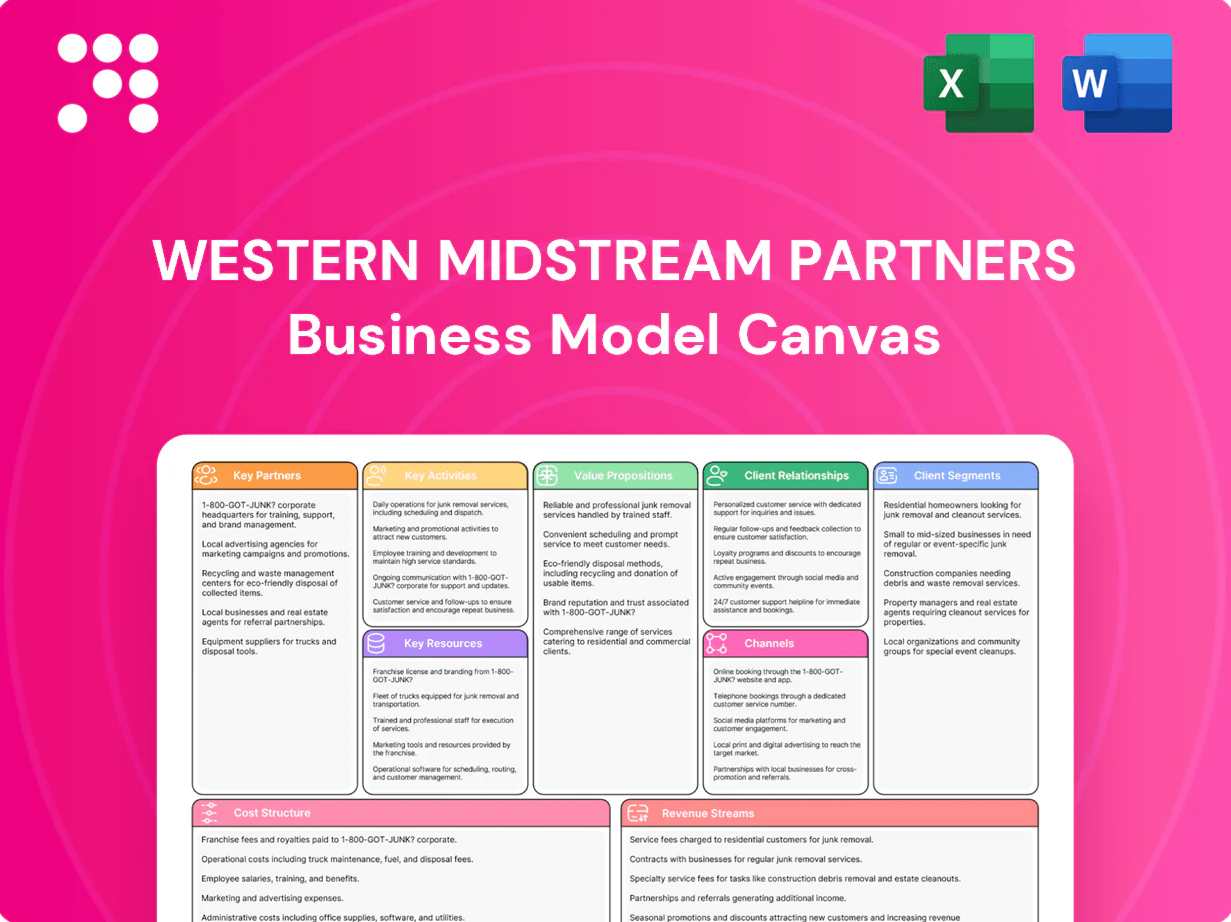
Western Midstream Partners Business Model Canvas

Midstream Business Model Canvas: assets, fee-based contracts, partnerships, cash flow drivers
Unlock the strategic mechanics of Western Midstream Partners with our concise Business Model Canvas—showing how midstream assets, fee-based contracts, and strategic partnerships drive stable cash flows. This 9-block analysis highlights risks, revenue drivers, and scaling levers for investors and strategists. Download the full Word/Excel canvas to apply these insights directly to valuation, benchmarking, or strategic planning.
Partnerships

E&P producer alliances
Core upstream producers dedicate acreage and volumes across the Rockies, North-Central Pennsylvania and Texas, anchoring throughput and enabling network planning; industry data show leading midstream agreements often secure over 70% of volumes under long-term contracts. Stable producer ties support capital efficiency via multi-year commitments, while coordinated drilling and completion timing cuts bottlenecks and idle assets, improving utilization and cash flow predictability.
Sponsor and affiliates
Strategic alignment with sponsor Occidental (which completed integration of Western Midstream in 2024) enhances deal flow and basin insight across the Permian. Affiliate agreements secure base volumes and commercial optionality for gathering and processing. Shared governance and operational standards improve safety and regulatory compliance. Sponsor financial backing reduces capital costs and supports midstream growth projects.

Interconnect and takeaway partners
Interconnects with downstream pipelines, fractionators and market hubs such as Mont Belvieu, Cushing and Houston (as of 2024) give Western Midstream egress and price optionality, while nominations and balancing are coordinated to be seamless across systems. Joint operating agreements standardize tariffs, quality specs and scheduling. Expanded takeaway capacity reduces basis risk for shippers and supports competitive market access.

Equipment and service vendors
Equipment OEMs for compression, treating, and processing sustain uptime and efficiency, commonly keeping compressor availability at or above 95% in 2024 operations.
Field service firms execute construction, integrity programs, and turnarounds, delivering scheduled outages and emergency response across multi‑site portfolios.
Long‑lead procurement (typically 12–24 months) and technology partners for SCADA, leak detection, and analytics reduce schedule, cost, and emissions detection time by ~80%.
- OEM uptime: ≥95%
- Field services: construction & turnarounds
- Procurement: 12–24 months
- Tech: SCADA, LDAR, analytics (~80% faster detection)
Regulators and landowners
Regulators and right-of-way owners are essential for Western Midstream expansions and reliability, with streamlined permitting shown in industry analyses (2020–2024) to cut pipeline project timelines by up to 30% and lower capital costs materially.
Strong relationships accelerate approvals and minimize disputes; coordinated environmental and safety programs improve community trust and reduce incident-driven downtime, supporting predictable access that shortens schedules and protects margins.
- Permitting: accelerates approvals, cuts timelines ~30%
- ROW access: lowers capex and schedule risk
- Env & safety: boosts community trust, reduces downtime
- Regulator ties: minimize disputes, protect margins
Contracts cover >70%; OEM uptime ≥95%; permitting ~30%
Anchor producer contracts secure >70% volumes under multi‑year take‑or‑pay (2024), stabilizing throughput and cash flow. Occidental sponsor integration (2024) supplies base volumes and lowers WACC. OEM uptime ≥95% and procurement lead times 12–24 months support reliability. Streamlined permitting cut project timelines ~30% (2020–2024).
| Metric | 2024 Value |
|---|---|
| Long‑term volume coverage | >70% |
| OEM uptime | ≥95% |
| Procurement lead time | 12–24 months |
| Permitting time reduction | ~30% |
What is included in the product
 Detailed Word Document
A comprehensive Business Model Canvas for Western Midstream Partners detailing customer segments, channels, value propositions, key activities, resources, partners, cost structure and revenue streams, reflecting real-world midstream operations and strategic plans. Ideal for investors and analysts, it includes SWOT-linked insights and competitive advantages per block for polished presentations and funding discussions.

 Customizable Excel Spreadsheet
High-level view of Western Midstream Partners’ business model with editable cells, clarifying midstream pain points like throughput bottlenecks, fee structures, commodity exposure and asset utilization for faster strategic decisions.
Activities

Gas gathering and transport
Operate pipeline networks to aggregate wellhead volumes across basins, tying into a U.S. market that averaged about 100 Bcf/d of marketed gas in 2024 (EIA). Manage flow assurance, pressure control and quality specs to meet pipeline and downstream standards. Coordinate daily nominations and balancing with shippers and optimize routing to minimize line losses and constraints.
Compression, treating, processing
In 2024 Western Midstream ran compression programs to maintain inlet pressures and throughput across its assets, ensuring steady flows to downstream customers. Gas was treated for CO2, H2S and dehydration to meet sales and pipeline specs and protect integrity. Processing facilities targeted NGL extraction where economics supported incremental margin. Plant recovery, reliability and emissions were monitored continuously to meet performance and regulatory targets.

Crude and NGL logistics
Stabilize condensate and move crude and NGLs to market connections, aligning flows with US 2024 crude production of ~12.4 million b/d and NGL supply near 4.5 million b/d to capture takeaway capacity. Schedule truck, pipe, and terminal interfaces to minimize dwell times and optimize fee capture. Manage product quality and custody transfer with locked samples and electronic tickets. Mitigate downtime via pipeline redundancy and storage buffers sized for seasonal swings.

Commercial contracting
Commercial contracting centers on fee-based, minimum volume commitment and acreage dedication agreements, using indexed escalators and tailored risk-sharing to align incentives and price services competitively. Forecasted volumes and capacity models drive capital allocation and project timing, while continuous shipper engagement and performance reporting preserve throughput reliability and contract renewal leverage.
- Contract types: fee-based, MVC, acreage dedication
- Pricing: indexed escalators + risk sharing
- Planning: volume/capacity forecasts for capex
- Operations: shipper communications & performance reporting
Asset integrity and HSE
Western Midstream executes scheduled inspections, maintenance, and integrity digs to address prioritized anomalies and maintain pipeline reliability, leveraging SCADA, LDAR, and analytics for proactive failure prevention. The company enforces consistent PHMSA, EPA, and state regulatory compliance and trains crews in safety, incident response, and environmental stewardship to reduce incidents and regulatory risk.
- 100% scheduled integrity digs on prioritized segments
- Continuous SCADA/LDAR monitoring with analytics-based alerts
- Full PHMSA/EPA/state rule adherence
- Ongoing crew HSE and incident-response training
Move ~100 Bcf/d to US; treat CO2/H2S; extract NGLs; PHMSA/SCADA
Operate pipelines/compression to move and process volumes into a US market ~100 Bcf/d (2024 EIA); treat for CO2/H2S/dehydration and extract NGLs where economic; schedule condensate/NGLs vs US crude ~12.4M b/d and NGLs ~4.5M b/d (2024); contract fee/MVC/acreage and enforce PHMSA/EPA with SCADA/LDAR monitoring.
| Metric | 2024 |
|---|---|
| US marketed gas | ~100 Bcf/d |
| US crude prod | ~12.4M b/d |
| US NGLs | ~4.5M b/d |
Preview Before You Purchase
Business Model Canvas
The Business Model Canvas previewed here is the exact, live section from the Western Midstream Partners file you’ll receive after purchase; it’s not a mockup. Upon ordering you’ll get the same complete, editable document—formatted for immediate use in Word and Excel. No surprises, just the full deliverable as shown.

Midstream Business Model Canvas: assets, fee-based contracts, partnerships, cash flow drivers
Unlock the strategic mechanics of Western Midstream Partners with our concise Business Model Canvas—showing how midstream assets, fee-based contracts, and strategic partnerships drive stable cash flows. This 9-block analysis highlights risks, revenue drivers, and scaling levers for investors and strategists. Download the full Word/Excel canvas to apply these insights directly to valuation, benchmarking, or strategic planning.
Partnerships
E&P producer alliances
Core upstream producers dedicate acreage and volumes across the Rockies, North-Central Pennsylvania and Texas, anchoring throughput and enabling network planning; industry data show leading midstream agreements often secure over 70% of volumes under long-term contracts. Stable producer ties support capital efficiency via multi-year commitments, while coordinated drilling and completion timing cuts bottlenecks and idle assets, improving utilization and cash flow predictability.
Sponsor and affiliates
Strategic alignment with sponsor Occidental (which completed integration of Western Midstream in 2024) enhances deal flow and basin insight across the Permian. Affiliate agreements secure base volumes and commercial optionality for gathering and processing. Shared governance and operational standards improve safety and regulatory compliance. Sponsor financial backing reduces capital costs and supports midstream growth projects.
Interconnect and takeaway partners
Interconnects with downstream pipelines, fractionators and market hubs such as Mont Belvieu, Cushing and Houston (as of 2024) give Western Midstream egress and price optionality, while nominations and balancing are coordinated to be seamless across systems. Joint operating agreements standardize tariffs, quality specs and scheduling. Expanded takeaway capacity reduces basis risk for shippers and supports competitive market access.
Equipment and service vendors
Equipment OEMs for compression, treating, and processing sustain uptime and efficiency, commonly keeping compressor availability at or above 95% in 2024 operations.
Field service firms execute construction, integrity programs, and turnarounds, delivering scheduled outages and emergency response across multi‑site portfolios.
Long‑lead procurement (typically 12–24 months) and technology partners for SCADA, leak detection, and analytics reduce schedule, cost, and emissions detection time by ~80%.
- OEM uptime: ≥95%
- Field services: construction & turnarounds
- Procurement: 12–24 months
- Tech: SCADA, LDAR, analytics (~80% faster detection)
Regulators and landowners
Regulators and right-of-way owners are essential for Western Midstream expansions and reliability, with streamlined permitting shown in industry analyses (2020–2024) to cut pipeline project timelines by up to 30% and lower capital costs materially.
Strong relationships accelerate approvals and minimize disputes; coordinated environmental and safety programs improve community trust and reduce incident-driven downtime, supporting predictable access that shortens schedules and protects margins.
- Permitting: accelerates approvals, cuts timelines ~30%
- ROW access: lowers capex and schedule risk
- Env & safety: boosts community trust, reduces downtime
- Regulator ties: minimize disputes, protect margins
Contracts cover >70%; OEM uptime ≥95%; permitting ~30%
Anchor producer contracts secure >70% volumes under multi‑year take‑or‑pay (2024), stabilizing throughput and cash flow. Occidental sponsor integration (2024) supplies base volumes and lowers WACC. OEM uptime ≥95% and procurement lead times 12–24 months support reliability. Streamlined permitting cut project timelines ~30% (2020–2024).
| Metric | 2024 Value |
|---|---|
| Long‑term volume coverage | >70% |
| OEM uptime | ≥95% |
| Procurement lead time | 12–24 months |
| Permitting time reduction | ~30% |
What is included in the product
Detailed Word Document
A comprehensive Business Model Canvas for Western Midstream Partners detailing customer segments, channels, value propositions, key activities, resources, partners, cost structure and revenue streams, reflecting real-world midstream operations and strategic plans. Ideal for investors and analysts, it includes SWOT-linked insights and competitive advantages per block for polished presentations and funding discussions.
Customizable Excel Spreadsheet
High-level view of Western Midstream Partners’ business model with editable cells, clarifying midstream pain points like throughput bottlenecks, fee structures, commodity exposure and asset utilization for faster strategic decisions.
Activities
Gas gathering and transport
Operate pipeline networks to aggregate wellhead volumes across basins, tying into a U.S. market that averaged about 100 Bcf/d of marketed gas in 2024 (EIA). Manage flow assurance, pressure control and quality specs to meet pipeline and downstream standards. Coordinate daily nominations and balancing with shippers and optimize routing to minimize line losses and constraints.
Compression, treating, processing
In 2024 Western Midstream ran compression programs to maintain inlet pressures and throughput across its assets, ensuring steady flows to downstream customers. Gas was treated for CO2, H2S and dehydration to meet sales and pipeline specs and protect integrity. Processing facilities targeted NGL extraction where economics supported incremental margin. Plant recovery, reliability and emissions were monitored continuously to meet performance and regulatory targets.
Crude and NGL logistics
Stabilize condensate and move crude and NGLs to market connections, aligning flows with US 2024 crude production of ~12.4 million b/d and NGL supply near 4.5 million b/d to capture takeaway capacity. Schedule truck, pipe, and terminal interfaces to minimize dwell times and optimize fee capture. Manage product quality and custody transfer with locked samples and electronic tickets. Mitigate downtime via pipeline redundancy and storage buffers sized for seasonal swings.
Commercial contracting
Commercial contracting centers on fee-based, minimum volume commitment and acreage dedication agreements, using indexed escalators and tailored risk-sharing to align incentives and price services competitively. Forecasted volumes and capacity models drive capital allocation and project timing, while continuous shipper engagement and performance reporting preserve throughput reliability and contract renewal leverage.
- Contract types: fee-based, MVC, acreage dedication
- Pricing: indexed escalators + risk sharing
- Planning: volume/capacity forecasts for capex
- Operations: shipper communications & performance reporting
Asset integrity and HSE
Western Midstream executes scheduled inspections, maintenance, and integrity digs to address prioritized anomalies and maintain pipeline reliability, leveraging SCADA, LDAR, and analytics for proactive failure prevention. The company enforces consistent PHMSA, EPA, and state regulatory compliance and trains crews in safety, incident response, and environmental stewardship to reduce incidents and regulatory risk.
- 100% scheduled integrity digs on prioritized segments
- Continuous SCADA/LDAR monitoring with analytics-based alerts
- Full PHMSA/EPA/state rule adherence
- Ongoing crew HSE and incident-response training
Move ~100 Bcf/d to US; treat CO2/H2S; extract NGLs; PHMSA/SCADA
Operate pipelines/compression to move and process volumes into a US market ~100 Bcf/d (2024 EIA); treat for CO2/H2S/dehydration and extract NGLs where economic; schedule condensate/NGLs vs US crude ~12.4M b/d and NGLs ~4.5M b/d (2024); contract fee/MVC/acreage and enforce PHMSA/EPA with SCADA/LDAR monitoring.
| Metric | 2024 |
|---|---|
| US marketed gas | ~100 Bcf/d |
| US crude prod | ~12.4M b/d |
| US NGLs | ~4.5M b/d |
Preview Before You Purchase
Business Model Canvas
The Business Model Canvas previewed here is the exact, live section from the Western Midstream Partners file you’ll receive after purchase; it’s not a mockup. Upon ordering you’ll get the same complete, editable document—formatted for immediate use in Word and Excel. No surprises, just the full deliverable as shown.
Original: $10.00
-65%$10.00
$3.50Description
Midstream Business Model Canvas: assets, fee-based contracts, partnerships, cash flow drivers
Unlock the strategic mechanics of Western Midstream Partners with our concise Business Model Canvas—showing how midstream assets, fee-based contracts, and strategic partnerships drive stable cash flows. This 9-block analysis highlights risks, revenue drivers, and scaling levers for investors and strategists. Download the full Word/Excel canvas to apply these insights directly to valuation, benchmarking, or strategic planning.
Partnerships
E&P producer alliances
Core upstream producers dedicate acreage and volumes across the Rockies, North-Central Pennsylvania and Texas, anchoring throughput and enabling network planning; industry data show leading midstream agreements often secure over 70% of volumes under long-term contracts. Stable producer ties support capital efficiency via multi-year commitments, while coordinated drilling and completion timing cuts bottlenecks and idle assets, improving utilization and cash flow predictability.
Sponsor and affiliates
Strategic alignment with sponsor Occidental (which completed integration of Western Midstream in 2024) enhances deal flow and basin insight across the Permian. Affiliate agreements secure base volumes and commercial optionality for gathering and processing. Shared governance and operational standards improve safety and regulatory compliance. Sponsor financial backing reduces capital costs and supports midstream growth projects.
Interconnect and takeaway partners
Interconnects with downstream pipelines, fractionators and market hubs such as Mont Belvieu, Cushing and Houston (as of 2024) give Western Midstream egress and price optionality, while nominations and balancing are coordinated to be seamless across systems. Joint operating agreements standardize tariffs, quality specs and scheduling. Expanded takeaway capacity reduces basis risk for shippers and supports competitive market access.
Equipment and service vendors
Equipment OEMs for compression, treating, and processing sustain uptime and efficiency, commonly keeping compressor availability at or above 95% in 2024 operations.
Field service firms execute construction, integrity programs, and turnarounds, delivering scheduled outages and emergency response across multi‑site portfolios.
Long‑lead procurement (typically 12–24 months) and technology partners for SCADA, leak detection, and analytics reduce schedule, cost, and emissions detection time by ~80%.
- OEM uptime: ≥95%
- Field services: construction & turnarounds
- Procurement: 12–24 months
- Tech: SCADA, LDAR, analytics (~80% faster detection)
Regulators and landowners
Regulators and right-of-way owners are essential for Western Midstream expansions and reliability, with streamlined permitting shown in industry analyses (2020–2024) to cut pipeline project timelines by up to 30% and lower capital costs materially.
Strong relationships accelerate approvals and minimize disputes; coordinated environmental and safety programs improve community trust and reduce incident-driven downtime, supporting predictable access that shortens schedules and protects margins.
- Permitting: accelerates approvals, cuts timelines ~30%
- ROW access: lowers capex and schedule risk
- Env & safety: boosts community trust, reduces downtime
- Regulator ties: minimize disputes, protect margins
Contracts cover >70%; OEM uptime ≥95%; permitting ~30%
Anchor producer contracts secure >70% volumes under multi‑year take‑or‑pay (2024), stabilizing throughput and cash flow. Occidental sponsor integration (2024) supplies base volumes and lowers WACC. OEM uptime ≥95% and procurement lead times 12–24 months support reliability. Streamlined permitting cut project timelines ~30% (2020–2024).
| Metric | 2024 Value |
|---|---|
| Long‑term volume coverage | >70% |
| OEM uptime | ≥95% |
| Procurement lead time | 12–24 months |
| Permitting time reduction | ~30% |
What is included in the product
Detailed Word Document
A comprehensive Business Model Canvas for Western Midstream Partners detailing customer segments, channels, value propositions, key activities, resources, partners, cost structure and revenue streams, reflecting real-world midstream operations and strategic plans. Ideal for investors and analysts, it includes SWOT-linked insights and competitive advantages per block for polished presentations and funding discussions.
Customizable Excel Spreadsheet
High-level view of Western Midstream Partners’ business model with editable cells, clarifying midstream pain points like throughput bottlenecks, fee structures, commodity exposure and asset utilization for faster strategic decisions.
Activities
Gas gathering and transport
Operate pipeline networks to aggregate wellhead volumes across basins, tying into a U.S. market that averaged about 100 Bcf/d of marketed gas in 2024 (EIA). Manage flow assurance, pressure control and quality specs to meet pipeline and downstream standards. Coordinate daily nominations and balancing with shippers and optimize routing to minimize line losses and constraints.
Compression, treating, processing
In 2024 Western Midstream ran compression programs to maintain inlet pressures and throughput across its assets, ensuring steady flows to downstream customers. Gas was treated for CO2, H2S and dehydration to meet sales and pipeline specs and protect integrity. Processing facilities targeted NGL extraction where economics supported incremental margin. Plant recovery, reliability and emissions were monitored continuously to meet performance and regulatory targets.
Crude and NGL logistics
Stabilize condensate and move crude and NGLs to market connections, aligning flows with US 2024 crude production of ~12.4 million b/d and NGL supply near 4.5 million b/d to capture takeaway capacity. Schedule truck, pipe, and terminal interfaces to minimize dwell times and optimize fee capture. Manage product quality and custody transfer with locked samples and electronic tickets. Mitigate downtime via pipeline redundancy and storage buffers sized for seasonal swings.
Commercial contracting
Commercial contracting centers on fee-based, minimum volume commitment and acreage dedication agreements, using indexed escalators and tailored risk-sharing to align incentives and price services competitively. Forecasted volumes and capacity models drive capital allocation and project timing, while continuous shipper engagement and performance reporting preserve throughput reliability and contract renewal leverage.
- Contract types: fee-based, MVC, acreage dedication
- Pricing: indexed escalators + risk sharing
- Planning: volume/capacity forecasts for capex
- Operations: shipper communications & performance reporting
Asset integrity and HSE
Western Midstream executes scheduled inspections, maintenance, and integrity digs to address prioritized anomalies and maintain pipeline reliability, leveraging SCADA, LDAR, and analytics for proactive failure prevention. The company enforces consistent PHMSA, EPA, and state regulatory compliance and trains crews in safety, incident response, and environmental stewardship to reduce incidents and regulatory risk.
- 100% scheduled integrity digs on prioritized segments
- Continuous SCADA/LDAR monitoring with analytics-based alerts
- Full PHMSA/EPA/state rule adherence
- Ongoing crew HSE and incident-response training
Move ~100 Bcf/d to US; treat CO2/H2S; extract NGLs; PHMSA/SCADA
Operate pipelines/compression to move and process volumes into a US market ~100 Bcf/d (2024 EIA); treat for CO2/H2S/dehydration and extract NGLs where economic; schedule condensate/NGLs vs US crude ~12.4M b/d and NGLs ~4.5M b/d (2024); contract fee/MVC/acreage and enforce PHMSA/EPA with SCADA/LDAR monitoring.
| Metric | 2024 |
|---|---|
| US marketed gas | ~100 Bcf/d |
| US crude prod | ~12.4M b/d |
| US NGLs | ~4.5M b/d |
Preview Before You Purchase
Business Model Canvas
The Business Model Canvas previewed here is the exact, live section from the Western Midstream Partners file you’ll receive after purchase; it’s not a mockup. Upon ordering you’ll get the same complete, editable document—formatted for immediate use in Word and Excel. No surprises, just the full deliverable as shown.











