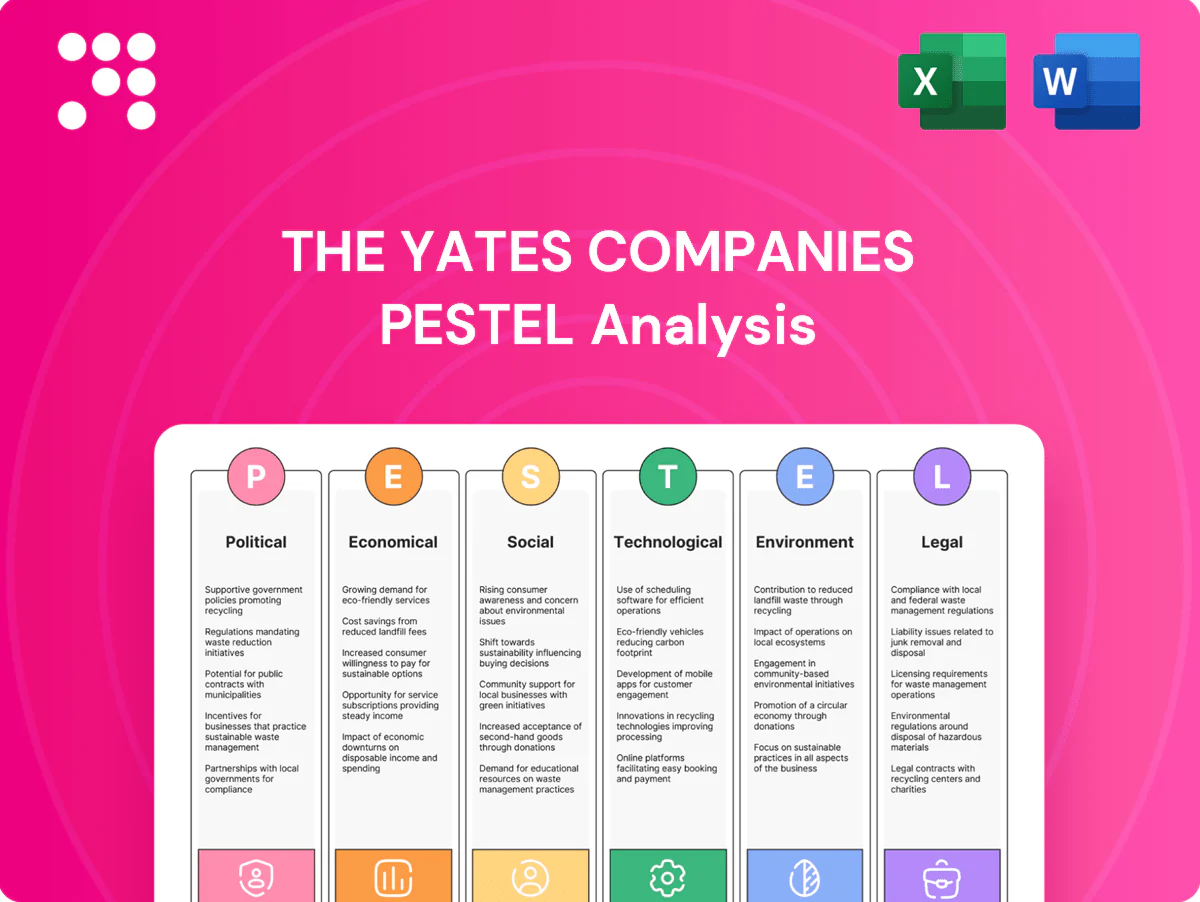
The Yates Companies PESTLE Analysis

Make Smarter Strategic Decisions with a Complete PESTEL View
Uncover how political shifts, economic cycles, social trends, technology disruption, legal changes and environmental pressures shape The Yates Companies’ outlook with our concise PESTLE snapshot—buy the full analysis for a downloadable, actionable deep-dive you can use in strategy, investment or pitch decks.
Political factors

Public infrastructure funding cycles
Federal and state budgets and stimulus—notably the 2021 Infrastructure Investment and Jobs Act (about $550 billion in new federal funding)—drive demand for large projects, but shifts in appropriations and state capital budgets (often moving double-digit percent year-to-year) create pipeline volatility. Yates must align bids to funding calendars and use active government relations to surface early opportunities.
Permitting and zoning approvals
Local political priorities can push entitlement timelines from 6 to 18 months in many U.S. markets, and 60% of developers cite permitting delays as a leading cause of schedule slippage (industry surveys). Each month of delay raises carrying costs and financing expense, while early stakeholder engagement in commercial and institutional builds cuts approval risk. A robust permit-tracking process preserves schedules and mitigates bid inflation and interest carry.

Trade policy and materials tariffs
US Section 232 tariffs (25% on steel, 10% on aluminum) that remain in effect since 2018 can skew bid accuracy and shave typical construction margins by an estimated 2–5% on materials-heavy projects. Policy shifts mid-project can strain guaranteed maximum price contracts and force contingency draws. Hedging metals exposure and diversifying suppliers reduced volatility in 2023–24, while transparent escalation clauses help allocate tariff risk with clients.

Labor policy and apprenticeship incentives
Public support for skilled-trades training can ease labor shortages and federal registered apprenticeships exceeded 700,000 in 2024 per US DOL, improving pipeline access for The Yates Companies. Prevailing wage rules such as the Davis-Bacon Act (applies to federal contracts over $2,000) affect public-sector bid pricing and margins. Partnering with apprenticeship programs reduces recruitment costs and compliance keeps bids competitive while avoiding legal exposure.
- Labor pipeline: apprenticeship growth 700,000+ (US DOL 2024)
- Regulation: Davis-Bacon threshold $2,000
- Benefit: lower hiring costs, trained workforce
- Risk mitigation: compliance avoids penalties, preserves bid eligibility
Disaster preparedness and resilience priorities
Political focus on resilient infrastructure, underscored by the IIJA ($1.2 trillion) and IRA (~$369 billion) funding streams, boosts demand for hardening and retrofit projects; federal resilience grant programs such as FEMA BRIC distribute billions annually and often prioritize critical facilities. Yates can position offerings around resilient design and construction management and quantify outcomes to strengthen public-sector credibility.
- Demand: retrofit/hardening growth tied to IIJA/IRA funding
- Funding: grants favor hospitals, utilities, transport
- Offer: resilient design + construction management
- Credibility: measurable outcomes win public contracts
IIJA funding spurs projects; permitting delays and tariffs squeeze margins—align bids, gov relations
Federal/state funding (IIJA $1.2T; ~$550B new) drives project demand but calendar volatility requires aligning bids and government relations. Permitting delays (6–18 months; 60% of developers cite delays) raise carrying costs and schedule risk. Tariffs (steel 25%, aluminum 10%) can cut margins ~2–5%; apprenticeships 700,000+ (US DOL 2024) ease labor shortages.
| Metric | Value |
|---|---|
| IIJA | $1.2T |
| New IIJA funding | $550B |
| Apprenticeships | 700,000+ |
What is included in the product
 Detailed Word Document
Explores how external macro-environmental factors uniquely affect The Yates Companies across six dimensions: Political, Economic, Social, Technological, Environmental, and Legal. Each section is data-backed, region- and industry-specific, and offers forward-looking insights to identify threats, opportunities, and strategic responses for executives, investors, and advisors.

 Customizable Excel Spreadsheet
A concise, visually segmented PESTLE summary for The Yates Companies that can be dropped into presentations, edited with context-specific notes, and easily shared to align teams and support external risk and market-positioning discussions.
Economic factors

Interest rates and financing costs
Higher borrowing costs—federal funds at roughly 5.25–5.50% and a 30-year mortgage near 6.7% (Freddie Mac mid-2025)—have damped private development and delayed groundbreakings. Owners face tighter underwriting and shrinking backlogs; Yates can pivot toward funded public or mission-critical projects. Value engineering and cost-control will differentiate wins in a capital-constrained market.
Construction materials price volatility
Fluctuations in concrete, steel, and lumber complicate project estimating for The Yates Companies, making margins vulnerable to raw-material swings. Index-linked procurement and bulk buys are used to stabilize costs and lock prices across multi-month pipelines. Real-time cost dashboards improve bid precision, while escalation clauses in contracts protect margins against sustained commodity spikes.

Labor availability and wage inflation
Tight labor markets push direct and subcontractor costs higher, with BLS reporting roughly 4.5% year‑over‑year wage growth in construction through 2024 and continued upward pressure into 2025.
Scarcity of specialty trades increases schedule risk and change-order exposure on Yates projects, raising completion uncertainty.
Expanding self‑perform capabilities and formal partnerships with trade schools widen the hiring funnel and reduce reliance on volatile subcontractor pricing.

Sectoral mix and cyclical exposure
Yates leverages a sectoral mix where industrial and institutional projects help offset commercial slowdowns; U.S. nonresidential construction spending was roughly $1.5 trillion in 2024 (U.S. Census Bureau), supporting demand diversification. Its full-service model captures margins across design, build and maintenance, while a targeted pursuit strategy balances growth and resilience.
- Industrial/institutional offset
- Revenue smoothing via diversification
- Full-service margin capture
- Targeted pursuit = growth + resilience
Client capital expenditure trends
Corporate capex shifts in 2024 compressed project sizes and staggered timing, with firms favoring modular, phased builds; nearshoring and elevated logistics demand continued to underpin industrial development through 2024–2025, while healthcare and education remained steady institutional pipelines. Early preconstruction engagement secured preferred-contractor status and higher win rates in competitive bids.
- Nearshoring: sustained industrial demand (2024)
- Institutional: healthcare/education steady pipelines
- Project mix: smaller, phased capex
- Strategy: early preconstruction wins preferred status
IIJA funding spurs projects; permitting delays and tariffs squeeze margins—align bids, gov relations
Higher rates (Fed 5.25–5.50%, 30y mortgage ~6.7% mid‑2025) curb private starts; Yates shifts to public/mission projects. Material volatility and 4.5% construction wage growth (BLS 2024) squeeze margins; index procurement and escalation clauses mitigate risk. Diversified mix (US nonresidential spend ~$1.5T in 2024) smooths revenue.
| Metric | Value |
|---|---|
| Fed funds | 5.25–5.50% |
| 30y mortgage | ~6.7% |
| Wage growth | 4.5% (2024) |
| Nonresidential spend | $1.5T (2024) |
Preview the Actual Deliverable
The Yates Companies PESTLE Analysis
The preview shown here is the exact PESTLE analysis of The Yates Companies you’ll receive after purchase—fully formatted and ready to use. The layout, content, and structure visible here are exactly what you’ll be able to download immediately after buying. No placeholders or teasers—this is the final, professionally structured file.

Make Smarter Strategic Decisions with a Complete PESTEL View
Uncover how political shifts, economic cycles, social trends, technology disruption, legal changes and environmental pressures shape The Yates Companies’ outlook with our concise PESTLE snapshot—buy the full analysis for a downloadable, actionable deep-dive you can use in strategy, investment or pitch decks.
Political factors
Public infrastructure funding cycles
Federal and state budgets and stimulus—notably the 2021 Infrastructure Investment and Jobs Act (about $550 billion in new federal funding)—drive demand for large projects, but shifts in appropriations and state capital budgets (often moving double-digit percent year-to-year) create pipeline volatility. Yates must align bids to funding calendars and use active government relations to surface early opportunities.
Permitting and zoning approvals
Local political priorities can push entitlement timelines from 6 to 18 months in many U.S. markets, and 60% of developers cite permitting delays as a leading cause of schedule slippage (industry surveys). Each month of delay raises carrying costs and financing expense, while early stakeholder engagement in commercial and institutional builds cuts approval risk. A robust permit-tracking process preserves schedules and mitigates bid inflation and interest carry.
Trade policy and materials tariffs
US Section 232 tariffs (25% on steel, 10% on aluminum) that remain in effect since 2018 can skew bid accuracy and shave typical construction margins by an estimated 2–5% on materials-heavy projects. Policy shifts mid-project can strain guaranteed maximum price contracts and force contingency draws. Hedging metals exposure and diversifying suppliers reduced volatility in 2023–24, while transparent escalation clauses help allocate tariff risk with clients.
Labor policy and apprenticeship incentives
Public support for skilled-trades training can ease labor shortages and federal registered apprenticeships exceeded 700,000 in 2024 per US DOL, improving pipeline access for The Yates Companies. Prevailing wage rules such as the Davis-Bacon Act (applies to federal contracts over $2,000) affect public-sector bid pricing and margins. Partnering with apprenticeship programs reduces recruitment costs and compliance keeps bids competitive while avoiding legal exposure.
- Labor pipeline: apprenticeship growth 700,000+ (US DOL 2024)
- Regulation: Davis-Bacon threshold $2,000
- Benefit: lower hiring costs, trained workforce
- Risk mitigation: compliance avoids penalties, preserves bid eligibility
Disaster preparedness and resilience priorities
Political focus on resilient infrastructure, underscored by the IIJA ($1.2 trillion) and IRA (~$369 billion) funding streams, boosts demand for hardening and retrofit projects; federal resilience grant programs such as FEMA BRIC distribute billions annually and often prioritize critical facilities. Yates can position offerings around resilient design and construction management and quantify outcomes to strengthen public-sector credibility.
- Demand: retrofit/hardening growth tied to IIJA/IRA funding
- Funding: grants favor hospitals, utilities, transport
- Offer: resilient design + construction management
- Credibility: measurable outcomes win public contracts
IIJA funding spurs projects; permitting delays and tariffs squeeze margins—align bids, gov relations
Federal/state funding (IIJA $1.2T; ~$550B new) drives project demand but calendar volatility requires aligning bids and government relations. Permitting delays (6–18 months; 60% of developers cite delays) raise carrying costs and schedule risk. Tariffs (steel 25%, aluminum 10%) can cut margins ~2–5%; apprenticeships 700,000+ (US DOL 2024) ease labor shortages.
| Metric | Value |
|---|---|
| IIJA | $1.2T |
| New IIJA funding | $550B |
| Apprenticeships | 700,000+ |
What is included in the product
Detailed Word Document
Explores how external macro-environmental factors uniquely affect The Yates Companies across six dimensions: Political, Economic, Social, Technological, Environmental, and Legal. Each section is data-backed, region- and industry-specific, and offers forward-looking insights to identify threats, opportunities, and strategic responses for executives, investors, and advisors.
Customizable Excel Spreadsheet
A concise, visually segmented PESTLE summary for The Yates Companies that can be dropped into presentations, edited with context-specific notes, and easily shared to align teams and support external risk and market-positioning discussions.
Economic factors
Interest rates and financing costs
Higher borrowing costs—federal funds at roughly 5.25–5.50% and a 30-year mortgage near 6.7% (Freddie Mac mid-2025)—have damped private development and delayed groundbreakings. Owners face tighter underwriting and shrinking backlogs; Yates can pivot toward funded public or mission-critical projects. Value engineering and cost-control will differentiate wins in a capital-constrained market.
Construction materials price volatility
Fluctuations in concrete, steel, and lumber complicate project estimating for The Yates Companies, making margins vulnerable to raw-material swings. Index-linked procurement and bulk buys are used to stabilize costs and lock prices across multi-month pipelines. Real-time cost dashboards improve bid precision, while escalation clauses in contracts protect margins against sustained commodity spikes.
Labor availability and wage inflation
Tight labor markets push direct and subcontractor costs higher, with BLS reporting roughly 4.5% year‑over‑year wage growth in construction through 2024 and continued upward pressure into 2025.
Scarcity of specialty trades increases schedule risk and change-order exposure on Yates projects, raising completion uncertainty.
Expanding self‑perform capabilities and formal partnerships with trade schools widen the hiring funnel and reduce reliance on volatile subcontractor pricing.
Sectoral mix and cyclical exposure
Yates leverages a sectoral mix where industrial and institutional projects help offset commercial slowdowns; U.S. nonresidential construction spending was roughly $1.5 trillion in 2024 (U.S. Census Bureau), supporting demand diversification. Its full-service model captures margins across design, build and maintenance, while a targeted pursuit strategy balances growth and resilience.
- Industrial/institutional offset
- Revenue smoothing via diversification
- Full-service margin capture
- Targeted pursuit = growth + resilience
Client capital expenditure trends
Corporate capex shifts in 2024 compressed project sizes and staggered timing, with firms favoring modular, phased builds; nearshoring and elevated logistics demand continued to underpin industrial development through 2024–2025, while healthcare and education remained steady institutional pipelines. Early preconstruction engagement secured preferred-contractor status and higher win rates in competitive bids.
- Nearshoring: sustained industrial demand (2024)
- Institutional: healthcare/education steady pipelines
- Project mix: smaller, phased capex
- Strategy: early preconstruction wins preferred status
IIJA funding spurs projects; permitting delays and tariffs squeeze margins—align bids, gov relations
Higher rates (Fed 5.25–5.50%, 30y mortgage ~6.7% mid‑2025) curb private starts; Yates shifts to public/mission projects. Material volatility and 4.5% construction wage growth (BLS 2024) squeeze margins; index procurement and escalation clauses mitigate risk. Diversified mix (US nonresidential spend ~$1.5T in 2024) smooths revenue.
| Metric | Value |
|---|---|
| Fed funds | 5.25–5.50% |
| 30y mortgage | ~6.7% |
| Wage growth | 4.5% (2024) |
| Nonresidential spend | $1.5T (2024) |
Preview the Actual Deliverable
The Yates Companies PESTLE Analysis
The preview shown here is the exact PESTLE analysis of The Yates Companies you’ll receive after purchase—fully formatted and ready to use. The layout, content, and structure visible here are exactly what you’ll be able to download immediately after buying. No placeholders or teasers—this is the final, professionally structured file.
Original: $10.00
-65%$10.00
$3.50Description
Make Smarter Strategic Decisions with a Complete PESTEL View
Uncover how political shifts, economic cycles, social trends, technology disruption, legal changes and environmental pressures shape The Yates Companies’ outlook with our concise PESTLE snapshot—buy the full analysis for a downloadable, actionable deep-dive you can use in strategy, investment or pitch decks.
Political factors
Public infrastructure funding cycles
Federal and state budgets and stimulus—notably the 2021 Infrastructure Investment and Jobs Act (about $550 billion in new federal funding)—drive demand for large projects, but shifts in appropriations and state capital budgets (often moving double-digit percent year-to-year) create pipeline volatility. Yates must align bids to funding calendars and use active government relations to surface early opportunities.
Permitting and zoning approvals
Local political priorities can push entitlement timelines from 6 to 18 months in many U.S. markets, and 60% of developers cite permitting delays as a leading cause of schedule slippage (industry surveys). Each month of delay raises carrying costs and financing expense, while early stakeholder engagement in commercial and institutional builds cuts approval risk. A robust permit-tracking process preserves schedules and mitigates bid inflation and interest carry.
Trade policy and materials tariffs
US Section 232 tariffs (25% on steel, 10% on aluminum) that remain in effect since 2018 can skew bid accuracy and shave typical construction margins by an estimated 2–5% on materials-heavy projects. Policy shifts mid-project can strain guaranteed maximum price contracts and force contingency draws. Hedging metals exposure and diversifying suppliers reduced volatility in 2023–24, while transparent escalation clauses help allocate tariff risk with clients.
Labor policy and apprenticeship incentives
Public support for skilled-trades training can ease labor shortages and federal registered apprenticeships exceeded 700,000 in 2024 per US DOL, improving pipeline access for The Yates Companies. Prevailing wage rules such as the Davis-Bacon Act (applies to federal contracts over $2,000) affect public-sector bid pricing and margins. Partnering with apprenticeship programs reduces recruitment costs and compliance keeps bids competitive while avoiding legal exposure.
- Labor pipeline: apprenticeship growth 700,000+ (US DOL 2024)
- Regulation: Davis-Bacon threshold $2,000
- Benefit: lower hiring costs, trained workforce
- Risk mitigation: compliance avoids penalties, preserves bid eligibility
Disaster preparedness and resilience priorities
Political focus on resilient infrastructure, underscored by the IIJA ($1.2 trillion) and IRA (~$369 billion) funding streams, boosts demand for hardening and retrofit projects; federal resilience grant programs such as FEMA BRIC distribute billions annually and often prioritize critical facilities. Yates can position offerings around resilient design and construction management and quantify outcomes to strengthen public-sector credibility.
- Demand: retrofit/hardening growth tied to IIJA/IRA funding
- Funding: grants favor hospitals, utilities, transport
- Offer: resilient design + construction management
- Credibility: measurable outcomes win public contracts
IIJA funding spurs projects; permitting delays and tariffs squeeze margins—align bids, gov relations
Federal/state funding (IIJA $1.2T; ~$550B new) drives project demand but calendar volatility requires aligning bids and government relations. Permitting delays (6–18 months; 60% of developers cite delays) raise carrying costs and schedule risk. Tariffs (steel 25%, aluminum 10%) can cut margins ~2–5%; apprenticeships 700,000+ (US DOL 2024) ease labor shortages.
| Metric | Value |
|---|---|
| IIJA | $1.2T |
| New IIJA funding | $550B |
| Apprenticeships | 700,000+ |
What is included in the product
Detailed Word Document
Explores how external macro-environmental factors uniquely affect The Yates Companies across six dimensions: Political, Economic, Social, Technological, Environmental, and Legal. Each section is data-backed, region- and industry-specific, and offers forward-looking insights to identify threats, opportunities, and strategic responses for executives, investors, and advisors.
Customizable Excel Spreadsheet
A concise, visually segmented PESTLE summary for The Yates Companies that can be dropped into presentations, edited with context-specific notes, and easily shared to align teams and support external risk and market-positioning discussions.
Economic factors
Interest rates and financing costs
Higher borrowing costs—federal funds at roughly 5.25–5.50% and a 30-year mortgage near 6.7% (Freddie Mac mid-2025)—have damped private development and delayed groundbreakings. Owners face tighter underwriting and shrinking backlogs; Yates can pivot toward funded public or mission-critical projects. Value engineering and cost-control will differentiate wins in a capital-constrained market.
Construction materials price volatility
Fluctuations in concrete, steel, and lumber complicate project estimating for The Yates Companies, making margins vulnerable to raw-material swings. Index-linked procurement and bulk buys are used to stabilize costs and lock prices across multi-month pipelines. Real-time cost dashboards improve bid precision, while escalation clauses in contracts protect margins against sustained commodity spikes.
Labor availability and wage inflation
Tight labor markets push direct and subcontractor costs higher, with BLS reporting roughly 4.5% year‑over‑year wage growth in construction through 2024 and continued upward pressure into 2025.
Scarcity of specialty trades increases schedule risk and change-order exposure on Yates projects, raising completion uncertainty.
Expanding self‑perform capabilities and formal partnerships with trade schools widen the hiring funnel and reduce reliance on volatile subcontractor pricing.
Sectoral mix and cyclical exposure
Yates leverages a sectoral mix where industrial and institutional projects help offset commercial slowdowns; U.S. nonresidential construction spending was roughly $1.5 trillion in 2024 (U.S. Census Bureau), supporting demand diversification. Its full-service model captures margins across design, build and maintenance, while a targeted pursuit strategy balances growth and resilience.
- Industrial/institutional offset
- Revenue smoothing via diversification
- Full-service margin capture
- Targeted pursuit = growth + resilience
Client capital expenditure trends
Corporate capex shifts in 2024 compressed project sizes and staggered timing, with firms favoring modular, phased builds; nearshoring and elevated logistics demand continued to underpin industrial development through 2024–2025, while healthcare and education remained steady institutional pipelines. Early preconstruction engagement secured preferred-contractor status and higher win rates in competitive bids.
- Nearshoring: sustained industrial demand (2024)
- Institutional: healthcare/education steady pipelines
- Project mix: smaller, phased capex
- Strategy: early preconstruction wins preferred status
IIJA funding spurs projects; permitting delays and tariffs squeeze margins—align bids, gov relations
Higher rates (Fed 5.25–5.50%, 30y mortgage ~6.7% mid‑2025) curb private starts; Yates shifts to public/mission projects. Material volatility and 4.5% construction wage growth (BLS 2024) squeeze margins; index procurement and escalation clauses mitigate risk. Diversified mix (US nonresidential spend ~$1.5T in 2024) smooths revenue.
| Metric | Value |
|---|---|
| Fed funds | 5.25–5.50% |
| 30y mortgage | ~6.7% |
| Wage growth | 4.5% (2024) |
| Nonresidential spend | $1.5T (2024) |
Preview the Actual Deliverable
The Yates Companies PESTLE Analysis
The preview shown here is the exact PESTLE analysis of The Yates Companies you’ll receive after purchase—fully formatted and ready to use. The layout, content, and structure visible here are exactly what you’ll be able to download immediately after buying. No placeholders or teasers—this is the final, professionally structured file.











