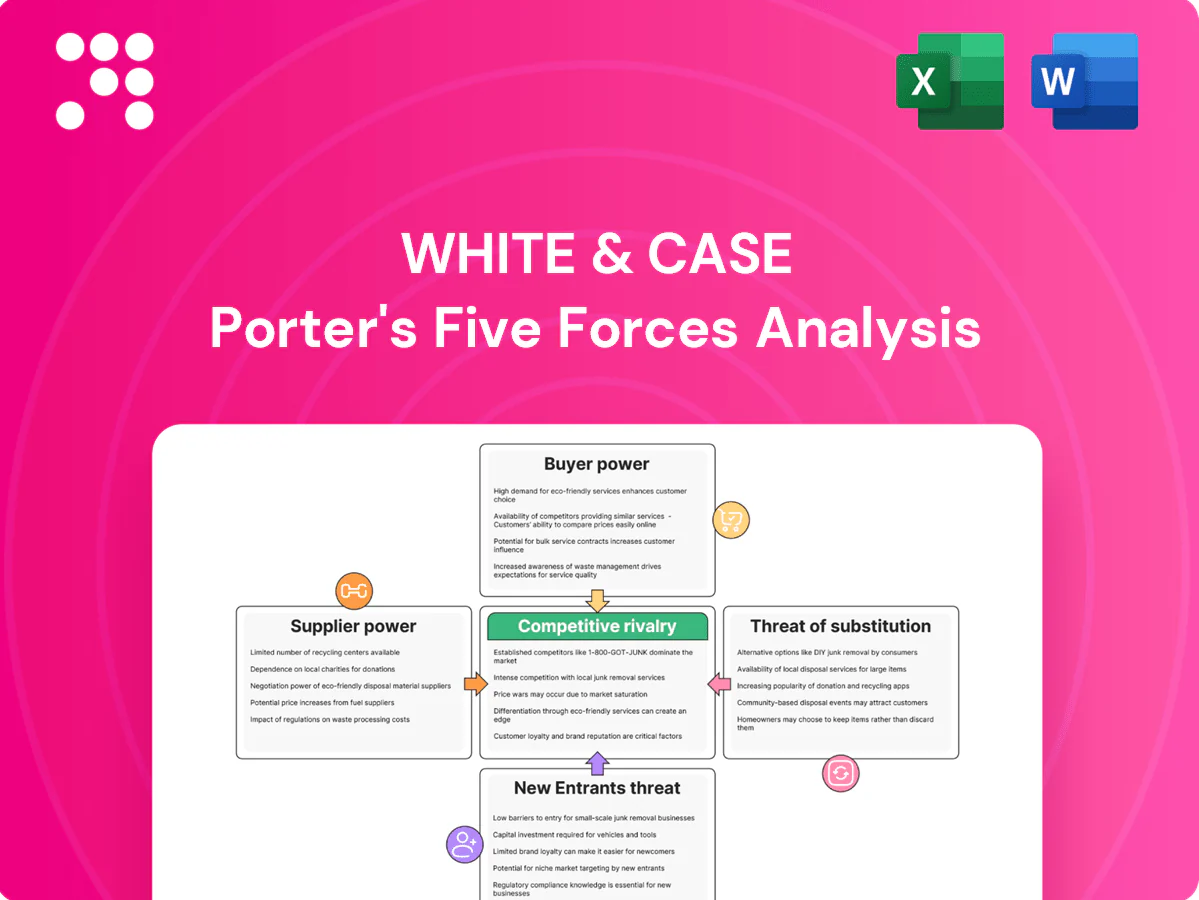
White & Case Porter's Five Forces Analysis

Elevate Your Analysis with the Complete Porter's Five Forces Analysis
White & Case’s Porter’s Five Forces snapshot highlights competitive rivalry, client bargaining power, supplier dynamics, substitute threats, and entry barriers in the global legal market. This concise view reveals key pressures shaping strategy and profitability. Ready for deeper, data-driven insights? Unlock the full Porter’s Five Forces Analysis to access force-by-force ratings, visuals, and actionable recommendations.
Suppliers Bargaining Power

Scarcity of elite legal talent
White & Case depends on scarce top-tier partners, arbitrators and industry specialists whose services are highly inelastic; star lawyers command premium compensation and often influence fee and engagement terms. In 2024 the premium for marquee partner hires reached reported levels up to 25%–40% above standard pay in major markets, intensifying wage pressure. Shortages in key jurisdictions drove higher retention costs and bargaining leverage for talent suppliers who can credibly threaten to relocate.
Lateral partner mobility
Lateral partner mobility is high; portable books make laterals de facto suppliers—global firms spent over $1bn on lateral recruiting in 2023 and lateral hires comprised roughly 40% of partner moves in 2024. Top performers extract guarantees and origination credits, reshaping firm economics as competitive bidding among T50 global firms raises costs. Integration risk amplifies dependence on laterals’ contract terms.

Critical tech and data vendors
Dependence on premium eDiscovery, AI research, due diligence and compliance platforms creates strong lock-in for White & Case, with migration often exceeding $1m and taking 6–12 months. A concentrated supplier base—top four vendors estimated to control over 60% of enterprise spend in 2024—limits price leverage. Security, uptime and analytics quality raise switching costs, and post-2022 consolidation pushed SaaS fees up roughly 10% by 2024.

Specialist third parties
Specialist third parties—expert witnesses, translators, local counsel and investigation firms—are essential in cross-border White & Case matters, with expert witness fees often exceeding 1,000/hour in complex disputes in 2024; niche expertise is scarce in regulated or emerging markets, weakening the firm’s leverage. Time-sensitive cases further constrain bargaining power and drive premium rates and tight availability.
- Essential roles: expert witnesses, translators, local counsel, investigators
- Scarcity: niche skills concentrated in regulated/emerging markets
- Pricing pressure: premiums and limited availability raise supplier power
Prime real estate and support services
- High rents: pricing power
- Capex: +15–30% per workstation
- Inventory: limited in top markets
- Relocation: client/talent risk
Supplier power hits firm: partner premiums 25–40%, top vendors 60%
White & Case faces strong supplier power: star partners command 25–40% premiums and laterals were ~40% of partner moves in 2024 (global lateral recruiting >$1bn in 2023). Top four eDiscovery/AI vendors hold ~60% share and SaaS fees rose ~10% by 2024. Expert witness fees often exceed $1,000/hr; prime NYC rent ~$85/sq ft in 2024.
| Metric | 2024 |
|---|---|
| Partner premium | 25–40% |
| Lateral share | ~40% |
| Top4 vendor share | ~60% |
| SaaS fee change | +10% |
| Expert fees | >$1,000/hr |
| Prime NYC rent | $85/sq ft |
What is included in the product
 Detailed Word Document
Uncovers key drivers of competition, buyer and supplier influence, substitute threats, and entry barriers specific to White & Case, providing strategic commentary on rivalry and disruptive forces shaping its market position.

 Customizable Excel Spreadsheet
White & Case Porter's Five Forces delivers a concise, one-sheet risk diagnosis that quantifies competitive pressures, lets you adjust threat levels for regulatory or new-entrant scenarios, and exports clean visuals for decks—no macros or complex setup required.
Customers Bargaining Power

Sophisticated procurement and panels
Large corporates and financial institutions increasingly run formal RFPs and panel reviews that use standardized scoring frameworks emphasizing price, diversity and efficiency. Multi-year panel deals, commonly spanning 2–4 years, give buyers volume leverage that drives work toward lower-cost providers. This dynamic compresses margins on commoditized matters as firms compete on rate, staffing and delivery efficiency.
Client concentration in marquee sectors
PE sponsors, global banks and multinationals drive large fee pools—with PE deal activity and corporate M&A sustaining sizeable legal spend—top clients often account for 25–35% of firm revenue, enabling concentrated spenders to negotiate preferential terms; conflicts between practices limit cross-selling and amplify individual client leverage, so losing a marquee account can depress utilization across multiple practices.

Value sensitivity by matter type
Clients show high willingness to pay for bet-the-company disputes and complex cross-border deals, where White & Case reported significant cross-border M&A advisory volume in 2024; routine matters, by contrast, face fee compression and competitive bidding. Buyers are segmenting portfolios and pushing alternative fee arrangements for predictable work, with AFAs growing as a share of corporate legal budgets in 2024. This duality produces selective buyer power, concentrated on commoditized services while preserving premium pricing for high-stakes mandates.

Alternative fee arrangements
Alternative fee arrangements such as success fees, caps, blended rates and subscriptions transfer greater revenue risk to White & Case, forcing tighter matter scoping; data-driven clients increasingly benchmark rates across peers and ALSPs, pressuring margins. AFAs require process discipline, rigorous matter budgeting and staffing controls because poor scoping or overruns can quickly erode profitability.
- Success fees shift upside risk to firm
- Caps and blended rates compress hourly realization
- Subscriptions demand steady-cost delivery
- Benchmarking by clients increases price transparency
- Poor scoping reduces margin and realization
Low switching costs on non-strategic work
Clients commonly split mandates across multiple firms, and for non-strategic, standardized work replacement is easy via panels and ALSPs; the ALSP market exceeded $10 billion in 2024, increasing buyer leverage. Deep client relationships and specialized know-how still raise switching costs for complex matters, but this is not universal. Buyers routinely pit firms against each other to obtain fee concessions and enhanced scope.
- Multi-firm mandates: common
- ALSP market: >$10bn (2024)
- High switching cost: complex matters only
- Buyers use competition for discounts
Buyers use RFPs, 2-4yr panels and AFAs to force price as ALSPs top >$10bn
Buyers use formal RFPs and 2–4 year panels to force price, diversity and efficiency, shifting work to lower‑cost providers. Top clients (PE, banks, multinationals) often represent 25–35% of firm revenue, enabling concentrated spenders to demand concessions. ALSP market >$10bn (2024) and rising AFAs increase price transparency and transfer revenue risk, forcing tighter scoping and staffing.
| Metric | 2024 |
|---|---|
| Top‑client revenue concentration | 25–35% |
| ALSP market size | >$10bn |
| Panel length | 2–4 yrs |
Full Version Awaits
White & Case Porter's Five Forces Analysis
This preview shows the exact White & Case Porter's Five Forces Analysis you'll receive immediately after purchase—no placeholders or mockups. The document displayed is the professionally formatted, final file ready for download and use the moment you buy. You're viewing the same deliverable that will be available to you instantly upon payment.

Elevate Your Analysis with the Complete Porter's Five Forces Analysis
White & Case’s Porter’s Five Forces snapshot highlights competitive rivalry, client bargaining power, supplier dynamics, substitute threats, and entry barriers in the global legal market. This concise view reveals key pressures shaping strategy and profitability. Ready for deeper, data-driven insights? Unlock the full Porter’s Five Forces Analysis to access force-by-force ratings, visuals, and actionable recommendations.
Suppliers Bargaining Power
Scarcity of elite legal talent
White & Case depends on scarce top-tier partners, arbitrators and industry specialists whose services are highly inelastic; star lawyers command premium compensation and often influence fee and engagement terms. In 2024 the premium for marquee partner hires reached reported levels up to 25%–40% above standard pay in major markets, intensifying wage pressure. Shortages in key jurisdictions drove higher retention costs and bargaining leverage for talent suppliers who can credibly threaten to relocate.
Lateral partner mobility
Lateral partner mobility is high; portable books make laterals de facto suppliers—global firms spent over $1bn on lateral recruiting in 2023 and lateral hires comprised roughly 40% of partner moves in 2024. Top performers extract guarantees and origination credits, reshaping firm economics as competitive bidding among T50 global firms raises costs. Integration risk amplifies dependence on laterals’ contract terms.
Critical tech and data vendors
Dependence on premium eDiscovery, AI research, due diligence and compliance platforms creates strong lock-in for White & Case, with migration often exceeding $1m and taking 6–12 months. A concentrated supplier base—top four vendors estimated to control over 60% of enterprise spend in 2024—limits price leverage. Security, uptime and analytics quality raise switching costs, and post-2022 consolidation pushed SaaS fees up roughly 10% by 2024.
Specialist third parties
Specialist third parties—expert witnesses, translators, local counsel and investigation firms—are essential in cross-border White & Case matters, with expert witness fees often exceeding 1,000/hour in complex disputes in 2024; niche expertise is scarce in regulated or emerging markets, weakening the firm’s leverage. Time-sensitive cases further constrain bargaining power and drive premium rates and tight availability.
- Essential roles: expert witnesses, translators, local counsel, investigators
- Scarcity: niche skills concentrated in regulated/emerging markets
- Pricing pressure: premiums and limited availability raise supplier power
Prime real estate and support services
- High rents: pricing power
- Capex: +15–30% per workstation
- Inventory: limited in top markets
- Relocation: client/talent risk
Supplier power hits firm: partner premiums 25–40%, top vendors 60%
White & Case faces strong supplier power: star partners command 25–40% premiums and laterals were ~40% of partner moves in 2024 (global lateral recruiting >$1bn in 2023). Top four eDiscovery/AI vendors hold ~60% share and SaaS fees rose ~10% by 2024. Expert witness fees often exceed $1,000/hr; prime NYC rent ~$85/sq ft in 2024.
| Metric | 2024 |
|---|---|
| Partner premium | 25–40% |
| Lateral share | ~40% |
| Top4 vendor share | ~60% |
| SaaS fee change | +10% |
| Expert fees | >$1,000/hr |
| Prime NYC rent | $85/sq ft |
What is included in the product
Detailed Word Document
Uncovers key drivers of competition, buyer and supplier influence, substitute threats, and entry barriers specific to White & Case, providing strategic commentary on rivalry and disruptive forces shaping its market position.
Customizable Excel Spreadsheet
White & Case Porter's Five Forces delivers a concise, one-sheet risk diagnosis that quantifies competitive pressures, lets you adjust threat levels for regulatory or new-entrant scenarios, and exports clean visuals for decks—no macros or complex setup required.
Customers Bargaining Power
Sophisticated procurement and panels
Large corporates and financial institutions increasingly run formal RFPs and panel reviews that use standardized scoring frameworks emphasizing price, diversity and efficiency. Multi-year panel deals, commonly spanning 2–4 years, give buyers volume leverage that drives work toward lower-cost providers. This dynamic compresses margins on commoditized matters as firms compete on rate, staffing and delivery efficiency.
Client concentration in marquee sectors
PE sponsors, global banks and multinationals drive large fee pools—with PE deal activity and corporate M&A sustaining sizeable legal spend—top clients often account for 25–35% of firm revenue, enabling concentrated spenders to negotiate preferential terms; conflicts between practices limit cross-selling and amplify individual client leverage, so losing a marquee account can depress utilization across multiple practices.
Value sensitivity by matter type
Clients show high willingness to pay for bet-the-company disputes and complex cross-border deals, where White & Case reported significant cross-border M&A advisory volume in 2024; routine matters, by contrast, face fee compression and competitive bidding. Buyers are segmenting portfolios and pushing alternative fee arrangements for predictable work, with AFAs growing as a share of corporate legal budgets in 2024. This duality produces selective buyer power, concentrated on commoditized services while preserving premium pricing for high-stakes mandates.
Alternative fee arrangements
Alternative fee arrangements such as success fees, caps, blended rates and subscriptions transfer greater revenue risk to White & Case, forcing tighter matter scoping; data-driven clients increasingly benchmark rates across peers and ALSPs, pressuring margins. AFAs require process discipline, rigorous matter budgeting and staffing controls because poor scoping or overruns can quickly erode profitability.
- Success fees shift upside risk to firm
- Caps and blended rates compress hourly realization
- Subscriptions demand steady-cost delivery
- Benchmarking by clients increases price transparency
- Poor scoping reduces margin and realization
Low switching costs on non-strategic work
Clients commonly split mandates across multiple firms, and for non-strategic, standardized work replacement is easy via panels and ALSPs; the ALSP market exceeded $10 billion in 2024, increasing buyer leverage. Deep client relationships and specialized know-how still raise switching costs for complex matters, but this is not universal. Buyers routinely pit firms against each other to obtain fee concessions and enhanced scope.
- Multi-firm mandates: common
- ALSP market: >$10bn (2024)
- High switching cost: complex matters only
- Buyers use competition for discounts
Buyers use RFPs, 2-4yr panels and AFAs to force price as ALSPs top >$10bn
Buyers use formal RFPs and 2–4 year panels to force price, diversity and efficiency, shifting work to lower‑cost providers. Top clients (PE, banks, multinationals) often represent 25–35% of firm revenue, enabling concentrated spenders to demand concessions. ALSP market >$10bn (2024) and rising AFAs increase price transparency and transfer revenue risk, forcing tighter scoping and staffing.
| Metric | 2024 |
|---|---|
| Top‑client revenue concentration | 25–35% |
| ALSP market size | >$10bn |
| Panel length | 2–4 yrs |
Full Version Awaits
White & Case Porter's Five Forces Analysis
This preview shows the exact White & Case Porter's Five Forces Analysis you'll receive immediately after purchase—no placeholders or mockups. The document displayed is the professionally formatted, final file ready for download and use the moment you buy. You're viewing the same deliverable that will be available to you instantly upon payment.
Original: $10.00
-65%$10.00
$3.50Description
Elevate Your Analysis with the Complete Porter's Five Forces Analysis
White & Case’s Porter’s Five Forces snapshot highlights competitive rivalry, client bargaining power, supplier dynamics, substitute threats, and entry barriers in the global legal market. This concise view reveals key pressures shaping strategy and profitability. Ready for deeper, data-driven insights? Unlock the full Porter’s Five Forces Analysis to access force-by-force ratings, visuals, and actionable recommendations.
Suppliers Bargaining Power
Scarcity of elite legal talent
White & Case depends on scarce top-tier partners, arbitrators and industry specialists whose services are highly inelastic; star lawyers command premium compensation and often influence fee and engagement terms. In 2024 the premium for marquee partner hires reached reported levels up to 25%–40% above standard pay in major markets, intensifying wage pressure. Shortages in key jurisdictions drove higher retention costs and bargaining leverage for talent suppliers who can credibly threaten to relocate.
Lateral partner mobility
Lateral partner mobility is high; portable books make laterals de facto suppliers—global firms spent over $1bn on lateral recruiting in 2023 and lateral hires comprised roughly 40% of partner moves in 2024. Top performers extract guarantees and origination credits, reshaping firm economics as competitive bidding among T50 global firms raises costs. Integration risk amplifies dependence on laterals’ contract terms.
Critical tech and data vendors
Dependence on premium eDiscovery, AI research, due diligence and compliance platforms creates strong lock-in for White & Case, with migration often exceeding $1m and taking 6–12 months. A concentrated supplier base—top four vendors estimated to control over 60% of enterprise spend in 2024—limits price leverage. Security, uptime and analytics quality raise switching costs, and post-2022 consolidation pushed SaaS fees up roughly 10% by 2024.
Specialist third parties
Specialist third parties—expert witnesses, translators, local counsel and investigation firms—are essential in cross-border White & Case matters, with expert witness fees often exceeding 1,000/hour in complex disputes in 2024; niche expertise is scarce in regulated or emerging markets, weakening the firm’s leverage. Time-sensitive cases further constrain bargaining power and drive premium rates and tight availability.
- Essential roles: expert witnesses, translators, local counsel, investigators
- Scarcity: niche skills concentrated in regulated/emerging markets
- Pricing pressure: premiums and limited availability raise supplier power
Prime real estate and support services
- High rents: pricing power
- Capex: +15–30% per workstation
- Inventory: limited in top markets
- Relocation: client/talent risk
Supplier power hits firm: partner premiums 25–40%, top vendors 60%
White & Case faces strong supplier power: star partners command 25–40% premiums and laterals were ~40% of partner moves in 2024 (global lateral recruiting >$1bn in 2023). Top four eDiscovery/AI vendors hold ~60% share and SaaS fees rose ~10% by 2024. Expert witness fees often exceed $1,000/hr; prime NYC rent ~$85/sq ft in 2024.
| Metric | 2024 |
|---|---|
| Partner premium | 25–40% |
| Lateral share | ~40% |
| Top4 vendor share | ~60% |
| SaaS fee change | +10% |
| Expert fees | >$1,000/hr |
| Prime NYC rent | $85/sq ft |
What is included in the product
Detailed Word Document
Uncovers key drivers of competition, buyer and supplier influence, substitute threats, and entry barriers specific to White & Case, providing strategic commentary on rivalry and disruptive forces shaping its market position.
Customizable Excel Spreadsheet
White & Case Porter's Five Forces delivers a concise, one-sheet risk diagnosis that quantifies competitive pressures, lets you adjust threat levels for regulatory or new-entrant scenarios, and exports clean visuals for decks—no macros or complex setup required.
Customers Bargaining Power
Sophisticated procurement and panels
Large corporates and financial institutions increasingly run formal RFPs and panel reviews that use standardized scoring frameworks emphasizing price, diversity and efficiency. Multi-year panel deals, commonly spanning 2–4 years, give buyers volume leverage that drives work toward lower-cost providers. This dynamic compresses margins on commoditized matters as firms compete on rate, staffing and delivery efficiency.
Client concentration in marquee sectors
PE sponsors, global banks and multinationals drive large fee pools—with PE deal activity and corporate M&A sustaining sizeable legal spend—top clients often account for 25–35% of firm revenue, enabling concentrated spenders to negotiate preferential terms; conflicts between practices limit cross-selling and amplify individual client leverage, so losing a marquee account can depress utilization across multiple practices.
Value sensitivity by matter type
Clients show high willingness to pay for bet-the-company disputes and complex cross-border deals, where White & Case reported significant cross-border M&A advisory volume in 2024; routine matters, by contrast, face fee compression and competitive bidding. Buyers are segmenting portfolios and pushing alternative fee arrangements for predictable work, with AFAs growing as a share of corporate legal budgets in 2024. This duality produces selective buyer power, concentrated on commoditized services while preserving premium pricing for high-stakes mandates.
Alternative fee arrangements
Alternative fee arrangements such as success fees, caps, blended rates and subscriptions transfer greater revenue risk to White & Case, forcing tighter matter scoping; data-driven clients increasingly benchmark rates across peers and ALSPs, pressuring margins. AFAs require process discipline, rigorous matter budgeting and staffing controls because poor scoping or overruns can quickly erode profitability.
- Success fees shift upside risk to firm
- Caps and blended rates compress hourly realization
- Subscriptions demand steady-cost delivery
- Benchmarking by clients increases price transparency
- Poor scoping reduces margin and realization
Low switching costs on non-strategic work
Clients commonly split mandates across multiple firms, and for non-strategic, standardized work replacement is easy via panels and ALSPs; the ALSP market exceeded $10 billion in 2024, increasing buyer leverage. Deep client relationships and specialized know-how still raise switching costs for complex matters, but this is not universal. Buyers routinely pit firms against each other to obtain fee concessions and enhanced scope.
- Multi-firm mandates: common
- ALSP market: >$10bn (2024)
- High switching cost: complex matters only
- Buyers use competition for discounts
Buyers use RFPs, 2-4yr panels and AFAs to force price as ALSPs top >$10bn
Buyers use formal RFPs and 2–4 year panels to force price, diversity and efficiency, shifting work to lower‑cost providers. Top clients (PE, banks, multinationals) often represent 25–35% of firm revenue, enabling concentrated spenders to demand concessions. ALSP market >$10bn (2024) and rising AFAs increase price transparency and transfer revenue risk, forcing tighter scoping and staffing.
| Metric | 2024 |
|---|---|
| Top‑client revenue concentration | 25–35% |
| ALSP market size | >$10bn |
| Panel length | 2–4 yrs |
Full Version Awaits
White & Case Porter's Five Forces Analysis
This preview shows the exact White & Case Porter's Five Forces Analysis you'll receive immediately after purchase—no placeholders or mockups. The document displayed is the professionally formatted, final file ready for download and use the moment you buy. You're viewing the same deliverable that will be available to you instantly upon payment.











