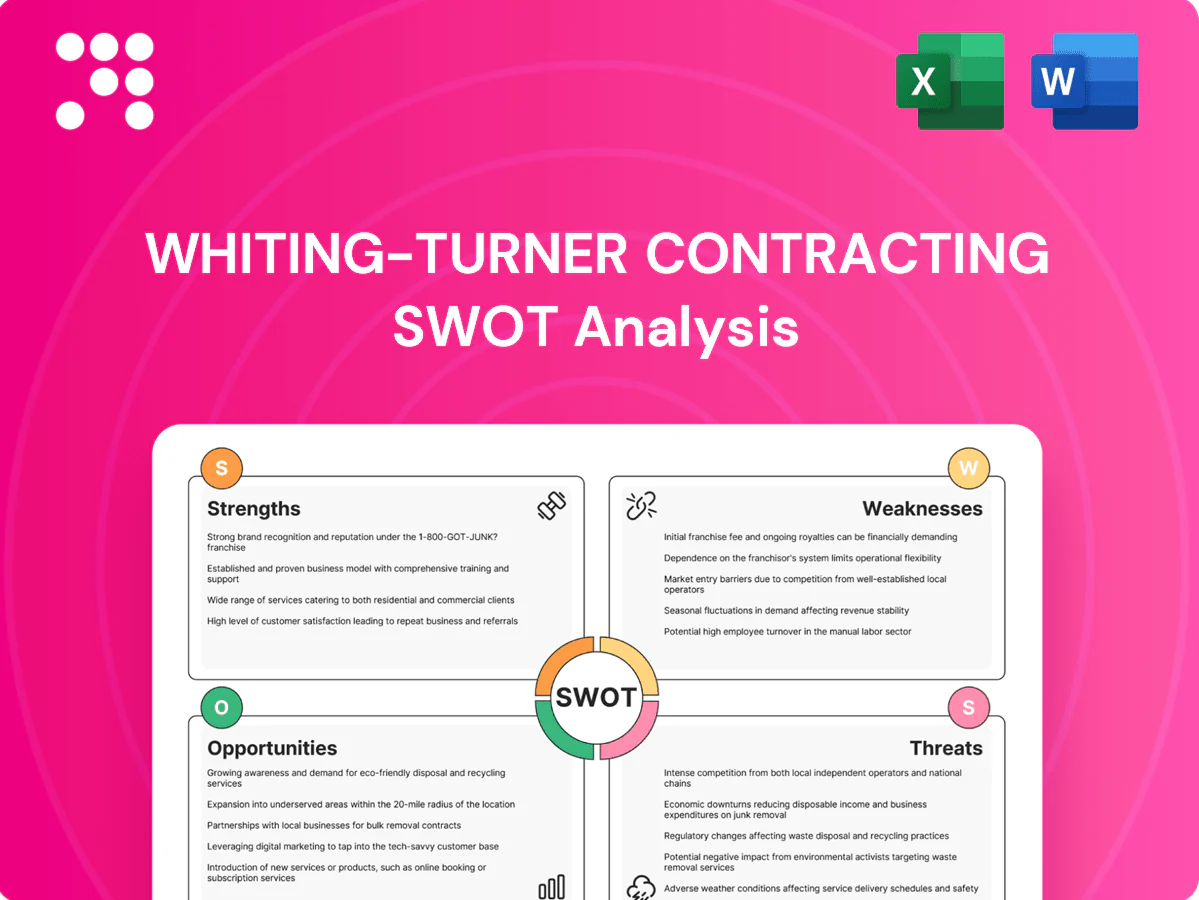
Whiting-Turner Contracting SWOT Analysis

Elevate Your Analysis with the Complete SWOT Report
Explore Whiting‑Turner’s competitive profile with our concise SWOT overview—highlighting core strengths, project execution risks, and market opportunities across sectors. Want deeper analysis and actionable strategy? Purchase the full SWOT report (editable Word + Excel) to plan, pitch, and invest with confidence.
Strengths

National footprint
Whiting-Turner’s national footprint, with over 50 offices across the U.S., supports large multi-site clients and diversifies regional risk by spreading project exposure. Scale enables resource sharing and consistent delivery standards across markets, improving efficiency and quality control. A broad geographic presence also strengthens vendor leverage, widens recruiting reach, and boosts brand credibility in large pursuits.
Diverse portfolio
Whiting-Turner’s exposure across healthcare, education, commercial and technology projects evens out market cycles and supports steady win rates. Cross-sector expertise transfers construction best practices and reduces revenue volatility across project pipelines. The firm’s 50+ offices and national footprint enable flexible allocation of teams to higher-margin work. Clients value a one-stop builder able to deliver multiple asset types from design through delivery.

Integrated delivery
Whiting-Turner leverages strong preconstruction, construction management, and design-build capabilities to lower cost and schedule risk, reflected in its reported 2023 revenue of $7.7 billion and sustained top-10 ENR contractor placement. Early involvement by integrated teams improves constructability and value-engineering outcomes, reducing change orders and accelerating handovers. Streamlined stakeholder coordination enables faster decisions and higher win rates on complex, fast-track projects.

Quality and safety
Whiting-Turner’s reputation for safety and high-quality execution reduces incident-driven costs and rework, with industry studies showing rework can add 5–15% to project cost; a strong safety culture boosts client trust and workforce morale, lowering turnover and preserving productivity; fewer disruptions protect schedules and margins, a decisive edge in risk-sensitive sectors like healthcare and life sciences.
- Lower rework: 5–15% of project cost
- Fewer disruptions: protects schedule/margins
- Stronger trust: wins risk-averse clients
Technical execution
Whiting-Turner’s experience in technology and healthcare projects demonstrates deep MEP and controls expertise, supported by advanced BIM/VDC workflows that cut clashes and RFIs and streamline coordination. Robust field management enhances logistics and commissioning, enabling predictable delivery on time-sensitive, mission-critical facilities.
- MEP and controls expertise
- BIM/VDC reduces clashes/RFIs
- Strong field logistics & commissioning
- Predictable delivery on critical projects
50+ offices and $7.7B revenue; BIM/VDC reduces rework
Whiting-Turner’s national 50+ office footprint and 2023 revenue of $7.7B drive scale, regional diversification, and vendor leverage. Integrated preconstruction/design-build and BIM/VDC cut rework (5–15%) and RFIs, improving schedule predictability for healthcare and technology projects.
| Metric | Value |
|---|---|
| Offices | 50+ |
| 2023 Revenue | $7.7B |
| Rework impact | 5–15% |
What is included in the product
 Detailed Word Document
Provides a concise SWOT analysis of Whiting-Turner Contracting, highlighting internal capabilities, operational gaps, market opportunities, and external threats shaping its strategic position.

 Customizable Excel Spreadsheet
Provides a concise SWOT matrix tailored to Whiting-Turner for fast, visual strategy alignment and risk mitigation; editable format enables quick updates to reflect project pipelines, regulatory shifts, and operational priorities.
Weaknesses

Margin pressure
General contracting is a low-margin, high-risk business; US general contractors posted median net margins around 2–3% in 2023, so competitive bidding and rising project complexity compress fees further. A 1–2% cost overrun can erase profits, and maintaining margin discipline across dozens of dispersed jobsites remains operationally difficult.
Labor constraints
Skilled trades and superintendent shortages constrain throughput, with 80% of contractors in the 2024 AGC survey reporting difficulty hiring craftworkers. Wage inflation (roughly 5.0% y/y for construction wages in 2024) squeezes budgets and fee envelopes. Subcontractor capacity swings by market and cycle, often shifting +/-20%, worsening variability. Talent gaps threaten schedule certainty and on-site quality, increasing rework and delay risk.

Supply volatility
Material price swings of up to 25% and long-lead equipment delays of 6–12 months strain Whiting-Turners GMP commitments, forcing re-pricing and claims management. Volatile commodities and extended vendor lead times complicate procurement, driving schedule risk and subcontractor disputes. Owners increasingly resist contingencies—often limiting allowances to 1–3%—shifting cost and timing risk onto contractors. On-site inventory buffers carry 5–8% carrying costs and are space-limited on active projects.

Project concentration
Large projects heighten single-job risk for Whiting-Turner; ENR lists the firm among top builders (around $12.5B revenue in 2023), so a major delay or dispute can materially affect annual results and bonding capacity. Heavy exposure to a few sectors amplifies revenue swings in downturns, and a healthy backlog can mask concentration risk.
- single-job risk: major project delays can move annual revenue and bonding
- sector concentration: reliance on limited markets magnifies downturn impact
- backlog opacity: large backlog may obscure concentration vulnerabilities
Legal exposure
Construction inherently carries claims, change-order and litigation risk that can affect project margins and cash flow; Whiting-Turner, an ENR Top 10 contractor (2024), must manage frequent contract scope gaps and design-driven disputes that trigger claims and extensions. Insurance and bonding remain meaningful overhead—brokers reported commercial construction insurance rate pressures into 2023–24—while isolated incidents can damage reputation and client trust.
- Claims/change orders: frequent
- Design gaps: primary dispute driver
- Insurance/bonding: rising cost pressure
- Reputation: vulnerable to single incidents
Margins squeezed: 2–3% nets, ~5% wages, 80% hiring strain
Low net margins (2–3% in 2023) and high single-job risk; wage inflation ~5% y/y (2024) and 6–12 month lead times strain GMPs; skilled labor shortages (80% of firms report hiring issues, AGC 2024) increase rework and delays.
| Metric | Value |
|---|---|
| Revenue (2023) | $12.5B |
| Net margin (2023) | 2–3% |
| Wage inflation (2024) | ~5% |
| Hiring difficulty (AGC 2024) | 80% |
Same Document Delivered
Whiting-Turner Contracting SWOT Analysis
This is the actual SWOT analysis document you’ll receive upon purchase—no surprises, just professional quality. The preview below is taken directly from the full SWOT report you'll get. Once purchased, the complete, editable version is unlocked immediately.

Elevate Your Analysis with the Complete SWOT Report
Explore Whiting‑Turner’s competitive profile with our concise SWOT overview—highlighting core strengths, project execution risks, and market opportunities across sectors. Want deeper analysis and actionable strategy? Purchase the full SWOT report (editable Word + Excel) to plan, pitch, and invest with confidence.
Strengths
National footprint
Whiting-Turner’s national footprint, with over 50 offices across the U.S., supports large multi-site clients and diversifies regional risk by spreading project exposure. Scale enables resource sharing and consistent delivery standards across markets, improving efficiency and quality control. A broad geographic presence also strengthens vendor leverage, widens recruiting reach, and boosts brand credibility in large pursuits.
Diverse portfolio
Whiting-Turner’s exposure across healthcare, education, commercial and technology projects evens out market cycles and supports steady win rates. Cross-sector expertise transfers construction best practices and reduces revenue volatility across project pipelines. The firm’s 50+ offices and national footprint enable flexible allocation of teams to higher-margin work. Clients value a one-stop builder able to deliver multiple asset types from design through delivery.
Integrated delivery
Whiting-Turner leverages strong preconstruction, construction management, and design-build capabilities to lower cost and schedule risk, reflected in its reported 2023 revenue of $7.7 billion and sustained top-10 ENR contractor placement. Early involvement by integrated teams improves constructability and value-engineering outcomes, reducing change orders and accelerating handovers. Streamlined stakeholder coordination enables faster decisions and higher win rates on complex, fast-track projects.
Quality and safety
Whiting-Turner’s reputation for safety and high-quality execution reduces incident-driven costs and rework, with industry studies showing rework can add 5–15% to project cost; a strong safety culture boosts client trust and workforce morale, lowering turnover and preserving productivity; fewer disruptions protect schedules and margins, a decisive edge in risk-sensitive sectors like healthcare and life sciences.
- Lower rework: 5–15% of project cost
- Fewer disruptions: protects schedule/margins
- Stronger trust: wins risk-averse clients
Technical execution
Whiting-Turner’s experience in technology and healthcare projects demonstrates deep MEP and controls expertise, supported by advanced BIM/VDC workflows that cut clashes and RFIs and streamline coordination. Robust field management enhances logistics and commissioning, enabling predictable delivery on time-sensitive, mission-critical facilities.
- MEP and controls expertise
- BIM/VDC reduces clashes/RFIs
- Strong field logistics & commissioning
- Predictable delivery on critical projects
50+ offices and $7.7B revenue; BIM/VDC reduces rework
Whiting-Turner’s national 50+ office footprint and 2023 revenue of $7.7B drive scale, regional diversification, and vendor leverage. Integrated preconstruction/design-build and BIM/VDC cut rework (5–15%) and RFIs, improving schedule predictability for healthcare and technology projects.
| Metric | Value |
|---|---|
| Offices | 50+ |
| 2023 Revenue | $7.7B |
| Rework impact | 5–15% |
What is included in the product
Detailed Word Document
Provides a concise SWOT analysis of Whiting-Turner Contracting, highlighting internal capabilities, operational gaps, market opportunities, and external threats shaping its strategic position.
Customizable Excel Spreadsheet
Provides a concise SWOT matrix tailored to Whiting-Turner for fast, visual strategy alignment and risk mitigation; editable format enables quick updates to reflect project pipelines, regulatory shifts, and operational priorities.
Weaknesses
Margin pressure
General contracting is a low-margin, high-risk business; US general contractors posted median net margins around 2–3% in 2023, so competitive bidding and rising project complexity compress fees further. A 1–2% cost overrun can erase profits, and maintaining margin discipline across dozens of dispersed jobsites remains operationally difficult.
Labor constraints
Skilled trades and superintendent shortages constrain throughput, with 80% of contractors in the 2024 AGC survey reporting difficulty hiring craftworkers. Wage inflation (roughly 5.0% y/y for construction wages in 2024) squeezes budgets and fee envelopes. Subcontractor capacity swings by market and cycle, often shifting +/-20%, worsening variability. Talent gaps threaten schedule certainty and on-site quality, increasing rework and delay risk.
Supply volatility
Material price swings of up to 25% and long-lead equipment delays of 6–12 months strain Whiting-Turners GMP commitments, forcing re-pricing and claims management. Volatile commodities and extended vendor lead times complicate procurement, driving schedule risk and subcontractor disputes. Owners increasingly resist contingencies—often limiting allowances to 1–3%—shifting cost and timing risk onto contractors. On-site inventory buffers carry 5–8% carrying costs and are space-limited on active projects.
Project concentration
Large projects heighten single-job risk for Whiting-Turner; ENR lists the firm among top builders (around $12.5B revenue in 2023), so a major delay or dispute can materially affect annual results and bonding capacity. Heavy exposure to a few sectors amplifies revenue swings in downturns, and a healthy backlog can mask concentration risk.
- single-job risk: major project delays can move annual revenue and bonding
- sector concentration: reliance on limited markets magnifies downturn impact
- backlog opacity: large backlog may obscure concentration vulnerabilities
Legal exposure
Construction inherently carries claims, change-order and litigation risk that can affect project margins and cash flow; Whiting-Turner, an ENR Top 10 contractor (2024), must manage frequent contract scope gaps and design-driven disputes that trigger claims and extensions. Insurance and bonding remain meaningful overhead—brokers reported commercial construction insurance rate pressures into 2023–24—while isolated incidents can damage reputation and client trust.
- Claims/change orders: frequent
- Design gaps: primary dispute driver
- Insurance/bonding: rising cost pressure
- Reputation: vulnerable to single incidents
Margins squeezed: 2–3% nets, ~5% wages, 80% hiring strain
Low net margins (2–3% in 2023) and high single-job risk; wage inflation ~5% y/y (2024) and 6–12 month lead times strain GMPs; skilled labor shortages (80% of firms report hiring issues, AGC 2024) increase rework and delays.
| Metric | Value |
|---|---|
| Revenue (2023) | $12.5B |
| Net margin (2023) | 2–3% |
| Wage inflation (2024) | ~5% |
| Hiring difficulty (AGC 2024) | 80% |
Same Document Delivered
Whiting-Turner Contracting SWOT Analysis
This is the actual SWOT analysis document you’ll receive upon purchase—no surprises, just professional quality. The preview below is taken directly from the full SWOT report you'll get. Once purchased, the complete, editable version is unlocked immediately.
Description
Elevate Your Analysis with the Complete SWOT Report
Explore Whiting‑Turner’s competitive profile with our concise SWOT overview—highlighting core strengths, project execution risks, and market opportunities across sectors. Want deeper analysis and actionable strategy? Purchase the full SWOT report (editable Word + Excel) to plan, pitch, and invest with confidence.
Strengths
National footprint
Whiting-Turner’s national footprint, with over 50 offices across the U.S., supports large multi-site clients and diversifies regional risk by spreading project exposure. Scale enables resource sharing and consistent delivery standards across markets, improving efficiency and quality control. A broad geographic presence also strengthens vendor leverage, widens recruiting reach, and boosts brand credibility in large pursuits.
Diverse portfolio
Whiting-Turner’s exposure across healthcare, education, commercial and technology projects evens out market cycles and supports steady win rates. Cross-sector expertise transfers construction best practices and reduces revenue volatility across project pipelines. The firm’s 50+ offices and national footprint enable flexible allocation of teams to higher-margin work. Clients value a one-stop builder able to deliver multiple asset types from design through delivery.
Integrated delivery
Whiting-Turner leverages strong preconstruction, construction management, and design-build capabilities to lower cost and schedule risk, reflected in its reported 2023 revenue of $7.7 billion and sustained top-10 ENR contractor placement. Early involvement by integrated teams improves constructability and value-engineering outcomes, reducing change orders and accelerating handovers. Streamlined stakeholder coordination enables faster decisions and higher win rates on complex, fast-track projects.
Quality and safety
Whiting-Turner’s reputation for safety and high-quality execution reduces incident-driven costs and rework, with industry studies showing rework can add 5–15% to project cost; a strong safety culture boosts client trust and workforce morale, lowering turnover and preserving productivity; fewer disruptions protect schedules and margins, a decisive edge in risk-sensitive sectors like healthcare and life sciences.
- Lower rework: 5–15% of project cost
- Fewer disruptions: protects schedule/margins
- Stronger trust: wins risk-averse clients
Technical execution
Whiting-Turner’s experience in technology and healthcare projects demonstrates deep MEP and controls expertise, supported by advanced BIM/VDC workflows that cut clashes and RFIs and streamline coordination. Robust field management enhances logistics and commissioning, enabling predictable delivery on time-sensitive, mission-critical facilities.
- MEP and controls expertise
- BIM/VDC reduces clashes/RFIs
- Strong field logistics & commissioning
- Predictable delivery on critical projects
50+ offices and $7.7B revenue; BIM/VDC reduces rework
Whiting-Turner’s national 50+ office footprint and 2023 revenue of $7.7B drive scale, regional diversification, and vendor leverage. Integrated preconstruction/design-build and BIM/VDC cut rework (5–15%) and RFIs, improving schedule predictability for healthcare and technology projects.
| Metric | Value |
|---|---|
| Offices | 50+ |
| 2023 Revenue | $7.7B |
| Rework impact | 5–15% |
What is included in the product
Detailed Word Document
Provides a concise SWOT analysis of Whiting-Turner Contracting, highlighting internal capabilities, operational gaps, market opportunities, and external threats shaping its strategic position.
Customizable Excel Spreadsheet
Provides a concise SWOT matrix tailored to Whiting-Turner for fast, visual strategy alignment and risk mitigation; editable format enables quick updates to reflect project pipelines, regulatory shifts, and operational priorities.
Weaknesses
Margin pressure
General contracting is a low-margin, high-risk business; US general contractors posted median net margins around 2–3% in 2023, so competitive bidding and rising project complexity compress fees further. A 1–2% cost overrun can erase profits, and maintaining margin discipline across dozens of dispersed jobsites remains operationally difficult.
Labor constraints
Skilled trades and superintendent shortages constrain throughput, with 80% of contractors in the 2024 AGC survey reporting difficulty hiring craftworkers. Wage inflation (roughly 5.0% y/y for construction wages in 2024) squeezes budgets and fee envelopes. Subcontractor capacity swings by market and cycle, often shifting +/-20%, worsening variability. Talent gaps threaten schedule certainty and on-site quality, increasing rework and delay risk.
Supply volatility
Material price swings of up to 25% and long-lead equipment delays of 6–12 months strain Whiting-Turners GMP commitments, forcing re-pricing and claims management. Volatile commodities and extended vendor lead times complicate procurement, driving schedule risk and subcontractor disputes. Owners increasingly resist contingencies—often limiting allowances to 1–3%—shifting cost and timing risk onto contractors. On-site inventory buffers carry 5–8% carrying costs and are space-limited on active projects.
Project concentration
Large projects heighten single-job risk for Whiting-Turner; ENR lists the firm among top builders (around $12.5B revenue in 2023), so a major delay or dispute can materially affect annual results and bonding capacity. Heavy exposure to a few sectors amplifies revenue swings in downturns, and a healthy backlog can mask concentration risk.
- single-job risk: major project delays can move annual revenue and bonding
- sector concentration: reliance on limited markets magnifies downturn impact
- backlog opacity: large backlog may obscure concentration vulnerabilities
Legal exposure
Construction inherently carries claims, change-order and litigation risk that can affect project margins and cash flow; Whiting-Turner, an ENR Top 10 contractor (2024), must manage frequent contract scope gaps and design-driven disputes that trigger claims and extensions. Insurance and bonding remain meaningful overhead—brokers reported commercial construction insurance rate pressures into 2023–24—while isolated incidents can damage reputation and client trust.
- Claims/change orders: frequent
- Design gaps: primary dispute driver
- Insurance/bonding: rising cost pressure
- Reputation: vulnerable to single incidents
Margins squeezed: 2–3% nets, ~5% wages, 80% hiring strain
Low net margins (2–3% in 2023) and high single-job risk; wage inflation ~5% y/y (2024) and 6–12 month lead times strain GMPs; skilled labor shortages (80% of firms report hiring issues, AGC 2024) increase rework and delays.
| Metric | Value |
|---|---|
| Revenue (2023) | $12.5B |
| Net margin (2023) | 2–3% |
| Wage inflation (2024) | ~5% |
| Hiring difficulty (AGC 2024) | 80% |
Same Document Delivered
Whiting-Turner Contracting SWOT Analysis
This is the actual SWOT analysis document you’ll receive upon purchase—no surprises, just professional quality. The preview below is taken directly from the full SWOT report you'll get. Once purchased, the complete, editable version is unlocked immediately.











