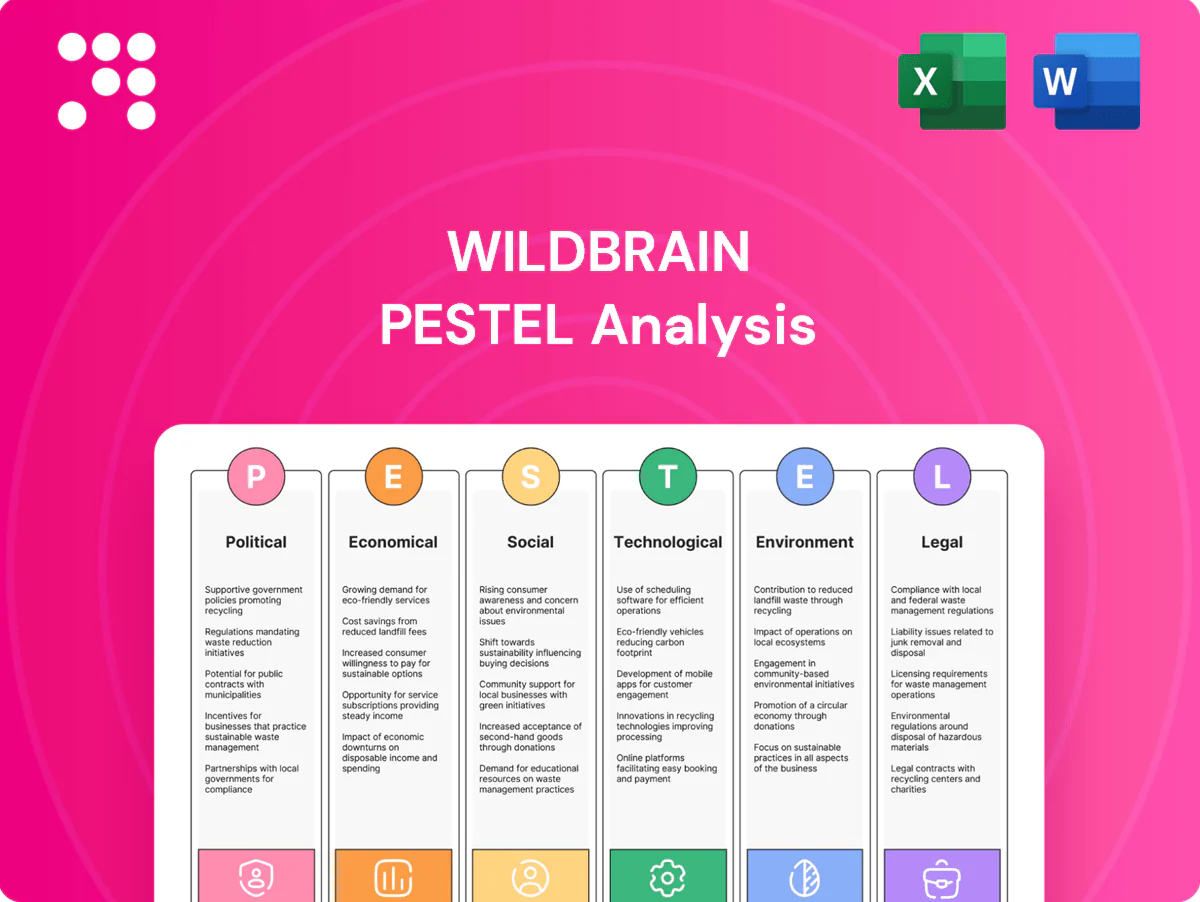
WildBrain PESTLE Analysis

Plan Smarter. Present Sharper. Compete Stronger.
Gain a competitive edge with our PESTLE Analysis of WildBrain. Uncover how political, economic, social, technological, legal and environmental forces shape strategy and risk, with actionable takeaways for investors and planners. Purchase the full report for the complete, editable breakdown—ready for boardrooms and investment cases.
Political factors

Screen content quotas
Screen quotas and incentives—notably the EU AVMSD 30% European-works requirement—shape commissioning and distribution across Canada, the EU and other markets. WildBrain can leverage government and provincial tax credits and funds that typically offset 20–40% of production costs but must align pipelines and spend to qualify. Shifts in cultural policy (eg. Canada’s recent streaming regulation updates) can redirect commissioning toward favored regions. Non-compliance risks losing subsidies and platform prominence, sometimes cutting project funding by millions.
Platform governance and geopolitics
Government scrutiny of big tech, reinforced by the EU Digital Services Act (penalties up to 6% of global turnover), drives stricter YouTube policies that directly affect WildBrain Spark’s distribution and monetization across YouTube’s 2+ billion logged‑in monthly users. Geopolitical tensions, notably post‑2022 Russia restrictions, can cut access to markets and depress ad demand; YouTube ad revenue reached about $29.2B in 2023, underscoring ad sensitivity. Sanctions and export controls complicate licensing and co‑productions across borders, while political stability in key territories enables predictable distribution deals and revenue forecasting.

Public broadcasting and subsidies
Budget changes at public broadcasters in 2024 materially affected kids commissioning for WildBrain, with several national broadcasters tightening children's slates amid fiscal reviews. Policy priorities such as education and diversity expanded co-finance opportunities tied to measurable outcomes. Cuts slowed greenlights while budget expansions catalyzed multi-title slates, making advocacy and regulatory compliance critical to keep pipelines funded.

Trade policy and tariffs
Tariffs on consumer products squeeze margins for licensed merchandise; applied MFN tariffs averaged around 3% globally in 2022–23 per WTO/OECD, while sector-specific duties and anti-dumping measures can be much higher. IP distribution agreements must navigate differing VAT, customs valuation and cross-border tax regimes, raising compliance and transfer-pricing complexity. Freight volatility — container rates peaked near US$14,000/FEU in 2021 — amplifies pricing and inventory risks.
- Tariffs affect margins on licensed goods
- Cross-border VAT, customs and transfer-pricing in IP deals
- Favorable trade deals lower friction for physical brand goods
- Freight and tariff volatility raise pricing and inventory risk
Market access and censorship
Content approvals vary across regions, forcing edits, longer timelines and sometimes cancelling releases; YouTube has been blocked in China since 2009, illustrating market-specific limits. Political sensitivities constrain storylines and characters, while local partners ease approvals but add contractual complexity. WildBrain's library of over 21,000 half-hours and distribution in 100+ territories supports diversification to reduce single-market exposure.
- Content approvals: edits, timelines, viability
- Political sensitivity: storyline/character limits
- Local partners: approvals help but add complexity
- Diversification: cuts single-market risk
EU 30% quota, 20–40% credits reshape streaming margins
Regulations like the EU AVMSD 30% quota and national streaming rules reshape commissioning; tax credits typically offset 20–40% of production costs. Platform rules and the EU DSA (penalties up to 6% global turnover) affect WildBrain Spark across YouTube's 2+ billion logged‑in monthly users and ad sensitivity. Trade/tariff volatility (MFN ~3% 2022–23; freight spikes to ~$14,000/FEU in 2021) pressures merchandise margins. Diversified library (21,000+ half‑hours, 100+ territories) mitigates single‑market risk.
| Metric | Value |
|---|---|
| Production tax credits | 20–40% |
| AVMSD quota | 30% EU |
| YouTube users | 2+ billion |
| WildBrain library | 21,000+ half‑hours |
What is included in the product
 Detailed Word Document
Explores how Political, Economic, Social, Technological, Environmental and Legal forces shape WildBrain's content, distribution and monetization strategies, with data-driven trends and regional regulatory context. Designed for executives and investors, the analysis highlights risks, growth opportunities and forward-looking scenarios ready for inclusion in plans and investor materials.

 Customizable Excel Spreadsheet
A concise, visually segmented WildBrain PESTLE summary that highlights regulatory, technological, and market risks for quick alignment in meetings; editable notes let teams tailor insights by region or business line for planning, presentations, and client reports.
Economic factors

Advertising cycle exposure
WildBrain Spark revenue tracks cyclical YouTube ad rates and brand CPMs, which commonly swing 20–40% between downturns and holiday peaks, directly impacting ad-led income. Macro slowdowns compress brand budgets and CPMs, while recoveries restore monetization momentum. Seasonality around year-end holidays measurably lifts kids’ content views and CPMs. Diversifying into ads, subscriptions and licensing reduces overall revenue volatility.
Consumer products demand
Merchandise sales for WildBrain correlate with consumer confidence and retail traffic: global toy market ~120 billion USD in 2024 and e-commerce accounted for roughly 22% of retail sales, amplifying online demand channels. Inflation (US CPI ~3.4% in 2024) and shifts in discretionary spending pressure royalty rates and per-unit spend. Strong legacy franchises sustain sales through downturns while new IP carries higher failure risk; omnichannel retailing mitigates store-closure exposure.

FX and global revenues
Multi-currency revenues and costs expose WildBrain to translation and transaction risk; USD/CAD averaged about 1.34 in 2024, amplifying the impact of US/EU contract flows on reported Canadian-dollar results. A Canadian-dollar cost base can be advantageous when CAD is weak versus USD/EUR but adverse when CAD strengthens. Active hedging programs reduce headline volatility yet add financing costs. Managing geographic revenue mix and local rights monetization supports margin stability.

Production cost inflation
Rising wage pressures for animation, VFX and voice talent are squeezing WildBrain budgets while public cloud spending rose about 20% year-over-year in 2023 per Gartner and energy inputs remain above pre‑pandemic levels, lifting software, storage and compute costs; efficient pipelines, co‑productions and slate discipline are being used to preserve ROI thresholds.
- Wage pressure: talent costs up
- Cloud/software: ~20% yr/yr growth (2023)
- Offset: pipelines, co‑prods, slate discipline
Capital access and rates
Higher global policy rates (US fed funds 5.25–5.50% mid‑2025; 10‑yr Treasury ~4.0%) raise borrowing costs for content libraries, tightening WildBrain’s financing and making long‑dated rights more expensive to fund. Tight debt covenants can slow greenlights, while predictable library cash flows and presales improve borrowing terms; falling rates would expand greenlight capacity.
- Higher policy rates: US fed funds 5.25–5.50% (mid‑2025)
- Debt covenants constrain investment pace
- Library cash flows/presales lower funding spreads
- Rate declines => more greenlights
EU 30% quota, 20–40% credits reshape streaming margins
WildBrain revenue swings with YouTube CPMs (20–40% cyclical), holiday seasonality and ad/sub/licensing mix; global toy market ~120B USD (2024), e‑commerce ~22% of retail. USD/CAD ~1.34 (2024) and US fed funds 5.25–5.50% (mid‑2025) affect translation and funding; cloud spend +20% (2023) and US CPI ~3.4% (2024) pressure costs.
| Metric | Value |
|---|---|
| YouTube CPM swing | 20–40% |
| Global toy market | ~120B USD (2024) |
| E‑commerce share | ~22% |
| USD/CAD | ~1.34 (2024) |
| US fed funds | 5.25–5.50% (mid‑2025) |
What You See Is What You Get
WildBrain PESTLE Analysis
The preview shown here is the exact document you’ll receive after purchase—fully formatted and ready to use. This WildBrain PESTLE Analysis includes complete, professionally structured political, economic, social, technological, legal and environmental insights tailored for strategic decisions. No placeholders or teasers—what you see is the final downloadable file.

Plan Smarter. Present Sharper. Compete Stronger.
Gain a competitive edge with our PESTLE Analysis of WildBrain. Uncover how political, economic, social, technological, legal and environmental forces shape strategy and risk, with actionable takeaways for investors and planners. Purchase the full report for the complete, editable breakdown—ready for boardrooms and investment cases.
Political factors
Screen content quotas
Screen quotas and incentives—notably the EU AVMSD 30% European-works requirement—shape commissioning and distribution across Canada, the EU and other markets. WildBrain can leverage government and provincial tax credits and funds that typically offset 20–40% of production costs but must align pipelines and spend to qualify. Shifts in cultural policy (eg. Canada’s recent streaming regulation updates) can redirect commissioning toward favored regions. Non-compliance risks losing subsidies and platform prominence, sometimes cutting project funding by millions.
Platform governance and geopolitics
Government scrutiny of big tech, reinforced by the EU Digital Services Act (penalties up to 6% of global turnover), drives stricter YouTube policies that directly affect WildBrain Spark’s distribution and monetization across YouTube’s 2+ billion logged‑in monthly users. Geopolitical tensions, notably post‑2022 Russia restrictions, can cut access to markets and depress ad demand; YouTube ad revenue reached about $29.2B in 2023, underscoring ad sensitivity. Sanctions and export controls complicate licensing and co‑productions across borders, while political stability in key territories enables predictable distribution deals and revenue forecasting.
Public broadcasting and subsidies
Budget changes at public broadcasters in 2024 materially affected kids commissioning for WildBrain, with several national broadcasters tightening children's slates amid fiscal reviews. Policy priorities such as education and diversity expanded co-finance opportunities tied to measurable outcomes. Cuts slowed greenlights while budget expansions catalyzed multi-title slates, making advocacy and regulatory compliance critical to keep pipelines funded.
Trade policy and tariffs
Tariffs on consumer products squeeze margins for licensed merchandise; applied MFN tariffs averaged around 3% globally in 2022–23 per WTO/OECD, while sector-specific duties and anti-dumping measures can be much higher. IP distribution agreements must navigate differing VAT, customs valuation and cross-border tax regimes, raising compliance and transfer-pricing complexity. Freight volatility — container rates peaked near US$14,000/FEU in 2021 — amplifies pricing and inventory risks.
- Tariffs affect margins on licensed goods
- Cross-border VAT, customs and transfer-pricing in IP deals
- Favorable trade deals lower friction for physical brand goods
- Freight and tariff volatility raise pricing and inventory risk
Market access and censorship
Content approvals vary across regions, forcing edits, longer timelines and sometimes cancelling releases; YouTube has been blocked in China since 2009, illustrating market-specific limits. Political sensitivities constrain storylines and characters, while local partners ease approvals but add contractual complexity. WildBrain's library of over 21,000 half-hours and distribution in 100+ territories supports diversification to reduce single-market exposure.
- Content approvals: edits, timelines, viability
- Political sensitivity: storyline/character limits
- Local partners: approvals help but add complexity
- Diversification: cuts single-market risk
EU 30% quota, 20–40% credits reshape streaming margins
Regulations like the EU AVMSD 30% quota and national streaming rules reshape commissioning; tax credits typically offset 20–40% of production costs. Platform rules and the EU DSA (penalties up to 6% global turnover) affect WildBrain Spark across YouTube's 2+ billion logged‑in monthly users and ad sensitivity. Trade/tariff volatility (MFN ~3% 2022–23; freight spikes to ~$14,000/FEU in 2021) pressures merchandise margins. Diversified library (21,000+ half‑hours, 100+ territories) mitigates single‑market risk.
| Metric | Value |
|---|---|
| Production tax credits | 20–40% |
| AVMSD quota | 30% EU |
| YouTube users | 2+ billion |
| WildBrain library | 21,000+ half‑hours |
What is included in the product
Detailed Word Document
Explores how Political, Economic, Social, Technological, Environmental and Legal forces shape WildBrain's content, distribution and monetization strategies, with data-driven trends and regional regulatory context. Designed for executives and investors, the analysis highlights risks, growth opportunities and forward-looking scenarios ready for inclusion in plans and investor materials.
Customizable Excel Spreadsheet
A concise, visually segmented WildBrain PESTLE summary that highlights regulatory, technological, and market risks for quick alignment in meetings; editable notes let teams tailor insights by region or business line for planning, presentations, and client reports.
Economic factors
Advertising cycle exposure
WildBrain Spark revenue tracks cyclical YouTube ad rates and brand CPMs, which commonly swing 20–40% between downturns and holiday peaks, directly impacting ad-led income. Macro slowdowns compress brand budgets and CPMs, while recoveries restore monetization momentum. Seasonality around year-end holidays measurably lifts kids’ content views and CPMs. Diversifying into ads, subscriptions and licensing reduces overall revenue volatility.
Consumer products demand
Merchandise sales for WildBrain correlate with consumer confidence and retail traffic: global toy market ~120 billion USD in 2024 and e-commerce accounted for roughly 22% of retail sales, amplifying online demand channels. Inflation (US CPI ~3.4% in 2024) and shifts in discretionary spending pressure royalty rates and per-unit spend. Strong legacy franchises sustain sales through downturns while new IP carries higher failure risk; omnichannel retailing mitigates store-closure exposure.
FX and global revenues
Multi-currency revenues and costs expose WildBrain to translation and transaction risk; USD/CAD averaged about 1.34 in 2024, amplifying the impact of US/EU contract flows on reported Canadian-dollar results. A Canadian-dollar cost base can be advantageous when CAD is weak versus USD/EUR but adverse when CAD strengthens. Active hedging programs reduce headline volatility yet add financing costs. Managing geographic revenue mix and local rights monetization supports margin stability.
Production cost inflation
Rising wage pressures for animation, VFX and voice talent are squeezing WildBrain budgets while public cloud spending rose about 20% year-over-year in 2023 per Gartner and energy inputs remain above pre‑pandemic levels, lifting software, storage and compute costs; efficient pipelines, co‑productions and slate discipline are being used to preserve ROI thresholds.
- Wage pressure: talent costs up
- Cloud/software: ~20% yr/yr growth (2023)
- Offset: pipelines, co‑prods, slate discipline
Capital access and rates
Higher global policy rates (US fed funds 5.25–5.50% mid‑2025; 10‑yr Treasury ~4.0%) raise borrowing costs for content libraries, tightening WildBrain’s financing and making long‑dated rights more expensive to fund. Tight debt covenants can slow greenlights, while predictable library cash flows and presales improve borrowing terms; falling rates would expand greenlight capacity.
- Higher policy rates: US fed funds 5.25–5.50% (mid‑2025)
- Debt covenants constrain investment pace
- Library cash flows/presales lower funding spreads
- Rate declines => more greenlights
EU 30% quota, 20–40% credits reshape streaming margins
WildBrain revenue swings with YouTube CPMs (20–40% cyclical), holiday seasonality and ad/sub/licensing mix; global toy market ~120B USD (2024), e‑commerce ~22% of retail. USD/CAD ~1.34 (2024) and US fed funds 5.25–5.50% (mid‑2025) affect translation and funding; cloud spend +20% (2023) and US CPI ~3.4% (2024) pressure costs.
| Metric | Value |
|---|---|
| YouTube CPM swing | 20–40% |
| Global toy market | ~120B USD (2024) |
| E‑commerce share | ~22% |
| USD/CAD | ~1.34 (2024) |
| US fed funds | 5.25–5.50% (mid‑2025) |
What You See Is What You Get
WildBrain PESTLE Analysis
The preview shown here is the exact document you’ll receive after purchase—fully formatted and ready to use. This WildBrain PESTLE Analysis includes complete, professionally structured political, economic, social, technological, legal and environmental insights tailored for strategic decisions. No placeholders or teasers—what you see is the final downloadable file.
Original: $10.00
-65%$10.00
$3.50Description
Plan Smarter. Present Sharper. Compete Stronger.
Gain a competitive edge with our PESTLE Analysis of WildBrain. Uncover how political, economic, social, technological, legal and environmental forces shape strategy and risk, with actionable takeaways for investors and planners. Purchase the full report for the complete, editable breakdown—ready for boardrooms and investment cases.
Political factors
Screen content quotas
Screen quotas and incentives—notably the EU AVMSD 30% European-works requirement—shape commissioning and distribution across Canada, the EU and other markets. WildBrain can leverage government and provincial tax credits and funds that typically offset 20–40% of production costs but must align pipelines and spend to qualify. Shifts in cultural policy (eg. Canada’s recent streaming regulation updates) can redirect commissioning toward favored regions. Non-compliance risks losing subsidies and platform prominence, sometimes cutting project funding by millions.
Platform governance and geopolitics
Government scrutiny of big tech, reinforced by the EU Digital Services Act (penalties up to 6% of global turnover), drives stricter YouTube policies that directly affect WildBrain Spark’s distribution and monetization across YouTube’s 2+ billion logged‑in monthly users. Geopolitical tensions, notably post‑2022 Russia restrictions, can cut access to markets and depress ad demand; YouTube ad revenue reached about $29.2B in 2023, underscoring ad sensitivity. Sanctions and export controls complicate licensing and co‑productions across borders, while political stability in key territories enables predictable distribution deals and revenue forecasting.
Public broadcasting and subsidies
Budget changes at public broadcasters in 2024 materially affected kids commissioning for WildBrain, with several national broadcasters tightening children's slates amid fiscal reviews. Policy priorities such as education and diversity expanded co-finance opportunities tied to measurable outcomes. Cuts slowed greenlights while budget expansions catalyzed multi-title slates, making advocacy and regulatory compliance critical to keep pipelines funded.
Trade policy and tariffs
Tariffs on consumer products squeeze margins for licensed merchandise; applied MFN tariffs averaged around 3% globally in 2022–23 per WTO/OECD, while sector-specific duties and anti-dumping measures can be much higher. IP distribution agreements must navigate differing VAT, customs valuation and cross-border tax regimes, raising compliance and transfer-pricing complexity. Freight volatility — container rates peaked near US$14,000/FEU in 2021 — amplifies pricing and inventory risks.
- Tariffs affect margins on licensed goods
- Cross-border VAT, customs and transfer-pricing in IP deals
- Favorable trade deals lower friction for physical brand goods
- Freight and tariff volatility raise pricing and inventory risk
Market access and censorship
Content approvals vary across regions, forcing edits, longer timelines and sometimes cancelling releases; YouTube has been blocked in China since 2009, illustrating market-specific limits. Political sensitivities constrain storylines and characters, while local partners ease approvals but add contractual complexity. WildBrain's library of over 21,000 half-hours and distribution in 100+ territories supports diversification to reduce single-market exposure.
- Content approvals: edits, timelines, viability
- Political sensitivity: storyline/character limits
- Local partners: approvals help but add complexity
- Diversification: cuts single-market risk
EU 30% quota, 20–40% credits reshape streaming margins
Regulations like the EU AVMSD 30% quota and national streaming rules reshape commissioning; tax credits typically offset 20–40% of production costs. Platform rules and the EU DSA (penalties up to 6% global turnover) affect WildBrain Spark across YouTube's 2+ billion logged‑in monthly users and ad sensitivity. Trade/tariff volatility (MFN ~3% 2022–23; freight spikes to ~$14,000/FEU in 2021) pressures merchandise margins. Diversified library (21,000+ half‑hours, 100+ territories) mitigates single‑market risk.
| Metric | Value |
|---|---|
| Production tax credits | 20–40% |
| AVMSD quota | 30% EU |
| YouTube users | 2+ billion |
| WildBrain library | 21,000+ half‑hours |
What is included in the product
Detailed Word Document
Explores how Political, Economic, Social, Technological, Environmental and Legal forces shape WildBrain's content, distribution and monetization strategies, with data-driven trends and regional regulatory context. Designed for executives and investors, the analysis highlights risks, growth opportunities and forward-looking scenarios ready for inclusion in plans and investor materials.
Customizable Excel Spreadsheet
A concise, visually segmented WildBrain PESTLE summary that highlights regulatory, technological, and market risks for quick alignment in meetings; editable notes let teams tailor insights by region or business line for planning, presentations, and client reports.
Economic factors
Advertising cycle exposure
WildBrain Spark revenue tracks cyclical YouTube ad rates and brand CPMs, which commonly swing 20–40% between downturns and holiday peaks, directly impacting ad-led income. Macro slowdowns compress brand budgets and CPMs, while recoveries restore monetization momentum. Seasonality around year-end holidays measurably lifts kids’ content views and CPMs. Diversifying into ads, subscriptions and licensing reduces overall revenue volatility.
Consumer products demand
Merchandise sales for WildBrain correlate with consumer confidence and retail traffic: global toy market ~120 billion USD in 2024 and e-commerce accounted for roughly 22% of retail sales, amplifying online demand channels. Inflation (US CPI ~3.4% in 2024) and shifts in discretionary spending pressure royalty rates and per-unit spend. Strong legacy franchises sustain sales through downturns while new IP carries higher failure risk; omnichannel retailing mitigates store-closure exposure.
FX and global revenues
Multi-currency revenues and costs expose WildBrain to translation and transaction risk; USD/CAD averaged about 1.34 in 2024, amplifying the impact of US/EU contract flows on reported Canadian-dollar results. A Canadian-dollar cost base can be advantageous when CAD is weak versus USD/EUR but adverse when CAD strengthens. Active hedging programs reduce headline volatility yet add financing costs. Managing geographic revenue mix and local rights monetization supports margin stability.
Production cost inflation
Rising wage pressures for animation, VFX and voice talent are squeezing WildBrain budgets while public cloud spending rose about 20% year-over-year in 2023 per Gartner and energy inputs remain above pre‑pandemic levels, lifting software, storage and compute costs; efficient pipelines, co‑productions and slate discipline are being used to preserve ROI thresholds.
- Wage pressure: talent costs up
- Cloud/software: ~20% yr/yr growth (2023)
- Offset: pipelines, co‑prods, slate discipline
Capital access and rates
Higher global policy rates (US fed funds 5.25–5.50% mid‑2025; 10‑yr Treasury ~4.0%) raise borrowing costs for content libraries, tightening WildBrain’s financing and making long‑dated rights more expensive to fund. Tight debt covenants can slow greenlights, while predictable library cash flows and presales improve borrowing terms; falling rates would expand greenlight capacity.
- Higher policy rates: US fed funds 5.25–5.50% (mid‑2025)
- Debt covenants constrain investment pace
- Library cash flows/presales lower funding spreads
- Rate declines => more greenlights
EU 30% quota, 20–40% credits reshape streaming margins
WildBrain revenue swings with YouTube CPMs (20–40% cyclical), holiday seasonality and ad/sub/licensing mix; global toy market ~120B USD (2024), e‑commerce ~22% of retail. USD/CAD ~1.34 (2024) and US fed funds 5.25–5.50% (mid‑2025) affect translation and funding; cloud spend +20% (2023) and US CPI ~3.4% (2024) pressure costs.
| Metric | Value |
|---|---|
| YouTube CPM swing | 20–40% |
| Global toy market | ~120B USD (2024) |
| E‑commerce share | ~22% |
| USD/CAD | ~1.34 (2024) |
| US fed funds | 5.25–5.50% (mid‑2025) |
What You See Is What You Get
WildBrain PESTLE Analysis
The preview shown here is the exact document you’ll receive after purchase—fully formatted and ready to use. This WildBrain PESTLE Analysis includes complete, professionally structured political, economic, social, technological, legal and environmental insights tailored for strategic decisions. No placeholders or teasers—what you see is the final downloadable file.











