WillScot Mobile Mini Porter's Five Forces Analysis

Elevate Your Analysis with the Complete Porter's Five Forces Analysis
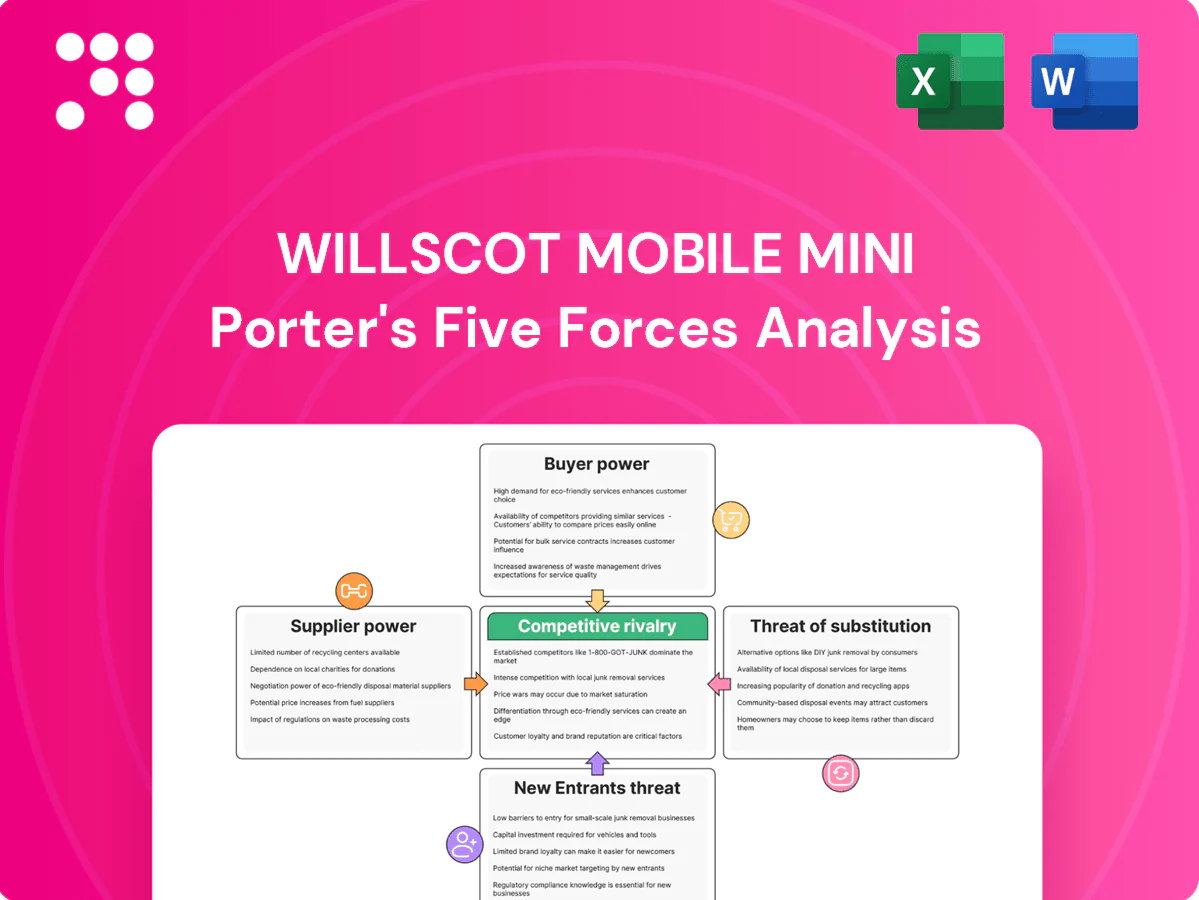
WillScot Mobile Mini's Porter's Five Forces snapshot highlights supplier leverage, buyer pressure, competitive rivalry, substitute risks and entry threats shaping margins and growth prospects. This brief scratches the surface—unlock the full Porter's Five Forces Analysis to see force-by-force ratings, visuals, and strategic implications tailored to WillScot Mobile Mini. Get the consultant-grade report to inform investment and strategy.
Suppliers Bargaining Power

Concentrated steel and component inputs
Suppliers of steel-based ISO containers, chassis and HVAC components are numerous but cyclical steel prices—US hot-rolled coil averaged about $700/ton in 2024—can compress margins during tight periods. WillScot Mobile Mini's scale and forward purchasing programs limit volatility. Multi-sourcing and refurbished fleet capability reduce single-supplier dependence and provide substitution during shortages.
Logistics and transport carriers
Regional trucking and crane services are essential for delivery and pick-up, with trucks moving about 72% of US freight tonnage (Bureau of Transportation Statistics). Capacity constraints or fuel spikes (diesel price volatility in 2024) raise costs and timing risk for WillScot Mobile Mini. Long-term carrier relationships and secured volume lanes provide bargaining leverage, lowering spot-rate exposure and improving on-time performance.

Specialized add-ons and site services
Restrooms, fencing, power and furniture bundles rely on niche vendors, giving some supplier leverage for specialty installs, while commoditized items like standard storage and basic power components limit supplier power. WillScot Mobile Mini reported approximately $3.0 billion revenue in 2024, supporting scale procurement and standardized SKUs; sizable in-house inventory and national distribution centers further mitigate supplier dependence and narrow price pressure.

Maintenance, parts, and refurbishment
Repair materials and parts are widely available, keeping supplier power moderate for WillScot Mobile Mini; common components and multiple distributors limit single-vendor leverage. Internal refurbishment and in-house repair lines provide effective substitution, reducing dependency on external suppliers and lowering marginal costs. Predictive maintenance scheduling evens out procurement cycles and smooths vendor demand, improving negotiating position.
- Supplier concentration: moderate
- In-house refurbishment: substitution option
- Predictive maintenance: stabilizes vendor demand
Technology and fleet management systems
Telematics, routing, and ERP providers can create meaningful switching costs for WillScot Mobile Mini by embedding telemetry, maintenance, and billing across operations; however the fleet-management market remains fragmented with dozens of vendors in 2024, limiting supplier concentration. Contractual terms and widely adopted API-first architectures among major vendors materially reduce long-term lock-in risk.
- Switching costs: integration of telematics and ERP
- Market structure: dozens of competitive vendors (2024)
- Risk mitigation: contract clauses and API-driven interoperability
Moderate supplier power — $700/ton HRC, trucking risk and fragmented telematics
Supplier power is moderate: steel volatility (US HRC ~700/ton in 2024) and niche install vendors can press costs, but WillScot Mobile Mini scale ($3.0B revenue 2024), multi-sourcing, in-house refurbishment and carrier agreements limit leverage; trucking (72% freight by tonnage) and diesel price swings raise execution risk; fragmented telematics/ERP market (dozens of vendors 2024) reduces long-term lock-in.
| Metric | 2024 Value |
|---|---|
| Revenue | $3.0B |
| HRC steel | $700/ton |
| US freight by truck | 72% |
| Telematics vendors | Dozens |
What is included in the product
 Detailed Word Document
Tailored Porter's Five Forces analysis for WillScot Mobile Mini that uncovers competitive rivalry, buyer and supplier power, threat of new entrants, and substitutes impacting pricing and margins. Identifies disruptive trends, regulatory and operational barriers to entry, and strategic levers management can use to defend market share.

 Customizable Excel Spreadsheet
Clear one-sheet Porter's Five Forces for WillScot | Mobile Mini — editable pressure levels with an instant spider chart, copy-ready layout for decks, no macros, duplicate tabs for scenarios, swap your data, and seamless Excel/Word integration for quick strategic decisions.
Customers Bargaining Power

Large national accounts vs. local buyers
National contractors and industrials push stronger bargaining power, negotiating volume discounts and service SLAs that drive margin pressure; in 2024 national accounts represented over half of WillScot Mobile Mini’s rental revenue, amplifying their leverage. Smaller local buyers on one-off projects lack scale and pay higher effective rates. WillScot Mobile Mini offsets this with tiered pricing, contractual SLAs and bundled value-added services to protect margins and customer retention.
Price sensitivity and utilization cycles
During construction downcycles buyers grow price-sensitive and extend bidding, pressuring rental rates; WillScot Mobile Mini saw utilization fluctuate but averaged roughly 84% in 2024, moderating discounting pressure. In tight local markets higher utilization supported pricing discipline and improved yields. The firm deploys dynamic pricing and term flexibility—shorter terms, surge pricing and contract add-ons—to manage swings in buyer power and protect margin.

Switching costs and service bundling
Relocation, set-up and site integration create practical switching costs for WillScot Mobile Mini customers, with moves often requiring coordinated logistics and downtime. Service bundles—furniture, power and security—raise account stickiness beyond the container, supporting cross-sell and higher ARPU. Performance history and rapid service response sustain retention, reflected in 2024 revenue near $4.0B and reported customer retention above 80%.

Alternative suppliers and bids
Multiple regional and national rivals let customers solicit competitive quotes quickly; WillScot | Mobile Mini (NYSE: WSC) faces dozens of competitors, keeping bids price-competitive. Standardized container and office-unit specs make price and term comparisons straightforward, so buyers often drive negotiations. Customers shift on delivery speed, fleet condition, and turnkey services where WSC reported faster fulfillment and higher uptime in 2024.
Public sector procurement
Public sector buyers use formal RFPs and framework agreements that compress margins and favor low-cost, compliant vendors; global public procurement represented about 12% of GDP (~$13 trillion) in 2024, concentrating buyer leverage. Compliance and safety track records are often decisive in bid awards, and multi-year contracts trade lower prices for volume and revenue visibility.
- RFPs/frameworks compress margins
- Compliance/safety drive selection
- Multi-year awards = price for visibility
National accounts dominate, compress margins; 84% utilization
National contractors and industrials exert strong bargaining power—national accounts drove over half of WillScot Mobile Mini’s rental revenue in 2024—forcing volume discounts and SLAs that compress margins. Local one-off buyers pay premium but are less influential. High utilization (~84% in 2024) and bundled services raise switching costs and retention (>80%), while many competitors keep spot pricing competitive.
| Metric | 2024 |
|---|---|
| National account share | ~50%+ |
| Utilization | ~84% |
| Revenue | $4.0B |
| Customer retention | >80% |
Same Document Delivered
WillScot Mobile Mini Porter's Five Forces Analysis
This preview shows the exact WillScot Mobile Mini Porter's Five Forces Analysis you'll receive upon purchase—no placeholders. The document is fully formatted, ready to download and use instantly. What you see here is the complete, professional final deliverable.

Elevate Your Analysis with the Complete Porter's Five Forces Analysis
WillScot Mobile Mini's Porter's Five Forces snapshot highlights supplier leverage, buyer pressure, competitive rivalry, substitute risks and entry threats shaping margins and growth prospects. This brief scratches the surface—unlock the full Porter's Five Forces Analysis to see force-by-force ratings, visuals, and strategic implications tailored to WillScot Mobile Mini. Get the consultant-grade report to inform investment and strategy.
Suppliers Bargaining Power
Concentrated steel and component inputs
Suppliers of steel-based ISO containers, chassis and HVAC components are numerous but cyclical steel prices—US hot-rolled coil averaged about $700/ton in 2024—can compress margins during tight periods. WillScot Mobile Mini's scale and forward purchasing programs limit volatility. Multi-sourcing and refurbished fleet capability reduce single-supplier dependence and provide substitution during shortages.
Logistics and transport carriers
Regional trucking and crane services are essential for delivery and pick-up, with trucks moving about 72% of US freight tonnage (Bureau of Transportation Statistics). Capacity constraints or fuel spikes (diesel price volatility in 2024) raise costs and timing risk for WillScot Mobile Mini. Long-term carrier relationships and secured volume lanes provide bargaining leverage, lowering spot-rate exposure and improving on-time performance.
Specialized add-ons and site services
Restrooms, fencing, power and furniture bundles rely on niche vendors, giving some supplier leverage for specialty installs, while commoditized items like standard storage and basic power components limit supplier power. WillScot Mobile Mini reported approximately $3.0 billion revenue in 2024, supporting scale procurement and standardized SKUs; sizable in-house inventory and national distribution centers further mitigate supplier dependence and narrow price pressure.
Maintenance, parts, and refurbishment
Repair materials and parts are widely available, keeping supplier power moderate for WillScot Mobile Mini; common components and multiple distributors limit single-vendor leverage. Internal refurbishment and in-house repair lines provide effective substitution, reducing dependency on external suppliers and lowering marginal costs. Predictive maintenance scheduling evens out procurement cycles and smooths vendor demand, improving negotiating position.
- Supplier concentration: moderate
- In-house refurbishment: substitution option
- Predictive maintenance: stabilizes vendor demand
Technology and fleet management systems
Telematics, routing, and ERP providers can create meaningful switching costs for WillScot Mobile Mini by embedding telemetry, maintenance, and billing across operations; however the fleet-management market remains fragmented with dozens of vendors in 2024, limiting supplier concentration. Contractual terms and widely adopted API-first architectures among major vendors materially reduce long-term lock-in risk.
- Switching costs: integration of telematics and ERP
- Market structure: dozens of competitive vendors (2024)
- Risk mitigation: contract clauses and API-driven interoperability
Moderate supplier power — $700/ton HRC, trucking risk and fragmented telematics
Supplier power is moderate: steel volatility (US HRC ~700/ton in 2024) and niche install vendors can press costs, but WillScot Mobile Mini scale ($3.0B revenue 2024), multi-sourcing, in-house refurbishment and carrier agreements limit leverage; trucking (72% freight by tonnage) and diesel price swings raise execution risk; fragmented telematics/ERP market (dozens of vendors 2024) reduces long-term lock-in.
| Metric | 2024 Value |
|---|---|
| Revenue | $3.0B |
| HRC steel | $700/ton |
| US freight by truck | 72% |
| Telematics vendors | Dozens |
What is included in the product
Detailed Word Document
Tailored Porter's Five Forces analysis for WillScot Mobile Mini that uncovers competitive rivalry, buyer and supplier power, threat of new entrants, and substitutes impacting pricing and margins. Identifies disruptive trends, regulatory and operational barriers to entry, and strategic levers management can use to defend market share.
Customizable Excel Spreadsheet
Clear one-sheet Porter's Five Forces for WillScot | Mobile Mini — editable pressure levels with an instant spider chart, copy-ready layout for decks, no macros, duplicate tabs for scenarios, swap your data, and seamless Excel/Word integration for quick strategic decisions.
Customers Bargaining Power
Large national accounts vs. local buyers
National contractors and industrials push stronger bargaining power, negotiating volume discounts and service SLAs that drive margin pressure; in 2024 national accounts represented over half of WillScot Mobile Mini’s rental revenue, amplifying their leverage. Smaller local buyers on one-off projects lack scale and pay higher effective rates. WillScot Mobile Mini offsets this with tiered pricing, contractual SLAs and bundled value-added services to protect margins and customer retention.
Price sensitivity and utilization cycles
During construction downcycles buyers grow price-sensitive and extend bidding, pressuring rental rates; WillScot Mobile Mini saw utilization fluctuate but averaged roughly 84% in 2024, moderating discounting pressure. In tight local markets higher utilization supported pricing discipline and improved yields. The firm deploys dynamic pricing and term flexibility—shorter terms, surge pricing and contract add-ons—to manage swings in buyer power and protect margin.
Switching costs and service bundling
Relocation, set-up and site integration create practical switching costs for WillScot Mobile Mini customers, with moves often requiring coordinated logistics and downtime. Service bundles—furniture, power and security—raise account stickiness beyond the container, supporting cross-sell and higher ARPU. Performance history and rapid service response sustain retention, reflected in 2024 revenue near $4.0B and reported customer retention above 80%.
Alternative suppliers and bids
Multiple regional and national rivals let customers solicit competitive quotes quickly; WillScot | Mobile Mini (NYSE: WSC) faces dozens of competitors, keeping bids price-competitive. Standardized container and office-unit specs make price and term comparisons straightforward, so buyers often drive negotiations. Customers shift on delivery speed, fleet condition, and turnkey services where WSC reported faster fulfillment and higher uptime in 2024.
Public sector procurement
Public sector buyers use formal RFPs and framework agreements that compress margins and favor low-cost, compliant vendors; global public procurement represented about 12% of GDP (~$13 trillion) in 2024, concentrating buyer leverage. Compliance and safety track records are often decisive in bid awards, and multi-year contracts trade lower prices for volume and revenue visibility.
- RFPs/frameworks compress margins
- Compliance/safety drive selection
- Multi-year awards = price for visibility
National accounts dominate, compress margins; 84% utilization
National contractors and industrials exert strong bargaining power—national accounts drove over half of WillScot Mobile Mini’s rental revenue in 2024—forcing volume discounts and SLAs that compress margins. Local one-off buyers pay premium but are less influential. High utilization (~84% in 2024) and bundled services raise switching costs and retention (>80%), while many competitors keep spot pricing competitive.
| Metric | 2024 |
|---|---|
| National account share | ~50%+ |
| Utilization | ~84% |
| Revenue | $4.0B |
| Customer retention | >80% |
Same Document Delivered
WillScot Mobile Mini Porter's Five Forces Analysis
This preview shows the exact WillScot Mobile Mini Porter's Five Forces Analysis you'll receive upon purchase—no placeholders. The document is fully formatted, ready to download and use instantly. What you see here is the complete, professional final deliverable.
Original: $10.00
-65%$10.00
$3.50Description
Elevate Your Analysis with the Complete Porter's Five Forces Analysis
WillScot Mobile Mini's Porter's Five Forces snapshot highlights supplier leverage, buyer pressure, competitive rivalry, substitute risks and entry threats shaping margins and growth prospects. This brief scratches the surface—unlock the full Porter's Five Forces Analysis to see force-by-force ratings, visuals, and strategic implications tailored to WillScot Mobile Mini. Get the consultant-grade report to inform investment and strategy.
Suppliers Bargaining Power
Concentrated steel and component inputs
Suppliers of steel-based ISO containers, chassis and HVAC components are numerous but cyclical steel prices—US hot-rolled coil averaged about $700/ton in 2024—can compress margins during tight periods. WillScot Mobile Mini's scale and forward purchasing programs limit volatility. Multi-sourcing and refurbished fleet capability reduce single-supplier dependence and provide substitution during shortages.
Logistics and transport carriers
Regional trucking and crane services are essential for delivery and pick-up, with trucks moving about 72% of US freight tonnage (Bureau of Transportation Statistics). Capacity constraints or fuel spikes (diesel price volatility in 2024) raise costs and timing risk for WillScot Mobile Mini. Long-term carrier relationships and secured volume lanes provide bargaining leverage, lowering spot-rate exposure and improving on-time performance.
Specialized add-ons and site services
Restrooms, fencing, power and furniture bundles rely on niche vendors, giving some supplier leverage for specialty installs, while commoditized items like standard storage and basic power components limit supplier power. WillScot Mobile Mini reported approximately $3.0 billion revenue in 2024, supporting scale procurement and standardized SKUs; sizable in-house inventory and national distribution centers further mitigate supplier dependence and narrow price pressure.
Maintenance, parts, and refurbishment
Repair materials and parts are widely available, keeping supplier power moderate for WillScot Mobile Mini; common components and multiple distributors limit single-vendor leverage. Internal refurbishment and in-house repair lines provide effective substitution, reducing dependency on external suppliers and lowering marginal costs. Predictive maintenance scheduling evens out procurement cycles and smooths vendor demand, improving negotiating position.
- Supplier concentration: moderate
- In-house refurbishment: substitution option
- Predictive maintenance: stabilizes vendor demand
Technology and fleet management systems
Telematics, routing, and ERP providers can create meaningful switching costs for WillScot Mobile Mini by embedding telemetry, maintenance, and billing across operations; however the fleet-management market remains fragmented with dozens of vendors in 2024, limiting supplier concentration. Contractual terms and widely adopted API-first architectures among major vendors materially reduce long-term lock-in risk.
- Switching costs: integration of telematics and ERP
- Market structure: dozens of competitive vendors (2024)
- Risk mitigation: contract clauses and API-driven interoperability
Moderate supplier power — $700/ton HRC, trucking risk and fragmented telematics
Supplier power is moderate: steel volatility (US HRC ~700/ton in 2024) and niche install vendors can press costs, but WillScot Mobile Mini scale ($3.0B revenue 2024), multi-sourcing, in-house refurbishment and carrier agreements limit leverage; trucking (72% freight by tonnage) and diesel price swings raise execution risk; fragmented telematics/ERP market (dozens of vendors 2024) reduces long-term lock-in.
| Metric | 2024 Value |
|---|---|
| Revenue | $3.0B |
| HRC steel | $700/ton |
| US freight by truck | 72% |
| Telematics vendors | Dozens |
What is included in the product
Detailed Word Document
Tailored Porter's Five Forces analysis for WillScot Mobile Mini that uncovers competitive rivalry, buyer and supplier power, threat of new entrants, and substitutes impacting pricing and margins. Identifies disruptive trends, regulatory and operational barriers to entry, and strategic levers management can use to defend market share.
Customizable Excel Spreadsheet
Clear one-sheet Porter's Five Forces for WillScot | Mobile Mini — editable pressure levels with an instant spider chart, copy-ready layout for decks, no macros, duplicate tabs for scenarios, swap your data, and seamless Excel/Word integration for quick strategic decisions.
Customers Bargaining Power
Large national accounts vs. local buyers
National contractors and industrials push stronger bargaining power, negotiating volume discounts and service SLAs that drive margin pressure; in 2024 national accounts represented over half of WillScot Mobile Mini’s rental revenue, amplifying their leverage. Smaller local buyers on one-off projects lack scale and pay higher effective rates. WillScot Mobile Mini offsets this with tiered pricing, contractual SLAs and bundled value-added services to protect margins and customer retention.
Price sensitivity and utilization cycles
During construction downcycles buyers grow price-sensitive and extend bidding, pressuring rental rates; WillScot Mobile Mini saw utilization fluctuate but averaged roughly 84% in 2024, moderating discounting pressure. In tight local markets higher utilization supported pricing discipline and improved yields. The firm deploys dynamic pricing and term flexibility—shorter terms, surge pricing and contract add-ons—to manage swings in buyer power and protect margin.
Switching costs and service bundling
Relocation, set-up and site integration create practical switching costs for WillScot Mobile Mini customers, with moves often requiring coordinated logistics and downtime. Service bundles—furniture, power and security—raise account stickiness beyond the container, supporting cross-sell and higher ARPU. Performance history and rapid service response sustain retention, reflected in 2024 revenue near $4.0B and reported customer retention above 80%.
Alternative suppliers and bids
Multiple regional and national rivals let customers solicit competitive quotes quickly; WillScot | Mobile Mini (NYSE: WSC) faces dozens of competitors, keeping bids price-competitive. Standardized container and office-unit specs make price and term comparisons straightforward, so buyers often drive negotiations. Customers shift on delivery speed, fleet condition, and turnkey services where WSC reported faster fulfillment and higher uptime in 2024.
Public sector procurement
Public sector buyers use formal RFPs and framework agreements that compress margins and favor low-cost, compliant vendors; global public procurement represented about 12% of GDP (~$13 trillion) in 2024, concentrating buyer leverage. Compliance and safety track records are often decisive in bid awards, and multi-year contracts trade lower prices for volume and revenue visibility.
- RFPs/frameworks compress margins
- Compliance/safety drive selection
- Multi-year awards = price for visibility
National accounts dominate, compress margins; 84% utilization
National contractors and industrials exert strong bargaining power—national accounts drove over half of WillScot Mobile Mini’s rental revenue in 2024—forcing volume discounts and SLAs that compress margins. Local one-off buyers pay premium but are less influential. High utilization (~84% in 2024) and bundled services raise switching costs and retention (>80%), while many competitors keep spot pricing competitive.
| Metric | 2024 |
|---|---|
| National account share | ~50%+ |
| Utilization | ~84% |
| Revenue | $4.0B |
| Customer retention | >80% |
Same Document Delivered
WillScot Mobile Mini Porter's Five Forces Analysis
This preview shows the exact WillScot Mobile Mini Porter's Five Forces Analysis you'll receive upon purchase—no placeholders. The document is fully formatted, ready to download and use instantly. What you see here is the complete, professional final deliverable.











