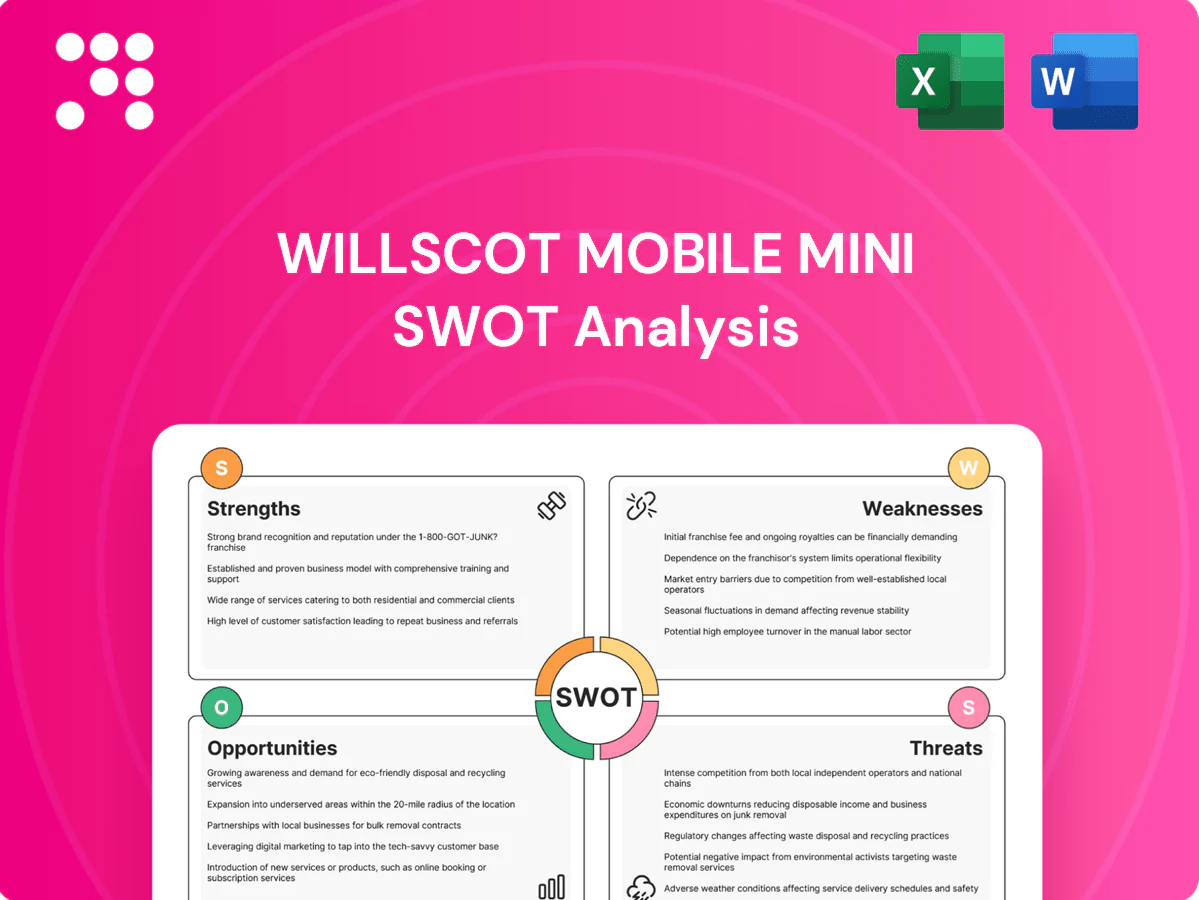
WillScot Mobile Mini SWOT Analysis

Elevate Your Analysis with the Complete SWOT Report
WillScot Mobile Mini’s SWOT highlights scale and recurring rental revenue as strengths, synergies from the merger and market leadership; weaknesses include cyclical construction demand and integration risks; opportunities lie in modular solutions and ESG-driven demand while competition and pricing pressure are key threats. Want the full story with editable Word and Excel deliverables? Purchase the complete SWOT for actionable strategy and investment insights.
Strengths

Scaled fleet network
WillScot Mobile Mini’s scaled fleet—over 300,000 units across North America and Europe—enables rapid deployment and consistent service levels, improving utilization and routing efficiency to shorten turnaround times. Scale drives procurement leverage and pricing power versus smaller rivals, while dense network hubs lower delivery costs and reduce idle time, supporting higher revenue per unit and margin expansion.
Recurring lease revenues
Primarily leasing model creates predictable, cash‑flowing revenue streams with long average rental durations, supporting high revenue visibility; as of FY2024 rental revenue represented about 75% of total revenue ($2.6B of $3.5B). Rate escalators and ancillary fees (fuel, delivery, service) help sustain margin stability and offset inflationary pressure. This recurring base cushions cyclicality versus pure sales models, with strong renewal dynamics and multi-year contract tails.

Cross-sell site services
Cross-selling steps, furniture, security, power and managed services raises ARPU and retention—WillScot|MobileMini, with roughly $3.1B revenue in FY2024, can convert low-margin box rentals into higher-margin platform sales. Bundles simplify vendor management for clients and increase wallet share, driving mix shift to services that typically carry 20–40% higher gross margins than pure rentals. This boosts stickiness and recurring revenue.

Diverse end markets
Diverse end markets reduce single‑sector dependence for WillScot Mobile Mini, with exposure across construction, commercial, industrial, government and education driving demand for temporary and semi‑permanent space solutions; fiscal 2024 revenue was about $3.5 billion, reflecting broad end‑market resilience. Public sector and infrastructure spending help offset private construction slowdowns, supporting utilization and pricing. Portfolio balance creates countercyclical pockets that stabilize cash flow and rental demand.
- Construction exposure lowers concentration risk
- Government & education provide countercyclical demand
- Temporary/semi‑permanent needs sustain recurring revenue
- Fiscal 2024 revenue ~3.5B supports diversification thesis
Proven M&A integration
Proven M&A integration: WillScot MobileMini closed its merger in June 2020 and has acquired regional players to broaden its footprint and product set using a repeatable integration playbook that speeds market rollout.
Integration yields fleet optimization, SG&A consolidation and pricing-analytics synergies, boosting site density, utilization and unit margins across acquired territories.
- Repeatable playbook → faster scale
- Fleet optimization → higher utilization
- SG&A consolidation → margin expansion
300,000+ unit fleet, FY24 revenue $3.5B
Scale: 300,000+ unit fleet across NA/EU enables rapid deployment and lower delivery costs. Predictable rental base: FY2024 revenue ~$3.5B with rental revenue ~$2.6B (≈75%), supporting cash flow visibility. Higher‑margin services and cross‑sell (20–40% incremental gross margin) plus repeatable M&A playbook drive utilization, mix shift and margin expansion.
| Metric | Value |
|---|---|
| Fleet | 300,000+ units |
| FY2024 revenue | $3.5B |
| Rental revenue | $2.6B (75%) |
| Services margin uplift | 20–40% |
What is included in the product
 Detailed Word Document
Provides a strategic overview of WillScot Mobile Mini’s internal strengths and weaknesses alongside external opportunities and threats, highlighting competitive position, growth drivers, operational gaps, and market risks shaping its future.

 Customizable Excel Spreadsheet
Provides a concise, visual SWOT matrix tailored to WillScot Mobile Mini for rapid strategic alignment; editable format enables quick updates to reflect shifting market conditions and operational priorities.
Weaknesses

Cyclical demand exposure
Cyclical demand ties WillScot Mobile Mini to construction starts, industrial activity and CapEx cycles, so slowdowns compress rental utilization and hinder rate growth; backlogs provide temporary cushioning but cannot remove revenue volatility, and the business remains highly sensitive to GDP, housing starts and corporate CapEx swings.
Capital intensive fleet
Capital intensive fleet requires ongoing capex for purchasing, refurbishing and maintaining containers and modular units, which elevates fixed investment needs and operating leverage. High capital demands can strain free cash flow during downturns and raise ROI hurdles on new deployments. Aging assets increase maintenance costs and depress resale values, forcing strict capex discipline and lifecycle optimization to protect margins.

Leverage and interest costs
Leverage in the modular space often relies on meaningful debt to finance fleet expansion and M&A, leaving WillScot Mobile Mini exposed as benchmark rates sit above 5.25–5.50% in 2024–25, which can squeeze interest coverage and earnings. Tight covenants may limit capital allocation and strategic optionality in weaker demand cycles. Addressing balance-sheet risk requires clear de‑leveraging paths: asset sales, capex discipline, and covenant renegotiation.

Project-based churn
Input and logistics costs
Steel, transport and labor cost volatility compress unit economics and refurbishment margins for WillScot Mobile Mini; higher steel and wage inputs raise per‑unit rebuild costs. Fuel and driver shortages delay deliveries—U.S. retail diesel averaged about $4.02/gal in 2024 (EIA), pressuring logistics. Pricing pass‑throughs to customers can lag spikes, increasing short‑term margin pressure and highlighting supply‑chain/vendor dependencies.
- Input cost exposure: steel, labor, refurbishment margins
- Logistics risk: diesel ~$4.02/gal (2024), driver availability impacts timelines
- Pricing lag: pass‑through delays amplify margin volatility
- Supply chain: vendor concentration risk
Cyclical construction demand, aging fleet and leverage squeeze margins; rates >5.25-5.50%
Revenue tied to cyclical construction/CapEx causes utilization volatility; backlogs help but not eliminate GDP sensitivity. High capex and aging fleet raise maintenance and OCF strain. Leverage exposure with benchmark rates >5.25–5.50% (2024–25) and input cost shocks (diesel ~$4.02/gal in 2024) compress margins.
| Weakness | Metric | 2024/25 |
|---|---|---|
| Cyclical demand | GDP/housing sensitivity | High |
| Leverage | Benchmark rates | >5.25–5.50% |
| Input costs | Diesel | $4.02/gal |
Preview Before You Purchase
WillScot Mobile Mini SWOT Analysis
This is the actual WillScot Mobile Mini SWOT analysis document you’ll receive upon purchase—no surprises, just professional quality. The preview below is taken directly from the full report; buy to unlock the complete, editable version. The file shown is the real, downloadable analysis, ready for immediate use.

Elevate Your Analysis with the Complete SWOT Report
WillScot Mobile Mini’s SWOT highlights scale and recurring rental revenue as strengths, synergies from the merger and market leadership; weaknesses include cyclical construction demand and integration risks; opportunities lie in modular solutions and ESG-driven demand while competition and pricing pressure are key threats. Want the full story with editable Word and Excel deliverables? Purchase the complete SWOT for actionable strategy and investment insights.
Strengths
Scaled fleet network
WillScot Mobile Mini’s scaled fleet—over 300,000 units across North America and Europe—enables rapid deployment and consistent service levels, improving utilization and routing efficiency to shorten turnaround times. Scale drives procurement leverage and pricing power versus smaller rivals, while dense network hubs lower delivery costs and reduce idle time, supporting higher revenue per unit and margin expansion.
Recurring lease revenues
Primarily leasing model creates predictable, cash‑flowing revenue streams with long average rental durations, supporting high revenue visibility; as of FY2024 rental revenue represented about 75% of total revenue ($2.6B of $3.5B). Rate escalators and ancillary fees (fuel, delivery, service) help sustain margin stability and offset inflationary pressure. This recurring base cushions cyclicality versus pure sales models, with strong renewal dynamics and multi-year contract tails.
Cross-sell site services
Cross-selling steps, furniture, security, power and managed services raises ARPU and retention—WillScot|MobileMini, with roughly $3.1B revenue in FY2024, can convert low-margin box rentals into higher-margin platform sales. Bundles simplify vendor management for clients and increase wallet share, driving mix shift to services that typically carry 20–40% higher gross margins than pure rentals. This boosts stickiness and recurring revenue.
Diverse end markets
Diverse end markets reduce single‑sector dependence for WillScot Mobile Mini, with exposure across construction, commercial, industrial, government and education driving demand for temporary and semi‑permanent space solutions; fiscal 2024 revenue was about $3.5 billion, reflecting broad end‑market resilience. Public sector and infrastructure spending help offset private construction slowdowns, supporting utilization and pricing. Portfolio balance creates countercyclical pockets that stabilize cash flow and rental demand.
- Construction exposure lowers concentration risk
- Government & education provide countercyclical demand
- Temporary/semi‑permanent needs sustain recurring revenue
- Fiscal 2024 revenue ~3.5B supports diversification thesis
Proven M&A integration
Proven M&A integration: WillScot MobileMini closed its merger in June 2020 and has acquired regional players to broaden its footprint and product set using a repeatable integration playbook that speeds market rollout.
Integration yields fleet optimization, SG&A consolidation and pricing-analytics synergies, boosting site density, utilization and unit margins across acquired territories.
- Repeatable playbook → faster scale
- Fleet optimization → higher utilization
- SG&A consolidation → margin expansion
300,000+ unit fleet, FY24 revenue $3.5B
Scale: 300,000+ unit fleet across NA/EU enables rapid deployment and lower delivery costs. Predictable rental base: FY2024 revenue ~$3.5B with rental revenue ~$2.6B (≈75%), supporting cash flow visibility. Higher‑margin services and cross‑sell (20–40% incremental gross margin) plus repeatable M&A playbook drive utilization, mix shift and margin expansion.
| Metric | Value |
|---|---|
| Fleet | 300,000+ units |
| FY2024 revenue | $3.5B |
| Rental revenue | $2.6B (75%) |
| Services margin uplift | 20–40% |
What is included in the product
Detailed Word Document
Provides a strategic overview of WillScot Mobile Mini’s internal strengths and weaknesses alongside external opportunities and threats, highlighting competitive position, growth drivers, operational gaps, and market risks shaping its future.
Customizable Excel Spreadsheet
Provides a concise, visual SWOT matrix tailored to WillScot Mobile Mini for rapid strategic alignment; editable format enables quick updates to reflect shifting market conditions and operational priorities.
Weaknesses
Cyclical demand exposure
Cyclical demand ties WillScot Mobile Mini to construction starts, industrial activity and CapEx cycles, so slowdowns compress rental utilization and hinder rate growth; backlogs provide temporary cushioning but cannot remove revenue volatility, and the business remains highly sensitive to GDP, housing starts and corporate CapEx swings.
Capital intensive fleet
Capital intensive fleet requires ongoing capex for purchasing, refurbishing and maintaining containers and modular units, which elevates fixed investment needs and operating leverage. High capital demands can strain free cash flow during downturns and raise ROI hurdles on new deployments. Aging assets increase maintenance costs and depress resale values, forcing strict capex discipline and lifecycle optimization to protect margins.
Leverage and interest costs
Leverage in the modular space often relies on meaningful debt to finance fleet expansion and M&A, leaving WillScot Mobile Mini exposed as benchmark rates sit above 5.25–5.50% in 2024–25, which can squeeze interest coverage and earnings. Tight covenants may limit capital allocation and strategic optionality in weaker demand cycles. Addressing balance-sheet risk requires clear de‑leveraging paths: asset sales, capex discipline, and covenant renegotiation.
Project-based churn
Input and logistics costs
Steel, transport and labor cost volatility compress unit economics and refurbishment margins for WillScot Mobile Mini; higher steel and wage inputs raise per‑unit rebuild costs. Fuel and driver shortages delay deliveries—U.S. retail diesel averaged about $4.02/gal in 2024 (EIA), pressuring logistics. Pricing pass‑throughs to customers can lag spikes, increasing short‑term margin pressure and highlighting supply‑chain/vendor dependencies.
- Input cost exposure: steel, labor, refurbishment margins
- Logistics risk: diesel ~$4.02/gal (2024), driver availability impacts timelines
- Pricing lag: pass‑through delays amplify margin volatility
- Supply chain: vendor concentration risk
Cyclical construction demand, aging fleet and leverage squeeze margins; rates >5.25-5.50%
Revenue tied to cyclical construction/CapEx causes utilization volatility; backlogs help but not eliminate GDP sensitivity. High capex and aging fleet raise maintenance and OCF strain. Leverage exposure with benchmark rates >5.25–5.50% (2024–25) and input cost shocks (diesel ~$4.02/gal in 2024) compress margins.
| Weakness | Metric | 2024/25 |
|---|---|---|
| Cyclical demand | GDP/housing sensitivity | High |
| Leverage | Benchmark rates | >5.25–5.50% |
| Input costs | Diesel | $4.02/gal |
Preview Before You Purchase
WillScot Mobile Mini SWOT Analysis
This is the actual WillScot Mobile Mini SWOT analysis document you’ll receive upon purchase—no surprises, just professional quality. The preview below is taken directly from the full report; buy to unlock the complete, editable version. The file shown is the real, downloadable analysis, ready for immediate use.
Description
Elevate Your Analysis with the Complete SWOT Report
WillScot Mobile Mini’s SWOT highlights scale and recurring rental revenue as strengths, synergies from the merger and market leadership; weaknesses include cyclical construction demand and integration risks; opportunities lie in modular solutions and ESG-driven demand while competition and pricing pressure are key threats. Want the full story with editable Word and Excel deliverables? Purchase the complete SWOT for actionable strategy and investment insights.
Strengths
Scaled fleet network
WillScot Mobile Mini’s scaled fleet—over 300,000 units across North America and Europe—enables rapid deployment and consistent service levels, improving utilization and routing efficiency to shorten turnaround times. Scale drives procurement leverage and pricing power versus smaller rivals, while dense network hubs lower delivery costs and reduce idle time, supporting higher revenue per unit and margin expansion.
Recurring lease revenues
Primarily leasing model creates predictable, cash‑flowing revenue streams with long average rental durations, supporting high revenue visibility; as of FY2024 rental revenue represented about 75% of total revenue ($2.6B of $3.5B). Rate escalators and ancillary fees (fuel, delivery, service) help sustain margin stability and offset inflationary pressure. This recurring base cushions cyclicality versus pure sales models, with strong renewal dynamics and multi-year contract tails.
Cross-sell site services
Cross-selling steps, furniture, security, power and managed services raises ARPU and retention—WillScot|MobileMini, with roughly $3.1B revenue in FY2024, can convert low-margin box rentals into higher-margin platform sales. Bundles simplify vendor management for clients and increase wallet share, driving mix shift to services that typically carry 20–40% higher gross margins than pure rentals. This boosts stickiness and recurring revenue.
Diverse end markets
Diverse end markets reduce single‑sector dependence for WillScot Mobile Mini, with exposure across construction, commercial, industrial, government and education driving demand for temporary and semi‑permanent space solutions; fiscal 2024 revenue was about $3.5 billion, reflecting broad end‑market resilience. Public sector and infrastructure spending help offset private construction slowdowns, supporting utilization and pricing. Portfolio balance creates countercyclical pockets that stabilize cash flow and rental demand.
- Construction exposure lowers concentration risk
- Government & education provide countercyclical demand
- Temporary/semi‑permanent needs sustain recurring revenue
- Fiscal 2024 revenue ~3.5B supports diversification thesis
Proven M&A integration
Proven M&A integration: WillScot MobileMini closed its merger in June 2020 and has acquired regional players to broaden its footprint and product set using a repeatable integration playbook that speeds market rollout.
Integration yields fleet optimization, SG&A consolidation and pricing-analytics synergies, boosting site density, utilization and unit margins across acquired territories.
- Repeatable playbook → faster scale
- Fleet optimization → higher utilization
- SG&A consolidation → margin expansion
300,000+ unit fleet, FY24 revenue $3.5B
Scale: 300,000+ unit fleet across NA/EU enables rapid deployment and lower delivery costs. Predictable rental base: FY2024 revenue ~$3.5B with rental revenue ~$2.6B (≈75%), supporting cash flow visibility. Higher‑margin services and cross‑sell (20–40% incremental gross margin) plus repeatable M&A playbook drive utilization, mix shift and margin expansion.
| Metric | Value |
|---|---|
| Fleet | 300,000+ units |
| FY2024 revenue | $3.5B |
| Rental revenue | $2.6B (75%) |
| Services margin uplift | 20–40% |
What is included in the product
Detailed Word Document
Provides a strategic overview of WillScot Mobile Mini’s internal strengths and weaknesses alongside external opportunities and threats, highlighting competitive position, growth drivers, operational gaps, and market risks shaping its future.
Customizable Excel Spreadsheet
Provides a concise, visual SWOT matrix tailored to WillScot Mobile Mini for rapid strategic alignment; editable format enables quick updates to reflect shifting market conditions and operational priorities.
Weaknesses
Cyclical demand exposure
Cyclical demand ties WillScot Mobile Mini to construction starts, industrial activity and CapEx cycles, so slowdowns compress rental utilization and hinder rate growth; backlogs provide temporary cushioning but cannot remove revenue volatility, and the business remains highly sensitive to GDP, housing starts and corporate CapEx swings.
Capital intensive fleet
Capital intensive fleet requires ongoing capex for purchasing, refurbishing and maintaining containers and modular units, which elevates fixed investment needs and operating leverage. High capital demands can strain free cash flow during downturns and raise ROI hurdles on new deployments. Aging assets increase maintenance costs and depress resale values, forcing strict capex discipline and lifecycle optimization to protect margins.
Leverage and interest costs
Leverage in the modular space often relies on meaningful debt to finance fleet expansion and M&A, leaving WillScot Mobile Mini exposed as benchmark rates sit above 5.25–5.50% in 2024–25, which can squeeze interest coverage and earnings. Tight covenants may limit capital allocation and strategic optionality in weaker demand cycles. Addressing balance-sheet risk requires clear de‑leveraging paths: asset sales, capex discipline, and covenant renegotiation.
Project-based churn
Input and logistics costs
Steel, transport and labor cost volatility compress unit economics and refurbishment margins for WillScot Mobile Mini; higher steel and wage inputs raise per‑unit rebuild costs. Fuel and driver shortages delay deliveries—U.S. retail diesel averaged about $4.02/gal in 2024 (EIA), pressuring logistics. Pricing pass‑throughs to customers can lag spikes, increasing short‑term margin pressure and highlighting supply‑chain/vendor dependencies.
- Input cost exposure: steel, labor, refurbishment margins
- Logistics risk: diesel ~$4.02/gal (2024), driver availability impacts timelines
- Pricing lag: pass‑through delays amplify margin volatility
- Supply chain: vendor concentration risk
Cyclical construction demand, aging fleet and leverage squeeze margins; rates >5.25-5.50%
Revenue tied to cyclical construction/CapEx causes utilization volatility; backlogs help but not eliminate GDP sensitivity. High capex and aging fleet raise maintenance and OCF strain. Leverage exposure with benchmark rates >5.25–5.50% (2024–25) and input cost shocks (diesel ~$4.02/gal in 2024) compress margins.
| Weakness | Metric | 2024/25 |
|---|---|---|
| Cyclical demand | GDP/housing sensitivity | High |
| Leverage | Benchmark rates | >5.25–5.50% |
| Input costs | Diesel | $4.02/gal |
Preview Before You Purchase
WillScot Mobile Mini SWOT Analysis
This is the actual WillScot Mobile Mini SWOT analysis document you’ll receive upon purchase—no surprises, just professional quality. The preview below is taken directly from the full report; buy to unlock the complete, editable version. The file shown is the real, downloadable analysis, ready for immediate use.











