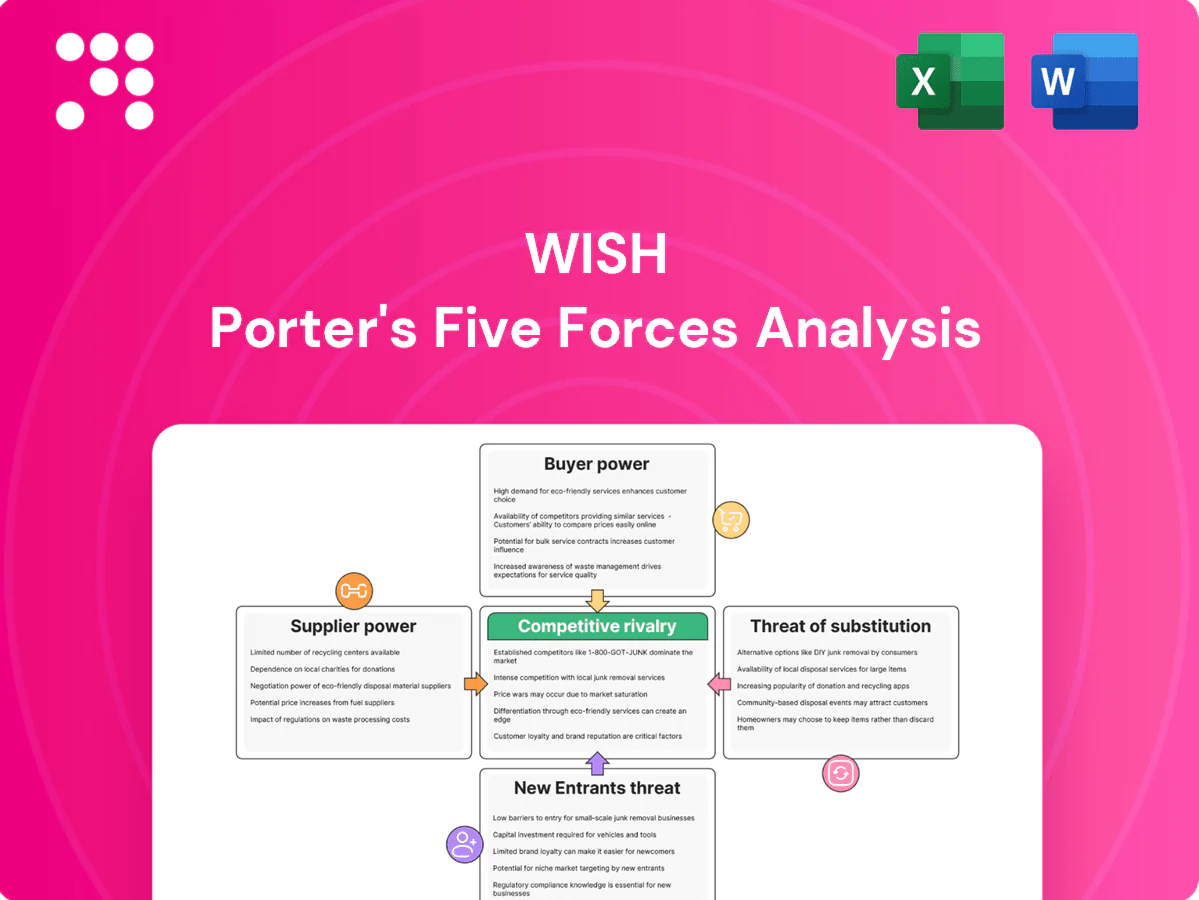
Wish Porter's Five Forces Analysis

From Overview to Strategy Blueprint
This brief snapshot only scratches the surface of Wish's competitive landscape, highlighting key pressures like buyer power, supplier influence, and substitute threats. Unlock the full Porter's Five Forces Analysis to explore force-by-force ratings, visuals, and strategic implications that shape Wish’s market position. Get the complete consultant-grade report for data-driven insights to inform investment or strategy decisions.
Suppliers Bargaining Power

Fragmented merchant base
Wish sources from thousands of small manufacturers and wholesalers, predominantly in China, so individual supplier leverage is low. No single merchant is critical for assortment breadth, and the fragmented base lets Wish rapidly replace poor performers. This dynamic strengthens Wish’s ability to negotiate fees and enforce quality and listing standards with limited supplier pushback.
Low switching costs for merchants
Merchants face low switching costs and can list on Amazon (≈300M active customers), eBay (≈136M active buyers in 2023), AliExpress, Temu and TikTok Shop, diluting dependence on Wish. Multi-homing strengthens suppliers' bargaining power on fees and policies, forcing Wish to offer traffic, seller tools, or lower take rates to retain supply. Those concessions can compress marketplace take-rates and margins.

Platform dependence on logistics partners
International shipping aggregators and last-mile carriers are critical suppliers for Wish, with typical China-to-market cross-border delivery times ranging broadly from 14 to 45 days, directly affecting refund rates and customer perception.
Limited premium logistics options from China to distant markets push unit shipping costs higher, and carriers with capacity constraints during peak seasons can exert strong bargaining leverage, often tightening available capacity by double-digit percentages.

Quality and compliance overhead
Merchants on Wish absorb costs to guarantee product authenticity, safety testing, and tax compliance, and stricter enforcement can drive churn when thin margins collapse. Suppliers increasingly demand better economics to cover returns, regulatory penalties, and remediation, shifting leverage toward compliant, higher-quality merchants and brands. Industry data show online return rates around 20% in 2023, raising cost pressures on low-margin sellers.
- Compliance costs: borne by merchants
- Enforcement risk: triggers merchant churn
- Supplier demands: higher economics to offset penalties
- Power shift: favors compliant, higher-quality merchants
Data and demand visibility
Wish’s feed-level demand data improves listing and pricing precision, lowering supplier uncertainty and return costs; the Wish app surpassed 100 million installs on Google Play by 2024, amplifying the value of platform insights. Data asymmetry lets top merchants sidestep rules or secure perks, turning consumer-behavior access into a bargaining chip that raises power for leading vendors.
- Feed data reduces mismatch and pricing friction
- Top merchants can leverage asymmetry for perks
- Preferred insight access increases vendor leverage
Logistics 14–45 days and 20% returns shift marketplace power
Suppliers are fragmented and low individual leverage, but multi-homing (Amazon ≈300M buyers, eBay ≈136M buyers 2023) and top-vendor data access raise bargaining power. Logistics (China→markets 14–45 days) and peak-season capacity cuts (double-digit %) boost carrier leverage. High returns (~20% 2023) and compliance costs shift power toward compliant, higher-quality merchants.
| Metric | Value |
|---|---|
| Wish app installs (Google Play) 2024 | >100M |
| Online return rate 2023 | ~20% |
| China→market delivery | 14–45 days |
What is included in the product
 Detailed Word Document
Comprehensive Porter’s Five Forces analysis for Wish that uncovers competitive drivers, buyer and supplier power, entry barriers, substitutes, and emerging disruptive threats to its marketplace model; includes industry data and strategic commentary to inform pricing, positioning, and defensive strategies.

 Customizable Excel Spreadsheet
Pinpoint competitive pressures at a glance with a one-sheet Five Forces summary and interactive radar—simplifies strategic tradeoffs, plugs into decks, and requires no code so teams can update scenarios fast.
Customers Bargaining Power

Extreme price sensitivity
Wish targets value-seeking consumers who prioritize low prices over brand loyalty, and these buyers switch quickly for even small savings. Their habitual search for bargains forces continual discounting and promotional spend on the platform. This dynamic elevates buyer bargaining power, reducing pricing flexibility for sellers. The result is persistent margin compression for merchants on Wish.
Minimal switching costs
Consumers can compare and purchase across Temu, AliExpress, Shein, Amazon and TikTok Shop instantly; by 2024 Temu and Shein routinely out-ranked Wish in US shopping app downloads, amplifying alternatives. App-based discovery and in-app links make cross-platform hopping frictionless, lowering switching costs. Low loyalty increases elasticity to price and shipping time, weakening Wish's pricing power.

Transparency via reviews
Ratings, customer photos, and refund metrics drive purchase decisions and force sellers to improve; more than 80% of online shoppers consult reviews before buying (2024 industry surveys). Negative feedback can halve conversion for affected listings within days, and aggregated low scores push platforms to delist or penalize suppliers. Collective signals give buyers indirect leverage over both sellers and platform policy.

Shipping time expectations
Abundant substitutes for attention
Discovery shopping on Wish competes directly with social feeds and other marketplaces for user attention; global average daily time on social media was about 2h31m in 2024 (DataReportal), intensifying competition. If engagement falls, customer acquisition cost rises as conversion rates hover near 2.3% for e-commerce in 2024 (Statista), widening buyer bargaining power. Wish must keep investing in personalization—consumers are ~80% more likely to buy with personalized experiences (Epsilon 2024)—to retain users.
- Competition: social feeds 2h31m/day (2024)
- Conversion: ~2.3% e‑commerce (Statista 2024)
- Personalization lift: ~80% higher purchase likelihood (Epsilon 2024)
Buyers switch for small savings; 69% expect 3-5d, squeezing margins
Wish buyers prioritize price and switch for small savings, forcing constant discounts and compressing merchant margins. Alternatives (Temu, Shein, AliExpress, TikTok) and 2024 app-download trends lower switching costs and raise buyer leverage. Reviews and shipping expectations (69% expect 3–5d; 46% abandon slow shipping) amplify bargaining power.
| Metric | 2024 |
|---|---|
| Conversion rate | ~2.3% |
| Personalization lift | ~80% |
| Delivery expectation | 69% (3–5d) |
| Cart abandonment (slow ship) | 46% |
What You See Is What You Get
Wish Porter's Five Forces Analysis
This preview shows the exact Wish Porter Five Forces Analysis you'll receive immediately after purchase—fully formatted and ready to use. No placeholders, mockups, or samples: the document displayed is the final deliverable. Once you complete payment, you’ll get instant access to this identical file for download and application.

From Overview to Strategy Blueprint
This brief snapshot only scratches the surface of Wish's competitive landscape, highlighting key pressures like buyer power, supplier influence, and substitute threats. Unlock the full Porter's Five Forces Analysis to explore force-by-force ratings, visuals, and strategic implications that shape Wish’s market position. Get the complete consultant-grade report for data-driven insights to inform investment or strategy decisions.
Suppliers Bargaining Power
Fragmented merchant base
Wish sources from thousands of small manufacturers and wholesalers, predominantly in China, so individual supplier leverage is low. No single merchant is critical for assortment breadth, and the fragmented base lets Wish rapidly replace poor performers. This dynamic strengthens Wish’s ability to negotiate fees and enforce quality and listing standards with limited supplier pushback.
Low switching costs for merchants
Merchants face low switching costs and can list on Amazon (≈300M active customers), eBay (≈136M active buyers in 2023), AliExpress, Temu and TikTok Shop, diluting dependence on Wish. Multi-homing strengthens suppliers' bargaining power on fees and policies, forcing Wish to offer traffic, seller tools, or lower take rates to retain supply. Those concessions can compress marketplace take-rates and margins.
Platform dependence on logistics partners
International shipping aggregators and last-mile carriers are critical suppliers for Wish, with typical China-to-market cross-border delivery times ranging broadly from 14 to 45 days, directly affecting refund rates and customer perception.
Limited premium logistics options from China to distant markets push unit shipping costs higher, and carriers with capacity constraints during peak seasons can exert strong bargaining leverage, often tightening available capacity by double-digit percentages.
Quality and compliance overhead
Merchants on Wish absorb costs to guarantee product authenticity, safety testing, and tax compliance, and stricter enforcement can drive churn when thin margins collapse. Suppliers increasingly demand better economics to cover returns, regulatory penalties, and remediation, shifting leverage toward compliant, higher-quality merchants and brands. Industry data show online return rates around 20% in 2023, raising cost pressures on low-margin sellers.
- Compliance costs: borne by merchants
- Enforcement risk: triggers merchant churn
- Supplier demands: higher economics to offset penalties
- Power shift: favors compliant, higher-quality merchants
Data and demand visibility
Wish’s feed-level demand data improves listing and pricing precision, lowering supplier uncertainty and return costs; the Wish app surpassed 100 million installs on Google Play by 2024, amplifying the value of platform insights. Data asymmetry lets top merchants sidestep rules or secure perks, turning consumer-behavior access into a bargaining chip that raises power for leading vendors.
- Feed data reduces mismatch and pricing friction
- Top merchants can leverage asymmetry for perks
- Preferred insight access increases vendor leverage
Logistics 14–45 days and 20% returns shift marketplace power
Suppliers are fragmented and low individual leverage, but multi-homing (Amazon ≈300M buyers, eBay ≈136M buyers 2023) and top-vendor data access raise bargaining power. Logistics (China→markets 14–45 days) and peak-season capacity cuts (double-digit %) boost carrier leverage. High returns (~20% 2023) and compliance costs shift power toward compliant, higher-quality merchants.
| Metric | Value |
|---|---|
| Wish app installs (Google Play) 2024 | >100M |
| Online return rate 2023 | ~20% |
| China→market delivery | 14–45 days |
What is included in the product
Detailed Word Document
Comprehensive Porter’s Five Forces analysis for Wish that uncovers competitive drivers, buyer and supplier power, entry barriers, substitutes, and emerging disruptive threats to its marketplace model; includes industry data and strategic commentary to inform pricing, positioning, and defensive strategies.
Customizable Excel Spreadsheet
Pinpoint competitive pressures at a glance with a one-sheet Five Forces summary and interactive radar—simplifies strategic tradeoffs, plugs into decks, and requires no code so teams can update scenarios fast.
Customers Bargaining Power
Extreme price sensitivity
Wish targets value-seeking consumers who prioritize low prices over brand loyalty, and these buyers switch quickly for even small savings. Their habitual search for bargains forces continual discounting and promotional spend on the platform. This dynamic elevates buyer bargaining power, reducing pricing flexibility for sellers. The result is persistent margin compression for merchants on Wish.
Minimal switching costs
Consumers can compare and purchase across Temu, AliExpress, Shein, Amazon and TikTok Shop instantly; by 2024 Temu and Shein routinely out-ranked Wish in US shopping app downloads, amplifying alternatives. App-based discovery and in-app links make cross-platform hopping frictionless, lowering switching costs. Low loyalty increases elasticity to price and shipping time, weakening Wish's pricing power.
Transparency via reviews
Ratings, customer photos, and refund metrics drive purchase decisions and force sellers to improve; more than 80% of online shoppers consult reviews before buying (2024 industry surveys). Negative feedback can halve conversion for affected listings within days, and aggregated low scores push platforms to delist or penalize suppliers. Collective signals give buyers indirect leverage over both sellers and platform policy.
Shipping time expectations
Abundant substitutes for attention
Discovery shopping on Wish competes directly with social feeds and other marketplaces for user attention; global average daily time on social media was about 2h31m in 2024 (DataReportal), intensifying competition. If engagement falls, customer acquisition cost rises as conversion rates hover near 2.3% for e-commerce in 2024 (Statista), widening buyer bargaining power. Wish must keep investing in personalization—consumers are ~80% more likely to buy with personalized experiences (Epsilon 2024)—to retain users.
- Competition: social feeds 2h31m/day (2024)
- Conversion: ~2.3% e‑commerce (Statista 2024)
- Personalization lift: ~80% higher purchase likelihood (Epsilon 2024)
Buyers switch for small savings; 69% expect 3-5d, squeezing margins
Wish buyers prioritize price and switch for small savings, forcing constant discounts and compressing merchant margins. Alternatives (Temu, Shein, AliExpress, TikTok) and 2024 app-download trends lower switching costs and raise buyer leverage. Reviews and shipping expectations (69% expect 3–5d; 46% abandon slow shipping) amplify bargaining power.
| Metric | 2024 |
|---|---|
| Conversion rate | ~2.3% |
| Personalization lift | ~80% |
| Delivery expectation | 69% (3–5d) |
| Cart abandonment (slow ship) | 46% |
What You See Is What You Get
Wish Porter's Five Forces Analysis
This preview shows the exact Wish Porter Five Forces Analysis you'll receive immediately after purchase—fully formatted and ready to use. No placeholders, mockups, or samples: the document displayed is the final deliverable. Once you complete payment, you’ll get instant access to this identical file for download and application.
Description
From Overview to Strategy Blueprint
This brief snapshot only scratches the surface of Wish's competitive landscape, highlighting key pressures like buyer power, supplier influence, and substitute threats. Unlock the full Porter's Five Forces Analysis to explore force-by-force ratings, visuals, and strategic implications that shape Wish’s market position. Get the complete consultant-grade report for data-driven insights to inform investment or strategy decisions.
Suppliers Bargaining Power
Fragmented merchant base
Wish sources from thousands of small manufacturers and wholesalers, predominantly in China, so individual supplier leverage is low. No single merchant is critical for assortment breadth, and the fragmented base lets Wish rapidly replace poor performers. This dynamic strengthens Wish’s ability to negotiate fees and enforce quality and listing standards with limited supplier pushback.
Low switching costs for merchants
Merchants face low switching costs and can list on Amazon (≈300M active customers), eBay (≈136M active buyers in 2023), AliExpress, Temu and TikTok Shop, diluting dependence on Wish. Multi-homing strengthens suppliers' bargaining power on fees and policies, forcing Wish to offer traffic, seller tools, or lower take rates to retain supply. Those concessions can compress marketplace take-rates and margins.
Platform dependence on logistics partners
International shipping aggregators and last-mile carriers are critical suppliers for Wish, with typical China-to-market cross-border delivery times ranging broadly from 14 to 45 days, directly affecting refund rates and customer perception.
Limited premium logistics options from China to distant markets push unit shipping costs higher, and carriers with capacity constraints during peak seasons can exert strong bargaining leverage, often tightening available capacity by double-digit percentages.
Quality and compliance overhead
Merchants on Wish absorb costs to guarantee product authenticity, safety testing, and tax compliance, and stricter enforcement can drive churn when thin margins collapse. Suppliers increasingly demand better economics to cover returns, regulatory penalties, and remediation, shifting leverage toward compliant, higher-quality merchants and brands. Industry data show online return rates around 20% in 2023, raising cost pressures on low-margin sellers.
- Compliance costs: borne by merchants
- Enforcement risk: triggers merchant churn
- Supplier demands: higher economics to offset penalties
- Power shift: favors compliant, higher-quality merchants
Data and demand visibility
Wish’s feed-level demand data improves listing and pricing precision, lowering supplier uncertainty and return costs; the Wish app surpassed 100 million installs on Google Play by 2024, amplifying the value of platform insights. Data asymmetry lets top merchants sidestep rules or secure perks, turning consumer-behavior access into a bargaining chip that raises power for leading vendors.
- Feed data reduces mismatch and pricing friction
- Top merchants can leverage asymmetry for perks
- Preferred insight access increases vendor leverage
Logistics 14–45 days and 20% returns shift marketplace power
Suppliers are fragmented and low individual leverage, but multi-homing (Amazon ≈300M buyers, eBay ≈136M buyers 2023) and top-vendor data access raise bargaining power. Logistics (China→markets 14–45 days) and peak-season capacity cuts (double-digit %) boost carrier leverage. High returns (~20% 2023) and compliance costs shift power toward compliant, higher-quality merchants.
| Metric | Value |
|---|---|
| Wish app installs (Google Play) 2024 | >100M |
| Online return rate 2023 | ~20% |
| China→market delivery | 14–45 days |
What is included in the product
Detailed Word Document
Comprehensive Porter’s Five Forces analysis for Wish that uncovers competitive drivers, buyer and supplier power, entry barriers, substitutes, and emerging disruptive threats to its marketplace model; includes industry data and strategic commentary to inform pricing, positioning, and defensive strategies.
Customizable Excel Spreadsheet
Pinpoint competitive pressures at a glance with a one-sheet Five Forces summary and interactive radar—simplifies strategic tradeoffs, plugs into decks, and requires no code so teams can update scenarios fast.
Customers Bargaining Power
Extreme price sensitivity
Wish targets value-seeking consumers who prioritize low prices over brand loyalty, and these buyers switch quickly for even small savings. Their habitual search for bargains forces continual discounting and promotional spend on the platform. This dynamic elevates buyer bargaining power, reducing pricing flexibility for sellers. The result is persistent margin compression for merchants on Wish.
Minimal switching costs
Consumers can compare and purchase across Temu, AliExpress, Shein, Amazon and TikTok Shop instantly; by 2024 Temu and Shein routinely out-ranked Wish in US shopping app downloads, amplifying alternatives. App-based discovery and in-app links make cross-platform hopping frictionless, lowering switching costs. Low loyalty increases elasticity to price and shipping time, weakening Wish's pricing power.
Transparency via reviews
Ratings, customer photos, and refund metrics drive purchase decisions and force sellers to improve; more than 80% of online shoppers consult reviews before buying (2024 industry surveys). Negative feedback can halve conversion for affected listings within days, and aggregated low scores push platforms to delist or penalize suppliers. Collective signals give buyers indirect leverage over both sellers and platform policy.
Shipping time expectations
Abundant substitutes for attention
Discovery shopping on Wish competes directly with social feeds and other marketplaces for user attention; global average daily time on social media was about 2h31m in 2024 (DataReportal), intensifying competition. If engagement falls, customer acquisition cost rises as conversion rates hover near 2.3% for e-commerce in 2024 (Statista), widening buyer bargaining power. Wish must keep investing in personalization—consumers are ~80% more likely to buy with personalized experiences (Epsilon 2024)—to retain users.
- Competition: social feeds 2h31m/day (2024)
- Conversion: ~2.3% e‑commerce (Statista 2024)
- Personalization lift: ~80% higher purchase likelihood (Epsilon 2024)
Buyers switch for small savings; 69% expect 3-5d, squeezing margins
Wish buyers prioritize price and switch for small savings, forcing constant discounts and compressing merchant margins. Alternatives (Temu, Shein, AliExpress, TikTok) and 2024 app-download trends lower switching costs and raise buyer leverage. Reviews and shipping expectations (69% expect 3–5d; 46% abandon slow shipping) amplify bargaining power.
| Metric | 2024 |
|---|---|
| Conversion rate | ~2.3% |
| Personalization lift | ~80% |
| Delivery expectation | 69% (3–5d) |
| Cart abandonment (slow ship) | 46% |
What You See Is What You Get
Wish Porter's Five Forces Analysis
This preview shows the exact Wish Porter Five Forces Analysis you'll receive immediately after purchase—fully formatted and ready to use. No placeholders, mockups, or samples: the document displayed is the final deliverable. Once you complete payment, you’ll get instant access to this identical file for download and application.











