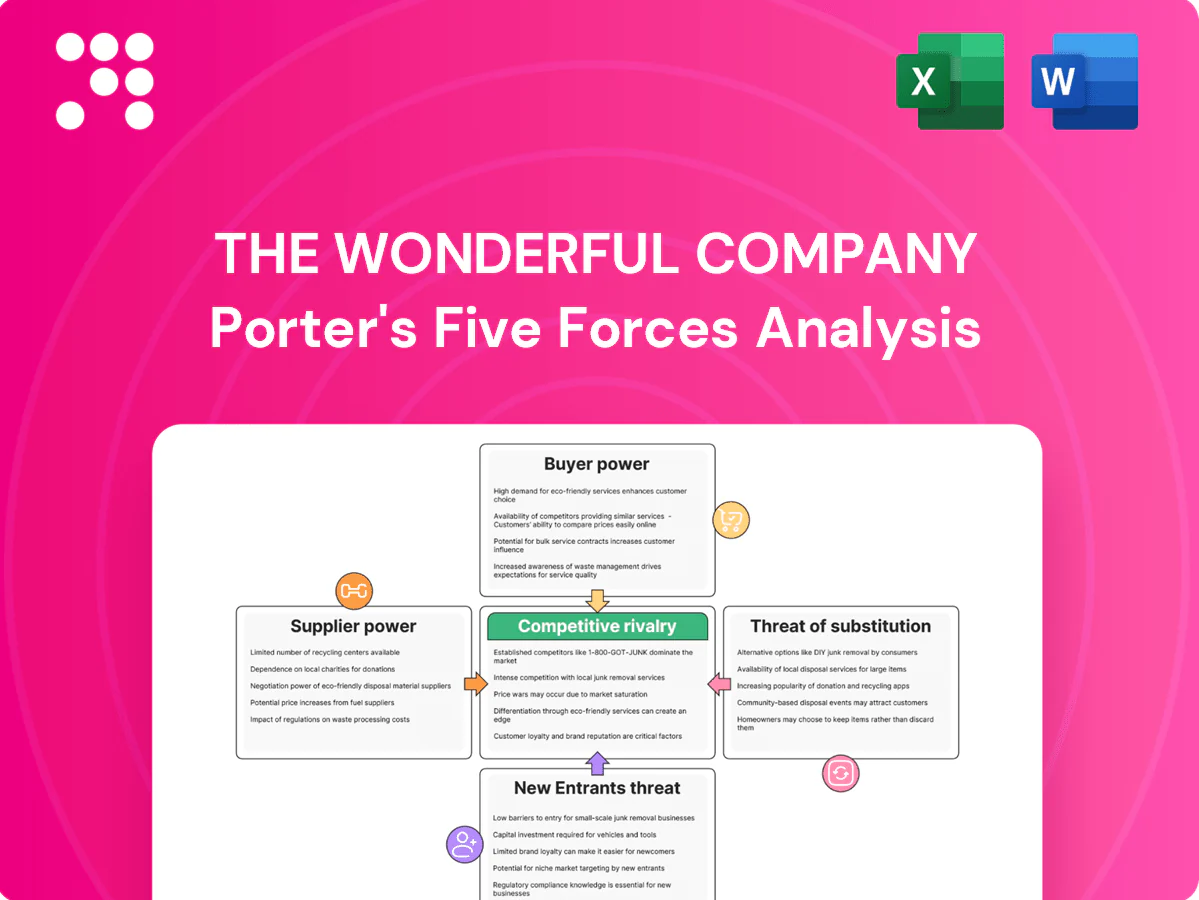
The Wonderful Company Porter's Five Forces Analysis

A Must-Have Tool for Decision-Makers
The Wonderful Company faces moderate supplier power, strong buyer expectations, and intense rivalry across branded snacks, beverages, and agriculture, while substitutes and regulatory shifts shape margins. Operational scale and brand strength mitigate some threats but capital intensity raises entry barriers. Strategic focus on innovation and supply resiliency is critical. This brief snapshot only scratches the surface. Unlock the full Porter's Five Forces Analysis to explore The Wonderful Company’s competitive dynamics, market pressures, and strategic advantages in detail.
Suppliers Bargaining Power

Extensive vertical integration reduces supplier leverage
Extensive vertical integration—ownership of pistachio, almond and citrus orchards plus processing—lowers Wonderful Companys dependence on upstream suppliers and insulates margins; the group controls over 100,000 acres of orchards and processes produce in‑house, curbing price shocks to raw crops. This control boosts quality and supply continuity across seasons and markets, though specialized inputs like packaging, labor and certain agrochemicals still create localized supplier power pockets.
Commodity inputs and ag chemicals remain price-volatile
Packaging resins, cartons, fertilizers and energy for The Wonderful Company are procured from global markets with cyclical pricing; World Bank data showed fertilizer prices down roughly 25% from 2022 peaks into 2024 while resin and pulp volatility persisted. Price spikes can compress margins despite hedging, with input cost swings eroding gross margins by several percentage points in ag-intensive peers. Concentrated chemical suppliers have passed through higher feedstock costs in 2023–24, and long-term contracts mitigate but do not eliminate exposure.

Specialized packaging and bottling equipment limit switching
FIJI Water and the company’s juice lines use proprietary square PET bottles, specific closures and inline filling machinery, limiting compatible equipment options. Qualified suppliers for such formats are relatively few, raising switching costs as tooling investments often exceed $100,000 and mold lead times typically run 8–24 weeks. Longer lead times and capital-intensive tooling give suppliers bargaining room; multisourcing mitigates but does not eliminate dependency.

Water, land, and logistics constraints influence input power
Water rights and reliable transport are scarce, region-specific inputs that give suppliers and service providers leverage; droughts and port congestion have historically shifted bargaining power, with peak wait times reaching weeks during 2021–22 spikes and intermittent 2024 delays. Premium water sourcing adds regulatory and locality complexity, while diversifying sources and routes tempers risk.
- Water rights scarcity
- Port/service provider leverage
- Regulatory complexity for premium water
- Diversification reduces exposure
Seasonal labor and compliance pressures add rigidity
Agricultural harvesting relies on seasonal labor with rising wage floors (California minimum wage $16.00/hr in 2024) and H-2A certified positions topping over 300,000 in recent years, narrowing available providers and boosting supplier power in peak seasons; mechanization and retention programs however mitigate some pressure.
Vertical integration (100,000+ acres) cuts supplier power; tooling costs and CA $16/hr tighten labor
Vertical integration (100,000+ acres) limits upstream supplier power but niche inputs—packaging tooling >$100,000 with 8–24 week lead times—create switching costs. Commodity inputs show mixed relief (fertilizer ~25% below 2022 peaks in 2024) while CA $16.00/hr and H‑2A demand >300,000 tighten labor supply, creating episodic supplier leverage.
| Input | 2024 metric | Impact |
|---|---|---|
| Orchards | 100,000+ acres | Low raw supply risk |
| Fertilizer | -25% vs 2022 | Cost relief |
| Labor | $16/hr; H‑2A >300k | Peak pressure |
What is included in the product
 Detailed Word Document
Tailored Porter’s Five Forces analysis of The Wonderful Company uncovers competitive intensity, supplier and buyer leverage, threat of substitutes and entry barriers, and highlights disruptive risks to its branded produce, nut and consumer-packaged goods businesses; includes strategic commentary on pricing power, margin protection, and defenses that sustain its market position.

 Customizable Excel Spreadsheet
A single-sheet Porter’s Five Forces snapshot for The Wonderful Company—ideal for rapid strategic decisions; customize force levels with the latest market data, swap in your own notes, and export a clean slide-ready layout for boardrooms and pitch decks.
Customers Bargaining Power

Concentrated retailers and club channels wield scale
Big-box, grocery chains and clubs command shelf space and terms—US top‑4 grocers hold roughly 55% market share and retailers like Walmart (fiscal 2024 revenue $611.3B) and Costco (fiscal 2024 net sales $261.9B) push trade spend and slotting. CPG trade promotion often equals 10–15% of revenue and private label accounts ~18% of US grocery sales in 2024, increasing negotiating pressure. Wonderful’s diverse brand portfolio (Wonderful Pistachios, Halos, POM, FIJI) helps balance account concentration risk.
Private label competes on price, tightening margins
Private label accounted for roughly 18% of US grocery dollar sales in 2024, anchoring price expectations across nuts, juices, and bottled water. Retailer brands create credible walk-away options by offering double-digit price gaps—commonly 10–30%—that tighten margins for branded suppliers. Differentiation must clearly justify any premium, and strong brand equity can resist but cannot fully ignore these price differentials.

Consumer price sensitivity varies by category
Staple items like packaged nuts and bottled water show higher price elasticity than indulgent or status products; FIJI Water and Halos sustain premiums through perceived quality, branding and convenience. Economic strain increases trade-down risk as 2024 US inflation averaged 3.4%, pressuring discretionary spend. Tactical pack-size mixes and promotions blunt elasticity by enabling downtrading without losing shoppers.

Brand recognition tempers buyer power
Iconic positioning of POM, Wonderful Pistachios and FIJI drives strong pull-through demand and gives The Wonderful Company leverage with retailers; FIJI is sold in over 100 countries (2024) and Wonderful Pistachios has national retail distribution, so retailers moderate their bargaining to avoid losing traffic. Consistent marketing funding sustains this advantage while weaker brands face tougher buyer demands.
- Brand strength: traffic-driver
- Distribution: global reach (FIJI: 100+ countries)
- Retail leverage: moderated vs weak brands
International distributors add negotiation layers
International distributors add negotiation layers for The Wonderful Company, which owns FIJI Water, POM Wonderful and Wonderful Pistachios; global channel partners control shelf access and lobby for margin share, while FX swings and local regulatory fees (import duties, labeling) are used as bargaining chips, and regional portfolio bundling (multi-brand deals) raises leverage for better terms.
- Distributor control: local shelf & logistics
- FX & duties: incremental cost pressure
- Bundling: improves distributor concessions
Top retailers own ~55% share; private label & promo spend squeeze brands
Large US retailers (top‑4 ~55% share) and chains like Walmart (FY2024 rev 611.3B) and Costco (FY2024 net sales 261.9B) wield strong negotiating leverage via slotting and trade spend (10–15% of CPG revenue). Private label (~18% of US grocery dollar sales 2024) and price gaps (10–30%) force branded margins; Wonderful’s marquee brands (FIJI 100+ countries) partially offset retailer power through traffic-driving equity.
| Metric | 2024 | Implication |
|---|---|---|
| Top‑4 grocers share | ~55% | High buyer concentration |
| Private label | ~18% | Price pressure |
| Trade promotion | 10–15% rev | Margins hit |
What You See Is What You Get
The Wonderful Company Porter's Five Forces Analysis
This preview shows the exact Porter's Five Forces analysis of The Wonderful Company you'll receive immediately after purchase—no surprises, no placeholders. The document covers supplier and buyer power, competitive rivalry, threat of substitutes and new entrants, with concise strategic implications. It's fully formatted and ready to download the moment you buy.

A Must-Have Tool for Decision-Makers
The Wonderful Company faces moderate supplier power, strong buyer expectations, and intense rivalry across branded snacks, beverages, and agriculture, while substitutes and regulatory shifts shape margins. Operational scale and brand strength mitigate some threats but capital intensity raises entry barriers. Strategic focus on innovation and supply resiliency is critical. This brief snapshot only scratches the surface. Unlock the full Porter's Five Forces Analysis to explore The Wonderful Company’s competitive dynamics, market pressures, and strategic advantages in detail.
Suppliers Bargaining Power
Extensive vertical integration reduces supplier leverage
Extensive vertical integration—ownership of pistachio, almond and citrus orchards plus processing—lowers Wonderful Companys dependence on upstream suppliers and insulates margins; the group controls over 100,000 acres of orchards and processes produce in‑house, curbing price shocks to raw crops. This control boosts quality and supply continuity across seasons and markets, though specialized inputs like packaging, labor and certain agrochemicals still create localized supplier power pockets.
Commodity inputs and ag chemicals remain price-volatile
Packaging resins, cartons, fertilizers and energy for The Wonderful Company are procured from global markets with cyclical pricing; World Bank data showed fertilizer prices down roughly 25% from 2022 peaks into 2024 while resin and pulp volatility persisted. Price spikes can compress margins despite hedging, with input cost swings eroding gross margins by several percentage points in ag-intensive peers. Concentrated chemical suppliers have passed through higher feedstock costs in 2023–24, and long-term contracts mitigate but do not eliminate exposure.
Specialized packaging and bottling equipment limit switching
FIJI Water and the company’s juice lines use proprietary square PET bottles, specific closures and inline filling machinery, limiting compatible equipment options. Qualified suppliers for such formats are relatively few, raising switching costs as tooling investments often exceed $100,000 and mold lead times typically run 8–24 weeks. Longer lead times and capital-intensive tooling give suppliers bargaining room; multisourcing mitigates but does not eliminate dependency.
Water, land, and logistics constraints influence input power
Water rights and reliable transport are scarce, region-specific inputs that give suppliers and service providers leverage; droughts and port congestion have historically shifted bargaining power, with peak wait times reaching weeks during 2021–22 spikes and intermittent 2024 delays. Premium water sourcing adds regulatory and locality complexity, while diversifying sources and routes tempers risk.
- Water rights scarcity
- Port/service provider leverage
- Regulatory complexity for premium water
- Diversification reduces exposure
Seasonal labor and compliance pressures add rigidity
Agricultural harvesting relies on seasonal labor with rising wage floors (California minimum wage $16.00/hr in 2024) and H-2A certified positions topping over 300,000 in recent years, narrowing available providers and boosting supplier power in peak seasons; mechanization and retention programs however mitigate some pressure.
Vertical integration (100,000+ acres) cuts supplier power; tooling costs and CA $16/hr tighten labor
Vertical integration (100,000+ acres) limits upstream supplier power but niche inputs—packaging tooling >$100,000 with 8–24 week lead times—create switching costs. Commodity inputs show mixed relief (fertilizer ~25% below 2022 peaks in 2024) while CA $16.00/hr and H‑2A demand >300,000 tighten labor supply, creating episodic supplier leverage.
| Input | 2024 metric | Impact |
|---|---|---|
| Orchards | 100,000+ acres | Low raw supply risk |
| Fertilizer | -25% vs 2022 | Cost relief |
| Labor | $16/hr; H‑2A >300k | Peak pressure |
What is included in the product
Detailed Word Document
Tailored Porter’s Five Forces analysis of The Wonderful Company uncovers competitive intensity, supplier and buyer leverage, threat of substitutes and entry barriers, and highlights disruptive risks to its branded produce, nut and consumer-packaged goods businesses; includes strategic commentary on pricing power, margin protection, and defenses that sustain its market position.
Customizable Excel Spreadsheet
A single-sheet Porter’s Five Forces snapshot for The Wonderful Company—ideal for rapid strategic decisions; customize force levels with the latest market data, swap in your own notes, and export a clean slide-ready layout for boardrooms and pitch decks.
Customers Bargaining Power
Concentrated retailers and club channels wield scale
Big-box, grocery chains and clubs command shelf space and terms—US top‑4 grocers hold roughly 55% market share and retailers like Walmart (fiscal 2024 revenue $611.3B) and Costco (fiscal 2024 net sales $261.9B) push trade spend and slotting. CPG trade promotion often equals 10–15% of revenue and private label accounts ~18% of US grocery sales in 2024, increasing negotiating pressure. Wonderful’s diverse brand portfolio (Wonderful Pistachios, Halos, POM, FIJI) helps balance account concentration risk.
Private label competes on price, tightening margins
Private label accounted for roughly 18% of US grocery dollar sales in 2024, anchoring price expectations across nuts, juices, and bottled water. Retailer brands create credible walk-away options by offering double-digit price gaps—commonly 10–30%—that tighten margins for branded suppliers. Differentiation must clearly justify any premium, and strong brand equity can resist but cannot fully ignore these price differentials.
Consumer price sensitivity varies by category
Staple items like packaged nuts and bottled water show higher price elasticity than indulgent or status products; FIJI Water and Halos sustain premiums through perceived quality, branding and convenience. Economic strain increases trade-down risk as 2024 US inflation averaged 3.4%, pressuring discretionary spend. Tactical pack-size mixes and promotions blunt elasticity by enabling downtrading without losing shoppers.
Brand recognition tempers buyer power
Iconic positioning of POM, Wonderful Pistachios and FIJI drives strong pull-through demand and gives The Wonderful Company leverage with retailers; FIJI is sold in over 100 countries (2024) and Wonderful Pistachios has national retail distribution, so retailers moderate their bargaining to avoid losing traffic. Consistent marketing funding sustains this advantage while weaker brands face tougher buyer demands.
- Brand strength: traffic-driver
- Distribution: global reach (FIJI: 100+ countries)
- Retail leverage: moderated vs weak brands
International distributors add negotiation layers
International distributors add negotiation layers for The Wonderful Company, which owns FIJI Water, POM Wonderful and Wonderful Pistachios; global channel partners control shelf access and lobby for margin share, while FX swings and local regulatory fees (import duties, labeling) are used as bargaining chips, and regional portfolio bundling (multi-brand deals) raises leverage for better terms.
- Distributor control: local shelf & logistics
- FX & duties: incremental cost pressure
- Bundling: improves distributor concessions
Top retailers own ~55% share; private label & promo spend squeeze brands
Large US retailers (top‑4 ~55% share) and chains like Walmart (FY2024 rev 611.3B) and Costco (FY2024 net sales 261.9B) wield strong negotiating leverage via slotting and trade spend (10–15% of CPG revenue). Private label (~18% of US grocery dollar sales 2024) and price gaps (10–30%) force branded margins; Wonderful’s marquee brands (FIJI 100+ countries) partially offset retailer power through traffic-driving equity.
| Metric | 2024 | Implication |
|---|---|---|
| Top‑4 grocers share | ~55% | High buyer concentration |
| Private label | ~18% | Price pressure |
| Trade promotion | 10–15% rev | Margins hit |
What You See Is What You Get
The Wonderful Company Porter's Five Forces Analysis
This preview shows the exact Porter's Five Forces analysis of The Wonderful Company you'll receive immediately after purchase—no surprises, no placeholders. The document covers supplier and buyer power, competitive rivalry, threat of substitutes and new entrants, with concise strategic implications. It's fully formatted and ready to download the moment you buy.
Description
A Must-Have Tool for Decision-Makers
The Wonderful Company faces moderate supplier power, strong buyer expectations, and intense rivalry across branded snacks, beverages, and agriculture, while substitutes and regulatory shifts shape margins. Operational scale and brand strength mitigate some threats but capital intensity raises entry barriers. Strategic focus on innovation and supply resiliency is critical. This brief snapshot only scratches the surface. Unlock the full Porter's Five Forces Analysis to explore The Wonderful Company’s competitive dynamics, market pressures, and strategic advantages in detail.
Suppliers Bargaining Power
Extensive vertical integration reduces supplier leverage
Extensive vertical integration—ownership of pistachio, almond and citrus orchards plus processing—lowers Wonderful Companys dependence on upstream suppliers and insulates margins; the group controls over 100,000 acres of orchards and processes produce in‑house, curbing price shocks to raw crops. This control boosts quality and supply continuity across seasons and markets, though specialized inputs like packaging, labor and certain agrochemicals still create localized supplier power pockets.
Commodity inputs and ag chemicals remain price-volatile
Packaging resins, cartons, fertilizers and energy for The Wonderful Company are procured from global markets with cyclical pricing; World Bank data showed fertilizer prices down roughly 25% from 2022 peaks into 2024 while resin and pulp volatility persisted. Price spikes can compress margins despite hedging, with input cost swings eroding gross margins by several percentage points in ag-intensive peers. Concentrated chemical suppliers have passed through higher feedstock costs in 2023–24, and long-term contracts mitigate but do not eliminate exposure.
Specialized packaging and bottling equipment limit switching
FIJI Water and the company’s juice lines use proprietary square PET bottles, specific closures and inline filling machinery, limiting compatible equipment options. Qualified suppliers for such formats are relatively few, raising switching costs as tooling investments often exceed $100,000 and mold lead times typically run 8–24 weeks. Longer lead times and capital-intensive tooling give suppliers bargaining room; multisourcing mitigates but does not eliminate dependency.
Water, land, and logistics constraints influence input power
Water rights and reliable transport are scarce, region-specific inputs that give suppliers and service providers leverage; droughts and port congestion have historically shifted bargaining power, with peak wait times reaching weeks during 2021–22 spikes and intermittent 2024 delays. Premium water sourcing adds regulatory and locality complexity, while diversifying sources and routes tempers risk.
- Water rights scarcity
- Port/service provider leverage
- Regulatory complexity for premium water
- Diversification reduces exposure
Seasonal labor and compliance pressures add rigidity
Agricultural harvesting relies on seasonal labor with rising wage floors (California minimum wage $16.00/hr in 2024) and H-2A certified positions topping over 300,000 in recent years, narrowing available providers and boosting supplier power in peak seasons; mechanization and retention programs however mitigate some pressure.
Vertical integration (100,000+ acres) cuts supplier power; tooling costs and CA $16/hr tighten labor
Vertical integration (100,000+ acres) limits upstream supplier power but niche inputs—packaging tooling >$100,000 with 8–24 week lead times—create switching costs. Commodity inputs show mixed relief (fertilizer ~25% below 2022 peaks in 2024) while CA $16.00/hr and H‑2A demand >300,000 tighten labor supply, creating episodic supplier leverage.
| Input | 2024 metric | Impact |
|---|---|---|
| Orchards | 100,000+ acres | Low raw supply risk |
| Fertilizer | -25% vs 2022 | Cost relief |
| Labor | $16/hr; H‑2A >300k | Peak pressure |
What is included in the product
Detailed Word Document
Tailored Porter’s Five Forces analysis of The Wonderful Company uncovers competitive intensity, supplier and buyer leverage, threat of substitutes and entry barriers, and highlights disruptive risks to its branded produce, nut and consumer-packaged goods businesses; includes strategic commentary on pricing power, margin protection, and defenses that sustain its market position.
Customizable Excel Spreadsheet
A single-sheet Porter’s Five Forces snapshot for The Wonderful Company—ideal for rapid strategic decisions; customize force levels with the latest market data, swap in your own notes, and export a clean slide-ready layout for boardrooms and pitch decks.
Customers Bargaining Power
Concentrated retailers and club channels wield scale
Big-box, grocery chains and clubs command shelf space and terms—US top‑4 grocers hold roughly 55% market share and retailers like Walmart (fiscal 2024 revenue $611.3B) and Costco (fiscal 2024 net sales $261.9B) push trade spend and slotting. CPG trade promotion often equals 10–15% of revenue and private label accounts ~18% of US grocery sales in 2024, increasing negotiating pressure. Wonderful’s diverse brand portfolio (Wonderful Pistachios, Halos, POM, FIJI) helps balance account concentration risk.
Private label competes on price, tightening margins
Private label accounted for roughly 18% of US grocery dollar sales in 2024, anchoring price expectations across nuts, juices, and bottled water. Retailer brands create credible walk-away options by offering double-digit price gaps—commonly 10–30%—that tighten margins for branded suppliers. Differentiation must clearly justify any premium, and strong brand equity can resist but cannot fully ignore these price differentials.
Consumer price sensitivity varies by category
Staple items like packaged nuts and bottled water show higher price elasticity than indulgent or status products; FIJI Water and Halos sustain premiums through perceived quality, branding and convenience. Economic strain increases trade-down risk as 2024 US inflation averaged 3.4%, pressuring discretionary spend. Tactical pack-size mixes and promotions blunt elasticity by enabling downtrading without losing shoppers.
Brand recognition tempers buyer power
Iconic positioning of POM, Wonderful Pistachios and FIJI drives strong pull-through demand and gives The Wonderful Company leverage with retailers; FIJI is sold in over 100 countries (2024) and Wonderful Pistachios has national retail distribution, so retailers moderate their bargaining to avoid losing traffic. Consistent marketing funding sustains this advantage while weaker brands face tougher buyer demands.
- Brand strength: traffic-driver
- Distribution: global reach (FIJI: 100+ countries)
- Retail leverage: moderated vs weak brands
International distributors add negotiation layers
International distributors add negotiation layers for The Wonderful Company, which owns FIJI Water, POM Wonderful and Wonderful Pistachios; global channel partners control shelf access and lobby for margin share, while FX swings and local regulatory fees (import duties, labeling) are used as bargaining chips, and regional portfolio bundling (multi-brand deals) raises leverage for better terms.
- Distributor control: local shelf & logistics
- FX & duties: incremental cost pressure
- Bundling: improves distributor concessions
Top retailers own ~55% share; private label & promo spend squeeze brands
Large US retailers (top‑4 ~55% share) and chains like Walmart (FY2024 rev 611.3B) and Costco (FY2024 net sales 261.9B) wield strong negotiating leverage via slotting and trade spend (10–15% of CPG revenue). Private label (~18% of US grocery dollar sales 2024) and price gaps (10–30%) force branded margins; Wonderful’s marquee brands (FIJI 100+ countries) partially offset retailer power through traffic-driving equity.
| Metric | 2024 | Implication |
|---|---|---|
| Top‑4 grocers share | ~55% | High buyer concentration |
| Private label | ~18% | Price pressure |
| Trade promotion | 10–15% rev | Margins hit |
What You See Is What You Get
The Wonderful Company Porter's Five Forces Analysis
This preview shows the exact Porter's Five Forces analysis of The Wonderful Company you'll receive immediately after purchase—no surprises, no placeholders. The document covers supplier and buyer power, competitive rivalry, threat of substitutes and new entrants, with concise strategic implications. It's fully formatted and ready to download the moment you buy.











