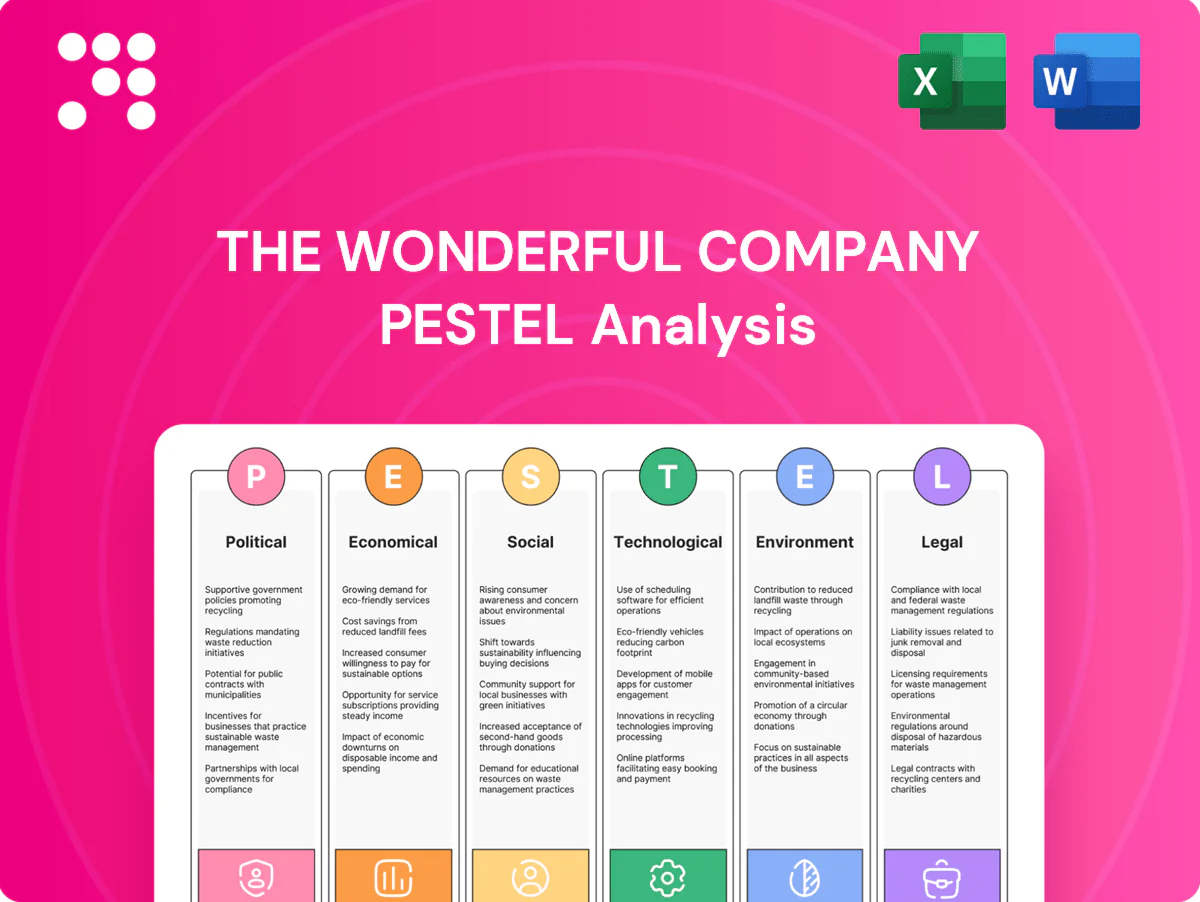
The Wonderful Company PESTLE Analysis

Plan Smarter. Present Sharper. Compete Stronger.
Gain strategic clarity with our PESTLE Analysis of The Wonderful Company. We map political, economic, social, technological, legal and environmental forces shaping growth and risks, with actionable implications for investors and planners. Purchase the full, editable report now to access deep‑dive insights and ready‑to‑use data.
Political factors

Agricultural subsidies and support programs
Eligibility for crop insurance, subsidies, and conservation programs shapes Wonderful's cost structure and risk transfer, with federal crop insurance indemnities topping $14 billion in 2023 and the 2018 farm bill authorizing about 867 billion USD over 10 years; shifts in farm bill priorities can reallocate support across nuts, citrus, and specialty crops. Wonderful must align planting and practices to maximize program fit; reduced support would raise operating volatility and capital needs.
Trade policy and tariffs on food exports
Tariff regimes—global average applied MFN agricultural tariff around 10%—directly affect demand for Wonderful Company staples like nuts, wine and juices by changing landed prices and competitiveness. Retaliatory tariffs and non-tariff barriers have historically reduced margins and rerouted volumes, forcing supply shifts; US agricultural exports totaled about $178 billion in 2022, underscoring trade exposure. Diversifying markets and hedging trade exposure are critical, and active policy engagement helps anticipate market-access changes.

Water allocation and regional governance
Water rights and allocations in California and Arizona directly shape The Wonderful Companys yields and planting choices, as California agriculture consumes about 40% of developed water and SGMA requires basins to achieve sustainability by 2040. Political decisions on groundwater management and surface allocations can constrain expansion and force crop shifts. Securing long-term water rights and investing in drip/precision irrigation reduces exposure. Strong community relations improve permitting and siting outcomes.

Labor and immigration policy
Field operations at The Wonderful Company rely on seasonal and skilled labor; US H-2A certifications rose to about 370,000 in FY2024, tightening markets and pushing farm labor costs up roughly 6% YoY in 2023–24, which raises production cost and reliability risks. Stricter immigration enforcement or visa changes can spike absenteeism; compliance and worker-welfare programs (higher housing, safety spend) stabilize supply. As labor tightens, mechanization and automation investment priorities increase to reduce dependency.
- H-2A ~370,000 (FY2024)
- Farm labor cost +6% YoY (2023–24)
- Compliance/welfare programs reduce turnover
- Mechanization capex rises as contingency
Geopolitical stability in sourcing and brand geographies
Operations tied to specific locales face political risk—regulatory shifts and civil unrest can disrupt supply; the global bottled water market surpassed $300 billion in 2023 (Statista), making host-country policies material for export brands. California drought emergency measures in 2021–22 illustrate local regulatory impact on sourcing. Scenario planning and localized stakeholder engagement reduce disruption, while insurance and multi-source strategies add resilience.
- Locale risk: regulatory shifts, civil unrest
- Bottled water sensitivity: >$300B global market (2023)
- Mitigation: scenario planning, local engagement
- Resilience: insurance, multi-source sourcing
SGMA 2040 plus policy cuts and H-2A shortages squeeze margins
Policy on crop insurance, farm-bill funding (≈$867B/10y) and tariffs (US ag exports $178B in 2022) directly affect Wonderfuls margins and market access; reduced supports raise volatility. Water laws (SGMA 2040) and regional allocations constrain acreage and capex. Labor scarcity (H-2A ≈370,000 FY2024; farm labor +6% YoY) pushes mechanization.
| Factor | Metric | Impact |
|---|---|---|
| Subsidies | $14B indemnities (2023) | Cost/risk buffer |
| Water | SGMA 2040 | Limits expansion |
| Labor | H-2A 370k | Higher capex |
What is included in the product
 Detailed Word Document
Explores how macro-environmental forces uniquely affect The Wonderful Company across Political, Economic, Social, Technological, Environmental and Legal dimensions, with data-driven insights and forward-looking implications to identify threats and opportunities for executives, investors and strategists.

 Customizable Excel Spreadsheet
Concise, visually segmented PESTLE summary of The Wonderful Company for quick meeting use—easy to drop into slides, share across teams, and annotate with region- or business-specific notes to streamline strategic discussions.
Economic factors

Commodity price and input cost volatility
Fertilizer, energy, packaging and freight swings remain primary drivers of margin volatility for The Wonderful Company, with fertilizer and energy costs falling from 2022 peaks through 2024 but still prone to sharp reversals. Long crop cycles in almonds, pistachios and citrus limit rapid supply response, extending price sensitivity across seasons. The company uses forward contracts and vertical integration across processing and logistics to buffer input shocks. Strong consumer brands and pricing power support effective pass-through to retailers and consumers.
Consumer spending and premiumization
Macroeconomic cycles materially affect demand for Wonderful Company’s premium nuts, wines and imported water: premium snack sales grew about 5% in 2023 while discretionary drink/spirit segments rebounded after 2022 weakness, making trade-down risk higher in downturns and pressuring mix and velocity. Portfolio balance across price tiers cushions impacts, and targeted promotions—often 10–15% off on core SKUs—help protect share while preserving brand equity.

Foreign exchange exposure
The Wonderful Company’s global brands (FIJI Water, Wonderful Pistachios, Halos, POM) create material foreign exchange exposure as international revenue and imported inputs expose margins to USD moves; the US dollar surged roughly 20% on the DXY from 2021–2022, dampening overseas sales and tourist demand for premium products. Hedging programs and local‑currency retail pricing are used to offset volatility, while supply contracts denominated in matched currencies reduce basis risk.

Logistics and transportation economics
Ocean freight spot rates normalized in 2024 (~$1,200/FEU) while US diesel averaged $4.03/gal, squeezing delivered margins; limited trucking capacity and rising fuel push landed costs higher. Port congestion (LA/LB dwell ~3.5 days in 2024) and carrier reliability force larger inventory buffers. Nearshoring and multimodal flexibility (Mexico share of US imports ~16% by 2024) cut lead times and costs, and demand-planning investments can lower expedites by ~15–20%.
- Ocean freight: ~$1,200/FEU (2024)
- Diesel: $4.03/gal (US avg, 2024)
- Port dwell: ~3.5 days (LA/LB, 2024)
- Mexico import share: ~16% (2024)
- Expedite reduction from planning: 15–20%
Interest rates and capital intensity
SGMA 2040 plus policy cuts and H-2A shortages squeeze margins
Fertilizer, energy, packaging and freight drive margin volatility despite declines from 2022 peaks; forward contracts and vertical integration blunt shocks. Long almond/pistachio/citrus cycles limit supply response, keeping price sensitivity. Premium mix cushions demand swings; fed funds ~5.25–5.50% (end‑2024) raises capex hurdle rates.
| Metric | 2024 |
|---|---|
| Ocean freight | $1,200/FEU |
| Diesel (US avg) | $4.03/gal |
| Port dwell (LA/LB) | 3.5 days |
| Fed funds | 5.25–5.50% |
Same Document Delivered
The Wonderful Company PESTLE Analysis
The Wonderful Company PESTLE Analysis preview shown here is the exact document you’ll receive after purchase—fully formatted and ready to use. This real screenshot reflects the final file’s layout, content, and structure with no placeholders or surprises. After payment you’ll instantly download the same professionally structured analysis of The Wonderful Company.

Plan Smarter. Present Sharper. Compete Stronger.
Gain strategic clarity with our PESTLE Analysis of The Wonderful Company. We map political, economic, social, technological, legal and environmental forces shaping growth and risks, with actionable implications for investors and planners. Purchase the full, editable report now to access deep‑dive insights and ready‑to‑use data.
Political factors
Agricultural subsidies and support programs
Eligibility for crop insurance, subsidies, and conservation programs shapes Wonderful's cost structure and risk transfer, with federal crop insurance indemnities topping $14 billion in 2023 and the 2018 farm bill authorizing about 867 billion USD over 10 years; shifts in farm bill priorities can reallocate support across nuts, citrus, and specialty crops. Wonderful must align planting and practices to maximize program fit; reduced support would raise operating volatility and capital needs.
Trade policy and tariffs on food exports
Tariff regimes—global average applied MFN agricultural tariff around 10%—directly affect demand for Wonderful Company staples like nuts, wine and juices by changing landed prices and competitiveness. Retaliatory tariffs and non-tariff barriers have historically reduced margins and rerouted volumes, forcing supply shifts; US agricultural exports totaled about $178 billion in 2022, underscoring trade exposure. Diversifying markets and hedging trade exposure are critical, and active policy engagement helps anticipate market-access changes.
Water allocation and regional governance
Water rights and allocations in California and Arizona directly shape The Wonderful Companys yields and planting choices, as California agriculture consumes about 40% of developed water and SGMA requires basins to achieve sustainability by 2040. Political decisions on groundwater management and surface allocations can constrain expansion and force crop shifts. Securing long-term water rights and investing in drip/precision irrigation reduces exposure. Strong community relations improve permitting and siting outcomes.
Labor and immigration policy
Field operations at The Wonderful Company rely on seasonal and skilled labor; US H-2A certifications rose to about 370,000 in FY2024, tightening markets and pushing farm labor costs up roughly 6% YoY in 2023–24, which raises production cost and reliability risks. Stricter immigration enforcement or visa changes can spike absenteeism; compliance and worker-welfare programs (higher housing, safety spend) stabilize supply. As labor tightens, mechanization and automation investment priorities increase to reduce dependency.
- H-2A ~370,000 (FY2024)
- Farm labor cost +6% YoY (2023–24)
- Compliance/welfare programs reduce turnover
- Mechanization capex rises as contingency
Geopolitical stability in sourcing and brand geographies
Operations tied to specific locales face political risk—regulatory shifts and civil unrest can disrupt supply; the global bottled water market surpassed $300 billion in 2023 (Statista), making host-country policies material for export brands. California drought emergency measures in 2021–22 illustrate local regulatory impact on sourcing. Scenario planning and localized stakeholder engagement reduce disruption, while insurance and multi-source strategies add resilience.
- Locale risk: regulatory shifts, civil unrest
- Bottled water sensitivity: >$300B global market (2023)
- Mitigation: scenario planning, local engagement
- Resilience: insurance, multi-source sourcing
SGMA 2040 plus policy cuts and H-2A shortages squeeze margins
Policy on crop insurance, farm-bill funding (≈$867B/10y) and tariffs (US ag exports $178B in 2022) directly affect Wonderfuls margins and market access; reduced supports raise volatility. Water laws (SGMA 2040) and regional allocations constrain acreage and capex. Labor scarcity (H-2A ≈370,000 FY2024; farm labor +6% YoY) pushes mechanization.
| Factor | Metric | Impact |
|---|---|---|
| Subsidies | $14B indemnities (2023) | Cost/risk buffer |
| Water | SGMA 2040 | Limits expansion |
| Labor | H-2A 370k | Higher capex |
What is included in the product
Detailed Word Document
Explores how macro-environmental forces uniquely affect The Wonderful Company across Political, Economic, Social, Technological, Environmental and Legal dimensions, with data-driven insights and forward-looking implications to identify threats and opportunities for executives, investors and strategists.
Customizable Excel Spreadsheet
Concise, visually segmented PESTLE summary of The Wonderful Company for quick meeting use—easy to drop into slides, share across teams, and annotate with region- or business-specific notes to streamline strategic discussions.
Economic factors
Commodity price and input cost volatility
Fertilizer, energy, packaging and freight swings remain primary drivers of margin volatility for The Wonderful Company, with fertilizer and energy costs falling from 2022 peaks through 2024 but still prone to sharp reversals. Long crop cycles in almonds, pistachios and citrus limit rapid supply response, extending price sensitivity across seasons. The company uses forward contracts and vertical integration across processing and logistics to buffer input shocks. Strong consumer brands and pricing power support effective pass-through to retailers and consumers.
Consumer spending and premiumization
Macroeconomic cycles materially affect demand for Wonderful Company’s premium nuts, wines and imported water: premium snack sales grew about 5% in 2023 while discretionary drink/spirit segments rebounded after 2022 weakness, making trade-down risk higher in downturns and pressuring mix and velocity. Portfolio balance across price tiers cushions impacts, and targeted promotions—often 10–15% off on core SKUs—help protect share while preserving brand equity.
Foreign exchange exposure
The Wonderful Company’s global brands (FIJI Water, Wonderful Pistachios, Halos, POM) create material foreign exchange exposure as international revenue and imported inputs expose margins to USD moves; the US dollar surged roughly 20% on the DXY from 2021–2022, dampening overseas sales and tourist demand for premium products. Hedging programs and local‑currency retail pricing are used to offset volatility, while supply contracts denominated in matched currencies reduce basis risk.
Logistics and transportation economics
Ocean freight spot rates normalized in 2024 (~$1,200/FEU) while US diesel averaged $4.03/gal, squeezing delivered margins; limited trucking capacity and rising fuel push landed costs higher. Port congestion (LA/LB dwell ~3.5 days in 2024) and carrier reliability force larger inventory buffers. Nearshoring and multimodal flexibility (Mexico share of US imports ~16% by 2024) cut lead times and costs, and demand-planning investments can lower expedites by ~15–20%.
- Ocean freight: ~$1,200/FEU (2024)
- Diesel: $4.03/gal (US avg, 2024)
- Port dwell: ~3.5 days (LA/LB, 2024)
- Mexico import share: ~16% (2024)
- Expedite reduction from planning: 15–20%
Interest rates and capital intensity
SGMA 2040 plus policy cuts and H-2A shortages squeeze margins
Fertilizer, energy, packaging and freight drive margin volatility despite declines from 2022 peaks; forward contracts and vertical integration blunt shocks. Long almond/pistachio/citrus cycles limit supply response, keeping price sensitivity. Premium mix cushions demand swings; fed funds ~5.25–5.50% (end‑2024) raises capex hurdle rates.
| Metric | 2024 |
|---|---|
| Ocean freight | $1,200/FEU |
| Diesel (US avg) | $4.03/gal |
| Port dwell (LA/LB) | 3.5 days |
| Fed funds | 5.25–5.50% |
Same Document Delivered
The Wonderful Company PESTLE Analysis
The Wonderful Company PESTLE Analysis preview shown here is the exact document you’ll receive after purchase—fully formatted and ready to use. This real screenshot reflects the final file’s layout, content, and structure with no placeholders or surprises. After payment you’ll instantly download the same professionally structured analysis of The Wonderful Company.
Description
Plan Smarter. Present Sharper. Compete Stronger.
Gain strategic clarity with our PESTLE Analysis of The Wonderful Company. We map political, economic, social, technological, legal and environmental forces shaping growth and risks, with actionable implications for investors and planners. Purchase the full, editable report now to access deep‑dive insights and ready‑to‑use data.
Political factors
Agricultural subsidies and support programs
Eligibility for crop insurance, subsidies, and conservation programs shapes Wonderful's cost structure and risk transfer, with federal crop insurance indemnities topping $14 billion in 2023 and the 2018 farm bill authorizing about 867 billion USD over 10 years; shifts in farm bill priorities can reallocate support across nuts, citrus, and specialty crops. Wonderful must align planting and practices to maximize program fit; reduced support would raise operating volatility and capital needs.
Trade policy and tariffs on food exports
Tariff regimes—global average applied MFN agricultural tariff around 10%—directly affect demand for Wonderful Company staples like nuts, wine and juices by changing landed prices and competitiveness. Retaliatory tariffs and non-tariff barriers have historically reduced margins and rerouted volumes, forcing supply shifts; US agricultural exports totaled about $178 billion in 2022, underscoring trade exposure. Diversifying markets and hedging trade exposure are critical, and active policy engagement helps anticipate market-access changes.
Water allocation and regional governance
Water rights and allocations in California and Arizona directly shape The Wonderful Companys yields and planting choices, as California agriculture consumes about 40% of developed water and SGMA requires basins to achieve sustainability by 2040. Political decisions on groundwater management and surface allocations can constrain expansion and force crop shifts. Securing long-term water rights and investing in drip/precision irrigation reduces exposure. Strong community relations improve permitting and siting outcomes.
Labor and immigration policy
Field operations at The Wonderful Company rely on seasonal and skilled labor; US H-2A certifications rose to about 370,000 in FY2024, tightening markets and pushing farm labor costs up roughly 6% YoY in 2023–24, which raises production cost and reliability risks. Stricter immigration enforcement or visa changes can spike absenteeism; compliance and worker-welfare programs (higher housing, safety spend) stabilize supply. As labor tightens, mechanization and automation investment priorities increase to reduce dependency.
- H-2A ~370,000 (FY2024)
- Farm labor cost +6% YoY (2023–24)
- Compliance/welfare programs reduce turnover
- Mechanization capex rises as contingency
Geopolitical stability in sourcing and brand geographies
Operations tied to specific locales face political risk—regulatory shifts and civil unrest can disrupt supply; the global bottled water market surpassed $300 billion in 2023 (Statista), making host-country policies material for export brands. California drought emergency measures in 2021–22 illustrate local regulatory impact on sourcing. Scenario planning and localized stakeholder engagement reduce disruption, while insurance and multi-source strategies add resilience.
- Locale risk: regulatory shifts, civil unrest
- Bottled water sensitivity: >$300B global market (2023)
- Mitigation: scenario planning, local engagement
- Resilience: insurance, multi-source sourcing
SGMA 2040 plus policy cuts and H-2A shortages squeeze margins
Policy on crop insurance, farm-bill funding (≈$867B/10y) and tariffs (US ag exports $178B in 2022) directly affect Wonderfuls margins and market access; reduced supports raise volatility. Water laws (SGMA 2040) and regional allocations constrain acreage and capex. Labor scarcity (H-2A ≈370,000 FY2024; farm labor +6% YoY) pushes mechanization.
| Factor | Metric | Impact |
|---|---|---|
| Subsidies | $14B indemnities (2023) | Cost/risk buffer |
| Water | SGMA 2040 | Limits expansion |
| Labor | H-2A 370k | Higher capex |
What is included in the product
Detailed Word Document
Explores how macro-environmental forces uniquely affect The Wonderful Company across Political, Economic, Social, Technological, Environmental and Legal dimensions, with data-driven insights and forward-looking implications to identify threats and opportunities for executives, investors and strategists.
Customizable Excel Spreadsheet
Concise, visually segmented PESTLE summary of The Wonderful Company for quick meeting use—easy to drop into slides, share across teams, and annotate with region- or business-specific notes to streamline strategic discussions.
Economic factors
Commodity price and input cost volatility
Fertilizer, energy, packaging and freight swings remain primary drivers of margin volatility for The Wonderful Company, with fertilizer and energy costs falling from 2022 peaks through 2024 but still prone to sharp reversals. Long crop cycles in almonds, pistachios and citrus limit rapid supply response, extending price sensitivity across seasons. The company uses forward contracts and vertical integration across processing and logistics to buffer input shocks. Strong consumer brands and pricing power support effective pass-through to retailers and consumers.
Consumer spending and premiumization
Macroeconomic cycles materially affect demand for Wonderful Company’s premium nuts, wines and imported water: premium snack sales grew about 5% in 2023 while discretionary drink/spirit segments rebounded after 2022 weakness, making trade-down risk higher in downturns and pressuring mix and velocity. Portfolio balance across price tiers cushions impacts, and targeted promotions—often 10–15% off on core SKUs—help protect share while preserving brand equity.
Foreign exchange exposure
The Wonderful Company’s global brands (FIJI Water, Wonderful Pistachios, Halos, POM) create material foreign exchange exposure as international revenue and imported inputs expose margins to USD moves; the US dollar surged roughly 20% on the DXY from 2021–2022, dampening overseas sales and tourist demand for premium products. Hedging programs and local‑currency retail pricing are used to offset volatility, while supply contracts denominated in matched currencies reduce basis risk.
Logistics and transportation economics
Ocean freight spot rates normalized in 2024 (~$1,200/FEU) while US diesel averaged $4.03/gal, squeezing delivered margins; limited trucking capacity and rising fuel push landed costs higher. Port congestion (LA/LB dwell ~3.5 days in 2024) and carrier reliability force larger inventory buffers. Nearshoring and multimodal flexibility (Mexico share of US imports ~16% by 2024) cut lead times and costs, and demand-planning investments can lower expedites by ~15–20%.
- Ocean freight: ~$1,200/FEU (2024)
- Diesel: $4.03/gal (US avg, 2024)
- Port dwell: ~3.5 days (LA/LB, 2024)
- Mexico import share: ~16% (2024)
- Expedite reduction from planning: 15–20%
Interest rates and capital intensity
SGMA 2040 plus policy cuts and H-2A shortages squeeze margins
Fertilizer, energy, packaging and freight drive margin volatility despite declines from 2022 peaks; forward contracts and vertical integration blunt shocks. Long almond/pistachio/citrus cycles limit supply response, keeping price sensitivity. Premium mix cushions demand swings; fed funds ~5.25–5.50% (end‑2024) raises capex hurdle rates.
| Metric | 2024 |
|---|---|
| Ocean freight | $1,200/FEU |
| Diesel (US avg) | $4.03/gal |
| Port dwell (LA/LB) | 3.5 days |
| Fed funds | 5.25–5.50% |
Same Document Delivered
The Wonderful Company PESTLE Analysis
The Wonderful Company PESTLE Analysis preview shown here is the exact document you’ll receive after purchase—fully formatted and ready to use. This real screenshot reflects the final file’s layout, content, and structure with no placeholders or surprises. After payment you’ll instantly download the same professionally structured analysis of The Wonderful Company.











