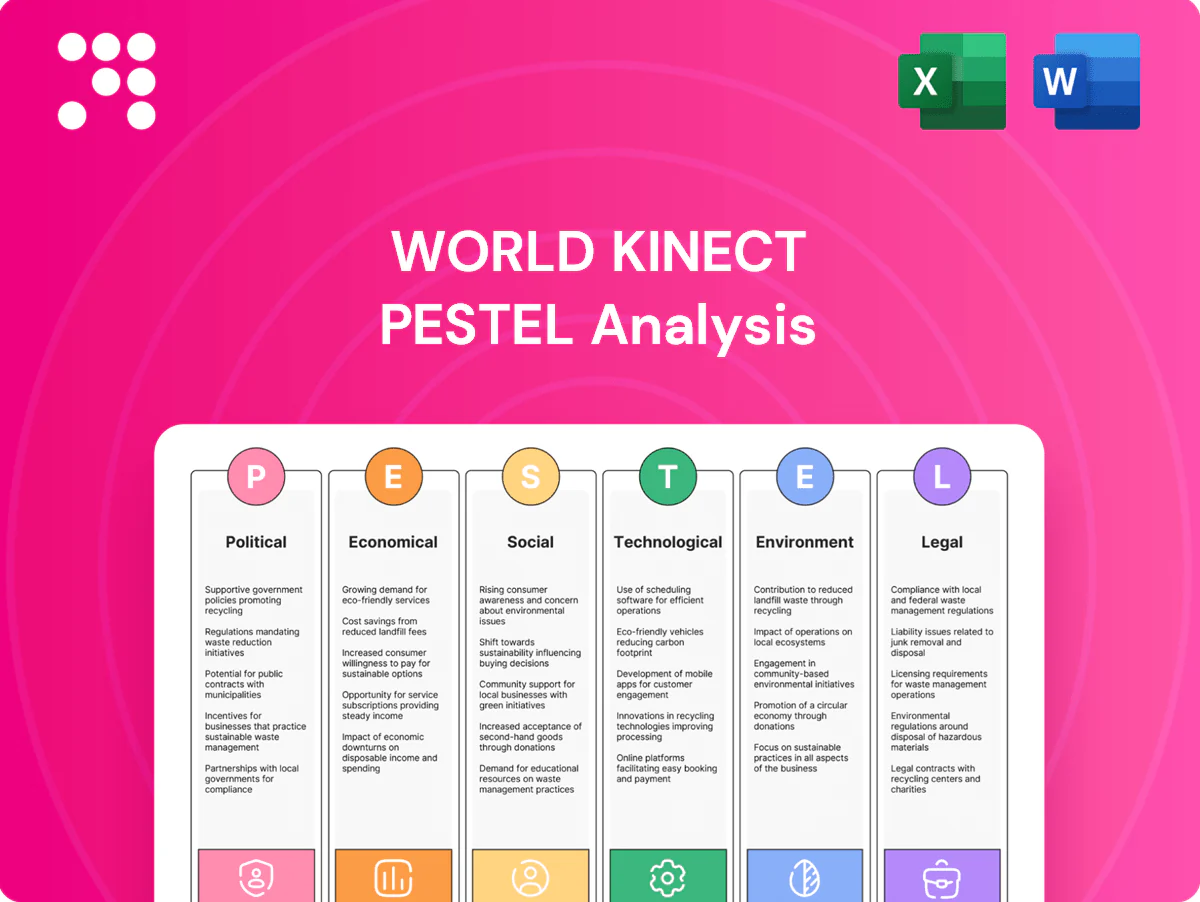
World Kinect PESTLE Analysis

Plan Smarter. Present Sharper. Compete Stronger.
Unlock how political shifts, economic cycles, social trends, and tech disruption shape World Kinect’s strategic outlook with our concise PESTLE snapshot—designed for investors and strategists who need clarity fast. Purchase the full analysis to access detailed risks, opportunities, and actionable recommendations ready for immediate use.
Political factors

Geopolitical volatility
Conflicts, sanctions and trade tensions disrupt fuel flows and raise costs, with seaborne trade carrying roughly 80% of world merchandise volume (UNCTAD). Route closures and port restrictions create delivery uncertainty across aviation, marine and land networks, spiking spot fuel premiums during regional disruptions by up to 15–20%. World Kinect must diversify sourcing and maintain contingency logistics. Political risk insurance and scenario planning help stabilize margins.
Energy policy shifts
Government energy security and transition priorities drive demand and incentives for World Kinect; IMF estimated global fossil-fuel subsidies at about $7 trillion in 2022, skewing markets. Subsidies, tax credits and mandates can accelerate SAF and lower-carbon fuel uptake, where SAF made under 0.1% of aviation fuel in 2022. Rapid policy reversals risk stranded inventories or assets. Active policy monitoring enables pricing, inventory and contract flexibility.

International coordination
ICAO’s CORSIA seeks carbon-neutral growth from 2020 while IMO’s GHG strategy targets at least a 50% reduction in shipping emissions by 2050 versus 2008; regional rules such as the EU Fit for 55 package (including FuelEU Maritime and ETS reforms adopted 2023) add stricter timelines. Alignment between these bodies smooths compliance and product-mix planning across borders; fragmentation raises operational and regulatory costs. Active advocacy helps World Kinect anticipate technical specs, certification and rollout schedules.

Trade and tariff regimes
Tariffs and quotas on refined products and components materially raise landed costs and logistics complexity, with many FTAs now eliminating duties on 80–99% of tariff lines, expanding low‑cost sourcing lanes for World Kinect.
Customs delays and documentation burdens—often adding days of dwell time—inflate working capital needs and inventory carrying costs; optimized hub selection and routing mitigate tariff exposure and duty recovery.
- Tariff impact: higher landed cost; FTAs cut duties on 80–99% of lines
- Customs delays: add days of dwell time, raising working capital
- Strategy: hub selection and routing to reduce duty and quota risk
Public sector procurement
Government agency contracts demand strict compliance and auditability; OECD estimates public procurement equals about 12% of GDP, driving high audit scrutiny and documentation standards. Political budget cycles in many markets (annual or multi-year) directly affect volumes and renewal timing. Tender criteria increasingly incorporate sustainability metrics, and strong governance and reporting materially improve bid competitiveness.
- Compliance: audit trails required
- Volume: tied to annual/multi-year budgets
- Sustainability: growing tender factor
- Advantage: robust governance boosts win rates
Geopolitical shocks, policy risk fuel supply, driving 15–20% spot premiums
Conflicts, sanctions and route closures disrupt fuel flows; seaborne trade carries ~80% of merchandise (UNCTAD) and spot premiums can rise 15–20%. Government energy policies shape demand; IMF estimated $7tn fossil‑fuel subsidies in 2022 and SAF <0.1% of aviation fuel in 2022. ICAO/IMO targets (IMO: ≥50% shipping GHG cut by 2050) and public procurement (~12% GDP) drive compliance and tender dynamics.
| Risk | Key metric | Impact | Mitigation |
|---|---|---|---|
| Supply shocks | 80% seaborne | 15–20% spot premium | diverse sourcing |
| Policy | $7tn subsidies | market distortion | policy monitoring |
What is included in the product
 Detailed Word Document
Explores how macro-environmental factors uniquely impact World Kinect across Political, Economic, Social, Technological, Environmental, and Legal dimensions, with data-driven insights and industry-specific examples. Designed for executives and investors, it highlights threats, opportunities, and forward-looking scenarios ready for reports and decks.

 Customizable Excel Spreadsheet
A concise, visually segmented PESTLE summary for World Kinect that’s editable, shareable and presentation-ready—ideal for meetings, planning sessions, and client reports to streamline external risk discussion and strategic alignment.
Economic factors

Commodity price volatility
Commodity price volatility — with Brent crude swinging roughly between $70–$100/bbl in 2024 — compresses margins and raises collateral requirements for trading counterparties. Robust hedging programs dampen earnings swings but increase operational and accounting complexity. Rapid price moves make inventory valuation and timing critical to P&L. Disciplined customer pass-through pricing preserves cash flow and credit metrics.
Macro demand cycles
Aviation, marine, and industrial throughput closely follow world GDP (3.0% in 2024, IMF), trade volumes (merchandise trade +2.5% in 2024, WTO) and travel demand (air traffic ~95% of 2019 levels in 2024, IATA); recessions compress volumes quickly while recoveries drive fast rebounds; diversified sector mix smooths cycles and flexible cost structures sustain margins through downturns.

FX and interest rates
Multi-currency transactions leave World Kinect earnings exposed to FX swings; the US dollar averaged a DXY of about 103 in 2024, amplifying translation effects. Higher global policy rates (US fed funds 5.25–5.50% in 2024–25) elevate working capital costs and customer credit stress. Active treasury hedging and natural currency offsets damp volatility. Robust credit underwriting preserves margins and cash flows.

Logistics and freight costs
Customer credit health
Geopolitical shocks, policy risk fuel supply, driving 15–20% spot premiums
Commodity swings (Brent ~70–100/bbl in 2024) squeeze margins and raise collateral; hedging reduces earnings volatility but adds complexity. Volumes track GDP 3.0% (IMF 2024), trade +2.5% (WTO 2024) and air traffic ~95% of 2019 (IATA 2024). FX (DXY ~103) and policy rates (fed funds 5.25–5.50% 2024–25) lift working capital costs; airline debt ~USD 400B raises credit risk.
| Metric | Value | Source |
|---|---|---|
| Brent | 70–100 USD/bbl (2024) | Market data |
| World GDP | 3.0% (2024) | IMF |
| Trade | +2.5% (2024) | WTO |
| Air traffic | ~95% of 2019 (2024) | IATA |
| DXY | ~103 (2024) | FX markets |
| Fed funds | 5.25–5.50% (2024–25) | Fed |
| Airline debt | ~USD 400B (2024) | Sector data |
Preview the Actual Deliverable
World Kinect PESTLE Analysis
The World Kinect PESTLE Analysis preview shown here is the exact document you’ll receive after purchase—fully formatted, professionally structured, and ready to use. This is a real screenshot of the product you’re buying; no placeholders or surprises. After payment you’ll instantly download this same finished file.

Plan Smarter. Present Sharper. Compete Stronger.
Unlock how political shifts, economic cycles, social trends, and tech disruption shape World Kinect’s strategic outlook with our concise PESTLE snapshot—designed for investors and strategists who need clarity fast. Purchase the full analysis to access detailed risks, opportunities, and actionable recommendations ready for immediate use.
Political factors
Geopolitical volatility
Conflicts, sanctions and trade tensions disrupt fuel flows and raise costs, with seaborne trade carrying roughly 80% of world merchandise volume (UNCTAD). Route closures and port restrictions create delivery uncertainty across aviation, marine and land networks, spiking spot fuel premiums during regional disruptions by up to 15–20%. World Kinect must diversify sourcing and maintain contingency logistics. Political risk insurance and scenario planning help stabilize margins.
Energy policy shifts
Government energy security and transition priorities drive demand and incentives for World Kinect; IMF estimated global fossil-fuel subsidies at about $7 trillion in 2022, skewing markets. Subsidies, tax credits and mandates can accelerate SAF and lower-carbon fuel uptake, where SAF made under 0.1% of aviation fuel in 2022. Rapid policy reversals risk stranded inventories or assets. Active policy monitoring enables pricing, inventory and contract flexibility.
International coordination
ICAO’s CORSIA seeks carbon-neutral growth from 2020 while IMO’s GHG strategy targets at least a 50% reduction in shipping emissions by 2050 versus 2008; regional rules such as the EU Fit for 55 package (including FuelEU Maritime and ETS reforms adopted 2023) add stricter timelines. Alignment between these bodies smooths compliance and product-mix planning across borders; fragmentation raises operational and regulatory costs. Active advocacy helps World Kinect anticipate technical specs, certification and rollout schedules.
Trade and tariff regimes
Tariffs and quotas on refined products and components materially raise landed costs and logistics complexity, with many FTAs now eliminating duties on 80–99% of tariff lines, expanding low‑cost sourcing lanes for World Kinect.
Customs delays and documentation burdens—often adding days of dwell time—inflate working capital needs and inventory carrying costs; optimized hub selection and routing mitigate tariff exposure and duty recovery.
- Tariff impact: higher landed cost; FTAs cut duties on 80–99% of lines
- Customs delays: add days of dwell time, raising working capital
- Strategy: hub selection and routing to reduce duty and quota risk
Public sector procurement
Government agency contracts demand strict compliance and auditability; OECD estimates public procurement equals about 12% of GDP, driving high audit scrutiny and documentation standards. Political budget cycles in many markets (annual or multi-year) directly affect volumes and renewal timing. Tender criteria increasingly incorporate sustainability metrics, and strong governance and reporting materially improve bid competitiveness.
- Compliance: audit trails required
- Volume: tied to annual/multi-year budgets
- Sustainability: growing tender factor
- Advantage: robust governance boosts win rates
Geopolitical shocks, policy risk fuel supply, driving 15–20% spot premiums
Conflicts, sanctions and route closures disrupt fuel flows; seaborne trade carries ~80% of merchandise (UNCTAD) and spot premiums can rise 15–20%. Government energy policies shape demand; IMF estimated $7tn fossil‑fuel subsidies in 2022 and SAF <0.1% of aviation fuel in 2022. ICAO/IMO targets (IMO: ≥50% shipping GHG cut by 2050) and public procurement (~12% GDP) drive compliance and tender dynamics.
| Risk | Key metric | Impact | Mitigation |
|---|---|---|---|
| Supply shocks | 80% seaborne | 15–20% spot premium | diverse sourcing |
| Policy | $7tn subsidies | market distortion | policy monitoring |
What is included in the product
Detailed Word Document
Explores how macro-environmental factors uniquely impact World Kinect across Political, Economic, Social, Technological, Environmental, and Legal dimensions, with data-driven insights and industry-specific examples. Designed for executives and investors, it highlights threats, opportunities, and forward-looking scenarios ready for reports and decks.
Customizable Excel Spreadsheet
A concise, visually segmented PESTLE summary for World Kinect that’s editable, shareable and presentation-ready—ideal for meetings, planning sessions, and client reports to streamline external risk discussion and strategic alignment.
Economic factors
Commodity price volatility
Commodity price volatility — with Brent crude swinging roughly between $70–$100/bbl in 2024 — compresses margins and raises collateral requirements for trading counterparties. Robust hedging programs dampen earnings swings but increase operational and accounting complexity. Rapid price moves make inventory valuation and timing critical to P&L. Disciplined customer pass-through pricing preserves cash flow and credit metrics.
Macro demand cycles
Aviation, marine, and industrial throughput closely follow world GDP (3.0% in 2024, IMF), trade volumes (merchandise trade +2.5% in 2024, WTO) and travel demand (air traffic ~95% of 2019 levels in 2024, IATA); recessions compress volumes quickly while recoveries drive fast rebounds; diversified sector mix smooths cycles and flexible cost structures sustain margins through downturns.
FX and interest rates
Multi-currency transactions leave World Kinect earnings exposed to FX swings; the US dollar averaged a DXY of about 103 in 2024, amplifying translation effects. Higher global policy rates (US fed funds 5.25–5.50% in 2024–25) elevate working capital costs and customer credit stress. Active treasury hedging and natural currency offsets damp volatility. Robust credit underwriting preserves margins and cash flows.
Logistics and freight costs
Customer credit health
Geopolitical shocks, policy risk fuel supply, driving 15–20% spot premiums
Commodity swings (Brent ~70–100/bbl in 2024) squeeze margins and raise collateral; hedging reduces earnings volatility but adds complexity. Volumes track GDP 3.0% (IMF 2024), trade +2.5% (WTO 2024) and air traffic ~95% of 2019 (IATA 2024). FX (DXY ~103) and policy rates (fed funds 5.25–5.50% 2024–25) lift working capital costs; airline debt ~USD 400B raises credit risk.
| Metric | Value | Source |
|---|---|---|
| Brent | 70–100 USD/bbl (2024) | Market data |
| World GDP | 3.0% (2024) | IMF |
| Trade | +2.5% (2024) | WTO |
| Air traffic | ~95% of 2019 (2024) | IATA |
| DXY | ~103 (2024) | FX markets |
| Fed funds | 5.25–5.50% (2024–25) | Fed |
| Airline debt | ~USD 400B (2024) | Sector data |
Preview the Actual Deliverable
World Kinect PESTLE Analysis
The World Kinect PESTLE Analysis preview shown here is the exact document you’ll receive after purchase—fully formatted, professionally structured, and ready to use. This is a real screenshot of the product you’re buying; no placeholders or surprises. After payment you’ll instantly download this same finished file.
Original: $10.00
-65%$10.00
$3.50Description
Plan Smarter. Present Sharper. Compete Stronger.
Unlock how political shifts, economic cycles, social trends, and tech disruption shape World Kinect’s strategic outlook with our concise PESTLE snapshot—designed for investors and strategists who need clarity fast. Purchase the full analysis to access detailed risks, opportunities, and actionable recommendations ready for immediate use.
Political factors
Geopolitical volatility
Conflicts, sanctions and trade tensions disrupt fuel flows and raise costs, with seaborne trade carrying roughly 80% of world merchandise volume (UNCTAD). Route closures and port restrictions create delivery uncertainty across aviation, marine and land networks, spiking spot fuel premiums during regional disruptions by up to 15–20%. World Kinect must diversify sourcing and maintain contingency logistics. Political risk insurance and scenario planning help stabilize margins.
Energy policy shifts
Government energy security and transition priorities drive demand and incentives for World Kinect; IMF estimated global fossil-fuel subsidies at about $7 trillion in 2022, skewing markets. Subsidies, tax credits and mandates can accelerate SAF and lower-carbon fuel uptake, where SAF made under 0.1% of aviation fuel in 2022. Rapid policy reversals risk stranded inventories or assets. Active policy monitoring enables pricing, inventory and contract flexibility.
International coordination
ICAO’s CORSIA seeks carbon-neutral growth from 2020 while IMO’s GHG strategy targets at least a 50% reduction in shipping emissions by 2050 versus 2008; regional rules such as the EU Fit for 55 package (including FuelEU Maritime and ETS reforms adopted 2023) add stricter timelines. Alignment between these bodies smooths compliance and product-mix planning across borders; fragmentation raises operational and regulatory costs. Active advocacy helps World Kinect anticipate technical specs, certification and rollout schedules.
Trade and tariff regimes
Tariffs and quotas on refined products and components materially raise landed costs and logistics complexity, with many FTAs now eliminating duties on 80–99% of tariff lines, expanding low‑cost sourcing lanes for World Kinect.
Customs delays and documentation burdens—often adding days of dwell time—inflate working capital needs and inventory carrying costs; optimized hub selection and routing mitigate tariff exposure and duty recovery.
- Tariff impact: higher landed cost; FTAs cut duties on 80–99% of lines
- Customs delays: add days of dwell time, raising working capital
- Strategy: hub selection and routing to reduce duty and quota risk
Public sector procurement
Government agency contracts demand strict compliance and auditability; OECD estimates public procurement equals about 12% of GDP, driving high audit scrutiny and documentation standards. Political budget cycles in many markets (annual or multi-year) directly affect volumes and renewal timing. Tender criteria increasingly incorporate sustainability metrics, and strong governance and reporting materially improve bid competitiveness.
- Compliance: audit trails required
- Volume: tied to annual/multi-year budgets
- Sustainability: growing tender factor
- Advantage: robust governance boosts win rates
Geopolitical shocks, policy risk fuel supply, driving 15–20% spot premiums
Conflicts, sanctions and route closures disrupt fuel flows; seaborne trade carries ~80% of merchandise (UNCTAD) and spot premiums can rise 15–20%. Government energy policies shape demand; IMF estimated $7tn fossil‑fuel subsidies in 2022 and SAF <0.1% of aviation fuel in 2022. ICAO/IMO targets (IMO: ≥50% shipping GHG cut by 2050) and public procurement (~12% GDP) drive compliance and tender dynamics.
| Risk | Key metric | Impact | Mitigation |
|---|---|---|---|
| Supply shocks | 80% seaborne | 15–20% spot premium | diverse sourcing |
| Policy | $7tn subsidies | market distortion | policy monitoring |
What is included in the product
Detailed Word Document
Explores how macro-environmental factors uniquely impact World Kinect across Political, Economic, Social, Technological, Environmental, and Legal dimensions, with data-driven insights and industry-specific examples. Designed for executives and investors, it highlights threats, opportunities, and forward-looking scenarios ready for reports and decks.
Customizable Excel Spreadsheet
A concise, visually segmented PESTLE summary for World Kinect that’s editable, shareable and presentation-ready—ideal for meetings, planning sessions, and client reports to streamline external risk discussion and strategic alignment.
Economic factors
Commodity price volatility
Commodity price volatility — with Brent crude swinging roughly between $70–$100/bbl in 2024 — compresses margins and raises collateral requirements for trading counterparties. Robust hedging programs dampen earnings swings but increase operational and accounting complexity. Rapid price moves make inventory valuation and timing critical to P&L. Disciplined customer pass-through pricing preserves cash flow and credit metrics.
Macro demand cycles
Aviation, marine, and industrial throughput closely follow world GDP (3.0% in 2024, IMF), trade volumes (merchandise trade +2.5% in 2024, WTO) and travel demand (air traffic ~95% of 2019 levels in 2024, IATA); recessions compress volumes quickly while recoveries drive fast rebounds; diversified sector mix smooths cycles and flexible cost structures sustain margins through downturns.
FX and interest rates
Multi-currency transactions leave World Kinect earnings exposed to FX swings; the US dollar averaged a DXY of about 103 in 2024, amplifying translation effects. Higher global policy rates (US fed funds 5.25–5.50% in 2024–25) elevate working capital costs and customer credit stress. Active treasury hedging and natural currency offsets damp volatility. Robust credit underwriting preserves margins and cash flows.
Logistics and freight costs
Customer credit health
Geopolitical shocks, policy risk fuel supply, driving 15–20% spot premiums
Commodity swings (Brent ~70–100/bbl in 2024) squeeze margins and raise collateral; hedging reduces earnings volatility but adds complexity. Volumes track GDP 3.0% (IMF 2024), trade +2.5% (WTO 2024) and air traffic ~95% of 2019 (IATA 2024). FX (DXY ~103) and policy rates (fed funds 5.25–5.50% 2024–25) lift working capital costs; airline debt ~USD 400B raises credit risk.
| Metric | Value | Source |
|---|---|---|
| Brent | 70–100 USD/bbl (2024) | Market data |
| World GDP | 3.0% (2024) | IMF |
| Trade | +2.5% (2024) | WTO |
| Air traffic | ~95% of 2019 (2024) | IATA |
| DXY | ~103 (2024) | FX markets |
| Fed funds | 5.25–5.50% (2024–25) | Fed |
| Airline debt | ~USD 400B (2024) | Sector data |
Preview the Actual Deliverable
World Kinect PESTLE Analysis
The World Kinect PESTLE Analysis preview shown here is the exact document you’ll receive after purchase—fully formatted, professionally structured, and ready to use. This is a real screenshot of the product you’re buying; no placeholders or surprises. After payment you’ll instantly download this same finished file.











