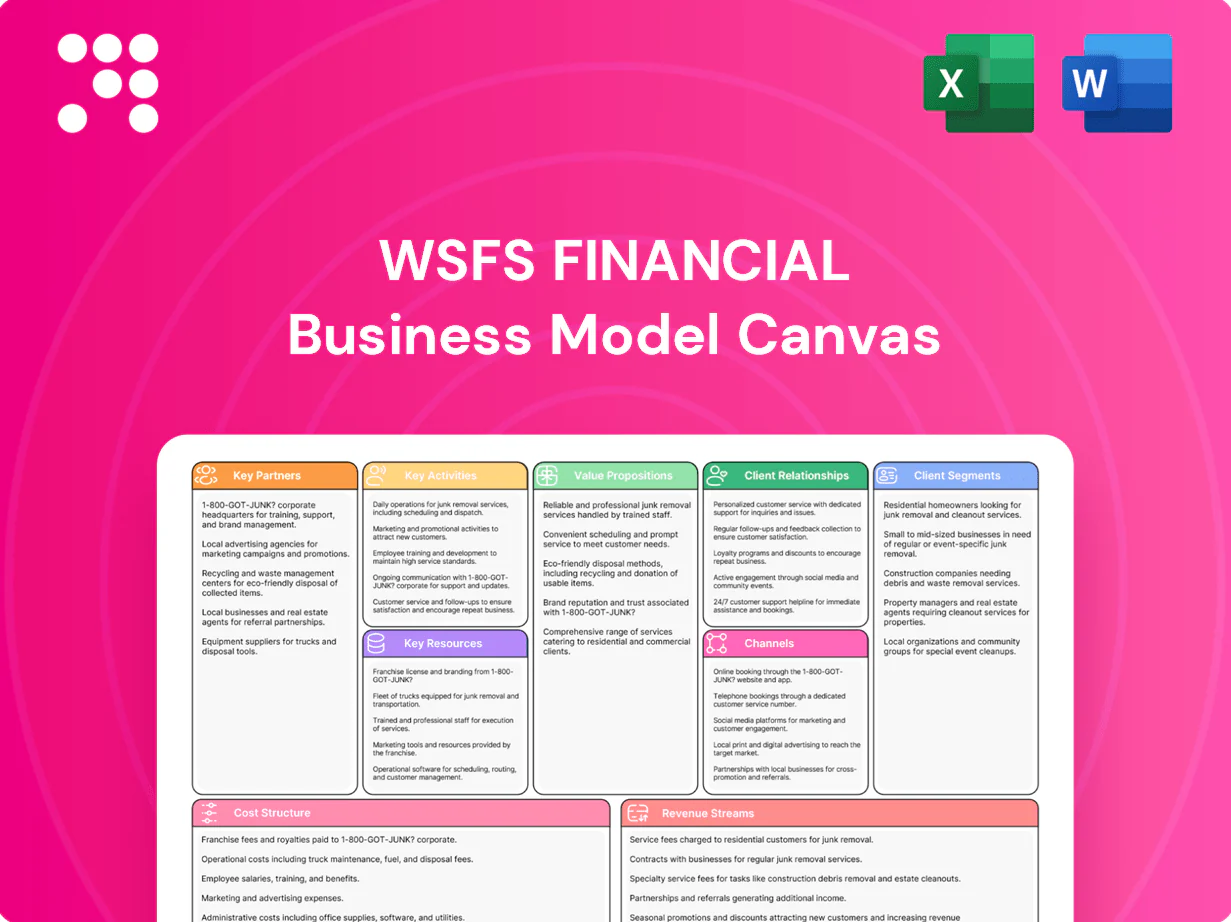
WSFS Financial Business Model Canvas

Business Model Canvas: Strategic blueprint for regional banking value creation and growth
Unlock WSFS Financial’s strategic blueprint with our Business Model Canvas — a concise, actionable analysis of how the bank creates value, acquires customers, and monetizes services. Ideal for investors, advisors, and entrepreneurs seeking competitive edge; download the full, editable canvas to apply these insights directly to your strategy.
Partnerships

Fintech and core tech vendors
WSFS leverages core banking platforms, cloud providers, and fintech partners to power digital banking and back-office efficiency, supporting a bank with roughly $18.5 billion in assets (2023) and rising digital volumes in 2024.
Payment networks and processors
WSFS partners with Visa/Mastercard, ACH, RTP and wire networks to underpin retail and commercial payments, expanding merchant services and card capabilities for clients. Access to faster RTP payments—which surpassed $1 trillion in annualized volume in 2024—improves business cash flow. Shared fraud tools and tokenization reduce chargebacks and enhance security across channels.

Mortgage investors and conduits
Mortgage investors and conduits, notably Fannie Mae, Freddie Mac and Ginnie Mae, supply critical secondary-market liquidity for WSFS, enabling sale and servicing of loans to manage interest-rate and capital constraints; in 2024 these agencies remained primary buyers of conforming paper. Pricing grids and best-ex execution rules drive margin and speed, while third-party servicing partnerships support long-term customer retention and portfolio performance.

Broker-dealers and custodians
Wealth management at WSFS relies on custodial platforms and broker-dealer networks to deliver advisory products, trading execution, and safekeeping, while open-architecture menus broaden investment choice and tax-efficient solutions; integrated compliance and surveillance with partners reinforce fiduciary oversight and reduce operational risk.
- custody-enabled advisory delivery
- open-architecture investment breadth
- trading + safekeeping
- shared compliance & surveillance
Community groups and referral networks
Regional bank: $18.5B assets, RTP > $1T powering digital growth
WSFS integrates core banking, cloud and fintech partners to support ~$18.5B assets (2023) and rising digital volumes in 2024. Payments partners (Visa/Mastercard, ACH, RTP) expand merchant services; RTP exceeded $1T annualized in 2024. Fannie/Freddie/Ginnie Mae provide primary mortgage liquidity; wealth custody and broker-dealers enable advisory scale. Community referrals drive regional SMB and mortgage pipelines.
| Partnership | 2023/24 metric |
|---|---|
| Bank assets | $18.5B (2023) |
| RTP volume | $1T+ annualized (2024) |
| Mortgage buyers | Fannie/Freddie/Ginnie primary (2024) |
What is included in the product
 Detailed Word Document
A concise, pre-written Business Model Canvas tailored to WSFS Financial, detailing customer segments, channels, value propositions and the nine BMC blocks with real-world operational insights. Includes competitive advantage analysis, linked SWOT and polished presentation-ready design for investor discussions and strategic decision-making.

 Customizable Excel Spreadsheet
High-level editable Business Model Canvas for WSFS Financial that saves hours of formatting and structuring, condensing strategy into a shareable one-page snapshot ideal for boardrooms, teams, quick comparisons, and fast executive deliverables.
Activities

Deposit gathering and retention
Designing competitive retail and commercial deposit products helped WSFS grow core deposits to $12.7 billion as of June 30, 2024, attracting low-cost balances. Relationship pricing and treasury service bundles increase stickiness and reduce attrition. Active liquidity management and diversified funding sources safeguard short-term stability. Cross-sell of lending and cash management deepens primary-bank relationships and boosts wallet share.
Credit underwriting and portfolio management
Prudent underwriting balances growth and risk for WSFS Financial, which manages a loan portfolio exceeding $10 billion, targeting disciplined credit metrics and covenant-based approvals. Ongoing monitoring includes quarterly stress tests and concentration limits to protect capital and liquidity. Workout and remediation teams minimize losses through restructuring and collateral recovery. Data-driven credit models speed decisions and improve consistency.

Treasury and cash management delivery
Implementing payables, receivables, and liquidity tools supports business cash flow and credit lines, driving transaction fee income and faster settlement. Onboarding and training ensure users adopt services and capture fees, with 2024 surveys showing 68% of corporates prioritizing treasury digitization. API and file integrations streamline operations and reconciliation, reducing manual work and error rates. Proactive service and relationship management cut churn and help grow average client balances.

Digital product development
- Mobile adoption: 80%+ (2024)
- Weekly agile sprints
- Personalized analytics-driven alerts
- Continuous UX and security updates
Compliance, risk, and cybersecurity
WSFS maintains robust controls aligned with BSA/AML and OCC standards to protect customers and limit regulatory exposure; AML, KYC, and fraud programs helped reduce suspicious activity by strengthening detection and reporting. Cyber resilience and an incident response playbook protect customer data—industry average cost of a breach was about 4.45 million USD in 2024 per IBM. Vendor risk management continuously assesses third-party exposures and contractual controls.
- Regulatory alignment: BSA/AML, OCC
- AML/KYC: enhanced detection & SAR reporting
- Cyber resilience: IBM 2024 breach avg cost ~4.45M USD
- Vendor risk: continuous third-party assessments
Core deposits $12.7B, loans >$10B, 80%+ mobile adoption, weekly sprints
WSFS grew core deposits to $12.7B (6/30/24), manages loans >$10B with disciplined underwriting and quarterly stress tests, and drives digital engagement (mobile adoption 80%+ in 2024) plus weekly agile sprints to accelerate products. Treasury and cash management (68% corporates prioritize digitization, 2024) and strong BSA/AML, cyber controls (IBM breach avg cost $4.45M, 2024) reduce risk and fees leakage.
| Metric | Value (2024) |
|---|---|
| Core deposits | $12.7B |
| Loan portfolio | >$10B |
| Mobile adoption | 80%+ |
| Corp treasury priority | 68% |
| IBM breach avg cost | $4.45M |
| Delivery cadence | Weekly sprints |
What You See Is What You Get
Business Model Canvas
The document you're previewing is the actual WSFS Financial Business Model Canvas, not a mockup. When you purchase, you will receive this exact file with all sections included. The final deliverable is ready-to-use and fully editable in Word and Excel. No surprises—what you see is what you get.

Business Model Canvas: Strategic blueprint for regional banking value creation and growth
Unlock WSFS Financial’s strategic blueprint with our Business Model Canvas — a concise, actionable analysis of how the bank creates value, acquires customers, and monetizes services. Ideal for investors, advisors, and entrepreneurs seeking competitive edge; download the full, editable canvas to apply these insights directly to your strategy.
Partnerships
Fintech and core tech vendors
WSFS leverages core banking platforms, cloud providers, and fintech partners to power digital banking and back-office efficiency, supporting a bank with roughly $18.5 billion in assets (2023) and rising digital volumes in 2024.
Payment networks and processors
WSFS partners with Visa/Mastercard, ACH, RTP and wire networks to underpin retail and commercial payments, expanding merchant services and card capabilities for clients. Access to faster RTP payments—which surpassed $1 trillion in annualized volume in 2024—improves business cash flow. Shared fraud tools and tokenization reduce chargebacks and enhance security across channels.
Mortgage investors and conduits
Mortgage investors and conduits, notably Fannie Mae, Freddie Mac and Ginnie Mae, supply critical secondary-market liquidity for WSFS, enabling sale and servicing of loans to manage interest-rate and capital constraints; in 2024 these agencies remained primary buyers of conforming paper. Pricing grids and best-ex execution rules drive margin and speed, while third-party servicing partnerships support long-term customer retention and portfolio performance.
Broker-dealers and custodians
Wealth management at WSFS relies on custodial platforms and broker-dealer networks to deliver advisory products, trading execution, and safekeeping, while open-architecture menus broaden investment choice and tax-efficient solutions; integrated compliance and surveillance with partners reinforce fiduciary oversight and reduce operational risk.
- custody-enabled advisory delivery
- open-architecture investment breadth
- trading + safekeeping
- shared compliance & surveillance
Community groups and referral networks
Regional bank: $18.5B assets, RTP > $1T powering digital growth
WSFS integrates core banking, cloud and fintech partners to support ~$18.5B assets (2023) and rising digital volumes in 2024. Payments partners (Visa/Mastercard, ACH, RTP) expand merchant services; RTP exceeded $1T annualized in 2024. Fannie/Freddie/Ginnie Mae provide primary mortgage liquidity; wealth custody and broker-dealers enable advisory scale. Community referrals drive regional SMB and mortgage pipelines.
| Partnership | 2023/24 metric |
|---|---|
| Bank assets | $18.5B (2023) |
| RTP volume | $1T+ annualized (2024) |
| Mortgage buyers | Fannie/Freddie/Ginnie primary (2024) |
What is included in the product
Detailed Word Document
A concise, pre-written Business Model Canvas tailored to WSFS Financial, detailing customer segments, channels, value propositions and the nine BMC blocks with real-world operational insights. Includes competitive advantage analysis, linked SWOT and polished presentation-ready design for investor discussions and strategic decision-making.
Customizable Excel Spreadsheet
High-level editable Business Model Canvas for WSFS Financial that saves hours of formatting and structuring, condensing strategy into a shareable one-page snapshot ideal for boardrooms, teams, quick comparisons, and fast executive deliverables.
Activities
Deposit gathering and retention
Designing competitive retail and commercial deposit products helped WSFS grow core deposits to $12.7 billion as of June 30, 2024, attracting low-cost balances. Relationship pricing and treasury service bundles increase stickiness and reduce attrition. Active liquidity management and diversified funding sources safeguard short-term stability. Cross-sell of lending and cash management deepens primary-bank relationships and boosts wallet share.
Credit underwriting and portfolio management
Prudent underwriting balances growth and risk for WSFS Financial, which manages a loan portfolio exceeding $10 billion, targeting disciplined credit metrics and covenant-based approvals. Ongoing monitoring includes quarterly stress tests and concentration limits to protect capital and liquidity. Workout and remediation teams minimize losses through restructuring and collateral recovery. Data-driven credit models speed decisions and improve consistency.
Treasury and cash management delivery
Implementing payables, receivables, and liquidity tools supports business cash flow and credit lines, driving transaction fee income and faster settlement. Onboarding and training ensure users adopt services and capture fees, with 2024 surveys showing 68% of corporates prioritizing treasury digitization. API and file integrations streamline operations and reconciliation, reducing manual work and error rates. Proactive service and relationship management cut churn and help grow average client balances.
Digital product development
- Mobile adoption: 80%+ (2024)
- Weekly agile sprints
- Personalized analytics-driven alerts
- Continuous UX and security updates
Compliance, risk, and cybersecurity
WSFS maintains robust controls aligned with BSA/AML and OCC standards to protect customers and limit regulatory exposure; AML, KYC, and fraud programs helped reduce suspicious activity by strengthening detection and reporting. Cyber resilience and an incident response playbook protect customer data—industry average cost of a breach was about 4.45 million USD in 2024 per IBM. Vendor risk management continuously assesses third-party exposures and contractual controls.
- Regulatory alignment: BSA/AML, OCC
- AML/KYC: enhanced detection & SAR reporting
- Cyber resilience: IBM 2024 breach avg cost ~4.45M USD
- Vendor risk: continuous third-party assessments
Core deposits $12.7B, loans >$10B, 80%+ mobile adoption, weekly sprints
WSFS grew core deposits to $12.7B (6/30/24), manages loans >$10B with disciplined underwriting and quarterly stress tests, and drives digital engagement (mobile adoption 80%+ in 2024) plus weekly agile sprints to accelerate products. Treasury and cash management (68% corporates prioritize digitization, 2024) and strong BSA/AML, cyber controls (IBM breach avg cost $4.45M, 2024) reduce risk and fees leakage.
| Metric | Value (2024) |
|---|---|
| Core deposits | $12.7B |
| Loan portfolio | >$10B |
| Mobile adoption | 80%+ |
| Corp treasury priority | 68% |
| IBM breach avg cost | $4.45M |
| Delivery cadence | Weekly sprints |
What You See Is What You Get
Business Model Canvas
The document you're previewing is the actual WSFS Financial Business Model Canvas, not a mockup. When you purchase, you will receive this exact file with all sections included. The final deliverable is ready-to-use and fully editable in Word and Excel. No surprises—what you see is what you get.
Original: $10.00
-65%$10.00
$3.50Description
Business Model Canvas: Strategic blueprint for regional banking value creation and growth
Unlock WSFS Financial’s strategic blueprint with our Business Model Canvas — a concise, actionable analysis of how the bank creates value, acquires customers, and monetizes services. Ideal for investors, advisors, and entrepreneurs seeking competitive edge; download the full, editable canvas to apply these insights directly to your strategy.
Partnerships
Fintech and core tech vendors
WSFS leverages core banking platforms, cloud providers, and fintech partners to power digital banking and back-office efficiency, supporting a bank with roughly $18.5 billion in assets (2023) and rising digital volumes in 2024.
Payment networks and processors
WSFS partners with Visa/Mastercard, ACH, RTP and wire networks to underpin retail and commercial payments, expanding merchant services and card capabilities for clients. Access to faster RTP payments—which surpassed $1 trillion in annualized volume in 2024—improves business cash flow. Shared fraud tools and tokenization reduce chargebacks and enhance security across channels.
Mortgage investors and conduits
Mortgage investors and conduits, notably Fannie Mae, Freddie Mac and Ginnie Mae, supply critical secondary-market liquidity for WSFS, enabling sale and servicing of loans to manage interest-rate and capital constraints; in 2024 these agencies remained primary buyers of conforming paper. Pricing grids and best-ex execution rules drive margin and speed, while third-party servicing partnerships support long-term customer retention and portfolio performance.
Broker-dealers and custodians
Wealth management at WSFS relies on custodial platforms and broker-dealer networks to deliver advisory products, trading execution, and safekeeping, while open-architecture menus broaden investment choice and tax-efficient solutions; integrated compliance and surveillance with partners reinforce fiduciary oversight and reduce operational risk.
- custody-enabled advisory delivery
- open-architecture investment breadth
- trading + safekeeping
- shared compliance & surveillance
Community groups and referral networks
Regional bank: $18.5B assets, RTP > $1T powering digital growth
WSFS integrates core banking, cloud and fintech partners to support ~$18.5B assets (2023) and rising digital volumes in 2024. Payments partners (Visa/Mastercard, ACH, RTP) expand merchant services; RTP exceeded $1T annualized in 2024. Fannie/Freddie/Ginnie Mae provide primary mortgage liquidity; wealth custody and broker-dealers enable advisory scale. Community referrals drive regional SMB and mortgage pipelines.
| Partnership | 2023/24 metric |
|---|---|
| Bank assets | $18.5B (2023) |
| RTP volume | $1T+ annualized (2024) |
| Mortgage buyers | Fannie/Freddie/Ginnie primary (2024) |
What is included in the product
Detailed Word Document
A concise, pre-written Business Model Canvas tailored to WSFS Financial, detailing customer segments, channels, value propositions and the nine BMC blocks with real-world operational insights. Includes competitive advantage analysis, linked SWOT and polished presentation-ready design for investor discussions and strategic decision-making.
Customizable Excel Spreadsheet
High-level editable Business Model Canvas for WSFS Financial that saves hours of formatting and structuring, condensing strategy into a shareable one-page snapshot ideal for boardrooms, teams, quick comparisons, and fast executive deliverables.
Activities
Deposit gathering and retention
Designing competitive retail and commercial deposit products helped WSFS grow core deposits to $12.7 billion as of June 30, 2024, attracting low-cost balances. Relationship pricing and treasury service bundles increase stickiness and reduce attrition. Active liquidity management and diversified funding sources safeguard short-term stability. Cross-sell of lending and cash management deepens primary-bank relationships and boosts wallet share.
Credit underwriting and portfolio management
Prudent underwriting balances growth and risk for WSFS Financial, which manages a loan portfolio exceeding $10 billion, targeting disciplined credit metrics and covenant-based approvals. Ongoing monitoring includes quarterly stress tests and concentration limits to protect capital and liquidity. Workout and remediation teams minimize losses through restructuring and collateral recovery. Data-driven credit models speed decisions and improve consistency.
Treasury and cash management delivery
Implementing payables, receivables, and liquidity tools supports business cash flow and credit lines, driving transaction fee income and faster settlement. Onboarding and training ensure users adopt services and capture fees, with 2024 surveys showing 68% of corporates prioritizing treasury digitization. API and file integrations streamline operations and reconciliation, reducing manual work and error rates. Proactive service and relationship management cut churn and help grow average client balances.
Digital product development
- Mobile adoption: 80%+ (2024)
- Weekly agile sprints
- Personalized analytics-driven alerts
- Continuous UX and security updates
Compliance, risk, and cybersecurity
WSFS maintains robust controls aligned with BSA/AML and OCC standards to protect customers and limit regulatory exposure; AML, KYC, and fraud programs helped reduce suspicious activity by strengthening detection and reporting. Cyber resilience and an incident response playbook protect customer data—industry average cost of a breach was about 4.45 million USD in 2024 per IBM. Vendor risk management continuously assesses third-party exposures and contractual controls.
- Regulatory alignment: BSA/AML, OCC
- AML/KYC: enhanced detection & SAR reporting
- Cyber resilience: IBM 2024 breach avg cost ~4.45M USD
- Vendor risk: continuous third-party assessments
Core deposits $12.7B, loans >$10B, 80%+ mobile adoption, weekly sprints
WSFS grew core deposits to $12.7B (6/30/24), manages loans >$10B with disciplined underwriting and quarterly stress tests, and drives digital engagement (mobile adoption 80%+ in 2024) plus weekly agile sprints to accelerate products. Treasury and cash management (68% corporates prioritize digitization, 2024) and strong BSA/AML, cyber controls (IBM breach avg cost $4.45M, 2024) reduce risk and fees leakage.
| Metric | Value (2024) |
|---|---|
| Core deposits | $12.7B |
| Loan portfolio | >$10B |
| Mobile adoption | 80%+ |
| Corp treasury priority | 68% |
| IBM breach avg cost | $4.45M |
| Delivery cadence | Weekly sprints |
What You See Is What You Get
Business Model Canvas
The document you're previewing is the actual WSFS Financial Business Model Canvas, not a mockup. When you purchase, you will receive this exact file with all sections included. The final deliverable is ready-to-use and fully editable in Word and Excel. No surprises—what you see is what you get.











