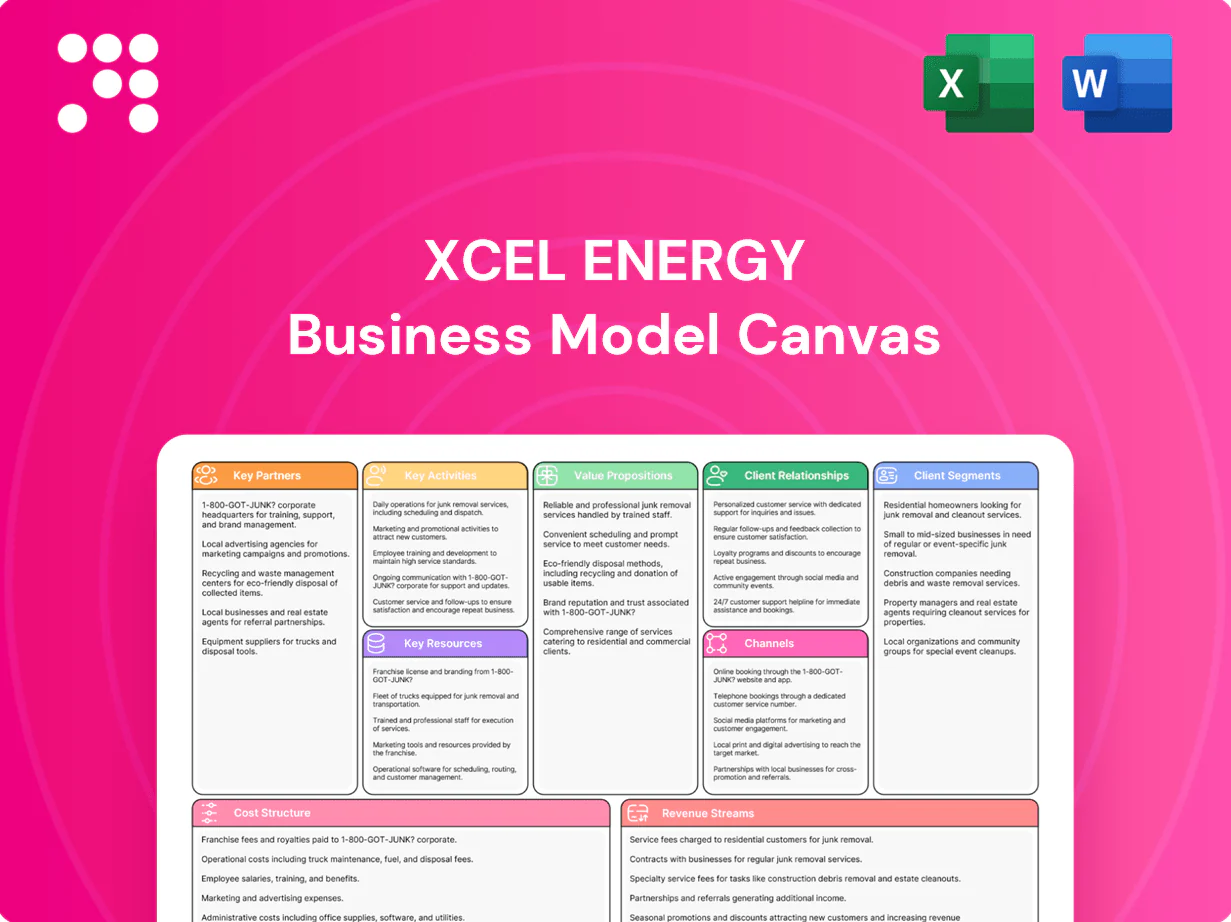
Xcel Energy Business Model Canvas

Unlock a strategic Business Model Canvas: concise map of value, revenue, partners
Unlock the full strategic blueprint behind Xcel Energy with our Business Model Canvas — a concise, actionable map of value propositions, revenue streams, key partners and cost drivers. Perfect for investors, consultants, and executives, this downloadable Word/Excel template speeds benchmarking and planning. Ready to transform insight into strategy? Purchase the complete Canvas to explore every building block in depth.
Partnerships

Regulators and policymakers
Xcel Energy works with state public utility commissions and federal agencies to set rates, approve investments, and align decarbonization pathways for its ~3.8 million electric customers. These partnerships secure cost recovery for capital projects and ensure safety and reliability compliance. Ongoing engagement shapes integrated resource plans and grid modernization approvals, and policy alignment de-risks long-term transformation and capital deployment.
Renewable developers and PPA partners
Xcel partners with independent power producers to source wind, solar and storage under long-term PPAs (typically 10–25 years), accelerating clean energy deployment without owning every asset. Developers supply project expertise, speed to market and tax incentives from the Inflation Reduction Act (up to ~30% ITC/PTC). PPAs stabilize costs and advance Xcel’s targets of 80% CO2 reduction by 2030 and 100% carbon‑free by 2050.

Fuel and equipment suppliers
Reliable gas suppliers, turbine OEMs, and maintenance vendors underpin Xcel Energy’s system availability, supporting operations for roughly 3.8 million electric and 2.0 million gas customers. Multi-year contracts secure fuel, critical parts, and services for generation and grid assets, reducing outage risk. Partnerships help manage commodity price volatility and lifecycle costs through hedging and long-term service agreements. Supplier innovation drives efficiency, flexibility, and emissions control via advanced turbines and controls.

Grid operators and interconnection partners
Grid coordination with RTOs/ISOs (MISO and SPP) and neighboring utilities supports transmission planning and market operations for Xcel Energy, which serves about 3.8 million electricity customers across eight states. Shared interties and infrastructure boost reliability and access to diverse resources; interconnection partners accelerate renewable integration and load balancing while market participation optimizes dispatch and lowers purchased-power costs.
- MISO/SPP coordination
- ~3.8M customers
- Shared interties enhance reliability
- Supports renewable integration and load balancing
- Market ops reduce dispatch and purchased-power costs
Communities and infrastructure allies
Municipalities, economic development groups, and EV charging networks enable local project siting and adoption, supporting Xcel Energy’s ~3.9 million electric customers across eight states (2024). Joint programs advance energy efficiency, demand response, and beneficial electrification, lowering peak loads and accelerating permitting. Stakeholder buy-in and community benefits agreements reduce project risk and build long-term resilience.
- Municipal siting & permits
- Joint EE, DR, electrification programs
- Stakeholder buy-in cuts permitting risk
- Community benefits = trust & resilience
Utility partners with regulators, ISOs, suppliers to secure cost recovery and accelerate clean energy
Xcel Energy partners with regulators, ISOs (MISO/SPP), independent power producers, gas suppliers, OEMs, municipalities and EV networks to secure cost recovery, grid reliability and accelerate decarbonization for ~3.8M electric and ~2.0M gas customers across 8 states (2024). PPAs (10–25y) and IRA incentives (~30% ITC/PTC) speed renewables; long-term contracts and RTO coordination reduce operational and market risk.
| Partner | Key metric | Impact |
|---|---|---|
| Regulators | 8 states | Rate approval, cost recovery |
| PPA developers | 10–25y | Renewable capacity, cost stability |
| RTOs (MISO/SPP) | Market ops | Dispatch optimization |
What is included in the product
 Detailed Word Document
A comprehensive, pre-written Business Model Canvas for Xcel Energy detailing customer segments, value propositions, channels, revenue streams and key resources across the 9 BMC blocks. Reflects real-world utility operations and decarbonization strategy, includes competitive advantages and linked SWOT insights for investor presentations and strategic decision-making.

 Customizable Excel Spreadsheet
Condenses Xcel Energy’s utility strategy into a digestible one-page snapshot with editable cells for team collaboration, saving hours of formatting and ideal for boardrooms, comparisons, and quick executive summaries.
Activities

Generation and power procurement
Xcel operates a diversified fleet and contracts >25 GW of renewable capacity across its system while serving ~3.8 million electric customers, using optimized dispatch, fuel hedging and active PPA management to meet load reliably. Resource plans target an 80% carbon reduction by 2030 (vs 2005) with continued additions of wind and solar. Operational excellence focuses on high availability and tight cost control to support margins.
Transmission and distribution operations
Xcel Energy builds, maintains, and upgrades lines, substations, and feeders across its service territory serving roughly 3.9 million electric customers in 2024. System planning targets load growth, resilience, and DER hosting capacity to support decarbonization goals. Grid monitoring and protection systems deliver real-time safety and reliability metrics. Vegetation management and regular inspections reduce outage risk and improve SAIDI/SAIFI performance.

Customer service and billing
Omnichannel support across phone, web and app handles billing, payments and service requests for Xcel Energy, which serves about 3.8 million electric and 2.2 million gas customers; digital billing adoption exceeds 60%, reducing call volumes. Credit, collections and affordability programs follow consistent regulatory frameworks across eight states, with targeted assistance for low-income customers. Outage communications deliver real-time ETAs and restoration updates; rigorous data accuracy underpins trust and compliance.

Grid modernization and DER integration
- Advanced metering and DMS improved grid visibility
- Streamlined interconnection for rooftop solar, storage and EVs
- Hosting capacity and non-wires solutions defer upgrades
- Cybersecurity protects critical infrastructure
Regulatory, planning, and decarbonization
Integrated resource planning aligns investments with policy and customer needs, targeting an 80% carbon reduction by 2030 and 100% carbon-free electricity by 2050; IRPs prioritize renewables and storage to meet those mandates. Stakeholder engagement—covering roughly 3.8 million electric customers—shapes portfolios and rate design. Carbon roadmaps drive coal retirements, renewables buildout and storage procurement while compliance reporting and expanded ESG disclosure sustain investor confidence.
- IRP target: 80% by 2030; 100% by 2050
- Customer base: ~3.8M electric customers
- Actions: coal retirements, renewables, battery storage
- Governance: annual IRP, ESG reporting, regulatory filings
Utility to cut 80% by 2030; serves ~3.9M
Xcel operates and dispatches a diversified fleet serving ~3.9M electric and 2.2M gas customers (2024), managing >25 GW contracted renewables and active PPA/fuel hedging to ensure reliability. IRP-driven resource shifts target an 80% carbon reduction by 2030 (vs 2005) and 100% carbon-free by 2050. Grid investments, AMI/DMS and vegetation management focus on resilience and lower SAIDI/SAIFI. Customer digital adoption exceeds 60%, reducing operating costs.
| Metric | 2024 value |
|---|---|
| Electric customers | ~3.9M |
| Gas customers | 2.2M |
| Renewable capacity contracted | >25 GW |
| IRP carbon target (2030) | 80% reduction vs 2005 |
| Digital billing adoption | >60% |
What You See Is What You Get
Business Model Canvas
The Xcel Energy Business Model Canvas shown here is the authentic deliverable, not a mockup or sample. This preview is a direct excerpt from the exact file you’ll receive upon purchase, formatted and structured for immediate use. When you complete your order, you’ll download the full, editable document—ready for presentation, analysis, or customization.

Unlock a strategic Business Model Canvas: concise map of value, revenue, partners
Unlock the full strategic blueprint behind Xcel Energy with our Business Model Canvas — a concise, actionable map of value propositions, revenue streams, key partners and cost drivers. Perfect for investors, consultants, and executives, this downloadable Word/Excel template speeds benchmarking and planning. Ready to transform insight into strategy? Purchase the complete Canvas to explore every building block in depth.
Partnerships
Regulators and policymakers
Xcel Energy works with state public utility commissions and federal agencies to set rates, approve investments, and align decarbonization pathways for its ~3.8 million electric customers. These partnerships secure cost recovery for capital projects and ensure safety and reliability compliance. Ongoing engagement shapes integrated resource plans and grid modernization approvals, and policy alignment de-risks long-term transformation and capital deployment.
Renewable developers and PPA partners
Xcel partners with independent power producers to source wind, solar and storage under long-term PPAs (typically 10–25 years), accelerating clean energy deployment without owning every asset. Developers supply project expertise, speed to market and tax incentives from the Inflation Reduction Act (up to ~30% ITC/PTC). PPAs stabilize costs and advance Xcel’s targets of 80% CO2 reduction by 2030 and 100% carbon‑free by 2050.
Fuel and equipment suppliers
Reliable gas suppliers, turbine OEMs, and maintenance vendors underpin Xcel Energy’s system availability, supporting operations for roughly 3.8 million electric and 2.0 million gas customers. Multi-year contracts secure fuel, critical parts, and services for generation and grid assets, reducing outage risk. Partnerships help manage commodity price volatility and lifecycle costs through hedging and long-term service agreements. Supplier innovation drives efficiency, flexibility, and emissions control via advanced turbines and controls.
Grid operators and interconnection partners
Grid coordination with RTOs/ISOs (MISO and SPP) and neighboring utilities supports transmission planning and market operations for Xcel Energy, which serves about 3.8 million electricity customers across eight states. Shared interties and infrastructure boost reliability and access to diverse resources; interconnection partners accelerate renewable integration and load balancing while market participation optimizes dispatch and lowers purchased-power costs.
- MISO/SPP coordination
- ~3.8M customers
- Shared interties enhance reliability
- Supports renewable integration and load balancing
- Market ops reduce dispatch and purchased-power costs
Communities and infrastructure allies
Municipalities, economic development groups, and EV charging networks enable local project siting and adoption, supporting Xcel Energy’s ~3.9 million electric customers across eight states (2024). Joint programs advance energy efficiency, demand response, and beneficial electrification, lowering peak loads and accelerating permitting. Stakeholder buy-in and community benefits agreements reduce project risk and build long-term resilience.
- Municipal siting & permits
- Joint EE, DR, electrification programs
- Stakeholder buy-in cuts permitting risk
- Community benefits = trust & resilience
Utility partners with regulators, ISOs, suppliers to secure cost recovery and accelerate clean energy
Xcel Energy partners with regulators, ISOs (MISO/SPP), independent power producers, gas suppliers, OEMs, municipalities and EV networks to secure cost recovery, grid reliability and accelerate decarbonization for ~3.8M electric and ~2.0M gas customers across 8 states (2024). PPAs (10–25y) and IRA incentives (~30% ITC/PTC) speed renewables; long-term contracts and RTO coordination reduce operational and market risk.
| Partner | Key metric | Impact |
|---|---|---|
| Regulators | 8 states | Rate approval, cost recovery |
| PPA developers | 10–25y | Renewable capacity, cost stability |
| RTOs (MISO/SPP) | Market ops | Dispatch optimization |
What is included in the product
Detailed Word Document
A comprehensive, pre-written Business Model Canvas for Xcel Energy detailing customer segments, value propositions, channels, revenue streams and key resources across the 9 BMC blocks. Reflects real-world utility operations and decarbonization strategy, includes competitive advantages and linked SWOT insights for investor presentations and strategic decision-making.
Customizable Excel Spreadsheet
Condenses Xcel Energy’s utility strategy into a digestible one-page snapshot with editable cells for team collaboration, saving hours of formatting and ideal for boardrooms, comparisons, and quick executive summaries.
Activities
Generation and power procurement
Xcel operates a diversified fleet and contracts >25 GW of renewable capacity across its system while serving ~3.8 million electric customers, using optimized dispatch, fuel hedging and active PPA management to meet load reliably. Resource plans target an 80% carbon reduction by 2030 (vs 2005) with continued additions of wind and solar. Operational excellence focuses on high availability and tight cost control to support margins.
Transmission and distribution operations
Xcel Energy builds, maintains, and upgrades lines, substations, and feeders across its service territory serving roughly 3.9 million electric customers in 2024. System planning targets load growth, resilience, and DER hosting capacity to support decarbonization goals. Grid monitoring and protection systems deliver real-time safety and reliability metrics. Vegetation management and regular inspections reduce outage risk and improve SAIDI/SAIFI performance.
Customer service and billing
Omnichannel support across phone, web and app handles billing, payments and service requests for Xcel Energy, which serves about 3.8 million electric and 2.2 million gas customers; digital billing adoption exceeds 60%, reducing call volumes. Credit, collections and affordability programs follow consistent regulatory frameworks across eight states, with targeted assistance for low-income customers. Outage communications deliver real-time ETAs and restoration updates; rigorous data accuracy underpins trust and compliance.
Grid modernization and DER integration
- Advanced metering and DMS improved grid visibility
- Streamlined interconnection for rooftop solar, storage and EVs
- Hosting capacity and non-wires solutions defer upgrades
- Cybersecurity protects critical infrastructure
Regulatory, planning, and decarbonization
Integrated resource planning aligns investments with policy and customer needs, targeting an 80% carbon reduction by 2030 and 100% carbon-free electricity by 2050; IRPs prioritize renewables and storage to meet those mandates. Stakeholder engagement—covering roughly 3.8 million electric customers—shapes portfolios and rate design. Carbon roadmaps drive coal retirements, renewables buildout and storage procurement while compliance reporting and expanded ESG disclosure sustain investor confidence.
- IRP target: 80% by 2030; 100% by 2050
- Customer base: ~3.8M electric customers
- Actions: coal retirements, renewables, battery storage
- Governance: annual IRP, ESG reporting, regulatory filings
Utility to cut 80% by 2030; serves ~3.9M
Xcel operates and dispatches a diversified fleet serving ~3.9M electric and 2.2M gas customers (2024), managing >25 GW contracted renewables and active PPA/fuel hedging to ensure reliability. IRP-driven resource shifts target an 80% carbon reduction by 2030 (vs 2005) and 100% carbon-free by 2050. Grid investments, AMI/DMS and vegetation management focus on resilience and lower SAIDI/SAIFI. Customer digital adoption exceeds 60%, reducing operating costs.
| Metric | 2024 value |
|---|---|
| Electric customers | ~3.9M |
| Gas customers | 2.2M |
| Renewable capacity contracted | >25 GW |
| IRP carbon target (2030) | 80% reduction vs 2005 |
| Digital billing adoption | >60% |
What You See Is What You Get
Business Model Canvas
The Xcel Energy Business Model Canvas shown here is the authentic deliverable, not a mockup or sample. This preview is a direct excerpt from the exact file you’ll receive upon purchase, formatted and structured for immediate use. When you complete your order, you’ll download the full, editable document—ready for presentation, analysis, or customization.
Original: $10.00
-65%$10.00
$3.50Description
Unlock a strategic Business Model Canvas: concise map of value, revenue, partners
Unlock the full strategic blueprint behind Xcel Energy with our Business Model Canvas — a concise, actionable map of value propositions, revenue streams, key partners and cost drivers. Perfect for investors, consultants, and executives, this downloadable Word/Excel template speeds benchmarking and planning. Ready to transform insight into strategy? Purchase the complete Canvas to explore every building block in depth.
Partnerships
Regulators and policymakers
Xcel Energy works with state public utility commissions and federal agencies to set rates, approve investments, and align decarbonization pathways for its ~3.8 million electric customers. These partnerships secure cost recovery for capital projects and ensure safety and reliability compliance. Ongoing engagement shapes integrated resource plans and grid modernization approvals, and policy alignment de-risks long-term transformation and capital deployment.
Renewable developers and PPA partners
Xcel partners with independent power producers to source wind, solar and storage under long-term PPAs (typically 10–25 years), accelerating clean energy deployment without owning every asset. Developers supply project expertise, speed to market and tax incentives from the Inflation Reduction Act (up to ~30% ITC/PTC). PPAs stabilize costs and advance Xcel’s targets of 80% CO2 reduction by 2030 and 100% carbon‑free by 2050.
Fuel and equipment suppliers
Reliable gas suppliers, turbine OEMs, and maintenance vendors underpin Xcel Energy’s system availability, supporting operations for roughly 3.8 million electric and 2.0 million gas customers. Multi-year contracts secure fuel, critical parts, and services for generation and grid assets, reducing outage risk. Partnerships help manage commodity price volatility and lifecycle costs through hedging and long-term service agreements. Supplier innovation drives efficiency, flexibility, and emissions control via advanced turbines and controls.
Grid operators and interconnection partners
Grid coordination with RTOs/ISOs (MISO and SPP) and neighboring utilities supports transmission planning and market operations for Xcel Energy, which serves about 3.8 million electricity customers across eight states. Shared interties and infrastructure boost reliability and access to diverse resources; interconnection partners accelerate renewable integration and load balancing while market participation optimizes dispatch and lowers purchased-power costs.
- MISO/SPP coordination
- ~3.8M customers
- Shared interties enhance reliability
- Supports renewable integration and load balancing
- Market ops reduce dispatch and purchased-power costs
Communities and infrastructure allies
Municipalities, economic development groups, and EV charging networks enable local project siting and adoption, supporting Xcel Energy’s ~3.9 million electric customers across eight states (2024). Joint programs advance energy efficiency, demand response, and beneficial electrification, lowering peak loads and accelerating permitting. Stakeholder buy-in and community benefits agreements reduce project risk and build long-term resilience.
- Municipal siting & permits
- Joint EE, DR, electrification programs
- Stakeholder buy-in cuts permitting risk
- Community benefits = trust & resilience
Utility partners with regulators, ISOs, suppliers to secure cost recovery and accelerate clean energy
Xcel Energy partners with regulators, ISOs (MISO/SPP), independent power producers, gas suppliers, OEMs, municipalities and EV networks to secure cost recovery, grid reliability and accelerate decarbonization for ~3.8M electric and ~2.0M gas customers across 8 states (2024). PPAs (10–25y) and IRA incentives (~30% ITC/PTC) speed renewables; long-term contracts and RTO coordination reduce operational and market risk.
| Partner | Key metric | Impact |
|---|---|---|
| Regulators | 8 states | Rate approval, cost recovery |
| PPA developers | 10–25y | Renewable capacity, cost stability |
| RTOs (MISO/SPP) | Market ops | Dispatch optimization |
What is included in the product
Detailed Word Document
A comprehensive, pre-written Business Model Canvas for Xcel Energy detailing customer segments, value propositions, channels, revenue streams and key resources across the 9 BMC blocks. Reflects real-world utility operations and decarbonization strategy, includes competitive advantages and linked SWOT insights for investor presentations and strategic decision-making.
Customizable Excel Spreadsheet
Condenses Xcel Energy’s utility strategy into a digestible one-page snapshot with editable cells for team collaboration, saving hours of formatting and ideal for boardrooms, comparisons, and quick executive summaries.
Activities
Generation and power procurement
Xcel operates a diversified fleet and contracts >25 GW of renewable capacity across its system while serving ~3.8 million electric customers, using optimized dispatch, fuel hedging and active PPA management to meet load reliably. Resource plans target an 80% carbon reduction by 2030 (vs 2005) with continued additions of wind and solar. Operational excellence focuses on high availability and tight cost control to support margins.
Transmission and distribution operations
Xcel Energy builds, maintains, and upgrades lines, substations, and feeders across its service territory serving roughly 3.9 million electric customers in 2024. System planning targets load growth, resilience, and DER hosting capacity to support decarbonization goals. Grid monitoring and protection systems deliver real-time safety and reliability metrics. Vegetation management and regular inspections reduce outage risk and improve SAIDI/SAIFI performance.
Customer service and billing
Omnichannel support across phone, web and app handles billing, payments and service requests for Xcel Energy, which serves about 3.8 million electric and 2.2 million gas customers; digital billing adoption exceeds 60%, reducing call volumes. Credit, collections and affordability programs follow consistent regulatory frameworks across eight states, with targeted assistance for low-income customers. Outage communications deliver real-time ETAs and restoration updates; rigorous data accuracy underpins trust and compliance.
Grid modernization and DER integration
- Advanced metering and DMS improved grid visibility
- Streamlined interconnection for rooftop solar, storage and EVs
- Hosting capacity and non-wires solutions defer upgrades
- Cybersecurity protects critical infrastructure
Regulatory, planning, and decarbonization
Integrated resource planning aligns investments with policy and customer needs, targeting an 80% carbon reduction by 2030 and 100% carbon-free electricity by 2050; IRPs prioritize renewables and storage to meet those mandates. Stakeholder engagement—covering roughly 3.8 million electric customers—shapes portfolios and rate design. Carbon roadmaps drive coal retirements, renewables buildout and storage procurement while compliance reporting and expanded ESG disclosure sustain investor confidence.
- IRP target: 80% by 2030; 100% by 2050
- Customer base: ~3.8M electric customers
- Actions: coal retirements, renewables, battery storage
- Governance: annual IRP, ESG reporting, regulatory filings
Utility to cut 80% by 2030; serves ~3.9M
Xcel operates and dispatches a diversified fleet serving ~3.9M electric and 2.2M gas customers (2024), managing >25 GW contracted renewables and active PPA/fuel hedging to ensure reliability. IRP-driven resource shifts target an 80% carbon reduction by 2030 (vs 2005) and 100% carbon-free by 2050. Grid investments, AMI/DMS and vegetation management focus on resilience and lower SAIDI/SAIFI. Customer digital adoption exceeds 60%, reducing operating costs.
| Metric | 2024 value |
|---|---|
| Electric customers | ~3.9M |
| Gas customers | 2.2M |
| Renewable capacity contracted | >25 GW |
| IRP carbon target (2030) | 80% reduction vs 2005 |
| Digital billing adoption | >60% |
What You See Is What You Get
Business Model Canvas
The Xcel Energy Business Model Canvas shown here is the authentic deliverable, not a mockup or sample. This preview is a direct excerpt from the exact file you’ll receive upon purchase, formatted and structured for immediate use. When you complete your order, you’ll download the full, editable document—ready for presentation, analysis, or customization.











