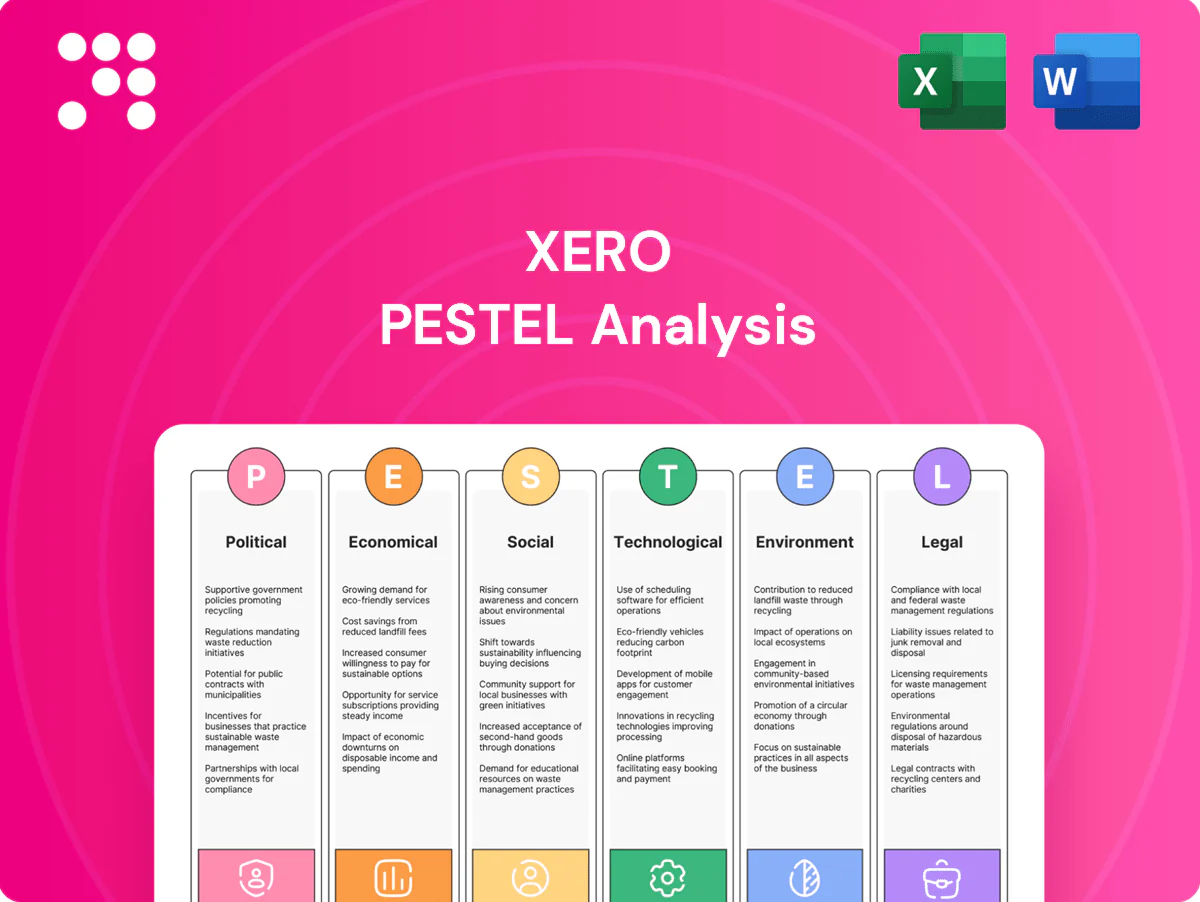
Xero PESTLE Analysis

Make Smarter Strategic Decisions with a Complete PESTEL View
Unearth how political shifts, economic cycles, and tech disruption are steering Xero's trajectory in our concise PESTLE snapshot. This actionable briefing highlights risks and opportunities you can apply today. Buy the full PESTLE for the complete, editable analysis and strategic recommendations.
Political factors

Government tax digitization mandates
Governments are mandating e-invoicing and real-time VAT/GST reporting, driving demand for compliant cloud accounting; PEPPOL, the UK Making Tax Digital program, and SAF-T variants (e.g., Poland, Portugal) are key frameworks. With e-invoicing mandates now in 50+ jurisdictions, rapid timelines accelerate adoption but raise compliance costs; first-mover compliance can differentiate Xero in high-growth markets.
Data sovereignty and localization policies
Expanding data sovereignty laws such as EU GDPR, China PIPL (2021) and India’s evolving rules force financial data to reside within borders; Xero, active in around 180 markets, must deploy regional hosting and controls to satisfy regulators without fragmenting its platform. Localization raises infrastructure complexity and costs, but rigorous compliance can strengthen trust with public-sector and regulated clients.

SME digitalization incentives
Many governments subsidize cloud tools to boost SME productivity—e.g., the EU Digital Europe Programme (€7.5bn 2021–27) and 30+ national SME digital schemes, with vouchers often covering up to 50% of costs. Targeted programs accelerate Xero customer acquisition via accountant and reseller partners by lowering buyer cost barriers. Political funding cycles are volatile and can be cut after elections, risking churn. Xero can co-market with agencies to maximize grant uptake and conversion.

Trade policy and geopolitical risk
Sanctions, tariffs and supply-chain frictions squeeze SME customer volumes and survival rates, noting SMEs account for about 90% of businesses and 50% of employment globally (World Bank). Xero’s multi-country footprint reduces concentrated risk but increases exposure to divergent policies and compliance costs; higher political risk can slow market entries and add regulatory burden. Scenario planning helps protect subscription revenue and ARR continuity.
- Sanctions/tariffs: raise SME input costs and churn risk
- Multi-country: hedges demand shocks but ups policy exposure
- Market entry: slows where compliance costs spike
- Mitigation: scenario planning preserves ARR resilience
Public procurement and lobbying dynamics
Standards for accounting and payroll interfaces are often shaped by industry input; Xero, serving roughly 3.6 million subscribers and 1,000+ connected apps, engages standards bodies to influence integration requirements. Shifts in payroll, pensions and benefits policy (eg UK auto‑enrolment covering ~10m workers) force roadmap changes. Constructive lobbying helps protect fair API access for third‑party apps and partner ecosystems.
- Standards influence integrations
- Engagement with bodies shapes requirements
- Policy shifts (eg pensions) alter roadmaps
- Lobbying safeguards third‑party access
E-invoicing mandates and data sovereignty drive uptake of compliant cloud accounting for SMEs
E-invoicing in 50+ jurisdictions and real-time tax rules drive demand for compliant cloud accounting; Xero serves ~3.6m subscribers across ~180 markets. Data sovereignty (GDPR, PIPL) and localization raise hosting costs but boost trust. EU Digital Europe (€7.5bn) and 30+ SME schemes accelerate adoption; SMEs = ~90% of firms, ~50% employment (World Bank).
| Metric | Value |
|---|---|
| Subscribers/Markets | 3.6m / ~180 |
| E-invoicing mandates | 50+ jurisdictions |
| EU funding | €7.5bn (2021–27) |
What is included in the product
 Detailed Word Document
Explores how macro-environmental factors affect Xero across Political, Economic, Social, Technological, Environmental and Legal dimensions, with data-backed, region- and industry-specific insights and forward-looking scenarios to help executives, consultants and entrepreneurs identify threats, opportunities and strategic responses—formatted for direct inclusion in plans and decks.

 Customizable Excel Spreadsheet
A concise, visually segmented PESTLE summary for Xero that speeds stakeholder alignment and can be dropped straight into presentations or planning sessions. It uses clear language and editable notes so teams can tailor risks and opportunities to their region or business line.
Economic factors

SME health and business formation cycles
Xero’s revenue closely tracks SME creation and survival cycles: SMEs make up about 99% of firms and roughly 70% of employment in OECD countries, so recession-driven churn and downgrades cut seat growth while recoveries drive new seat additions. Diversification across industries and regions smooths volatility, and targeted pricing/retention offers have been shown to stabilise ARR by reducing churn during downturns.
Inflation and interest rate environment
High interest rates tighten SME cash flows, pressuring subscription spend as benchmark Fed funds of 5.25–5.50% (mid‑2025) raises borrowing costs. Xero’s cash‑flow tools and invoice‑financing partners become more valuable to its ~3.9m subscribers (FY24). Input‑cost inflation may force price and packaging changes. Elasticity testing guides localized pricing moves.

Currency fluctuations and multi-currency needs
SMEs trading cross-border increasingly need robust multi-currency accounting; Xero reported over 3.2 million subscribers as of FY24, many exposed to FX. Global FX turnover remains around USD 7.5 trillion/day (BIS 2022), and recent volatility has driven demand for real-time reporting and hedging insights. FX swings can move reported results by multiple percentage points and raise partner costs, so accurate FX feeds and revaluation features are key competitive levers.

SaaS competitive intensity and consolidation
Price-based competition from incumbents and freemium entrants can compress ARPU, pressuring Xero to protect margins; bundling payroll, expenses and payments improves wallet share and can offset churn. Consolidation in fintech via M&A reshapes partner ecosystems and referral flows, while clear ROI messaging and deep integrations sustain customer stickiness and lifetime value.
- Price pressure: ARPU compression risk
- Bundling: payroll/expenses/payments to defend share
- M&A: partner ecosystem shifts
- ROI + integrations: sustain stickiness
Labor market and productivity pressures
Tight labor markets push SMEs to automate bookkeeping and payroll; SMEs account for ~90% of businesses and provide over 50% of global employment. Xero’s AI automation helps offset staffing constraints and supports rising DIY behavior in downturns. Education and advisory channels reduce adoption cost and broaden reach.
- SMEs ~90% of businesses; >50% employment
- Xero AI offsets staffing limits, boosts automation
- DIY rises in downturns, advisory channels cut CAC
E-invoicing mandates and data sovereignty drive uptake of compliant cloud accounting for SMEs
Xero’s growth closely follows SME cycles: SMEs (≈99% of firms, ~70% of OECD employment) drive seat demand while recessions raise churn. High rates (Fed 5.25–5.50% mid‑2025) and input inflation pressure SME cashflows and ARPU; cash‑flow tools and invoice financing gain value for Xero’s ~3.9m FY24 subscribers. FX volatility (USD 7.5tn/day) increases demand for real‑time revaluation and hedging integrations.
| Metric | Value | Implication |
|---|---|---|
| SME share | ≈99% firms; ~70% OECD employment | Primary demand driver |
| Xero subs | ≈3.9m (FY24) | Scale for upsell |
| Fed funds | 5.25–5.50% (mid‑2025) | Higher borrowing cost |
| FX turnover | USD 7.5tn/day (BIS 2022) | Need real‑time FX |
Full Version Awaits
Xero PESTLE Analysis
This Xero PESTLE analysis examines the political, economic, social, technological, legal, and environmental factors shaping Xero’s strategy and market position. It highlights regulatory risks, macroeconomic trends, customer behavior shifts, innovation drivers, compliance issues, and sustainability impacts. The preview shown here is the exact document you’ll receive after purchase—fully formatted and ready to use.

Make Smarter Strategic Decisions with a Complete PESTEL View
Unearth how political shifts, economic cycles, and tech disruption are steering Xero's trajectory in our concise PESTLE snapshot. This actionable briefing highlights risks and opportunities you can apply today. Buy the full PESTLE for the complete, editable analysis and strategic recommendations.
Political factors
Government tax digitization mandates
Governments are mandating e-invoicing and real-time VAT/GST reporting, driving demand for compliant cloud accounting; PEPPOL, the UK Making Tax Digital program, and SAF-T variants (e.g., Poland, Portugal) are key frameworks. With e-invoicing mandates now in 50+ jurisdictions, rapid timelines accelerate adoption but raise compliance costs; first-mover compliance can differentiate Xero in high-growth markets.
Data sovereignty and localization policies
Expanding data sovereignty laws such as EU GDPR, China PIPL (2021) and India’s evolving rules force financial data to reside within borders; Xero, active in around 180 markets, must deploy regional hosting and controls to satisfy regulators without fragmenting its platform. Localization raises infrastructure complexity and costs, but rigorous compliance can strengthen trust with public-sector and regulated clients.
SME digitalization incentives
Many governments subsidize cloud tools to boost SME productivity—e.g., the EU Digital Europe Programme (€7.5bn 2021–27) and 30+ national SME digital schemes, with vouchers often covering up to 50% of costs. Targeted programs accelerate Xero customer acquisition via accountant and reseller partners by lowering buyer cost barriers. Political funding cycles are volatile and can be cut after elections, risking churn. Xero can co-market with agencies to maximize grant uptake and conversion.
Trade policy and geopolitical risk
Sanctions, tariffs and supply-chain frictions squeeze SME customer volumes and survival rates, noting SMEs account for about 90% of businesses and 50% of employment globally (World Bank). Xero’s multi-country footprint reduces concentrated risk but increases exposure to divergent policies and compliance costs; higher political risk can slow market entries and add regulatory burden. Scenario planning helps protect subscription revenue and ARR continuity.
- Sanctions/tariffs: raise SME input costs and churn risk
- Multi-country: hedges demand shocks but ups policy exposure
- Market entry: slows where compliance costs spike
- Mitigation: scenario planning preserves ARR resilience
Public procurement and lobbying dynamics
Standards for accounting and payroll interfaces are often shaped by industry input; Xero, serving roughly 3.6 million subscribers and 1,000+ connected apps, engages standards bodies to influence integration requirements. Shifts in payroll, pensions and benefits policy (eg UK auto‑enrolment covering ~10m workers) force roadmap changes. Constructive lobbying helps protect fair API access for third‑party apps and partner ecosystems.
- Standards influence integrations
- Engagement with bodies shapes requirements
- Policy shifts (eg pensions) alter roadmaps
- Lobbying safeguards third‑party access
E-invoicing mandates and data sovereignty drive uptake of compliant cloud accounting for SMEs
E-invoicing in 50+ jurisdictions and real-time tax rules drive demand for compliant cloud accounting; Xero serves ~3.6m subscribers across ~180 markets. Data sovereignty (GDPR, PIPL) and localization raise hosting costs but boost trust. EU Digital Europe (€7.5bn) and 30+ SME schemes accelerate adoption; SMEs = ~90% of firms, ~50% employment (World Bank).
| Metric | Value |
|---|---|
| Subscribers/Markets | 3.6m / ~180 |
| E-invoicing mandates | 50+ jurisdictions |
| EU funding | €7.5bn (2021–27) |
What is included in the product
Detailed Word Document
Explores how macro-environmental factors affect Xero across Political, Economic, Social, Technological, Environmental and Legal dimensions, with data-backed, region- and industry-specific insights and forward-looking scenarios to help executives, consultants and entrepreneurs identify threats, opportunities and strategic responses—formatted for direct inclusion in plans and decks.
Customizable Excel Spreadsheet
A concise, visually segmented PESTLE summary for Xero that speeds stakeholder alignment and can be dropped straight into presentations or planning sessions. It uses clear language and editable notes so teams can tailor risks and opportunities to their region or business line.
Economic factors
SME health and business formation cycles
Xero’s revenue closely tracks SME creation and survival cycles: SMEs make up about 99% of firms and roughly 70% of employment in OECD countries, so recession-driven churn and downgrades cut seat growth while recoveries drive new seat additions. Diversification across industries and regions smooths volatility, and targeted pricing/retention offers have been shown to stabilise ARR by reducing churn during downturns.
Inflation and interest rate environment
High interest rates tighten SME cash flows, pressuring subscription spend as benchmark Fed funds of 5.25–5.50% (mid‑2025) raises borrowing costs. Xero’s cash‑flow tools and invoice‑financing partners become more valuable to its ~3.9m subscribers (FY24). Input‑cost inflation may force price and packaging changes. Elasticity testing guides localized pricing moves.
Currency fluctuations and multi-currency needs
SMEs trading cross-border increasingly need robust multi-currency accounting; Xero reported over 3.2 million subscribers as of FY24, many exposed to FX. Global FX turnover remains around USD 7.5 trillion/day (BIS 2022), and recent volatility has driven demand for real-time reporting and hedging insights. FX swings can move reported results by multiple percentage points and raise partner costs, so accurate FX feeds and revaluation features are key competitive levers.
SaaS competitive intensity and consolidation
Price-based competition from incumbents and freemium entrants can compress ARPU, pressuring Xero to protect margins; bundling payroll, expenses and payments improves wallet share and can offset churn. Consolidation in fintech via M&A reshapes partner ecosystems and referral flows, while clear ROI messaging and deep integrations sustain customer stickiness and lifetime value.
- Price pressure: ARPU compression risk
- Bundling: payroll/expenses/payments to defend share
- M&A: partner ecosystem shifts
- ROI + integrations: sustain stickiness
Labor market and productivity pressures
Tight labor markets push SMEs to automate bookkeeping and payroll; SMEs account for ~90% of businesses and provide over 50% of global employment. Xero’s AI automation helps offset staffing constraints and supports rising DIY behavior in downturns. Education and advisory channels reduce adoption cost and broaden reach.
- SMEs ~90% of businesses; >50% employment
- Xero AI offsets staffing limits, boosts automation
- DIY rises in downturns, advisory channels cut CAC
E-invoicing mandates and data sovereignty drive uptake of compliant cloud accounting for SMEs
Xero’s growth closely follows SME cycles: SMEs (≈99% of firms, ~70% of OECD employment) drive seat demand while recessions raise churn. High rates (Fed 5.25–5.50% mid‑2025) and input inflation pressure SME cashflows and ARPU; cash‑flow tools and invoice financing gain value for Xero’s ~3.9m FY24 subscribers. FX volatility (USD 7.5tn/day) increases demand for real‑time revaluation and hedging integrations.
| Metric | Value | Implication |
|---|---|---|
| SME share | ≈99% firms; ~70% OECD employment | Primary demand driver |
| Xero subs | ≈3.9m (FY24) | Scale for upsell |
| Fed funds | 5.25–5.50% (mid‑2025) | Higher borrowing cost |
| FX turnover | USD 7.5tn/day (BIS 2022) | Need real‑time FX |
Full Version Awaits
Xero PESTLE Analysis
This Xero PESTLE analysis examines the political, economic, social, technological, legal, and environmental factors shaping Xero’s strategy and market position. It highlights regulatory risks, macroeconomic trends, customer behavior shifts, innovation drivers, compliance issues, and sustainability impacts. The preview shown here is the exact document you’ll receive after purchase—fully formatted and ready to use.
Description
Make Smarter Strategic Decisions with a Complete PESTEL View
Unearth how political shifts, economic cycles, and tech disruption are steering Xero's trajectory in our concise PESTLE snapshot. This actionable briefing highlights risks and opportunities you can apply today. Buy the full PESTLE for the complete, editable analysis and strategic recommendations.
Political factors
Government tax digitization mandates
Governments are mandating e-invoicing and real-time VAT/GST reporting, driving demand for compliant cloud accounting; PEPPOL, the UK Making Tax Digital program, and SAF-T variants (e.g., Poland, Portugal) are key frameworks. With e-invoicing mandates now in 50+ jurisdictions, rapid timelines accelerate adoption but raise compliance costs; first-mover compliance can differentiate Xero in high-growth markets.
Data sovereignty and localization policies
Expanding data sovereignty laws such as EU GDPR, China PIPL (2021) and India’s evolving rules force financial data to reside within borders; Xero, active in around 180 markets, must deploy regional hosting and controls to satisfy regulators without fragmenting its platform. Localization raises infrastructure complexity and costs, but rigorous compliance can strengthen trust with public-sector and regulated clients.
SME digitalization incentives
Many governments subsidize cloud tools to boost SME productivity—e.g., the EU Digital Europe Programme (€7.5bn 2021–27) and 30+ national SME digital schemes, with vouchers often covering up to 50% of costs. Targeted programs accelerate Xero customer acquisition via accountant and reseller partners by lowering buyer cost barriers. Political funding cycles are volatile and can be cut after elections, risking churn. Xero can co-market with agencies to maximize grant uptake and conversion.
Trade policy and geopolitical risk
Sanctions, tariffs and supply-chain frictions squeeze SME customer volumes and survival rates, noting SMEs account for about 90% of businesses and 50% of employment globally (World Bank). Xero’s multi-country footprint reduces concentrated risk but increases exposure to divergent policies and compliance costs; higher political risk can slow market entries and add regulatory burden. Scenario planning helps protect subscription revenue and ARR continuity.
- Sanctions/tariffs: raise SME input costs and churn risk
- Multi-country: hedges demand shocks but ups policy exposure
- Market entry: slows where compliance costs spike
- Mitigation: scenario planning preserves ARR resilience
Public procurement and lobbying dynamics
Standards for accounting and payroll interfaces are often shaped by industry input; Xero, serving roughly 3.6 million subscribers and 1,000+ connected apps, engages standards bodies to influence integration requirements. Shifts in payroll, pensions and benefits policy (eg UK auto‑enrolment covering ~10m workers) force roadmap changes. Constructive lobbying helps protect fair API access for third‑party apps and partner ecosystems.
- Standards influence integrations
- Engagement with bodies shapes requirements
- Policy shifts (eg pensions) alter roadmaps
- Lobbying safeguards third‑party access
E-invoicing mandates and data sovereignty drive uptake of compliant cloud accounting for SMEs
E-invoicing in 50+ jurisdictions and real-time tax rules drive demand for compliant cloud accounting; Xero serves ~3.6m subscribers across ~180 markets. Data sovereignty (GDPR, PIPL) and localization raise hosting costs but boost trust. EU Digital Europe (€7.5bn) and 30+ SME schemes accelerate adoption; SMEs = ~90% of firms, ~50% employment (World Bank).
| Metric | Value |
|---|---|
| Subscribers/Markets | 3.6m / ~180 |
| E-invoicing mandates | 50+ jurisdictions |
| EU funding | €7.5bn (2021–27) |
What is included in the product
Detailed Word Document
Explores how macro-environmental factors affect Xero across Political, Economic, Social, Technological, Environmental and Legal dimensions, with data-backed, region- and industry-specific insights and forward-looking scenarios to help executives, consultants and entrepreneurs identify threats, opportunities and strategic responses—formatted for direct inclusion in plans and decks.
Customizable Excel Spreadsheet
A concise, visually segmented PESTLE summary for Xero that speeds stakeholder alignment and can be dropped straight into presentations or planning sessions. It uses clear language and editable notes so teams can tailor risks and opportunities to their region or business line.
Economic factors
SME health and business formation cycles
Xero’s revenue closely tracks SME creation and survival cycles: SMEs make up about 99% of firms and roughly 70% of employment in OECD countries, so recession-driven churn and downgrades cut seat growth while recoveries drive new seat additions. Diversification across industries and regions smooths volatility, and targeted pricing/retention offers have been shown to stabilise ARR by reducing churn during downturns.
Inflation and interest rate environment
High interest rates tighten SME cash flows, pressuring subscription spend as benchmark Fed funds of 5.25–5.50% (mid‑2025) raises borrowing costs. Xero’s cash‑flow tools and invoice‑financing partners become more valuable to its ~3.9m subscribers (FY24). Input‑cost inflation may force price and packaging changes. Elasticity testing guides localized pricing moves.
Currency fluctuations and multi-currency needs
SMEs trading cross-border increasingly need robust multi-currency accounting; Xero reported over 3.2 million subscribers as of FY24, many exposed to FX. Global FX turnover remains around USD 7.5 trillion/day (BIS 2022), and recent volatility has driven demand for real-time reporting and hedging insights. FX swings can move reported results by multiple percentage points and raise partner costs, so accurate FX feeds and revaluation features are key competitive levers.
SaaS competitive intensity and consolidation
Price-based competition from incumbents and freemium entrants can compress ARPU, pressuring Xero to protect margins; bundling payroll, expenses and payments improves wallet share and can offset churn. Consolidation in fintech via M&A reshapes partner ecosystems and referral flows, while clear ROI messaging and deep integrations sustain customer stickiness and lifetime value.
- Price pressure: ARPU compression risk
- Bundling: payroll/expenses/payments to defend share
- M&A: partner ecosystem shifts
- ROI + integrations: sustain stickiness
Labor market and productivity pressures
Tight labor markets push SMEs to automate bookkeeping and payroll; SMEs account for ~90% of businesses and provide over 50% of global employment. Xero’s AI automation helps offset staffing constraints and supports rising DIY behavior in downturns. Education and advisory channels reduce adoption cost and broaden reach.
- SMEs ~90% of businesses; >50% employment
- Xero AI offsets staffing limits, boosts automation
- DIY rises in downturns, advisory channels cut CAC
E-invoicing mandates and data sovereignty drive uptake of compliant cloud accounting for SMEs
Xero’s growth closely follows SME cycles: SMEs (≈99% of firms, ~70% of OECD employment) drive seat demand while recessions raise churn. High rates (Fed 5.25–5.50% mid‑2025) and input inflation pressure SME cashflows and ARPU; cash‑flow tools and invoice financing gain value for Xero’s ~3.9m FY24 subscribers. FX volatility (USD 7.5tn/day) increases demand for real‑time revaluation and hedging integrations.
| Metric | Value | Implication |
|---|---|---|
| SME share | ≈99% firms; ~70% OECD employment | Primary demand driver |
| Xero subs | ≈3.9m (FY24) | Scale for upsell |
| Fed funds | 5.25–5.50% (mid‑2025) | Higher borrowing cost |
| FX turnover | USD 7.5tn/day (BIS 2022) | Need real‑time FX |
Full Version Awaits
Xero PESTLE Analysis
This Xero PESTLE analysis examines the political, economic, social, technological, legal, and environmental factors shaping Xero’s strategy and market position. It highlights regulatory risks, macroeconomic trends, customer behavior shifts, innovation drivers, compliance issues, and sustainability impacts. The preview shown here is the exact document you’ll receive after purchase—fully formatted and ready to use.











