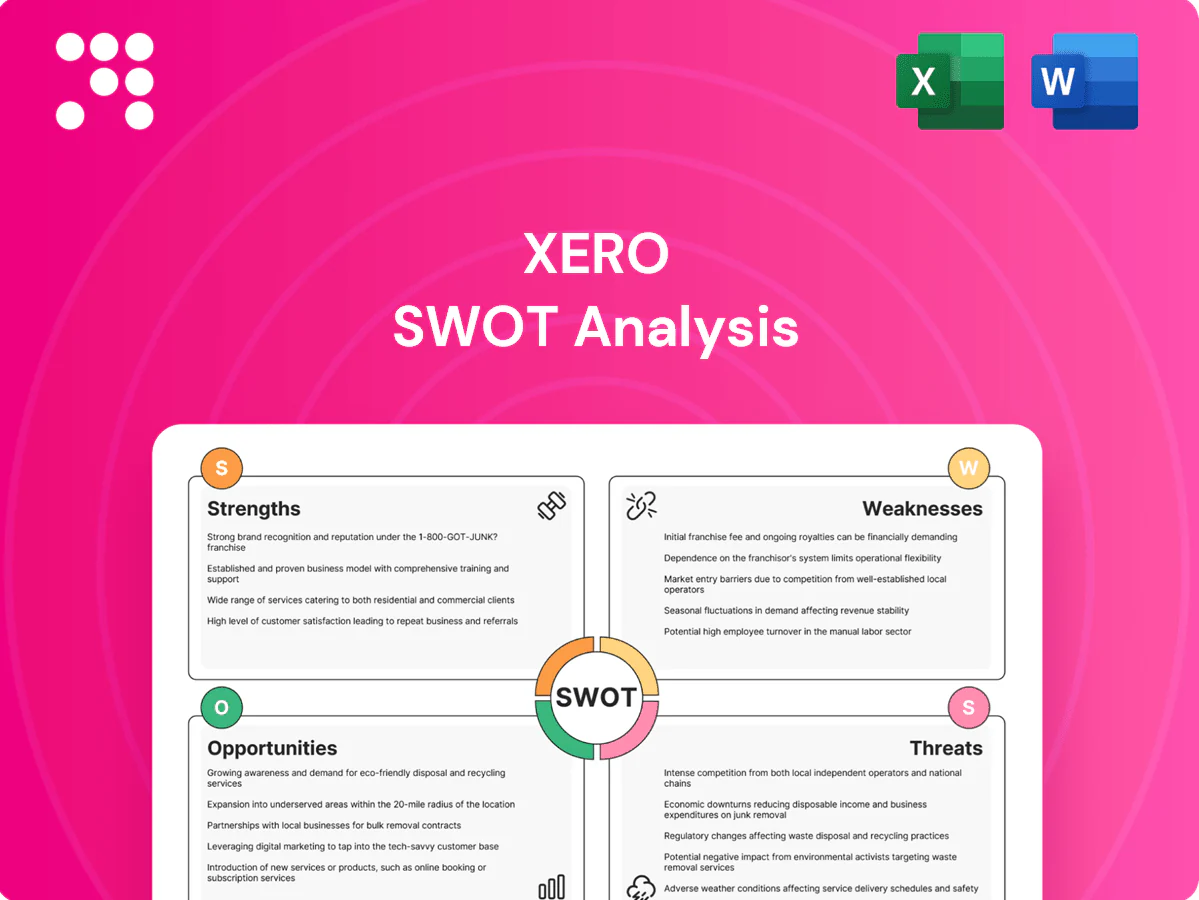
Xero SWOT Analysis

Elevate Your Analysis with the Complete SWOT Report
Xero's SWOT snapshot highlights strong cloud-native positioning, robust SME adoption, and integration strengths, alongside competition and scaling risks. Want the full story behind Xero’s strengths, threats, and growth levers? Purchase the complete SWOT analysis for a professionally written, editable report and Excel matrix to support strategy, pitches, and investment decisions.
Strengths

SMB-focused cloud platform
Designed for SMBs, Xero’s workflows mirror day-to-day accounting needs, serving over 3 million small business subscribers globally. Cloud-first delivery gives owners and advisors anytime, anywhere access and integrates with 1,000+ apps to simplify operations versus enterprise suites. The SMB focus trims complexity, enabling faster onboarding and higher user satisfaction.
Robust core accounting suite
Xero’s core suite consolidates invoicing, bank reconciliation, expenses, payroll and real-time reporting in one platform, serving 3+ million subscribers across 180+ countries. Integrated features reduce app-switching and data silos, improving data integrity and workflow continuity. Strong automation cuts repetitive manual tasks and errors, while the breadth of capabilities supports scalable growth for small and midmarket customers.

Accountant–advisor collaboration
Shared ledgers and granular permissions let accountants and clients work in real time, cutting month-end close times and raising accuracy; Xero supported about 3.9 million subscribers and over 200,000 advisor partners as of March 2024, amplifying this effect. Advisors use up-to-date data to deliver proactive cashflow and tax insights, strengthening network effects across practices and SMB clients.

Subscription recurring revenue
Xero’s subscription model delivers predictable, high-visibility cash flows, supporting continuous product investment and R&D; by 2024 Xero served over 3 million subscribers, underpinning scale advantages. Recurring revenue drives stable growth as engaged users exhibit lower churn, while tiered plans enable systematic upsell as small-business needs expand.
- stable cash flow: subscription-led
- scale: >3 million subscribers (2024)
- investment: funds continuous product development
- growth: lower churn + tiered upsell
Open ecosystem and integrations
Xero integrates with banks, payments, payroll and thousands of third-party apps, and its open API supports a 1,200+ app marketplace, enabling customers to tailor solutions without heavy custom builds; this extensibility boosts stickiness and lifetime value across its ~3.8m subscribers.
- 3.8m subscribers
- 1,200+ apps
- thousands of bank feeds
Cloud-first SMB unified core, 1,200+ apps and predictable recurring revenue
SMB-focused workflows and cloud-first access drive high adoption and satisfaction; Xero served about 3.9 million subscribers and 200,000 advisor partners as of March 2024. A consolidated core (invoicing, reconciliation, payroll, reporting) plus 1,200+ app integrations reduces friction and boosts stickiness. Subscription model yields predictable recurring revenue supporting continuous R&D and scalable upsell.
| Metric | Value |
|---|---|
| Subscribers (Mar 2024) | ~3.9m |
| Advisor partners | ~200k |
| App ecosystem | 1,200+ |
What is included in the product
 Detailed Word Document
Delivers a strategic overview of Xero’s internal and external business factors, outlining strengths, weaknesses, opportunities, and threats. Identifies key growth drivers, operational gaps, and market risks shaping Xero’s competitive position.

 Customizable Excel Spreadsheet
Provides a focused SWOT matrix highlighting Xero’s strengths, weaknesses, opportunities, and threats to quickly pinpoint pain points, prioritize fixes, and align remediation strategies across teams.
Weaknesses

Reliance on third-party add-ons
Many advanced Xero workflows depend on the Xero App Marketplace, which lists over 1,000 third-party add-ons, creating fragmented user journeys and added support complexity. Dependency risks rise if partners change pricing or discontinue features, exposing customers to sudden cost or functionality gaps. This can make Xero appear less comprehensive versus all-in-one rivals, weakening perceived value.
Limited enterprise depth
Xero is engineered for SMBs rather than complex enterprises, so advanced consolidation, strict governance controls and many industry-specific modules are limited. Fast-growing customers frequently migrate to ERP platforms for multi-entity consolidation and compliance, creating churn risk as firms scale. This ceiling on functionality constrains average revenue per user at the upper end compared with enterprise-focused vendors.

Regional functionality differences
Tax, payroll and compliance features vary significantly across the 180+ countries where Xero operates, leaving uneven localization that can hinder adoption in new markets. Customers often resort to manual workarounds or third-party apps to meet local requirements, increasing support volume and implementation time. This complexity raises operational support load and slows international expansion.

Price sensitivity of SMBs
SMB customers are highly cost-conscious and churn-prone in downturns; price increases often trigger switching, and tight budgets slow upsell velocity, constraining ARPU growth and margin expansion. SMEs account for over 90% of businesses globally (World Bank), intensifying Xero’s exposure to price-sensitive segments in 2024–25.
- High churn risk
- Price-sensitive SMB base
- Slow upsell = capped ARPU
- Margin pressure in downturns
Data migration and setup friction
Onboarding from legacy tools or spreadsheets can be time-consuming; historical data cleanup and bank feed setup often require extra consultancy hours, elongating sales cycles and raising implementation costs. Perceived complexity deters some small businesses despite Xero’s ecosystem scale.
- Over 1,000 apps in Xero App Store (2024)
- Data cleanup increases implementation time
- Perceived complexity slows conversions
1,000+ app reliance fragments UX; scale caps ARPU; gaps in 180+ countries
Heavy reliance on 1,000+ third-party apps (Xero App Store, 2024) fragments UX and raises partner risk, exposing customers to sudden cost or feature gaps. Platform limits for complex multi-entity consolidation and governance push scaling SMBs to ERPs, capping ARPU and increasing churn. Localization gaps across 180+ countries and price-sensitive SMB base (>90% of firms globally, World Bank) raise support load and slow expansion.
| Weakness | Metric | Impact |
|---|---|---|
| App dependency | 1,000+ apps (2024) | Fragmentation, partner risk |
| Scale ceiling | Limited ERP features | Capped ARPU, churn to ERPs |
| Localization | 180+ countries | Uneven compliance, support load |
Preview the Actual Deliverable
Xero SWOT Analysis
This is the actual Xero SWOT analysis document you’ll receive upon purchase—no surprises, just professional quality. The preview below is taken directly from the full report and the complete, editable version is unlocked after checkout.

Elevate Your Analysis with the Complete SWOT Report
Xero's SWOT snapshot highlights strong cloud-native positioning, robust SME adoption, and integration strengths, alongside competition and scaling risks. Want the full story behind Xero’s strengths, threats, and growth levers? Purchase the complete SWOT analysis for a professionally written, editable report and Excel matrix to support strategy, pitches, and investment decisions.
Strengths
SMB-focused cloud platform
Designed for SMBs, Xero’s workflows mirror day-to-day accounting needs, serving over 3 million small business subscribers globally. Cloud-first delivery gives owners and advisors anytime, anywhere access and integrates with 1,000+ apps to simplify operations versus enterprise suites. The SMB focus trims complexity, enabling faster onboarding and higher user satisfaction.
Robust core accounting suite
Xero’s core suite consolidates invoicing, bank reconciliation, expenses, payroll and real-time reporting in one platform, serving 3+ million subscribers across 180+ countries. Integrated features reduce app-switching and data silos, improving data integrity and workflow continuity. Strong automation cuts repetitive manual tasks and errors, while the breadth of capabilities supports scalable growth for small and midmarket customers.
Accountant–advisor collaboration
Shared ledgers and granular permissions let accountants and clients work in real time, cutting month-end close times and raising accuracy; Xero supported about 3.9 million subscribers and over 200,000 advisor partners as of March 2024, amplifying this effect. Advisors use up-to-date data to deliver proactive cashflow and tax insights, strengthening network effects across practices and SMB clients.
Subscription recurring revenue
Xero’s subscription model delivers predictable, high-visibility cash flows, supporting continuous product investment and R&D; by 2024 Xero served over 3 million subscribers, underpinning scale advantages. Recurring revenue drives stable growth as engaged users exhibit lower churn, while tiered plans enable systematic upsell as small-business needs expand.
- stable cash flow: subscription-led
- scale: >3 million subscribers (2024)
- investment: funds continuous product development
- growth: lower churn + tiered upsell
Open ecosystem and integrations
Xero integrates with banks, payments, payroll and thousands of third-party apps, and its open API supports a 1,200+ app marketplace, enabling customers to tailor solutions without heavy custom builds; this extensibility boosts stickiness and lifetime value across its ~3.8m subscribers.
- 3.8m subscribers
- 1,200+ apps
- thousands of bank feeds
Cloud-first SMB unified core, 1,200+ apps and predictable recurring revenue
SMB-focused workflows and cloud-first access drive high adoption and satisfaction; Xero served about 3.9 million subscribers and 200,000 advisor partners as of March 2024. A consolidated core (invoicing, reconciliation, payroll, reporting) plus 1,200+ app integrations reduces friction and boosts stickiness. Subscription model yields predictable recurring revenue supporting continuous R&D and scalable upsell.
| Metric | Value |
|---|---|
| Subscribers (Mar 2024) | ~3.9m |
| Advisor partners | ~200k |
| App ecosystem | 1,200+ |
What is included in the product
Detailed Word Document
Delivers a strategic overview of Xero’s internal and external business factors, outlining strengths, weaknesses, opportunities, and threats. Identifies key growth drivers, operational gaps, and market risks shaping Xero’s competitive position.
Customizable Excel Spreadsheet
Provides a focused SWOT matrix highlighting Xero’s strengths, weaknesses, opportunities, and threats to quickly pinpoint pain points, prioritize fixes, and align remediation strategies across teams.
Weaknesses
Reliance on third-party add-ons
Many advanced Xero workflows depend on the Xero App Marketplace, which lists over 1,000 third-party add-ons, creating fragmented user journeys and added support complexity. Dependency risks rise if partners change pricing or discontinue features, exposing customers to sudden cost or functionality gaps. This can make Xero appear less comprehensive versus all-in-one rivals, weakening perceived value.
Limited enterprise depth
Xero is engineered for SMBs rather than complex enterprises, so advanced consolidation, strict governance controls and many industry-specific modules are limited. Fast-growing customers frequently migrate to ERP platforms for multi-entity consolidation and compliance, creating churn risk as firms scale. This ceiling on functionality constrains average revenue per user at the upper end compared with enterprise-focused vendors.
Regional functionality differences
Tax, payroll and compliance features vary significantly across the 180+ countries where Xero operates, leaving uneven localization that can hinder adoption in new markets. Customers often resort to manual workarounds or third-party apps to meet local requirements, increasing support volume and implementation time. This complexity raises operational support load and slows international expansion.
Price sensitivity of SMBs
SMB customers are highly cost-conscious and churn-prone in downturns; price increases often trigger switching, and tight budgets slow upsell velocity, constraining ARPU growth and margin expansion. SMEs account for over 90% of businesses globally (World Bank), intensifying Xero’s exposure to price-sensitive segments in 2024–25.
- High churn risk
- Price-sensitive SMB base
- Slow upsell = capped ARPU
- Margin pressure in downturns
Data migration and setup friction
Onboarding from legacy tools or spreadsheets can be time-consuming; historical data cleanup and bank feed setup often require extra consultancy hours, elongating sales cycles and raising implementation costs. Perceived complexity deters some small businesses despite Xero’s ecosystem scale.
- Over 1,000 apps in Xero App Store (2024)
- Data cleanup increases implementation time
- Perceived complexity slows conversions
1,000+ app reliance fragments UX; scale caps ARPU; gaps in 180+ countries
Heavy reliance on 1,000+ third-party apps (Xero App Store, 2024) fragments UX and raises partner risk, exposing customers to sudden cost or feature gaps. Platform limits for complex multi-entity consolidation and governance push scaling SMBs to ERPs, capping ARPU and increasing churn. Localization gaps across 180+ countries and price-sensitive SMB base (>90% of firms globally, World Bank) raise support load and slow expansion.
| Weakness | Metric | Impact |
|---|---|---|
| App dependency | 1,000+ apps (2024) | Fragmentation, partner risk |
| Scale ceiling | Limited ERP features | Capped ARPU, churn to ERPs |
| Localization | 180+ countries | Uneven compliance, support load |
Preview the Actual Deliverable
Xero SWOT Analysis
This is the actual Xero SWOT analysis document you’ll receive upon purchase—no surprises, just professional quality. The preview below is taken directly from the full report and the complete, editable version is unlocked after checkout.
Description
Elevate Your Analysis with the Complete SWOT Report
Xero's SWOT snapshot highlights strong cloud-native positioning, robust SME adoption, and integration strengths, alongside competition and scaling risks. Want the full story behind Xero’s strengths, threats, and growth levers? Purchase the complete SWOT analysis for a professionally written, editable report and Excel matrix to support strategy, pitches, and investment decisions.
Strengths
SMB-focused cloud platform
Designed for SMBs, Xero’s workflows mirror day-to-day accounting needs, serving over 3 million small business subscribers globally. Cloud-first delivery gives owners and advisors anytime, anywhere access and integrates with 1,000+ apps to simplify operations versus enterprise suites. The SMB focus trims complexity, enabling faster onboarding and higher user satisfaction.
Robust core accounting suite
Xero’s core suite consolidates invoicing, bank reconciliation, expenses, payroll and real-time reporting in one platform, serving 3+ million subscribers across 180+ countries. Integrated features reduce app-switching and data silos, improving data integrity and workflow continuity. Strong automation cuts repetitive manual tasks and errors, while the breadth of capabilities supports scalable growth for small and midmarket customers.
Accountant–advisor collaboration
Shared ledgers and granular permissions let accountants and clients work in real time, cutting month-end close times and raising accuracy; Xero supported about 3.9 million subscribers and over 200,000 advisor partners as of March 2024, amplifying this effect. Advisors use up-to-date data to deliver proactive cashflow and tax insights, strengthening network effects across practices and SMB clients.
Subscription recurring revenue
Xero’s subscription model delivers predictable, high-visibility cash flows, supporting continuous product investment and R&D; by 2024 Xero served over 3 million subscribers, underpinning scale advantages. Recurring revenue drives stable growth as engaged users exhibit lower churn, while tiered plans enable systematic upsell as small-business needs expand.
- stable cash flow: subscription-led
- scale: >3 million subscribers (2024)
- investment: funds continuous product development
- growth: lower churn + tiered upsell
Open ecosystem and integrations
Xero integrates with banks, payments, payroll and thousands of third-party apps, and its open API supports a 1,200+ app marketplace, enabling customers to tailor solutions without heavy custom builds; this extensibility boosts stickiness and lifetime value across its ~3.8m subscribers.
- 3.8m subscribers
- 1,200+ apps
- thousands of bank feeds
Cloud-first SMB unified core, 1,200+ apps and predictable recurring revenue
SMB-focused workflows and cloud-first access drive high adoption and satisfaction; Xero served about 3.9 million subscribers and 200,000 advisor partners as of March 2024. A consolidated core (invoicing, reconciliation, payroll, reporting) plus 1,200+ app integrations reduces friction and boosts stickiness. Subscription model yields predictable recurring revenue supporting continuous R&D and scalable upsell.
| Metric | Value |
|---|---|
| Subscribers (Mar 2024) | ~3.9m |
| Advisor partners | ~200k |
| App ecosystem | 1,200+ |
What is included in the product
Detailed Word Document
Delivers a strategic overview of Xero’s internal and external business factors, outlining strengths, weaknesses, opportunities, and threats. Identifies key growth drivers, operational gaps, and market risks shaping Xero’s competitive position.
Customizable Excel Spreadsheet
Provides a focused SWOT matrix highlighting Xero’s strengths, weaknesses, opportunities, and threats to quickly pinpoint pain points, prioritize fixes, and align remediation strategies across teams.
Weaknesses
Reliance on third-party add-ons
Many advanced Xero workflows depend on the Xero App Marketplace, which lists over 1,000 third-party add-ons, creating fragmented user journeys and added support complexity. Dependency risks rise if partners change pricing or discontinue features, exposing customers to sudden cost or functionality gaps. This can make Xero appear less comprehensive versus all-in-one rivals, weakening perceived value.
Limited enterprise depth
Xero is engineered for SMBs rather than complex enterprises, so advanced consolidation, strict governance controls and many industry-specific modules are limited. Fast-growing customers frequently migrate to ERP platforms for multi-entity consolidation and compliance, creating churn risk as firms scale. This ceiling on functionality constrains average revenue per user at the upper end compared with enterprise-focused vendors.
Regional functionality differences
Tax, payroll and compliance features vary significantly across the 180+ countries where Xero operates, leaving uneven localization that can hinder adoption in new markets. Customers often resort to manual workarounds or third-party apps to meet local requirements, increasing support volume and implementation time. This complexity raises operational support load and slows international expansion.
Price sensitivity of SMBs
SMB customers are highly cost-conscious and churn-prone in downturns; price increases often trigger switching, and tight budgets slow upsell velocity, constraining ARPU growth and margin expansion. SMEs account for over 90% of businesses globally (World Bank), intensifying Xero’s exposure to price-sensitive segments in 2024–25.
- High churn risk
- Price-sensitive SMB base
- Slow upsell = capped ARPU
- Margin pressure in downturns
Data migration and setup friction
Onboarding from legacy tools or spreadsheets can be time-consuming; historical data cleanup and bank feed setup often require extra consultancy hours, elongating sales cycles and raising implementation costs. Perceived complexity deters some small businesses despite Xero’s ecosystem scale.
- Over 1,000 apps in Xero App Store (2024)
- Data cleanup increases implementation time
- Perceived complexity slows conversions
1,000+ app reliance fragments UX; scale caps ARPU; gaps in 180+ countries
Heavy reliance on 1,000+ third-party apps (Xero App Store, 2024) fragments UX and raises partner risk, exposing customers to sudden cost or feature gaps. Platform limits for complex multi-entity consolidation and governance push scaling SMBs to ERPs, capping ARPU and increasing churn. Localization gaps across 180+ countries and price-sensitive SMB base (>90% of firms globally, World Bank) raise support load and slow expansion.
| Weakness | Metric | Impact |
|---|---|---|
| App dependency | 1,000+ apps (2024) | Fragmentation, partner risk |
| Scale ceiling | Limited ERP features | Capped ARPU, churn to ERPs |
| Localization | 180+ countries | Uneven compliance, support load |
Preview the Actual Deliverable
Xero SWOT Analysis
This is the actual Xero SWOT analysis document you’ll receive upon purchase—no surprises, just professional quality. The preview below is taken directly from the full report and the complete, editable version is unlocked after checkout.











