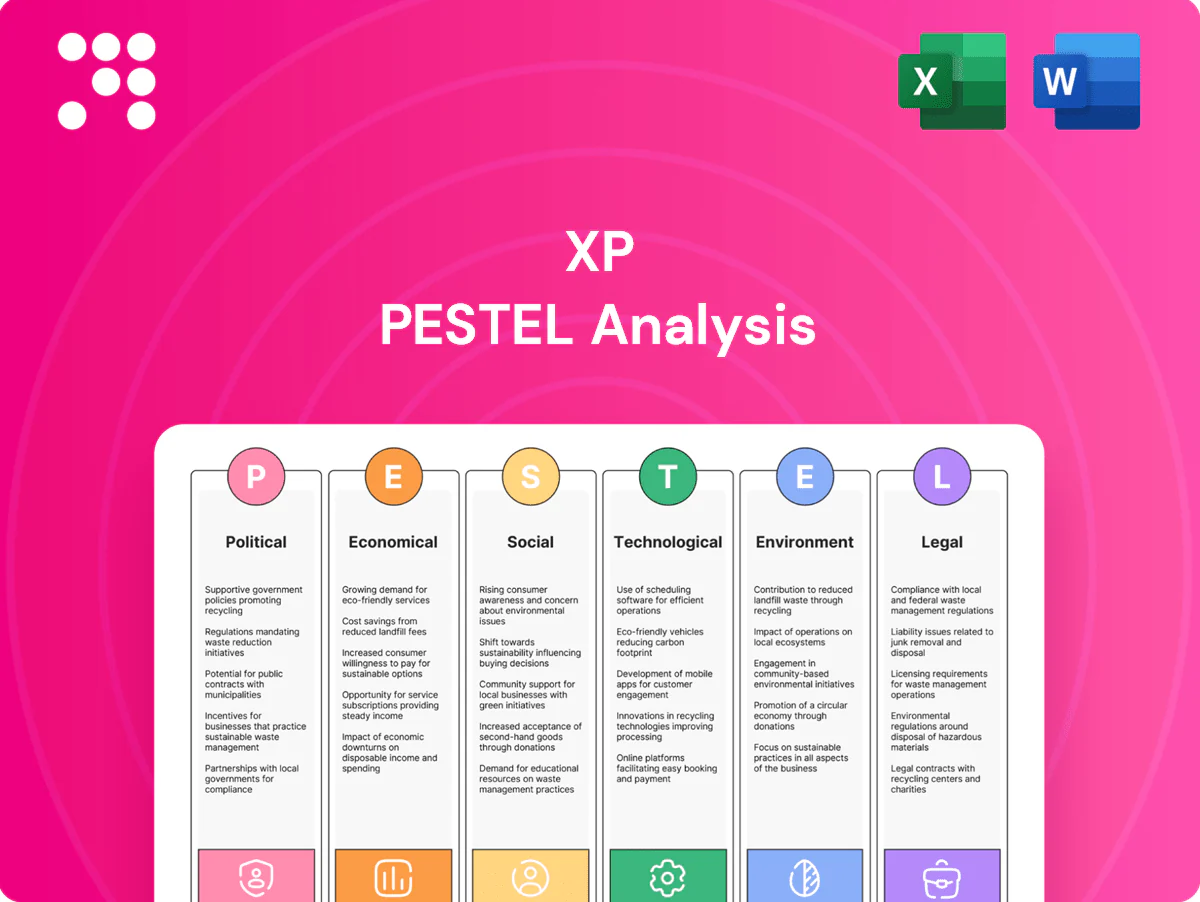
XP PESTLE Analysis

Your Shortcut to Market Insight Starts Here
Discover how political, economic, social, technological, legal, and environmental forces are reshaping XP’s prospects in our concise PESTLE snapshot. This analysis highlights risks and growth levers investors and strategists need to know. Purchase the full report for the complete, actionable breakdown and ready-to-use insights.
Political factors

Regulatory stance by CVM/BCB
Brazil’s securities regulator (CVM) and Central Bank (BCB) set prudential, conduct and market rules that directly shape XP’s brokerage operations, suitability assessments and leverage limits. Recent policy focus on investor protection, crypto asset rules and crowdfunding frameworks can expand or constrain XP’s product shelf. XP must sustain proactive regulatory dialogue and rapid compliance readiness. Swift rule changes can compress margins, slow onboarding and delay product timelines.
Policy continuity & election cycles
National and state election cycles (municipal elections Oct 2024, next general election Oct 2026) shift fiscal priorities, privatization agendas and influence capital market depth in Brazil.
Policy uncertainty around elections raises volatility and can reduce trading volumes and risk appetite, affecting brokerage revenue streams.
XP gains from stable macro frameworks that support listings and savings migration into capital markets, while election rhetoric can alter tax incentives and fee structures.

State influence & public banks
Large state-owned banks and development entities like BNDES, Caixa and Banco do Brasil — which together account for roughly 40% of Brazil’s banking assets — can steer credit allocation and market liquidity, with BNDES playing a key role in long-term project finance. Shifts to directed lending or subsidized rates risk crowding out private intermediation, while market-friendly reforms historically boost brokerage volumes. XP must hedge against policy-driven competitive distortions through product diversification, risk pricing and active regulatory engagement.

Regional integration & diplomacy
Regional diplomacy — notably Mercosur dynamics (regional GDP ~US$2.5tn, Brazil ~US$1.9tn) and bilateral ties — shapes foreign investor flows and product passporting; cross-border capital rules and geopolitical tensions that drove ~15% BRL volatility in 2023–24 can change commodity terms-of-trade and FX risk for XP’s asset and advisory flows.
- Mercosur impact on passporting
- Bilateral FTAs drive FDI allocation
- FX volatility raises hedging needs
- Regulatory harmonization reduces compliance friction
Public financial education agendas
Government-backed financial literacy programs have broadened retail participation and diversified funding channels; Brazil's individual investor base on B3 surpassed 8 million by 2023, highlighting growth potential for XP's retail funnel. Aligning XP's education brand with public initiatives can boost lead-gen and trust, though budget constraints or shifting political priorities may slow program momentum. Partnerships with schools and agencies provide continuity across political cycles.
- increased retail reach
- brand amplification via public alignment
- risk: budgetary shifts
- mitigation: school/agency partnerships
Regulatory shifts and election risk squeeze margins; state banks hold ~40%, retail >8m
Regulatory bodies CVM and BCB drive XP’s product, leverage and compliance landscape; fast rule changes compress margins and delay launches. Election cycles (municipal Oct 2024, general Oct 2026) raise policy uncertainty, reducing volumes and risk appetite. State banks hold ~40% of banking assets, risking crowding out private intermediation; retail base on B3 surpassed 8m investors (2023).
| Metric | Value |
|---|---|
| State banks share | ~40% of assets |
| B3 retail investors | >8m (2023) |
| Mercosur GDP | ~US$2.5tn |
| BRL vol (2023–24) | ~15% |
What is included in the product
 Detailed Word Document
Explores how external macro-environmental factors uniquely affect the XP across Political, Economic, Social, Technological, Environmental and Legal dimensions, with data-backed insights, forward-looking scenario guidance, and ready-to-use findings to help executives, investors and entrepreneurs identify risks, opportunities and competitive impacts.

 Customizable Excel Spreadsheet
Visually segmented by PESTLE categories and written in clear, simple language to speed stakeholder understanding, the XP PESTLE Analysis delivers a concise, editable summary that can be dropped into presentations or planning sessions. Its shareable format and note-friendly layout remove friction in team alignment and risk discussion across regions and business lines.
Economic factors

Interest rate trajectory
Brazil's high, cyclical policy rate — Selic at 12.25% in July 2025 — keeps real rates elevated (~6–7% vs. inflation), steering allocations between fixed income and equities; easing cycles historically (post-2023 peak) re-route flows into risk assets and fee-rich products, tightening reverses that dynamic. XP's revenue mix is sensitive to net interest, brokerage and performance fees, while its broad hedging product set cushions abrupt cycle turns.
FX volatility & capital flows
BRL swings (around 15% vs USD through 2024) have tightened foreign appetite for Brazilian assets and raised the landed cost of imported tech, squeezing margins for brokers and clients. FX volatility can lift trading volumes—vols spiked to the mid-20s% implied in stress episodes—but also raises hedging costs and client risk aversion. Global liquidity cycles and risk‑on/off regimes narrow IPO windows, so XP must capture trading uplift while tightening margin and credit controls.

Household income & savings rate
Employment at ~7.8% unemployment (2024) and modest real wage growth of about 1.5% in Brazil determine household investable surplus, while household debt-to-income near 52% compresses discretionary flows. Rising formalization and real incomes have driven brokerage penetration, with XP reporting roughly 5.2 million client accounts (end-2024). Credit stress reduces lump-sum investments; XP’s financial education and goal-based planning help smooth contributions across cycles.

Capital market depth
Capital market depth affects XP by shaping fee pools: a robust pipeline of IPOs, follow‑ons and debentures increases distribution fees and wallet share, while pension reform and rising institutional demand (global pension assets ~56.2 trillion USD in 2023, OECD) lift demand for long‑duration products; deep liquidity enables advisory cross‑sells and alternatives, whereas thin markets drive higher execution costs and client churn risk.
- Pipeline = distribution fees
- Pensions = long‑duration demand
- Liquidity = cross‑sell & alternatives
- Thin markets = execution cost & churn
Inflation dynamics
Inflation alters real returns, asset mix and client risk tolerance; US CPI averaged 3.4% in 2024 while Brazil IPCA hovered near 4.5%, pushing nominal rates (Selic ~13.75% in 2024) higher — boosting cash spreads but reducing equity appetite; stable inflation supports multi-asset adoption and longer horizons; XP must update pricing, product design and client guidance swiftly.
- real-returns: adjust for CPI 3.4%/4.5%
- asset-mix: cash yields ↑, equities ↓
- client-risk: lower equity tolerance
- action: update pricing/products/guidance
Regulatory shifts and election risk squeeze margins; state banks hold ~40%, retail >8m
Brazil's Selic at 12.25% (Jul 2025) and IPCA ~4.5% (2024) keep real rates high, favoring fixed income; easing shifts assets to equities and fee‑rich products. BRL volatility (~15% vs USD in 2024) raises hedging costs but lifts trading volumes; unemployment ~7.8% (2024) and 5.2m XP accounts limit retail inflows. Capital market depth and global pension demand (~$56.2T, 2023) expand distribution and long‑duration demand.
| Metric | Value | Impact |
|---|---|---|
| Selic | 12.25% | ↑Cash yields |
| BRL vol | ~15% | ↑Hedge cost/volumes |
| XP accounts | 5.2m | Retail base |
What You See Is What You Get
XP PESTLE Analysis
The preview shown here is the exact XP PESTLE Analysis document you’ll receive after purchase—fully formatted and ready to use. This is the final file with complete content, structure, and professional layout. No placeholders or surprises; you can download it immediately after checkout.

Your Shortcut to Market Insight Starts Here
Discover how political, economic, social, technological, legal, and environmental forces are reshaping XP’s prospects in our concise PESTLE snapshot. This analysis highlights risks and growth levers investors and strategists need to know. Purchase the full report for the complete, actionable breakdown and ready-to-use insights.
Political factors
Regulatory stance by CVM/BCB
Brazil’s securities regulator (CVM) and Central Bank (BCB) set prudential, conduct and market rules that directly shape XP’s brokerage operations, suitability assessments and leverage limits. Recent policy focus on investor protection, crypto asset rules and crowdfunding frameworks can expand or constrain XP’s product shelf. XP must sustain proactive regulatory dialogue and rapid compliance readiness. Swift rule changes can compress margins, slow onboarding and delay product timelines.
Policy continuity & election cycles
National and state election cycles (municipal elections Oct 2024, next general election Oct 2026) shift fiscal priorities, privatization agendas and influence capital market depth in Brazil.
Policy uncertainty around elections raises volatility and can reduce trading volumes and risk appetite, affecting brokerage revenue streams.
XP gains from stable macro frameworks that support listings and savings migration into capital markets, while election rhetoric can alter tax incentives and fee structures.
State influence & public banks
Large state-owned banks and development entities like BNDES, Caixa and Banco do Brasil — which together account for roughly 40% of Brazil’s banking assets — can steer credit allocation and market liquidity, with BNDES playing a key role in long-term project finance. Shifts to directed lending or subsidized rates risk crowding out private intermediation, while market-friendly reforms historically boost brokerage volumes. XP must hedge against policy-driven competitive distortions through product diversification, risk pricing and active regulatory engagement.
Regional integration & diplomacy
Regional diplomacy — notably Mercosur dynamics (regional GDP ~US$2.5tn, Brazil ~US$1.9tn) and bilateral ties — shapes foreign investor flows and product passporting; cross-border capital rules and geopolitical tensions that drove ~15% BRL volatility in 2023–24 can change commodity terms-of-trade and FX risk for XP’s asset and advisory flows.
- Mercosur impact on passporting
- Bilateral FTAs drive FDI allocation
- FX volatility raises hedging needs
- Regulatory harmonization reduces compliance friction
Public financial education agendas
Government-backed financial literacy programs have broadened retail participation and diversified funding channels; Brazil's individual investor base on B3 surpassed 8 million by 2023, highlighting growth potential for XP's retail funnel. Aligning XP's education brand with public initiatives can boost lead-gen and trust, though budget constraints or shifting political priorities may slow program momentum. Partnerships with schools and agencies provide continuity across political cycles.
- increased retail reach
- brand amplification via public alignment
- risk: budgetary shifts
- mitigation: school/agency partnerships
Regulatory shifts and election risk squeeze margins; state banks hold ~40%, retail >8m
Regulatory bodies CVM and BCB drive XP’s product, leverage and compliance landscape; fast rule changes compress margins and delay launches. Election cycles (municipal Oct 2024, general Oct 2026) raise policy uncertainty, reducing volumes and risk appetite. State banks hold ~40% of banking assets, risking crowding out private intermediation; retail base on B3 surpassed 8m investors (2023).
| Metric | Value |
|---|---|
| State banks share | ~40% of assets |
| B3 retail investors | >8m (2023) |
| Mercosur GDP | ~US$2.5tn |
| BRL vol (2023–24) | ~15% |
What is included in the product
Detailed Word Document
Explores how external macro-environmental factors uniquely affect the XP across Political, Economic, Social, Technological, Environmental and Legal dimensions, with data-backed insights, forward-looking scenario guidance, and ready-to-use findings to help executives, investors and entrepreneurs identify risks, opportunities and competitive impacts.
Customizable Excel Spreadsheet
Visually segmented by PESTLE categories and written in clear, simple language to speed stakeholder understanding, the XP PESTLE Analysis delivers a concise, editable summary that can be dropped into presentations or planning sessions. Its shareable format and note-friendly layout remove friction in team alignment and risk discussion across regions and business lines.
Economic factors
Interest rate trajectory
Brazil's high, cyclical policy rate — Selic at 12.25% in July 2025 — keeps real rates elevated (~6–7% vs. inflation), steering allocations between fixed income and equities; easing cycles historically (post-2023 peak) re-route flows into risk assets and fee-rich products, tightening reverses that dynamic. XP's revenue mix is sensitive to net interest, brokerage and performance fees, while its broad hedging product set cushions abrupt cycle turns.
FX volatility & capital flows
BRL swings (around 15% vs USD through 2024) have tightened foreign appetite for Brazilian assets and raised the landed cost of imported tech, squeezing margins for brokers and clients. FX volatility can lift trading volumes—vols spiked to the mid-20s% implied in stress episodes—but also raises hedging costs and client risk aversion. Global liquidity cycles and risk‑on/off regimes narrow IPO windows, so XP must capture trading uplift while tightening margin and credit controls.
Household income & savings rate
Employment at ~7.8% unemployment (2024) and modest real wage growth of about 1.5% in Brazil determine household investable surplus, while household debt-to-income near 52% compresses discretionary flows. Rising formalization and real incomes have driven brokerage penetration, with XP reporting roughly 5.2 million client accounts (end-2024). Credit stress reduces lump-sum investments; XP’s financial education and goal-based planning help smooth contributions across cycles.
Capital market depth
Capital market depth affects XP by shaping fee pools: a robust pipeline of IPOs, follow‑ons and debentures increases distribution fees and wallet share, while pension reform and rising institutional demand (global pension assets ~56.2 trillion USD in 2023, OECD) lift demand for long‑duration products; deep liquidity enables advisory cross‑sells and alternatives, whereas thin markets drive higher execution costs and client churn risk.
- Pipeline = distribution fees
- Pensions = long‑duration demand
- Liquidity = cross‑sell & alternatives
- Thin markets = execution cost & churn
Inflation dynamics
Inflation alters real returns, asset mix and client risk tolerance; US CPI averaged 3.4% in 2024 while Brazil IPCA hovered near 4.5%, pushing nominal rates (Selic ~13.75% in 2024) higher — boosting cash spreads but reducing equity appetite; stable inflation supports multi-asset adoption and longer horizons; XP must update pricing, product design and client guidance swiftly.
- real-returns: adjust for CPI 3.4%/4.5%
- asset-mix: cash yields ↑, equities ↓
- client-risk: lower equity tolerance
- action: update pricing/products/guidance
Regulatory shifts and election risk squeeze margins; state banks hold ~40%, retail >8m
Brazil's Selic at 12.25% (Jul 2025) and IPCA ~4.5% (2024) keep real rates high, favoring fixed income; easing shifts assets to equities and fee‑rich products. BRL volatility (~15% vs USD in 2024) raises hedging costs but lifts trading volumes; unemployment ~7.8% (2024) and 5.2m XP accounts limit retail inflows. Capital market depth and global pension demand (~$56.2T, 2023) expand distribution and long‑duration demand.
| Metric | Value | Impact |
|---|---|---|
| Selic | 12.25% | ↑Cash yields |
| BRL vol | ~15% | ↑Hedge cost/volumes |
| XP accounts | 5.2m | Retail base |
What You See Is What You Get
XP PESTLE Analysis
The preview shown here is the exact XP PESTLE Analysis document you’ll receive after purchase—fully formatted and ready to use. This is the final file with complete content, structure, and professional layout. No placeholders or surprises; you can download it immediately after checkout.
Original: $10.00
-65%$10.00
$3.50Description
Your Shortcut to Market Insight Starts Here
Discover how political, economic, social, technological, legal, and environmental forces are reshaping XP’s prospects in our concise PESTLE snapshot. This analysis highlights risks and growth levers investors and strategists need to know. Purchase the full report for the complete, actionable breakdown and ready-to-use insights.
Political factors
Regulatory stance by CVM/BCB
Brazil’s securities regulator (CVM) and Central Bank (BCB) set prudential, conduct and market rules that directly shape XP’s brokerage operations, suitability assessments and leverage limits. Recent policy focus on investor protection, crypto asset rules and crowdfunding frameworks can expand or constrain XP’s product shelf. XP must sustain proactive regulatory dialogue and rapid compliance readiness. Swift rule changes can compress margins, slow onboarding and delay product timelines.
Policy continuity & election cycles
National and state election cycles (municipal elections Oct 2024, next general election Oct 2026) shift fiscal priorities, privatization agendas and influence capital market depth in Brazil.
Policy uncertainty around elections raises volatility and can reduce trading volumes and risk appetite, affecting brokerage revenue streams.
XP gains from stable macro frameworks that support listings and savings migration into capital markets, while election rhetoric can alter tax incentives and fee structures.
State influence & public banks
Large state-owned banks and development entities like BNDES, Caixa and Banco do Brasil — which together account for roughly 40% of Brazil’s banking assets — can steer credit allocation and market liquidity, with BNDES playing a key role in long-term project finance. Shifts to directed lending or subsidized rates risk crowding out private intermediation, while market-friendly reforms historically boost brokerage volumes. XP must hedge against policy-driven competitive distortions through product diversification, risk pricing and active regulatory engagement.
Regional integration & diplomacy
Regional diplomacy — notably Mercosur dynamics (regional GDP ~US$2.5tn, Brazil ~US$1.9tn) and bilateral ties — shapes foreign investor flows and product passporting; cross-border capital rules and geopolitical tensions that drove ~15% BRL volatility in 2023–24 can change commodity terms-of-trade and FX risk for XP’s asset and advisory flows.
- Mercosur impact on passporting
- Bilateral FTAs drive FDI allocation
- FX volatility raises hedging needs
- Regulatory harmonization reduces compliance friction
Public financial education agendas
Government-backed financial literacy programs have broadened retail participation and diversified funding channels; Brazil's individual investor base on B3 surpassed 8 million by 2023, highlighting growth potential for XP's retail funnel. Aligning XP's education brand with public initiatives can boost lead-gen and trust, though budget constraints or shifting political priorities may slow program momentum. Partnerships with schools and agencies provide continuity across political cycles.
- increased retail reach
- brand amplification via public alignment
- risk: budgetary shifts
- mitigation: school/agency partnerships
Regulatory shifts and election risk squeeze margins; state banks hold ~40%, retail >8m
Regulatory bodies CVM and BCB drive XP’s product, leverage and compliance landscape; fast rule changes compress margins and delay launches. Election cycles (municipal Oct 2024, general Oct 2026) raise policy uncertainty, reducing volumes and risk appetite. State banks hold ~40% of banking assets, risking crowding out private intermediation; retail base on B3 surpassed 8m investors (2023).
| Metric | Value |
|---|---|
| State banks share | ~40% of assets |
| B3 retail investors | >8m (2023) |
| Mercosur GDP | ~US$2.5tn |
| BRL vol (2023–24) | ~15% |
What is included in the product
Detailed Word Document
Explores how external macro-environmental factors uniquely affect the XP across Political, Economic, Social, Technological, Environmental and Legal dimensions, with data-backed insights, forward-looking scenario guidance, and ready-to-use findings to help executives, investors and entrepreneurs identify risks, opportunities and competitive impacts.
Customizable Excel Spreadsheet
Visually segmented by PESTLE categories and written in clear, simple language to speed stakeholder understanding, the XP PESTLE Analysis delivers a concise, editable summary that can be dropped into presentations or planning sessions. Its shareable format and note-friendly layout remove friction in team alignment and risk discussion across regions and business lines.
Economic factors
Interest rate trajectory
Brazil's high, cyclical policy rate — Selic at 12.25% in July 2025 — keeps real rates elevated (~6–7% vs. inflation), steering allocations between fixed income and equities; easing cycles historically (post-2023 peak) re-route flows into risk assets and fee-rich products, tightening reverses that dynamic. XP's revenue mix is sensitive to net interest, brokerage and performance fees, while its broad hedging product set cushions abrupt cycle turns.
FX volatility & capital flows
BRL swings (around 15% vs USD through 2024) have tightened foreign appetite for Brazilian assets and raised the landed cost of imported tech, squeezing margins for brokers and clients. FX volatility can lift trading volumes—vols spiked to the mid-20s% implied in stress episodes—but also raises hedging costs and client risk aversion. Global liquidity cycles and risk‑on/off regimes narrow IPO windows, so XP must capture trading uplift while tightening margin and credit controls.
Household income & savings rate
Employment at ~7.8% unemployment (2024) and modest real wage growth of about 1.5% in Brazil determine household investable surplus, while household debt-to-income near 52% compresses discretionary flows. Rising formalization and real incomes have driven brokerage penetration, with XP reporting roughly 5.2 million client accounts (end-2024). Credit stress reduces lump-sum investments; XP’s financial education and goal-based planning help smooth contributions across cycles.
Capital market depth
Capital market depth affects XP by shaping fee pools: a robust pipeline of IPOs, follow‑ons and debentures increases distribution fees and wallet share, while pension reform and rising institutional demand (global pension assets ~56.2 trillion USD in 2023, OECD) lift demand for long‑duration products; deep liquidity enables advisory cross‑sells and alternatives, whereas thin markets drive higher execution costs and client churn risk.
- Pipeline = distribution fees
- Pensions = long‑duration demand
- Liquidity = cross‑sell & alternatives
- Thin markets = execution cost & churn
Inflation dynamics
Inflation alters real returns, asset mix and client risk tolerance; US CPI averaged 3.4% in 2024 while Brazil IPCA hovered near 4.5%, pushing nominal rates (Selic ~13.75% in 2024) higher — boosting cash spreads but reducing equity appetite; stable inflation supports multi-asset adoption and longer horizons; XP must update pricing, product design and client guidance swiftly.
- real-returns: adjust for CPI 3.4%/4.5%
- asset-mix: cash yields ↑, equities ↓
- client-risk: lower equity tolerance
- action: update pricing/products/guidance
Regulatory shifts and election risk squeeze margins; state banks hold ~40%, retail >8m
Brazil's Selic at 12.25% (Jul 2025) and IPCA ~4.5% (2024) keep real rates high, favoring fixed income; easing shifts assets to equities and fee‑rich products. BRL volatility (~15% vs USD in 2024) raises hedging costs but lifts trading volumes; unemployment ~7.8% (2024) and 5.2m XP accounts limit retail inflows. Capital market depth and global pension demand (~$56.2T, 2023) expand distribution and long‑duration demand.
| Metric | Value | Impact |
|---|---|---|
| Selic | 12.25% | ↑Cash yields |
| BRL vol | ~15% | ↑Hedge cost/volumes |
| XP accounts | 5.2m | Retail base |
What You See Is What You Get
XP PESTLE Analysis
The preview shown here is the exact XP PESTLE Analysis document you’ll receive after purchase—fully formatted and ready to use. This is the final file with complete content, structure, and professional layout. No placeholders or surprises; you can download it immediately after checkout.











