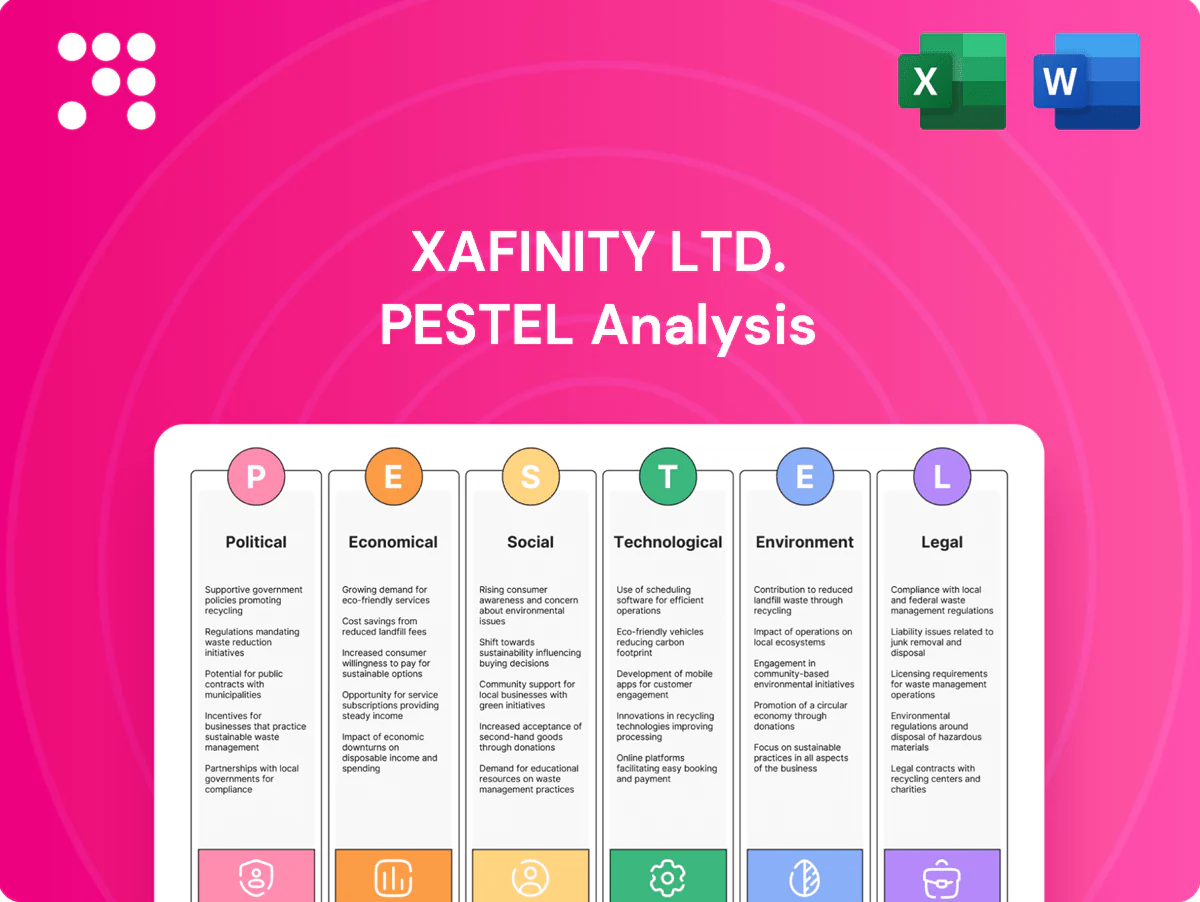
Xafinity Ltd. PESTLE Analysis

Plan Smarter. Present Sharper. Compete Stronger.
Xafinity Ltd.'s PESTLE Analysis highlights regulatory pressures, shifting pension economics, evolving tech platforms, demographic trends affecting demand, and rising ESG expectations; these external forces are reshaping strategy and risk. Gain clear, actionable context to inform investment or strategic moves. Purchase the full PESTLE for the complete, ready-to-use breakdown.
Political factors

UK pensions policy shifts
Post-election shifts can change funding rules, auto-enrolment settings and consolidation policy, affecting schemes within the UK pension market, which held over £3 trillion in assets by 2024. XPS and advisers must rapidly align guidance with DWP/TPR directives to manage compliance and covenant risk. Continued Mansion House reform momentum could accelerate DC investment shifts and consolidation; policy divergence would reshape product demand and trustee strategy.
Regulator stance (TPR)
TPR’s General Code, published in 2024 and now in force, raises governance expectations and makes proactive, evidence-led compliance a market differentiator for Xafinity Ltd. Heightened scrutiny of DB endgames and journey plans is driving measurable demand for actuarial and covenant advice across the sector. Xafinity must align resource planning to TPR consultations and statutory timelines to avoid intervention risk.

Public-sector pension dynamics
Government reforms on LGPS pooling and responsible investment stewardship are reshaping advisory pipelines, with pooled arrangements covering the bulk of LGPS assets (c.£360–380bn range in recent public reports). Political scrutiny of public savings and fee levels is increasing procurement pressure and drives demand for transparent, lower‑cost models. XPS must offer tailored governance and stewardship solutions for public trustees amid tightened expectations. Election cycles can abruptly delay or accelerate mandate decisions.

Geopolitical market volatility
Geopolitical market volatility pushes 10-year gilt yields into the c.4–5% range and can widen corporate credit spreads by up to 200bps during major shocks, raising hedging costs and straining liquidity. Political shocks force repricing and timing shifts in risk transfer, prompting clients to request scenario analysis and dynamic de-risking. XPS/Xafinity benefits from strong ALM capabilities and collateral advisory to manage higher hedging and funding expenses.
- gilt yields: c.4–5%
- credit spread shock: up to 200bps
- clients: increased demand for scenario analysis
- XPS strength: ALM + collateral advisory
Brexit-era rule divergence
Brexit-era rule divergence means UK-specific prudential, data and investment rules now follow UK frameworks rather than EU law: passporting ended in 2021, the EU granted UK data adequacy in June 2021, and the PRA implemented Solvency II reforms in 2022, so Xafinity must monitor ongoing partial equivalence decisions through 2024 and adapt cross-border documentation and compliance models.
- UK passporting ended: 2021
- EU data adequacy granted: June 2021
- PRA Solvency II reforms: 2022
- Action: update vendor/insurer terms, dual documentation, track equivalence
Post-election reforms reshape UK pensions: £3tn market, LGPS pooling pressure
Post-election shifts and Mansion House reform risk change to consolidation, auto‑enrolment and fiduciary policy, impacting the UK pension market (>£3tn assets by 2024). TPR General Code (in force 2024) raises governance demands, boosting actuarial/covenant advisory need. LGPS pooling (~£360–380bn) and gilt yields c.4–5% increase procurement and hedging pressures for Xafinity.
| Metric | Value |
|---|---|
| UK pension assets (2024) | £>3tn |
| LGPS pooled | £360–380bn |
| Gilt yields | c.4–5% |
What is included in the product
 Detailed Word Document
Explores how external macro-environmental factors uniquely affect Xafinity Ltd. across Political, Economic, Social, Technological, Environmental and Legal dimensions; each section is data‑backed, region- and industry-specific, and includes forward‑looking insights to inform strategy, risk mitigation and investor communications.

 Customizable Excel Spreadsheet
A concise, visually segmented PESTLE summary of Xafinity Ltd. tailored for quick sharing and editable notes, enabling teams to align on external risks and market positioning during planning sessions.
Economic factors

Rates and gilt yields
Higher-for-longer UK Bank Rate (around 5.25% through 2024–25) and 10y gilt yields trading near 4–5% have improved defined-benefit funding but raised collateral volatility. Buy-in/buy-out affordability can surge, shifting advisory demand; XPS can monetise endgame planning, LDI governance and hedging calibration. Rapid rate moves continue to stress operational readiness.
Inflation and wages
Stubborn inflation (UK CPI 2.0% June 2025) raises indexation costs and erodes member outcomes, forcing higher defined benefit accrual provisions. Strong wage growth (regular pay ~6% year-on-year, mid-2025) increases DC contributions but alters scheme cash flows and employer affordability. Communication and investment glidepaths must be recalibrated to protect replacement ratios. XPS needs to align assumptions and member guidance accordingly.

Insurer capacity cycle
Insurer capacity cycle drives bulk annuity volumes—2024 UK market transacted roughly £45bn, with capacity tied to insurer capital, reinsurance availability and quality of asset sourcing. Tight capacity in 2024 widened spreads and created transaction queues, pushing prices higher and elongating deal timelines. XPS can differentiate by readying pipelines and ensuring asset-readiness to match insurer underwriting windows. Agile execution captures narrow market windows when capacity loosens.

Employer covenant stress
Macro slowdowns (IMF 2024 global growth 3.1%, 2025 3.2%) elevate employer insolvency risk and force closer scrutiny of recovery plans; covenant assessments and funding negotiations intensify as trustees demand stronger security and shorter remediation timelines. XPS can structure contingent assets and staged journey plans to protect members, while sector-specific shocks require bespoke analytics and scenario testing.
- Covenant stress: tighter recovery plan scrutiny
- Funding talks: more frequent, higher security
- XPS role: contingent assets, journey plans
- Analytics: sector-specific scenario modeling
Productivity and fee pressure
Client cost controls force Xafinity to push efficiency and outcome-based fees; industry surveys in 2024 showed 62% of UK corporates prioritised fee-for-outcome over time-based billing, tightening margins.
Automation and standardisation — including RPA and template-driven advice — act as primary margin levers, supporting 20–30% productivity gains reported by professional services pilots in 2023–24.
Scalable platforms and shared services defend pricing and improve retention when paired with clear ROI narratives; firms demonstrating payback within 12–18 months see materially higher client stickiness.
- 62% industry shift to outcome fees (2024)
- 20–30% productivity uplift from automation (2023–24 pilots)
- 12–18 month ROI drives higher client retention
Post-election reforms reshape UK pensions: £3tn market, LGPS pooling pressure
Higher-for-longer UK Bank Rate (~5.25% through 2024–25) and 10y gilts at 4–5% improve DB funding yet raise collateral volatility, shifting demand to buy-in/buy-out and LDI governance. Stubborn inflation (UK CPI 2.0% June 2025) and ~6% regular pay growth mid-2025 increase indexation and accrual costs. 2024 bulk annuity flows ~£45bn amid tight insurer capacity; IMF growth 2024 3.1%/2025 3.2% heightens covenant risk.
| Metric | Value |
|---|---|
| Bank Rate | ~5.25% |
| UK CPI Jun 2025 | 2.0% |
| Regular pay growth | ~6% |
| 2024 bulk annuities | £45bn |
Preview the Actual Deliverable
Xafinity Ltd. PESTLE Analysis
The Xafinity Ltd. PESTLE Analysis shown here is the exact document you’ll receive after purchase—fully formatted and ready to use. This real preview reflects the final content, layout, and structure with no placeholders or surprises. After checkout you’ll instantly download this same professionally structured file.

Plan Smarter. Present Sharper. Compete Stronger.
Xafinity Ltd.'s PESTLE Analysis highlights regulatory pressures, shifting pension economics, evolving tech platforms, demographic trends affecting demand, and rising ESG expectations; these external forces are reshaping strategy and risk. Gain clear, actionable context to inform investment or strategic moves. Purchase the full PESTLE for the complete, ready-to-use breakdown.
Political factors
UK pensions policy shifts
Post-election shifts can change funding rules, auto-enrolment settings and consolidation policy, affecting schemes within the UK pension market, which held over £3 trillion in assets by 2024. XPS and advisers must rapidly align guidance with DWP/TPR directives to manage compliance and covenant risk. Continued Mansion House reform momentum could accelerate DC investment shifts and consolidation; policy divergence would reshape product demand and trustee strategy.
Regulator stance (TPR)
TPR’s General Code, published in 2024 and now in force, raises governance expectations and makes proactive, evidence-led compliance a market differentiator for Xafinity Ltd. Heightened scrutiny of DB endgames and journey plans is driving measurable demand for actuarial and covenant advice across the sector. Xafinity must align resource planning to TPR consultations and statutory timelines to avoid intervention risk.
Public-sector pension dynamics
Government reforms on LGPS pooling and responsible investment stewardship are reshaping advisory pipelines, with pooled arrangements covering the bulk of LGPS assets (c.£360–380bn range in recent public reports). Political scrutiny of public savings and fee levels is increasing procurement pressure and drives demand for transparent, lower‑cost models. XPS must offer tailored governance and stewardship solutions for public trustees amid tightened expectations. Election cycles can abruptly delay or accelerate mandate decisions.
Geopolitical market volatility
Geopolitical market volatility pushes 10-year gilt yields into the c.4–5% range and can widen corporate credit spreads by up to 200bps during major shocks, raising hedging costs and straining liquidity. Political shocks force repricing and timing shifts in risk transfer, prompting clients to request scenario analysis and dynamic de-risking. XPS/Xafinity benefits from strong ALM capabilities and collateral advisory to manage higher hedging and funding expenses.
- gilt yields: c.4–5%
- credit spread shock: up to 200bps
- clients: increased demand for scenario analysis
- XPS strength: ALM + collateral advisory
Brexit-era rule divergence
Brexit-era rule divergence means UK-specific prudential, data and investment rules now follow UK frameworks rather than EU law: passporting ended in 2021, the EU granted UK data adequacy in June 2021, and the PRA implemented Solvency II reforms in 2022, so Xafinity must monitor ongoing partial equivalence decisions through 2024 and adapt cross-border documentation and compliance models.
- UK passporting ended: 2021
- EU data adequacy granted: June 2021
- PRA Solvency II reforms: 2022
- Action: update vendor/insurer terms, dual documentation, track equivalence
Post-election reforms reshape UK pensions: £3tn market, LGPS pooling pressure
Post-election shifts and Mansion House reform risk change to consolidation, auto‑enrolment and fiduciary policy, impacting the UK pension market (>£3tn assets by 2024). TPR General Code (in force 2024) raises governance demands, boosting actuarial/covenant advisory need. LGPS pooling (~£360–380bn) and gilt yields c.4–5% increase procurement and hedging pressures for Xafinity.
| Metric | Value |
|---|---|
| UK pension assets (2024) | £>3tn |
| LGPS pooled | £360–380bn |
| Gilt yields | c.4–5% |
What is included in the product
Detailed Word Document
Explores how external macro-environmental factors uniquely affect Xafinity Ltd. across Political, Economic, Social, Technological, Environmental and Legal dimensions; each section is data‑backed, region- and industry-specific, and includes forward‑looking insights to inform strategy, risk mitigation and investor communications.
Customizable Excel Spreadsheet
A concise, visually segmented PESTLE summary of Xafinity Ltd. tailored for quick sharing and editable notes, enabling teams to align on external risks and market positioning during planning sessions.
Economic factors
Rates and gilt yields
Higher-for-longer UK Bank Rate (around 5.25% through 2024–25) and 10y gilt yields trading near 4–5% have improved defined-benefit funding but raised collateral volatility. Buy-in/buy-out affordability can surge, shifting advisory demand; XPS can monetise endgame planning, LDI governance and hedging calibration. Rapid rate moves continue to stress operational readiness.
Inflation and wages
Stubborn inflation (UK CPI 2.0% June 2025) raises indexation costs and erodes member outcomes, forcing higher defined benefit accrual provisions. Strong wage growth (regular pay ~6% year-on-year, mid-2025) increases DC contributions but alters scheme cash flows and employer affordability. Communication and investment glidepaths must be recalibrated to protect replacement ratios. XPS needs to align assumptions and member guidance accordingly.
Insurer capacity cycle
Insurer capacity cycle drives bulk annuity volumes—2024 UK market transacted roughly £45bn, with capacity tied to insurer capital, reinsurance availability and quality of asset sourcing. Tight capacity in 2024 widened spreads and created transaction queues, pushing prices higher and elongating deal timelines. XPS can differentiate by readying pipelines and ensuring asset-readiness to match insurer underwriting windows. Agile execution captures narrow market windows when capacity loosens.
Employer covenant stress
Macro slowdowns (IMF 2024 global growth 3.1%, 2025 3.2%) elevate employer insolvency risk and force closer scrutiny of recovery plans; covenant assessments and funding negotiations intensify as trustees demand stronger security and shorter remediation timelines. XPS can structure contingent assets and staged journey plans to protect members, while sector-specific shocks require bespoke analytics and scenario testing.
- Covenant stress: tighter recovery plan scrutiny
- Funding talks: more frequent, higher security
- XPS role: contingent assets, journey plans
- Analytics: sector-specific scenario modeling
Productivity and fee pressure
Client cost controls force Xafinity to push efficiency and outcome-based fees; industry surveys in 2024 showed 62% of UK corporates prioritised fee-for-outcome over time-based billing, tightening margins.
Automation and standardisation — including RPA and template-driven advice — act as primary margin levers, supporting 20–30% productivity gains reported by professional services pilots in 2023–24.
Scalable platforms and shared services defend pricing and improve retention when paired with clear ROI narratives; firms demonstrating payback within 12–18 months see materially higher client stickiness.
- 62% industry shift to outcome fees (2024)
- 20–30% productivity uplift from automation (2023–24 pilots)
- 12–18 month ROI drives higher client retention
Post-election reforms reshape UK pensions: £3tn market, LGPS pooling pressure
Higher-for-longer UK Bank Rate (~5.25% through 2024–25) and 10y gilts at 4–5% improve DB funding yet raise collateral volatility, shifting demand to buy-in/buy-out and LDI governance. Stubborn inflation (UK CPI 2.0% June 2025) and ~6% regular pay growth mid-2025 increase indexation and accrual costs. 2024 bulk annuity flows ~£45bn amid tight insurer capacity; IMF growth 2024 3.1%/2025 3.2% heightens covenant risk.
| Metric | Value |
|---|---|
| Bank Rate | ~5.25% |
| UK CPI Jun 2025 | 2.0% |
| Regular pay growth | ~6% |
| 2024 bulk annuities | £45bn |
Preview the Actual Deliverable
Xafinity Ltd. PESTLE Analysis
The Xafinity Ltd. PESTLE Analysis shown here is the exact document you’ll receive after purchase—fully formatted and ready to use. This real preview reflects the final content, layout, and structure with no placeholders or surprises. After checkout you’ll instantly download this same professionally structured file.
Original: $10.00
-65%$10.00
$3.50Description
Plan Smarter. Present Sharper. Compete Stronger.
Xafinity Ltd.'s PESTLE Analysis highlights regulatory pressures, shifting pension economics, evolving tech platforms, demographic trends affecting demand, and rising ESG expectations; these external forces are reshaping strategy and risk. Gain clear, actionable context to inform investment or strategic moves. Purchase the full PESTLE for the complete, ready-to-use breakdown.
Political factors
UK pensions policy shifts
Post-election shifts can change funding rules, auto-enrolment settings and consolidation policy, affecting schemes within the UK pension market, which held over £3 trillion in assets by 2024. XPS and advisers must rapidly align guidance with DWP/TPR directives to manage compliance and covenant risk. Continued Mansion House reform momentum could accelerate DC investment shifts and consolidation; policy divergence would reshape product demand and trustee strategy.
Regulator stance (TPR)
TPR’s General Code, published in 2024 and now in force, raises governance expectations and makes proactive, evidence-led compliance a market differentiator for Xafinity Ltd. Heightened scrutiny of DB endgames and journey plans is driving measurable demand for actuarial and covenant advice across the sector. Xafinity must align resource planning to TPR consultations and statutory timelines to avoid intervention risk.
Public-sector pension dynamics
Government reforms on LGPS pooling and responsible investment stewardship are reshaping advisory pipelines, with pooled arrangements covering the bulk of LGPS assets (c.£360–380bn range in recent public reports). Political scrutiny of public savings and fee levels is increasing procurement pressure and drives demand for transparent, lower‑cost models. XPS must offer tailored governance and stewardship solutions for public trustees amid tightened expectations. Election cycles can abruptly delay or accelerate mandate decisions.
Geopolitical market volatility
Geopolitical market volatility pushes 10-year gilt yields into the c.4–5% range and can widen corporate credit spreads by up to 200bps during major shocks, raising hedging costs and straining liquidity. Political shocks force repricing and timing shifts in risk transfer, prompting clients to request scenario analysis and dynamic de-risking. XPS/Xafinity benefits from strong ALM capabilities and collateral advisory to manage higher hedging and funding expenses.
- gilt yields: c.4–5%
- credit spread shock: up to 200bps
- clients: increased demand for scenario analysis
- XPS strength: ALM + collateral advisory
Brexit-era rule divergence
Brexit-era rule divergence means UK-specific prudential, data and investment rules now follow UK frameworks rather than EU law: passporting ended in 2021, the EU granted UK data adequacy in June 2021, and the PRA implemented Solvency II reforms in 2022, so Xafinity must monitor ongoing partial equivalence decisions through 2024 and adapt cross-border documentation and compliance models.
- UK passporting ended: 2021
- EU data adequacy granted: June 2021
- PRA Solvency II reforms: 2022
- Action: update vendor/insurer terms, dual documentation, track equivalence
Post-election reforms reshape UK pensions: £3tn market, LGPS pooling pressure
Post-election shifts and Mansion House reform risk change to consolidation, auto‑enrolment and fiduciary policy, impacting the UK pension market (>£3tn assets by 2024). TPR General Code (in force 2024) raises governance demands, boosting actuarial/covenant advisory need. LGPS pooling (~£360–380bn) and gilt yields c.4–5% increase procurement and hedging pressures for Xafinity.
| Metric | Value |
|---|---|
| UK pension assets (2024) | £>3tn |
| LGPS pooled | £360–380bn |
| Gilt yields | c.4–5% |
What is included in the product
Detailed Word Document
Explores how external macro-environmental factors uniquely affect Xafinity Ltd. across Political, Economic, Social, Technological, Environmental and Legal dimensions; each section is data‑backed, region- and industry-specific, and includes forward‑looking insights to inform strategy, risk mitigation and investor communications.
Customizable Excel Spreadsheet
A concise, visually segmented PESTLE summary of Xafinity Ltd. tailored for quick sharing and editable notes, enabling teams to align on external risks and market positioning during planning sessions.
Economic factors
Rates and gilt yields
Higher-for-longer UK Bank Rate (around 5.25% through 2024–25) and 10y gilt yields trading near 4–5% have improved defined-benefit funding but raised collateral volatility. Buy-in/buy-out affordability can surge, shifting advisory demand; XPS can monetise endgame planning, LDI governance and hedging calibration. Rapid rate moves continue to stress operational readiness.
Inflation and wages
Stubborn inflation (UK CPI 2.0% June 2025) raises indexation costs and erodes member outcomes, forcing higher defined benefit accrual provisions. Strong wage growth (regular pay ~6% year-on-year, mid-2025) increases DC contributions but alters scheme cash flows and employer affordability. Communication and investment glidepaths must be recalibrated to protect replacement ratios. XPS needs to align assumptions and member guidance accordingly.
Insurer capacity cycle
Insurer capacity cycle drives bulk annuity volumes—2024 UK market transacted roughly £45bn, with capacity tied to insurer capital, reinsurance availability and quality of asset sourcing. Tight capacity in 2024 widened spreads and created transaction queues, pushing prices higher and elongating deal timelines. XPS can differentiate by readying pipelines and ensuring asset-readiness to match insurer underwriting windows. Agile execution captures narrow market windows when capacity loosens.
Employer covenant stress
Macro slowdowns (IMF 2024 global growth 3.1%, 2025 3.2%) elevate employer insolvency risk and force closer scrutiny of recovery plans; covenant assessments and funding negotiations intensify as trustees demand stronger security and shorter remediation timelines. XPS can structure contingent assets and staged journey plans to protect members, while sector-specific shocks require bespoke analytics and scenario testing.
- Covenant stress: tighter recovery plan scrutiny
- Funding talks: more frequent, higher security
- XPS role: contingent assets, journey plans
- Analytics: sector-specific scenario modeling
Productivity and fee pressure
Client cost controls force Xafinity to push efficiency and outcome-based fees; industry surveys in 2024 showed 62% of UK corporates prioritised fee-for-outcome over time-based billing, tightening margins.
Automation and standardisation — including RPA and template-driven advice — act as primary margin levers, supporting 20–30% productivity gains reported by professional services pilots in 2023–24.
Scalable platforms and shared services defend pricing and improve retention when paired with clear ROI narratives; firms demonstrating payback within 12–18 months see materially higher client stickiness.
- 62% industry shift to outcome fees (2024)
- 20–30% productivity uplift from automation (2023–24 pilots)
- 12–18 month ROI drives higher client retention
Post-election reforms reshape UK pensions: £3tn market, LGPS pooling pressure
Higher-for-longer UK Bank Rate (~5.25% through 2024–25) and 10y gilts at 4–5% improve DB funding yet raise collateral volatility, shifting demand to buy-in/buy-out and LDI governance. Stubborn inflation (UK CPI 2.0% June 2025) and ~6% regular pay growth mid-2025 increase indexation and accrual costs. 2024 bulk annuity flows ~£45bn amid tight insurer capacity; IMF growth 2024 3.1%/2025 3.2% heightens covenant risk.
| Metric | Value |
|---|---|
| Bank Rate | ~5.25% |
| UK CPI Jun 2025 | 2.0% |
| Regular pay growth | ~6% |
| 2024 bulk annuities | £45bn |
Preview the Actual Deliverable
Xafinity Ltd. PESTLE Analysis
The Xafinity Ltd. PESTLE Analysis shown here is the exact document you’ll receive after purchase—fully formatted and ready to use. This real preview reflects the final content, layout, and structure with no placeholders or surprises. After checkout you’ll instantly download this same professionally structured file.











