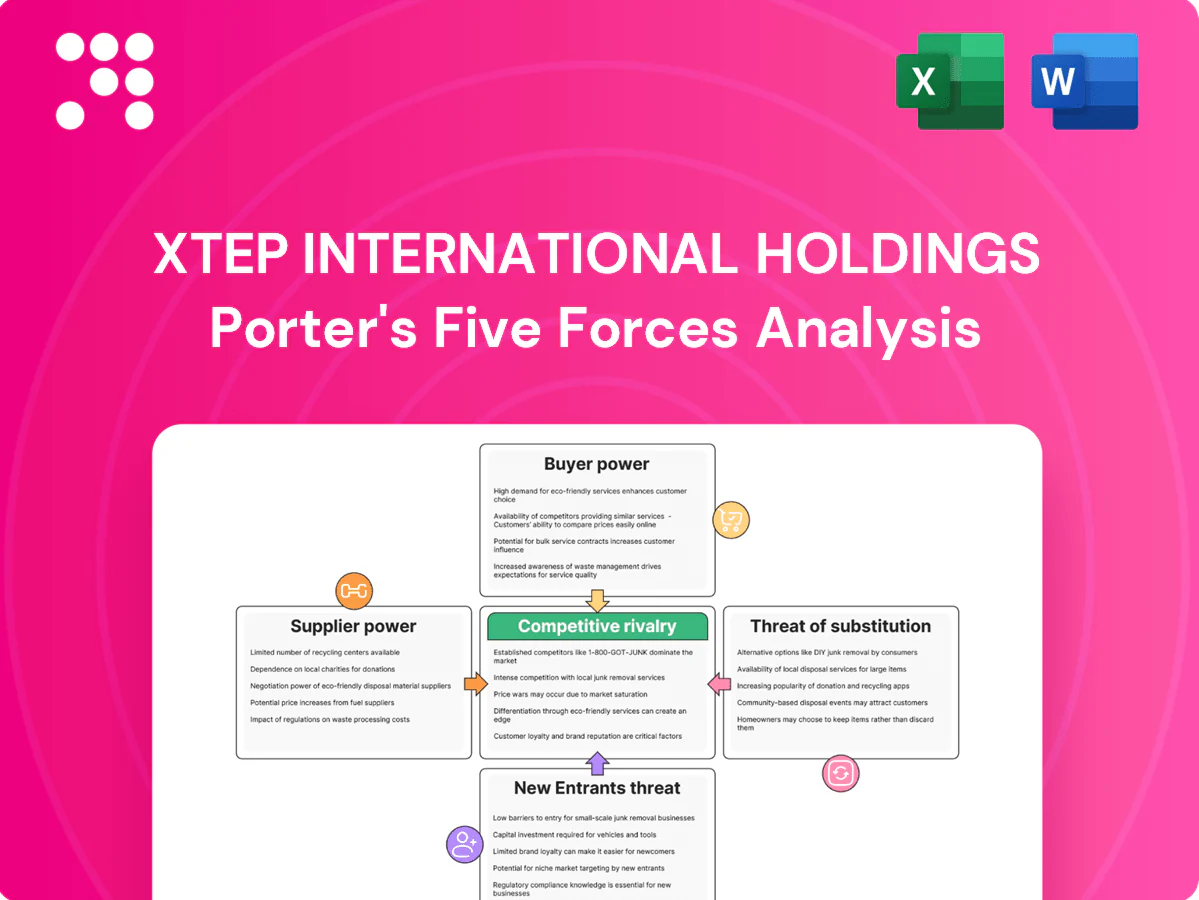
Xtep International Holdings Porter's Five Forces Analysis

Don't Miss the Bigger Picture
Xtep faces intense rivalry from global and domestic sportswear brands, with moderate supplier power and price-sensitive buyers increasing margin pressure. Brand strength raises entry barriers, yet athleisure substitutes and channel risks keep threats elevated. This brief snapshot only scratches the surface—unlock the full Porter's Five Forces Analysis for a force-by-force breakdown and strategic implications.
Suppliers Bargaining Power

Fragmented raw material base
Most textiles, rubber and foam are sourced from a broad, fragmented supplier pool, limiting individual supplier leverage over Xtep and enabling dual-sourcing of standardized materials to keep switching costs low. Consolidation in specialty fabrics or molded soles could temporarily raise supplier power. Geographic diversification of suppliers provides a buffer against localized disruptions and price spikes.
Specialty tech components
Advanced midsoles, carbon plates and performance fabrics come from a small pool of qualified vendors, with qualification cycles typically taking 12–18 months and tooling investments often exceeding $1 million, increasing Xtep’s supplier dependency and switching costs. Co-development deals can accelerate innovation but entrench reliance on specific partners. Xtep can mitigate risk by developing in-house formulations and second-sourcing key compounds to reduce single-supplier exposure.

Scale and contract leverage
Xtep’s large volumes and multi-brand portfolio give it significant negotiating leverage over price, payment terms and capacity guarantees, reinforced by 2024 long-term framework agreements that helped stabilize sourcing and reduce volatility. Tiered vendor management and supplier scorecards introduced in 2024 incentivize quality, on-time delivery and compliance. However, peak-season capacity tightness—notably during the 2024 fourth-quarter ramp—can temporarily shift bargaining power to suppliers.

Cost volatility pass-through
Fluctuations in oil-derived inputs (Brent ~85 USD/bbl in 2024), cotton (ICE cotton ~0.85 USD/lb in 2024) and FX moves (RMB ≈5% weaker vs USD in 2024) can squeeze Xtep’s margins if costs are not hedged or passed to retail; suppliers may impose surcharges during commodity spikes. Xtep’s hedging, design-to-cost and channel/mix management dilute impact, while rapid calendar refresh allows spec changes to cut costs without harming performance.
- Hedging: reduces raw-material P&L volatility
- Design-to-cost: protects gross margin
- Mix management: shifts towards higher-margin SKUs
- Fast refresh: enables specification-cost trade-offs
Compliance and ESG constraints
Heightened labor, environmental and traceability standards shrink the qualified supplier pool, raising suppliers' bargaining power as audited factories command premiums or longer lead times; Xtep’s stricter ESG criteria reduce brand risk but concentrate sourcing with top-tier vendors.
- Supplier base contraction
- Premiums and lead-time risk
- Higher dependence on audited vendors
- Supplier development can expand compliance
Textiles low leverage; advanced midsoles and performance fabrics drive supplier power
Suppliers have limited leverage for commoditized textiles but strong power for advanced midsoles and performance fabrics due to few qualified vendors and >$1m tooling costs. 2024 long-term agreements and scale give Xtep negotiating strength, yet Q4 capacity tightness and ESG-driven supplier consolidation raise short-term supplier power. Hedging and design-to-cost mitigate margin risk.
| Metric | 2024 |
|---|---|
| Brent | ~85 USD/bbl |
| Cotton (ICE) | ~0.85 USD/lb |
| RMB vs USD | ≈-5% |
What is included in the product
 Detailed Word Document
Tailored Porter's Five Forces analysis for Xtep International Holdings that examines competitive rivalry, supplier and buyer bargaining power, and threats from new entrants and substitutes to evaluate pricing pressure, profitability, and strategic vulnerabilities within the athletic apparel market.

 Customizable Excel Spreadsheet
Clear one-sheet Porter’s Five Forces for Xtep International—instantly visualizes competitive pressure with a spider chart and customizable force levels, ready to drop into pitch decks or boardroom slides as a concise decision-ready appendix.
Customers Bargaining Power

Price-sensitive mass market
Core consumers in China’s mass athletic segment show high price elasticity and promotion-seeking behavior, driving strong demand spikes during discount festivals. Frequent discounting and events like Singles Day amplify buyer power and compress margins. Xtep counters via value engineering and tiered product lines to protect ASPs. Differentiated design and storytelling reduce pure price comparisons and support higher margins.
E-commerce transparency
Online marketplaces and DTC sites let 73% of shoppers instantly compare prices and reviews, increasing buyer leverage and transparency. Return-friendly apparel e-commerce averages ~20% return rates, lowering switching costs and pressuring margins. Xtep must keep sharp pricing, sub-48-hour delivery and rich content as its online channel, which grew ~36% YoY in recent reports, while exclusive drops can recreate urgency and reduce direct comparisons.

Franchisee and distributor influence
Wholesale franchisees place bulk orders and negotiate terms, markdown support, and rebates — wholesale still accounts for roughly half of Xtep’s retail footprint, giving partners leverage through order size and floor-space control.
Their sell-through data and allocation power amplify bargaining power; Xtep is offsetting this via DTC growth (double-digit expansion in 2024), tighter data-sharing, differentiated assortments, and performance-based incentives to align interests and reduce channel conflict.

Brand loyalty vs switching ease
While Xtep enjoys local brand affinity, footwear and apparel buyers switch readily for fit, style, and hype; limited-edition capsules and athlete collabs (notably expanded since Xtep's reported 2023 revenue ~RMB10.2bn) help lock loyalty. Consistent fit and reliable sizing reduce return-driven churn, and membership programs with points/early access raise switching costs and repeat purchase rates.
- Local affinity vs easy switching
- Limited editions + collabs = higher retention
- Fit consistency lowers returns
- Memberships increase switching costs
International customer dynamics
Overseas consumers often view Chinese sportswear as value-driven, pressuring margins and fueling promotions; online apparel return rates averaged about 25% in 2024, raising service costs.
Local regulations and differing sizing expectations increase after-sales complexity and inventory fragmentation across markets.
Partnerships with reputable local retailers and region-specific designs and marketing have raised willingness to pay, supporting premium positioning in select markets.
- value perception: high
- online returns (2024): ~25%
- retailer partnerships: validate pricing
- local design/marketing: boost willingness to pay
Price power: 73%, 25% returns cut margins
Customers wield strong price leverage: 73% compare online, fueling promo spikes and ~25% apparel return rates in 2024 that compress margins. Xtep offsets with DTC growth (~36% YoY online; double-digit DTC expansion in 2024), tiered assortments, limited drops and retail partnerships to raise willingness-to-pay and blunt buyer bargaining.
| Metric | Value |
|---|---|
| Online price comparison | 73% |
| Online growth (recent) | ~36% YoY |
| Return rate (apparel 2024) | ~25% |
| DTC expansion (2024) | Double-digit |
Preview the Actual Deliverable
Xtep International Holdings Porter's Five Forces Analysis
This preview shows the exact Xtep International Holdings Porter's Five Forces Analysis you'll receive after purchase—no placeholders or samples. The document is fully formatted and ready for download immediately upon payment. Use it as-is for decision-making, reporting, or strategic planning.

Don't Miss the Bigger Picture
Xtep faces intense rivalry from global and domestic sportswear brands, with moderate supplier power and price-sensitive buyers increasing margin pressure. Brand strength raises entry barriers, yet athleisure substitutes and channel risks keep threats elevated. This brief snapshot only scratches the surface—unlock the full Porter's Five Forces Analysis for a force-by-force breakdown and strategic implications.
Suppliers Bargaining Power
Fragmented raw material base
Most textiles, rubber and foam are sourced from a broad, fragmented supplier pool, limiting individual supplier leverage over Xtep and enabling dual-sourcing of standardized materials to keep switching costs low. Consolidation in specialty fabrics or molded soles could temporarily raise supplier power. Geographic diversification of suppliers provides a buffer against localized disruptions and price spikes.
Specialty tech components
Advanced midsoles, carbon plates and performance fabrics come from a small pool of qualified vendors, with qualification cycles typically taking 12–18 months and tooling investments often exceeding $1 million, increasing Xtep’s supplier dependency and switching costs. Co-development deals can accelerate innovation but entrench reliance on specific partners. Xtep can mitigate risk by developing in-house formulations and second-sourcing key compounds to reduce single-supplier exposure.
Scale and contract leverage
Xtep’s large volumes and multi-brand portfolio give it significant negotiating leverage over price, payment terms and capacity guarantees, reinforced by 2024 long-term framework agreements that helped stabilize sourcing and reduce volatility. Tiered vendor management and supplier scorecards introduced in 2024 incentivize quality, on-time delivery and compliance. However, peak-season capacity tightness—notably during the 2024 fourth-quarter ramp—can temporarily shift bargaining power to suppliers.
Cost volatility pass-through
Fluctuations in oil-derived inputs (Brent ~85 USD/bbl in 2024), cotton (ICE cotton ~0.85 USD/lb in 2024) and FX moves (RMB ≈5% weaker vs USD in 2024) can squeeze Xtep’s margins if costs are not hedged or passed to retail; suppliers may impose surcharges during commodity spikes. Xtep’s hedging, design-to-cost and channel/mix management dilute impact, while rapid calendar refresh allows spec changes to cut costs without harming performance.
- Hedging: reduces raw-material P&L volatility
- Design-to-cost: protects gross margin
- Mix management: shifts towards higher-margin SKUs
- Fast refresh: enables specification-cost trade-offs
Compliance and ESG constraints
Heightened labor, environmental and traceability standards shrink the qualified supplier pool, raising suppliers' bargaining power as audited factories command premiums or longer lead times; Xtep’s stricter ESG criteria reduce brand risk but concentrate sourcing with top-tier vendors.
- Supplier base contraction
- Premiums and lead-time risk
- Higher dependence on audited vendors
- Supplier development can expand compliance
Textiles low leverage; advanced midsoles and performance fabrics drive supplier power
Suppliers have limited leverage for commoditized textiles but strong power for advanced midsoles and performance fabrics due to few qualified vendors and >$1m tooling costs. 2024 long-term agreements and scale give Xtep negotiating strength, yet Q4 capacity tightness and ESG-driven supplier consolidation raise short-term supplier power. Hedging and design-to-cost mitigate margin risk.
| Metric | 2024 |
|---|---|
| Brent | ~85 USD/bbl |
| Cotton (ICE) | ~0.85 USD/lb |
| RMB vs USD | ≈-5% |
What is included in the product
Detailed Word Document
Tailored Porter's Five Forces analysis for Xtep International Holdings that examines competitive rivalry, supplier and buyer bargaining power, and threats from new entrants and substitutes to evaluate pricing pressure, profitability, and strategic vulnerabilities within the athletic apparel market.
Customizable Excel Spreadsheet
Clear one-sheet Porter’s Five Forces for Xtep International—instantly visualizes competitive pressure with a spider chart and customizable force levels, ready to drop into pitch decks or boardroom slides as a concise decision-ready appendix.
Customers Bargaining Power
Price-sensitive mass market
Core consumers in China’s mass athletic segment show high price elasticity and promotion-seeking behavior, driving strong demand spikes during discount festivals. Frequent discounting and events like Singles Day amplify buyer power and compress margins. Xtep counters via value engineering and tiered product lines to protect ASPs. Differentiated design and storytelling reduce pure price comparisons and support higher margins.
E-commerce transparency
Online marketplaces and DTC sites let 73% of shoppers instantly compare prices and reviews, increasing buyer leverage and transparency. Return-friendly apparel e-commerce averages ~20% return rates, lowering switching costs and pressuring margins. Xtep must keep sharp pricing, sub-48-hour delivery and rich content as its online channel, which grew ~36% YoY in recent reports, while exclusive drops can recreate urgency and reduce direct comparisons.
Franchisee and distributor influence
Wholesale franchisees place bulk orders and negotiate terms, markdown support, and rebates — wholesale still accounts for roughly half of Xtep’s retail footprint, giving partners leverage through order size and floor-space control.
Their sell-through data and allocation power amplify bargaining power; Xtep is offsetting this via DTC growth (double-digit expansion in 2024), tighter data-sharing, differentiated assortments, and performance-based incentives to align interests and reduce channel conflict.
Brand loyalty vs switching ease
While Xtep enjoys local brand affinity, footwear and apparel buyers switch readily for fit, style, and hype; limited-edition capsules and athlete collabs (notably expanded since Xtep's reported 2023 revenue ~RMB10.2bn) help lock loyalty. Consistent fit and reliable sizing reduce return-driven churn, and membership programs with points/early access raise switching costs and repeat purchase rates.
- Local affinity vs easy switching
- Limited editions + collabs = higher retention
- Fit consistency lowers returns
- Memberships increase switching costs
International customer dynamics
Overseas consumers often view Chinese sportswear as value-driven, pressuring margins and fueling promotions; online apparel return rates averaged about 25% in 2024, raising service costs.
Local regulations and differing sizing expectations increase after-sales complexity and inventory fragmentation across markets.
Partnerships with reputable local retailers and region-specific designs and marketing have raised willingness to pay, supporting premium positioning in select markets.
- value perception: high
- online returns (2024): ~25%
- retailer partnerships: validate pricing
- local design/marketing: boost willingness to pay
Price power: 73%, 25% returns cut margins
Customers wield strong price leverage: 73% compare online, fueling promo spikes and ~25% apparel return rates in 2024 that compress margins. Xtep offsets with DTC growth (~36% YoY online; double-digit DTC expansion in 2024), tiered assortments, limited drops and retail partnerships to raise willingness-to-pay and blunt buyer bargaining.
| Metric | Value |
|---|---|
| Online price comparison | 73% |
| Online growth (recent) | ~36% YoY |
| Return rate (apparel 2024) | ~25% |
| DTC expansion (2024) | Double-digit |
Preview the Actual Deliverable
Xtep International Holdings Porter's Five Forces Analysis
This preview shows the exact Xtep International Holdings Porter's Five Forces Analysis you'll receive after purchase—no placeholders or samples. The document is fully formatted and ready for download immediately upon payment. Use it as-is for decision-making, reporting, or strategic planning.
Original: $10.00
-65%$10.00
$3.50Description
Don't Miss the Bigger Picture
Xtep faces intense rivalry from global and domestic sportswear brands, with moderate supplier power and price-sensitive buyers increasing margin pressure. Brand strength raises entry barriers, yet athleisure substitutes and channel risks keep threats elevated. This brief snapshot only scratches the surface—unlock the full Porter's Five Forces Analysis for a force-by-force breakdown and strategic implications.
Suppliers Bargaining Power
Fragmented raw material base
Most textiles, rubber and foam are sourced from a broad, fragmented supplier pool, limiting individual supplier leverage over Xtep and enabling dual-sourcing of standardized materials to keep switching costs low. Consolidation in specialty fabrics or molded soles could temporarily raise supplier power. Geographic diversification of suppliers provides a buffer against localized disruptions and price spikes.
Specialty tech components
Advanced midsoles, carbon plates and performance fabrics come from a small pool of qualified vendors, with qualification cycles typically taking 12–18 months and tooling investments often exceeding $1 million, increasing Xtep’s supplier dependency and switching costs. Co-development deals can accelerate innovation but entrench reliance on specific partners. Xtep can mitigate risk by developing in-house formulations and second-sourcing key compounds to reduce single-supplier exposure.
Scale and contract leverage
Xtep’s large volumes and multi-brand portfolio give it significant negotiating leverage over price, payment terms and capacity guarantees, reinforced by 2024 long-term framework agreements that helped stabilize sourcing and reduce volatility. Tiered vendor management and supplier scorecards introduced in 2024 incentivize quality, on-time delivery and compliance. However, peak-season capacity tightness—notably during the 2024 fourth-quarter ramp—can temporarily shift bargaining power to suppliers.
Cost volatility pass-through
Fluctuations in oil-derived inputs (Brent ~85 USD/bbl in 2024), cotton (ICE cotton ~0.85 USD/lb in 2024) and FX moves (RMB ≈5% weaker vs USD in 2024) can squeeze Xtep’s margins if costs are not hedged or passed to retail; suppliers may impose surcharges during commodity spikes. Xtep’s hedging, design-to-cost and channel/mix management dilute impact, while rapid calendar refresh allows spec changes to cut costs without harming performance.
- Hedging: reduces raw-material P&L volatility
- Design-to-cost: protects gross margin
- Mix management: shifts towards higher-margin SKUs
- Fast refresh: enables specification-cost trade-offs
Compliance and ESG constraints
Heightened labor, environmental and traceability standards shrink the qualified supplier pool, raising suppliers' bargaining power as audited factories command premiums or longer lead times; Xtep’s stricter ESG criteria reduce brand risk but concentrate sourcing with top-tier vendors.
- Supplier base contraction
- Premiums and lead-time risk
- Higher dependence on audited vendors
- Supplier development can expand compliance
Textiles low leverage; advanced midsoles and performance fabrics drive supplier power
Suppliers have limited leverage for commoditized textiles but strong power for advanced midsoles and performance fabrics due to few qualified vendors and >$1m tooling costs. 2024 long-term agreements and scale give Xtep negotiating strength, yet Q4 capacity tightness and ESG-driven supplier consolidation raise short-term supplier power. Hedging and design-to-cost mitigate margin risk.
| Metric | 2024 |
|---|---|
| Brent | ~85 USD/bbl |
| Cotton (ICE) | ~0.85 USD/lb |
| RMB vs USD | ≈-5% |
What is included in the product
Detailed Word Document
Tailored Porter's Five Forces analysis for Xtep International Holdings that examines competitive rivalry, supplier and buyer bargaining power, and threats from new entrants and substitutes to evaluate pricing pressure, profitability, and strategic vulnerabilities within the athletic apparel market.
Customizable Excel Spreadsheet
Clear one-sheet Porter’s Five Forces for Xtep International—instantly visualizes competitive pressure with a spider chart and customizable force levels, ready to drop into pitch decks or boardroom slides as a concise decision-ready appendix.
Customers Bargaining Power
Price-sensitive mass market
Core consumers in China’s mass athletic segment show high price elasticity and promotion-seeking behavior, driving strong demand spikes during discount festivals. Frequent discounting and events like Singles Day amplify buyer power and compress margins. Xtep counters via value engineering and tiered product lines to protect ASPs. Differentiated design and storytelling reduce pure price comparisons and support higher margins.
E-commerce transparency
Online marketplaces and DTC sites let 73% of shoppers instantly compare prices and reviews, increasing buyer leverage and transparency. Return-friendly apparel e-commerce averages ~20% return rates, lowering switching costs and pressuring margins. Xtep must keep sharp pricing, sub-48-hour delivery and rich content as its online channel, which grew ~36% YoY in recent reports, while exclusive drops can recreate urgency and reduce direct comparisons.
Franchisee and distributor influence
Wholesale franchisees place bulk orders and negotiate terms, markdown support, and rebates — wholesale still accounts for roughly half of Xtep’s retail footprint, giving partners leverage through order size and floor-space control.
Their sell-through data and allocation power amplify bargaining power; Xtep is offsetting this via DTC growth (double-digit expansion in 2024), tighter data-sharing, differentiated assortments, and performance-based incentives to align interests and reduce channel conflict.
Brand loyalty vs switching ease
While Xtep enjoys local brand affinity, footwear and apparel buyers switch readily for fit, style, and hype; limited-edition capsules and athlete collabs (notably expanded since Xtep's reported 2023 revenue ~RMB10.2bn) help lock loyalty. Consistent fit and reliable sizing reduce return-driven churn, and membership programs with points/early access raise switching costs and repeat purchase rates.
- Local affinity vs easy switching
- Limited editions + collabs = higher retention
- Fit consistency lowers returns
- Memberships increase switching costs
International customer dynamics
Overseas consumers often view Chinese sportswear as value-driven, pressuring margins and fueling promotions; online apparel return rates averaged about 25% in 2024, raising service costs.
Local regulations and differing sizing expectations increase after-sales complexity and inventory fragmentation across markets.
Partnerships with reputable local retailers and region-specific designs and marketing have raised willingness to pay, supporting premium positioning in select markets.
- value perception: high
- online returns (2024): ~25%
- retailer partnerships: validate pricing
- local design/marketing: boost willingness to pay
Price power: 73%, 25% returns cut margins
Customers wield strong price leverage: 73% compare online, fueling promo spikes and ~25% apparel return rates in 2024 that compress margins. Xtep offsets with DTC growth (~36% YoY online; double-digit DTC expansion in 2024), tiered assortments, limited drops and retail partnerships to raise willingness-to-pay and blunt buyer bargaining.
| Metric | Value |
|---|---|
| Online price comparison | 73% |
| Online growth (recent) | ~36% YoY |
| Return rate (apparel 2024) | ~25% |
| DTC expansion (2024) | Double-digit |
Preview the Actual Deliverable
Xtep International Holdings Porter's Five Forces Analysis
This preview shows the exact Xtep International Holdings Porter's Five Forces Analysis you'll receive after purchase—no placeholders or samples. The document is fully formatted and ready for download immediately upon payment. Use it as-is for decision-making, reporting, or strategic planning.











