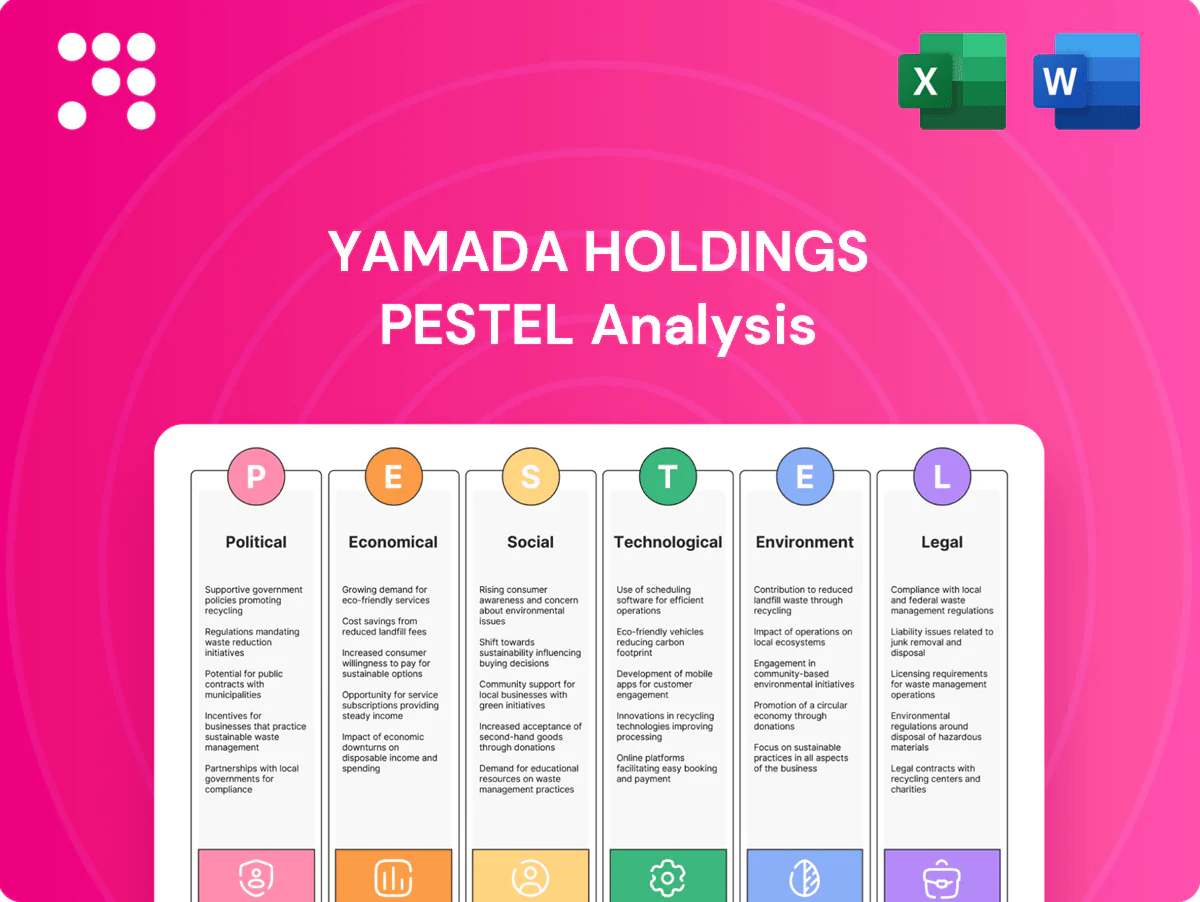
Yamada Holdings PESTLE Analysis

Skip the Research. Get the Strategy.
Our PESTLE analysis of Yamada Holdings reveals how political regulation, shifting consumer economics, rapid tech adoption, social demographics, and environmental mandates converge to reshape its retail strategy; it highlights key risks and growth levers for investors and strategists. Actionable, concise, and market-focused, this briefing primes decision-making. Purchase the full report for the complete, editable breakdown and immediate insights.
Political factors

Trade policy, tariffs, and import dependency
Japan’s electronics retail sector relies heavily on imported components and finished goods, so tariff shifts and trade frictions materially compress margins and disrupt inventory flows.
RCEP (in force since 2022) covers about 30% of global GDP and can ease sourcing/expand private‑label opportunities between Japan and regional suppliers.
Changes in Japan–China or Japan–US relations alter supply availability and costs, so Yamada must hedge FX and diversify suppliers to mitigate policy shocks.
Industrial and digital transformation subsidies
National and local subsidy windows—allocations exceeding ¥100 billion in FY2024 for digitalization and energy-efficient housing—can boost demand for smart appliances; Yamada should align promotions with these windows to accelerate turnover, join government-backed smart-city and disaster-resilient housing projects to expand renovation pipelines, and prioritize timely compliance and applications to maximize public fund capture.

Housing and urban revitalization initiatives
Government housing revitalization policies and subsidies that target regional cities directly affect renovation and construction volumes within Japan’s ¥2.8 trillion renovation market (2022), while 29.1% of the population aged 65+ (2024) boosts demand for elderly‑friendly and barrier‑free retrofits; Yamada Holdings (¥1.03 trillion revenue FY2023) can bundle appliances, furniture and remodels via its one‑stop model and gain share by coordinating with municipalities.

Energy policy and electrification push
Disaster preparedness and resilience spending
Government emphasis on disaster readiness is driving demand for backup power, resilient housing, and safety devices; Japan increased its disaster resilience funding in 2024 to roughly 1.2 trillion yen, boosting market opportunities for suppliers. Yamada’s construction and services arms can bundle resilience upgrades into retrofit packages and bid for public procurement contracts. Serving as certified installers for government programs creates recurring revenue streams and faster post-disaster recovery sales. Clear compliance with national standards enhances trust and accelerates adoption after disasters.
RCEP, ¥100bn+ subsidies and 2030/2050 targets boost demand for efficient appliances
Trade policy and tariffs (RCEP in force since 2022) affect margins and sourcing; FX hedging and supplier diversification are critical. National targets—2050 carbon neutrality, 2030 −46% GHG (vs 2013), 36–38% renewables—drive demand for efficient appliances and storage. FY2024 subsidies >¥100bn and a ¥1.2tn 2024 resilience budget create retrofit and procurement opportunities for Yamada (¥1.03tn revenue FY2023).
| Policy | Key figure | Impact on Yamada |
|---|---|---|
| RCEP | In force 2022 | Lower sourcing costs |
| Carbon targets | 2030 −46% vs 2013; 2050 neutrality | Demand for heat pumps, solar |
| Subsidies | ¥100bn+ FY2024; resilience ¥1.2tn 2024 | Renovation & procurement revenue |
What is included in the product
 Detailed Word Document
Explores how macro-environmental forces uniquely affect Yamada Holdings across Political, Economic, Social, Technological, Environmental and Legal dimensions, with data-backed trends and forward-looking insights to help executives, consultants and investors identify risks, opportunities and strategy actions aligned to regional market and regulatory dynamics.

 Customizable Excel Spreadsheet
A concise, visually segmented PESTLE summary of Yamada Holdings that can be dropped into decks, edited with notes for region or business line, and easily shared across teams to quickly align on external risks and strategic positioning.
Economic factors

Consumer confidence and discretionary spend
CE categories are highly cyclical, so shifts in consumer confidence sharply reduce big-ticket purchases and home renovations; Japan’s 65+ population reached about 29% in 2024, raising demand for repairs and service-led purchases. Bundled value propositions help defend basket size in downturns by combining essentials with peripherals. Counter-cyclical services such as repairs and point-of-sale financing smooth revenue volatility. Promotional efficiency becomes critical as wallets tighten.
Yen volatility and import cost pass-through
Weak yen (USD/JPY near 155–160 in mid‑2025) raises landed costs for imported electronics and components, squeezing gross margins as import bills rise roughly in the low‑double digits for typical product lines. Yamada’s pricing power and product‑mix management determine margin resilience; hedging and supplier renegotiations mitigate but timing mismatches can still compress margins. Expanded private‑label sales help offset cost spikes by preserving margin control and reducing reliance on FX‑exposed branded imports.

Interest rates, credit, and housing starts
Mortgage rates (US 30-year ~7% in 2024) and housing starts (US ~1.5M annualized in 2024) drive renovation and furniture cycles, boosting demand when activity rises. Yamada’s financial services — point-of-sale installments and consumer loans — expand affordability and conversion. Rate normalization (BOJ short-term ~0.1% mid-2025) shifts credit demand and raises default-risk monitoring needs while coordinated cross-product offers increase conversion.

E-commerce growth and price transparency
E-commerce penetration in Japan rose to about 12% in 2024, intensifying online price discovery and compressing gross margins on commoditized SKUs; Yamada must counter via omnichannel differentiation—BOPIS, rapid delivery and in‑home services—to outperform pure‑play rivals. Dynamic pricing and membership ecosystems can sustain loyalty and ARPU, while logistics efficiency (last‑mile cost control) becomes a key profit lever.
- Online penetration ~12% (2024)
- BOPIS/rapid delivery = differentiation
- Dynamic pricing + memberships protect loyalty
- Logistics efficiency drives margin recovery
Demographics and labor market dynamics
Japan’s 65+ population reached about 29.1% in 2023, shifting demand at Yamada Holdings toward healthcare electronics, accessibility remodels and services; tight 2024 labor markets (unemployment ~2.5%) push up store and installer wages. Automation and targeted training have raised delivery/installation productivity, while tailored assortments for seniors and caregivers sustain sales growth.
- Demographics: 29.1% 65+ (2023)
- Labor: unemployment ~2.5% (2024)
- Strategy: automation + training
- Product: senior/caregiver assortments
RCEP, ¥100bn+ subsidies and 2030/2050 targets boost demand for efficient appliances
CE cyclicality and weaker consumer confidence compress big-ticket sales; Japan 65+ ~29% (2023–24) shifts mix to services/repairs. Weak yen (USD/JPY ~155–160 mid‑2025) raises import costs, pressuring margins; hedging and private‑label offset some FX pain. E‑commerce ~12% (2024) and BOJ short‑term ~0.1% (mid‑2025) reshape omnichannel and financing demand.
| Metric | Value |
|---|---|
| 65+ population | ~29% (2023–24) |
| USD/JPY | ~155–160 (mid‑2025) |
| E‑commerce | ~12% (2024) |
| Unemployment | ~2.5% (2024) |
| BOJ short rate | ~0.1% (mid‑2025) |
Full Version Awaits
Yamada Holdings PESTLE Analysis
This Yamada Holdings PESTLE Analysis delivers a concise, practical review of political, economic, social, technological, legal and environmental factors affecting the company. The preview shown here is the exact document you’ll receive after purchase—fully formatted and ready to use. No placeholders or teasers; download is immediate upon payment.

Skip the Research. Get the Strategy.
Our PESTLE analysis of Yamada Holdings reveals how political regulation, shifting consumer economics, rapid tech adoption, social demographics, and environmental mandates converge to reshape its retail strategy; it highlights key risks and growth levers for investors and strategists. Actionable, concise, and market-focused, this briefing primes decision-making. Purchase the full report for the complete, editable breakdown and immediate insights.
Political factors
Trade policy, tariffs, and import dependency
Japan’s electronics retail sector relies heavily on imported components and finished goods, so tariff shifts and trade frictions materially compress margins and disrupt inventory flows.
RCEP (in force since 2022) covers about 30% of global GDP and can ease sourcing/expand private‑label opportunities between Japan and regional suppliers.
Changes in Japan–China or Japan–US relations alter supply availability and costs, so Yamada must hedge FX and diversify suppliers to mitigate policy shocks.
Industrial and digital transformation subsidies
National and local subsidy windows—allocations exceeding ¥100 billion in FY2024 for digitalization and energy-efficient housing—can boost demand for smart appliances; Yamada should align promotions with these windows to accelerate turnover, join government-backed smart-city and disaster-resilient housing projects to expand renovation pipelines, and prioritize timely compliance and applications to maximize public fund capture.
Housing and urban revitalization initiatives
Government housing revitalization policies and subsidies that target regional cities directly affect renovation and construction volumes within Japan’s ¥2.8 trillion renovation market (2022), while 29.1% of the population aged 65+ (2024) boosts demand for elderly‑friendly and barrier‑free retrofits; Yamada Holdings (¥1.03 trillion revenue FY2023) can bundle appliances, furniture and remodels via its one‑stop model and gain share by coordinating with municipalities.
Energy policy and electrification push
Disaster preparedness and resilience spending
Government emphasis on disaster readiness is driving demand for backup power, resilient housing, and safety devices; Japan increased its disaster resilience funding in 2024 to roughly 1.2 trillion yen, boosting market opportunities for suppliers. Yamada’s construction and services arms can bundle resilience upgrades into retrofit packages and bid for public procurement contracts. Serving as certified installers for government programs creates recurring revenue streams and faster post-disaster recovery sales. Clear compliance with national standards enhances trust and accelerates adoption after disasters.
RCEP, ¥100bn+ subsidies and 2030/2050 targets boost demand for efficient appliances
Trade policy and tariffs (RCEP in force since 2022) affect margins and sourcing; FX hedging and supplier diversification are critical. National targets—2050 carbon neutrality, 2030 −46% GHG (vs 2013), 36–38% renewables—drive demand for efficient appliances and storage. FY2024 subsidies >¥100bn and a ¥1.2tn 2024 resilience budget create retrofit and procurement opportunities for Yamada (¥1.03tn revenue FY2023).
| Policy | Key figure | Impact on Yamada |
|---|---|---|
| RCEP | In force 2022 | Lower sourcing costs |
| Carbon targets | 2030 −46% vs 2013; 2050 neutrality | Demand for heat pumps, solar |
| Subsidies | ¥100bn+ FY2024; resilience ¥1.2tn 2024 | Renovation & procurement revenue |
What is included in the product
Detailed Word Document
Explores how macro-environmental forces uniquely affect Yamada Holdings across Political, Economic, Social, Technological, Environmental and Legal dimensions, with data-backed trends and forward-looking insights to help executives, consultants and investors identify risks, opportunities and strategy actions aligned to regional market and regulatory dynamics.
Customizable Excel Spreadsheet
A concise, visually segmented PESTLE summary of Yamada Holdings that can be dropped into decks, edited with notes for region or business line, and easily shared across teams to quickly align on external risks and strategic positioning.
Economic factors
Consumer confidence and discretionary spend
CE categories are highly cyclical, so shifts in consumer confidence sharply reduce big-ticket purchases and home renovations; Japan’s 65+ population reached about 29% in 2024, raising demand for repairs and service-led purchases. Bundled value propositions help defend basket size in downturns by combining essentials with peripherals. Counter-cyclical services such as repairs and point-of-sale financing smooth revenue volatility. Promotional efficiency becomes critical as wallets tighten.
Yen volatility and import cost pass-through
Weak yen (USD/JPY near 155–160 in mid‑2025) raises landed costs for imported electronics and components, squeezing gross margins as import bills rise roughly in the low‑double digits for typical product lines. Yamada’s pricing power and product‑mix management determine margin resilience; hedging and supplier renegotiations mitigate but timing mismatches can still compress margins. Expanded private‑label sales help offset cost spikes by preserving margin control and reducing reliance on FX‑exposed branded imports.
Interest rates, credit, and housing starts
Mortgage rates (US 30-year ~7% in 2024) and housing starts (US ~1.5M annualized in 2024) drive renovation and furniture cycles, boosting demand when activity rises. Yamada’s financial services — point-of-sale installments and consumer loans — expand affordability and conversion. Rate normalization (BOJ short-term ~0.1% mid-2025) shifts credit demand and raises default-risk monitoring needs while coordinated cross-product offers increase conversion.
E-commerce growth and price transparency
E-commerce penetration in Japan rose to about 12% in 2024, intensifying online price discovery and compressing gross margins on commoditized SKUs; Yamada must counter via omnichannel differentiation—BOPIS, rapid delivery and in‑home services—to outperform pure‑play rivals. Dynamic pricing and membership ecosystems can sustain loyalty and ARPU, while logistics efficiency (last‑mile cost control) becomes a key profit lever.
- Online penetration ~12% (2024)
- BOPIS/rapid delivery = differentiation
- Dynamic pricing + memberships protect loyalty
- Logistics efficiency drives margin recovery
Demographics and labor market dynamics
Japan’s 65+ population reached about 29.1% in 2023, shifting demand at Yamada Holdings toward healthcare electronics, accessibility remodels and services; tight 2024 labor markets (unemployment ~2.5%) push up store and installer wages. Automation and targeted training have raised delivery/installation productivity, while tailored assortments for seniors and caregivers sustain sales growth.
- Demographics: 29.1% 65+ (2023)
- Labor: unemployment ~2.5% (2024)
- Strategy: automation + training
- Product: senior/caregiver assortments
RCEP, ¥100bn+ subsidies and 2030/2050 targets boost demand for efficient appliances
CE cyclicality and weaker consumer confidence compress big-ticket sales; Japan 65+ ~29% (2023–24) shifts mix to services/repairs. Weak yen (USD/JPY ~155–160 mid‑2025) raises import costs, pressuring margins; hedging and private‑label offset some FX pain. E‑commerce ~12% (2024) and BOJ short‑term ~0.1% (mid‑2025) reshape omnichannel and financing demand.
| Metric | Value |
|---|---|
| 65+ population | ~29% (2023–24) |
| USD/JPY | ~155–160 (mid‑2025) |
| E‑commerce | ~12% (2024) |
| Unemployment | ~2.5% (2024) |
| BOJ short rate | ~0.1% (mid‑2025) |
Full Version Awaits
Yamada Holdings PESTLE Analysis
This Yamada Holdings PESTLE Analysis delivers a concise, practical review of political, economic, social, technological, legal and environmental factors affecting the company. The preview shown here is the exact document you’ll receive after purchase—fully formatted and ready to use. No placeholders or teasers; download is immediate upon payment.
Original: $10.00
-65%$10.00
$3.50Description
Skip the Research. Get the Strategy.
Our PESTLE analysis of Yamada Holdings reveals how political regulation, shifting consumer economics, rapid tech adoption, social demographics, and environmental mandates converge to reshape its retail strategy; it highlights key risks and growth levers for investors and strategists. Actionable, concise, and market-focused, this briefing primes decision-making. Purchase the full report for the complete, editable breakdown and immediate insights.
Political factors
Trade policy, tariffs, and import dependency
Japan’s electronics retail sector relies heavily on imported components and finished goods, so tariff shifts and trade frictions materially compress margins and disrupt inventory flows.
RCEP (in force since 2022) covers about 30% of global GDP and can ease sourcing/expand private‑label opportunities between Japan and regional suppliers.
Changes in Japan–China or Japan–US relations alter supply availability and costs, so Yamada must hedge FX and diversify suppliers to mitigate policy shocks.
Industrial and digital transformation subsidies
National and local subsidy windows—allocations exceeding ¥100 billion in FY2024 for digitalization and energy-efficient housing—can boost demand for smart appliances; Yamada should align promotions with these windows to accelerate turnover, join government-backed smart-city and disaster-resilient housing projects to expand renovation pipelines, and prioritize timely compliance and applications to maximize public fund capture.
Housing and urban revitalization initiatives
Government housing revitalization policies and subsidies that target regional cities directly affect renovation and construction volumes within Japan’s ¥2.8 trillion renovation market (2022), while 29.1% of the population aged 65+ (2024) boosts demand for elderly‑friendly and barrier‑free retrofits; Yamada Holdings (¥1.03 trillion revenue FY2023) can bundle appliances, furniture and remodels via its one‑stop model and gain share by coordinating with municipalities.
Energy policy and electrification push
Disaster preparedness and resilience spending
Government emphasis on disaster readiness is driving demand for backup power, resilient housing, and safety devices; Japan increased its disaster resilience funding in 2024 to roughly 1.2 trillion yen, boosting market opportunities for suppliers. Yamada’s construction and services arms can bundle resilience upgrades into retrofit packages and bid for public procurement contracts. Serving as certified installers for government programs creates recurring revenue streams and faster post-disaster recovery sales. Clear compliance with national standards enhances trust and accelerates adoption after disasters.
RCEP, ¥100bn+ subsidies and 2030/2050 targets boost demand for efficient appliances
Trade policy and tariffs (RCEP in force since 2022) affect margins and sourcing; FX hedging and supplier diversification are critical. National targets—2050 carbon neutrality, 2030 −46% GHG (vs 2013), 36–38% renewables—drive demand for efficient appliances and storage. FY2024 subsidies >¥100bn and a ¥1.2tn 2024 resilience budget create retrofit and procurement opportunities for Yamada (¥1.03tn revenue FY2023).
| Policy | Key figure | Impact on Yamada |
|---|---|---|
| RCEP | In force 2022 | Lower sourcing costs |
| Carbon targets | 2030 −46% vs 2013; 2050 neutrality | Demand for heat pumps, solar |
| Subsidies | ¥100bn+ FY2024; resilience ¥1.2tn 2024 | Renovation & procurement revenue |
What is included in the product
Detailed Word Document
Explores how macro-environmental forces uniquely affect Yamada Holdings across Political, Economic, Social, Technological, Environmental and Legal dimensions, with data-backed trends and forward-looking insights to help executives, consultants and investors identify risks, opportunities and strategy actions aligned to regional market and regulatory dynamics.
Customizable Excel Spreadsheet
A concise, visually segmented PESTLE summary of Yamada Holdings that can be dropped into decks, edited with notes for region or business line, and easily shared across teams to quickly align on external risks and strategic positioning.
Economic factors
Consumer confidence and discretionary spend
CE categories are highly cyclical, so shifts in consumer confidence sharply reduce big-ticket purchases and home renovations; Japan’s 65+ population reached about 29% in 2024, raising demand for repairs and service-led purchases. Bundled value propositions help defend basket size in downturns by combining essentials with peripherals. Counter-cyclical services such as repairs and point-of-sale financing smooth revenue volatility. Promotional efficiency becomes critical as wallets tighten.
Yen volatility and import cost pass-through
Weak yen (USD/JPY near 155–160 in mid‑2025) raises landed costs for imported electronics and components, squeezing gross margins as import bills rise roughly in the low‑double digits for typical product lines. Yamada’s pricing power and product‑mix management determine margin resilience; hedging and supplier renegotiations mitigate but timing mismatches can still compress margins. Expanded private‑label sales help offset cost spikes by preserving margin control and reducing reliance on FX‑exposed branded imports.
Interest rates, credit, and housing starts
Mortgage rates (US 30-year ~7% in 2024) and housing starts (US ~1.5M annualized in 2024) drive renovation and furniture cycles, boosting demand when activity rises. Yamada’s financial services — point-of-sale installments and consumer loans — expand affordability and conversion. Rate normalization (BOJ short-term ~0.1% mid-2025) shifts credit demand and raises default-risk monitoring needs while coordinated cross-product offers increase conversion.
E-commerce growth and price transparency
E-commerce penetration in Japan rose to about 12% in 2024, intensifying online price discovery and compressing gross margins on commoditized SKUs; Yamada must counter via omnichannel differentiation—BOPIS, rapid delivery and in‑home services—to outperform pure‑play rivals. Dynamic pricing and membership ecosystems can sustain loyalty and ARPU, while logistics efficiency (last‑mile cost control) becomes a key profit lever.
- Online penetration ~12% (2024)
- BOPIS/rapid delivery = differentiation
- Dynamic pricing + memberships protect loyalty
- Logistics efficiency drives margin recovery
Demographics and labor market dynamics
Japan’s 65+ population reached about 29.1% in 2023, shifting demand at Yamada Holdings toward healthcare electronics, accessibility remodels and services; tight 2024 labor markets (unemployment ~2.5%) push up store and installer wages. Automation and targeted training have raised delivery/installation productivity, while tailored assortments for seniors and caregivers sustain sales growth.
- Demographics: 29.1% 65+ (2023)
- Labor: unemployment ~2.5% (2024)
- Strategy: automation + training
- Product: senior/caregiver assortments
RCEP, ¥100bn+ subsidies and 2030/2050 targets boost demand for efficient appliances
CE cyclicality and weaker consumer confidence compress big-ticket sales; Japan 65+ ~29% (2023–24) shifts mix to services/repairs. Weak yen (USD/JPY ~155–160 mid‑2025) raises import costs, pressuring margins; hedging and private‑label offset some FX pain. E‑commerce ~12% (2024) and BOJ short‑term ~0.1% (mid‑2025) reshape omnichannel and financing demand.
| Metric | Value |
|---|---|
| 65+ population | ~29% (2023–24) |
| USD/JPY | ~155–160 (mid‑2025) |
| E‑commerce | ~12% (2024) |
| Unemployment | ~2.5% (2024) |
| BOJ short rate | ~0.1% (mid‑2025) |
Full Version Awaits
Yamada Holdings PESTLE Analysis
This Yamada Holdings PESTLE Analysis delivers a concise, practical review of political, economic, social, technological, legal and environmental factors affecting the company. The preview shown here is the exact document you’ll receive after purchase—fully formatted and ready to use. No placeholders or teasers; download is immediate upon payment.











