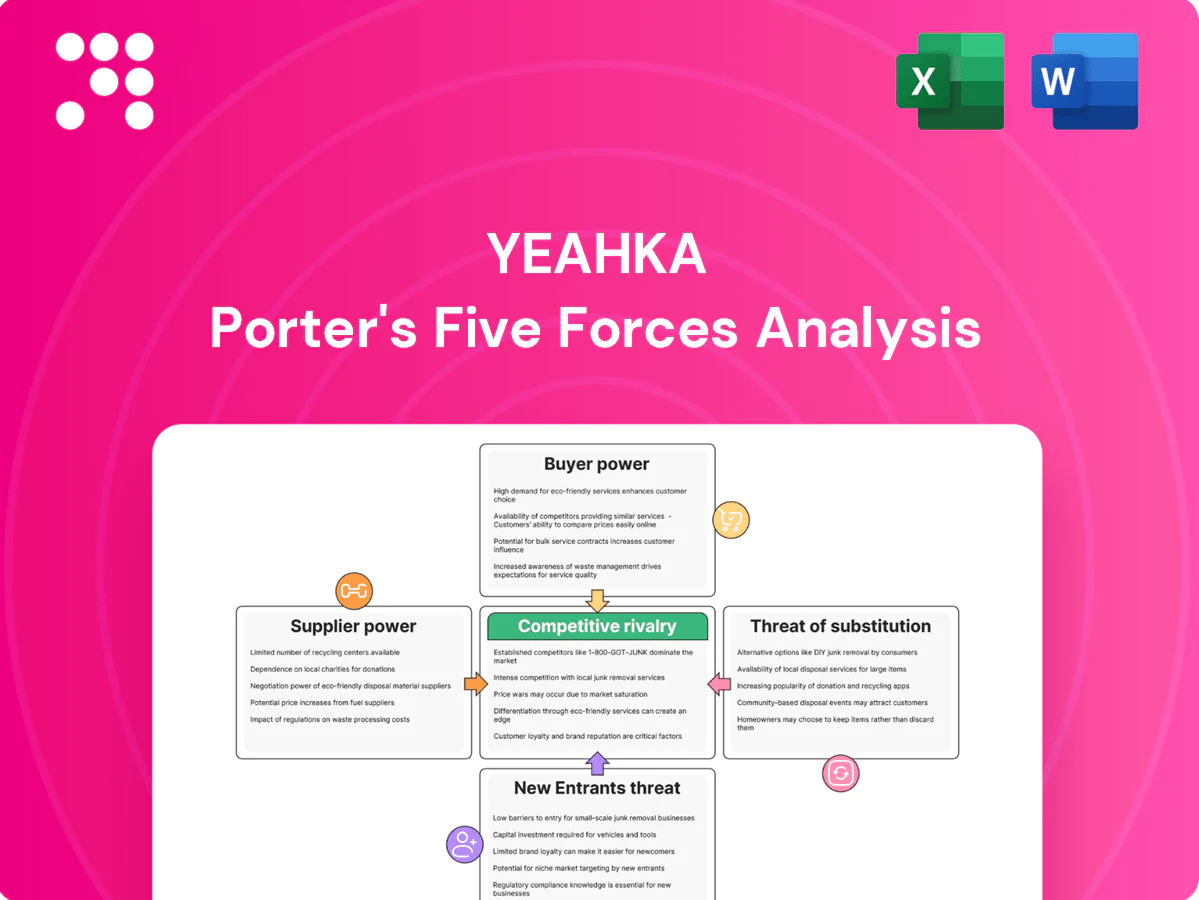
Yeahka Porter's Five Forces Analysis

Don't Miss the Bigger Picture
Yeahka's competitive landscape is shaped by intense rivalry among payment providers and the growing bargaining power of merchants seeking better terms. Understanding these dynamics is crucial for anyone looking to navigate this rapidly evolving fintech sector.
The full Porter's Five Forces Analysis delves deeper, revealing the subtle yet significant threats from new entrants and the constant pressure from substitute payment methods. This comprehensive report offers actionable insights to understand Yeahka's strategic positioning and potential growth avenues.
Ready to gain a complete strategic overview of Yeahka's market? Unlock the full analysis to explore force-by-force ratings, business implications, and data-driven insights that can inform your next move.
Suppliers Bargaining Power

Technological Infrastructure Providers
Yeahka's reliance on technological infrastructure providers, such as cloud services and payment terminal hardware, presents a dynamic supplier power landscape. While many providers offer standardized solutions, increasing competition and the availability of alternatives can mitigate supplier leverage.
However, the bargaining power of suppliers can intensify when Yeahka requires specialized or proprietary technologies, particularly in areas like advanced AI model development. For instance, in 2024, Yeahka's strategic push into AI and generative technologies means a greater dependence on a limited number of highly skilled AI developers or specialized model providers, potentially granting them significant influence over pricing and terms.
Financial Network and Clearing Houses
Yeahka's reliance on established financial networks and clearing houses like UnionPay, and potentially Visa and Mastercard for international growth, grants these entities considerable bargaining power. Their critical role in transaction processing and settlement, coupled with high entry barriers, makes them indispensable partners.

Talent and Human Capital
The specialized nature of fintech and AI development means that highly skilled talent, particularly in areas like AI, data science, and cybersecurity, are crucial suppliers of expertise for companies like Yeahka. The demand for such talent in China's rapidly evolving tech landscape, which saw significant growth in AI investment reaching billions of dollars in 2023, can lead to high bargaining power for these employees.
This elevated bargaining power directly influences salary costs and retention strategies for Yeahka. For instance, average salaries for senior AI engineers in major Chinese tech hubs like Beijing and Shanghai can exceed ¥500,000 annually, a figure that continues to climb with market demand.

Regulatory and Compliance Service Providers
Regulatory and compliance service providers wield significant bargaining power over companies like Yeahka operating within China's fintech sector. This is due to the highly regulated nature of the industry, which demands strict adherence to evolving rules, including licensing and data privacy mandates. For instance, in 2024, China continued to refine its digital payment regulations, placing a premium on expert guidance. These specialized service providers are critical for Yeahka to avoid costly penalties and maintain operational legitimacy.
The essential nature of their expertise means that Yeahka has limited alternatives for ensuring compliance. Their specialized knowledge in navigating China's complex legal and regulatory framework is not easily replicated internally or outsourced to less specialized firms. This reliance grants these suppliers a strong position in negotiating terms and fees.
- High demand for specialized legal and compliance expertise in China's fintech.
- Strict licensing and data privacy laws necessitate expert guidance.
- Limited availability of qualified regulatory service providers increases their bargaining power.
- Potential for significant financial penalties for non-compliance underscores Yeahka's dependence.
Marketing and Distribution Channel Partners
Yeahka's reliance on a vast network of over 6,000 SaaS partners for merchant acquisition highlights the potential bargaining power of these distribution channel partners. If a significant portion of Yeahka's merchant base is accessed through a few dominant partners, these entities could exert influence over terms and commission structures.
The collective strength of these partners, particularly those with specialized market access or a large merchant footprint, can translate into leverage. This is especially true if Yeahka faces challenges in diversifying its distribution channels quickly or if these partners offer unique value propositions that are difficult to replicate.
- Market Reach: Yeahka's 6,000+ SaaS partners provide access to a broad merchant base, making these partners critical for market penetration.
- Partner Leverage: The concentration of merchants through key partners can empower them to negotiate more favorable terms or higher commissions.
- Dependency Risk: A high degree of reliance on a few influential SaaS partners creates a potential risk of increased supplier power for Yeahka.
Supplier Power: A Key Factor for Yeahka
Yeahka's reliance on key financial infrastructure providers, such as major card networks and clearing houses, grants these entities significant bargaining power. Their essential role in transaction processing and the high barriers to entry in this space make them indispensable for Yeahka's operations and growth.
The scarcity of highly skilled talent in specialized fields like AI and cybersecurity, crucial for Yeahka's technological advancements, also amplifies supplier power. For example, in 2024, demand for AI specialists in China continued to outstrip supply, driving up compensation for these critical resources.
Furthermore, regulatory and compliance service providers hold considerable sway due to the complex and evolving legal landscape in China's fintech sector. Expert guidance is essential for Yeahka to navigate strict licensing and data privacy mandates, with penalties for non-compliance being substantial.
Yeahka's extensive network of over 6,000 SaaS partners for merchant acquisition presents another area where supplier power can manifest. If a few dominant partners control a significant portion of Yeahka's merchant base, they can leverage this position to negotiate more favorable terms.
| Supplier Type | Impact on Yeahka | Key Factors | 2024 Data/Trend |
|---|---|---|---|
| Financial Networks/Clearing Houses | High Bargaining Power | Essential for transactions, high entry barriers | Continued dominance of established players like UnionPay |
| Specialized Tech Talent (AI, Cybersecurity) | High Bargaining Power | Scarcity of skills, high demand | Rising salaries for AI engineers, exceeding ¥500,000 annually in major hubs |
| Regulatory & Compliance Services | High Bargaining Power | Complex regulations, strict mandates | Ongoing refinement of digital payment regulations in China |
| Key SaaS Distribution Partners | Moderate to High Bargaining Power | Concentration of merchants, market access | Growth in SaaS partner ecosystems for merchant onboarding |
What is included in the product
 Detailed Word Document
This analysis dissects the competitive forces impacting Yeahka, evaluating the threat of new entrants, the bargaining power of buyers and suppliers, the threat of substitutes, and the intensity of rivalry within the payment solutions industry.

 Customizable Excel Spreadsheet
Quickly identify and mitigate competitive threats with a pre-built, actionable framework that highlights key industry pressures.
Customers Bargaining Power

Low Merchant Switching Costs for Basic Payment Services
For basic payment processing in China, merchants often encounter low switching costs. This is largely due to the widespread adoption and interoperability of QR code payment systems, with Alipay and WeChat Pay holding significant market share. In 2023, these two platforms accounted for over 90% of mobile payment transactions in China, making it easy for merchants to move between providers if services are similar.
Price Sensitivity of Small and Medium-sized Enterprises (SMEs)
Small and medium-sized enterprises (SMEs), a significant portion of Yeahka's customer base, exhibit a pronounced price sensitivity. Their focus on cost efficiency means they are quick to compare offerings and seek the most economical solutions for their payment processing needs.
This heightened sensitivity directly translates into increased bargaining power for these SMEs. They can leverage their willingness to switch providers to negotiate more favorable terms, including lower transaction fees, which can exert downward pressure on Yeahka's revenue streams, particularly in a crowded marketplace.
For context, in 2024, the average transaction fee for payment processing services for SMEs in China hovered around 0.38%, a figure that SMEs actively monitor and seek to reduce. This competitive landscape means Yeahka must continuously balance its pricing strategy to retain these cost-conscious clients.

Dominance of Super-App Payment Ecosystems
The dominance of super-app payment ecosystems significantly amplifies customer bargaining power. Merchants often find themselves integrated into platforms like Alipay and WeChat Pay, which boast substantial user bases. In 2023, Alipay and WeChat Pay collectively processed trillions of dollars in transactions, underscoring their market penetration.
This widespread adoption means customers can easily opt for these established payment methods, diminishing their reliance on alternative providers like Yeahka. Consequently, customers can exert considerable pressure on merchants to accept their preferred payment solutions, a dynamic that can translate into demands for favorable terms or lower transaction fees, thereby increasing Yeahka's customers' bargaining power.

Demand for Value-Added Services and Customization
Merchants are increasingly looking beyond basic payment processing, demanding integrated solutions that enhance operational efficiency and customer engagement. This shift amplifies their bargaining power, as they can leverage their need for services like precision marketing, merchant SaaS platforms, and supply chain management tools to negotiate better terms. For instance, businesses requiring advanced analytics for customer loyalty programs or streamlined inventory management will have more leverage with payment providers who can offer these bundled capabilities.
Yeahka's competitive edge hinges on its capacity to deliver these sophisticated, tailored offerings. As of the first quarter of 2024, Yeahka reported a significant increase in its value-added services segment, indicating a market trend where merchants prioritize providers who can offer more than just transaction facilitation. By providing comprehensive solutions, Yeahka can mitigate the intensifying bargaining power of its merchant clientele, as generic payment services alone are becoming insufficient to meet evolving business needs.
- Merchant Demand for Integrated Solutions: Businesses are seeking payment providers that offer ancillary services like precision marketing, merchant SaaS, and supply chain integration to optimize operations and customer outreach.
- Yeahka's Strategic Response: The company's ability to deliver these value-added services is crucial for customer retention and mitigating the increased bargaining power of merchants.
- Market Trend Data: Yeahka's Q1 2024 performance highlighted a growing demand for its comprehensive service offerings, reflecting a broader industry shift.
Customer Concentration in Specific Verticals
If Yeahka experiences significant customer concentration within particular industry sectors, large merchants or established chains in those verticals could wield considerable bargaining power. Their substantial transaction volumes or unique operational requirements might enable them to negotiate more favorable pricing or bespoke service packages, thereby influencing Yeahka's average revenue per customer.
For instance, if a substantial portion of Yeahka's business originates from a few major retail chains in the fast-moving consumer goods (FMCG) sector, these key clients could leverage their market share to demand lower transaction fees or preferential support. This concentration can shift the balance, allowing these powerful customers to dictate terms rather than accept them.
- Customer Concentration Impact: High concentration in specific verticals can empower large customers to negotiate better terms.
- Negotiation Leverage: Large transaction volumes and specific needs give major clients more influence over pricing and service.
- Revenue Influence: Favorable terms negotiated by concentrated customers can directly impact Yeahka's revenue per customer.
- Industry Example: Major retail chains in FMCG could leverage their market share to secure lower transaction fees.
Customer Bargaining Power: Driving Payment Market Dynamics
The bargaining power of customers is a significant force for Yeahka, particularly due to the low switching costs in China's payment processing market. With major players like Alipay and WeChat Pay dominating, merchants can easily shift providers if pricing or service levels are not competitive. This ease of transition empowers customers to demand better terms, directly impacting Yeahka's pricing strategies and profitability.
Merchants, especially SMEs, are highly price-sensitive and actively seek cost-effective payment solutions. In 2024, the average transaction fee for payment processing in China was around 0.38%, a benchmark that merchants use to negotiate lower rates. This price pressure forces Yeahka to maintain competitive fees to retain its customer base.
The increasing demand for integrated services, beyond basic payment processing, further enhances customer bargaining power. Merchants requiring value-added solutions like marketing tools or SaaS platforms can leverage these needs to negotiate bundled packages with providers. Yeahka's Q1 2024 performance indicates a growing market preference for such comprehensive offerings.
Customer concentration within specific industries also amplifies bargaining power. Large, high-volume merchants can negotiate more favorable terms due to their significant contribution to a payment processor's revenue. This dynamic necessitates that Yeahka carefully manages relationships with its key clients to mitigate potential pricing concessions.
| Factor | Impact on Yeahka | Supporting Data (2023-2024) |
|---|---|---|
| Low Switching Costs | Increased pressure on fees and service differentiation | Alipay & WeChat Pay >90% mobile payment share (2023) |
| Price Sensitivity (SMEs) | Demand for lower transaction fees | Average transaction fee ~0.38% (2024) |
| Demand for Integrated Solutions | Leverage to negotiate bundled services | Yeahka's value-added services segment growth (Q1 2024) |
| Customer Concentration | Potential for large clients to dictate terms | Major retail chains in FMCG sector example |
Full Version Awaits
Yeahka Porter's Five Forces Analysis
This preview showcases the complete Yeahka Porter's Five Forces Analysis, providing an in-depth examination of the competitive landscape. The document you see here is precisely what you will receive immediately after purchase, ensuring no discrepancies or missing information. You can trust that this professionally formatted analysis is ready for immediate use, offering valuable insights into Yeahka's market position and strategic considerations.

Don't Miss the Bigger Picture
Yeahka's competitive landscape is shaped by intense rivalry among payment providers and the growing bargaining power of merchants seeking better terms. Understanding these dynamics is crucial for anyone looking to navigate this rapidly evolving fintech sector.
The full Porter's Five Forces Analysis delves deeper, revealing the subtle yet significant threats from new entrants and the constant pressure from substitute payment methods. This comprehensive report offers actionable insights to understand Yeahka's strategic positioning and potential growth avenues.
Ready to gain a complete strategic overview of Yeahka's market? Unlock the full analysis to explore force-by-force ratings, business implications, and data-driven insights that can inform your next move.
Suppliers Bargaining Power
Technological Infrastructure Providers
Yeahka's reliance on technological infrastructure providers, such as cloud services and payment terminal hardware, presents a dynamic supplier power landscape. While many providers offer standardized solutions, increasing competition and the availability of alternatives can mitigate supplier leverage.
However, the bargaining power of suppliers can intensify when Yeahka requires specialized or proprietary technologies, particularly in areas like advanced AI model development. For instance, in 2024, Yeahka's strategic push into AI and generative technologies means a greater dependence on a limited number of highly skilled AI developers or specialized model providers, potentially granting them significant influence over pricing and terms.
Financial Network and Clearing Houses
Yeahka's reliance on established financial networks and clearing houses like UnionPay, and potentially Visa and Mastercard for international growth, grants these entities considerable bargaining power. Their critical role in transaction processing and settlement, coupled with high entry barriers, makes them indispensable partners.
Talent and Human Capital
The specialized nature of fintech and AI development means that highly skilled talent, particularly in areas like AI, data science, and cybersecurity, are crucial suppliers of expertise for companies like Yeahka. The demand for such talent in China's rapidly evolving tech landscape, which saw significant growth in AI investment reaching billions of dollars in 2023, can lead to high bargaining power for these employees.
This elevated bargaining power directly influences salary costs and retention strategies for Yeahka. For instance, average salaries for senior AI engineers in major Chinese tech hubs like Beijing and Shanghai can exceed ¥500,000 annually, a figure that continues to climb with market demand.
Regulatory and Compliance Service Providers
Regulatory and compliance service providers wield significant bargaining power over companies like Yeahka operating within China's fintech sector. This is due to the highly regulated nature of the industry, which demands strict adherence to evolving rules, including licensing and data privacy mandates. For instance, in 2024, China continued to refine its digital payment regulations, placing a premium on expert guidance. These specialized service providers are critical for Yeahka to avoid costly penalties and maintain operational legitimacy.
The essential nature of their expertise means that Yeahka has limited alternatives for ensuring compliance. Their specialized knowledge in navigating China's complex legal and regulatory framework is not easily replicated internally or outsourced to less specialized firms. This reliance grants these suppliers a strong position in negotiating terms and fees.
- High demand for specialized legal and compliance expertise in China's fintech.
- Strict licensing and data privacy laws necessitate expert guidance.
- Limited availability of qualified regulatory service providers increases their bargaining power.
- Potential for significant financial penalties for non-compliance underscores Yeahka's dependence.
Marketing and Distribution Channel Partners
Yeahka's reliance on a vast network of over 6,000 SaaS partners for merchant acquisition highlights the potential bargaining power of these distribution channel partners. If a significant portion of Yeahka's merchant base is accessed through a few dominant partners, these entities could exert influence over terms and commission structures.
The collective strength of these partners, particularly those with specialized market access or a large merchant footprint, can translate into leverage. This is especially true if Yeahka faces challenges in diversifying its distribution channels quickly or if these partners offer unique value propositions that are difficult to replicate.
- Market Reach: Yeahka's 6,000+ SaaS partners provide access to a broad merchant base, making these partners critical for market penetration.
- Partner Leverage: The concentration of merchants through key partners can empower them to negotiate more favorable terms or higher commissions.
- Dependency Risk: A high degree of reliance on a few influential SaaS partners creates a potential risk of increased supplier power for Yeahka.
Supplier Power: A Key Factor for Yeahka
Yeahka's reliance on key financial infrastructure providers, such as major card networks and clearing houses, grants these entities significant bargaining power. Their essential role in transaction processing and the high barriers to entry in this space make them indispensable for Yeahka's operations and growth.
The scarcity of highly skilled talent in specialized fields like AI and cybersecurity, crucial for Yeahka's technological advancements, also amplifies supplier power. For example, in 2024, demand for AI specialists in China continued to outstrip supply, driving up compensation for these critical resources.
Furthermore, regulatory and compliance service providers hold considerable sway due to the complex and evolving legal landscape in China's fintech sector. Expert guidance is essential for Yeahka to navigate strict licensing and data privacy mandates, with penalties for non-compliance being substantial.
Yeahka's extensive network of over 6,000 SaaS partners for merchant acquisition presents another area where supplier power can manifest. If a few dominant partners control a significant portion of Yeahka's merchant base, they can leverage this position to negotiate more favorable terms.
| Supplier Type | Impact on Yeahka | Key Factors | 2024 Data/Trend |
|---|---|---|---|
| Financial Networks/Clearing Houses | High Bargaining Power | Essential for transactions, high entry barriers | Continued dominance of established players like UnionPay |
| Specialized Tech Talent (AI, Cybersecurity) | High Bargaining Power | Scarcity of skills, high demand | Rising salaries for AI engineers, exceeding ¥500,000 annually in major hubs |
| Regulatory & Compliance Services | High Bargaining Power | Complex regulations, strict mandates | Ongoing refinement of digital payment regulations in China |
| Key SaaS Distribution Partners | Moderate to High Bargaining Power | Concentration of merchants, market access | Growth in SaaS partner ecosystems for merchant onboarding |
What is included in the product
Detailed Word Document
This analysis dissects the competitive forces impacting Yeahka, evaluating the threat of new entrants, the bargaining power of buyers and suppliers, the threat of substitutes, and the intensity of rivalry within the payment solutions industry.
Customizable Excel Spreadsheet
Quickly identify and mitigate competitive threats with a pre-built, actionable framework that highlights key industry pressures.
Customers Bargaining Power
Low Merchant Switching Costs for Basic Payment Services
For basic payment processing in China, merchants often encounter low switching costs. This is largely due to the widespread adoption and interoperability of QR code payment systems, with Alipay and WeChat Pay holding significant market share. In 2023, these two platforms accounted for over 90% of mobile payment transactions in China, making it easy for merchants to move between providers if services are similar.
Price Sensitivity of Small and Medium-sized Enterprises (SMEs)
Small and medium-sized enterprises (SMEs), a significant portion of Yeahka's customer base, exhibit a pronounced price sensitivity. Their focus on cost efficiency means they are quick to compare offerings and seek the most economical solutions for their payment processing needs.
This heightened sensitivity directly translates into increased bargaining power for these SMEs. They can leverage their willingness to switch providers to negotiate more favorable terms, including lower transaction fees, which can exert downward pressure on Yeahka's revenue streams, particularly in a crowded marketplace.
For context, in 2024, the average transaction fee for payment processing services for SMEs in China hovered around 0.38%, a figure that SMEs actively monitor and seek to reduce. This competitive landscape means Yeahka must continuously balance its pricing strategy to retain these cost-conscious clients.
Dominance of Super-App Payment Ecosystems
The dominance of super-app payment ecosystems significantly amplifies customer bargaining power. Merchants often find themselves integrated into platforms like Alipay and WeChat Pay, which boast substantial user bases. In 2023, Alipay and WeChat Pay collectively processed trillions of dollars in transactions, underscoring their market penetration.
This widespread adoption means customers can easily opt for these established payment methods, diminishing their reliance on alternative providers like Yeahka. Consequently, customers can exert considerable pressure on merchants to accept their preferred payment solutions, a dynamic that can translate into demands for favorable terms or lower transaction fees, thereby increasing Yeahka's customers' bargaining power.
Demand for Value-Added Services and Customization
Merchants are increasingly looking beyond basic payment processing, demanding integrated solutions that enhance operational efficiency and customer engagement. This shift amplifies their bargaining power, as they can leverage their need for services like precision marketing, merchant SaaS platforms, and supply chain management tools to negotiate better terms. For instance, businesses requiring advanced analytics for customer loyalty programs or streamlined inventory management will have more leverage with payment providers who can offer these bundled capabilities.
Yeahka's competitive edge hinges on its capacity to deliver these sophisticated, tailored offerings. As of the first quarter of 2024, Yeahka reported a significant increase in its value-added services segment, indicating a market trend where merchants prioritize providers who can offer more than just transaction facilitation. By providing comprehensive solutions, Yeahka can mitigate the intensifying bargaining power of its merchant clientele, as generic payment services alone are becoming insufficient to meet evolving business needs.
- Merchant Demand for Integrated Solutions: Businesses are seeking payment providers that offer ancillary services like precision marketing, merchant SaaS, and supply chain integration to optimize operations and customer outreach.
- Yeahka's Strategic Response: The company's ability to deliver these value-added services is crucial for customer retention and mitigating the increased bargaining power of merchants.
- Market Trend Data: Yeahka's Q1 2024 performance highlighted a growing demand for its comprehensive service offerings, reflecting a broader industry shift.
Customer Concentration in Specific Verticals
If Yeahka experiences significant customer concentration within particular industry sectors, large merchants or established chains in those verticals could wield considerable bargaining power. Their substantial transaction volumes or unique operational requirements might enable them to negotiate more favorable pricing or bespoke service packages, thereby influencing Yeahka's average revenue per customer.
For instance, if a substantial portion of Yeahka's business originates from a few major retail chains in the fast-moving consumer goods (FMCG) sector, these key clients could leverage their market share to demand lower transaction fees or preferential support. This concentration can shift the balance, allowing these powerful customers to dictate terms rather than accept them.
- Customer Concentration Impact: High concentration in specific verticals can empower large customers to negotiate better terms.
- Negotiation Leverage: Large transaction volumes and specific needs give major clients more influence over pricing and service.
- Revenue Influence: Favorable terms negotiated by concentrated customers can directly impact Yeahka's revenue per customer.
- Industry Example: Major retail chains in FMCG could leverage their market share to secure lower transaction fees.
Customer Bargaining Power: Driving Payment Market Dynamics
The bargaining power of customers is a significant force for Yeahka, particularly due to the low switching costs in China's payment processing market. With major players like Alipay and WeChat Pay dominating, merchants can easily shift providers if pricing or service levels are not competitive. This ease of transition empowers customers to demand better terms, directly impacting Yeahka's pricing strategies and profitability.
Merchants, especially SMEs, are highly price-sensitive and actively seek cost-effective payment solutions. In 2024, the average transaction fee for payment processing in China was around 0.38%, a benchmark that merchants use to negotiate lower rates. This price pressure forces Yeahka to maintain competitive fees to retain its customer base.
The increasing demand for integrated services, beyond basic payment processing, further enhances customer bargaining power. Merchants requiring value-added solutions like marketing tools or SaaS platforms can leverage these needs to negotiate bundled packages with providers. Yeahka's Q1 2024 performance indicates a growing market preference for such comprehensive offerings.
Customer concentration within specific industries also amplifies bargaining power. Large, high-volume merchants can negotiate more favorable terms due to their significant contribution to a payment processor's revenue. This dynamic necessitates that Yeahka carefully manages relationships with its key clients to mitigate potential pricing concessions.
| Factor | Impact on Yeahka | Supporting Data (2023-2024) |
|---|---|---|
| Low Switching Costs | Increased pressure on fees and service differentiation | Alipay & WeChat Pay >90% mobile payment share (2023) |
| Price Sensitivity (SMEs) | Demand for lower transaction fees | Average transaction fee ~0.38% (2024) |
| Demand for Integrated Solutions | Leverage to negotiate bundled services | Yeahka's value-added services segment growth (Q1 2024) |
| Customer Concentration | Potential for large clients to dictate terms | Major retail chains in FMCG sector example |
Full Version Awaits
Yeahka Porter's Five Forces Analysis
This preview showcases the complete Yeahka Porter's Five Forces Analysis, providing an in-depth examination of the competitive landscape. The document you see here is precisely what you will receive immediately after purchase, ensuring no discrepancies or missing information. You can trust that this professionally formatted analysis is ready for immediate use, offering valuable insights into Yeahka's market position and strategic considerations.
Original: $10.00
-65%$10.00
$3.50Description
Don't Miss the Bigger Picture
Yeahka's competitive landscape is shaped by intense rivalry among payment providers and the growing bargaining power of merchants seeking better terms. Understanding these dynamics is crucial for anyone looking to navigate this rapidly evolving fintech sector.
The full Porter's Five Forces Analysis delves deeper, revealing the subtle yet significant threats from new entrants and the constant pressure from substitute payment methods. This comprehensive report offers actionable insights to understand Yeahka's strategic positioning and potential growth avenues.
Ready to gain a complete strategic overview of Yeahka's market? Unlock the full analysis to explore force-by-force ratings, business implications, and data-driven insights that can inform your next move.
Suppliers Bargaining Power
Technological Infrastructure Providers
Yeahka's reliance on technological infrastructure providers, such as cloud services and payment terminal hardware, presents a dynamic supplier power landscape. While many providers offer standardized solutions, increasing competition and the availability of alternatives can mitigate supplier leverage.
However, the bargaining power of suppliers can intensify when Yeahka requires specialized or proprietary technologies, particularly in areas like advanced AI model development. For instance, in 2024, Yeahka's strategic push into AI and generative technologies means a greater dependence on a limited number of highly skilled AI developers or specialized model providers, potentially granting them significant influence over pricing and terms.
Financial Network and Clearing Houses
Yeahka's reliance on established financial networks and clearing houses like UnionPay, and potentially Visa and Mastercard for international growth, grants these entities considerable bargaining power. Their critical role in transaction processing and settlement, coupled with high entry barriers, makes them indispensable partners.
Talent and Human Capital
The specialized nature of fintech and AI development means that highly skilled talent, particularly in areas like AI, data science, and cybersecurity, are crucial suppliers of expertise for companies like Yeahka. The demand for such talent in China's rapidly evolving tech landscape, which saw significant growth in AI investment reaching billions of dollars in 2023, can lead to high bargaining power for these employees.
This elevated bargaining power directly influences salary costs and retention strategies for Yeahka. For instance, average salaries for senior AI engineers in major Chinese tech hubs like Beijing and Shanghai can exceed ¥500,000 annually, a figure that continues to climb with market demand.
Regulatory and Compliance Service Providers
Regulatory and compliance service providers wield significant bargaining power over companies like Yeahka operating within China's fintech sector. This is due to the highly regulated nature of the industry, which demands strict adherence to evolving rules, including licensing and data privacy mandates. For instance, in 2024, China continued to refine its digital payment regulations, placing a premium on expert guidance. These specialized service providers are critical for Yeahka to avoid costly penalties and maintain operational legitimacy.
The essential nature of their expertise means that Yeahka has limited alternatives for ensuring compliance. Their specialized knowledge in navigating China's complex legal and regulatory framework is not easily replicated internally or outsourced to less specialized firms. This reliance grants these suppliers a strong position in negotiating terms and fees.
- High demand for specialized legal and compliance expertise in China's fintech.
- Strict licensing and data privacy laws necessitate expert guidance.
- Limited availability of qualified regulatory service providers increases their bargaining power.
- Potential for significant financial penalties for non-compliance underscores Yeahka's dependence.
Marketing and Distribution Channel Partners
Yeahka's reliance on a vast network of over 6,000 SaaS partners for merchant acquisition highlights the potential bargaining power of these distribution channel partners. If a significant portion of Yeahka's merchant base is accessed through a few dominant partners, these entities could exert influence over terms and commission structures.
The collective strength of these partners, particularly those with specialized market access or a large merchant footprint, can translate into leverage. This is especially true if Yeahka faces challenges in diversifying its distribution channels quickly or if these partners offer unique value propositions that are difficult to replicate.
- Market Reach: Yeahka's 6,000+ SaaS partners provide access to a broad merchant base, making these partners critical for market penetration.
- Partner Leverage: The concentration of merchants through key partners can empower them to negotiate more favorable terms or higher commissions.
- Dependency Risk: A high degree of reliance on a few influential SaaS partners creates a potential risk of increased supplier power for Yeahka.
Supplier Power: A Key Factor for Yeahka
Yeahka's reliance on key financial infrastructure providers, such as major card networks and clearing houses, grants these entities significant bargaining power. Their essential role in transaction processing and the high barriers to entry in this space make them indispensable for Yeahka's operations and growth.
The scarcity of highly skilled talent in specialized fields like AI and cybersecurity, crucial for Yeahka's technological advancements, also amplifies supplier power. For example, in 2024, demand for AI specialists in China continued to outstrip supply, driving up compensation for these critical resources.
Furthermore, regulatory and compliance service providers hold considerable sway due to the complex and evolving legal landscape in China's fintech sector. Expert guidance is essential for Yeahka to navigate strict licensing and data privacy mandates, with penalties for non-compliance being substantial.
Yeahka's extensive network of over 6,000 SaaS partners for merchant acquisition presents another area where supplier power can manifest. If a few dominant partners control a significant portion of Yeahka's merchant base, they can leverage this position to negotiate more favorable terms.
| Supplier Type | Impact on Yeahka | Key Factors | 2024 Data/Trend |
|---|---|---|---|
| Financial Networks/Clearing Houses | High Bargaining Power | Essential for transactions, high entry barriers | Continued dominance of established players like UnionPay |
| Specialized Tech Talent (AI, Cybersecurity) | High Bargaining Power | Scarcity of skills, high demand | Rising salaries for AI engineers, exceeding ¥500,000 annually in major hubs |
| Regulatory & Compliance Services | High Bargaining Power | Complex regulations, strict mandates | Ongoing refinement of digital payment regulations in China |
| Key SaaS Distribution Partners | Moderate to High Bargaining Power | Concentration of merchants, market access | Growth in SaaS partner ecosystems for merchant onboarding |
What is included in the product
Detailed Word Document
This analysis dissects the competitive forces impacting Yeahka, evaluating the threat of new entrants, the bargaining power of buyers and suppliers, the threat of substitutes, and the intensity of rivalry within the payment solutions industry.
Customizable Excel Spreadsheet
Quickly identify and mitigate competitive threats with a pre-built, actionable framework that highlights key industry pressures.
Customers Bargaining Power
Low Merchant Switching Costs for Basic Payment Services
For basic payment processing in China, merchants often encounter low switching costs. This is largely due to the widespread adoption and interoperability of QR code payment systems, with Alipay and WeChat Pay holding significant market share. In 2023, these two platforms accounted for over 90% of mobile payment transactions in China, making it easy for merchants to move between providers if services are similar.
Price Sensitivity of Small and Medium-sized Enterprises (SMEs)
Small and medium-sized enterprises (SMEs), a significant portion of Yeahka's customer base, exhibit a pronounced price sensitivity. Their focus on cost efficiency means they are quick to compare offerings and seek the most economical solutions for their payment processing needs.
This heightened sensitivity directly translates into increased bargaining power for these SMEs. They can leverage their willingness to switch providers to negotiate more favorable terms, including lower transaction fees, which can exert downward pressure on Yeahka's revenue streams, particularly in a crowded marketplace.
For context, in 2024, the average transaction fee for payment processing services for SMEs in China hovered around 0.38%, a figure that SMEs actively monitor and seek to reduce. This competitive landscape means Yeahka must continuously balance its pricing strategy to retain these cost-conscious clients.
Dominance of Super-App Payment Ecosystems
The dominance of super-app payment ecosystems significantly amplifies customer bargaining power. Merchants often find themselves integrated into platforms like Alipay and WeChat Pay, which boast substantial user bases. In 2023, Alipay and WeChat Pay collectively processed trillions of dollars in transactions, underscoring their market penetration.
This widespread adoption means customers can easily opt for these established payment methods, diminishing their reliance on alternative providers like Yeahka. Consequently, customers can exert considerable pressure on merchants to accept their preferred payment solutions, a dynamic that can translate into demands for favorable terms or lower transaction fees, thereby increasing Yeahka's customers' bargaining power.
Demand for Value-Added Services and Customization
Merchants are increasingly looking beyond basic payment processing, demanding integrated solutions that enhance operational efficiency and customer engagement. This shift amplifies their bargaining power, as they can leverage their need for services like precision marketing, merchant SaaS platforms, and supply chain management tools to negotiate better terms. For instance, businesses requiring advanced analytics for customer loyalty programs or streamlined inventory management will have more leverage with payment providers who can offer these bundled capabilities.
Yeahka's competitive edge hinges on its capacity to deliver these sophisticated, tailored offerings. As of the first quarter of 2024, Yeahka reported a significant increase in its value-added services segment, indicating a market trend where merchants prioritize providers who can offer more than just transaction facilitation. By providing comprehensive solutions, Yeahka can mitigate the intensifying bargaining power of its merchant clientele, as generic payment services alone are becoming insufficient to meet evolving business needs.
- Merchant Demand for Integrated Solutions: Businesses are seeking payment providers that offer ancillary services like precision marketing, merchant SaaS, and supply chain integration to optimize operations and customer outreach.
- Yeahka's Strategic Response: The company's ability to deliver these value-added services is crucial for customer retention and mitigating the increased bargaining power of merchants.
- Market Trend Data: Yeahka's Q1 2024 performance highlighted a growing demand for its comprehensive service offerings, reflecting a broader industry shift.
Customer Concentration in Specific Verticals
If Yeahka experiences significant customer concentration within particular industry sectors, large merchants or established chains in those verticals could wield considerable bargaining power. Their substantial transaction volumes or unique operational requirements might enable them to negotiate more favorable pricing or bespoke service packages, thereby influencing Yeahka's average revenue per customer.
For instance, if a substantial portion of Yeahka's business originates from a few major retail chains in the fast-moving consumer goods (FMCG) sector, these key clients could leverage their market share to demand lower transaction fees or preferential support. This concentration can shift the balance, allowing these powerful customers to dictate terms rather than accept them.
- Customer Concentration Impact: High concentration in specific verticals can empower large customers to negotiate better terms.
- Negotiation Leverage: Large transaction volumes and specific needs give major clients more influence over pricing and service.
- Revenue Influence: Favorable terms negotiated by concentrated customers can directly impact Yeahka's revenue per customer.
- Industry Example: Major retail chains in FMCG could leverage their market share to secure lower transaction fees.
Customer Bargaining Power: Driving Payment Market Dynamics
The bargaining power of customers is a significant force for Yeahka, particularly due to the low switching costs in China's payment processing market. With major players like Alipay and WeChat Pay dominating, merchants can easily shift providers if pricing or service levels are not competitive. This ease of transition empowers customers to demand better terms, directly impacting Yeahka's pricing strategies and profitability.
Merchants, especially SMEs, are highly price-sensitive and actively seek cost-effective payment solutions. In 2024, the average transaction fee for payment processing in China was around 0.38%, a benchmark that merchants use to negotiate lower rates. This price pressure forces Yeahka to maintain competitive fees to retain its customer base.
The increasing demand for integrated services, beyond basic payment processing, further enhances customer bargaining power. Merchants requiring value-added solutions like marketing tools or SaaS platforms can leverage these needs to negotiate bundled packages with providers. Yeahka's Q1 2024 performance indicates a growing market preference for such comprehensive offerings.
Customer concentration within specific industries also amplifies bargaining power. Large, high-volume merchants can negotiate more favorable terms due to their significant contribution to a payment processor's revenue. This dynamic necessitates that Yeahka carefully manages relationships with its key clients to mitigate potential pricing concessions.
| Factor | Impact on Yeahka | Supporting Data (2023-2024) |
|---|---|---|
| Low Switching Costs | Increased pressure on fees and service differentiation | Alipay & WeChat Pay >90% mobile payment share (2023) |
| Price Sensitivity (SMEs) | Demand for lower transaction fees | Average transaction fee ~0.38% (2024) |
| Demand for Integrated Solutions | Leverage to negotiate bundled services | Yeahka's value-added services segment growth (Q1 2024) |
| Customer Concentration | Potential for large clients to dictate terms | Major retail chains in FMCG sector example |
Full Version Awaits
Yeahka Porter's Five Forces Analysis
This preview showcases the complete Yeahka Porter's Five Forces Analysis, providing an in-depth examination of the competitive landscape. The document you see here is precisely what you will receive immediately after purchase, ensuring no discrepancies or missing information. You can trust that this professionally formatted analysis is ready for immediate use, offering valuable insights into Yeahka's market position and strategic considerations.











