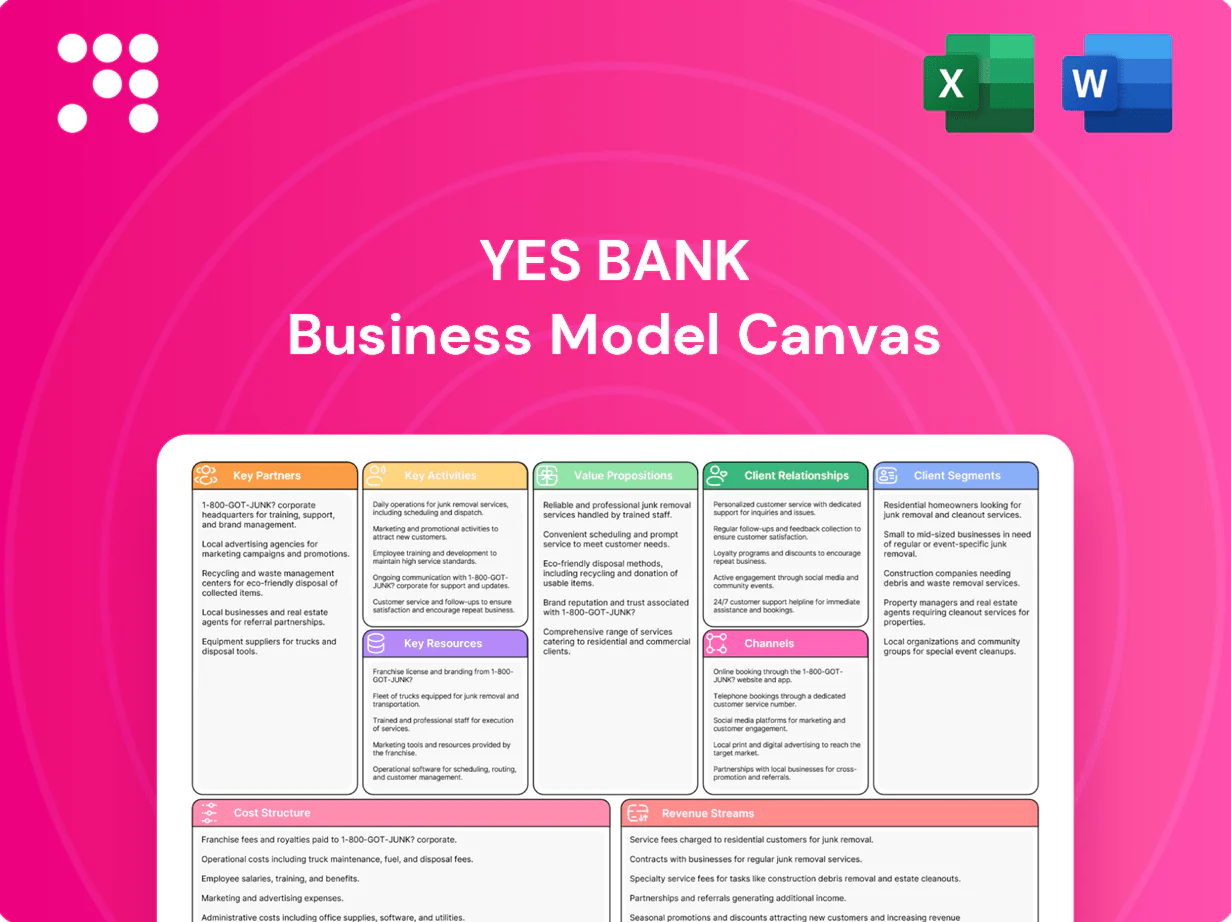
Yes Bank Business Model Canvas

Business Model Canvas: Strategic snapshot of a leading private bank for investors and strategists
Discover the strategic backbone of Yes Bank with our Business Model Canvas—clarifying its customer segments, core value propositions, revenue streams, and key partnerships in one concise view. This actionable snapshot highlights competitive advantages, growth levers, and operational risks to inform investors, advisors, and strategists. Purchase the full, editable canvas to access detailed, company-specific insights and ready-to-use templates for analysis and planning.
Partnerships

Payment networks and card schemes
Alliances with Visa, Mastercard and RuPay enable Yes Bank to issue and accept co-branded and debit/credit cards across networks that collectively process trillions of transactions annually, ensuring wide merchant acceptance and network resilience.
These partners enforce global security standards (EMV, PCI-DSS) and provide co-branding and marketing support; joint campaigns with network partners have historically driven double-digit growth in card spends and interchange revenue.
Deep API and gateway integration reduces friction at checkout, improving customer experience and expanding merchant reach across e-commerce and POS channels nationwide.
Fintechs and digital ecosystems
Partnerships with fintechs accelerate onboarding, lending and payments for Yes Bank, leveraging India’s booming ecosystem that processed ~90 billion UPI transactions in FY2023‑24 to drive scale. APIs and developer sandboxes support rapid product launches and embedded finance, with banks partnering across hundreds of fintechs in 2024. Co-creation expands reach into new segments while consent‑based data sharing (Account Aggregator framework) improves underwriting accuracy and personalization.

Technology vendors and cloud providers
Ties with core-banking, cloud, cybersecurity, and analytics vendors give Yes Bank scalable, API-driven operations and elastic capacity for peak loads. SLAs typically target 99.99% uptime — about 52.6 minutes of downtime per year — to guarantee resilience and security. Modern cloud-native stacks shorten release cycles and lower infrastructure overhead, while joint roadmaps align upgrades with regulatory timelines and business priorities.

Correspondent banks and capital market counterparties
Correspondent banks and capital market counterparties enable Yes Bank to facilitate trade, remittances and forex settlement, while counterparties supply liquidity for treasury operations and hedging; as of FY2024 these ties underpin expanded pricing competitiveness and broader market access for clients, strengthening cross-border corporate solutions.
- Trade & remittances facilitation
- Treasury liquidity & hedging
- Improved pricing & market access
- Enhanced cross-border corporate solutions
Government, regulators, and payment rails
Engagement with RBI, NPCI and government ensures Yes Bank’s compliance and direct access to UPI/AEPS/IMPS rails, supporting interoperability; UPI averaged ~11 billion monthly transactions in 2024 while NPCI-led rails scaled nationwide. Participation in public schemes (PMJDY ~470 million accounts in 2024) expands inclusion; ongoing regulatory dialogue informs risk, capital practices and builds trust and systemic stability.
- RBI/NPCI access: UPI ~11B/month (2024)
- Financial inclusion: PMJDY ~470M accounts (2024)
- Regulatory dialogue: shapes risk & capital norms
- Systemic trust: enhances stability & interoperability
Card networks + fintech scale: UPI 11B/mo, SLA 99.99%
Yes Bank’s card network alliances (Visa/Mastercard/RuPay) secure wide acceptance and card revenue across networks processing trillions of annual transactions.
Fintech and NPCI ties drive scale via UPI (~11B monthly txns in 2024) and embedded finance, improving onboarding and underwriting.
Cloud, security vendors and correspondent banks provide 99.99% SLA resilience, liquidity and cross‑border capabilities.
| Partner | Role | 2024 metric |
|---|---|---|
| Card networks | Acceptance & co‑brand | Trillions txn/yr |
| NPCI/Fintechs | Payments & scale | UPI ~11B/mo |
| Cloud/vendors | Resilience & ops | SLA 99.99% |
What is included in the product
 Detailed Word Document
A comprehensive Business Model Canvas for Yes Bank that maps its nine strategic blocks—customer segments, value propositions, channels, customer relationships, revenue streams, key resources, key activities, key partners, and cost structure—reflecting real-world operations and strategic priorities. Includes competitive analysis, SWOT-linked insights, and polished narrative for presentations, funding or strategic planning.

 Customizable Excel Spreadsheet
High-level view of Yes Bank’s business model with editable cells to quickly identify risk hotspots, revenue drivers and capital gaps for faster strategic decisions.
Activities

Deposit mobilization and liability management
Acquire and retain CASA and term deposits at optimal cost, with Yes Bank reporting a CASA ratio near 43% in 2024 while steadily growing low-cost deposits to reduce funding costs. Design products and pricing across retail, SME and corporate segments to meet diverse needs and improve stickiness. Actively manage liquidity, ALM and interest rate risk through tenor-matched funding and dynamic gap limits. Ensure seamless onboarding and KYC via digital e-KYC and API-driven processes to shorten acquisition time.
Lending, underwriting, and portfolio management
Originate retail, MSME and corporate credit with risk-based pricing, targeting segments aligned to Yes Bank’s FY2024 strategic priorities while balancing yield and credit quality. Use data-driven underwriting and continuous monitoring via credit analytics and portfolio dashboards to detect early stress. Manage collections and restructuring prudently, prioritizing recoveries and sustainable cures. Optimize RWA and capital allocation to enhance return on equity and regulatory ratios.

Risk, compliance, and governance
Yes Bank operates robust frameworks for credit, market, operational and cyber risk with board-approved policies, conducting quarterly stress tests (4 per year) and regular internal audits. The bank complies with prudential norms, AML reporting (cash transaction reporting threshold ₹10,000) and India’s data protection rules (DPDP/IT provisions). Transparent disclosures and active board oversight ensure governance and regulatory alignment.

Digital product development and technology operations
Yes Bank builds and runs mobile, internet and API platforms to deliver retail and corporate banking; it implements analytics, AI and automation to reduce processing times and detect fraud while ensuring high uptime, cybersecurity and cloud scalability; continuous UX and feature improvements drive adoption and engagement.
- Platform ops: mobile, internet, APIs
- Analytics/AI/automation for efficiency
- Uptime, cybersecurity, scalability
- Ongoing UX and feature releases
Treasury, payments, and transaction banking
Yes Bank manages investments, liquidity buffers and hedging to protect margins and meet regulatory liquidity coverage; in 2024 retail real-time rails scaled as UPI crossed 100 billion transactions, increasing settlement velocity and collections. The bank provides trade finance, cash management and FX services, runs real-time payments and collections, and actively optimizes spreads and fee income through pricing and cross-sell.
- Manage investments & liquidity buffers
- Hedging & FX services
- Trade finance & cash management
- Real-time payments and collections (UPI 2024 >100B)
- Optimize spreads and fee income
CASA ≈43%, UPI >100B, stress tests 4/yr, AML ₹10,000
Acquire and retain CASA (≈43% in 2024) via segmented pricing; originate retail/MSME/corporate credit with risk-based pricing and data-driven underwriting; run digital platforms, analytics, cybersecurity and real-time payments (UPI >100B txns in 2024); manage liquidity, hedging, quarterly stress tests (4/yr) and AML CTR ₹10,000.
| Metric | 2024 |
|---|---|
| CASA ratio | ≈43% |
| UPI volume | >100 billion txns |
| Stress tests | 4 per year |
| AML CTR threshold | ₹10,000 |
Full Version Awaits
Business Model Canvas
The document you're previewing is the actual Yes Bank Business Model Canvas you will receive after purchase, not a mockup or sample. On checkout you'll get the complete, editable file formatted exactly as shown, ready for analysis, presentation, or customization. No placeholders, no hidden pages—what you see is the deliverable in full.

Business Model Canvas: Strategic snapshot of a leading private bank for investors and strategists
Discover the strategic backbone of Yes Bank with our Business Model Canvas—clarifying its customer segments, core value propositions, revenue streams, and key partnerships in one concise view. This actionable snapshot highlights competitive advantages, growth levers, and operational risks to inform investors, advisors, and strategists. Purchase the full, editable canvas to access detailed, company-specific insights and ready-to-use templates for analysis and planning.
Partnerships
Payment networks and card schemes
Alliances with Visa, Mastercard and RuPay enable Yes Bank to issue and accept co-branded and debit/credit cards across networks that collectively process trillions of transactions annually, ensuring wide merchant acceptance and network resilience.
These partners enforce global security standards (EMV, PCI-DSS) and provide co-branding and marketing support; joint campaigns with network partners have historically driven double-digit growth in card spends and interchange revenue.
Deep API and gateway integration reduces friction at checkout, improving customer experience and expanding merchant reach across e-commerce and POS channels nationwide.
Fintechs and digital ecosystems
Partnerships with fintechs accelerate onboarding, lending and payments for Yes Bank, leveraging India’s booming ecosystem that processed ~90 billion UPI transactions in FY2023‑24 to drive scale. APIs and developer sandboxes support rapid product launches and embedded finance, with banks partnering across hundreds of fintechs in 2024. Co-creation expands reach into new segments while consent‑based data sharing (Account Aggregator framework) improves underwriting accuracy and personalization.
Technology vendors and cloud providers
Ties with core-banking, cloud, cybersecurity, and analytics vendors give Yes Bank scalable, API-driven operations and elastic capacity for peak loads. SLAs typically target 99.99% uptime — about 52.6 minutes of downtime per year — to guarantee resilience and security. Modern cloud-native stacks shorten release cycles and lower infrastructure overhead, while joint roadmaps align upgrades with regulatory timelines and business priorities.
Correspondent banks and capital market counterparties
Correspondent banks and capital market counterparties enable Yes Bank to facilitate trade, remittances and forex settlement, while counterparties supply liquidity for treasury operations and hedging; as of FY2024 these ties underpin expanded pricing competitiveness and broader market access for clients, strengthening cross-border corporate solutions.
- Trade & remittances facilitation
- Treasury liquidity & hedging
- Improved pricing & market access
- Enhanced cross-border corporate solutions
Government, regulators, and payment rails
Engagement with RBI, NPCI and government ensures Yes Bank’s compliance and direct access to UPI/AEPS/IMPS rails, supporting interoperability; UPI averaged ~11 billion monthly transactions in 2024 while NPCI-led rails scaled nationwide. Participation in public schemes (PMJDY ~470 million accounts in 2024) expands inclusion; ongoing regulatory dialogue informs risk, capital practices and builds trust and systemic stability.
- RBI/NPCI access: UPI ~11B/month (2024)
- Financial inclusion: PMJDY ~470M accounts (2024)
- Regulatory dialogue: shapes risk & capital norms
- Systemic trust: enhances stability & interoperability
Card networks + fintech scale: UPI 11B/mo, SLA 99.99%
Yes Bank’s card network alliances (Visa/Mastercard/RuPay) secure wide acceptance and card revenue across networks processing trillions of annual transactions.
Fintech and NPCI ties drive scale via UPI (~11B monthly txns in 2024) and embedded finance, improving onboarding and underwriting.
Cloud, security vendors and correspondent banks provide 99.99% SLA resilience, liquidity and cross‑border capabilities.
| Partner | Role | 2024 metric |
|---|---|---|
| Card networks | Acceptance & co‑brand | Trillions txn/yr |
| NPCI/Fintechs | Payments & scale | UPI ~11B/mo |
| Cloud/vendors | Resilience & ops | SLA 99.99% |
What is included in the product
Detailed Word Document
A comprehensive Business Model Canvas for Yes Bank that maps its nine strategic blocks—customer segments, value propositions, channels, customer relationships, revenue streams, key resources, key activities, key partners, and cost structure—reflecting real-world operations and strategic priorities. Includes competitive analysis, SWOT-linked insights, and polished narrative for presentations, funding or strategic planning.
Customizable Excel Spreadsheet
High-level view of Yes Bank’s business model with editable cells to quickly identify risk hotspots, revenue drivers and capital gaps for faster strategic decisions.
Activities
Deposit mobilization and liability management
Acquire and retain CASA and term deposits at optimal cost, with Yes Bank reporting a CASA ratio near 43% in 2024 while steadily growing low-cost deposits to reduce funding costs. Design products and pricing across retail, SME and corporate segments to meet diverse needs and improve stickiness. Actively manage liquidity, ALM and interest rate risk through tenor-matched funding and dynamic gap limits. Ensure seamless onboarding and KYC via digital e-KYC and API-driven processes to shorten acquisition time.
Lending, underwriting, and portfolio management
Originate retail, MSME and corporate credit with risk-based pricing, targeting segments aligned to Yes Bank’s FY2024 strategic priorities while balancing yield and credit quality. Use data-driven underwriting and continuous monitoring via credit analytics and portfolio dashboards to detect early stress. Manage collections and restructuring prudently, prioritizing recoveries and sustainable cures. Optimize RWA and capital allocation to enhance return on equity and regulatory ratios.
Risk, compliance, and governance
Yes Bank operates robust frameworks for credit, market, operational and cyber risk with board-approved policies, conducting quarterly stress tests (4 per year) and regular internal audits. The bank complies with prudential norms, AML reporting (cash transaction reporting threshold ₹10,000) and India’s data protection rules (DPDP/IT provisions). Transparent disclosures and active board oversight ensure governance and regulatory alignment.
Digital product development and technology operations
Yes Bank builds and runs mobile, internet and API platforms to deliver retail and corporate banking; it implements analytics, AI and automation to reduce processing times and detect fraud while ensuring high uptime, cybersecurity and cloud scalability; continuous UX and feature improvements drive adoption and engagement.
- Platform ops: mobile, internet, APIs
- Analytics/AI/automation for efficiency
- Uptime, cybersecurity, scalability
- Ongoing UX and feature releases
Treasury, payments, and transaction banking
Yes Bank manages investments, liquidity buffers and hedging to protect margins and meet regulatory liquidity coverage; in 2024 retail real-time rails scaled as UPI crossed 100 billion transactions, increasing settlement velocity and collections. The bank provides trade finance, cash management and FX services, runs real-time payments and collections, and actively optimizes spreads and fee income through pricing and cross-sell.
- Manage investments & liquidity buffers
- Hedging & FX services
- Trade finance & cash management
- Real-time payments and collections (UPI 2024 >100B)
- Optimize spreads and fee income
CASA ≈43%, UPI >100B, stress tests 4/yr, AML ₹10,000
Acquire and retain CASA (≈43% in 2024) via segmented pricing; originate retail/MSME/corporate credit with risk-based pricing and data-driven underwriting; run digital platforms, analytics, cybersecurity and real-time payments (UPI >100B txns in 2024); manage liquidity, hedging, quarterly stress tests (4/yr) and AML CTR ₹10,000.
| Metric | 2024 |
|---|---|
| CASA ratio | ≈43% |
| UPI volume | >100 billion txns |
| Stress tests | 4 per year |
| AML CTR threshold | ₹10,000 |
Full Version Awaits
Business Model Canvas
The document you're previewing is the actual Yes Bank Business Model Canvas you will receive after purchase, not a mockup or sample. On checkout you'll get the complete, editable file formatted exactly as shown, ready for analysis, presentation, or customization. No placeholders, no hidden pages—what you see is the deliverable in full.
Original: $10.00
-65%$10.00
$3.50Description
Business Model Canvas: Strategic snapshot of a leading private bank for investors and strategists
Discover the strategic backbone of Yes Bank with our Business Model Canvas—clarifying its customer segments, core value propositions, revenue streams, and key partnerships in one concise view. This actionable snapshot highlights competitive advantages, growth levers, and operational risks to inform investors, advisors, and strategists. Purchase the full, editable canvas to access detailed, company-specific insights and ready-to-use templates for analysis and planning.
Partnerships
Payment networks and card schemes
Alliances with Visa, Mastercard and RuPay enable Yes Bank to issue and accept co-branded and debit/credit cards across networks that collectively process trillions of transactions annually, ensuring wide merchant acceptance and network resilience.
These partners enforce global security standards (EMV, PCI-DSS) and provide co-branding and marketing support; joint campaigns with network partners have historically driven double-digit growth in card spends and interchange revenue.
Deep API and gateway integration reduces friction at checkout, improving customer experience and expanding merchant reach across e-commerce and POS channels nationwide.
Fintechs and digital ecosystems
Partnerships with fintechs accelerate onboarding, lending and payments for Yes Bank, leveraging India’s booming ecosystem that processed ~90 billion UPI transactions in FY2023‑24 to drive scale. APIs and developer sandboxes support rapid product launches and embedded finance, with banks partnering across hundreds of fintechs in 2024. Co-creation expands reach into new segments while consent‑based data sharing (Account Aggregator framework) improves underwriting accuracy and personalization.
Technology vendors and cloud providers
Ties with core-banking, cloud, cybersecurity, and analytics vendors give Yes Bank scalable, API-driven operations and elastic capacity for peak loads. SLAs typically target 99.99% uptime — about 52.6 minutes of downtime per year — to guarantee resilience and security. Modern cloud-native stacks shorten release cycles and lower infrastructure overhead, while joint roadmaps align upgrades with regulatory timelines and business priorities.
Correspondent banks and capital market counterparties
Correspondent banks and capital market counterparties enable Yes Bank to facilitate trade, remittances and forex settlement, while counterparties supply liquidity for treasury operations and hedging; as of FY2024 these ties underpin expanded pricing competitiveness and broader market access for clients, strengthening cross-border corporate solutions.
- Trade & remittances facilitation
- Treasury liquidity & hedging
- Improved pricing & market access
- Enhanced cross-border corporate solutions
Government, regulators, and payment rails
Engagement with RBI, NPCI and government ensures Yes Bank’s compliance and direct access to UPI/AEPS/IMPS rails, supporting interoperability; UPI averaged ~11 billion monthly transactions in 2024 while NPCI-led rails scaled nationwide. Participation in public schemes (PMJDY ~470 million accounts in 2024) expands inclusion; ongoing regulatory dialogue informs risk, capital practices and builds trust and systemic stability.
- RBI/NPCI access: UPI ~11B/month (2024)
- Financial inclusion: PMJDY ~470M accounts (2024)
- Regulatory dialogue: shapes risk & capital norms
- Systemic trust: enhances stability & interoperability
Card networks + fintech scale: UPI 11B/mo, SLA 99.99%
Yes Bank’s card network alliances (Visa/Mastercard/RuPay) secure wide acceptance and card revenue across networks processing trillions of annual transactions.
Fintech and NPCI ties drive scale via UPI (~11B monthly txns in 2024) and embedded finance, improving onboarding and underwriting.
Cloud, security vendors and correspondent banks provide 99.99% SLA resilience, liquidity and cross‑border capabilities.
| Partner | Role | 2024 metric |
|---|---|---|
| Card networks | Acceptance & co‑brand | Trillions txn/yr |
| NPCI/Fintechs | Payments & scale | UPI ~11B/mo |
| Cloud/vendors | Resilience & ops | SLA 99.99% |
What is included in the product
Detailed Word Document
A comprehensive Business Model Canvas for Yes Bank that maps its nine strategic blocks—customer segments, value propositions, channels, customer relationships, revenue streams, key resources, key activities, key partners, and cost structure—reflecting real-world operations and strategic priorities. Includes competitive analysis, SWOT-linked insights, and polished narrative for presentations, funding or strategic planning.
Customizable Excel Spreadsheet
High-level view of Yes Bank’s business model with editable cells to quickly identify risk hotspots, revenue drivers and capital gaps for faster strategic decisions.
Activities
Deposit mobilization and liability management
Acquire and retain CASA and term deposits at optimal cost, with Yes Bank reporting a CASA ratio near 43% in 2024 while steadily growing low-cost deposits to reduce funding costs. Design products and pricing across retail, SME and corporate segments to meet diverse needs and improve stickiness. Actively manage liquidity, ALM and interest rate risk through tenor-matched funding and dynamic gap limits. Ensure seamless onboarding and KYC via digital e-KYC and API-driven processes to shorten acquisition time.
Lending, underwriting, and portfolio management
Originate retail, MSME and corporate credit with risk-based pricing, targeting segments aligned to Yes Bank’s FY2024 strategic priorities while balancing yield and credit quality. Use data-driven underwriting and continuous monitoring via credit analytics and portfolio dashboards to detect early stress. Manage collections and restructuring prudently, prioritizing recoveries and sustainable cures. Optimize RWA and capital allocation to enhance return on equity and regulatory ratios.
Risk, compliance, and governance
Yes Bank operates robust frameworks for credit, market, operational and cyber risk with board-approved policies, conducting quarterly stress tests (4 per year) and regular internal audits. The bank complies with prudential norms, AML reporting (cash transaction reporting threshold ₹10,000) and India’s data protection rules (DPDP/IT provisions). Transparent disclosures and active board oversight ensure governance and regulatory alignment.
Digital product development and technology operations
Yes Bank builds and runs mobile, internet and API platforms to deliver retail and corporate banking; it implements analytics, AI and automation to reduce processing times and detect fraud while ensuring high uptime, cybersecurity and cloud scalability; continuous UX and feature improvements drive adoption and engagement.
- Platform ops: mobile, internet, APIs
- Analytics/AI/automation for efficiency
- Uptime, cybersecurity, scalability
- Ongoing UX and feature releases
Treasury, payments, and transaction banking
Yes Bank manages investments, liquidity buffers and hedging to protect margins and meet regulatory liquidity coverage; in 2024 retail real-time rails scaled as UPI crossed 100 billion transactions, increasing settlement velocity and collections. The bank provides trade finance, cash management and FX services, runs real-time payments and collections, and actively optimizes spreads and fee income through pricing and cross-sell.
- Manage investments & liquidity buffers
- Hedging & FX services
- Trade finance & cash management
- Real-time payments and collections (UPI 2024 >100B)
- Optimize spreads and fee income
CASA ≈43%, UPI >100B, stress tests 4/yr, AML ₹10,000
Acquire and retain CASA (≈43% in 2024) via segmented pricing; originate retail/MSME/corporate credit with risk-based pricing and data-driven underwriting; run digital platforms, analytics, cybersecurity and real-time payments (UPI >100B txns in 2024); manage liquidity, hedging, quarterly stress tests (4/yr) and AML CTR ₹10,000.
| Metric | 2024 |
|---|---|
| CASA ratio | ≈43% |
| UPI volume | >100 billion txns |
| Stress tests | 4 per year |
| AML CTR threshold | ₹10,000 |
Full Version Awaits
Business Model Canvas
The document you're previewing is the actual Yes Bank Business Model Canvas you will receive after purchase, not a mockup or sample. On checkout you'll get the complete, editable file formatted exactly as shown, ready for analysis, presentation, or customization. No placeholders, no hidden pages—what you see is the deliverable in full.











