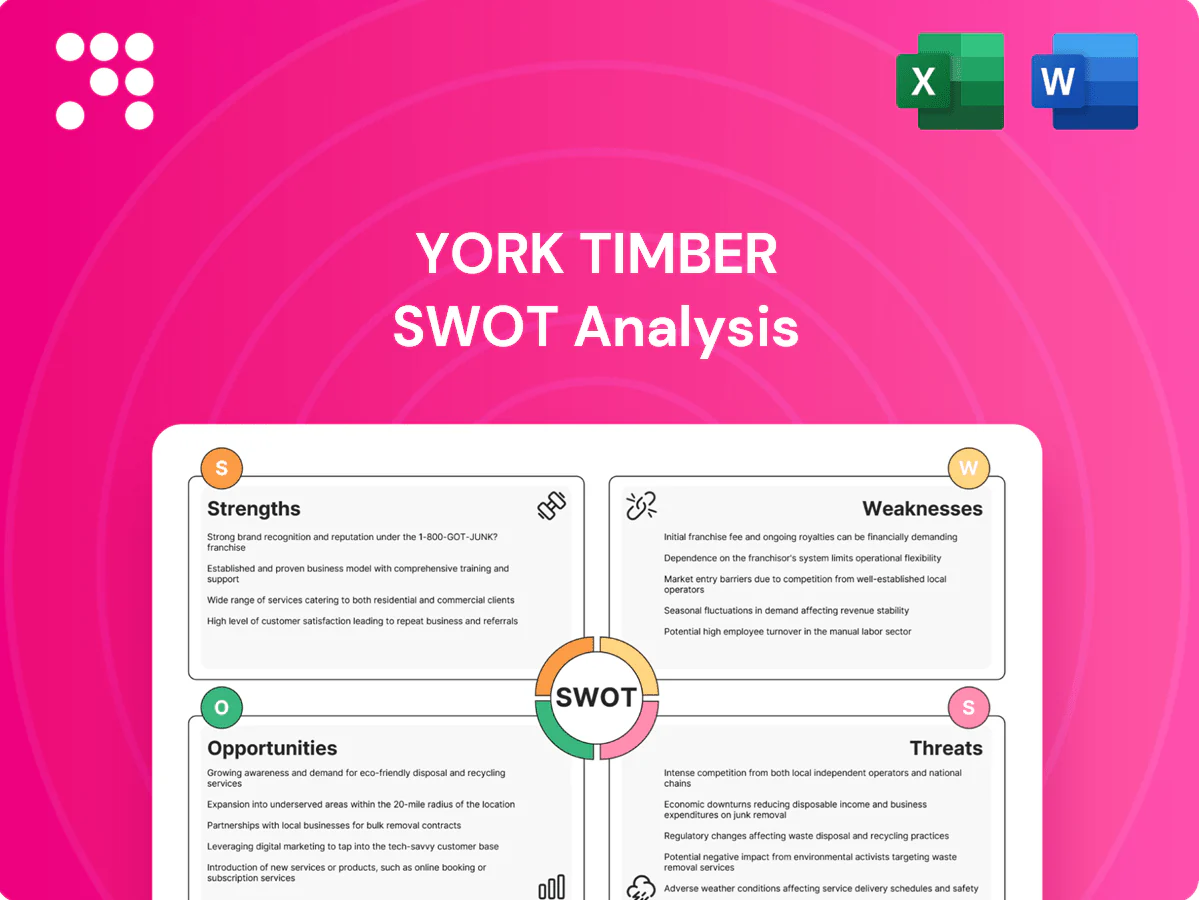
York Timber SWOT Analysis

Go Beyond the Preview—Access the Full Strategic Report
York Timber’s timber-grade focus and integrated supply chain provide solid margins, while exposure to housing cycles and raw‑material volatility pose clear risks. Strategic opportunities include sustainable product lines and export expansion, but execution and regulatory shifts are critical. Purchase the full SWOT analysis for a researcher-ready Word report and editable Excel matrix to plan and pitch with confidence.
Strengths

Integrated forest-to-finished chain
Owning plantations and converting logs into lumber, plywood and value-added products gives York Timber end-to-end control over quality, costs and supply continuity, enabling better margin capture across the chain. Vertical integration reduces reliance on third-party inputs and allows faster product-mix shifts as demand cycles change. This structure helps buffer raw-material price swings, as seen when lumber futures moved over 200% in 2020–21.
Diversified wood product portfolio
Exposure to multiple product lines—sawn timber, plywood and value-added items—reduces single-product risk and lets York Timber supply construction, furniture and industrial end-markets.
Breadth of portfolio supports better mill utilization and smooths sales across cycles by shifting output to higher-demand product lines when markets swing.
Cross-selling of complementary products increases customer stickiness and raises average order value.

Established plantation asset base
Owned and managed plantation assets give York Timber secure log supply and species consistency, reducing exposure to market sourcing shocks. Ongoing long-term silviculture programs underpin predictable yields, improved timber quality and stable harvesting costs. Close proximity of plantations to company mills cuts transport costs and log losses. Tangible plantation asset backing enhances balance sheet strength and creditworthiness.

Domestic reach with export channels
York Timber leverages strong domestic distribution while selling to international buyers, diversifying revenue streams and reducing reliance on local demand cycles. Export channels enable the company to capitalize on favorable currency movements and absorb excess mill capacity, supporting margin resilience. Maintaining core volumes through domestic relationships with builders and merchants preserves market share and strengthens pricing power and inventory flexibility across markets.
- Domestic volumes sustain cash flow
- Exports monetize currency swings
- Excess capacity routed to export markets
- Dual markets improve pricing & inventory management
Operational know-how and compliance
Decades operating in South African conditions deliver efficient harvesting and processing, supported by process control and sustainable certifications that open regulated markets; South Africa had c.1.2 million hectares of commercial plantations in 2024 (SA Forestry Statistics), and strong safety, quality and environmental systems lower operational risk and boost credibility with institutional buyers.
- Operational experience: decades in SA terrain
- Market access: sustainable certifications
- Risk control: safety, quality, environmental systems
- Credibility: trusted by institutional buyers
Vertical integration hedges 200% lumber futures shock; SA plantations, multi-product exports
Vertical integration from plantation to value-added products secures margins and supply; lumber futures rose ~200% in 2020–21, highlighting raw-material volatility hedged by integration. Multi-product mix (sawn, plywood, value-add) and domestic plus export channels diversify demand exposure. Decades in South Africa and sustainable certifications underpin market credibility.
| Strength | Evidence | Metric |
|---|---|---|
| Secure supply | Owned plantations | SA commercial plantations 1.2m ha (2024) |
| Integration | End-to-end | Lumber futures +200% (2020–21) |
What is included in the product
 Detailed Word Document
Provides a concise strategic overview of York Timber’s internal strengths and weaknesses and external opportunities and threats, mapping competitive position, growth drivers, operational gaps and market risks to inform strategic decisions.

 Customizable Excel Spreadsheet
Provides a concise SWOT matrix that quickly highlights York Timber's strategic pain points and actionable priorities for fast stakeholder alignment.
Weaknesses

Exposure to cyclical construction demand
Revenue is tightly tied to housing starts, renovations and infrastructure cycles—UK housing starts are around c.150,000 units annually, so downturns compress volumes and pricing, squeezing margins. Inventory can build rapidly when demand slows, elevating working-capital needs. This cyclicality complicates capacity planning and cash-flow management, increasing sensitivity to short-term construction activity shifts.
Capital-intensive, aging assets
Forestry and mill operations require continuous capex for replanting, machinery and upgrades, while older equipment raises maintenance and lowers yield recovery, eroding margins. Deferred capex risks competitiveness versus newer mills and capacity to meet quality benchmarks. Higher borrowing costs — Bank of England base rate 5.25% in 2024 — can strain free cash flow in weak markets.

Geographic and species concentration
Operations concentrated in South Africa, where the plantation estate is about 1.15 million hectares (SA Forestry 2023) and is dominated by pine and eucalyptus, concentrates York Timber’s risk exposure. This geographic and species concentration raises vulnerability to local macro and policy shifts, and climate shocks such as droughts or fire. A limited species mix constrains product properties and end-use diversification and reduces resilience to species-specific pests and diseases.

Logistics and energy constraints
Dependence on regional transport infrastructure causes frequent delays and cost overruns, with longer lead times versus well-serviced import routes. Power instability and load-shedding increase operating costs and unplanned downtime for mills and warehouses. Investment in backup energy (generators, solar + storage) raises capital needs and operational complexity, eroding price competitiveness against imports.
- Transport delays → higher logistics cost
- Load-shedding → increased downtime and OPEX
- Backup energy → higher CAPEX and complexity
- Net effect → weaker competitiveness vs imports
Working capital intensity
York Timber's forestry operations are working capital intensive: biological assets and inventories tie up cash across long growth cycles (often 15–30 years), extending payback and raising liquidity risk. Seasonality and export lead times routinely lengthen receivable days by 60–120 days, pressuring cash conversion. With UK Bank Rate around 5.25% in mid‑2025, elevated financing costs worsen stress in downturns.
- Working capital intensity
- 15–30 year growth cycles
- Receivables +60–120 days
- Financing cost risk at ~5.25%
Housing cycles, long rotations and rising rates squeeze cash flow
Revenue and margins tightly track UK housing starts (~150,000 pa) and construction cycles, so downturns compress volumes and inventory builds, pressuring cash flow. Capital-intensive forestry/mill capex and 15–30 year rotation cycles raise payback and liquidity risk; receivables often extend 60–120 days. Concentration in South Africa (~1.15m ha estate) plus 2025 UK Bank Rate ~5.25% increase refinancing strain.
| Metric | Value |
|---|---|
| UK housing starts | ~150,000 pa |
| SA plantation estate | ~1.15m ha (2023) |
| Receivables | 60–120 days |
| UK Bank Rate | ~5.25% (mid‑2025) |
Same Document Delivered
York Timber SWOT Analysis
This is the actual York Timber SWOT analysis document you’ll receive upon purchase—no surprises, just professional quality. The preview below is taken directly from the full report you'll get; purchase unlocks the entire, editable version. You’re viewing a live preview of the real file, structured and ready to use once payment is completed.

Go Beyond the Preview—Access the Full Strategic Report
York Timber’s timber-grade focus and integrated supply chain provide solid margins, while exposure to housing cycles and raw‑material volatility pose clear risks. Strategic opportunities include sustainable product lines and export expansion, but execution and regulatory shifts are critical. Purchase the full SWOT analysis for a researcher-ready Word report and editable Excel matrix to plan and pitch with confidence.
Strengths
Integrated forest-to-finished chain
Owning plantations and converting logs into lumber, plywood and value-added products gives York Timber end-to-end control over quality, costs and supply continuity, enabling better margin capture across the chain. Vertical integration reduces reliance on third-party inputs and allows faster product-mix shifts as demand cycles change. This structure helps buffer raw-material price swings, as seen when lumber futures moved over 200% in 2020–21.
Diversified wood product portfolio
Exposure to multiple product lines—sawn timber, plywood and value-added items—reduces single-product risk and lets York Timber supply construction, furniture and industrial end-markets.
Breadth of portfolio supports better mill utilization and smooths sales across cycles by shifting output to higher-demand product lines when markets swing.
Cross-selling of complementary products increases customer stickiness and raises average order value.
Established plantation asset base
Owned and managed plantation assets give York Timber secure log supply and species consistency, reducing exposure to market sourcing shocks. Ongoing long-term silviculture programs underpin predictable yields, improved timber quality and stable harvesting costs. Close proximity of plantations to company mills cuts transport costs and log losses. Tangible plantation asset backing enhances balance sheet strength and creditworthiness.
Domestic reach with export channels
York Timber leverages strong domestic distribution while selling to international buyers, diversifying revenue streams and reducing reliance on local demand cycles. Export channels enable the company to capitalize on favorable currency movements and absorb excess mill capacity, supporting margin resilience. Maintaining core volumes through domestic relationships with builders and merchants preserves market share and strengthens pricing power and inventory flexibility across markets.
- Domestic volumes sustain cash flow
- Exports monetize currency swings
- Excess capacity routed to export markets
- Dual markets improve pricing & inventory management
Operational know-how and compliance
Decades operating in South African conditions deliver efficient harvesting and processing, supported by process control and sustainable certifications that open regulated markets; South Africa had c.1.2 million hectares of commercial plantations in 2024 (SA Forestry Statistics), and strong safety, quality and environmental systems lower operational risk and boost credibility with institutional buyers.
- Operational experience: decades in SA terrain
- Market access: sustainable certifications
- Risk control: safety, quality, environmental systems
- Credibility: trusted by institutional buyers
Vertical integration hedges 200% lumber futures shock; SA plantations, multi-product exports
Vertical integration from plantation to value-added products secures margins and supply; lumber futures rose ~200% in 2020–21, highlighting raw-material volatility hedged by integration. Multi-product mix (sawn, plywood, value-add) and domestic plus export channels diversify demand exposure. Decades in South Africa and sustainable certifications underpin market credibility.
| Strength | Evidence | Metric |
|---|---|---|
| Secure supply | Owned plantations | SA commercial plantations 1.2m ha (2024) |
| Integration | End-to-end | Lumber futures +200% (2020–21) |
What is included in the product
Detailed Word Document
Provides a concise strategic overview of York Timber’s internal strengths and weaknesses and external opportunities and threats, mapping competitive position, growth drivers, operational gaps and market risks to inform strategic decisions.
Customizable Excel Spreadsheet
Provides a concise SWOT matrix that quickly highlights York Timber's strategic pain points and actionable priorities for fast stakeholder alignment.
Weaknesses
Exposure to cyclical construction demand
Revenue is tightly tied to housing starts, renovations and infrastructure cycles—UK housing starts are around c.150,000 units annually, so downturns compress volumes and pricing, squeezing margins. Inventory can build rapidly when demand slows, elevating working-capital needs. This cyclicality complicates capacity planning and cash-flow management, increasing sensitivity to short-term construction activity shifts.
Capital-intensive, aging assets
Forestry and mill operations require continuous capex for replanting, machinery and upgrades, while older equipment raises maintenance and lowers yield recovery, eroding margins. Deferred capex risks competitiveness versus newer mills and capacity to meet quality benchmarks. Higher borrowing costs — Bank of England base rate 5.25% in 2024 — can strain free cash flow in weak markets.
Geographic and species concentration
Operations concentrated in South Africa, where the plantation estate is about 1.15 million hectares (SA Forestry 2023) and is dominated by pine and eucalyptus, concentrates York Timber’s risk exposure. This geographic and species concentration raises vulnerability to local macro and policy shifts, and climate shocks such as droughts or fire. A limited species mix constrains product properties and end-use diversification and reduces resilience to species-specific pests and diseases.
Logistics and energy constraints
Dependence on regional transport infrastructure causes frequent delays and cost overruns, with longer lead times versus well-serviced import routes. Power instability and load-shedding increase operating costs and unplanned downtime for mills and warehouses. Investment in backup energy (generators, solar + storage) raises capital needs and operational complexity, eroding price competitiveness against imports.
- Transport delays → higher logistics cost
- Load-shedding → increased downtime and OPEX
- Backup energy → higher CAPEX and complexity
- Net effect → weaker competitiveness vs imports
Working capital intensity
York Timber's forestry operations are working capital intensive: biological assets and inventories tie up cash across long growth cycles (often 15–30 years), extending payback and raising liquidity risk. Seasonality and export lead times routinely lengthen receivable days by 60–120 days, pressuring cash conversion. With UK Bank Rate around 5.25% in mid‑2025, elevated financing costs worsen stress in downturns.
- Working capital intensity
- 15–30 year growth cycles
- Receivables +60–120 days
- Financing cost risk at ~5.25%
Housing cycles, long rotations and rising rates squeeze cash flow
Revenue and margins tightly track UK housing starts (~150,000 pa) and construction cycles, so downturns compress volumes and inventory builds, pressuring cash flow. Capital-intensive forestry/mill capex and 15–30 year rotation cycles raise payback and liquidity risk; receivables often extend 60–120 days. Concentration in South Africa (~1.15m ha estate) plus 2025 UK Bank Rate ~5.25% increase refinancing strain.
| Metric | Value |
|---|---|
| UK housing starts | ~150,000 pa |
| SA plantation estate | ~1.15m ha (2023) |
| Receivables | 60–120 days |
| UK Bank Rate | ~5.25% (mid‑2025) |
Same Document Delivered
York Timber SWOT Analysis
This is the actual York Timber SWOT analysis document you’ll receive upon purchase—no surprises, just professional quality. The preview below is taken directly from the full report you'll get; purchase unlocks the entire, editable version. You’re viewing a live preview of the real file, structured and ready to use once payment is completed.
Description
Go Beyond the Preview—Access the Full Strategic Report
York Timber’s timber-grade focus and integrated supply chain provide solid margins, while exposure to housing cycles and raw‑material volatility pose clear risks. Strategic opportunities include sustainable product lines and export expansion, but execution and regulatory shifts are critical. Purchase the full SWOT analysis for a researcher-ready Word report and editable Excel matrix to plan and pitch with confidence.
Strengths
Integrated forest-to-finished chain
Owning plantations and converting logs into lumber, plywood and value-added products gives York Timber end-to-end control over quality, costs and supply continuity, enabling better margin capture across the chain. Vertical integration reduces reliance on third-party inputs and allows faster product-mix shifts as demand cycles change. This structure helps buffer raw-material price swings, as seen when lumber futures moved over 200% in 2020–21.
Diversified wood product portfolio
Exposure to multiple product lines—sawn timber, plywood and value-added items—reduces single-product risk and lets York Timber supply construction, furniture and industrial end-markets.
Breadth of portfolio supports better mill utilization and smooths sales across cycles by shifting output to higher-demand product lines when markets swing.
Cross-selling of complementary products increases customer stickiness and raises average order value.
Established plantation asset base
Owned and managed plantation assets give York Timber secure log supply and species consistency, reducing exposure to market sourcing shocks. Ongoing long-term silviculture programs underpin predictable yields, improved timber quality and stable harvesting costs. Close proximity of plantations to company mills cuts transport costs and log losses. Tangible plantation asset backing enhances balance sheet strength and creditworthiness.
Domestic reach with export channels
York Timber leverages strong domestic distribution while selling to international buyers, diversifying revenue streams and reducing reliance on local demand cycles. Export channels enable the company to capitalize on favorable currency movements and absorb excess mill capacity, supporting margin resilience. Maintaining core volumes through domestic relationships with builders and merchants preserves market share and strengthens pricing power and inventory flexibility across markets.
- Domestic volumes sustain cash flow
- Exports monetize currency swings
- Excess capacity routed to export markets
- Dual markets improve pricing & inventory management
Operational know-how and compliance
Decades operating in South African conditions deliver efficient harvesting and processing, supported by process control and sustainable certifications that open regulated markets; South Africa had c.1.2 million hectares of commercial plantations in 2024 (SA Forestry Statistics), and strong safety, quality and environmental systems lower operational risk and boost credibility with institutional buyers.
- Operational experience: decades in SA terrain
- Market access: sustainable certifications
- Risk control: safety, quality, environmental systems
- Credibility: trusted by institutional buyers
Vertical integration hedges 200% lumber futures shock; SA plantations, multi-product exports
Vertical integration from plantation to value-added products secures margins and supply; lumber futures rose ~200% in 2020–21, highlighting raw-material volatility hedged by integration. Multi-product mix (sawn, plywood, value-add) and domestic plus export channels diversify demand exposure. Decades in South Africa and sustainable certifications underpin market credibility.
| Strength | Evidence | Metric |
|---|---|---|
| Secure supply | Owned plantations | SA commercial plantations 1.2m ha (2024) |
| Integration | End-to-end | Lumber futures +200% (2020–21) |
What is included in the product
Detailed Word Document
Provides a concise strategic overview of York Timber’s internal strengths and weaknesses and external opportunities and threats, mapping competitive position, growth drivers, operational gaps and market risks to inform strategic decisions.
Customizable Excel Spreadsheet
Provides a concise SWOT matrix that quickly highlights York Timber's strategic pain points and actionable priorities for fast stakeholder alignment.
Weaknesses
Exposure to cyclical construction demand
Revenue is tightly tied to housing starts, renovations and infrastructure cycles—UK housing starts are around c.150,000 units annually, so downturns compress volumes and pricing, squeezing margins. Inventory can build rapidly when demand slows, elevating working-capital needs. This cyclicality complicates capacity planning and cash-flow management, increasing sensitivity to short-term construction activity shifts.
Capital-intensive, aging assets
Forestry and mill operations require continuous capex for replanting, machinery and upgrades, while older equipment raises maintenance and lowers yield recovery, eroding margins. Deferred capex risks competitiveness versus newer mills and capacity to meet quality benchmarks. Higher borrowing costs — Bank of England base rate 5.25% in 2024 — can strain free cash flow in weak markets.
Geographic and species concentration
Operations concentrated in South Africa, where the plantation estate is about 1.15 million hectares (SA Forestry 2023) and is dominated by pine and eucalyptus, concentrates York Timber’s risk exposure. This geographic and species concentration raises vulnerability to local macro and policy shifts, and climate shocks such as droughts or fire. A limited species mix constrains product properties and end-use diversification and reduces resilience to species-specific pests and diseases.
Logistics and energy constraints
Dependence on regional transport infrastructure causes frequent delays and cost overruns, with longer lead times versus well-serviced import routes. Power instability and load-shedding increase operating costs and unplanned downtime for mills and warehouses. Investment in backup energy (generators, solar + storage) raises capital needs and operational complexity, eroding price competitiveness against imports.
- Transport delays → higher logistics cost
- Load-shedding → increased downtime and OPEX
- Backup energy → higher CAPEX and complexity
- Net effect → weaker competitiveness vs imports
Working capital intensity
York Timber's forestry operations are working capital intensive: biological assets and inventories tie up cash across long growth cycles (often 15–30 years), extending payback and raising liquidity risk. Seasonality and export lead times routinely lengthen receivable days by 60–120 days, pressuring cash conversion. With UK Bank Rate around 5.25% in mid‑2025, elevated financing costs worsen stress in downturns.
- Working capital intensity
- 15–30 year growth cycles
- Receivables +60–120 days
- Financing cost risk at ~5.25%
Housing cycles, long rotations and rising rates squeeze cash flow
Revenue and margins tightly track UK housing starts (~150,000 pa) and construction cycles, so downturns compress volumes and inventory builds, pressuring cash flow. Capital-intensive forestry/mill capex and 15–30 year rotation cycles raise payback and liquidity risk; receivables often extend 60–120 days. Concentration in South Africa (~1.15m ha estate) plus 2025 UK Bank Rate ~5.25% increase refinancing strain.
| Metric | Value |
|---|---|
| UK housing starts | ~150,000 pa |
| SA plantation estate | ~1.15m ha (2023) |
| Receivables | 60–120 days |
| UK Bank Rate | ~5.25% (mid‑2025) |
Same Document Delivered
York Timber SWOT Analysis
This is the actual York Timber SWOT analysis document you’ll receive upon purchase—no surprises, just professional quality. The preview below is taken directly from the full report you'll get; purchase unlocks the entire, editable version. You’re viewing a live preview of the real file, structured and ready to use once payment is completed.











