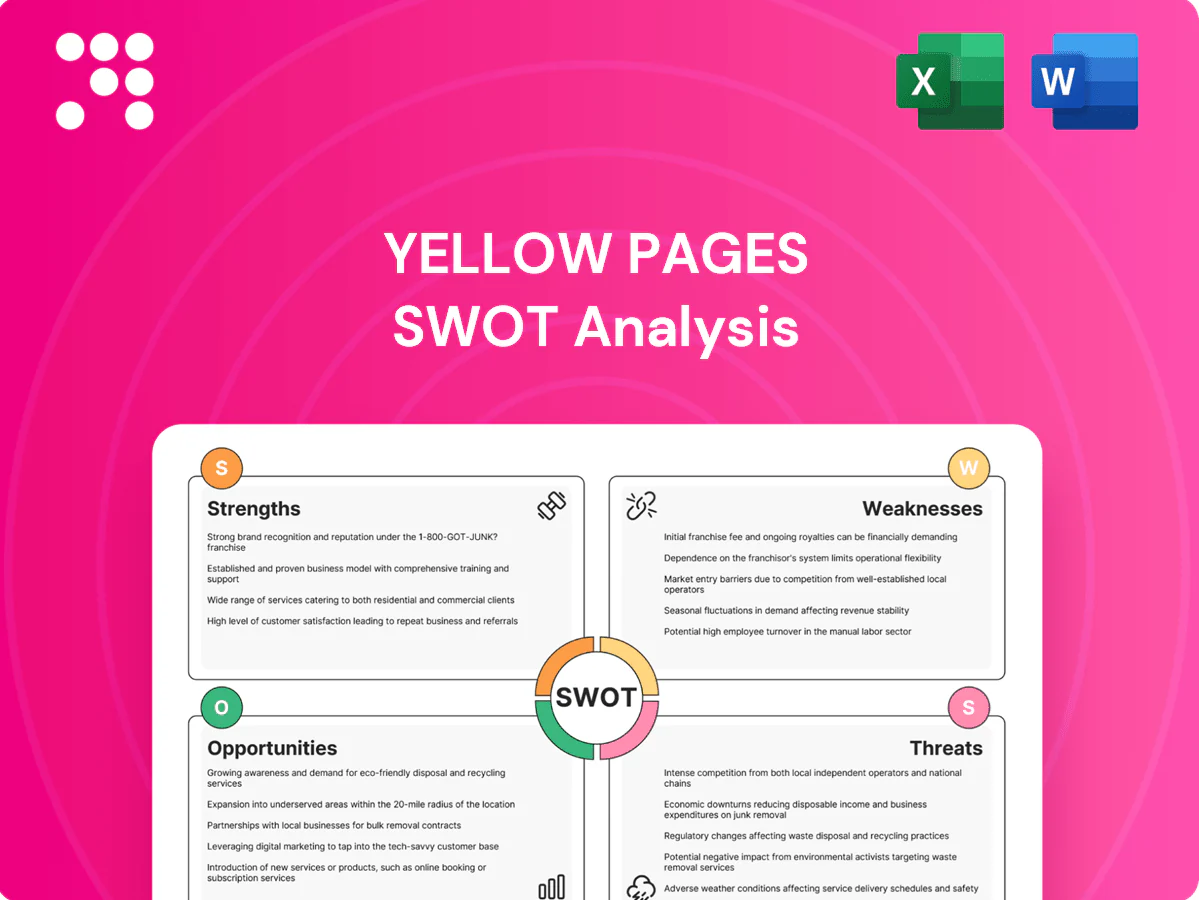
Yellow Pages SWOT Analysis

Make Insightful Decisions Backed by Expert Research
Unlock strategic clarity on Yellow Pages with our concise SWOT overview—highlighting digital-transition strengths, legacy brand recognition, monetization challenges, and market opportunities. Want the full story behind the company’s strengths, risks, and growth drivers? Purchase the complete SWOT analysis to gain access to a professionally written, fully editable report designed to support planning, pitches, and research. Ideal for investors and strategists who need actionable, research-backed insights.
Strengths

Trusted local brand
Decades of presence make Yellow Pages a recognizable, trusted name for local discovery in Canada, lowering SMB acquisition friction and supporting premium pricing for bundled solutions; this brand trust typically boosts advertiser conversion rates and helps cross-sell newer digital products to legacy customers.
Large SMB customer base
A broad footprint among small and medium businesses drives steady recurring revenue and strong referral flow. Established relationships shorten sales cycles for add-on services such as SEO and websites, improving upsell conversion rates. Rich customer data enables tailored packages and lifecycle management, while scale delivers actionable insights into local market dynamics.

Multi-product digital suite
Offering websites, SEO, listings and digital ads makes Yellow Pages a one-stop shop for SMBs, driving higher ARPU and lower churn via bundle stickiness; cross-product performance data enables better campaign optimization and ROI measurement, and tiered pricing fits varied SMB budgets — supporting the move as over 80% of consumers search online for local businesses, increasing digital demand.

Local search and directory assets
Yellow Pages' online directory continues to drive intent-rich traffic for local businesses: Google reports nearly half of searches have local intent, and directories still deliver millions of monthly, conversion-ready visits. Owned media inventory reduces dependence on paid third-party channels, lowering lead costs and preserving customer relationships. Deep categorical coverage captures niche and long-tail queries, while robust directory data improves citations and NAP consistency for SEO.
- Local intent: nearly half of searches (Google)
- Owned inventory: lowers third-party lead spend
- Category depth: captures long-tail queries
- Directory data: enhances citations and NAP consistency
National sales and service coverage
An experienced national salesforce and support teams deliver high-touch onboarding and improved retention, enabling Yellow Pages to convert enterprise deals and reduce churn; McKinsey 2024 notes personalization can boost revenue 10–15%, underscoring this value. Local reps capture regional nuances and vertical needs, while deeper service offerings differentiate from self-serve ad platforms and enable outcomes-based selling and case-study development.
- Experienced reps: high-touch onboarding & retention
- Local market insight: regional & vertical fit
- Service depth: differentiates vs self-serve; supports outcomes selling
Reach 90% of Canadian SMBs; ARPU +15%, retention +20%
Yellow Pages reaches ~90% of Canadian SMBs with strong brand trust, lowering acquisition friction and enabling premium bundle pricing.
Cross-selling websites, SEO and ads drives ARPU uplift (≈15%) and retention ~20% higher than self-serve alternatives; digital adoption among legacy clients ≈65% (2024–25).
Owned directory traffic supplies intent-rich leads, reducing third-party lead spend and improving local SEO outcomes.
| Metric | Value |
|---|---|
| SMB reach | 90% |
| Digital adoption | 65% |
| ARPU uplift | +15% |
| Retention uplift | +20% |
What is included in the product
 Detailed Word Document
Provides a concise SWOT overview of Yellow Pages, highlighting its core strengths in brand recognition and local listings, weaknesses in declining print revenue and digital transition, opportunities in digital advertising and data services, and threats from online search platforms and changing consumer behavior.

 Customizable Excel Spreadsheet
Provides a focused Yellow Pages SWOT that pinpoints legacy directory pain points and digital transformation opportunities for rapid strategy alignment and stakeholder-ready summaries.
Weaknesses

Legacy print decline
Structural decline in legacy print—print revenue for directory publishers has fallen over 50% in the past decade—creates persistent revenue headwinds and negative optics for Yellow Pages. Moving legacy contracts to digital often faces pricing pressure and lower ARPU, squeezing margin recovery. Resources diverted to wind-down activities distract from growth initiatives and can depress investor sentiment and valuation multiples.
Perception of being outdated
Some consumers and SMBs still associate Yellow Pages with an analog era, limiting trust in new digital services; this matters as global internet users reached about 5.3 billion in 2024 and digital-first expectations rise.
Repositioning requires incremental marketing spend—reallocating budget toward digital branding and UX—while competitors can exploit the outdated narrative during sales, pressuring conversion and CAC.

Platform dependence
Reliance on Google and Meta—which together captured about 60% of US digital ad spend in 2024—exposes Yellow Pages to policy and algorithm shifts that can abruptly cut ad reach. Rising traffic acquisition costs on those platforms can compress already thin digital margins. Walled-garden reporting limits reduce attribution transparency and hinder performance optimization. Platform dependence also constrains product differentiation.

SMB churn sensitivity
Small businesses face high failure and budget volatility—about 20% close in year one and roughly 50% within five years (SBA historical data)—making SMB churn a core vulnerability for Yellow Pages. Churn shortens customer LTV and magnifies CAC burden, while inconsistent local ad performance often triggers cancellations. Sustained retention demands intensive account management, raising operating costs.
- SMB failure: 20% year one, ~50% five years (SBA)
- Churn → lower LTV, higher CAC
- Variable local ROI drives cancellations
- Retention needs intensive, costly service
Limited scale vs big adtech
Compared to global platforms, Yellow Pages has fewer data signals and engineering resources. In 2024 Google and Meta captured roughly 56% of global digital ad revenue, concentrating scale and AI investment and slowing Yellow Pages' product and AI feature rollout. Pricing power is constrained by self-serve alternatives and partner bargaining asymmetry.
- Scale gap vs top platforms (~56% ad share)
- Slower AI/feature deployment
- Constrained pricing & weaker partner terms
Print down >50%; digital shift with ~5.3B users, ~56–60% ad duopoly
Legacy print decline (>50% revenue drop past decade) and low ARPU limit recovery. Brand seen as analog while ~5.3B global internet users lift digital expectations. Dependence on Google/Meta (~56–60% ad share 2024) raises traffic risk and costs. High SMB churn (20% year one, ~50% five years) inflates CAC and compresses LTV.
| Metric | Value |
|---|---|
| Print revenue decline | >50% decade |
| Global internet users (2024) | ~5.3B |
| Google/Meta ad share (2024) | ~56–60% |
| SMB failure | 20% Y1 / ~50% Y5 |
Same Document Delivered
Yellow Pages SWOT Analysis
This Yellow Pages SWOT Analysis delivers a concise review of strengths, weaknesses, opportunities and threats plus actionable insights for strategy and valuation. The preview below is taken directly from the full SWOT report you'll get. Purchase unlocks the entire in-depth, editable version for immediate download. Use it for competitive planning, investor briefs, or internal strategy work.

Make Insightful Decisions Backed by Expert Research
Unlock strategic clarity on Yellow Pages with our concise SWOT overview—highlighting digital-transition strengths, legacy brand recognition, monetization challenges, and market opportunities. Want the full story behind the company’s strengths, risks, and growth drivers? Purchase the complete SWOT analysis to gain access to a professionally written, fully editable report designed to support planning, pitches, and research. Ideal for investors and strategists who need actionable, research-backed insights.
Strengths
Trusted local brand
Decades of presence make Yellow Pages a recognizable, trusted name for local discovery in Canada, lowering SMB acquisition friction and supporting premium pricing for bundled solutions; this brand trust typically boosts advertiser conversion rates and helps cross-sell newer digital products to legacy customers.
Large SMB customer base
A broad footprint among small and medium businesses drives steady recurring revenue and strong referral flow. Established relationships shorten sales cycles for add-on services such as SEO and websites, improving upsell conversion rates. Rich customer data enables tailored packages and lifecycle management, while scale delivers actionable insights into local market dynamics.
Multi-product digital suite
Offering websites, SEO, listings and digital ads makes Yellow Pages a one-stop shop for SMBs, driving higher ARPU and lower churn via bundle stickiness; cross-product performance data enables better campaign optimization and ROI measurement, and tiered pricing fits varied SMB budgets — supporting the move as over 80% of consumers search online for local businesses, increasing digital demand.
Local search and directory assets
Yellow Pages' online directory continues to drive intent-rich traffic for local businesses: Google reports nearly half of searches have local intent, and directories still deliver millions of monthly, conversion-ready visits. Owned media inventory reduces dependence on paid third-party channels, lowering lead costs and preserving customer relationships. Deep categorical coverage captures niche and long-tail queries, while robust directory data improves citations and NAP consistency for SEO.
- Local intent: nearly half of searches (Google)
- Owned inventory: lowers third-party lead spend
- Category depth: captures long-tail queries
- Directory data: enhances citations and NAP consistency
National sales and service coverage
An experienced national salesforce and support teams deliver high-touch onboarding and improved retention, enabling Yellow Pages to convert enterprise deals and reduce churn; McKinsey 2024 notes personalization can boost revenue 10–15%, underscoring this value. Local reps capture regional nuances and vertical needs, while deeper service offerings differentiate from self-serve ad platforms and enable outcomes-based selling and case-study development.
- Experienced reps: high-touch onboarding & retention
- Local market insight: regional & vertical fit
- Service depth: differentiates vs self-serve; supports outcomes selling
Reach 90% of Canadian SMBs; ARPU +15%, retention +20%
Yellow Pages reaches ~90% of Canadian SMBs with strong brand trust, lowering acquisition friction and enabling premium bundle pricing.
Cross-selling websites, SEO and ads drives ARPU uplift (≈15%) and retention ~20% higher than self-serve alternatives; digital adoption among legacy clients ≈65% (2024–25).
Owned directory traffic supplies intent-rich leads, reducing third-party lead spend and improving local SEO outcomes.
| Metric | Value |
|---|---|
| SMB reach | 90% |
| Digital adoption | 65% |
| ARPU uplift | +15% |
| Retention uplift | +20% |
What is included in the product
Detailed Word Document
Provides a concise SWOT overview of Yellow Pages, highlighting its core strengths in brand recognition and local listings, weaknesses in declining print revenue and digital transition, opportunities in digital advertising and data services, and threats from online search platforms and changing consumer behavior.
Customizable Excel Spreadsheet
Provides a focused Yellow Pages SWOT that pinpoints legacy directory pain points and digital transformation opportunities for rapid strategy alignment and stakeholder-ready summaries.
Weaknesses
Legacy print decline
Structural decline in legacy print—print revenue for directory publishers has fallen over 50% in the past decade—creates persistent revenue headwinds and negative optics for Yellow Pages. Moving legacy contracts to digital often faces pricing pressure and lower ARPU, squeezing margin recovery. Resources diverted to wind-down activities distract from growth initiatives and can depress investor sentiment and valuation multiples.
Perception of being outdated
Some consumers and SMBs still associate Yellow Pages with an analog era, limiting trust in new digital services; this matters as global internet users reached about 5.3 billion in 2024 and digital-first expectations rise.
Repositioning requires incremental marketing spend—reallocating budget toward digital branding and UX—while competitors can exploit the outdated narrative during sales, pressuring conversion and CAC.
Platform dependence
Reliance on Google and Meta—which together captured about 60% of US digital ad spend in 2024—exposes Yellow Pages to policy and algorithm shifts that can abruptly cut ad reach. Rising traffic acquisition costs on those platforms can compress already thin digital margins. Walled-garden reporting limits reduce attribution transparency and hinder performance optimization. Platform dependence also constrains product differentiation.
SMB churn sensitivity
Small businesses face high failure and budget volatility—about 20% close in year one and roughly 50% within five years (SBA historical data)—making SMB churn a core vulnerability for Yellow Pages. Churn shortens customer LTV and magnifies CAC burden, while inconsistent local ad performance often triggers cancellations. Sustained retention demands intensive account management, raising operating costs.
- SMB failure: 20% year one, ~50% five years (SBA)
- Churn → lower LTV, higher CAC
- Variable local ROI drives cancellations
- Retention needs intensive, costly service
Limited scale vs big adtech
Compared to global platforms, Yellow Pages has fewer data signals and engineering resources. In 2024 Google and Meta captured roughly 56% of global digital ad revenue, concentrating scale and AI investment and slowing Yellow Pages' product and AI feature rollout. Pricing power is constrained by self-serve alternatives and partner bargaining asymmetry.
- Scale gap vs top platforms (~56% ad share)
- Slower AI/feature deployment
- Constrained pricing & weaker partner terms
Print down >50%; digital shift with ~5.3B users, ~56–60% ad duopoly
Legacy print decline (>50% revenue drop past decade) and low ARPU limit recovery. Brand seen as analog while ~5.3B global internet users lift digital expectations. Dependence on Google/Meta (~56–60% ad share 2024) raises traffic risk and costs. High SMB churn (20% year one, ~50% five years) inflates CAC and compresses LTV.
| Metric | Value |
|---|---|
| Print revenue decline | >50% decade |
| Global internet users (2024) | ~5.3B |
| Google/Meta ad share (2024) | ~56–60% |
| SMB failure | 20% Y1 / ~50% Y5 |
Same Document Delivered
Yellow Pages SWOT Analysis
This Yellow Pages SWOT Analysis delivers a concise review of strengths, weaknesses, opportunities and threats plus actionable insights for strategy and valuation. The preview below is taken directly from the full SWOT report you'll get. Purchase unlocks the entire in-depth, editable version for immediate download. Use it for competitive planning, investor briefs, or internal strategy work.
Description
Make Insightful Decisions Backed by Expert Research
Unlock strategic clarity on Yellow Pages with our concise SWOT overview—highlighting digital-transition strengths, legacy brand recognition, monetization challenges, and market opportunities. Want the full story behind the company’s strengths, risks, and growth drivers? Purchase the complete SWOT analysis to gain access to a professionally written, fully editable report designed to support planning, pitches, and research. Ideal for investors and strategists who need actionable, research-backed insights.
Strengths
Trusted local brand
Decades of presence make Yellow Pages a recognizable, trusted name for local discovery in Canada, lowering SMB acquisition friction and supporting premium pricing for bundled solutions; this brand trust typically boosts advertiser conversion rates and helps cross-sell newer digital products to legacy customers.
Large SMB customer base
A broad footprint among small and medium businesses drives steady recurring revenue and strong referral flow. Established relationships shorten sales cycles for add-on services such as SEO and websites, improving upsell conversion rates. Rich customer data enables tailored packages and lifecycle management, while scale delivers actionable insights into local market dynamics.
Multi-product digital suite
Offering websites, SEO, listings and digital ads makes Yellow Pages a one-stop shop for SMBs, driving higher ARPU and lower churn via bundle stickiness; cross-product performance data enables better campaign optimization and ROI measurement, and tiered pricing fits varied SMB budgets — supporting the move as over 80% of consumers search online for local businesses, increasing digital demand.
Local search and directory assets
Yellow Pages' online directory continues to drive intent-rich traffic for local businesses: Google reports nearly half of searches have local intent, and directories still deliver millions of monthly, conversion-ready visits. Owned media inventory reduces dependence on paid third-party channels, lowering lead costs and preserving customer relationships. Deep categorical coverage captures niche and long-tail queries, while robust directory data improves citations and NAP consistency for SEO.
- Local intent: nearly half of searches (Google)
- Owned inventory: lowers third-party lead spend
- Category depth: captures long-tail queries
- Directory data: enhances citations and NAP consistency
National sales and service coverage
An experienced national salesforce and support teams deliver high-touch onboarding and improved retention, enabling Yellow Pages to convert enterprise deals and reduce churn; McKinsey 2024 notes personalization can boost revenue 10–15%, underscoring this value. Local reps capture regional nuances and vertical needs, while deeper service offerings differentiate from self-serve ad platforms and enable outcomes-based selling and case-study development.
- Experienced reps: high-touch onboarding & retention
- Local market insight: regional & vertical fit
- Service depth: differentiates vs self-serve; supports outcomes selling
Reach 90% of Canadian SMBs; ARPU +15%, retention +20%
Yellow Pages reaches ~90% of Canadian SMBs with strong brand trust, lowering acquisition friction and enabling premium bundle pricing.
Cross-selling websites, SEO and ads drives ARPU uplift (≈15%) and retention ~20% higher than self-serve alternatives; digital adoption among legacy clients ≈65% (2024–25).
Owned directory traffic supplies intent-rich leads, reducing third-party lead spend and improving local SEO outcomes.
| Metric | Value |
|---|---|
| SMB reach | 90% |
| Digital adoption | 65% |
| ARPU uplift | +15% |
| Retention uplift | +20% |
What is included in the product
Detailed Word Document
Provides a concise SWOT overview of Yellow Pages, highlighting its core strengths in brand recognition and local listings, weaknesses in declining print revenue and digital transition, opportunities in digital advertising and data services, and threats from online search platforms and changing consumer behavior.
Customizable Excel Spreadsheet
Provides a focused Yellow Pages SWOT that pinpoints legacy directory pain points and digital transformation opportunities for rapid strategy alignment and stakeholder-ready summaries.
Weaknesses
Legacy print decline
Structural decline in legacy print—print revenue for directory publishers has fallen over 50% in the past decade—creates persistent revenue headwinds and negative optics for Yellow Pages. Moving legacy contracts to digital often faces pricing pressure and lower ARPU, squeezing margin recovery. Resources diverted to wind-down activities distract from growth initiatives and can depress investor sentiment and valuation multiples.
Perception of being outdated
Some consumers and SMBs still associate Yellow Pages with an analog era, limiting trust in new digital services; this matters as global internet users reached about 5.3 billion in 2024 and digital-first expectations rise.
Repositioning requires incremental marketing spend—reallocating budget toward digital branding and UX—while competitors can exploit the outdated narrative during sales, pressuring conversion and CAC.
Platform dependence
Reliance on Google and Meta—which together captured about 60% of US digital ad spend in 2024—exposes Yellow Pages to policy and algorithm shifts that can abruptly cut ad reach. Rising traffic acquisition costs on those platforms can compress already thin digital margins. Walled-garden reporting limits reduce attribution transparency and hinder performance optimization. Platform dependence also constrains product differentiation.
SMB churn sensitivity
Small businesses face high failure and budget volatility—about 20% close in year one and roughly 50% within five years (SBA historical data)—making SMB churn a core vulnerability for Yellow Pages. Churn shortens customer LTV and magnifies CAC burden, while inconsistent local ad performance often triggers cancellations. Sustained retention demands intensive account management, raising operating costs.
- SMB failure: 20% year one, ~50% five years (SBA)
- Churn → lower LTV, higher CAC
- Variable local ROI drives cancellations
- Retention needs intensive, costly service
Limited scale vs big adtech
Compared to global platforms, Yellow Pages has fewer data signals and engineering resources. In 2024 Google and Meta captured roughly 56% of global digital ad revenue, concentrating scale and AI investment and slowing Yellow Pages' product and AI feature rollout. Pricing power is constrained by self-serve alternatives and partner bargaining asymmetry.
- Scale gap vs top platforms (~56% ad share)
- Slower AI/feature deployment
- Constrained pricing & weaker partner terms
Print down >50%; digital shift with ~5.3B users, ~56–60% ad duopoly
Legacy print decline (>50% revenue drop past decade) and low ARPU limit recovery. Brand seen as analog while ~5.3B global internet users lift digital expectations. Dependence on Google/Meta (~56–60% ad share 2024) raises traffic risk and costs. High SMB churn (20% year one, ~50% five years) inflates CAC and compresses LTV.
| Metric | Value |
|---|---|
| Print revenue decline | >50% decade |
| Global internet users (2024) | ~5.3B |
| Google/Meta ad share (2024) | ~56–60% |
| SMB failure | 20% Y1 / ~50% Y5 |
Same Document Delivered
Yellow Pages SWOT Analysis
This Yellow Pages SWOT Analysis delivers a concise review of strengths, weaknesses, opportunities and threats plus actionable insights for strategy and valuation. The preview below is taken directly from the full SWOT report you'll get. Purchase unlocks the entire in-depth, editable version for immediate download. Use it for competitive planning, investor briefs, or internal strategy work.











