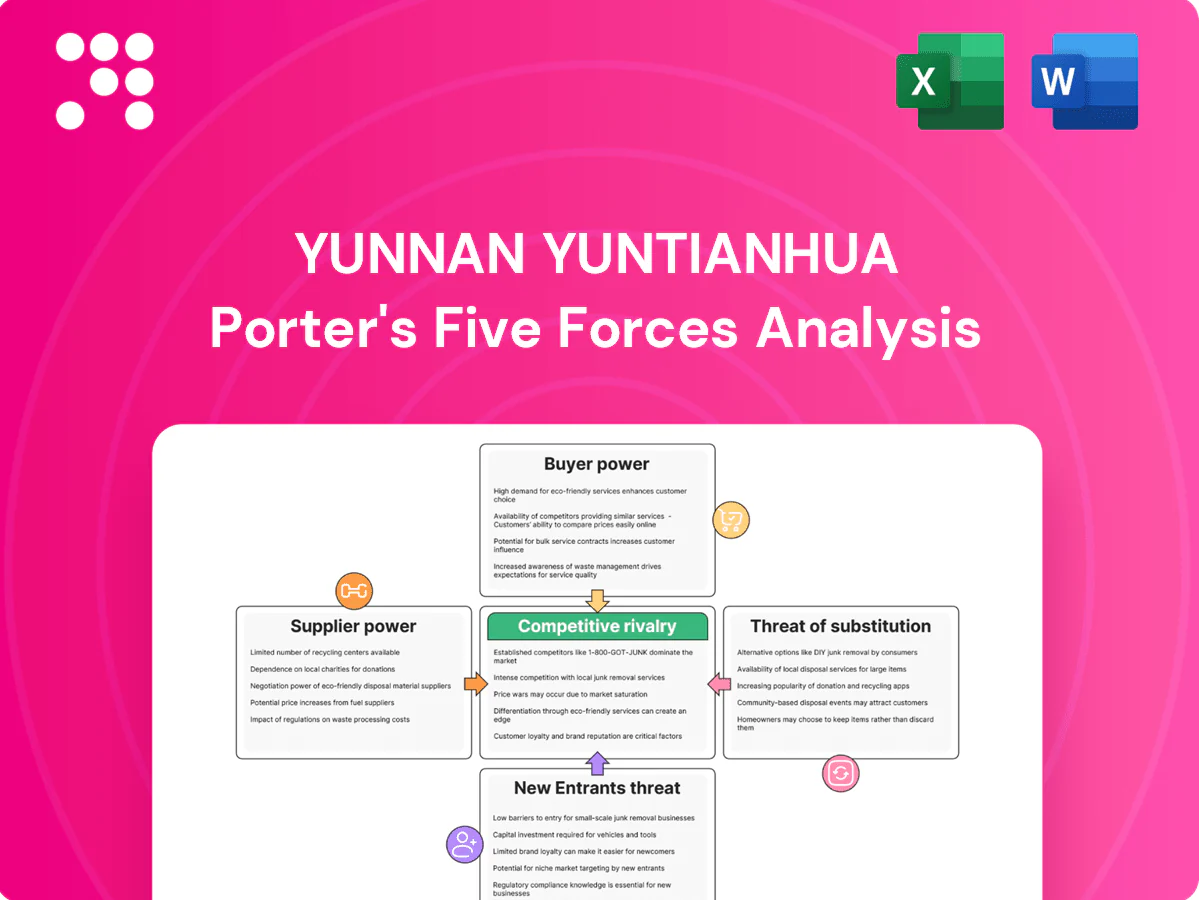
Yunnan Yuntianhua Porter's Five Forces Analysis

From Overview to Strategy Blueprint
Yunnan Yuntianhua faces intense industry rivalry, regulatory scrutiny and cyclicality typical of the fertilizer/chemical sector, with moderate supplier power and growing buyer sensitivity to price and sustainability. Barriers to entry are medium—capital and regulation protect incumbents but technological shifts lower costs for disruptors. Substitute threats from alternative nutrients and imports are rising. This brief snapshot only scratches the surface. Unlock the full Porter's Five Forces Analysis to explore Yunnan Yuntianhua’s competitive dynamics, market pressures, and strategic advantages in detail.
Suppliers Bargaining Power

Concentrated raw materials (phosphate rock, sulfur, potash)
Yuntianhua’s phosphate and DAP chains rely on a few global and domestic suppliers for sulfur and potash, creating pockets of leverage; the seaborne potash market remains highly concentrated, with the top three players accounting for about 70% of volumes in 2024. Phosphate rock access is strategic and tied to mining licenses, raising switching costs for competitors. Long-term contracts and partial self-supply (company-owned mines) mitigate risk, but supply shocks quickly transmit to DAP margins. Net effect: moderate-to-high supplier power in constrained cycles.
Energy and feedstock exposure (coal, natural gas, ammonia)
Coal and gas prices drive urea and coal-chemical margins, with spot thermal coal swinging roughly $80–160/t in 2024 and global natural gas hub spreads still elevated, giving upstream suppliers strong cyclical leverage over Yunnan Yuntianhua. Vertical coal assets reduce exposure but do not remove price volatility, while regional energy policy and constrained rail capacity periodically raise delivered costs by double digits. Imperfect pass-through in downturns amplifies supplier influence on earnings.

Logistics and rail/port capacity constraints
Bulk fertilizer shipments for Yunnan Yuntianhua rely heavily on rail, trucking and limited port slots, and China's rail system moved about 4.8 billion tonnes of freight in 2024, making seasonal fertilizer peaks cause sharp freight and priority surcharges. Limited inland route alternatives raise switching costs for large bulk flows. Securing contracted rail/port capacity is thus strategic to mitigate this quasi-supplier power.

Technology, catalysts, and equipment vendors
Proprietary catalysts, process licenses and critical granulation and ammonia-synthesis equipment are concentrated among a few suppliers (BASF, Haldor Topsoe, Johnson Matthey), giving them strong leverage; switching requires lengthy qualification, capex often in the high tens to hundreds of millions CNY and production risk during ramp-up. Service contracts and long spare-parts lead times (often 6–24 months) create lock-in, while multi-sourcing and targeted in-house R&D can reduce dependence over several years.
Environmental compliance inputs and services
Environmental compliance inputs—desulfurization agents, emissions controls and waste treatment—are specialized and mandatory, concentrating supplier power as certified providers dominate uptake; industry reports in 2024 noted regulatory-driven procurement spikes with price surges up to 20% near deadlines. Compliance risk raises dependence on certified firms, while early procurement and multi-year contracts can cap escalation and stabilize budgets.
- Concentration: certified providers limit switching
- Price pressure: near-deadline spikes reported up to 20% (2024)
- Mitigation: early buy and long-term contracts cap cost rises
Supplier power tightens: potash concentration, coal swings and freight squeeze raise risks
Supplier power is moderate-to-high: top-3 potash firms controlled ~70% of seaborne volumes in 2024, coal spot moved about $80–160/t in 2024, and China rail carried ~4.8bn t in 2024 raising freight squeeze. Critical catalysts/vendors (BASF, Haldor Topsoe, Johnson Matthey) and spare-part lead times (6–24 months) create lock-in; long-term contracts, vertical assets and multi-sourcing partially mitigate.
| Factor | 2024 metric | Impact |
|---|---|---|
| Potash concentration | Top-3 ~70% seaborne | High |
| Coal price volatility | $80–160/t spot range | High cyclical |
| Freight dependence | China rail 4.8bn t | Elevated |
| Critical vendors | 3 dominant suppliers | Lock-in |
| Spare parts lead time | 6–24 months | Supply risk |
What is included in the product
 Detailed Word Document
Uncovers key drivers of competition, supplier and buyer power, and entry/substitute threats specific to Yunnan Yuntianhua. Provides strategic commentary on how these forces affect pricing, profitability, and defensive opportunities for the company.

 Customizable Excel Spreadsheet
One-sheet Porter's Five Forces for Yunnan Yuntianhua—instantly visualizes competitive pressures with a spider chart and customizable intensity levels, ready to copy into decks or embed in Excel dashboards to relieve strategic analysis bottlenecks.
Customers Bargaining Power

Fragmented smallholder demand vs. large distributors
China has roughly 200 million smallholder farmers, but commercial fertilizer procurement is funneled through a concentrated network of large distributors and ag retailers that capture the majority of channel volumes; these intermediaries leverage volume rebates and extended payment terms to extract concessions, raising buyer power. Yuntianhua's branding and agronomic support partially mitigate this, leaving overall buyer power at a medium level due to channel concentration.
Price sensitivity in commodity fertilizers
Urea, DAP and NPK are highly commoditized with cross-brand substitutability, driving buyers to switch on price, logistics and credit; China's wholesale urea prices declined about 18% in 2024 versus 2023, intensifying price-driven purchases. Limited product differentiation constrains Yuntianhua's pricing power during peak competition, though tailored blends and agronomic services—which commanded up to 10% price premiums in 2024 contracts—can lower demand elasticity.

Seasonality and inventory timing leverage
Seasonal planting in China centers on spring (March–May) and autumn (September–October), creating predictable buying windows that allow customers to time purchases to price dips.
Distributors exploit inventory carry and import flexibility to negotiate, pressuring margins as producers weigh utilization trade-offs and often concede discounts to keep plants running.
Use of forward contracts and dynamic pricing, increasingly adopted in 2024, has reduced timing arbitrage by smoothing demand across these windows.

Industrial customers for coal-chemicals and fine chemicals
Industrial customers for coal-chemicals and fine chemicals are few, often negotiating bespoke specifications and strict delivery reliability; long-tenure supply contracts typically span 3–5 years and lock in volumes while concentrating counterparty power, compressing spreads.
- Fewer buyers: bespoke specs, high delivery reliability
- Qualification barriers: volume lock-in, concentrated counterparty power
- Feedstock indexation: limits margin upside in price upswings
- Long-tenure ties: lower churn, tighter spreads
Access to international alternatives
Imports set a reference price for Yunnan Yuntianhua, especially in coastal and border markets; when domestic urea/NP prices decouple buyers in 2024 threaten to switch to imports, raising their bargaining power. Tariff, quota and logistics shifts in 2024 moderate this channel, while inland logistics costs (about 20–30% premium) still shield some domestic pricing.
- reference-price: imports shape coastal/border pricing (2024)
- switching-threat: decoupling raises buyer leverage (2024)
- barriers: tariffs/quotas/logistics dampen switches (2024)
- protection: inland freight adds ~20–30% to import cost (2024)
Buyer power medium: urea -18%; inland freight 20–30%
Buyer power is medium: concentrated distributor channels and commoditized urea/DAP/NPK push price sensitivity, but Yuntianhua’s brand and agronomic services limit full pass-through. Domestic wholesale urea fell ~18% in 2024, heightening price-driven switching; inland buyers face ~20–30% import freight premium, and tailored blends can command up to 10% contract premiums.
| Metric | 2024 value | Impact |
|---|---|---|
| Wholesale urea price change | -18% | Boosts buyer leverage |
| Inland import freight premium | 20–30% | Shields domestic pricing |
| Agronomic/branding premium | Up to 10% | Reduces elasticity |
Preview the Actual Deliverable
Yunnan Yuntianhua Porter's Five Forces Analysis
This preview is the complete Porter's Five Forces analysis for Yunnan Yuntianhua—covering competitive rivalry, supplier and buyer power, threat of substitutes, and barriers to entry in detail. The document you see is the exact file you'll receive upon purchase, fully formatted and ready to download. No placeholders or samples—what's shown is the final deliverable.

From Overview to Strategy Blueprint
Yunnan Yuntianhua faces intense industry rivalry, regulatory scrutiny and cyclicality typical of the fertilizer/chemical sector, with moderate supplier power and growing buyer sensitivity to price and sustainability. Barriers to entry are medium—capital and regulation protect incumbents but technological shifts lower costs for disruptors. Substitute threats from alternative nutrients and imports are rising. This brief snapshot only scratches the surface. Unlock the full Porter's Five Forces Analysis to explore Yunnan Yuntianhua’s competitive dynamics, market pressures, and strategic advantages in detail.
Suppliers Bargaining Power
Concentrated raw materials (phosphate rock, sulfur, potash)
Yuntianhua’s phosphate and DAP chains rely on a few global and domestic suppliers for sulfur and potash, creating pockets of leverage; the seaborne potash market remains highly concentrated, with the top three players accounting for about 70% of volumes in 2024. Phosphate rock access is strategic and tied to mining licenses, raising switching costs for competitors. Long-term contracts and partial self-supply (company-owned mines) mitigate risk, but supply shocks quickly transmit to DAP margins. Net effect: moderate-to-high supplier power in constrained cycles.
Energy and feedstock exposure (coal, natural gas, ammonia)
Coal and gas prices drive urea and coal-chemical margins, with spot thermal coal swinging roughly $80–160/t in 2024 and global natural gas hub spreads still elevated, giving upstream suppliers strong cyclical leverage over Yunnan Yuntianhua. Vertical coal assets reduce exposure but do not remove price volatility, while regional energy policy and constrained rail capacity periodically raise delivered costs by double digits. Imperfect pass-through in downturns amplifies supplier influence on earnings.
Logistics and rail/port capacity constraints
Bulk fertilizer shipments for Yunnan Yuntianhua rely heavily on rail, trucking and limited port slots, and China's rail system moved about 4.8 billion tonnes of freight in 2024, making seasonal fertilizer peaks cause sharp freight and priority surcharges. Limited inland route alternatives raise switching costs for large bulk flows. Securing contracted rail/port capacity is thus strategic to mitigate this quasi-supplier power.
Technology, catalysts, and equipment vendors
Proprietary catalysts, process licenses and critical granulation and ammonia-synthesis equipment are concentrated among a few suppliers (BASF, Haldor Topsoe, Johnson Matthey), giving them strong leverage; switching requires lengthy qualification, capex often in the high tens to hundreds of millions CNY and production risk during ramp-up. Service contracts and long spare-parts lead times (often 6–24 months) create lock-in, while multi-sourcing and targeted in-house R&D can reduce dependence over several years.
Environmental compliance inputs and services
Environmental compliance inputs—desulfurization agents, emissions controls and waste treatment—are specialized and mandatory, concentrating supplier power as certified providers dominate uptake; industry reports in 2024 noted regulatory-driven procurement spikes with price surges up to 20% near deadlines. Compliance risk raises dependence on certified firms, while early procurement and multi-year contracts can cap escalation and stabilize budgets.
- Concentration: certified providers limit switching
- Price pressure: near-deadline spikes reported up to 20% (2024)
- Mitigation: early buy and long-term contracts cap cost rises
Supplier power tightens: potash concentration, coal swings and freight squeeze raise risks
Supplier power is moderate-to-high: top-3 potash firms controlled ~70% of seaborne volumes in 2024, coal spot moved about $80–160/t in 2024, and China rail carried ~4.8bn t in 2024 raising freight squeeze. Critical catalysts/vendors (BASF, Haldor Topsoe, Johnson Matthey) and spare-part lead times (6–24 months) create lock-in; long-term contracts, vertical assets and multi-sourcing partially mitigate.
| Factor | 2024 metric | Impact |
|---|---|---|
| Potash concentration | Top-3 ~70% seaborne | High |
| Coal price volatility | $80–160/t spot range | High cyclical |
| Freight dependence | China rail 4.8bn t | Elevated |
| Critical vendors | 3 dominant suppliers | Lock-in |
| Spare parts lead time | 6–24 months | Supply risk |
What is included in the product
Detailed Word Document
Uncovers key drivers of competition, supplier and buyer power, and entry/substitute threats specific to Yunnan Yuntianhua. Provides strategic commentary on how these forces affect pricing, profitability, and defensive opportunities for the company.
Customizable Excel Spreadsheet
One-sheet Porter's Five Forces for Yunnan Yuntianhua—instantly visualizes competitive pressures with a spider chart and customizable intensity levels, ready to copy into decks or embed in Excel dashboards to relieve strategic analysis bottlenecks.
Customers Bargaining Power
Fragmented smallholder demand vs. large distributors
China has roughly 200 million smallholder farmers, but commercial fertilizer procurement is funneled through a concentrated network of large distributors and ag retailers that capture the majority of channel volumes; these intermediaries leverage volume rebates and extended payment terms to extract concessions, raising buyer power. Yuntianhua's branding and agronomic support partially mitigate this, leaving overall buyer power at a medium level due to channel concentration.
Price sensitivity in commodity fertilizers
Urea, DAP and NPK are highly commoditized with cross-brand substitutability, driving buyers to switch on price, logistics and credit; China's wholesale urea prices declined about 18% in 2024 versus 2023, intensifying price-driven purchases. Limited product differentiation constrains Yuntianhua's pricing power during peak competition, though tailored blends and agronomic services—which commanded up to 10% price premiums in 2024 contracts—can lower demand elasticity.
Seasonality and inventory timing leverage
Seasonal planting in China centers on spring (March–May) and autumn (September–October), creating predictable buying windows that allow customers to time purchases to price dips.
Distributors exploit inventory carry and import flexibility to negotiate, pressuring margins as producers weigh utilization trade-offs and often concede discounts to keep plants running.
Use of forward contracts and dynamic pricing, increasingly adopted in 2024, has reduced timing arbitrage by smoothing demand across these windows.
Industrial customers for coal-chemicals and fine chemicals
Industrial customers for coal-chemicals and fine chemicals are few, often negotiating bespoke specifications and strict delivery reliability; long-tenure supply contracts typically span 3–5 years and lock in volumes while concentrating counterparty power, compressing spreads.
- Fewer buyers: bespoke specs, high delivery reliability
- Qualification barriers: volume lock-in, concentrated counterparty power
- Feedstock indexation: limits margin upside in price upswings
- Long-tenure ties: lower churn, tighter spreads
Access to international alternatives
Imports set a reference price for Yunnan Yuntianhua, especially in coastal and border markets; when domestic urea/NP prices decouple buyers in 2024 threaten to switch to imports, raising their bargaining power. Tariff, quota and logistics shifts in 2024 moderate this channel, while inland logistics costs (about 20–30% premium) still shield some domestic pricing.
- reference-price: imports shape coastal/border pricing (2024)
- switching-threat: decoupling raises buyer leverage (2024)
- barriers: tariffs/quotas/logistics dampen switches (2024)
- protection: inland freight adds ~20–30% to import cost (2024)
Buyer power medium: urea -18%; inland freight 20–30%
Buyer power is medium: concentrated distributor channels and commoditized urea/DAP/NPK push price sensitivity, but Yuntianhua’s brand and agronomic services limit full pass-through. Domestic wholesale urea fell ~18% in 2024, heightening price-driven switching; inland buyers face ~20–30% import freight premium, and tailored blends can command up to 10% contract premiums.
| Metric | 2024 value | Impact |
|---|---|---|
| Wholesale urea price change | -18% | Boosts buyer leverage |
| Inland import freight premium | 20–30% | Shields domestic pricing |
| Agronomic/branding premium | Up to 10% | Reduces elasticity |
Preview the Actual Deliverable
Yunnan Yuntianhua Porter's Five Forces Analysis
This preview is the complete Porter's Five Forces analysis for Yunnan Yuntianhua—covering competitive rivalry, supplier and buyer power, threat of substitutes, and barriers to entry in detail. The document you see is the exact file you'll receive upon purchase, fully formatted and ready to download. No placeholders or samples—what's shown is the final deliverable.
Original: $10.00
-65%$10.00
$3.50Description
From Overview to Strategy Blueprint
Yunnan Yuntianhua faces intense industry rivalry, regulatory scrutiny and cyclicality typical of the fertilizer/chemical sector, with moderate supplier power and growing buyer sensitivity to price and sustainability. Barriers to entry are medium—capital and regulation protect incumbents but technological shifts lower costs for disruptors. Substitute threats from alternative nutrients and imports are rising. This brief snapshot only scratches the surface. Unlock the full Porter's Five Forces Analysis to explore Yunnan Yuntianhua’s competitive dynamics, market pressures, and strategic advantages in detail.
Suppliers Bargaining Power
Concentrated raw materials (phosphate rock, sulfur, potash)
Yuntianhua’s phosphate and DAP chains rely on a few global and domestic suppliers for sulfur and potash, creating pockets of leverage; the seaborne potash market remains highly concentrated, with the top three players accounting for about 70% of volumes in 2024. Phosphate rock access is strategic and tied to mining licenses, raising switching costs for competitors. Long-term contracts and partial self-supply (company-owned mines) mitigate risk, but supply shocks quickly transmit to DAP margins. Net effect: moderate-to-high supplier power in constrained cycles.
Energy and feedstock exposure (coal, natural gas, ammonia)
Coal and gas prices drive urea and coal-chemical margins, with spot thermal coal swinging roughly $80–160/t in 2024 and global natural gas hub spreads still elevated, giving upstream suppliers strong cyclical leverage over Yunnan Yuntianhua. Vertical coal assets reduce exposure but do not remove price volatility, while regional energy policy and constrained rail capacity periodically raise delivered costs by double digits. Imperfect pass-through in downturns amplifies supplier influence on earnings.
Logistics and rail/port capacity constraints
Bulk fertilizer shipments for Yunnan Yuntianhua rely heavily on rail, trucking and limited port slots, and China's rail system moved about 4.8 billion tonnes of freight in 2024, making seasonal fertilizer peaks cause sharp freight and priority surcharges. Limited inland route alternatives raise switching costs for large bulk flows. Securing contracted rail/port capacity is thus strategic to mitigate this quasi-supplier power.
Technology, catalysts, and equipment vendors
Proprietary catalysts, process licenses and critical granulation and ammonia-synthesis equipment are concentrated among a few suppliers (BASF, Haldor Topsoe, Johnson Matthey), giving them strong leverage; switching requires lengthy qualification, capex often in the high tens to hundreds of millions CNY and production risk during ramp-up. Service contracts and long spare-parts lead times (often 6–24 months) create lock-in, while multi-sourcing and targeted in-house R&D can reduce dependence over several years.
Environmental compliance inputs and services
Environmental compliance inputs—desulfurization agents, emissions controls and waste treatment—are specialized and mandatory, concentrating supplier power as certified providers dominate uptake; industry reports in 2024 noted regulatory-driven procurement spikes with price surges up to 20% near deadlines. Compliance risk raises dependence on certified firms, while early procurement and multi-year contracts can cap escalation and stabilize budgets.
- Concentration: certified providers limit switching
- Price pressure: near-deadline spikes reported up to 20% (2024)
- Mitigation: early buy and long-term contracts cap cost rises
Supplier power tightens: potash concentration, coal swings and freight squeeze raise risks
Supplier power is moderate-to-high: top-3 potash firms controlled ~70% of seaborne volumes in 2024, coal spot moved about $80–160/t in 2024, and China rail carried ~4.8bn t in 2024 raising freight squeeze. Critical catalysts/vendors (BASF, Haldor Topsoe, Johnson Matthey) and spare-part lead times (6–24 months) create lock-in; long-term contracts, vertical assets and multi-sourcing partially mitigate.
| Factor | 2024 metric | Impact |
|---|---|---|
| Potash concentration | Top-3 ~70% seaborne | High |
| Coal price volatility | $80–160/t spot range | High cyclical |
| Freight dependence | China rail 4.8bn t | Elevated |
| Critical vendors | 3 dominant suppliers | Lock-in |
| Spare parts lead time | 6–24 months | Supply risk |
What is included in the product
Detailed Word Document
Uncovers key drivers of competition, supplier and buyer power, and entry/substitute threats specific to Yunnan Yuntianhua. Provides strategic commentary on how these forces affect pricing, profitability, and defensive opportunities for the company.
Customizable Excel Spreadsheet
One-sheet Porter's Five Forces for Yunnan Yuntianhua—instantly visualizes competitive pressures with a spider chart and customizable intensity levels, ready to copy into decks or embed in Excel dashboards to relieve strategic analysis bottlenecks.
Customers Bargaining Power
Fragmented smallholder demand vs. large distributors
China has roughly 200 million smallholder farmers, but commercial fertilizer procurement is funneled through a concentrated network of large distributors and ag retailers that capture the majority of channel volumes; these intermediaries leverage volume rebates and extended payment terms to extract concessions, raising buyer power. Yuntianhua's branding and agronomic support partially mitigate this, leaving overall buyer power at a medium level due to channel concentration.
Price sensitivity in commodity fertilizers
Urea, DAP and NPK are highly commoditized with cross-brand substitutability, driving buyers to switch on price, logistics and credit; China's wholesale urea prices declined about 18% in 2024 versus 2023, intensifying price-driven purchases. Limited product differentiation constrains Yuntianhua's pricing power during peak competition, though tailored blends and agronomic services—which commanded up to 10% price premiums in 2024 contracts—can lower demand elasticity.
Seasonality and inventory timing leverage
Seasonal planting in China centers on spring (March–May) and autumn (September–October), creating predictable buying windows that allow customers to time purchases to price dips.
Distributors exploit inventory carry and import flexibility to negotiate, pressuring margins as producers weigh utilization trade-offs and often concede discounts to keep plants running.
Use of forward contracts and dynamic pricing, increasingly adopted in 2024, has reduced timing arbitrage by smoothing demand across these windows.
Industrial customers for coal-chemicals and fine chemicals
Industrial customers for coal-chemicals and fine chemicals are few, often negotiating bespoke specifications and strict delivery reliability; long-tenure supply contracts typically span 3–5 years and lock in volumes while concentrating counterparty power, compressing spreads.
- Fewer buyers: bespoke specs, high delivery reliability
- Qualification barriers: volume lock-in, concentrated counterparty power
- Feedstock indexation: limits margin upside in price upswings
- Long-tenure ties: lower churn, tighter spreads
Access to international alternatives
Imports set a reference price for Yunnan Yuntianhua, especially in coastal and border markets; when domestic urea/NP prices decouple buyers in 2024 threaten to switch to imports, raising their bargaining power. Tariff, quota and logistics shifts in 2024 moderate this channel, while inland logistics costs (about 20–30% premium) still shield some domestic pricing.
- reference-price: imports shape coastal/border pricing (2024)
- switching-threat: decoupling raises buyer leverage (2024)
- barriers: tariffs/quotas/logistics dampen switches (2024)
- protection: inland freight adds ~20–30% to import cost (2024)
Buyer power medium: urea -18%; inland freight 20–30%
Buyer power is medium: concentrated distributor channels and commoditized urea/DAP/NPK push price sensitivity, but Yuntianhua’s brand and agronomic services limit full pass-through. Domestic wholesale urea fell ~18% in 2024, heightening price-driven switching; inland buyers face ~20–30% import freight premium, and tailored blends can command up to 10% contract premiums.
| Metric | 2024 value | Impact |
|---|---|---|
| Wholesale urea price change | -18% | Boosts buyer leverage |
| Inland import freight premium | 20–30% | Shields domestic pricing |
| Agronomic/branding premium | Up to 10% | Reduces elasticity |
Preview the Actual Deliverable
Yunnan Yuntianhua Porter's Five Forces Analysis
This preview is the complete Porter's Five Forces analysis for Yunnan Yuntianhua—covering competitive rivalry, supplier and buyer power, threat of substitutes, and barriers to entry in detail. The document you see is the exact file you'll receive upon purchase, fully formatted and ready to download. No placeholders or samples—what's shown is the final deliverable.











