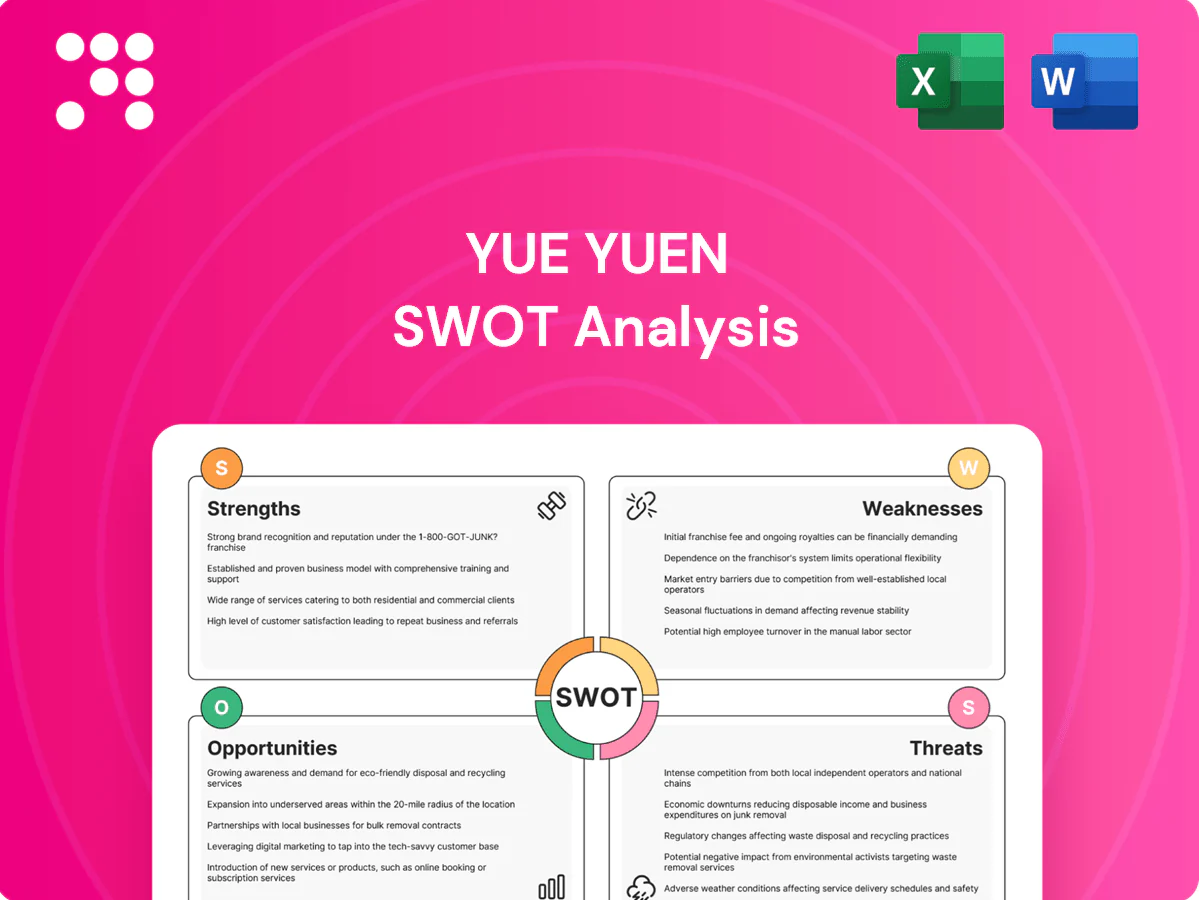
Yue Yuen SWOT Analysis

Your Strategic Toolkit Starts Here
Yue Yuen’s global scale and contract-manufacturing expertise underpin strong market positioning, but exposure to labour costs, raw material swings, and client concentration creates notable risks. Our full SWOT analysis unlocks detailed, research-backed insights, strategic implications, and an editable Word/Excel package to inform investment or operational decisions—purchase the complete report to act with confidence.
Strengths

Scale leadership in athletic footwear OEM/ODM
Yue Yuen is one of the world’s largest athletic and casual footwear OEM/ODM providers, with annual capacity exceeding 600 million pairs and global throughput that underpins scale advantages. This scale drove reported 2024 revenue of HK$47.8 billion, enabling unit-cost efficiencies, rapid model ramp-ups and smooth global brand onboarding. A multi-country production footprint secures brand timelines and creates barriers that smaller rivals struggle to replicate.
Deep partnerships with top global brands
Yue Yuen manufactures for Nike, Adidas, Puma and other tier-1 brands, embedding itself into their global supply chains and remaining the world’s largest athletic-footwear manufacturer by capacity. Longstanding, multi-decade relationships improve demand visibility and product roadmapping, enabling collaborative forecasting. Its co-development and ODM capabilities raise switching costs and preferred-vendor status secures volume and new product introductions.

Integrated design-to-retail capability
Yue Yuen’s OEM/ODM manufacturing paired with Pou Sheng’s retail distribution creates vertical visibility from factory to consumer, enabling retail sell-through to directly inform product design and merchandising decisions. Real-time retail data supports more accurate capacity planning and demand forecasting, tightening lead times and reducing forecasting errors while elevating service levels. This integrated model also diversifies revenue beyond manufacturing margins by capturing retail-level profits and brand-linked sales uplift.

Geographically diversified manufacturing base
Yue Yuen’s manufacturing footprint spans multiple Asian countries, reducing single-country risk and enabling tariff and sourcing optimization for major footwear brands. The geographic spread enhances resilience to local disruptions and wage-inflation spikes, allowing dynamic reallocation of capacity by product complexity and lead time. Brands value this redundancy for assured supply continuity and faster reaction to demand shifts.
- Multicountry footprint: reduced country-concentration risk
- Tariff/sourcing flexibility: cost and lead-time optimization
- Operational resilience: mitigates local disruptions and wage shocks
- Order flexibility: allocates by complexity and lead time
Operational know-how and process engineering
Decades of footwear process expertise at Yue Yuen deliver measurable yield, quality, and time-to-market advantages, supporting major brands in rapid global rollouts. Continuous investment in automation and materials handling has sustained steady output—Yue Yuen operates over 40 production sites and employs roughly 90,000 staff, enabling complex multi-material assembly as a core competency. This operational discipline underpins reliable launches and consistent OEM performance.
- Scale: 40+ plants
- Workforce: ~90,000 employees
- Core: multi-material assembly
- Focus: automation & materials handling
Largest athletic-footwear OEM: >600m pairs capacity, HK$47.8bn 2024 revenue
Yue Yuen is the world’s largest athletic-footwear OEM/ODM with >600m pairs annual capacity and 2024 revenue HK$47.8bn, delivering unit-cost advantages and fast ramp-up. Longstanding contracts with Nike, Adidas and others provide demand visibility and high switching costs. A 40+ plant, ~90,000-employee multicountry footprint enhances resilience and tariff/sourcing flexibility.
| Metric | Value |
|---|---|
| 2024 revenue | HK$47.8bn |
| Annual capacity | >600m pairs |
| Plants | 40+ |
| Employees | ~90,000 |
What is included in the product
 Detailed Word Document
Provides a concise strategic overview of Yue Yuen’s internal strengths and weaknesses and external opportunities and threats, highlighting scale and manufacturing capabilities, supply-chain and labor/ESG risks, brand and client concentration exposure, and growth opportunities from product diversification and emerging-market expansion.

 Customizable Excel Spreadsheet
Provides a focused SWOT matrix tailored to Yue Yuen for rapid identification and resolution of supply‑chain, labor and margin risks. Editable format enables quick updates to reflect factory cost shifts, client contract changes and compliance issues for faster decision-making.
Weaknesses

High customer concentration
Reliance on a few mega-brands concentrates bargaining power with buyers—Nike and adidas together represented about 45% of Yue Yuen’s sales in 2023, leaving the supplier exposed to price concessions. Price pressure and vendor consolidation compressed gross margins, with Yue Yuen’s 2023 gross margin falling to roughly 8–10% from prior years. Lost programs are hard to replace at equivalent scale, as top-5 customers contributed over 65% of revenue in 2023. This concentration heightens exposure to any brand-specific demand shocks, amplifying revenue volatility.
Labor-intensive cost structure
Footwear assembly at Yue Yuen remains labor-heavy, leaving margins exposed to wage inflation and local labor shortages; as one of the world’s largest footwear OEMs serving global brands, the company faces concentrated labor risk. Productivity upgrades need significant capital and change management, while strikes or regulatory shifts can interrupt output. Competitive bidding limits Yue Yuen’s ability to pass higher costs to brand customers.

Thin OEM/ODM margins
Contract manufacturing typically posts thin operating margins—often below 5% for OEM/ODM versus 10–20% for branded peers—so Yue Yuen’s profitability is structurally constrained. Mix shifts, startup inefficiencies and idle capacity can shave several hundred basis points from margins. Currency volatility can swing margins by roughly 1–3 percentage points if not fully hedged, while recurring capex (industry capex/sales ~3–6%) weighs on free cash flow in down cycles.

Retail execution risk at Pou Sheng
Retail execution risk at Pou Sheng is pronounced: retail is working-capital intensive and exposed to consumer cycles in China, where demand patterns continued to shift in 2024, so inventory missteps can quickly compress gross margins and cash conversion. Omnichannel and digital capabilities must keep pace with fast-evolving consumer behavior, while store productivity and regional lease costs remain volatile.
- Working-capital sensitivity: inventory turns drive margins
- Consumer-cycle exposure: China demand volatility in 2024
- Omnichannel gap: digital investment required to retain market share
- Store economics: productivity and lease cost volatility regionally
Exposure to fashion and product-cycle volatility
Frequent model changes in fashion-footwear raise complexity and retooling costs, eroding Yue Yuen margins and stretching plant capacity. Forecast errors drive inefficiencies and overtime premiums, increasing unit labor costs and inventory write-down risk. Shorter product lifecycles and rapid trend shifts amplify operational risk across its manufacturing network.
- Higher retooling & setup costs
- Increased overtime and inefficiency
- Tighter procurement windows
- Elevated plant-level operational risk
Client concentration: top-two 45%, top-5 > 65%
High customer concentration: Nike+adidas ~45% of sales and top-5 clients >65% in 2023, amplifying revenue volatility. Manufacturing margins compressed—gross margin ~8–10% in 2023; OEM operating margins often <5%, capex/sales ~3–6%. Pou Sheng retail exposure and China demand shifts in 2024 raise inventory, working-capital and omnichannel risks.
| Metric | Value | Year |
|---|---|---|
| Nike + adidas share | ~45% | 2023 |
| Top-5 customers | >65% | 2023 |
| Gross margin | ~8–10% | 2023 |
| OEM operating margin | <5% | 2023 |
| Capex / sales (industry) | 3–6% | 2023–24 |
| China retail demand | Higher volatility | 2024 |
Preview the Actual Deliverable
Yue Yuen SWOT Analysis
This is the actual Yue Yuen SWOT analysis document you’ll receive upon purchase—no surprises, just professional quality. The preview below is taken directly from the full report you'll get; purchase unlocks the entire in-depth, editable version. You’re viewing a live preview of the real file, structured and ready to use immediately after checkout.

Your Strategic Toolkit Starts Here
Yue Yuen’s global scale and contract-manufacturing expertise underpin strong market positioning, but exposure to labour costs, raw material swings, and client concentration creates notable risks. Our full SWOT analysis unlocks detailed, research-backed insights, strategic implications, and an editable Word/Excel package to inform investment or operational decisions—purchase the complete report to act with confidence.
Strengths
Scale leadership in athletic footwear OEM/ODM
Yue Yuen is one of the world’s largest athletic and casual footwear OEM/ODM providers, with annual capacity exceeding 600 million pairs and global throughput that underpins scale advantages. This scale drove reported 2024 revenue of HK$47.8 billion, enabling unit-cost efficiencies, rapid model ramp-ups and smooth global brand onboarding. A multi-country production footprint secures brand timelines and creates barriers that smaller rivals struggle to replicate.
Deep partnerships with top global brands
Yue Yuen manufactures for Nike, Adidas, Puma and other tier-1 brands, embedding itself into their global supply chains and remaining the world’s largest athletic-footwear manufacturer by capacity. Longstanding, multi-decade relationships improve demand visibility and product roadmapping, enabling collaborative forecasting. Its co-development and ODM capabilities raise switching costs and preferred-vendor status secures volume and new product introductions.
Integrated design-to-retail capability
Yue Yuen’s OEM/ODM manufacturing paired with Pou Sheng’s retail distribution creates vertical visibility from factory to consumer, enabling retail sell-through to directly inform product design and merchandising decisions. Real-time retail data supports more accurate capacity planning and demand forecasting, tightening lead times and reducing forecasting errors while elevating service levels. This integrated model also diversifies revenue beyond manufacturing margins by capturing retail-level profits and brand-linked sales uplift.
Geographically diversified manufacturing base
Yue Yuen’s manufacturing footprint spans multiple Asian countries, reducing single-country risk and enabling tariff and sourcing optimization for major footwear brands. The geographic spread enhances resilience to local disruptions and wage-inflation spikes, allowing dynamic reallocation of capacity by product complexity and lead time. Brands value this redundancy for assured supply continuity and faster reaction to demand shifts.
- Multicountry footprint: reduced country-concentration risk
- Tariff/sourcing flexibility: cost and lead-time optimization
- Operational resilience: mitigates local disruptions and wage shocks
- Order flexibility: allocates by complexity and lead time
Operational know-how and process engineering
Decades of footwear process expertise at Yue Yuen deliver measurable yield, quality, and time-to-market advantages, supporting major brands in rapid global rollouts. Continuous investment in automation and materials handling has sustained steady output—Yue Yuen operates over 40 production sites and employs roughly 90,000 staff, enabling complex multi-material assembly as a core competency. This operational discipline underpins reliable launches and consistent OEM performance.
- Scale: 40+ plants
- Workforce: ~90,000 employees
- Core: multi-material assembly
- Focus: automation & materials handling
Largest athletic-footwear OEM: >600m pairs capacity, HK$47.8bn 2024 revenue
Yue Yuen is the world’s largest athletic-footwear OEM/ODM with >600m pairs annual capacity and 2024 revenue HK$47.8bn, delivering unit-cost advantages and fast ramp-up. Longstanding contracts with Nike, Adidas and others provide demand visibility and high switching costs. A 40+ plant, ~90,000-employee multicountry footprint enhances resilience and tariff/sourcing flexibility.
| Metric | Value |
|---|---|
| 2024 revenue | HK$47.8bn |
| Annual capacity | >600m pairs |
| Plants | 40+ |
| Employees | ~90,000 |
What is included in the product
Detailed Word Document
Provides a concise strategic overview of Yue Yuen’s internal strengths and weaknesses and external opportunities and threats, highlighting scale and manufacturing capabilities, supply-chain and labor/ESG risks, brand and client concentration exposure, and growth opportunities from product diversification and emerging-market expansion.
Customizable Excel Spreadsheet
Provides a focused SWOT matrix tailored to Yue Yuen for rapid identification and resolution of supply‑chain, labor and margin risks. Editable format enables quick updates to reflect factory cost shifts, client contract changes and compliance issues for faster decision-making.
Weaknesses
High customer concentration
Reliance on a few mega-brands concentrates bargaining power with buyers—Nike and adidas together represented about 45% of Yue Yuen’s sales in 2023, leaving the supplier exposed to price concessions. Price pressure and vendor consolidation compressed gross margins, with Yue Yuen’s 2023 gross margin falling to roughly 8–10% from prior years. Lost programs are hard to replace at equivalent scale, as top-5 customers contributed over 65% of revenue in 2023. This concentration heightens exposure to any brand-specific demand shocks, amplifying revenue volatility.
Labor-intensive cost structure
Footwear assembly at Yue Yuen remains labor-heavy, leaving margins exposed to wage inflation and local labor shortages; as one of the world’s largest footwear OEMs serving global brands, the company faces concentrated labor risk. Productivity upgrades need significant capital and change management, while strikes or regulatory shifts can interrupt output. Competitive bidding limits Yue Yuen’s ability to pass higher costs to brand customers.
Thin OEM/ODM margins
Contract manufacturing typically posts thin operating margins—often below 5% for OEM/ODM versus 10–20% for branded peers—so Yue Yuen’s profitability is structurally constrained. Mix shifts, startup inefficiencies and idle capacity can shave several hundred basis points from margins. Currency volatility can swing margins by roughly 1–3 percentage points if not fully hedged, while recurring capex (industry capex/sales ~3–6%) weighs on free cash flow in down cycles.
Retail execution risk at Pou Sheng
Retail execution risk at Pou Sheng is pronounced: retail is working-capital intensive and exposed to consumer cycles in China, where demand patterns continued to shift in 2024, so inventory missteps can quickly compress gross margins and cash conversion. Omnichannel and digital capabilities must keep pace with fast-evolving consumer behavior, while store productivity and regional lease costs remain volatile.
- Working-capital sensitivity: inventory turns drive margins
- Consumer-cycle exposure: China demand volatility in 2024
- Omnichannel gap: digital investment required to retain market share
- Store economics: productivity and lease cost volatility regionally
Exposure to fashion and product-cycle volatility
Frequent model changes in fashion-footwear raise complexity and retooling costs, eroding Yue Yuen margins and stretching plant capacity. Forecast errors drive inefficiencies and overtime premiums, increasing unit labor costs and inventory write-down risk. Shorter product lifecycles and rapid trend shifts amplify operational risk across its manufacturing network.
- Higher retooling & setup costs
- Increased overtime and inefficiency
- Tighter procurement windows
- Elevated plant-level operational risk
Client concentration: top-two 45%, top-5 > 65%
High customer concentration: Nike+adidas ~45% of sales and top-5 clients >65% in 2023, amplifying revenue volatility. Manufacturing margins compressed—gross margin ~8–10% in 2023; OEM operating margins often <5%, capex/sales ~3–6%. Pou Sheng retail exposure and China demand shifts in 2024 raise inventory, working-capital and omnichannel risks.
| Metric | Value | Year |
|---|---|---|
| Nike + adidas share | ~45% | 2023 |
| Top-5 customers | >65% | 2023 |
| Gross margin | ~8–10% | 2023 |
| OEM operating margin | <5% | 2023 |
| Capex / sales (industry) | 3–6% | 2023–24 |
| China retail demand | Higher volatility | 2024 |
Preview the Actual Deliverable
Yue Yuen SWOT Analysis
This is the actual Yue Yuen SWOT analysis document you’ll receive upon purchase—no surprises, just professional quality. The preview below is taken directly from the full report you'll get; purchase unlocks the entire in-depth, editable version. You’re viewing a live preview of the real file, structured and ready to use immediately after checkout.
Original: $10.00
-65%$10.00
$3.50Description
Your Strategic Toolkit Starts Here
Yue Yuen’s global scale and contract-manufacturing expertise underpin strong market positioning, but exposure to labour costs, raw material swings, and client concentration creates notable risks. Our full SWOT analysis unlocks detailed, research-backed insights, strategic implications, and an editable Word/Excel package to inform investment or operational decisions—purchase the complete report to act with confidence.
Strengths
Scale leadership in athletic footwear OEM/ODM
Yue Yuen is one of the world’s largest athletic and casual footwear OEM/ODM providers, with annual capacity exceeding 600 million pairs and global throughput that underpins scale advantages. This scale drove reported 2024 revenue of HK$47.8 billion, enabling unit-cost efficiencies, rapid model ramp-ups and smooth global brand onboarding. A multi-country production footprint secures brand timelines and creates barriers that smaller rivals struggle to replicate.
Deep partnerships with top global brands
Yue Yuen manufactures for Nike, Adidas, Puma and other tier-1 brands, embedding itself into their global supply chains and remaining the world’s largest athletic-footwear manufacturer by capacity. Longstanding, multi-decade relationships improve demand visibility and product roadmapping, enabling collaborative forecasting. Its co-development and ODM capabilities raise switching costs and preferred-vendor status secures volume and new product introductions.
Integrated design-to-retail capability
Yue Yuen’s OEM/ODM manufacturing paired with Pou Sheng’s retail distribution creates vertical visibility from factory to consumer, enabling retail sell-through to directly inform product design and merchandising decisions. Real-time retail data supports more accurate capacity planning and demand forecasting, tightening lead times and reducing forecasting errors while elevating service levels. This integrated model also diversifies revenue beyond manufacturing margins by capturing retail-level profits and brand-linked sales uplift.
Geographically diversified manufacturing base
Yue Yuen’s manufacturing footprint spans multiple Asian countries, reducing single-country risk and enabling tariff and sourcing optimization for major footwear brands. The geographic spread enhances resilience to local disruptions and wage-inflation spikes, allowing dynamic reallocation of capacity by product complexity and lead time. Brands value this redundancy for assured supply continuity and faster reaction to demand shifts.
- Multicountry footprint: reduced country-concentration risk
- Tariff/sourcing flexibility: cost and lead-time optimization
- Operational resilience: mitigates local disruptions and wage shocks
- Order flexibility: allocates by complexity and lead time
Operational know-how and process engineering
Decades of footwear process expertise at Yue Yuen deliver measurable yield, quality, and time-to-market advantages, supporting major brands in rapid global rollouts. Continuous investment in automation and materials handling has sustained steady output—Yue Yuen operates over 40 production sites and employs roughly 90,000 staff, enabling complex multi-material assembly as a core competency. This operational discipline underpins reliable launches and consistent OEM performance.
- Scale: 40+ plants
- Workforce: ~90,000 employees
- Core: multi-material assembly
- Focus: automation & materials handling
Largest athletic-footwear OEM: >600m pairs capacity, HK$47.8bn 2024 revenue
Yue Yuen is the world’s largest athletic-footwear OEM/ODM with >600m pairs annual capacity and 2024 revenue HK$47.8bn, delivering unit-cost advantages and fast ramp-up. Longstanding contracts with Nike, Adidas and others provide demand visibility and high switching costs. A 40+ plant, ~90,000-employee multicountry footprint enhances resilience and tariff/sourcing flexibility.
| Metric | Value |
|---|---|
| 2024 revenue | HK$47.8bn |
| Annual capacity | >600m pairs |
| Plants | 40+ |
| Employees | ~90,000 |
What is included in the product
Detailed Word Document
Provides a concise strategic overview of Yue Yuen’s internal strengths and weaknesses and external opportunities and threats, highlighting scale and manufacturing capabilities, supply-chain and labor/ESG risks, brand and client concentration exposure, and growth opportunities from product diversification and emerging-market expansion.
Customizable Excel Spreadsheet
Provides a focused SWOT matrix tailored to Yue Yuen for rapid identification and resolution of supply‑chain, labor and margin risks. Editable format enables quick updates to reflect factory cost shifts, client contract changes and compliance issues for faster decision-making.
Weaknesses
High customer concentration
Reliance on a few mega-brands concentrates bargaining power with buyers—Nike and adidas together represented about 45% of Yue Yuen’s sales in 2023, leaving the supplier exposed to price concessions. Price pressure and vendor consolidation compressed gross margins, with Yue Yuen’s 2023 gross margin falling to roughly 8–10% from prior years. Lost programs are hard to replace at equivalent scale, as top-5 customers contributed over 65% of revenue in 2023. This concentration heightens exposure to any brand-specific demand shocks, amplifying revenue volatility.
Labor-intensive cost structure
Footwear assembly at Yue Yuen remains labor-heavy, leaving margins exposed to wage inflation and local labor shortages; as one of the world’s largest footwear OEMs serving global brands, the company faces concentrated labor risk. Productivity upgrades need significant capital and change management, while strikes or regulatory shifts can interrupt output. Competitive bidding limits Yue Yuen’s ability to pass higher costs to brand customers.
Thin OEM/ODM margins
Contract manufacturing typically posts thin operating margins—often below 5% for OEM/ODM versus 10–20% for branded peers—so Yue Yuen’s profitability is structurally constrained. Mix shifts, startup inefficiencies and idle capacity can shave several hundred basis points from margins. Currency volatility can swing margins by roughly 1–3 percentage points if not fully hedged, while recurring capex (industry capex/sales ~3–6%) weighs on free cash flow in down cycles.
Retail execution risk at Pou Sheng
Retail execution risk at Pou Sheng is pronounced: retail is working-capital intensive and exposed to consumer cycles in China, where demand patterns continued to shift in 2024, so inventory missteps can quickly compress gross margins and cash conversion. Omnichannel and digital capabilities must keep pace with fast-evolving consumer behavior, while store productivity and regional lease costs remain volatile.
- Working-capital sensitivity: inventory turns drive margins
- Consumer-cycle exposure: China demand volatility in 2024
- Omnichannel gap: digital investment required to retain market share
- Store economics: productivity and lease cost volatility regionally
Exposure to fashion and product-cycle volatility
Frequent model changes in fashion-footwear raise complexity and retooling costs, eroding Yue Yuen margins and stretching plant capacity. Forecast errors drive inefficiencies and overtime premiums, increasing unit labor costs and inventory write-down risk. Shorter product lifecycles and rapid trend shifts amplify operational risk across its manufacturing network.
- Higher retooling & setup costs
- Increased overtime and inefficiency
- Tighter procurement windows
- Elevated plant-level operational risk
Client concentration: top-two 45%, top-5 > 65%
High customer concentration: Nike+adidas ~45% of sales and top-5 clients >65% in 2023, amplifying revenue volatility. Manufacturing margins compressed—gross margin ~8–10% in 2023; OEM operating margins often <5%, capex/sales ~3–6%. Pou Sheng retail exposure and China demand shifts in 2024 raise inventory, working-capital and omnichannel risks.
| Metric | Value | Year |
|---|---|---|
| Nike + adidas share | ~45% | 2023 |
| Top-5 customers | >65% | 2023 |
| Gross margin | ~8–10% | 2023 |
| OEM operating margin | <5% | 2023 |
| Capex / sales (industry) | 3–6% | 2023–24 |
| China retail demand | Higher volatility | 2024 |
Preview the Actual Deliverable
Yue Yuen SWOT Analysis
This is the actual Yue Yuen SWOT analysis document you’ll receive upon purchase—no surprises, just professional quality. The preview below is taken directly from the full report you'll get; purchase unlocks the entire in-depth, editable version. You’re viewing a live preview of the real file, structured and ready to use immediately after checkout.











