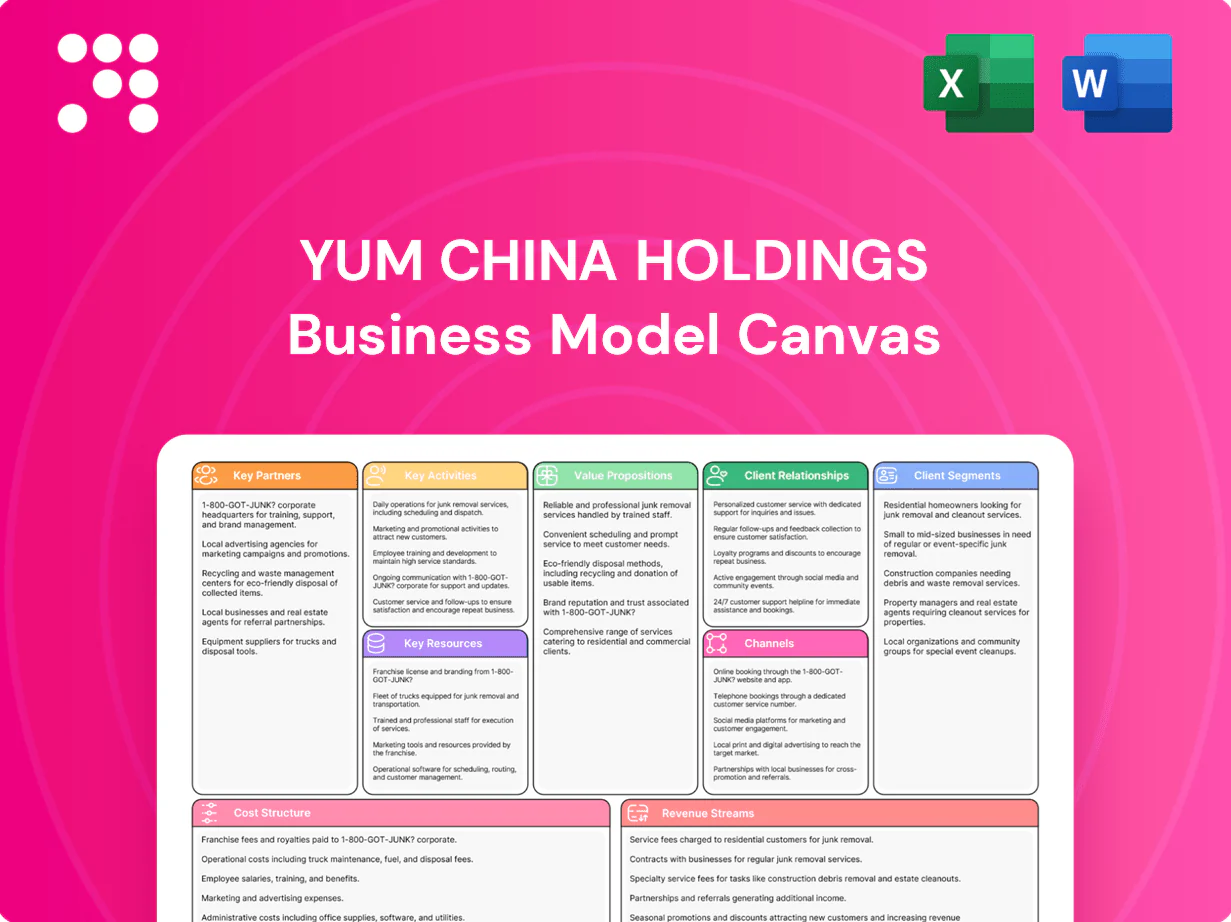
Yum China Holdings Business Model Canvas

Business Model Canvas for China restaurant portfolio: franchising, local supply chain, revenue
Explore Yum China Holdings's Business Model Canvas to see how its brand portfolio, franchising model, and local supply-chain scale profits across China. This concise overview highlights core value propositions, customer segments, and revenue streams. Ready to apply these insights? Purchase the full editable Canvas in Word/Excel for benchmarking, strategic planning, and investor-ready analysis.
Partnerships

Global brand licensors (Yum! Brands)
Master franchise agreements with Yum! Brands authorize operation of KFC, Pizza Hut and Taco Bell in China, supplying brand standards, IP and product pipelines; as of 2024 Yum China operated over 12,000 restaurants, leveraging these systems for scale. Alignment drives consistent customer experience and rapid rollout of innovations, with governance boards and contract KPIs managing brand integrity and local adaptation.
Domestic supply chain and agrifood vendors
Partnerships with poultry, dairy, flour and produce suppliers underpin quality and scale for Yum China, the operator of KFC and Pizza Hut with over 13,000 restaurants across China. Long-term contracts (multi-year) stabilize pricing and availability for nationwide procurement. Co-investments in safety, digital traceability and cold-chain infrastructure boost reliability and reduce spoilage across the network. Local sourcing accelerates speed-to-market and regulatory compliance.

Delivery platforms and last-mile logistics
Yum China partners with Meituan and Ele.me plus proprietary riders to expand delivery reach across hundreds of cities, while API integrations synchronize menus, pricing and promotions in real time. SLAs target 30–40 minute delivery windows, mandate temperature controls and close customer feedback loops for food-safety compliance. Seasonal capacity scaling for Lunar New Year and Singles Day uses surge staffing and third-party fleets to sustain peak demand.

Digital ecosystem partners (payments, cloud, data)
Alliances with Alipay and WeChat Pay (each ~1.3 billion users) and UnionPay streamline checkout and boost digital sales conversion.
Cloud providers enable app scalability and advanced analytics; martech partners power personalization, CRM and loyalty; cybersecurity vendors strengthen compliance and risk controls.
- Payments: Alipay, WeChat Pay, UnionPay
- Cloud: scalability & analytics
- Martech: personalization, CRM, loyalty
- Security: compliance & risk
Franchisees, landlords, and mall operators
Franchisees extend Yum China’s footprint via shared capex, supporting over 13,500 restaurants in 2024 and lowering company-owned capex exposure. Real estate partners secure prime mall locations and favorable leases that shorten payback periods. Co-marketing with malls boosts footfall and brand visibility; KPI-driven performance frameworks (audits, training) maintain operational standards.
- Franchise expansion: shared capex, 2024 ~13,500+ stores
- Real estate: prime mall leases, faster payback
- Co-marketing: higher footfall, brand lift
- Performance: KPIs, audits, training
Partnerships power national growth, digital sales & robust supply-13,500+
Yum China’s key partnerships—master franchise with Yum! Brands, national suppliers, delivery platforms (Meituan, Ele.me), payments (Alipay, WeChat Pay, UnionPay), cloud and martech vendors, and franchisees—enable nationwide scale, digital sales growth and supply-chain resilience; 2024 footprint exceeded 13,500 restaurants. Long-term supplier contracts, cold-chain investments and API integrations sustain quality, safety and peak-demand capacity.
| Partner | Role | 2024 metric |
|---|---|---|
| Franchise/Yum! | Brand/IP, rollout | 13,500+ stores |
| Suppliers | Quality & cold-chain | Multi-year contracts |
| Meituan/Ele.me | Delivery reach | Hundreds of cities |
| Alipay/WeChat | Payments | ~1.3B users |
What is included in the product
 Detailed Word Document
A comprehensive Business Model Canvas for Yum China outlining customer segments, channels, value propositions, revenue streams, key partners, activities, resources, cost structure and customer relationships, with insights on competitive advantages, SWOT-linked opportunities and risks, and practical implications for investors and strategists.

 Customizable Excel Spreadsheet
High-level snapshot of Yum China’s business model with editable cells to quickly identify franchise, supply chain, operations, and digital-channel pain points for rapid problem-solving and team collaboration.
Activities

Menu innovation and localization
Continuous R&D adapts global favorites to Chinese tastes, producing localized items like KFC congee and region-specific flavors across Yum China's network of over 12,000 restaurants. Limited-time offers boost visit frequency and ticket size as a core promotion tool. Test-and-learn kitchens shorten iteration cycles and speed rollouts. Close supplier collaboration secures scale benefits and tighter cost control.
Digital ordering and loyalty operations
Own apps and mini-programs enable ordering, payment, and rewards across channels, consolidating customer touchpoints into a single digital wallet and loyalty ID. Personalization engines segment users by cohort to optimize offers and upsell, driving repeat visits. Data pipelines measure LTV, churn, and campaign ROI in near real time, informing budget allocation. Continuous A/B testing tightens conversion funnels and boosts incremental sales.

Restaurant development and operations
Siting, design, and fast build-out scale Yum China’s network—supporting 13,000+ restaurants in 2024—while standardized formats lower unit costs and time-to-open. Operational excellence enforces speed, consistency, and food safety through workflow engineering and tech-enabled kitchen systems. Rigorous staff training and SOPs reduce service variance and food waste, cutting operating inefficiencies. Continuous improvement programs focus on throughput, driving higher table turns and margin expansion.

Omnichannel delivery and drive-through
Omnichannel integration of dine-in, takeaway, delivery and drive-through maximizes reach across Yum China’s network of over 12,000 restaurants (2024); dynamic capacity management shifts staff and kitchen capacity across channels to smooth peaks; packaging engineering preserves quality in transit; partnerships with Meituan and Ele.me secure peak-time reliability.
- reach: >12,000 restaurants (2024)
- operations: dynamic capacity balancing
- quality: engineered packaging for delivery
- reliability: Meituan, Ele.me partnerships
Brand marketing and partnerships
Yum China runs integrated digital, social and offline campaigns to build demand; KOL and IP tie‑ins target youth segments while value platforms and bundle offers preserve price competitiveness, and city‑specific promotions around local festivals drive relevance across its network of over 13,000 restaurants in 2024.
- Campaigns: omni‑channel demand generation
- KOL/IP: youth engagement
- Value bundles: margin & traffic retention
- Local festivals: city-level relevance
R&D localizes menus, apps & data scale 13,000+ restaurants
R&D localizes global menus and LTOs across 13,000+ restaurants (2024), test kitchens accelerate rollouts. Owned apps and mini-programs unify ordering, payments and loyalty; data pipelines drive segmentation and A/B testing. Standardized formats and SOPs scale openings and ensure food safety; omnichannel ops and Meituan/Ele.me partnerships secure delivery reliability.
| Metric | 2024 |
|---|---|
| Restaurants | 13,000+ |
| Delivery partners | Meituan, Ele.me |
| Channels | App, mini‑program, dine‑in, delivery |
Delivered as Displayed
Business Model Canvas
The document you're previewing is the actual Yum China Business Model Canvas you will receive after purchase. It outlines value propositions, customer segments, channels, revenue streams, key partners and activities in the exact format provided. Upon purchase you'll download the full editable file—no mockups or omissions. Ready to edit, present, and apply to strategy or valuation.

Business Model Canvas for China restaurant portfolio: franchising, local supply chain, revenue
Explore Yum China Holdings's Business Model Canvas to see how its brand portfolio, franchising model, and local supply-chain scale profits across China. This concise overview highlights core value propositions, customer segments, and revenue streams. Ready to apply these insights? Purchase the full editable Canvas in Word/Excel for benchmarking, strategic planning, and investor-ready analysis.
Partnerships
Global brand licensors (Yum! Brands)
Master franchise agreements with Yum! Brands authorize operation of KFC, Pizza Hut and Taco Bell in China, supplying brand standards, IP and product pipelines; as of 2024 Yum China operated over 12,000 restaurants, leveraging these systems for scale. Alignment drives consistent customer experience and rapid rollout of innovations, with governance boards and contract KPIs managing brand integrity and local adaptation.
Domestic supply chain and agrifood vendors
Partnerships with poultry, dairy, flour and produce suppliers underpin quality and scale for Yum China, the operator of KFC and Pizza Hut with over 13,000 restaurants across China. Long-term contracts (multi-year) stabilize pricing and availability for nationwide procurement. Co-investments in safety, digital traceability and cold-chain infrastructure boost reliability and reduce spoilage across the network. Local sourcing accelerates speed-to-market and regulatory compliance.
Delivery platforms and last-mile logistics
Yum China partners with Meituan and Ele.me plus proprietary riders to expand delivery reach across hundreds of cities, while API integrations synchronize menus, pricing and promotions in real time. SLAs target 30–40 minute delivery windows, mandate temperature controls and close customer feedback loops for food-safety compliance. Seasonal capacity scaling for Lunar New Year and Singles Day uses surge staffing and third-party fleets to sustain peak demand.
Digital ecosystem partners (payments, cloud, data)
Alliances with Alipay and WeChat Pay (each ~1.3 billion users) and UnionPay streamline checkout and boost digital sales conversion.
Cloud providers enable app scalability and advanced analytics; martech partners power personalization, CRM and loyalty; cybersecurity vendors strengthen compliance and risk controls.
- Payments: Alipay, WeChat Pay, UnionPay
- Cloud: scalability & analytics
- Martech: personalization, CRM, loyalty
- Security: compliance & risk
Franchisees, landlords, and mall operators
Franchisees extend Yum China’s footprint via shared capex, supporting over 13,500 restaurants in 2024 and lowering company-owned capex exposure. Real estate partners secure prime mall locations and favorable leases that shorten payback periods. Co-marketing with malls boosts footfall and brand visibility; KPI-driven performance frameworks (audits, training) maintain operational standards.
- Franchise expansion: shared capex, 2024 ~13,500+ stores
- Real estate: prime mall leases, faster payback
- Co-marketing: higher footfall, brand lift
- Performance: KPIs, audits, training
Partnerships power national growth, digital sales & robust supply-13,500+
Yum China’s key partnerships—master franchise with Yum! Brands, national suppliers, delivery platforms (Meituan, Ele.me), payments (Alipay, WeChat Pay, UnionPay), cloud and martech vendors, and franchisees—enable nationwide scale, digital sales growth and supply-chain resilience; 2024 footprint exceeded 13,500 restaurants. Long-term supplier contracts, cold-chain investments and API integrations sustain quality, safety and peak-demand capacity.
| Partner | Role | 2024 metric |
|---|---|---|
| Franchise/Yum! | Brand/IP, rollout | 13,500+ stores |
| Suppliers | Quality & cold-chain | Multi-year contracts |
| Meituan/Ele.me | Delivery reach | Hundreds of cities |
| Alipay/WeChat | Payments | ~1.3B users |
What is included in the product
Detailed Word Document
A comprehensive Business Model Canvas for Yum China outlining customer segments, channels, value propositions, revenue streams, key partners, activities, resources, cost structure and customer relationships, with insights on competitive advantages, SWOT-linked opportunities and risks, and practical implications for investors and strategists.
Customizable Excel Spreadsheet
High-level snapshot of Yum China’s business model with editable cells to quickly identify franchise, supply chain, operations, and digital-channel pain points for rapid problem-solving and team collaboration.
Activities
Menu innovation and localization
Continuous R&D adapts global favorites to Chinese tastes, producing localized items like KFC congee and region-specific flavors across Yum China's network of over 12,000 restaurants. Limited-time offers boost visit frequency and ticket size as a core promotion tool. Test-and-learn kitchens shorten iteration cycles and speed rollouts. Close supplier collaboration secures scale benefits and tighter cost control.
Digital ordering and loyalty operations
Own apps and mini-programs enable ordering, payment, and rewards across channels, consolidating customer touchpoints into a single digital wallet and loyalty ID. Personalization engines segment users by cohort to optimize offers and upsell, driving repeat visits. Data pipelines measure LTV, churn, and campaign ROI in near real time, informing budget allocation. Continuous A/B testing tightens conversion funnels and boosts incremental sales.
Restaurant development and operations
Siting, design, and fast build-out scale Yum China’s network—supporting 13,000+ restaurants in 2024—while standardized formats lower unit costs and time-to-open. Operational excellence enforces speed, consistency, and food safety through workflow engineering and tech-enabled kitchen systems. Rigorous staff training and SOPs reduce service variance and food waste, cutting operating inefficiencies. Continuous improvement programs focus on throughput, driving higher table turns and margin expansion.
Omnichannel delivery and drive-through
Omnichannel integration of dine-in, takeaway, delivery and drive-through maximizes reach across Yum China’s network of over 12,000 restaurants (2024); dynamic capacity management shifts staff and kitchen capacity across channels to smooth peaks; packaging engineering preserves quality in transit; partnerships with Meituan and Ele.me secure peak-time reliability.
- reach: >12,000 restaurants (2024)
- operations: dynamic capacity balancing
- quality: engineered packaging for delivery
- reliability: Meituan, Ele.me partnerships
Brand marketing and partnerships
Yum China runs integrated digital, social and offline campaigns to build demand; KOL and IP tie‑ins target youth segments while value platforms and bundle offers preserve price competitiveness, and city‑specific promotions around local festivals drive relevance across its network of over 13,000 restaurants in 2024.
- Campaigns: omni‑channel demand generation
- KOL/IP: youth engagement
- Value bundles: margin & traffic retention
- Local festivals: city-level relevance
R&D localizes menus, apps & data scale 13,000+ restaurants
R&D localizes global menus and LTOs across 13,000+ restaurants (2024), test kitchens accelerate rollouts. Owned apps and mini-programs unify ordering, payments and loyalty; data pipelines drive segmentation and A/B testing. Standardized formats and SOPs scale openings and ensure food safety; omnichannel ops and Meituan/Ele.me partnerships secure delivery reliability.
| Metric | 2024 |
|---|---|
| Restaurants | 13,000+ |
| Delivery partners | Meituan, Ele.me |
| Channels | App, mini‑program, dine‑in, delivery |
Delivered as Displayed
Business Model Canvas
The document you're previewing is the actual Yum China Business Model Canvas you will receive after purchase. It outlines value propositions, customer segments, channels, revenue streams, key partners and activities in the exact format provided. Upon purchase you'll download the full editable file—no mockups or omissions. Ready to edit, present, and apply to strategy or valuation.
Description
Business Model Canvas for China restaurant portfolio: franchising, local supply chain, revenue
Explore Yum China Holdings's Business Model Canvas to see how its brand portfolio, franchising model, and local supply-chain scale profits across China. This concise overview highlights core value propositions, customer segments, and revenue streams. Ready to apply these insights? Purchase the full editable Canvas in Word/Excel for benchmarking, strategic planning, and investor-ready analysis.
Partnerships
Global brand licensors (Yum! Brands)
Master franchise agreements with Yum! Brands authorize operation of KFC, Pizza Hut and Taco Bell in China, supplying brand standards, IP and product pipelines; as of 2024 Yum China operated over 12,000 restaurants, leveraging these systems for scale. Alignment drives consistent customer experience and rapid rollout of innovations, with governance boards and contract KPIs managing brand integrity and local adaptation.
Domestic supply chain and agrifood vendors
Partnerships with poultry, dairy, flour and produce suppliers underpin quality and scale for Yum China, the operator of KFC and Pizza Hut with over 13,000 restaurants across China. Long-term contracts (multi-year) stabilize pricing and availability for nationwide procurement. Co-investments in safety, digital traceability and cold-chain infrastructure boost reliability and reduce spoilage across the network. Local sourcing accelerates speed-to-market and regulatory compliance.
Delivery platforms and last-mile logistics
Yum China partners with Meituan and Ele.me plus proprietary riders to expand delivery reach across hundreds of cities, while API integrations synchronize menus, pricing and promotions in real time. SLAs target 30–40 minute delivery windows, mandate temperature controls and close customer feedback loops for food-safety compliance. Seasonal capacity scaling for Lunar New Year and Singles Day uses surge staffing and third-party fleets to sustain peak demand.
Digital ecosystem partners (payments, cloud, data)
Alliances with Alipay and WeChat Pay (each ~1.3 billion users) and UnionPay streamline checkout and boost digital sales conversion.
Cloud providers enable app scalability and advanced analytics; martech partners power personalization, CRM and loyalty; cybersecurity vendors strengthen compliance and risk controls.
- Payments: Alipay, WeChat Pay, UnionPay
- Cloud: scalability & analytics
- Martech: personalization, CRM, loyalty
- Security: compliance & risk
Franchisees, landlords, and mall operators
Franchisees extend Yum China’s footprint via shared capex, supporting over 13,500 restaurants in 2024 and lowering company-owned capex exposure. Real estate partners secure prime mall locations and favorable leases that shorten payback periods. Co-marketing with malls boosts footfall and brand visibility; KPI-driven performance frameworks (audits, training) maintain operational standards.
- Franchise expansion: shared capex, 2024 ~13,500+ stores
- Real estate: prime mall leases, faster payback
- Co-marketing: higher footfall, brand lift
- Performance: KPIs, audits, training
Partnerships power national growth, digital sales & robust supply-13,500+
Yum China’s key partnerships—master franchise with Yum! Brands, national suppliers, delivery platforms (Meituan, Ele.me), payments (Alipay, WeChat Pay, UnionPay), cloud and martech vendors, and franchisees—enable nationwide scale, digital sales growth and supply-chain resilience; 2024 footprint exceeded 13,500 restaurants. Long-term supplier contracts, cold-chain investments and API integrations sustain quality, safety and peak-demand capacity.
| Partner | Role | 2024 metric |
|---|---|---|
| Franchise/Yum! | Brand/IP, rollout | 13,500+ stores |
| Suppliers | Quality & cold-chain | Multi-year contracts |
| Meituan/Ele.me | Delivery reach | Hundreds of cities |
| Alipay/WeChat | Payments | ~1.3B users |
What is included in the product
Detailed Word Document
A comprehensive Business Model Canvas for Yum China outlining customer segments, channels, value propositions, revenue streams, key partners, activities, resources, cost structure and customer relationships, with insights on competitive advantages, SWOT-linked opportunities and risks, and practical implications for investors and strategists.
Customizable Excel Spreadsheet
High-level snapshot of Yum China’s business model with editable cells to quickly identify franchise, supply chain, operations, and digital-channel pain points for rapid problem-solving and team collaboration.
Activities
Menu innovation and localization
Continuous R&D adapts global favorites to Chinese tastes, producing localized items like KFC congee and region-specific flavors across Yum China's network of over 12,000 restaurants. Limited-time offers boost visit frequency and ticket size as a core promotion tool. Test-and-learn kitchens shorten iteration cycles and speed rollouts. Close supplier collaboration secures scale benefits and tighter cost control.
Digital ordering and loyalty operations
Own apps and mini-programs enable ordering, payment, and rewards across channels, consolidating customer touchpoints into a single digital wallet and loyalty ID. Personalization engines segment users by cohort to optimize offers and upsell, driving repeat visits. Data pipelines measure LTV, churn, and campaign ROI in near real time, informing budget allocation. Continuous A/B testing tightens conversion funnels and boosts incremental sales.
Restaurant development and operations
Siting, design, and fast build-out scale Yum China’s network—supporting 13,000+ restaurants in 2024—while standardized formats lower unit costs and time-to-open. Operational excellence enforces speed, consistency, and food safety through workflow engineering and tech-enabled kitchen systems. Rigorous staff training and SOPs reduce service variance and food waste, cutting operating inefficiencies. Continuous improvement programs focus on throughput, driving higher table turns and margin expansion.
Omnichannel delivery and drive-through
Omnichannel integration of dine-in, takeaway, delivery and drive-through maximizes reach across Yum China’s network of over 12,000 restaurants (2024); dynamic capacity management shifts staff and kitchen capacity across channels to smooth peaks; packaging engineering preserves quality in transit; partnerships with Meituan and Ele.me secure peak-time reliability.
- reach: >12,000 restaurants (2024)
- operations: dynamic capacity balancing
- quality: engineered packaging for delivery
- reliability: Meituan, Ele.me partnerships
Brand marketing and partnerships
Yum China runs integrated digital, social and offline campaigns to build demand; KOL and IP tie‑ins target youth segments while value platforms and bundle offers preserve price competitiveness, and city‑specific promotions around local festivals drive relevance across its network of over 13,000 restaurants in 2024.
- Campaigns: omni‑channel demand generation
- KOL/IP: youth engagement
- Value bundles: margin & traffic retention
- Local festivals: city-level relevance
R&D localizes menus, apps & data scale 13,000+ restaurants
R&D localizes global menus and LTOs across 13,000+ restaurants (2024), test kitchens accelerate rollouts. Owned apps and mini-programs unify ordering, payments and loyalty; data pipelines drive segmentation and A/B testing. Standardized formats and SOPs scale openings and ensure food safety; omnichannel ops and Meituan/Ele.me partnerships secure delivery reliability.
| Metric | 2024 |
|---|---|
| Restaurants | 13,000+ |
| Delivery partners | Meituan, Ele.me |
| Channels | App, mini‑program, dine‑in, delivery |
Delivered as Displayed
Business Model Canvas
The document you're previewing is the actual Yum China Business Model Canvas you will receive after purchase. It outlines value propositions, customer segments, channels, revenue streams, key partners and activities in the exact format provided. Upon purchase you'll download the full editable file—no mockups or omissions. Ready to edit, present, and apply to strategy or valuation.











