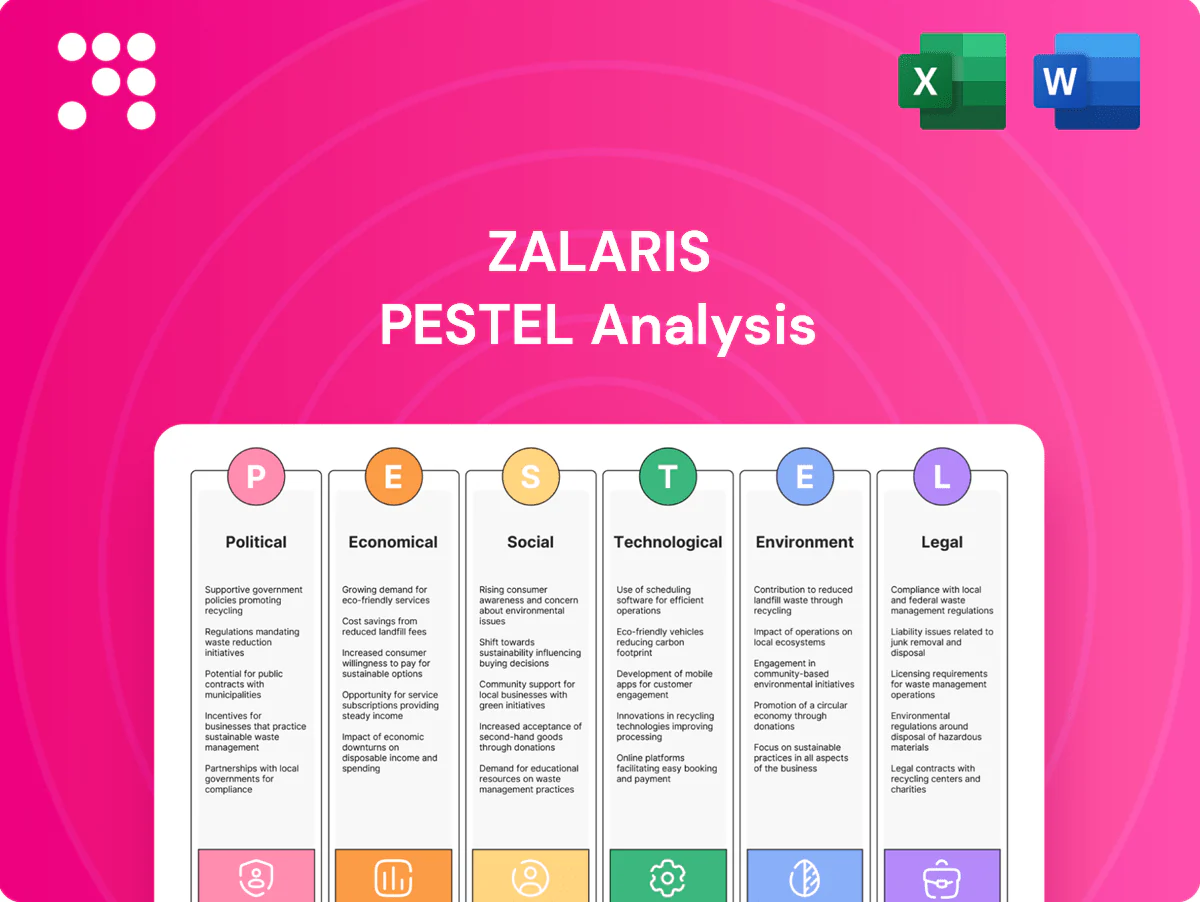
Zalaris PESTLE Analysis

Plan Smarter. Present Sharper. Compete Stronger.
Unlock how political shifts, economic cycles, and tech trends are shaping Zalaris with our targeted PESTLE analysis—concise, expert-led, and immediately actionable. Ideal for investors, consultants, and strategists, this report highlights risks and growth levers you can use today. Buy the full PESTLE to get the complete, editable breakdown and make smarter strategic decisions instantly.
Political factors

EU labor and HR policy harmonization
Shifts in EU directives on working time, pay transparency and platform work are reshaping payroll across 27 member states and roughly 215 million employees; Zalaris must rapidly update configurations to keep clients compliant, driving near‑term costs. Harmonization could lower long‑term complexity, but firms face implementation expenses and must closely monitor Brussels timelines and transposition windows typically of 12–24 months.
Government digitalization and public-sector outsourcing
European public bodies’ push to modernize HR/payroll creates tenders within a public procurement market worth roughly 14% of EU GDP (about €2tn annually), with procurement cycles typically 12–18 months and compliance favoring experienced vendors. Winning contracts, often 3–7 year frameworks (avg ~5 years), can anchor multi‑year revenue. 2024 political shifts and EU elections increased budget reprioritization risk and can slow decision timetables.

Cross-border employment and mobility policies
Post-Brexit and evolving EU mobility rules complicate tax, social security and reporting for roughly 1.9 million EU cross‑border workers and telework rates near 17% in 2023, increasing compliance touchpoints. Zalaris’ cross‑country payroll and HRIS capabilities become a clear differentiator for multinational clients. Frequent updates to expatriate and remote‑work frameworks demand agile rule engines and rapid config changes. Missteps can trigger client penalties, reputational damage and churn.

Geopolitical instability and cyber sovereignty
Geopolitical tensions and sanction regimes since 2022 have disrupted data flows and vendor access in affected markets, forcing payroll vendors and clients to reroute services; the EU Data Governance Act (2022) and the GAIA-X initiative reinforce in-region hosting and interoperability; Zalaris must meet national cloud and security requirements and expand supply-chain vetting as political scrutiny increases.
- Sanctions impact vendors/clients
- EU Data Governance Act 2022
- GAIA-X drives in-region hosting
- Higher supply-chain vetting
Subsidies for digital and AI adoption
EU Digital Europe Programme allocates €7.5 billion and the Recovery and Resilience Facility totals €723.8 billion, channeling funds to cloud, AI and SME digitalization; clients leveraging these grants can accelerate HR transformations and payroll modernization. Zalaris can tailor proposals to specific funding criteria to boost win rates, but policy windows are time‑bound so proactive engagement is essential.
- Fund size: €7.5bn (Digital Europe) + RRF €723.8bn
- Opportunity: faster client HR transformation via grants
- Action: align offerings to funding rules; engage proactively
EU pay/transparency, procurement and data rules reshape costs for ~215m workers and €2tn markets
EU pay/transparency directives affect ~215m employees; harmonization lowers long‑term complexity but forces 12–24m transposition work and near‑term implementation costs. Public procurement (~14% of EU GDP ≈ €2tn/year) yields 3–7y frameworks (avg ~5y) with 12–18m cycles. Cross‑border rules hit ~1.9m workers; sanctions, GAIA‑X and Data Governance Act push in‑region hosting. Grants: Digital Europe €7.5bn, RRF €723.8bn.
| Item | Figure |
|---|---|
| Employees affected | ~215m |
| Procurement share | ~14% EU GDP ≈ €2tn/yr |
| Framework length | 3–7y (avg 5y) |
| Transposition window | 12–24 months |
| Cross‑border workers | ~1.9m |
| Digital grants | €7.5bn (Digital Europe), €723.8bn (RRF) |
What is included in the product
 Detailed Word Document
Explores how macro-environmental factors uniquely affect Zalaris across Political, Economic, Social, Technological, Environmental and Legal dimensions, with data-driven trends and regional regulatory context. Designed to help executives and investors spot threats, opportunities and inform scenario planning.

 Customizable Excel Spreadsheet
A concise, visually segmented Zalaris PESTLE summary eases meeting prep and stakeholder alignment by distilling external risks and opportunities into editable, shareable notes that can be dropped into presentations or planning packs.
Economic factors

Macro cycles and employment levels
Payroll volumes track client headcount, so economic downturns compress variable payroll revenues while growth phases expand payroll processing and project demand. Firms often outsource payroll counter‑cyclically to convert fixed payroll costs to variable service fees, boosting demand for providers like Zalaris. Zalaris’ sensitivity to cycles hinges on its client industry mix and geographic exposure.
Wage inflation and cost pass‑through
Rising wages and indexation—Norway 2024 negotiated wage settlements near 5.5%—elevate Zalaris service costs and intensify pricing pressure, forcing tighter margin management. Contracts require clear escalators and CPI linkage to protect margins against recurring wage uplifts. Automation and RPA investments that lift productivity by 20–30% in payroll operations can offset labor inflation, while clients increasingly demand stronger ROI and shorter payback in high‑cost environments.

Interest rates and cost of capital
Higher policy rates averaging about 4–5% across major central banks in 2024–25 raise financing costs for investments and M&A, prompting clients to delay large HR transformations when capital tightens. Zalaris’ historically strong cash generation and disciplined pricing provide resilience against rate pressure. When rates decline, project backlogs and transformation spend typically re‑ignite, accelerating pipeline conversion.

Currency exposure in European markets
- FX exposures: NOK/EUR/GBP prominent
- Market rates mid‑2025: EUR/NOK ~11.20, GBP/NOK ~13.10
- Hedging: adds cost, reduces margin volatility
- Pricing in client currency: lowers transaction risk
- Economic divergence: uneven regional demand
Market consolidation and competitive intensity
Market consolidation in HR/payroll sees global suites and niche local players vying for share; consolidation compresses prices but expands cross‑sell ecosystems. Zalaris can differentiate via multi‑country compliance depth, serving about 2.2 million employees and reporting roughly NOK 1.1bn revenue in 2024. Scale efficiencies are critical to defend margins amid an estimated ~10% market CAGR.
- Global vs local competition intensifies
- Zalaris: multi‑country compliance; ~2.2m employees; ~NOK 1.1bn revenue (2024)
- Consolidation compresses prices but enables cross‑sell; scale protects margins
EU pay/transparency, procurement and data rules reshape costs for ~215m workers and €2tn markets
Payroll revenue tracks client headcount, so downturns compress variable fees while outsourcing demand rises; Zalaris served ~2.2m employees and reported ~NOK 1.1bn revenue in 2024. Norway 2024 wage settlements ~5.5% and automation gains (20–30%) shape margin cadence. Policy rates ~4–5% in 2024–25 raise financing costs; FX mid‑2025: EUR/NOK ~11.20, GBP/NOK ~13.10.
| Metric | Value |
|---|---|
| Revenue (2024) | NOK 1.1bn |
| Employees served | ~2.2m |
| Norway wage settlement (2024) | ~5.5% |
| Policy rates (2024–25) | 4–5% |
| FX mid‑2025 | EUR/NOK 11.20; GBP/NOK 13.10 |
| Payroll automation uplift | 20–30% |
| Market CAGR | ~10% |
Preview the Actual Deliverable
Zalaris PESTLE Analysis
The preview shown here is the exact Zalaris PESTLE Analysis document you’ll receive after purchase—fully formatted and ready to use. This is the real, finished file with complete political, economic, social, technological, legal and environmental sections, delivered exactly as displayed. No placeholders or teasers—download this exact document immediately after payment.

Plan Smarter. Present Sharper. Compete Stronger.
Unlock how political shifts, economic cycles, and tech trends are shaping Zalaris with our targeted PESTLE analysis—concise, expert-led, and immediately actionable. Ideal for investors, consultants, and strategists, this report highlights risks and growth levers you can use today. Buy the full PESTLE to get the complete, editable breakdown and make smarter strategic decisions instantly.
Political factors
EU labor and HR policy harmonization
Shifts in EU directives on working time, pay transparency and platform work are reshaping payroll across 27 member states and roughly 215 million employees; Zalaris must rapidly update configurations to keep clients compliant, driving near‑term costs. Harmonization could lower long‑term complexity, but firms face implementation expenses and must closely monitor Brussels timelines and transposition windows typically of 12–24 months.
Government digitalization and public-sector outsourcing
European public bodies’ push to modernize HR/payroll creates tenders within a public procurement market worth roughly 14% of EU GDP (about €2tn annually), with procurement cycles typically 12–18 months and compliance favoring experienced vendors. Winning contracts, often 3–7 year frameworks (avg ~5 years), can anchor multi‑year revenue. 2024 political shifts and EU elections increased budget reprioritization risk and can slow decision timetables.
Cross-border employment and mobility policies
Post-Brexit and evolving EU mobility rules complicate tax, social security and reporting for roughly 1.9 million EU cross‑border workers and telework rates near 17% in 2023, increasing compliance touchpoints. Zalaris’ cross‑country payroll and HRIS capabilities become a clear differentiator for multinational clients. Frequent updates to expatriate and remote‑work frameworks demand agile rule engines and rapid config changes. Missteps can trigger client penalties, reputational damage and churn.
Geopolitical instability and cyber sovereignty
Geopolitical tensions and sanction regimes since 2022 have disrupted data flows and vendor access in affected markets, forcing payroll vendors and clients to reroute services; the EU Data Governance Act (2022) and the GAIA-X initiative reinforce in-region hosting and interoperability; Zalaris must meet national cloud and security requirements and expand supply-chain vetting as political scrutiny increases.
- Sanctions impact vendors/clients
- EU Data Governance Act 2022
- GAIA-X drives in-region hosting
- Higher supply-chain vetting
Subsidies for digital and AI adoption
EU Digital Europe Programme allocates €7.5 billion and the Recovery and Resilience Facility totals €723.8 billion, channeling funds to cloud, AI and SME digitalization; clients leveraging these grants can accelerate HR transformations and payroll modernization. Zalaris can tailor proposals to specific funding criteria to boost win rates, but policy windows are time‑bound so proactive engagement is essential.
- Fund size: €7.5bn (Digital Europe) + RRF €723.8bn
- Opportunity: faster client HR transformation via grants
- Action: align offerings to funding rules; engage proactively
EU pay/transparency, procurement and data rules reshape costs for ~215m workers and €2tn markets
EU pay/transparency directives affect ~215m employees; harmonization lowers long‑term complexity but forces 12–24m transposition work and near‑term implementation costs. Public procurement (~14% of EU GDP ≈ €2tn/year) yields 3–7y frameworks (avg ~5y) with 12–18m cycles. Cross‑border rules hit ~1.9m workers; sanctions, GAIA‑X and Data Governance Act push in‑region hosting. Grants: Digital Europe €7.5bn, RRF €723.8bn.
| Item | Figure |
|---|---|
| Employees affected | ~215m |
| Procurement share | ~14% EU GDP ≈ €2tn/yr |
| Framework length | 3–7y (avg 5y) |
| Transposition window | 12–24 months |
| Cross‑border workers | ~1.9m |
| Digital grants | €7.5bn (Digital Europe), €723.8bn (RRF) |
What is included in the product
Detailed Word Document
Explores how macro-environmental factors uniquely affect Zalaris across Political, Economic, Social, Technological, Environmental and Legal dimensions, with data-driven trends and regional regulatory context. Designed to help executives and investors spot threats, opportunities and inform scenario planning.
Customizable Excel Spreadsheet
A concise, visually segmented Zalaris PESTLE summary eases meeting prep and stakeholder alignment by distilling external risks and opportunities into editable, shareable notes that can be dropped into presentations or planning packs.
Economic factors
Macro cycles and employment levels
Payroll volumes track client headcount, so economic downturns compress variable payroll revenues while growth phases expand payroll processing and project demand. Firms often outsource payroll counter‑cyclically to convert fixed payroll costs to variable service fees, boosting demand for providers like Zalaris. Zalaris’ sensitivity to cycles hinges on its client industry mix and geographic exposure.
Wage inflation and cost pass‑through
Rising wages and indexation—Norway 2024 negotiated wage settlements near 5.5%—elevate Zalaris service costs and intensify pricing pressure, forcing tighter margin management. Contracts require clear escalators and CPI linkage to protect margins against recurring wage uplifts. Automation and RPA investments that lift productivity by 20–30% in payroll operations can offset labor inflation, while clients increasingly demand stronger ROI and shorter payback in high‑cost environments.
Interest rates and cost of capital
Higher policy rates averaging about 4–5% across major central banks in 2024–25 raise financing costs for investments and M&A, prompting clients to delay large HR transformations when capital tightens. Zalaris’ historically strong cash generation and disciplined pricing provide resilience against rate pressure. When rates decline, project backlogs and transformation spend typically re‑ignite, accelerating pipeline conversion.
Currency exposure in European markets
- FX exposures: NOK/EUR/GBP prominent
- Market rates mid‑2025: EUR/NOK ~11.20, GBP/NOK ~13.10
- Hedging: adds cost, reduces margin volatility
- Pricing in client currency: lowers transaction risk
- Economic divergence: uneven regional demand
Market consolidation and competitive intensity
Market consolidation in HR/payroll sees global suites and niche local players vying for share; consolidation compresses prices but expands cross‑sell ecosystems. Zalaris can differentiate via multi‑country compliance depth, serving about 2.2 million employees and reporting roughly NOK 1.1bn revenue in 2024. Scale efficiencies are critical to defend margins amid an estimated ~10% market CAGR.
- Global vs local competition intensifies
- Zalaris: multi‑country compliance; ~2.2m employees; ~NOK 1.1bn revenue (2024)
- Consolidation compresses prices but enables cross‑sell; scale protects margins
EU pay/transparency, procurement and data rules reshape costs for ~215m workers and €2tn markets
Payroll revenue tracks client headcount, so downturns compress variable fees while outsourcing demand rises; Zalaris served ~2.2m employees and reported ~NOK 1.1bn revenue in 2024. Norway 2024 wage settlements ~5.5% and automation gains (20–30%) shape margin cadence. Policy rates ~4–5% in 2024–25 raise financing costs; FX mid‑2025: EUR/NOK ~11.20, GBP/NOK ~13.10.
| Metric | Value |
|---|---|
| Revenue (2024) | NOK 1.1bn |
| Employees served | ~2.2m |
| Norway wage settlement (2024) | ~5.5% |
| Policy rates (2024–25) | 4–5% |
| FX mid‑2025 | EUR/NOK 11.20; GBP/NOK 13.10 |
| Payroll automation uplift | 20–30% |
| Market CAGR | ~10% |
Preview the Actual Deliverable
Zalaris PESTLE Analysis
The preview shown here is the exact Zalaris PESTLE Analysis document you’ll receive after purchase—fully formatted and ready to use. This is the real, finished file with complete political, economic, social, technological, legal and environmental sections, delivered exactly as displayed. No placeholders or teasers—download this exact document immediately after payment.
Original: $10.00
-65%$10.00
$3.50Description
Plan Smarter. Present Sharper. Compete Stronger.
Unlock how political shifts, economic cycles, and tech trends are shaping Zalaris with our targeted PESTLE analysis—concise, expert-led, and immediately actionable. Ideal for investors, consultants, and strategists, this report highlights risks and growth levers you can use today. Buy the full PESTLE to get the complete, editable breakdown and make smarter strategic decisions instantly.
Political factors
EU labor and HR policy harmonization
Shifts in EU directives on working time, pay transparency and platform work are reshaping payroll across 27 member states and roughly 215 million employees; Zalaris must rapidly update configurations to keep clients compliant, driving near‑term costs. Harmonization could lower long‑term complexity, but firms face implementation expenses and must closely monitor Brussels timelines and transposition windows typically of 12–24 months.
Government digitalization and public-sector outsourcing
European public bodies’ push to modernize HR/payroll creates tenders within a public procurement market worth roughly 14% of EU GDP (about €2tn annually), with procurement cycles typically 12–18 months and compliance favoring experienced vendors. Winning contracts, often 3–7 year frameworks (avg ~5 years), can anchor multi‑year revenue. 2024 political shifts and EU elections increased budget reprioritization risk and can slow decision timetables.
Cross-border employment and mobility policies
Post-Brexit and evolving EU mobility rules complicate tax, social security and reporting for roughly 1.9 million EU cross‑border workers and telework rates near 17% in 2023, increasing compliance touchpoints. Zalaris’ cross‑country payroll and HRIS capabilities become a clear differentiator for multinational clients. Frequent updates to expatriate and remote‑work frameworks demand agile rule engines and rapid config changes. Missteps can trigger client penalties, reputational damage and churn.
Geopolitical instability and cyber sovereignty
Geopolitical tensions and sanction regimes since 2022 have disrupted data flows and vendor access in affected markets, forcing payroll vendors and clients to reroute services; the EU Data Governance Act (2022) and the GAIA-X initiative reinforce in-region hosting and interoperability; Zalaris must meet national cloud and security requirements and expand supply-chain vetting as political scrutiny increases.
- Sanctions impact vendors/clients
- EU Data Governance Act 2022
- GAIA-X drives in-region hosting
- Higher supply-chain vetting
Subsidies for digital and AI adoption
EU Digital Europe Programme allocates €7.5 billion and the Recovery and Resilience Facility totals €723.8 billion, channeling funds to cloud, AI and SME digitalization; clients leveraging these grants can accelerate HR transformations and payroll modernization. Zalaris can tailor proposals to specific funding criteria to boost win rates, but policy windows are time‑bound so proactive engagement is essential.
- Fund size: €7.5bn (Digital Europe) + RRF €723.8bn
- Opportunity: faster client HR transformation via grants
- Action: align offerings to funding rules; engage proactively
EU pay/transparency, procurement and data rules reshape costs for ~215m workers and €2tn markets
EU pay/transparency directives affect ~215m employees; harmonization lowers long‑term complexity but forces 12–24m transposition work and near‑term implementation costs. Public procurement (~14% of EU GDP ≈ €2tn/year) yields 3–7y frameworks (avg ~5y) with 12–18m cycles. Cross‑border rules hit ~1.9m workers; sanctions, GAIA‑X and Data Governance Act push in‑region hosting. Grants: Digital Europe €7.5bn, RRF €723.8bn.
| Item | Figure |
|---|---|
| Employees affected | ~215m |
| Procurement share | ~14% EU GDP ≈ €2tn/yr |
| Framework length | 3–7y (avg 5y) |
| Transposition window | 12–24 months |
| Cross‑border workers | ~1.9m |
| Digital grants | €7.5bn (Digital Europe), €723.8bn (RRF) |
What is included in the product
Detailed Word Document
Explores how macro-environmental factors uniquely affect Zalaris across Political, Economic, Social, Technological, Environmental and Legal dimensions, with data-driven trends and regional regulatory context. Designed to help executives and investors spot threats, opportunities and inform scenario planning.
Customizable Excel Spreadsheet
A concise, visually segmented Zalaris PESTLE summary eases meeting prep and stakeholder alignment by distilling external risks and opportunities into editable, shareable notes that can be dropped into presentations or planning packs.
Economic factors
Macro cycles and employment levels
Payroll volumes track client headcount, so economic downturns compress variable payroll revenues while growth phases expand payroll processing and project demand. Firms often outsource payroll counter‑cyclically to convert fixed payroll costs to variable service fees, boosting demand for providers like Zalaris. Zalaris’ sensitivity to cycles hinges on its client industry mix and geographic exposure.
Wage inflation and cost pass‑through
Rising wages and indexation—Norway 2024 negotiated wage settlements near 5.5%—elevate Zalaris service costs and intensify pricing pressure, forcing tighter margin management. Contracts require clear escalators and CPI linkage to protect margins against recurring wage uplifts. Automation and RPA investments that lift productivity by 20–30% in payroll operations can offset labor inflation, while clients increasingly demand stronger ROI and shorter payback in high‑cost environments.
Interest rates and cost of capital
Higher policy rates averaging about 4–5% across major central banks in 2024–25 raise financing costs for investments and M&A, prompting clients to delay large HR transformations when capital tightens. Zalaris’ historically strong cash generation and disciplined pricing provide resilience against rate pressure. When rates decline, project backlogs and transformation spend typically re‑ignite, accelerating pipeline conversion.
Currency exposure in European markets
- FX exposures: NOK/EUR/GBP prominent
- Market rates mid‑2025: EUR/NOK ~11.20, GBP/NOK ~13.10
- Hedging: adds cost, reduces margin volatility
- Pricing in client currency: lowers transaction risk
- Economic divergence: uneven regional demand
Market consolidation and competitive intensity
Market consolidation in HR/payroll sees global suites and niche local players vying for share; consolidation compresses prices but expands cross‑sell ecosystems. Zalaris can differentiate via multi‑country compliance depth, serving about 2.2 million employees and reporting roughly NOK 1.1bn revenue in 2024. Scale efficiencies are critical to defend margins amid an estimated ~10% market CAGR.
- Global vs local competition intensifies
- Zalaris: multi‑country compliance; ~2.2m employees; ~NOK 1.1bn revenue (2024)
- Consolidation compresses prices but enables cross‑sell; scale protects margins
EU pay/transparency, procurement and data rules reshape costs for ~215m workers and €2tn markets
Payroll revenue tracks client headcount, so downturns compress variable fees while outsourcing demand rises; Zalaris served ~2.2m employees and reported ~NOK 1.1bn revenue in 2024. Norway 2024 wage settlements ~5.5% and automation gains (20–30%) shape margin cadence. Policy rates ~4–5% in 2024–25 raise financing costs; FX mid‑2025: EUR/NOK ~11.20, GBP/NOK ~13.10.
| Metric | Value |
|---|---|
| Revenue (2024) | NOK 1.1bn |
| Employees served | ~2.2m |
| Norway wage settlement (2024) | ~5.5% |
| Policy rates (2024–25) | 4–5% |
| FX mid‑2025 | EUR/NOK 11.20; GBP/NOK 13.10 |
| Payroll automation uplift | 20–30% |
| Market CAGR | ~10% |
Preview the Actual Deliverable
Zalaris PESTLE Analysis
The preview shown here is the exact Zalaris PESTLE Analysis document you’ll receive after purchase—fully formatted and ready to use. This is the real, finished file with complete political, economic, social, technological, legal and environmental sections, delivered exactly as displayed. No placeholders or teasers—download this exact document immediately after payment.











