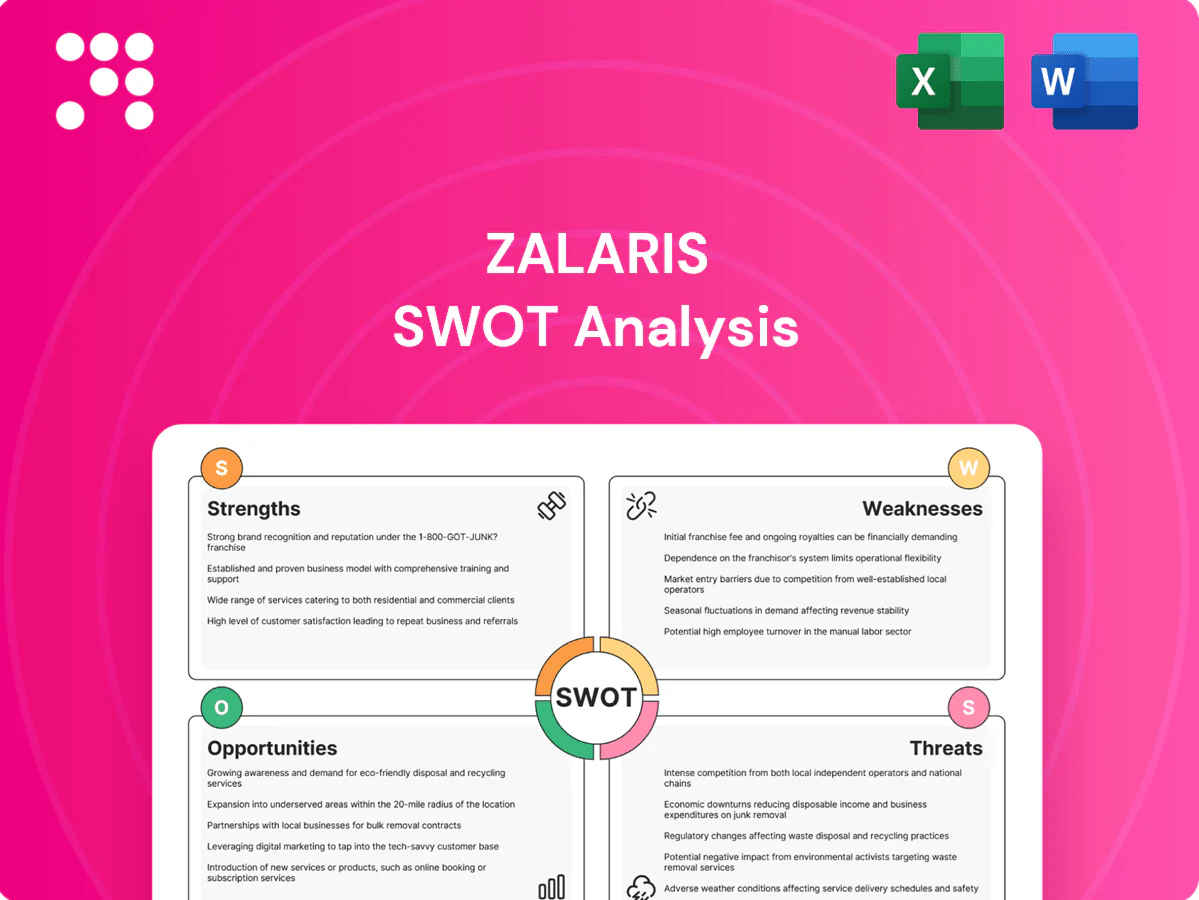
Zalaris SWOT Analysis

Make Insightful Decisions Backed by Expert Research
Zalaris' SWOT highlights strengths like strong Nordic payroll/HCM expertise and cloud services, plus scalable tech; weaknesses include regional concentration and margin pressure; opportunities in EU outsourcing growth and digital transformation, with risks from competition and regulatory changes. Want full, editable Word+Excel analysis with strategic takeaways? Purchase the complete SWOT for investor-ready insights.
Strengths

Comprehensive HR and payroll suite
Zalaris offers end-to-end coverage across payroll, time & attendance, talent and HR master data, reducing vendor sprawl for clients and lowering integration overhead. Integrated modules ensure consistent data flows and fewer manual handoffs, improving accuracy and compliance. This breadth boosts cross-sell opportunities and client stickiness, differentiating Zalaris versus niche point solutions.
Cloud-native delivery model
Zalaris cloud-native SaaS architecture accelerates deployment, scaling and updates for enterprise clients, enabling go-live in weeks rather than months. Forrester TEI studies show SaaS can lower total cost of ownership by up to 30–50%, while subscription pricing gives budget owners predictable spending. Continuous, low-client-lift updates drive recurring revenue and support margin scalability for Zalaris.

European enterprise focus
Deep familiarity with complex, multi-country payroll and HR regulations across the EU's 27 member states and 24 official languages is a core capability. Localized compliance and language support build trust with large and mid-sized organizations. Established regional references reduce sales friction and regional density improves service economics through scale and process standardization.

Process standardization and efficiency
Platformized best practices in Zalaris streamline HR operations and reduce errors, underpinning service delivery for over 1.1 million supported employees (company disclosures). Automation and employee self-service boost HR productivity and experience, while standardized workflows accelerate onboarding and change management, delivering measurable client ROI.
Strategic partnerships and integrations
Strategic partnerships and certified integrations with leading HCM and ERP ecosystems, including SAP and Workday, enhance Zalaris usefulness by ensuring seamless data flow and standardized processes, cutting project risk and time-to-value. These alliances expand distribution channels and solution breadth, strengthening bids in complex enterprise RFPs and supporting scalable deployments across markets.
- Connectivity: certified SAP and Workday integrations
- Risk: reduces implementation time-to-value
- Reach: expanded distribution and solution breadth
- Competitive: stronger positioning in enterprise RFPs
Cloud payroll & HCM SaaS: faster go-live, 30–50% lower TCO, EU compliance
Zalaris delivers end-to-end payroll and HCM SaaS that reduces vendor sprawl, improves compliance and increases cross-sell stickiness. Cloud-native delivery enables faster go-live and subscription economics, with Forrester TEI citing 30–50% lower TCO for SaaS. Deep EU compliance (27 member states, 24 languages) and platformized workflows support 1.1 million employees, plus certified SAP and Workday integrations.
| Metric | Value |
|---|---|
| Employees supported | 1.1 million |
| Estimated SaaS TCO reduction | 30–50% |
| EU coverage | 27 states / 24 languages |
| Key integrations | SAP, Workday (certified) |
What is included in the product
 Detailed Word Document
Provides a strategic overview of Zalaris’s internal strengths and weaknesses and external opportunities and threats, mapping competitive position, growth drivers, operational gaps, and market risks to inform strategic decision-making.

 Customizable Excel Spreadsheet
Provides a concise, visual SWOT matrix tailored to Zalaris for fast strategic alignment and pain-point resolution, enabling quick edits and seamless integration into reports and stakeholder presentations.
Weaknesses

Concentration in Europe
Concentration in Europe limits growth optionality for Zalaris, with FY2024 revenue around NOK 1.1bn driven predominantly by Nordic and UK clients, elevating exposure to regional macro cycles and regulatory shifts; global enterprise clients often favor vendors with broader geographic coverage, and meaningful expansion into APAC or Americas would require significant investment and recruitment of local payroll and compliance expertise.
Enterprise sales cycles
Long, complex enterprise RFPs and implementations (commonly 6–18 months) delay revenue recognition; high pre-sales and onboarding costs (often 10–20% of first‑year contract value) compress near‑term margins. Procurement scrutiny stalls ~25–40% of expansion deals, and single large contracts >10% of annual revenue make forecasting volatile.

Integration and change management complexity
Replacing legacy HR/payroll systems is highly disruptive and resource-intensive; McKinsey estimates roughly 70% of transformations fail to meet objectives, underscoring execution risk. Data migration, interfaces and process redesign drive most failures and can trigger costly incidents — IBM’s 2024 Cost of a Data Breach averaged 4.45 million USD. Clients demand strong stakeholder alignment and training; missteps directly harm satisfaction and future references.

Price competitiveness vs. global giants
Larger HCM vendors like SAP and Workday can bundle services and outspend on product and marketing, creating discounting pressure in multinational deals; this squeezes Zalaris margins and forces continual margin defense. Differentiation must lean on localization, high service quality and lower total cost of ownership to compete effectively in a market estimated around USD 30bn in 2024.
- Price pressure from global giants
- Discounting in multinational RFPs
- Need to sell localization & TCO
- Continuous margin defense
Brand visibility outside core niches
Europe focus NOK 1.1bn limits margins; 6–18m impls, 10–20% onboarding
Concentration in Europe (FY2024 rev NOK 1.1bn) raises regional exposure; implementations (6–18 months) and 10–20% onboarding costs compress margins; competition from SAP/Workday creates price pressure and higher CAC, slowing APAC/US expansion.
| Metric | Value |
|---|---|
| FY2024 revenue | NOK 1.1bn |
| Impl. time | 6–18 months |
| Onboarding cost | 10–20% ACV |
| Market size 2024 | USD 30bn |
Preview Before You Purchase
Zalaris SWOT Analysis
This is the actual Zalaris SWOT analysis document you’re previewing—no samples or placeholders, just the real report. The excerpt shown is taken directly from the full file you’ll receive upon purchase. Buy to unlock the complete, editable SWOT with professional, structured insights. No surprises—what you see is what you get.

Make Insightful Decisions Backed by Expert Research
Zalaris' SWOT highlights strengths like strong Nordic payroll/HCM expertise and cloud services, plus scalable tech; weaknesses include regional concentration and margin pressure; opportunities in EU outsourcing growth and digital transformation, with risks from competition and regulatory changes. Want full, editable Word+Excel analysis with strategic takeaways? Purchase the complete SWOT for investor-ready insights.
Strengths
Comprehensive HR and payroll suite
Zalaris offers end-to-end coverage across payroll, time & attendance, talent and HR master data, reducing vendor sprawl for clients and lowering integration overhead. Integrated modules ensure consistent data flows and fewer manual handoffs, improving accuracy and compliance. This breadth boosts cross-sell opportunities and client stickiness, differentiating Zalaris versus niche point solutions.
Cloud-native delivery model
Zalaris cloud-native SaaS architecture accelerates deployment, scaling and updates for enterprise clients, enabling go-live in weeks rather than months. Forrester TEI studies show SaaS can lower total cost of ownership by up to 30–50%, while subscription pricing gives budget owners predictable spending. Continuous, low-client-lift updates drive recurring revenue and support margin scalability for Zalaris.
European enterprise focus
Deep familiarity with complex, multi-country payroll and HR regulations across the EU's 27 member states and 24 official languages is a core capability. Localized compliance and language support build trust with large and mid-sized organizations. Established regional references reduce sales friction and regional density improves service economics through scale and process standardization.
Process standardization and efficiency
Platformized best practices in Zalaris streamline HR operations and reduce errors, underpinning service delivery for over 1.1 million supported employees (company disclosures). Automation and employee self-service boost HR productivity and experience, while standardized workflows accelerate onboarding and change management, delivering measurable client ROI.
Strategic partnerships and integrations
Strategic partnerships and certified integrations with leading HCM and ERP ecosystems, including SAP and Workday, enhance Zalaris usefulness by ensuring seamless data flow and standardized processes, cutting project risk and time-to-value. These alliances expand distribution channels and solution breadth, strengthening bids in complex enterprise RFPs and supporting scalable deployments across markets.
- Connectivity: certified SAP and Workday integrations
- Risk: reduces implementation time-to-value
- Reach: expanded distribution and solution breadth
- Competitive: stronger positioning in enterprise RFPs
Cloud payroll & HCM SaaS: faster go-live, 30–50% lower TCO, EU compliance
Zalaris delivers end-to-end payroll and HCM SaaS that reduces vendor sprawl, improves compliance and increases cross-sell stickiness. Cloud-native delivery enables faster go-live and subscription economics, with Forrester TEI citing 30–50% lower TCO for SaaS. Deep EU compliance (27 member states, 24 languages) and platformized workflows support 1.1 million employees, plus certified SAP and Workday integrations.
| Metric | Value |
|---|---|
| Employees supported | 1.1 million |
| Estimated SaaS TCO reduction | 30–50% |
| EU coverage | 27 states / 24 languages |
| Key integrations | SAP, Workday (certified) |
What is included in the product
Detailed Word Document
Provides a strategic overview of Zalaris’s internal strengths and weaknesses and external opportunities and threats, mapping competitive position, growth drivers, operational gaps, and market risks to inform strategic decision-making.
Customizable Excel Spreadsheet
Provides a concise, visual SWOT matrix tailored to Zalaris for fast strategic alignment and pain-point resolution, enabling quick edits and seamless integration into reports and stakeholder presentations.
Weaknesses
Concentration in Europe
Concentration in Europe limits growth optionality for Zalaris, with FY2024 revenue around NOK 1.1bn driven predominantly by Nordic and UK clients, elevating exposure to regional macro cycles and regulatory shifts; global enterprise clients often favor vendors with broader geographic coverage, and meaningful expansion into APAC or Americas would require significant investment and recruitment of local payroll and compliance expertise.
Enterprise sales cycles
Long, complex enterprise RFPs and implementations (commonly 6–18 months) delay revenue recognition; high pre-sales and onboarding costs (often 10–20% of first‑year contract value) compress near‑term margins. Procurement scrutiny stalls ~25–40% of expansion deals, and single large contracts >10% of annual revenue make forecasting volatile.
Integration and change management complexity
Replacing legacy HR/payroll systems is highly disruptive and resource-intensive; McKinsey estimates roughly 70% of transformations fail to meet objectives, underscoring execution risk. Data migration, interfaces and process redesign drive most failures and can trigger costly incidents — IBM’s 2024 Cost of a Data Breach averaged 4.45 million USD. Clients demand strong stakeholder alignment and training; missteps directly harm satisfaction and future references.
Price competitiveness vs. global giants
Larger HCM vendors like SAP and Workday can bundle services and outspend on product and marketing, creating discounting pressure in multinational deals; this squeezes Zalaris margins and forces continual margin defense. Differentiation must lean on localization, high service quality and lower total cost of ownership to compete effectively in a market estimated around USD 30bn in 2024.
- Price pressure from global giants
- Discounting in multinational RFPs
- Need to sell localization & TCO
- Continuous margin defense
Brand visibility outside core niches
Europe focus NOK 1.1bn limits margins; 6–18m impls, 10–20% onboarding
Concentration in Europe (FY2024 rev NOK 1.1bn) raises regional exposure; implementations (6–18 months) and 10–20% onboarding costs compress margins; competition from SAP/Workday creates price pressure and higher CAC, slowing APAC/US expansion.
| Metric | Value |
|---|---|
| FY2024 revenue | NOK 1.1bn |
| Impl. time | 6–18 months |
| Onboarding cost | 10–20% ACV |
| Market size 2024 | USD 30bn |
Preview Before You Purchase
Zalaris SWOT Analysis
This is the actual Zalaris SWOT analysis document you’re previewing—no samples or placeholders, just the real report. The excerpt shown is taken directly from the full file you’ll receive upon purchase. Buy to unlock the complete, editable SWOT with professional, structured insights. No surprises—what you see is what you get.
Original: $10.00
-65%$10.00
$3.50Description
Make Insightful Decisions Backed by Expert Research
Zalaris' SWOT highlights strengths like strong Nordic payroll/HCM expertise and cloud services, plus scalable tech; weaknesses include regional concentration and margin pressure; opportunities in EU outsourcing growth and digital transformation, with risks from competition and regulatory changes. Want full, editable Word+Excel analysis with strategic takeaways? Purchase the complete SWOT for investor-ready insights.
Strengths
Comprehensive HR and payroll suite
Zalaris offers end-to-end coverage across payroll, time & attendance, talent and HR master data, reducing vendor sprawl for clients and lowering integration overhead. Integrated modules ensure consistent data flows and fewer manual handoffs, improving accuracy and compliance. This breadth boosts cross-sell opportunities and client stickiness, differentiating Zalaris versus niche point solutions.
Cloud-native delivery model
Zalaris cloud-native SaaS architecture accelerates deployment, scaling and updates for enterprise clients, enabling go-live in weeks rather than months. Forrester TEI studies show SaaS can lower total cost of ownership by up to 30–50%, while subscription pricing gives budget owners predictable spending. Continuous, low-client-lift updates drive recurring revenue and support margin scalability for Zalaris.
European enterprise focus
Deep familiarity with complex, multi-country payroll and HR regulations across the EU's 27 member states and 24 official languages is a core capability. Localized compliance and language support build trust with large and mid-sized organizations. Established regional references reduce sales friction and regional density improves service economics through scale and process standardization.
Process standardization and efficiency
Platformized best practices in Zalaris streamline HR operations and reduce errors, underpinning service delivery for over 1.1 million supported employees (company disclosures). Automation and employee self-service boost HR productivity and experience, while standardized workflows accelerate onboarding and change management, delivering measurable client ROI.
Strategic partnerships and integrations
Strategic partnerships and certified integrations with leading HCM and ERP ecosystems, including SAP and Workday, enhance Zalaris usefulness by ensuring seamless data flow and standardized processes, cutting project risk and time-to-value. These alliances expand distribution channels and solution breadth, strengthening bids in complex enterprise RFPs and supporting scalable deployments across markets.
- Connectivity: certified SAP and Workday integrations
- Risk: reduces implementation time-to-value
- Reach: expanded distribution and solution breadth
- Competitive: stronger positioning in enterprise RFPs
Cloud payroll & HCM SaaS: faster go-live, 30–50% lower TCO, EU compliance
Zalaris delivers end-to-end payroll and HCM SaaS that reduces vendor sprawl, improves compliance and increases cross-sell stickiness. Cloud-native delivery enables faster go-live and subscription economics, with Forrester TEI citing 30–50% lower TCO for SaaS. Deep EU compliance (27 member states, 24 languages) and platformized workflows support 1.1 million employees, plus certified SAP and Workday integrations.
| Metric | Value |
|---|---|
| Employees supported | 1.1 million |
| Estimated SaaS TCO reduction | 30–50% |
| EU coverage | 27 states / 24 languages |
| Key integrations | SAP, Workday (certified) |
What is included in the product
Detailed Word Document
Provides a strategic overview of Zalaris’s internal strengths and weaknesses and external opportunities and threats, mapping competitive position, growth drivers, operational gaps, and market risks to inform strategic decision-making.
Customizable Excel Spreadsheet
Provides a concise, visual SWOT matrix tailored to Zalaris for fast strategic alignment and pain-point resolution, enabling quick edits and seamless integration into reports and stakeholder presentations.
Weaknesses
Concentration in Europe
Concentration in Europe limits growth optionality for Zalaris, with FY2024 revenue around NOK 1.1bn driven predominantly by Nordic and UK clients, elevating exposure to regional macro cycles and regulatory shifts; global enterprise clients often favor vendors with broader geographic coverage, and meaningful expansion into APAC or Americas would require significant investment and recruitment of local payroll and compliance expertise.
Enterprise sales cycles
Long, complex enterprise RFPs and implementations (commonly 6–18 months) delay revenue recognition; high pre-sales and onboarding costs (often 10–20% of first‑year contract value) compress near‑term margins. Procurement scrutiny stalls ~25–40% of expansion deals, and single large contracts >10% of annual revenue make forecasting volatile.
Integration and change management complexity
Replacing legacy HR/payroll systems is highly disruptive and resource-intensive; McKinsey estimates roughly 70% of transformations fail to meet objectives, underscoring execution risk. Data migration, interfaces and process redesign drive most failures and can trigger costly incidents — IBM’s 2024 Cost of a Data Breach averaged 4.45 million USD. Clients demand strong stakeholder alignment and training; missteps directly harm satisfaction and future references.
Price competitiveness vs. global giants
Larger HCM vendors like SAP and Workday can bundle services and outspend on product and marketing, creating discounting pressure in multinational deals; this squeezes Zalaris margins and forces continual margin defense. Differentiation must lean on localization, high service quality and lower total cost of ownership to compete effectively in a market estimated around USD 30bn in 2024.
- Price pressure from global giants
- Discounting in multinational RFPs
- Need to sell localization & TCO
- Continuous margin defense
Brand visibility outside core niches
Europe focus NOK 1.1bn limits margins; 6–18m impls, 10–20% onboarding
Concentration in Europe (FY2024 rev NOK 1.1bn) raises regional exposure; implementations (6–18 months) and 10–20% onboarding costs compress margins; competition from SAP/Workday creates price pressure and higher CAC, slowing APAC/US expansion.
| Metric | Value |
|---|---|
| FY2024 revenue | NOK 1.1bn |
| Impl. time | 6–18 months |
| Onboarding cost | 10–20% ACV |
| Market size 2024 | USD 30bn |
Preview Before You Purchase
Zalaris SWOT Analysis
This is the actual Zalaris SWOT analysis document you’re previewing—no samples or placeholders, just the real report. The excerpt shown is taken directly from the full file you’ll receive upon purchase. Buy to unlock the complete, editable SWOT with professional, structured insights. No surprises—what you see is what you get.











