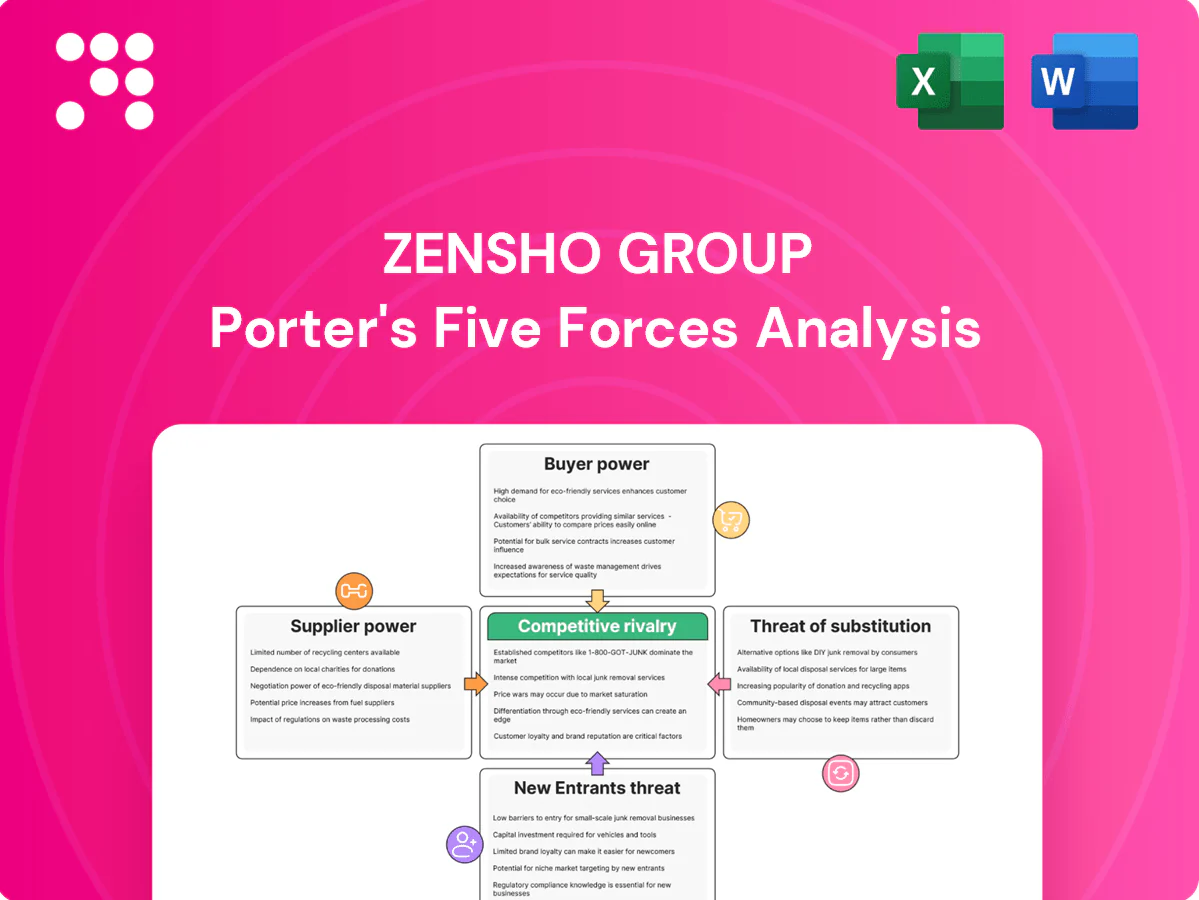
Zensho Group Porter's Five Forces Analysis

From Overview to Strategy Blueprint
Zensho Group faces moderate buyer power, intense rivalry in Japan’s fast-food sector, and manageable supplier leverage thanks to scale. Digital disruption and low-cost entrants raise threat levels, while substitutes remain a steady concern. This snapshot highlights key tensions and strategic levers. Unlock the full Porter's Five Forces Analysis for force-by-force ratings, visuals, and actionable insights.
Suppliers Bargaining Power

Fragmented agri/fish supply base
Zensho sources beef, rice, vegetables and seafood from a broad global network, limiting any single supplier’s leverage and supporting competitive bidding for its over 2,000 outlets (Sukiya and group brands as of 2024). Fragmentation enables rapid switching, but strict quality and traceability requirements reduce viable vendors for premium lines. Sustainability and origin certifications increasingly concentrate supply among certified producers.
Scale-driven purchasing leverage
Large volumes across Sukiya (over 2,000 outlets as of 2024), Hamazushi and family-brand chains give Zensho significant price negotiation power with suppliers. Centralized procurement and multi-year contracts reported in 2024 stabilize input costs and margin volatility. Private-label specifications lock in favorable terms and quality control, while sudden demand shifts—seen in periodic COVID-era rebounds—can strain contracted capacity and logistics.

Commodity and FX volatility risk
Input costs for beef and seafood move with global commodity markets and FX—USD/JPY averaged about 150 in 2024, which elevated import costs for Zensho’s supply chain. Suppliers commonly pass through price rises when margins compress; global beef prices rose roughly 15% YoY in 2024, tightening restaurant margins. Hedging and menu engineering soften but cannot eliminate shocks, and periods of extreme volatility temporarily strengthen supplier bargaining power.

Logistics and cold-chain dependencies
Chilled/frozen distribution for sushi and proteins raises switching costs to logistics partners, as 2024 global cold-chain capacity and specialized handling drove contract lock-in; disruptions create Porter-like bottlenecks that can sharply delay inventory turnover. Multi-DC networks and dual-sourcing reduce concentration risk, while 2024 energy and fuel surcharges shifted an outsized share of margin to logistics providers.
- Higher switching costs: specialized cold-chain handling
- Disruption risk: bottlenecks in peak seasons
- Mitigants: multi-DCs, dual-sourcing
- Margin pressure: 2024 fuel/energy surcharges transferred costs
Regulatory and sustainability constraints
Regulatory limits on food safety, animal welfare and sustainable fishery certifications shrink Zensho Group’s supplier pool, raising dependence on certified vendors as corporate ESG commitments grow; compliance costs are often passed through via contract pricing, boosting supplier leverage in specialized categories.
- Supplier pool constrained by safety, welfare, fishery standards
- Compliance costs priced into contracts
- ESG commitments drive reliance on certified vendors
- Higher supplier power in specialized inputs
Centralized buying boosts leverage; FX (~JPY150) and beef inflation squeeze margins
Zensho’s broad global sourcing across 2,000+ Sukiya and group outlets dilutes single-supplier leverage but strict quality/traceability narrows vendors for premium lines. Centralized procurement, private-labels and multi-year contracts increase buyer power, yet commodity/FX shocks (USD/JPY ~150 in 2024; global beef +15% YoY in 2024) raise supplier leverage and margin risk.
| Metric | 2024 | Impact |
|---|---|---|
| Outlets (Sukiya+group) | 2,000+ | Scale bargaining |
| USD/JPY | ~150 | Higher import costs |
| Global beef | +15% YoY | Margin pressure |
What is included in the product
 Detailed Word Document
Tailored Porter’s Five Forces analysis for Zensho Group uncovering competitive intensity, buyer/supplier power, substitution risks, entry barriers and emerging disruptors affecting pricing, margins and strategic positioning.

 Customizable Excel Spreadsheet
A concise one-sheet Porter's Five Forces for Zensho Group that highlights supplier/customer power, competitive rivalry, threats of entry/substitution and regulatory risks—ideal for quick strategy pivots, boardroom slides, and rapid decision-making.
Customers Bargaining Power

Highly price-sensitive diners
Zensho’s core low-price positioning attracts cost-conscious diners, supported by roughly 2,800 outlets in 2024, concentrating volume on value offers. Small menu price moves can shift traffic to rivals quickly, so time-limited promotions and set menus (which drove noted weekend traffic uplifts in 2024) are critical levers. Elastic demand during downturns elevates buyer power as consumers trade down or delay visits.
Low switching costs and high choice
Low switching costs let consumers move freely among gyudon, sushi and family restaurants, intensifying price and menu comparisons as many staples sit in the 500–800 JPY range. Dense networks—Sukiya alone surpassing 2,000 outlets—mean alternatives are nearby, raising customer bargaining power. Loyalty programs and targeted promotions are required to counter effortless switching and preserve average spend per visit.

Digital discovery and delivery platforms
Apps aggregate options and enable rapid price and fee comparisons, pushing consumers to the lowest-cost offer and increasing price elasticity of Zensho brands.
Platform algorithms can steer demand away from restaurants with weak ratings or non-promoted offers, concentrating traffic among favored partners.
Commission fees commonly range 10–35% (avg ~20% in 2024), squeezing margins and indirectly empowering buyers; owning first-party channels reduces dependence and helps protect margin.

Quality, speed, and consistency expectations
Frequent users of Zensho brands demand reliable taste, fast service and consistency; any lapse drives immediate churn to competitors. Standardized operations and rigorous training are essential defenses across Zensho’s network (Sukiya 2,000+ outlets in 2024). Continuous mystery shopping and VOC loops monitor compliance and close service gaps. High repeat rates make speed and consistency directly tied to revenue retention.
- Customer expectations: reliable taste, fast service
- Risk: immediate churn on service lapses
- Defense: standardized ops & training
- Tools: mystery shopping, VOC loops
Group and corporate orders
Larger group and corporate orders enable buyers to secure volume discounts or bespoke payment and delivery terms, reducing Zensho Group margins while increasing order visibility; in 2024 corporate catering and subscription deals accounted for an estimated 5–10% of institutional foodservice spend in Japan, amplifying buyer leverage during peak periods.
Subscription and catering contracts lock in recurring revenue but at lower gross margins, making service-level guarantees (timely delivery, food temperature, safety) key differentiators that can justify premium pricing and reduce churn.
- Volume discounts: high
- Peak-period leverage: amplified
- Subscriptions: lower margins, higher retention
- Service-level guarantees: differentiation
Low-price, high-density chain ≈2,800 outlets; delivery fees ~20%
Zensho’s low-price, high-density model (≈2,800 outlets in 2024; Sukiya 2,000+) gives customers strong price leverage; small price moves shift traffic. Apps and platforms raise price elasticity and channel power; delivery commissions averaged ~20% in 2024. Corporate/subscription deals (≈5–10% institutional spend) lower margins but boost retention, making service SLAs key.
| Metric | 2024 |
|---|---|
| Total outlets | ≈2,800 |
| Sukiya outlets | 2,000+ |
| Avg delivery commission | ~20% |
| Corporate/subscription share | 5–10% |
Preview Before You Purchase
Zensho Group Porter's Five Forces Analysis
This preview shows the exact Porter's Five Forces analysis of Zensho Group you'll receive after purchase—fully formatted and ready for use. The assessment covers threat of new entrants, bargaining power of suppliers and buyers, threat of substitutes, and industry rivalry with concise evidence-based conclusions. No placeholders or mockups; the file available to download is this same complete document.

From Overview to Strategy Blueprint
Zensho Group faces moderate buyer power, intense rivalry in Japan’s fast-food sector, and manageable supplier leverage thanks to scale. Digital disruption and low-cost entrants raise threat levels, while substitutes remain a steady concern. This snapshot highlights key tensions and strategic levers. Unlock the full Porter's Five Forces Analysis for force-by-force ratings, visuals, and actionable insights.
Suppliers Bargaining Power
Fragmented agri/fish supply base
Zensho sources beef, rice, vegetables and seafood from a broad global network, limiting any single supplier’s leverage and supporting competitive bidding for its over 2,000 outlets (Sukiya and group brands as of 2024). Fragmentation enables rapid switching, but strict quality and traceability requirements reduce viable vendors for premium lines. Sustainability and origin certifications increasingly concentrate supply among certified producers.
Scale-driven purchasing leverage
Large volumes across Sukiya (over 2,000 outlets as of 2024), Hamazushi and family-brand chains give Zensho significant price negotiation power with suppliers. Centralized procurement and multi-year contracts reported in 2024 stabilize input costs and margin volatility. Private-label specifications lock in favorable terms and quality control, while sudden demand shifts—seen in periodic COVID-era rebounds—can strain contracted capacity and logistics.
Commodity and FX volatility risk
Input costs for beef and seafood move with global commodity markets and FX—USD/JPY averaged about 150 in 2024, which elevated import costs for Zensho’s supply chain. Suppliers commonly pass through price rises when margins compress; global beef prices rose roughly 15% YoY in 2024, tightening restaurant margins. Hedging and menu engineering soften but cannot eliminate shocks, and periods of extreme volatility temporarily strengthen supplier bargaining power.
Logistics and cold-chain dependencies
Chilled/frozen distribution for sushi and proteins raises switching costs to logistics partners, as 2024 global cold-chain capacity and specialized handling drove contract lock-in; disruptions create Porter-like bottlenecks that can sharply delay inventory turnover. Multi-DC networks and dual-sourcing reduce concentration risk, while 2024 energy and fuel surcharges shifted an outsized share of margin to logistics providers.
- Higher switching costs: specialized cold-chain handling
- Disruption risk: bottlenecks in peak seasons
- Mitigants: multi-DCs, dual-sourcing
- Margin pressure: 2024 fuel/energy surcharges transferred costs
Regulatory and sustainability constraints
Regulatory limits on food safety, animal welfare and sustainable fishery certifications shrink Zensho Group’s supplier pool, raising dependence on certified vendors as corporate ESG commitments grow; compliance costs are often passed through via contract pricing, boosting supplier leverage in specialized categories.
- Supplier pool constrained by safety, welfare, fishery standards
- Compliance costs priced into contracts
- ESG commitments drive reliance on certified vendors
- Higher supplier power in specialized inputs
Centralized buying boosts leverage; FX (~JPY150) and beef inflation squeeze margins
Zensho’s broad global sourcing across 2,000+ Sukiya and group outlets dilutes single-supplier leverage but strict quality/traceability narrows vendors for premium lines. Centralized procurement, private-labels and multi-year contracts increase buyer power, yet commodity/FX shocks (USD/JPY ~150 in 2024; global beef +15% YoY in 2024) raise supplier leverage and margin risk.
| Metric | 2024 | Impact |
|---|---|---|
| Outlets (Sukiya+group) | 2,000+ | Scale bargaining |
| USD/JPY | ~150 | Higher import costs |
| Global beef | +15% YoY | Margin pressure |
What is included in the product
Detailed Word Document
Tailored Porter’s Five Forces analysis for Zensho Group uncovering competitive intensity, buyer/supplier power, substitution risks, entry barriers and emerging disruptors affecting pricing, margins and strategic positioning.
Customizable Excel Spreadsheet
A concise one-sheet Porter's Five Forces for Zensho Group that highlights supplier/customer power, competitive rivalry, threats of entry/substitution and regulatory risks—ideal for quick strategy pivots, boardroom slides, and rapid decision-making.
Customers Bargaining Power
Highly price-sensitive diners
Zensho’s core low-price positioning attracts cost-conscious diners, supported by roughly 2,800 outlets in 2024, concentrating volume on value offers. Small menu price moves can shift traffic to rivals quickly, so time-limited promotions and set menus (which drove noted weekend traffic uplifts in 2024) are critical levers. Elastic demand during downturns elevates buyer power as consumers trade down or delay visits.
Low switching costs and high choice
Low switching costs let consumers move freely among gyudon, sushi and family restaurants, intensifying price and menu comparisons as many staples sit in the 500–800 JPY range. Dense networks—Sukiya alone surpassing 2,000 outlets—mean alternatives are nearby, raising customer bargaining power. Loyalty programs and targeted promotions are required to counter effortless switching and preserve average spend per visit.
Digital discovery and delivery platforms
Apps aggregate options and enable rapid price and fee comparisons, pushing consumers to the lowest-cost offer and increasing price elasticity of Zensho brands.
Platform algorithms can steer demand away from restaurants with weak ratings or non-promoted offers, concentrating traffic among favored partners.
Commission fees commonly range 10–35% (avg ~20% in 2024), squeezing margins and indirectly empowering buyers; owning first-party channels reduces dependence and helps protect margin.
Quality, speed, and consistency expectations
Frequent users of Zensho brands demand reliable taste, fast service and consistency; any lapse drives immediate churn to competitors. Standardized operations and rigorous training are essential defenses across Zensho’s network (Sukiya 2,000+ outlets in 2024). Continuous mystery shopping and VOC loops monitor compliance and close service gaps. High repeat rates make speed and consistency directly tied to revenue retention.
- Customer expectations: reliable taste, fast service
- Risk: immediate churn on service lapses
- Defense: standardized ops & training
- Tools: mystery shopping, VOC loops
Group and corporate orders
Larger group and corporate orders enable buyers to secure volume discounts or bespoke payment and delivery terms, reducing Zensho Group margins while increasing order visibility; in 2024 corporate catering and subscription deals accounted for an estimated 5–10% of institutional foodservice spend in Japan, amplifying buyer leverage during peak periods.
Subscription and catering contracts lock in recurring revenue but at lower gross margins, making service-level guarantees (timely delivery, food temperature, safety) key differentiators that can justify premium pricing and reduce churn.
- Volume discounts: high
- Peak-period leverage: amplified
- Subscriptions: lower margins, higher retention
- Service-level guarantees: differentiation
Low-price, high-density chain ≈2,800 outlets; delivery fees ~20%
Zensho’s low-price, high-density model (≈2,800 outlets in 2024; Sukiya 2,000+) gives customers strong price leverage; small price moves shift traffic. Apps and platforms raise price elasticity and channel power; delivery commissions averaged ~20% in 2024. Corporate/subscription deals (≈5–10% institutional spend) lower margins but boost retention, making service SLAs key.
| Metric | 2024 |
|---|---|
| Total outlets | ≈2,800 |
| Sukiya outlets | 2,000+ |
| Avg delivery commission | ~20% |
| Corporate/subscription share | 5–10% |
Preview Before You Purchase
Zensho Group Porter's Five Forces Analysis
This preview shows the exact Porter's Five Forces analysis of Zensho Group you'll receive after purchase—fully formatted and ready for use. The assessment covers threat of new entrants, bargaining power of suppliers and buyers, threat of substitutes, and industry rivalry with concise evidence-based conclusions. No placeholders or mockups; the file available to download is this same complete document.
Original: $10.00
-65%$10.00
$3.50Description
From Overview to Strategy Blueprint
Zensho Group faces moderate buyer power, intense rivalry in Japan’s fast-food sector, and manageable supplier leverage thanks to scale. Digital disruption and low-cost entrants raise threat levels, while substitutes remain a steady concern. This snapshot highlights key tensions and strategic levers. Unlock the full Porter's Five Forces Analysis for force-by-force ratings, visuals, and actionable insights.
Suppliers Bargaining Power
Fragmented agri/fish supply base
Zensho sources beef, rice, vegetables and seafood from a broad global network, limiting any single supplier’s leverage and supporting competitive bidding for its over 2,000 outlets (Sukiya and group brands as of 2024). Fragmentation enables rapid switching, but strict quality and traceability requirements reduce viable vendors for premium lines. Sustainability and origin certifications increasingly concentrate supply among certified producers.
Scale-driven purchasing leverage
Large volumes across Sukiya (over 2,000 outlets as of 2024), Hamazushi and family-brand chains give Zensho significant price negotiation power with suppliers. Centralized procurement and multi-year contracts reported in 2024 stabilize input costs and margin volatility. Private-label specifications lock in favorable terms and quality control, while sudden demand shifts—seen in periodic COVID-era rebounds—can strain contracted capacity and logistics.
Commodity and FX volatility risk
Input costs for beef and seafood move with global commodity markets and FX—USD/JPY averaged about 150 in 2024, which elevated import costs for Zensho’s supply chain. Suppliers commonly pass through price rises when margins compress; global beef prices rose roughly 15% YoY in 2024, tightening restaurant margins. Hedging and menu engineering soften but cannot eliminate shocks, and periods of extreme volatility temporarily strengthen supplier bargaining power.
Logistics and cold-chain dependencies
Chilled/frozen distribution for sushi and proteins raises switching costs to logistics partners, as 2024 global cold-chain capacity and specialized handling drove contract lock-in; disruptions create Porter-like bottlenecks that can sharply delay inventory turnover. Multi-DC networks and dual-sourcing reduce concentration risk, while 2024 energy and fuel surcharges shifted an outsized share of margin to logistics providers.
- Higher switching costs: specialized cold-chain handling
- Disruption risk: bottlenecks in peak seasons
- Mitigants: multi-DCs, dual-sourcing
- Margin pressure: 2024 fuel/energy surcharges transferred costs
Regulatory and sustainability constraints
Regulatory limits on food safety, animal welfare and sustainable fishery certifications shrink Zensho Group’s supplier pool, raising dependence on certified vendors as corporate ESG commitments grow; compliance costs are often passed through via contract pricing, boosting supplier leverage in specialized categories.
- Supplier pool constrained by safety, welfare, fishery standards
- Compliance costs priced into contracts
- ESG commitments drive reliance on certified vendors
- Higher supplier power in specialized inputs
Centralized buying boosts leverage; FX (~JPY150) and beef inflation squeeze margins
Zensho’s broad global sourcing across 2,000+ Sukiya and group outlets dilutes single-supplier leverage but strict quality/traceability narrows vendors for premium lines. Centralized procurement, private-labels and multi-year contracts increase buyer power, yet commodity/FX shocks (USD/JPY ~150 in 2024; global beef +15% YoY in 2024) raise supplier leverage and margin risk.
| Metric | 2024 | Impact |
|---|---|---|
| Outlets (Sukiya+group) | 2,000+ | Scale bargaining |
| USD/JPY | ~150 | Higher import costs |
| Global beef | +15% YoY | Margin pressure |
What is included in the product
Detailed Word Document
Tailored Porter’s Five Forces analysis for Zensho Group uncovering competitive intensity, buyer/supplier power, substitution risks, entry barriers and emerging disruptors affecting pricing, margins and strategic positioning.
Customizable Excel Spreadsheet
A concise one-sheet Porter's Five Forces for Zensho Group that highlights supplier/customer power, competitive rivalry, threats of entry/substitution and regulatory risks—ideal for quick strategy pivots, boardroom slides, and rapid decision-making.
Customers Bargaining Power
Highly price-sensitive diners
Zensho’s core low-price positioning attracts cost-conscious diners, supported by roughly 2,800 outlets in 2024, concentrating volume on value offers. Small menu price moves can shift traffic to rivals quickly, so time-limited promotions and set menus (which drove noted weekend traffic uplifts in 2024) are critical levers. Elastic demand during downturns elevates buyer power as consumers trade down or delay visits.
Low switching costs and high choice
Low switching costs let consumers move freely among gyudon, sushi and family restaurants, intensifying price and menu comparisons as many staples sit in the 500–800 JPY range. Dense networks—Sukiya alone surpassing 2,000 outlets—mean alternatives are nearby, raising customer bargaining power. Loyalty programs and targeted promotions are required to counter effortless switching and preserve average spend per visit.
Digital discovery and delivery platforms
Apps aggregate options and enable rapid price and fee comparisons, pushing consumers to the lowest-cost offer and increasing price elasticity of Zensho brands.
Platform algorithms can steer demand away from restaurants with weak ratings or non-promoted offers, concentrating traffic among favored partners.
Commission fees commonly range 10–35% (avg ~20% in 2024), squeezing margins and indirectly empowering buyers; owning first-party channels reduces dependence and helps protect margin.
Quality, speed, and consistency expectations
Frequent users of Zensho brands demand reliable taste, fast service and consistency; any lapse drives immediate churn to competitors. Standardized operations and rigorous training are essential defenses across Zensho’s network (Sukiya 2,000+ outlets in 2024). Continuous mystery shopping and VOC loops monitor compliance and close service gaps. High repeat rates make speed and consistency directly tied to revenue retention.
- Customer expectations: reliable taste, fast service
- Risk: immediate churn on service lapses
- Defense: standardized ops & training
- Tools: mystery shopping, VOC loops
Group and corporate orders
Larger group and corporate orders enable buyers to secure volume discounts or bespoke payment and delivery terms, reducing Zensho Group margins while increasing order visibility; in 2024 corporate catering and subscription deals accounted for an estimated 5–10% of institutional foodservice spend in Japan, amplifying buyer leverage during peak periods.
Subscription and catering contracts lock in recurring revenue but at lower gross margins, making service-level guarantees (timely delivery, food temperature, safety) key differentiators that can justify premium pricing and reduce churn.
- Volume discounts: high
- Peak-period leverage: amplified
- Subscriptions: lower margins, higher retention
- Service-level guarantees: differentiation
Low-price, high-density chain ≈2,800 outlets; delivery fees ~20%
Zensho’s low-price, high-density model (≈2,800 outlets in 2024; Sukiya 2,000+) gives customers strong price leverage; small price moves shift traffic. Apps and platforms raise price elasticity and channel power; delivery commissions averaged ~20% in 2024. Corporate/subscription deals (≈5–10% institutional spend) lower margins but boost retention, making service SLAs key.
| Metric | 2024 |
|---|---|
| Total outlets | ≈2,800 |
| Sukiya outlets | 2,000+ |
| Avg delivery commission | ~20% |
| Corporate/subscription share | 5–10% |
Preview Before You Purchase
Zensho Group Porter's Five Forces Analysis
This preview shows the exact Porter's Five Forces analysis of Zensho Group you'll receive after purchase—fully formatted and ready for use. The assessment covers threat of new entrants, bargaining power of suppliers and buyers, threat of substitutes, and industry rivalry with concise evidence-based conclusions. No placeholders or mockups; the file available to download is this same complete document.











