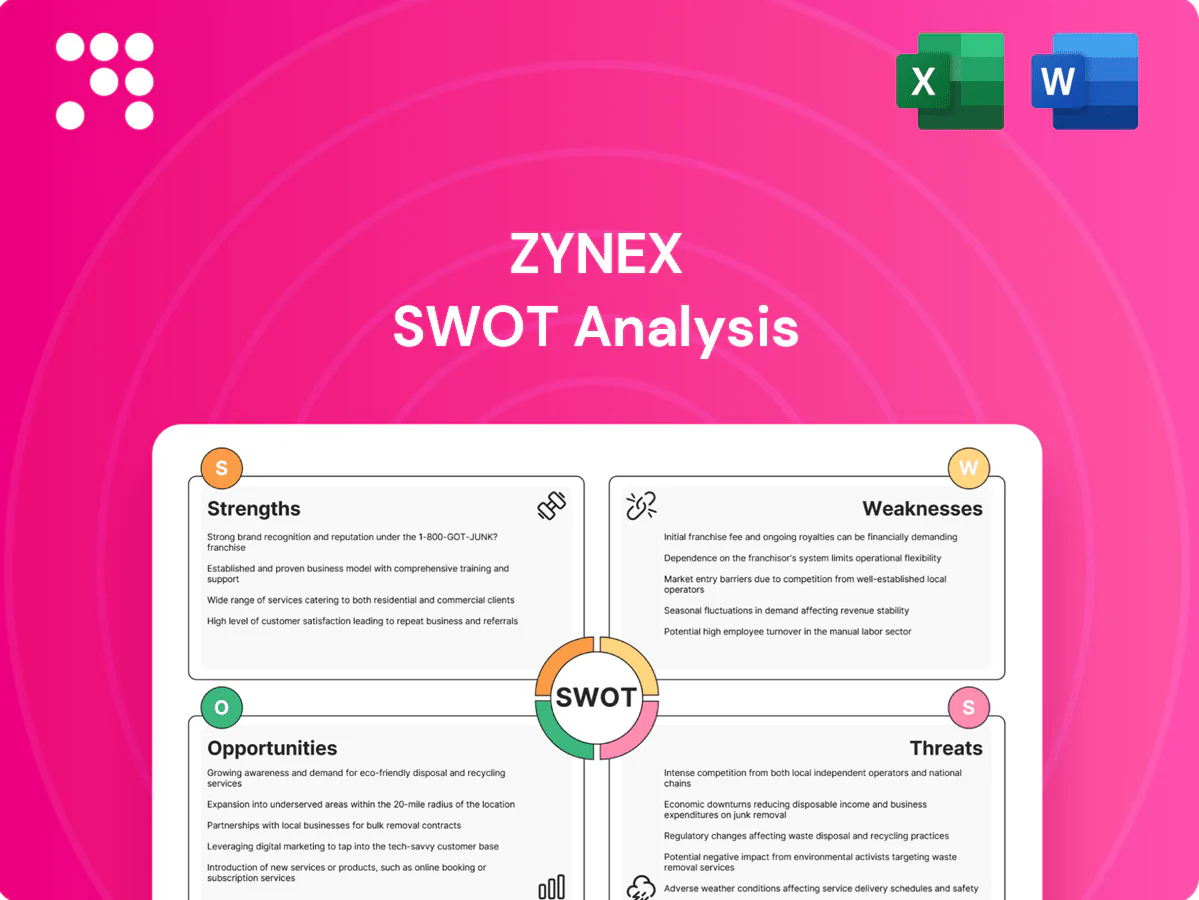
Zynex SWOT Analysis

Dive Deeper Into the Company’s Strategic Blueprint
Zynex’s SWOT highlights its niche leadership in electrotherapy, revenue tailwinds from outpatient care, and regulatory and reimbursement sensitivities that could constrain growth. Our full SWOT unpacks competitive threats, R&D opportunities, and financial implications in actionable detail. Purchase the complete report for a professionally formatted Word and Excel package. Use it to plan, pitch, or invest with confidence.
Strengths

Focused non-invasive pain niche
Zynex concentrates on electrotherapy for pain management and rehab, creating a clear, defensible niche that supports clinical depth and specialized salesforce training. This focus aligns with efforts to reduce opioid use amid over 100,000 US overdose deaths in 2021, strengthening payer discussions and provider adoption.
Recurring revenue from consumables
Devices drive ongoing demand for electrodes (typically replaced every 2–4 weeks), batteries (6–12 months) and leads, creating high-margin repeat purchases. Recurring supply sales smooth revenue volatility and elevate lifetime value per patient by ensuring steady, predictable cash flow. That steady revenue can fund R&D and sales expansion. The model also buffers seasonality and macro swings, supporting resilience in downturns.

Integrated design and manufacturing
Integrated design and in-house manufacturing at Zynex accelerates iteration and quality control, enabling faster regulatory responses and customization for clinical segments; as of 2024 the company leverages vertical integration to better manage supply risk and costs. Tighter control across R&D-to-production supports consistent device-supply fit and reliability, reducing dependency on external suppliers and improving clinical adoption timelines. Internal production also shortens lead times for product updates and recalls, strengthening customer trust.

Reimbursement and distribution expertise
Zynex’s long-standing DME reimbursement and documentation expertise minimizes payer denials by leveraging robust coding protocols and established payer relationships, while a trained salesforce educates prescribers and expedites patient onboarding. This operational discipline—covering processes, coding know-how, and field support—is difficult for new entrants to replicate quickly.
- Reimbursement specialization
- Lower denial risk
- Salesforce-driven onboarding
- High replication barrier
Complementary neurodiagnostics portfolio
Complementary neurodiagnostics expand Zynex clinical touchpoints by pairing objective diagnostic data with therapy delivery, enabling cross-selling that reduces customer acquisition costs and deepens account penetration; diagnostics also diversify revenue beyond core pain devices and generate clinical evidence that strengthens therapy positioning.
- Cross-sell lowers acquisition costs
- Diversifies revenue streams
- Generates clinical data to support therapy
In-house electrotherapy devices and recurring consumables drive adoption and revenue
Zynex’s focused electrotherapy niche and in-house manufacturing enable rapid iteration, better quality control and lower supplier risk. Consumable-driven recurring sales (electrodes 2–4 weeks; batteries 6–12 months) create predictable lifetime value and fund R&D. Reimbursement expertise and a trained salesforce lower denials and raise adoption amid efforts to reduce opioid use after 100,000+ US overdose deaths in 2021.
| Metric | Value |
|---|---|
| Electrode replacement | 2–4 weeks |
| Battery life | 6–12 months |
What is included in the product
 Detailed Word Document
Provides a concise SWOT overview of Zynex, outlining internal strengths and weaknesses and external opportunities and threats to assess its competitive position and strategic risks.

 Customizable Excel Spreadsheet
Provides a focused Zynex SWOT matrix to quickly identify strengths, weaknesses, opportunities and threats, easing strategic prioritization and accelerating risk mitigation for busy stakeholders.
Weaknesses

High payer dependence
Zynex relies heavily on third-party reimbursement for devices and supplies, exposing revenue to payer policy shifts and audit activity. Industry claim denial rates hovered around 5–10% in 2023, and denials can spike working capital needs and back-office costs. Documentation frictions or delayed approvals slow cash flow and increase earnings volatility, magnifying quarter-to-quarter revenue swings.
Limited scale versus medtech majors
Zynex faces larger medtech rivals with substantially deeper R&D and marketing war chests, which can accelerate product development and market penetration. Its smaller scale limits negotiating leverage with suppliers and payers, often yielding less favorable pricing and reimbursement terms. International expansion pace and geographic breadth are constrained by limited resources, and brand recognition can lag in crowded device categories.

Sales-intensive DME model
Zynexs sales-intensive DME model relies on a sizable field force to educate prescribers and manage complex paperwork, driving up customer acquisition costs and fixed overhead. High frontline turnover or training gaps can slow prescription flow and reduce utilization rates. The approach is less efficient when entering new geographies where provider relationships and billing workflows are undeveloped. This concentration raises scalability and margin risk.

Product concentration
Zynex’s revenue remains concentrated in electrotherapy devices and related supplies, a point highlighted in the company’s 2024 filings; this narrow base means category-specific shocks, recalls, or clinical guideline changes can disproportionately reduce top-line and margins.
Limited product diversification raises strategic risk and market sensitivity, and any pipeline delays in 2024–2025 would further amplify exposure to demand or reimbursement swings.
- Core revenue concentration: electrotherapy-focused
- Key risks: recalls, guideline shifts, reimbursement
- Strategic weakness: limited diversification
- Amplifier: pipeline delays 2024–2025
Pricing and ASP sensitivity
Pricing and ASP sensitivity: commoditized TENS alternatives and intensified payer scrutiny have compressed average selling prices for Zynex, forcing frequent discounting to secure formulary and clinic access and eroding margins.
Rising supply-input inflation cannot always be passed to buyers, and channel mix shifts toward lower-priced distributors further dilute profitability.
- Discounting risks: margin erosion
- Input inflation: limited pass-through
- Channel mix: lower ASP dilution
High reimbursement risk: 5-10% claim denials amplify electrotherapy revenue exposure
Zynex depends on third-party reimbursement; claim denial rates were 5–10% in 2023, increasing working capital needs and earnings volatility. Revenue is concentrated in electrotherapy per 2024 filings, heightening sensitivity to recalls, guideline changes and payer cuts. Limited scale vs large medtech peers constrains pricing power, margins and geographic expansion.
| Metric | Value/Note |
|---|---|
| Claim denials | 5–10% (2023) |
| Revenue concentration | Electrotherapy (2024 filings) |
| Pipeline/Timing risk | Delays amplify exposure (2024–2025) |
What You See Is What You Get
Zynex SWOT Analysis
This is the actual SWOT analysis document you’ll receive upon purchase—no surprises, just professional quality. The preview below is taken directly from the full SWOT report you'll get, and the complete, editable version becomes available after checkout. Purchase unlocks the entire in-depth file, ready to download and use immediately.

Dive Deeper Into the Company’s Strategic Blueprint
Zynex’s SWOT highlights its niche leadership in electrotherapy, revenue tailwinds from outpatient care, and regulatory and reimbursement sensitivities that could constrain growth. Our full SWOT unpacks competitive threats, R&D opportunities, and financial implications in actionable detail. Purchase the complete report for a professionally formatted Word and Excel package. Use it to plan, pitch, or invest with confidence.
Strengths
Focused non-invasive pain niche
Zynex concentrates on electrotherapy for pain management and rehab, creating a clear, defensible niche that supports clinical depth and specialized salesforce training. This focus aligns with efforts to reduce opioid use amid over 100,000 US overdose deaths in 2021, strengthening payer discussions and provider adoption.
Recurring revenue from consumables
Devices drive ongoing demand for electrodes (typically replaced every 2–4 weeks), batteries (6–12 months) and leads, creating high-margin repeat purchases. Recurring supply sales smooth revenue volatility and elevate lifetime value per patient by ensuring steady, predictable cash flow. That steady revenue can fund R&D and sales expansion. The model also buffers seasonality and macro swings, supporting resilience in downturns.
Integrated design and manufacturing
Integrated design and in-house manufacturing at Zynex accelerates iteration and quality control, enabling faster regulatory responses and customization for clinical segments; as of 2024 the company leverages vertical integration to better manage supply risk and costs. Tighter control across R&D-to-production supports consistent device-supply fit and reliability, reducing dependency on external suppliers and improving clinical adoption timelines. Internal production also shortens lead times for product updates and recalls, strengthening customer trust.
Reimbursement and distribution expertise
Zynex’s long-standing DME reimbursement and documentation expertise minimizes payer denials by leveraging robust coding protocols and established payer relationships, while a trained salesforce educates prescribers and expedites patient onboarding. This operational discipline—covering processes, coding know-how, and field support—is difficult for new entrants to replicate quickly.
- Reimbursement specialization
- Lower denial risk
- Salesforce-driven onboarding
- High replication barrier
Complementary neurodiagnostics portfolio
Complementary neurodiagnostics expand Zynex clinical touchpoints by pairing objective diagnostic data with therapy delivery, enabling cross-selling that reduces customer acquisition costs and deepens account penetration; diagnostics also diversify revenue beyond core pain devices and generate clinical evidence that strengthens therapy positioning.
- Cross-sell lowers acquisition costs
- Diversifies revenue streams
- Generates clinical data to support therapy
In-house electrotherapy devices and recurring consumables drive adoption and revenue
Zynex’s focused electrotherapy niche and in-house manufacturing enable rapid iteration, better quality control and lower supplier risk. Consumable-driven recurring sales (electrodes 2–4 weeks; batteries 6–12 months) create predictable lifetime value and fund R&D. Reimbursement expertise and a trained salesforce lower denials and raise adoption amid efforts to reduce opioid use after 100,000+ US overdose deaths in 2021.
| Metric | Value |
|---|---|
| Electrode replacement | 2–4 weeks |
| Battery life | 6–12 months |
What is included in the product
Detailed Word Document
Provides a concise SWOT overview of Zynex, outlining internal strengths and weaknesses and external opportunities and threats to assess its competitive position and strategic risks.
Customizable Excel Spreadsheet
Provides a focused Zynex SWOT matrix to quickly identify strengths, weaknesses, opportunities and threats, easing strategic prioritization and accelerating risk mitigation for busy stakeholders.
Weaknesses
High payer dependence
Zynex relies heavily on third-party reimbursement for devices and supplies, exposing revenue to payer policy shifts and audit activity. Industry claim denial rates hovered around 5–10% in 2023, and denials can spike working capital needs and back-office costs. Documentation frictions or delayed approvals slow cash flow and increase earnings volatility, magnifying quarter-to-quarter revenue swings.
Limited scale versus medtech majors
Zynex faces larger medtech rivals with substantially deeper R&D and marketing war chests, which can accelerate product development and market penetration. Its smaller scale limits negotiating leverage with suppliers and payers, often yielding less favorable pricing and reimbursement terms. International expansion pace and geographic breadth are constrained by limited resources, and brand recognition can lag in crowded device categories.
Sales-intensive DME model
Zynexs sales-intensive DME model relies on a sizable field force to educate prescribers and manage complex paperwork, driving up customer acquisition costs and fixed overhead. High frontline turnover or training gaps can slow prescription flow and reduce utilization rates. The approach is less efficient when entering new geographies where provider relationships and billing workflows are undeveloped. This concentration raises scalability and margin risk.
Product concentration
Zynex’s revenue remains concentrated in electrotherapy devices and related supplies, a point highlighted in the company’s 2024 filings; this narrow base means category-specific shocks, recalls, or clinical guideline changes can disproportionately reduce top-line and margins.
Limited product diversification raises strategic risk and market sensitivity, and any pipeline delays in 2024–2025 would further amplify exposure to demand or reimbursement swings.
- Core revenue concentration: electrotherapy-focused
- Key risks: recalls, guideline shifts, reimbursement
- Strategic weakness: limited diversification
- Amplifier: pipeline delays 2024–2025
Pricing and ASP sensitivity
Pricing and ASP sensitivity: commoditized TENS alternatives and intensified payer scrutiny have compressed average selling prices for Zynex, forcing frequent discounting to secure formulary and clinic access and eroding margins.
Rising supply-input inflation cannot always be passed to buyers, and channel mix shifts toward lower-priced distributors further dilute profitability.
- Discounting risks: margin erosion
- Input inflation: limited pass-through
- Channel mix: lower ASP dilution
High reimbursement risk: 5-10% claim denials amplify electrotherapy revenue exposure
Zynex depends on third-party reimbursement; claim denial rates were 5–10% in 2023, increasing working capital needs and earnings volatility. Revenue is concentrated in electrotherapy per 2024 filings, heightening sensitivity to recalls, guideline changes and payer cuts. Limited scale vs large medtech peers constrains pricing power, margins and geographic expansion.
| Metric | Value/Note |
|---|---|
| Claim denials | 5–10% (2023) |
| Revenue concentration | Electrotherapy (2024 filings) |
| Pipeline/Timing risk | Delays amplify exposure (2024–2025) |
What You See Is What You Get
Zynex SWOT Analysis
This is the actual SWOT analysis document you’ll receive upon purchase—no surprises, just professional quality. The preview below is taken directly from the full SWOT report you'll get, and the complete, editable version becomes available after checkout. Purchase unlocks the entire in-depth file, ready to download and use immediately.
Original: $10.00
-65%$10.00
$3.50Description
Dive Deeper Into the Company’s Strategic Blueprint
Zynex’s SWOT highlights its niche leadership in electrotherapy, revenue tailwinds from outpatient care, and regulatory and reimbursement sensitivities that could constrain growth. Our full SWOT unpacks competitive threats, R&D opportunities, and financial implications in actionable detail. Purchase the complete report for a professionally formatted Word and Excel package. Use it to plan, pitch, or invest with confidence.
Strengths
Focused non-invasive pain niche
Zynex concentrates on electrotherapy for pain management and rehab, creating a clear, defensible niche that supports clinical depth and specialized salesforce training. This focus aligns with efforts to reduce opioid use amid over 100,000 US overdose deaths in 2021, strengthening payer discussions and provider adoption.
Recurring revenue from consumables
Devices drive ongoing demand for electrodes (typically replaced every 2–4 weeks), batteries (6–12 months) and leads, creating high-margin repeat purchases. Recurring supply sales smooth revenue volatility and elevate lifetime value per patient by ensuring steady, predictable cash flow. That steady revenue can fund R&D and sales expansion. The model also buffers seasonality and macro swings, supporting resilience in downturns.
Integrated design and manufacturing
Integrated design and in-house manufacturing at Zynex accelerates iteration and quality control, enabling faster regulatory responses and customization for clinical segments; as of 2024 the company leverages vertical integration to better manage supply risk and costs. Tighter control across R&D-to-production supports consistent device-supply fit and reliability, reducing dependency on external suppliers and improving clinical adoption timelines. Internal production also shortens lead times for product updates and recalls, strengthening customer trust.
Reimbursement and distribution expertise
Zynex’s long-standing DME reimbursement and documentation expertise minimizes payer denials by leveraging robust coding protocols and established payer relationships, while a trained salesforce educates prescribers and expedites patient onboarding. This operational discipline—covering processes, coding know-how, and field support—is difficult for new entrants to replicate quickly.
- Reimbursement specialization
- Lower denial risk
- Salesforce-driven onboarding
- High replication barrier
Complementary neurodiagnostics portfolio
Complementary neurodiagnostics expand Zynex clinical touchpoints by pairing objective diagnostic data with therapy delivery, enabling cross-selling that reduces customer acquisition costs and deepens account penetration; diagnostics also diversify revenue beyond core pain devices and generate clinical evidence that strengthens therapy positioning.
- Cross-sell lowers acquisition costs
- Diversifies revenue streams
- Generates clinical data to support therapy
In-house electrotherapy devices and recurring consumables drive adoption and revenue
Zynex’s focused electrotherapy niche and in-house manufacturing enable rapid iteration, better quality control and lower supplier risk. Consumable-driven recurring sales (electrodes 2–4 weeks; batteries 6–12 months) create predictable lifetime value and fund R&D. Reimbursement expertise and a trained salesforce lower denials and raise adoption amid efforts to reduce opioid use after 100,000+ US overdose deaths in 2021.
| Metric | Value |
|---|---|
| Electrode replacement | 2–4 weeks |
| Battery life | 6–12 months |
What is included in the product
Detailed Word Document
Provides a concise SWOT overview of Zynex, outlining internal strengths and weaknesses and external opportunities and threats to assess its competitive position and strategic risks.
Customizable Excel Spreadsheet
Provides a focused Zynex SWOT matrix to quickly identify strengths, weaknesses, opportunities and threats, easing strategic prioritization and accelerating risk mitigation for busy stakeholders.
Weaknesses
High payer dependence
Zynex relies heavily on third-party reimbursement for devices and supplies, exposing revenue to payer policy shifts and audit activity. Industry claim denial rates hovered around 5–10% in 2023, and denials can spike working capital needs and back-office costs. Documentation frictions or delayed approvals slow cash flow and increase earnings volatility, magnifying quarter-to-quarter revenue swings.
Limited scale versus medtech majors
Zynex faces larger medtech rivals with substantially deeper R&D and marketing war chests, which can accelerate product development and market penetration. Its smaller scale limits negotiating leverage with suppliers and payers, often yielding less favorable pricing and reimbursement terms. International expansion pace and geographic breadth are constrained by limited resources, and brand recognition can lag in crowded device categories.
Sales-intensive DME model
Zynexs sales-intensive DME model relies on a sizable field force to educate prescribers and manage complex paperwork, driving up customer acquisition costs and fixed overhead. High frontline turnover or training gaps can slow prescription flow and reduce utilization rates. The approach is less efficient when entering new geographies where provider relationships and billing workflows are undeveloped. This concentration raises scalability and margin risk.
Product concentration
Zynex’s revenue remains concentrated in electrotherapy devices and related supplies, a point highlighted in the company’s 2024 filings; this narrow base means category-specific shocks, recalls, or clinical guideline changes can disproportionately reduce top-line and margins.
Limited product diversification raises strategic risk and market sensitivity, and any pipeline delays in 2024–2025 would further amplify exposure to demand or reimbursement swings.
- Core revenue concentration: electrotherapy-focused
- Key risks: recalls, guideline shifts, reimbursement
- Strategic weakness: limited diversification
- Amplifier: pipeline delays 2024–2025
Pricing and ASP sensitivity
Pricing and ASP sensitivity: commoditized TENS alternatives and intensified payer scrutiny have compressed average selling prices for Zynex, forcing frequent discounting to secure formulary and clinic access and eroding margins.
Rising supply-input inflation cannot always be passed to buyers, and channel mix shifts toward lower-priced distributors further dilute profitability.
- Discounting risks: margin erosion
- Input inflation: limited pass-through
- Channel mix: lower ASP dilution
High reimbursement risk: 5-10% claim denials amplify electrotherapy revenue exposure
Zynex depends on third-party reimbursement; claim denial rates were 5–10% in 2023, increasing working capital needs and earnings volatility. Revenue is concentrated in electrotherapy per 2024 filings, heightening sensitivity to recalls, guideline changes and payer cuts. Limited scale vs large medtech peers constrains pricing power, margins and geographic expansion.
| Metric | Value/Note |
|---|---|
| Claim denials | 5–10% (2023) |
| Revenue concentration | Electrotherapy (2024 filings) |
| Pipeline/Timing risk | Delays amplify exposure (2024–2025) |
What You See Is What You Get
Zynex SWOT Analysis
This is the actual SWOT analysis document you’ll receive upon purchase—no surprises, just professional quality. The preview below is taken directly from the full SWOT report you'll get, and the complete, editable version becomes available after checkout. Purchase unlocks the entire in-depth file, ready to download and use immediately.











